

How Often to Flush a Water Heater: Eight Manuals Compared
We read eight Bradford White, Rheem, A. O. Smith and Rinnai manuals and DOE’s maintenance list, and matched their hard-water thresholds to USGS data.
- Last reviewed Oct 15, 2026
- 15 cited sources
- 6 min read
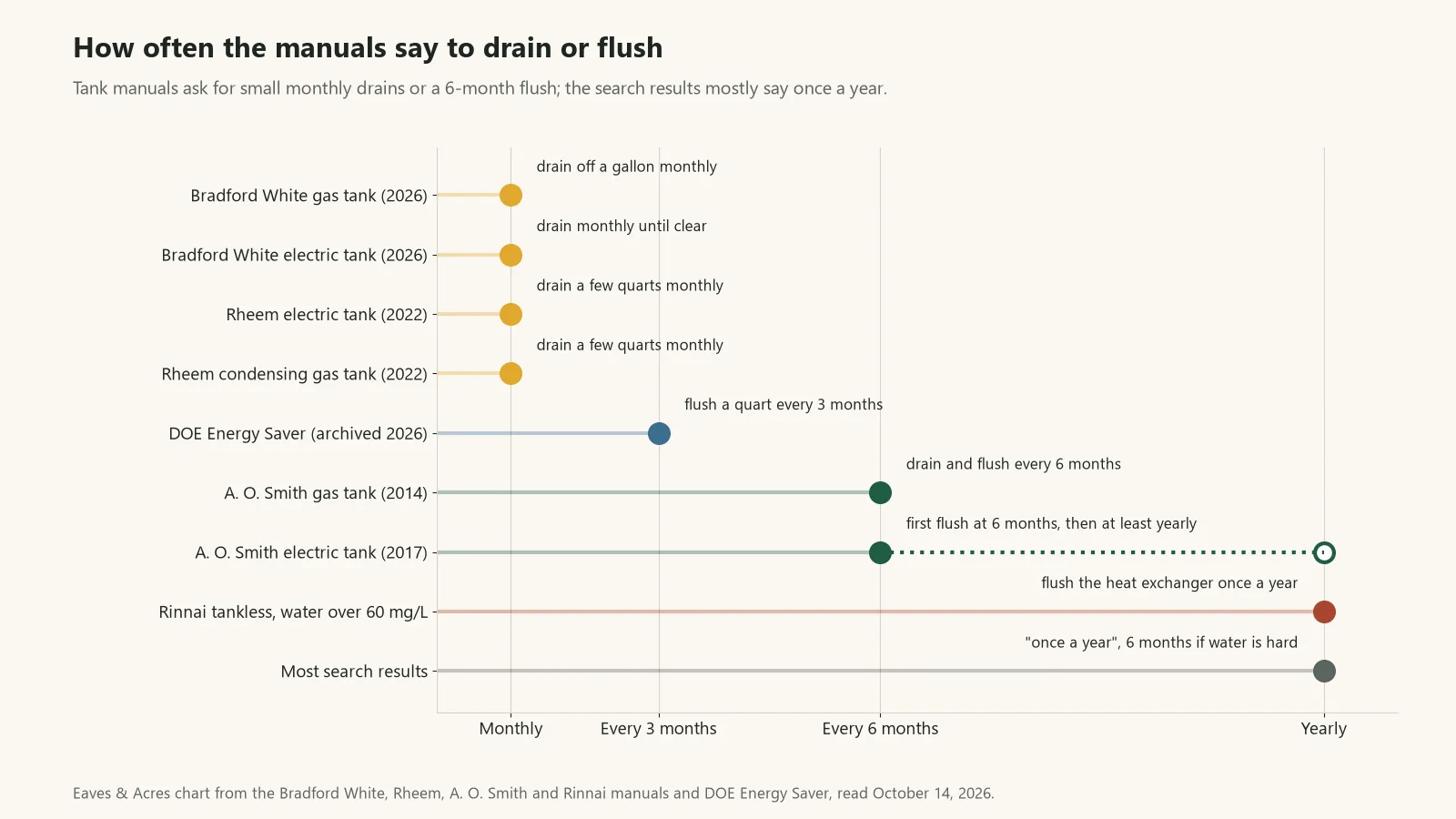
- 1Bradford White and Rheem tank manuals say drain a gallon or a few quarts monthly; A. O. Smith, drain and flush every 6 months.
- 2Online “once a year” advice is longer than most manuals allow; your manual sets the interval.
- 3Rheem calls only 0–5 grains (about 86 mg/L) soft; USGS calls that moderately hard.
- 4Rinnai tankless units need a yearly heat-exchanger flush unless the water is soft (0–60 mg/L).
- 5Check the relief valve at least yearly and the anode rod on your manual’s schedule.
Flush a tank water heater at least as often as its owner’s manual says, and for most tanks that is more often than the “once a year” you see online. The Bradford White and Rheem manuals we read ask you to drain a little water every month, and A. O. Smith says to drain and flush every 6 months.1,3,5 Tankless models are flushed differently: Rinnai’s schedule depends on how hard your water is.7
We read eight tank and tankless manuals and DOE’s maintenance list side by side, then matched the manuals’ “hard water” thresholds to USGS hardness data.
What eight water heater manuals say, side by side
| Manual | Drain or flush | Anode rod | Relief valve |
|---|---|---|---|
| Bradford White gas tank 238-51007, Rev 07/26 | Monthly: drain off a gallon to remove silt and sediment1 | Inspect every 2 years; more often with softened water | Check at least once a year |
| Bradford White electric tank 238-44422, Rev 08/26 | At least monthly, until the water runs clear; monthly gallon in the checklist2 | Every 2 years; more often with softened water | At least once a year |
| Rheem electric tank AP21980 Rev 02, 2022 | A few quarts every month3 | Remove yearly to inspect; replace when more than 6″ of core wire shows | At least once a year |
| Rheem condensing gas tank AP21831 Rev 02, 2022 | A few quarts every month; scale builds unless water is 0–5 grains4 | Not in its maintenance list | Periodic inspection by a qualified technician |
| A. O. Smith gas tank 326940-001, 2014 | Drain and flush every 6 months5 | By year 3, then yearly; yearly with softened water | Operate at least once a year |
| A. O. Smith electric tank 100264218 Rev B, 2017 | First at 6 months, then at least yearly, more often if your water needs it6 | Same visits; depletes faster with a softener | Yearly; inspect every 2–4 years per its label |
| Rinnai Sensei RX tankless 100000839, 2025 | Heat exchanger once a year in homes if water is over 60 mg/L; none if soft7 | Not listed | Operate once a year |
| Rheem Eagle tankless AP22009 Rev 04, 2023 | “Regularly” if water is outside its limits; optional reminder after 500–1,000 burner hours8 | Not listed | Check yearly |
| DOE Energy Saver archived page, 2026 | A quart every three months9 | Every 3–4 years | Every 6 months |
Bradford White’s gas manual puts it in one line:
Monthly drain off a gallon of water to remove silt and sediment.
A monthly gallon adds up to 12 gallons a year; DOE’s quarterly quart, 4 quarts (1 gallon). Bradford White also wants the heater inspected at least once a year by a qualified service technician, which a quick drain does not replace.1,9
Why the search results say once a year
The guides at the top of the search results, including Rheem’s own blog, give a yearly flush and every 6 months for hard water.13 An A. O. Smith product expert told Martha Stewart once a year is a guideline for normal use at 120°F.14 Neither cites a manual. DOE’s Energy Saver page, now offline but archived, sends you back to the paperwork:
Read your owner’s manual for specific maintenance recommendations.
Hard water: what the manuals mean by it
USGS explains why hardness matters: when hard water is heated, calcium carbonate scale forms that can reduce the life of equipment, raise heating costs and lower the efficiency of electric water heaters.10 Rheem says that unless water is soft, 0 to 5 grains of hardness, scale builds in the tank, faster at higher temperatures.4 That is one more reason to keep the dial at the 120°F setting most sources recommend.

| USGS class | mg/L as calcium carbonate | Grains per gallon | Rinnai tankless (homes) |
|---|---|---|---|
| Soft | 0–60 | 0–3.5 | No flushing, no treatment |
| Moderately hard | 61–120 | 3.6–7.0 | Once a year; softener or scale control recommended |
| Hard | 121–180 | 7.1–10.5 | Once a year; recommended, then strongly recommended above 160 |
| Very hard | Over 180 | Over 10.5 | Once a year; strongly recommended, then required above 200 mg/L |
Grains use the Maryland Geological Survey factor of 17.118 mg/L per grain.12 By that factor Rheem’s 5-grain “soft” ceiling is about 86 mg/L, which USGS already calls moderately hard. Rinnai and Rheem list 200 mg/L, about 11.7 grains, as the maximum total hardness for their tankless models.7,8

A USGS study of about 2,100 domestic wells found hard water “prevalent in the east-central and western United States.”11 USGS cautions that its 1975 national hardness map is not meant for decisions about a single property; local numbers should come from your water utility or local health agency.10
Tankless water heaters: flush the heat exchanger
In a tankless unit, scale builds up in the heat exchanger. Rinnai’s table ties flushing to hardness, from none in soft water to once a year for homes in all harder classes, and it can show an SS (“Service Soon”) code that tells you to call a service provider.7 Rinnai is blunt:
Failure to flush the appliance will cause damage to the heat exchanger.
It adds that lime and scale damage is not covered by the warranty. Rheem’s Eagle manual offers a reminder after 500, 750 or 1,000 hours of burner operation.7,8 Our tankless vs tank comparison counts this descaling as an ongoing cost.
Anode rod and relief valve checks

The anode rod slowly wears away to protect the glass-lined tank from corrosion, A. O. Smith explains. Inspection intervals run from yearly (Rheem) to every 3–4 years (DOE), and Bradford White and A. O. Smith say softened water uses it up faster.1,3,5,9
On the temperature and pressure relief valve, the manuals say the same three things: check it at least yearly, keep clear of the discharge because the water is hot and under pressure, and never plug the outlet. If it releases water on its own, Bradford White points to thermal expansion and says to contact your water supplier or plumbing inspector.1,5,7
What the manuals say before you drain
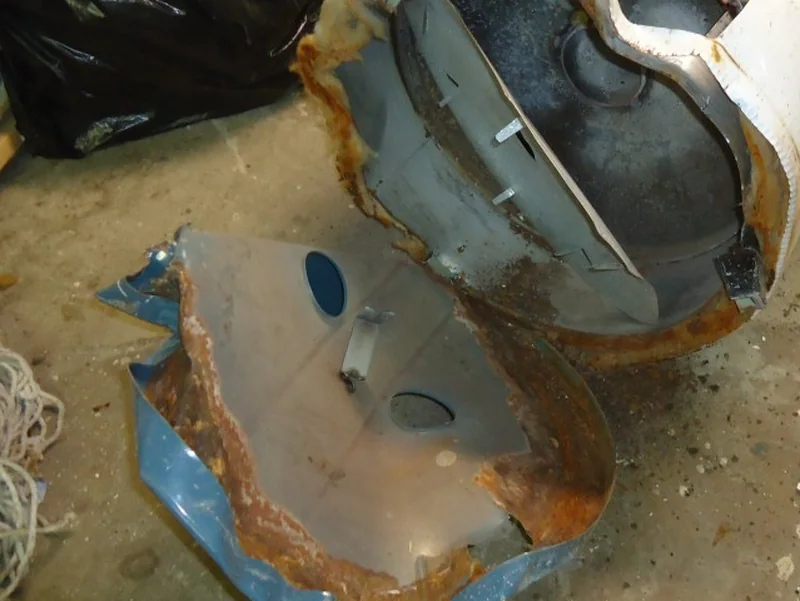

The tank manuals’ draining steps start the same way: turn the gas control off and shut off the gas, or disconnect the electric power.1,2,5 A. O. Smith’s electric guide says to let the hot water run until it is cool first, to reduce the risk of scalding, and never to turn the power back on unless the tank is completely full.6 A. O. Smith’s gas manual warns the flushing water will be hot, and not to turn the gas on unless the tank is full. If sediment has hardened into masses that stop the tank from draining, A. O. Smith says to have a qualified person use a de-liming agent suitable for potable water.5,6
Next step
Find your model number, download its manual and put its interval on your calendar. More on water heaters: our furnace filter guide uses the same manual-first approach, and the generator size calculator shows what an electric water heater adds to an outage load.
Frequently asked questions
Most tank manuals we read ask for more: monthly draining (Bradford White, Rheem) or a flush every 6 months (A. O. Smith).
Follow the manual’s calendar. Bradford White says skipping monthly draining may cause noisy operation and lime and sediment buildup.
No manual we read covers it. Rheem’s blog suggests a professional for units 8–12 years or older, or a drain valve that sticks or leaks.
Rinnai says once a year in homes when hardness is over 60 mg/L, and not in soft water. Rheem says flush regularly outside its limits.
Yearly (Rheem), every 2 years (Bradford White), or by year 3, then yearly (A. O. Smith gas). Softened water wears it faster.
Yes. A. O. Smith’s electric guide ties its schedule to your water’s hardness. Ask your water utility for your number.
Sources
- 1.Gas-Fired Water Heater Installation and Operation Manual (238-51007-00R, Rev 07/26). Bradford White, 2026. Used for: monthly drain a gallon; relief valve yearly; anode every 2 years; softened water; annual inspection by a qualified technician; no gas-control or burner repairs; scald warning Back to text
- 2.Electric Water Heater Installation and Operation Manual (238-44422-00AB, Rev 08/26). Bradford White, 2026. Used for: drain at least monthly until clear; monthly gallon; disconnect power before draining; no element or wiring repairs; anode every 2 years Back to text
- 3.Use & Care Manual: Electric Residential Water Heaters with Electronic Control (AP21980 Rev 02). Rheem, 2022. Used for: a few quarts drained every month; anode yearly, replace at 6 in. of core wire; relief valve yearly; scald hazard Back to text
- 4.Use & Care Manual: Residential Super High Efficiency Gas Water Heater (AP21831 Rev 02). Rheem, 2022. Used for: soft = 0 to 5 grains; scale faster at higher temperature; drain a few quarts every month; power off before maintenance Back to text
- 5.Residential Gas Water Heaters Installation and Operating Manual (326940-001). A. O. Smith, 2014. Used for: drain and flush every 6 months; relief valve at least yearly; anode by year 3 then yearly; gas off; water hot; gas on only when full Back to text
- 6.Residential Electric Water Heater Installation Instructions and Use & Care Guide (100264218 Rev B). A. O. Smith, 2017. Used for: first flush at 6 months, then at least yearly by hardness; run water cool before draining; power on only when full; de-liming by a qualified person Back to text
- 7.Sensei RX Residential Installation and Operation Manual (100000839). Rinnai, 2025. Used for: Table 3 hardness classes and flushing frequency; total hardness up to 200 mg/L; failure to flush damages the heat exchanger; Service Soon code; relief valve yearly Back to text
- 8.Use and Care Manual: Eagle High-Efficiency Non-Condensing Tankless Water Heater (AP22009 Rev 04). Rheem, 2023. Used for: hardness up to 200 mg/L; flush regularly outside limits; maintenance notice at 500, 750 or 1,000 hours; relief valve yearly Back to text
- 9.Energy Saver: Storage Water Heaters (archived copy; page no longer online). U.S. Department of Energy, archived 2026-05-01. Used for: read your owner’s manual; a quart every three months; relief valve every six months; anode every three to four years Back to text
- 10.Hardness of Water (Water Science School). U.S. Geological Survey, read 2026-10-14. Used for: hardness classes; scale in water heaters; national map caveats and local sources Back to text
- 11.Quality of water from domestic wells in the United States (hardness map). U.S. Geological Survey, read 2026-10-14. Used for: about 2,100 domestic wells; hard water prevalent in east-central and western US; public domain map Back to text
- 12.Hardness (groundwater). Maryland Geological Survey, Maryland Department of Natural Resources, read 2026-10-14. Used for: 1 grain per gallon = 17.118 mg/L Back to text
- 13.How Often To Flush Your Water Heater (And How To Do It). Rheem (blog), 2026. Used for: once a year, 6 months for hard water; professional for units 8–12 years or older or a stuck or leaking drain valve Back to text
- 14.Here’s How Often You Should Flush Your Water Heater (Emily Hayes). Martha Stewart, 2026. Used for: A. O. Smith product expert: at least once a year for regular use at 120°F Back to text
- 15.Handyman project to disassemble hot water heater 9 (photo). Tomwsulcer, Wikimedia Commons, CC0, 2013. Used for: tank underside photo, cropped
How this guide was made
- Written by the Home Systems Desk and reviewed by the Data & Methodology Desk.
- Data: intervals are copied from each manual (read 2026-10-14). Grains per gallon use the Maryland Geological Survey factor of 17.118 mg/L per grain: Rheem’s 5-grain “soft” limit ≈ 86 mg/L, the 200 mg/L tankless limit ≈ 11.7 grains. USGS hardness maps are national-scale; get your own number from your water utility. See our methodology.
- AI use: AI tools help us research, draft and check this guide. Every figure is checked against the source cited for it, and calculated figures come from our own code, described on the methodology page.
- Spotted an error? Tell us — the form opens with this page’s address filled in.
Change log
- Oct 15, 2026Published. Eight Bradford White, Rheem, A. O. Smith and Rinnai manuals read and compared; DOE Energy Saver (archived); USGS hardness classes and domestic-well map; Maryland Geological Survey grain conversion.
Covers heating, cooling, generators and water heaters. We maintain the sizing calculators and the guides that explain what a number means before you call a contractor.
Keep reading
What Temperature Should a Water Heater Be Set At? 120°F, and When to Go Higher
Most homes should run a water heater at 120°F. What DOE, CDC, CPSC, EPA and OSHA each say, how fast hotter water burns, and what a lower setting really saves.
Tankless vs Tank Water Heater: Real Savings and Winter Flow Where You Live
Gas tankless beats a minimum-efficiency tank by $90–$210 a year but an ENERGY STAR tank by only $18–$42, and its flow drops with cold winter water. Estimates for 22 cities.

What Size Generator Do I Need for My House? A Chart by Amp Service and Square Feet
A 200 A service can carry 48 kW, but a 2,000 sq ft gas-heat home with central AC runs about 10 kW. Generator sizes for 100 to 400 amp services and 1,000 to 4,000 sq ft homes, the code rule for automatic switches, and 25 cities.
Seasonal reminders for your ZIP
Get a short email when it’s time to overseed, start seeds, open the pool or service your furnace — timed to your climate.