


How Often to Change a Furnace Filter: Manual First, Then Your ZIP Code
Check it every month and replace it at least every 3 months, or on your manual’s schedule. Here is what EPA, ENERGY STAR and three furnace manuals say, plus our NOAA-based estimate of the interval in your climate.
- Last reviewed Oct 13, 2026
- 12 cited sources
- 10 min read


- 1Check the filter every month and change it when it looks dirty. ENERGY STAR says change it at a minimum every 3 months; EPA says manufacturers typically recommend 60 to 90 days.
- 2Your manual wins: a Lennox manual says inspect monthly, a Carrier-brand manual every four weeks (factory media filters at least yearly), and Trane monthly, or twice a month when the system runs more.
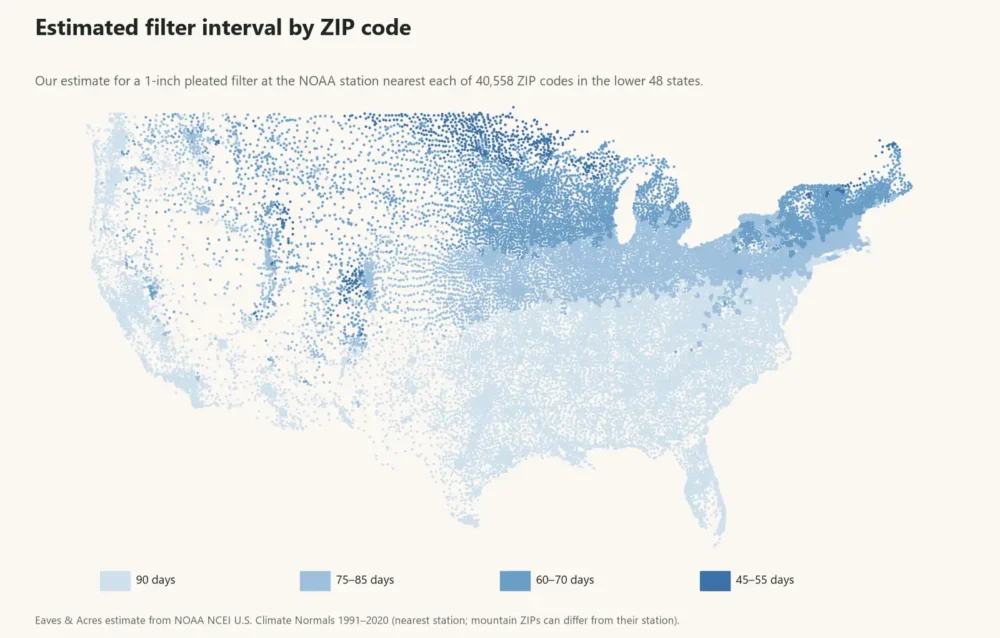
- 3Our estimate from NOAA heating plus cooling degree days: 90 days for a 1-inch pleated filter in 54% of US ZIP codes, 60–70 days in 15.5% and 45–55 in 2%. It is a proxy, not a manufacturer rule.
- 4Check monthly in your heavy months: December to February in Fargo and Minneapolis (about half of yearly demand), June to August in Phoenix (47%) and Dallas (38%).
- 5Higher-rated filters can restrict airflow and clog faster (Lennox, DOE). Never run a furnace without a filter.
Check your furnace filter every month, and replace it when it looks dirty or on the schedule in your furnace’s manual. ENERGY STAR says to change it at a minimum every 3 months,2 and EPA says manufacturers typically recommend replacement every 60 to 90 days.1 Our own estimate, built from NOAA heating and cooling degree days, keeps a 1-inch pleated filter at 90 days in 54% of US ZIP codes and shortens it toward 60 days across the cold northern tier. It is our estimate on a proxy, not a manufacturer rule.
Below: what EPA, ENERGY STAR and three furnace manuals say, the ZIP-level estimate and its limits, when to go sooner, and why a higher-rated filter can cost you airflow.
What EPA, ENERGY STAR and DOE say
EPA’s consumer guide tells owners to replace filters according to the manufacturer’s recommendations. It adds that manufacturers typically recommend replacement every 60 to 90 days, and that heavily soiled filters mean you should change them more often.1 ENERGY STAR sets the check rhythm:
Check your filter every month, especially during heavy use months (winter and summer).
It adds that a filter that looks dirty after a month should be changed, and that three months is the longest gap.2,3 The Department of Energy’s Energy Saver guide says to clean or replace furnace filters once a month or as recommended.4
| Source | Filter or situation | What it says |
|---|---|---|
| EPA, Guide to Air Cleaners in the Home | Typical manufacturer advice | Replace per the manufacturer, typically every 60 to 90 days; sooner if filters look heavily soiled.1 |
| ENERGY STAR | Furnace or AC filter | Check every month, especially in winter and summer; change if dirty after a month; at a minimum every 3 months.2 |
| Department of Energy, Energy Saver guide | Furnaces | Clean or replace once a month or as recommended.4 |
| Lennox ML180UHVK user manual | External filter | Inspect monthly; clean or replace when necessary; never run without one.6 |
| Carrier-brand 90% AFUE furnace manual | Standard / factory media filter | Check every four weeks; media filter before each heating and cooling season, at least yearly.7 |
| Trane owner’s guide | Gas furnace / air handler | Furnace: clean monthly. Air handler: monthly, twice a month when running more.8 |
| Carrier maintenance article | 1-inch fiberglass / pleated / 4-inch media | 30 days / 30 to 90 days / 6 to 12 months.9 |
| Consumer Reports | Disposable filters | Most last 3 to 12 months; thicker lasts longer.10 |
Why your furnace manual beats any calendar
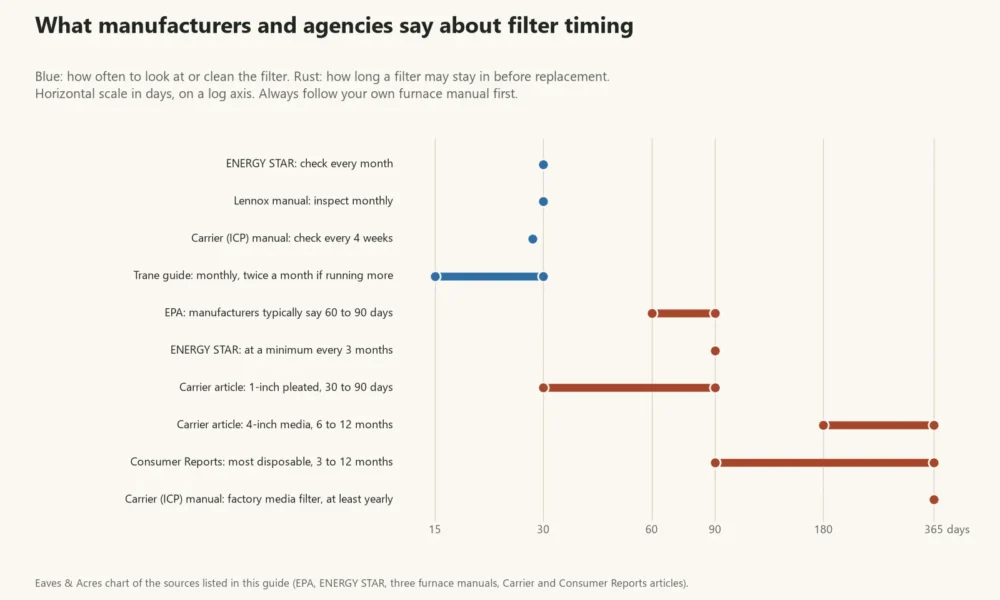
Three manufacturers’ manuals, three different rules. Lennox’s user manual for its ML180UHVK furnace says filters should be inspected monthly and cleaned or replaced when necessary, and that a filter must be in place whenever the unit runs.6 A Carrier-brand 90% efficiency furnace manual says to check the filter every four weeks, but to check or replace its factory-specified disposable media filter before each heating and cooling season and at least once a year.7 Trane’s guide says to clean a furnace filter once a month, and its air-handler section sets the pace by run time:8
twice a month when the system is running more
That is the manual-first rule. Find your furnace’s model number on its label, look up the manual, and use its interval and its filter size and type. Lennox says to use replacements similar in size and efficiency to the originals; Trane says the same size and type.6,8 The rest of this guide covers what the manual does not: your climate and household.
How long each filter type lasts
Thickness and media change the answer more than any other factor. Carrier’s maintenance article lists 1-inch fiberglass filters at 30 days, 1-inch pleated at 30 to 90 days and 4-inch media at 6 to 12 months.9 Consumer Reports found that most disposable filters last 3 to 12 months and that thicker ones need changing less often; it gives a 5-inch Lennox filter about 12 months and a 1-inch Filtrete about three.10 Google’s AI summary shows 6 to 9 months for 3- and 4-inch filters, but the Carrier page it cites says 6 to 12 months for 4-inch media, so we use Carrier’s figure.
Our estimate: how climate changes the interval
A filter only collects dust while the blower runs. EPA says home HVAC systems run usually less than 25% of the time in heating and cooling seasons,1 so a ZIP code with more heating and cooling demand pushes more air through the filter. We use NOAA’s yearly heating plus cooling degree days (base 65°F) as that proxy: the heating degree days guide explains the count, and the ZIP box on our home page shows both totals for your ZIP code.
The steps: add your heating and cooling degree days; divide by 6,014, the middle of the 40,735 ZIP codes we checked; divide 90 days by that ratio; keep the result between 30 and 90 days. We anchor the middle ZIP at 90 days, the long end of EPA’s range and ENERGY STAR’s minimum, and never stretch past it.
Minneapolis, 1-inch pleated filter
- Scenario
- NOAA normals for the station behind ZIP 55401: 7,699 heating and 734 cooling degree days a year.
- Math
- 7,699 + 734 = 8,433. 8,433 ÷ 6,014 = 1.40. 90 ÷ 1.40 = 64 days.
- Answer
- About 65 days. Seattle's 4,622 degree days give a ratio of 0.77, so it stays at 90.
What this estimate is not: a manufacturer rule, a measurement of your house, or a reason to wait longer than your manual says. It counts heating and cooling equally, assumes the blower runs only when the thermostat calls for it, and ignores dust, pets, smoke, filter type, house size and local pollen or wildfire smoke. It uses the station nearest your ZIP code, not your address. If we had anchored the middle ZIP at 60 days instead, every number would be a third shorter (Minneapolis 43 days).

Estimates for 20 US cities
Table 2 applies the estimate to the same stations as our winter thermostat guide, plus a 4-inch media version: the same ratio applied to a 12-month top and a 6-month floor.11
| City (ZIP) | HDD | CDD | vs. middle ZIP | 1-inch, days | 4-inch, months | Heaviest 3 months |
|---|---|---|---|---|---|---|
| Fargo, ND (58102) | 8,806 | 542 | 1.55× | 60 | 8 | Jan, Feb, Dec (50%) |
| Minneapolis, MN (55401) | 7,699 | 734 | 1.40× | 65 | 9 | Jan, Feb, Dec (50%) |
| Madison, WI (53703) | 7,096 | 640 | 1.29× | 70 | 9 | Jan, Feb, Dec (49%) |
| Omaha, NE (68102) | 5,833 | 1,294 | 1.19× | 75 | 10 | Jan, Feb, Dec (48%) |
| Detroit, MI (48226) | 6,106 | 854 | 1.16× | 80 | 10 | Jan, Feb, Dec (47%) |
| Chicago, IL (60602) | 6,018 | 862 | 1.14× | 80 | 10 | Jan, Feb, Dec (47%) |
| Columbus, OH (43215) | 5,417 | 995 | 1.07× | 85 | 11 | Jan, Feb, Dec (47%) |
| Boston, MA (02108) | 5,545 | 802 | 1.06× | 85 | 11 | Jan, Feb, Dec (46%) |
| Kansas City, MO (64106) | 4,613 | 1,708 | 1.05× | 85 | 11 | Jan, Feb, Dec (44%) |
| Denver, CO (80202) | 5,262 | 1,045 | 1.05× | 85 | 11 | Jan, Feb, Dec (43%) |
| Salt Lake City, UT (84101) | 4,724 | 1,402 | 1.02× | 90 | 12 | Jan, Feb, Dec (43%) |
| Louisville, KY (40202) | 4,141 | 1,642 | 0.96× | 90 | 12 | Jan, Feb, Dec (43%) |
| New York, NY (10001) | 4,553 | 1,222 | 0.96× | 90 | 12 | Jan, Feb, Dec (45%) |
| Phoenix, AZ (85004) | 874 | 4,765 | 0.94× | 90 | 12 | Jun, Jul, Aug (47%) |
| Nashville, TN (37201) | 3,648 | 1,587 | 0.87× | 90 | 12 | Jan, Feb, Dec (43%) |
| Dallas, TX (75201) | 1,992 | 3,125 | 0.85× | 90 | 12 | Jun, Jul, Aug (38%) |
| Seattle, WA (98101) | 4,340 | 282 | 0.77× | 90 | 12 | Jan, Feb, Dec (43%) |
| Portland, OR (97204) | 4,167 | 448 | 0.77× | 90 | 12 | Jan, Feb, Dec (43%) |
| Atlanta, GA (30303) | 2,775 | 1,825 | 0.76× | 90 | 12 | Jan, Feb, Dec (38%) |
| Sacramento, CA (95814) | 2,138 | 1,576 | 0.62× | 90 | 12 | Jan, Jul, Dec (38%) |
The heavy months differ by place. In Fargo and Minneapolis, December through February carry about half of the year’s heating and cooling demand; in Phoenix, June through August carry 47%, and in Dallas 38%. That matches ENERGY STAR’s “winter and summer” advice: check monthly in your heavy months even when the yearly estimate says 90 days.

By state and ZIP code
Across the 40,735 ZIP codes with both values, 53.7% round to 90 days, 28.6% to 75–85, 15.5% to 60–70 and 2.0% to 45–55, with 48 at 30–40. Alaska’s median ZIP lands at 50 days, North Dakota at 55 and Minnesota at 60. Climate moves the answer by weeks, not months, which is why household and filter type matter more.
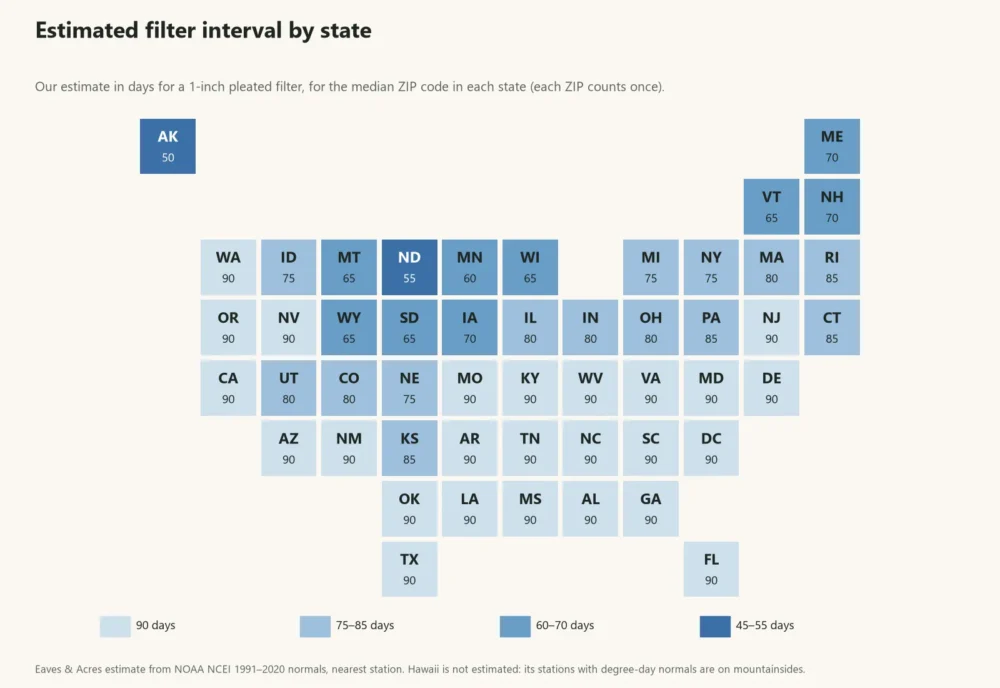
We give no estimate for 137 Hawaii ZIP codes: our dataset’s only Hawaii stations with degree-day normals sit on mountainsides, so beach ZIPs would inherit mountain numbers. Another 105 ZIP codes (96 in Alaska, 8 in Florida, 1 in California) have no value. There, follow your manual.
Winter, summer or both
Where one blower heats and cools, one filter sees both seasons. Carrier says a furnace filter schedule generally mirrors the air conditioner’s when they share an air handler, and that a system running continuously, as in a hot Florida summer, needs changes more often.9 By our measure 55.6% of ZIP codes are heating-dominated (80% or more of demand), 3.0% cooling-dominated and 41.4% mixed. Heat pump or furnace, the filter sits in the same air stream; see our heat pump vs. furnace guide for costs and our cold-weather heat pump guide for how those systems run when it is freezing.
Pets, smoke, dust and big houses: go sooner
Carrier advises changing at least every 30 days if you smoke indoors, burn scented candles or wood fires, cook often, or live near construction or poor outdoor air. With several pets it says to check every 30 days. It also says larger homes move more air and need more attention, and that a rarely used vacation home may go longer.9 Our climate estimate says nothing about these, so use the shortest of your manual’s interval, our estimate and what the filter looks like. Dirty after a month, change it.3
Higher MERV and thick filters: the airflow trade-off
MERV rates how well a filter catches particles. If you decide to upgrade, EPA advises at least MERV 13, or as high as your system’s fan and filter slot can accommodate, and says most furnaces can take a MERV 13 filter without equipment problems if it is replaced frequently. It also says a technician can determine the highest rating your system can use.1 The Department of Energy’s Building America program warns that higher-MERV filters impose much more resistance to airflow and are likely to clog faster, and that most filter boxes were sized for a 1-inch fiberglass filter.5 Lennox’s manual is blunter:
Use of replacement filters with higher filtration ratings may restrict air flow to the furnace.
We do not recommend a rating. Use what your manual specifies, and ask a technician before changing the filter slot or going above it. A filter also does not fix moisture; EPA says furnace filters do not solve mold, which needs the moisture source removed (see winter indoor humidity).1
Signs it is overdue, and never running without one
Carrier lists a gray or clogged filter, reduced airflow, more dust, higher bills and musty odors.9 The Carrier-brand manual says a dirty filter can cause excessive stress on the furnace, heat exchanger and blower (see how long a furnace lasts) and can make it overheat and shut itself off.7 To the common question of whether you can run the system without a filter for a day: all three manuals say never to run it without one.6,7,8
Changing it the manufacturer’s way
Swapping a filter is the owner task manuals describe. Use the size and type your manual names. EPA says it should fit snugly so air does not leak around it, without bending or crushing it.1 Trane says to insert it with the arrows pointing in the direction of airflow,8 and the Carrier-brand manual says to turn off electrical supply to the furnace first.7 Put the date and size on the frame.
Next step
Find your manual, set a monthly reminder to look, and note your city’s heavy months from Table 2. If you plan backup power for the blower, see what size generator runs a furnace and the generator size calculator.
Frequently asked questions
Look at it every month. ENERGY STAR says to change a filter that looks dirty after a month. Carrier lists a gray or clogged filter, reduced airflow, more dust, higher bills and musty odors as signs.
EPA says manufacturers typically recommend replacement every 60 to 90 days. Carrier lists 30 days for 1-inch fiberglass and 30 to 90 days for 1-inch pleated, and ENERGY STAR’s longest gap is 3 months. Our estimate for a 1-inch pleated filter is 90 days in 54% of US ZIP codes and 60–70 days in 15.5%.
16x25x1 is a size (16 by 25 inches, 1 inch thick), not a type, so use the 1-inch answers above and your manual. EPA says the filter should fit snugly so air does not leak around it, without being bent or crushed.
No. The Lennox, Carrier-brand and Trane manuals we read all say a filter must be in place whenever the unit runs. The Carrier-brand manual adds that running without one may damage the blower motor.
ENERGY STAR names winter and summer as the heavy-use months to check every month. Carrier says a system running continuously, as in a hot Florida summer, needs changes more often. In our NOAA data the heavy months are December to February in Fargo and June to August in Phoenix.
Carrier says one pet means following the manufacturer’s standard recommendation, several pets means checking the filter every 30 days, and high-shedding pets may call for more frequent changes.
Carrier lists 6 to 12 months for 4-inch media filters, and Consumer Reports gives a 5-inch Lennox filter about 12 months. A Carrier-brand manual says its factory media filter should be replaced at least once a year. Our 4-inch estimate is about 8 months in Fargo and 12 months across most of the South.
No source we read gives an interval by MERV rating. DOE’s Building America program says higher-MERV filters add airflow resistance and are likely to clog faster, and EPA says most furnaces can take a MERV 13 filter if it is replaced frequently. Follow your manual and ask a technician before going above the filter it specifies.
Sources
- 1.Guide to Air Cleaners in the Home. U.S. Environmental Protection Agency, 2nd ed. 2018, page updated 2026-10-01. Used for: replace per manufacturer, typically every 60 to 90 days; systems run under 25% of the time; MERV 13 or as high as the system accommodates; filters do not solve mold; snug fit Back to text
- 2.Heat & Cool Efficiently (Change your air filter regularly). ENERGY STAR (U.S. EPA and U.S. DOE), checked 2026-10-13. Used for: check every month, especially winter and summer; change if dirty after a month; at a minimum every 3 months Back to text
- 3.Does changing my furnace or air conditioning filter each month save energy?. ENERGY STAR Help Center, 2025-06-26. Used for: same guidance: monthly check, change if dirty after a month, minimum every 3 months Back to text
- 4.Energy Saver Guide: Tips on Saving Money and Energy at Home. U.S. Department of Energy, 2022. Used for: clean or replace furnace filters once a month or as recommended Back to text
- 5.California Energy Standards Recognize the Importance of Filter Selection (Building America Top Innovations 2014 Profile, PNNL-SA-106306). U.S. Department of Energy Building America, 2014. Used for: higher-MERV filters impose much more airflow resistance and clog faster; most filter boxes sized for 1-inch fiberglass Back to text
- 6.ML180UHVK User’s Information Manual 508548-01. Lennox Industries, 05/2025. Used for: filters inspected monthly; filter must be in place; higher filtration ratings may restrict air flow Back to text
- 7.Condensing 90+% AFUE Gas Furnace Owner’s Manual 90GSFRN-ICP-01OM. Carrier (ICP), edition 03/22. Used for: check every four weeks; factory media filter before each season and at least yearly; never operate without a filter; dirty filter can cause overheating shutdown Back to text
- 8.Owner’s Guide: Indoor Units (Air Handlers, Gas Furnaces) 32-5064-WEB01. Trane, undated. Used for: furnace filter once a month; air handler at least monthly, twice a month when running more; same size and type; never operate with filters removed Back to text
- 9.How Often to Change Air Filter (AC and Furnace Maintenance Guide). Carrier, read 2026-10-13. Used for: 1-inch fiberglass 30 days, pleated 30–90 days, 4-inch media 6–12 months; pets, smoke, larger homes, continuous running; signs of a clogged filter Back to text
- 10.How Often Do You Need to Change the Air Filter on Your Heating and Cooling Systems?. Consumer Reports, 2023-10-21. Used for: most disposable filters last 3 to 12 months; 5-inch Lennox about 12 months, 1-inch Filtrete about 3 Back to text
- 11.U.S. Climate Normals 1991–2020 (annual and monthly heating and cooling degree days). NOAA National Centers for Environmental Information, 2021. Used for: heating and cooling degree days (base 65°F) for the station nearest 40,735 ZIP codes and 20 city stations Back to text
- 12.HVAC air filter (photo). Wikideas1, Wikimedia Commons, CC0, 2025. Used for: photo, cropped
How this guide was made
- Written by the Home Systems Desk and reviewed by the Data & Methodology Desk.
- Data: the filter intervals by ZIP are an Eaves & Acres estimate built on a proxy, not a manufacturer rule. Demand D = yearly heating degree days + cooling degree days (base 65°F, NOAA NCEI U.S. Climate Normals 1991–2020, station nearest each ZIP code; Hawaii and ZIP codes without both values excluded). Ratio r = D ÷ 6,014 (the median of 40,735 ZIP codes). 1-inch pleated filter: days = 90 ÷ r, kept between 30 and 90 (90 is the long end of EPA’s “60 to 90 days”; ENERGY STAR’s minimum is every 3 months). 4-inch media: months = 12 ÷ r, kept between 6 and 12 (Carrier’s 6 to 12 months). It counts heating and cooling equally, assumes the blower runs only on a thermostat call, and ignores dust, pets, smoke, filter type, house size and local pollen or wildfire smoke. Anchoring the middle ZIP at 60 days instead would shorten every figure by a third. Follow your furnace manual first. See our methodology.
- AI use: AI tools help us research, draft and check this guide. Every figure is checked against the source cited for it, and calculated figures come from our own code, described on the methodology page.
- Spotted an error? Tell us — the form opens with this page’s address filled in.
Change log
- Oct 13, 2026Published. EPA, ENERGY STAR, DOE (Energy Saver guide and Building America), three furnace manuals (Lennox, Carrier-brand, Trane), Carrier and Consumer Reports articles read on the live pages or files; ZIP-level estimate computed from NOAA 1991–2020 heating and cooling degree days.
Covers heating, cooling, generators and water heaters. We maintain the sizing calculators and the guides that explain what a number means before you call a contractor.
Keep reading
How Many BTU to Heat a Room? Rules of Thumb Tested Against Design Temperatures
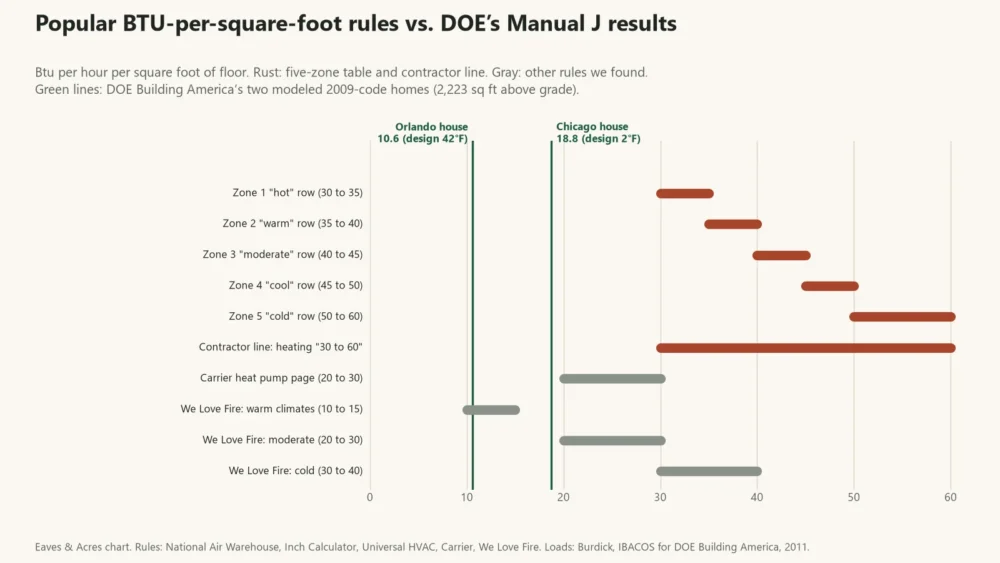
Popular tables say 30 to 60 BTU per square foot; DOE's modeled homes need 10.6 to 18.8. We convert BTU to watts and test the rules against design temperatures for 39 cities and 40,565 ZIP codes.

How Long Does a Furnace Last? DOE, NAHB and Manufacturer Figures Compared
Sources put furnace life at 15 to 22 years: NAHB says gas 18, Minnesota 15 to 20, DOE 21.4. We show why they differ and estimate run hours for 20 cities from NOAA data.

How to Winterize Your House: A Fall Checklist With Dates
The typical US ZIP code gets its first freeze around October 25. A deadline-ordered fall checklist for caulk, hoses, gutters, attic, furnace and alarms, with dates for 24 cities and what labels, CPSC and extension services say.
Seasonal reminders for your ZIP
Get a short email when it’s time to overseed, start seeds, open the pool or service your furnace — timed to your climate.