




What Humidity Should a House Be in Winter? 30–40%, Lower on Cold Nights
About 30–40% relative humidity, inside EPA’s 30–50% range, and lower when it is very cold outside. Here is what EPA and CDC say, the dew-point math behind window fog, and the January ceiling for your city and window type.
- Last reviewed Oct 13, 2026
- 14 cited sources
- 6 min read
- 1Aim for about 30–40% relative humidity in winter: inside EPA’s ideal 30–50% (CDC says no higher than 50%) and low enough for most double-pane windows on a typical January night.
- 2Cold glass sets the limit. In a 68°F room, by our estimate, clear double-pane glass fogs above 40% at about 7°F outside, and single pane above 30% at about 26°F.
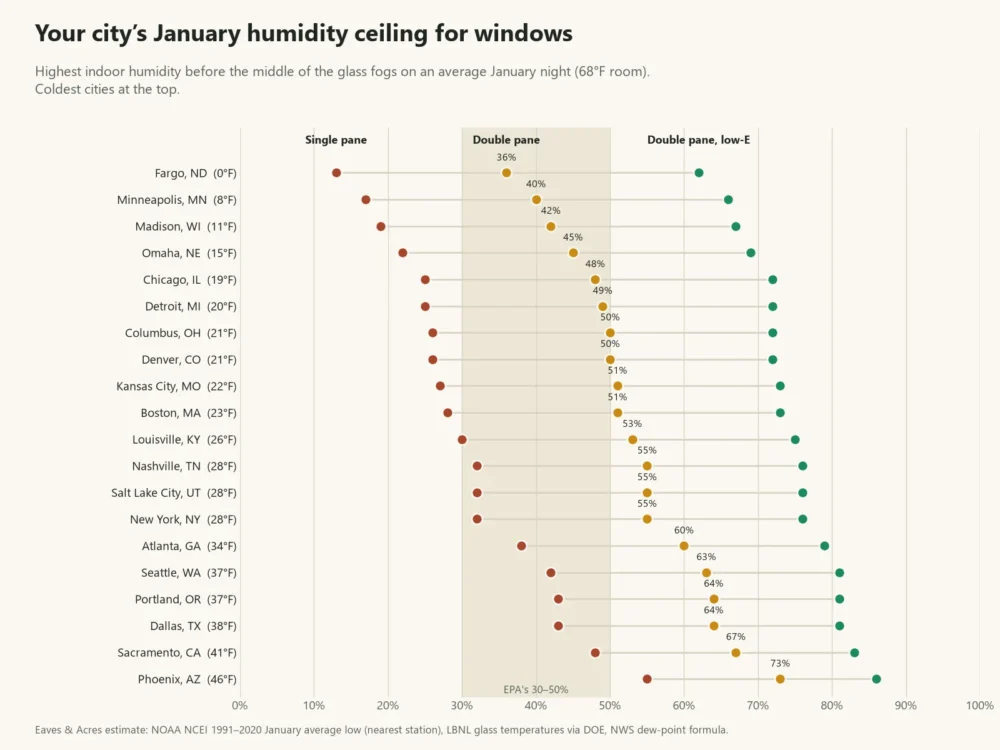
- 3On an average January night, the median US ZIP code’s ceiling is about 51% for clear double pane, 73% for low-E double pane and 28% for single pane (NOAA 1991–2020 normals).
- 4The common outdoor-temperature humidity chart roughly fits clear double-pane windows with a margin for cold edges, but it is too high for single pane and stricter than low-E glass needs.
- 5Fog or frost on the glass means turn the humidity down. If you humidify, EPA advises low-mineral water and cleaning portable units every third day.
Keep your house at about 30–40% relative humidity in winter, and lower on the coldest nights. EPA’s ideal indoor range is 30–50%,1 but in January your windows set the real ceiling. In a 68°F room, by our estimate, clear double-pane glass starts to fog above 40% once it drops to about 7°F outside, and single-pane glass fogs above 30% at about 26°F.
Below: what EPA and CDC actually say, the dew-point math, a January ceiling for 20 US cities from NOAA normals, and how to tell whether your air is too dry or too damp.
What EPA, CDC and the research say
EPA’s mold guidance is the source of the range most sites repeat:
keep indoor humidity below 60 percent (ideally between 30 and 50 percent)
Its indoor air guide gives the same 30–50%,3 and its mold course adds that low humidity also discourages dust mites and cockroaches.2 CDC is stricter:
as low as you can — no higher than 50% — all day long
No agency sets a winter floor below 30%, but one lab study points upward. In a CDC NIOSH test with coughing manikins in a 68°F room, flu virus kept 71–77% of its infectivity at 23% humidity or less, but only 15–22% at 43% or more.5
Maintaining indoor relative humidity >40% will significantly reduce the infectivity of aerosolized virus.
That was one simulated room, not a study of homes. Treat 40% as a target to reach only when your windows allow it.
| Source | Number | What it is for |
|---|---|---|
| EPA | 30–50% ideal; below 60% | Mold and moisture, all year |
| CDC | No higher than 50% | Mold prevention, all day |
| NDSU Extension | Around 40% in winter | Comfort vs. window condensation |
| CDC NIOSH lab study | Above 40% cut flu infectivity | One simulated room, not homes |
| Center for Energy and Environment chart | Below 40% at 20–40°F, down to under 15% at −20°F | Window condensation, no source given |
| Your windows (Table 2) | Depends on glass and outdoor temperature | Upper limit on cold nights |
Why cold windows set your winter limit
Water condenses on any surface colder than the air’s dew point. In a 68°F room, the dew point is 35.5°F at 30% humidity, 42.8°F at 40% and 48.7°F at 50%. Window glass runs far colder than the room. A DOE Building America window guide notes that single glazing runs only 10–15°F warmer than outdoors. Its Lawrence Berkeley National Laboratory chart gives the inside-glass temperature at 0°F and 20°F outdoors for each window type.8 We read those bars and turned them into a ceiling:
Glass temperature = room − f × (room − outdoor), where f = 0.77 for single pane, 0.42 for clear double pane and 0.20 for low-E double pane with argon (from the LBNL chart, 70°F room).
Humidity ceiling = es(glass) ÷ es(room) × 100, with the National Weather Service vapor-pressure formula es = 6.11 × 10(7.5T ÷ (237.3 + T)), T in °C.7
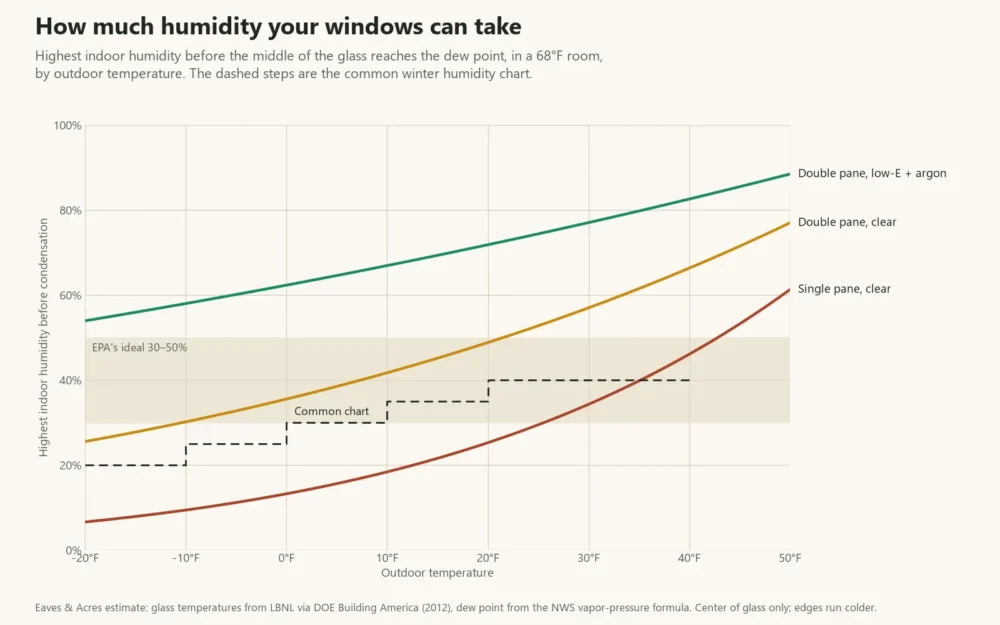
These are center-of-glass figures. The DOE guide says the bottom edge of a window carries the highest condensation risk, and frames vary,8 so fog usually shows at the edges first. Below freezing the water forms frost, which starts slightly sooner than this formula shows.
Your city’s ceiling on an average January night
We ran the model at each city’s January average low from NOAA’s 1991–2020 normals, the same stations as our winter thermostat guide.11
| City (ZIP) | January average low | Single pane | Double pane, clear | Double pane, low-E | Common chart says |
|---|---|---|---|---|---|
| Fargo, ND (58102) | 0°F | 13% | 36% | 62% | below 30% |
| Minneapolis, MN (55401) | 8°F | 17% | 40% | 66% | below 30% |
| Madison, WI (53703) | 11°F | 19% | 42% | 67% | below 35% |
| Omaha, NE (68102) | 15°F | 22% | 45% | 69% | below 35% |
| Chicago, IL (60602) | 19°F | 25% | 48% | 72% | below 35% |
| Detroit, MI (48226) | 20°F | 25% | 49% | 72% | below 35% |
| Columbus, OH (43215) | 21°F | 26% | 50% | 72% | below 40% |
| Denver, CO (80202) | 21°F | 26% | 50% | 72% | below 40% |
| Kansas City, MO (64106) | 22°F | 27% | 51% | 73% | below 40% |
| Boston, MA (02108) | 23°F | 28% | 51% | 73% | below 40% |
| Louisville, KY (40202) | 26°F | 30% | 53% | 75% | below 40% |
| Nashville, TN (37201) | 28°F | 32% | 55% | 76% | below 40% |
| Salt Lake City, UT (84101) | 28°F | 32% | 55% | 76% | below 40% |
| New York, NY (10001) | 28°F | 32% | 55% | 76% | below 40% |
| Atlanta, GA (30303) | 34°F | 38% | 60% | 79% | below 40% |
| Seattle, WA (98101) | 37°F | 42% | 63% | 81% | below 40% |
| Portland, OR (97204) | 37°F | 43% | 64% | 81% | below 40% |
| Dallas, TX (75201) | 38°F | 43% | 64% | 81% | below 40% |
| Sacramento, CA (95814) | 41°F | 48% | 67% | 83% | not covered |
| Phoenix, AZ (85004) | 46°F | 55% | 73% | 86% | not covered |
Chicago, clear double-pane window, 68°F room
- Scenario
- NOAA's January average low at Chicago Northerly Island is 19.4°F.
- Math
- Glass: 68 − 0.416 × (68 − 19.4) = 47.8°F. Vapor pressure at 47.8°F is 11.3 hPa; at 68°F it is 23.4 hPa. 11.3 ÷ 23.4 = 48%.
- Answer
- About 48% before the middle of the glass fogs on a typical January night; aim lower to keep the edges dry.
Across the 40,906 ZIP codes in our NOAA dataset, the median January low is 23°F. On that night, clear double-pane glass tolerates 51% in the median ZIP and low-E glass 73%, but single pane only 28%. In 57.5% of ZIP codes, a single-pane window fogs before the room reaches EPA’s 30% floor. On clear double-pane glass, each 10°F colder costs about 6–7 points.
Is the outdoor-temperature humidity chart right?
The stepped chart that Google’s AI Overview repeats (below 40% at 20–40°F outside, stepping down to under 15% at −20°F and colder) is published by Minnesota’s Center for Energy and Environment, which cites no origin.10 A Canadian builder’s metric version labels it for double-pane windows in a 68°F room. Our check: from −20°F to 20°F it runs 5–10 points below the clear double-pane estimate, roughly the margin colder edges need. It is too generous for single pane (11–17 points too high below 30°F) and much stricter than low-E glass needs.
NDSU Extension’s rule of thumb is that, at 40% humidity, double-pane windows start to show condensation below 0°F outside.9 That falls between our clear (7°F) and low-E estimates.
Too dry: measure first, then add moisture carefully
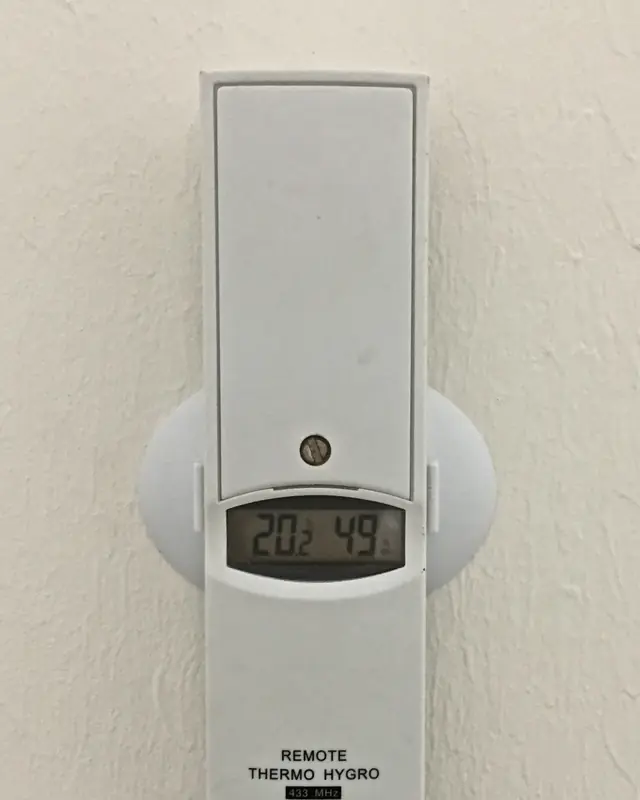
NDSU Extension warns that air that is too dry can dry out skin and nasal passages.9 A hygrometer, which EPA notes costs about $10–$50, tells you where you stand.1 Your thermostat moves the reading too: air at 40% in a 68°F room reads about 35% at 72°F and 53% at 60°F. A night setback raises humidity just as the glass gets coldest. A space heater adds no water; it lowers the reading by warming the air.
If you add moisture, EPA advises using a humidifier only when conditions require it, at the correct setting, and cleaning portable units every third day. It suggests low-mineral water such as distilled water, because ultrasonic and impeller (“cool mist”) units can spray minerals and microorganisms into the air. Steam vaporizers and evaporative units are not expected to disperse substantial amounts of minerals.6
Too humid: signs and what to do
Condensation is the first sign. EPA says to dry the wet surface quickly and reduce the moisture source.1 Its mold course lists humidifiers, steam radiators, dryers, combustion appliances, cooking and showers as sources, and notes that mold often grows on walls in cold corners behind furniture.2
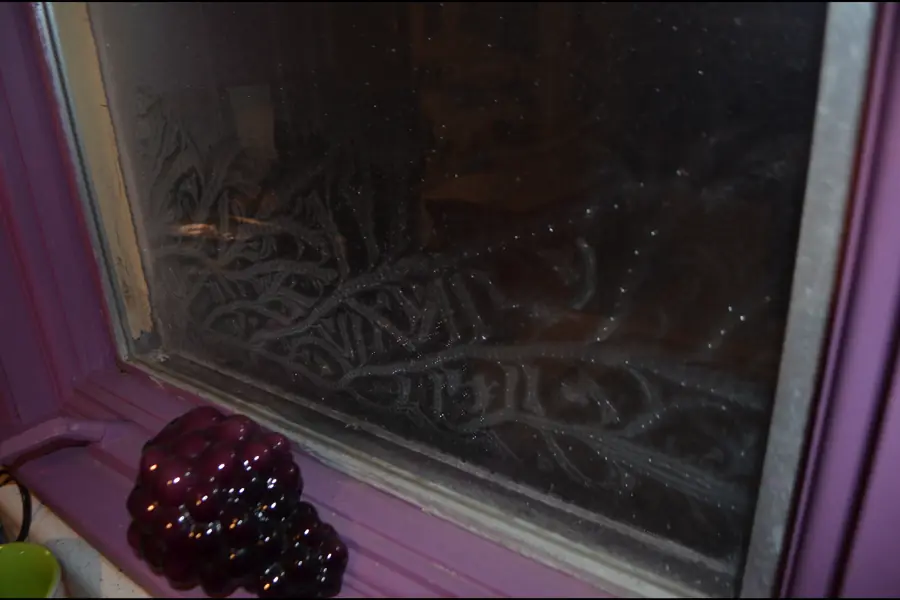
EPA’s fixes: lower the humidity, vent clothes dryers and stoves outside where possible, use exhaust fans or open windows when cooking or running the dishwasher, add air movement, and raise the air temperature.1 If condensation forms behind drapes, NDSU suggests leaving them open at night, at some cost in heat loss.9 The same dew-point physics is why a heat pump’s outdoor coil frosts in cold, humid weather.
Next step
Put a hygrometer in your coldest room, set any humidifier at or below your city’s row for your window type, and turn it down before an arctic night. That same night is when pipes freeze; if you plan backup power for the furnace, the generator size calculator adds up the watts.
Frequently asked questions
Yes. It is above EPA’s 60% limit and CDC’s 50%. At 70% in a 68°F room the dew point is about 58°F, so by our estimate clear double-pane glass fogs whenever it is below about 44°F outside. At 67% it is nearly the same: a 57°F dew point, and fog below about 41°F.
No. It is inside EPA’s 30–50% range, and by our estimate it keeps the middle of clear double-pane glass dry down to about −1°F outside in a 68°F room.
It is EPA’s upper ideal and CDC’s maximum, but often too high for windows. Clear double-pane glass fogs at 50% once it is below about 22°F outside, which happens on an average January night in about 44% of US ZIP codes.
EPA treats 60% as high humidity that can feed mold and advises staying below it, ideally at 30–50%; CDC says no higher than 50%. In winter the bigger risk at 55% is condensation on cold glass and wall corners, where EPA says mold often grows.
For clear double-pane windows in a 68°F room, our estimate is about 49% at 20°F outside, 42% at 10°F, 36% at 0°F and 30% at −10°F. Single pane needs far less (about 25% at 20°F); low-E glass tolerates more.
The same 30–50% range. A warmer room reads lower for the same moisture: air at 40% in a 68°F room reads about 37% at 70°F, and the windows run slightly warmer too.
No. EPA lists opening windows as a way to lower indoor humidity when it is not humid outside, and as a way to prevent condensation. Cold winter air holds little water.
Below 30% is under EPA’s range. No agency sets a hard floor, but in a CDC NIOSH lab study flu virus stayed far more infectious at 23% humidity or less than at 43% or more.
Sources
- 1.A Brief Guide to Mold, Moisture and Your Home. U.S. Environmental Protection Agency, updated 2026-02-18. Used for: below 60%, ideally 30–50% relative humidity; humidity meters $10–$50; condensation as a sign of high humidity; ways to reduce humidity and prevent condensation Back to text
- 2.Mold Course Chapter 2: Why and Where Mold Grows. U.S. Environmental Protection Agency, updated 2025-12-01. Used for: RH below 60%, ideally 30–50%; low humidity discourages dust mites and cockroaches; indoor moisture sources; mold in cold corners behind furniture Back to text
- 3.Care for Your Air: A Guide to Indoor Air Quality. U.S. Environmental Protection Agency, updated 2026-08-17. Used for: keep indoor humidity between 30 and 50 percent; open windows to lower humidity when it is not humid outside Back to text
- 4.Mold. Centers for Disease Control and Prevention, checked 2026-10-12. Used for: keep humidity as low as you can, no higher than 50%, all day long
- 5.High Humidity Leads to Loss of Infectious Influenza Virus from Simulated Coughs (Noti et al.). CDC National Institute for Occupational Safety and Health, PLOS ONE, 2013. Used for: 70.6–77.3% infectivity at RH ≤23% vs 14.6–22.2% at ≥43% in a simulated room at 20°C Back to text
- 6.Use and Care of Home Humidifiers. U.S. Environmental Protection Agency, updated 2026-04-29. Used for: use only when needed; clean portable units every third day; low-mineral water; ultrasonic and impeller units disperse minerals and microorganisms Back to text
- 7.Vapor Pressure (wxcalc formula sheet). National Weather Service, El Paso, accessed 2026-10-12. Used for: saturation vapor pressure es = 6.11 × 10^(7.5T/(237.3+T)) and RH = e/es × 100 Back to text
- 8.Measure Guideline: Energy-Efficient Window Performance and Selection (Carmody and Haglund, NorthernSTAR). U.S. Department of Energy Building America (NREL report), figure courtesy of Lawrence Berkeley National Laboratory, 2012. Used for: inside glass surface temperatures at 0°F and 20°F outdoors by glazing type; single glazing 10–15°F above outdoors; bottom edge has the highest condensation risk Back to text
- 9.Window Condensation Common Problem. North Dakota State University Extension, 2011. Used for: around 40% in winter; double-pane windows show condensation below 0°F at 40%; leave drapes open at night Back to text
- 10.Managing Indoor Humidity Levels All Year Round. Center for Energy and Environment (Minnesota), 2026. Used for: the stepped winter humidity chart by outdoor temperature, as published (no source given) Back to text
- 11.U.S. Climate Normals 1991–2020 (monthly normals). NOAA National Centers for Environmental Information, 2021. Used for: January average low and mean temperature for the station nearest each city ZIP code and for 40,906 ZIP codes Back to text
- 12.Closeup detail of moisture condensation problems (photo). Shixart1985, Wikimedia Commons, CC BY 2.0, 2019. Used for: photo, cropped
- 13.Window frost formation (photo). B137, Wikimedia Commons, CC0, 2015. Used for: photo, cropped
- 14.Remote Thermo-Hygrometer (photo). FaceMePLS, Wikimedia Commons, CC BY 2.0, 2016. Used for: photo, cropped


.jpg)
How this guide was made
- Written by the Home Systems Desk and reviewed by the Data & Methodology Desk.
- Data: window-condensation ceilings are an Eaves & Acres estimate for a 68°F room: inside-glass temperature = room − f × (room − outdoor), with f read from the LBNL chart in DOE’s Building America window guide (single 0.77, clear double 0.42, low-E double 0.20; center of glass, 70°F room), and the ceiling = saturation vapor pressure at the glass ÷ that at room temperature (NWS formula). Outdoor temperatures are January average lows from NOAA NCEI U.S. Climate Normals 1991–2020 for the station nearest each city ZIP code (the same stations as our thermostat guide) and for 40,906 ZIP codes. Window edges and frames run colder, so condensation can start sooner. Estimates, not a guarantee. See our methodology.
- AI use: AI tools help us research, draft and check this guide. Every figure is checked against the source cited for it, and calculated figures come from our own code, described on the methodology page.
- Spotted an error? Tell us — the form opens with this page’s address filled in.
Change log
- Oct 13, 2026Re-checked EPA, CDC, the NIOSH study, NDSU and CEE against the live pages. Added NDSU Extension's note that too-dry air can dry out skin and nasal passages, and the 67% case to the 70% FAQ answer.
- Oct 12, 2026Published. EPA (three mold and indoor air pages, humidifier fact sheet), CDC and the CDC NIOSH humidity study checked on the live pages; window-condensation ceilings estimated from LBNL inside-glass temperatures in DOE’s Building America window guide, the NWS vapor-pressure formula and NOAA 1991–2020 January normals for 20 cities and 40,906 ZIP codes; NDSU Extension rule of thumb compared.
Covers heating, cooling, generators and water heaters. We maintain the sizing calculators and the guides that explain what a number means before you call a contractor.
Keep reading
How Much Does It Cost to Run a Space Heater? Costs by State and City
A 1,500-watt space heater costs about 27¢ an hour at the 2026 US average electricity price. Costs by state and in 20 cities, and how its heat compares with a furnace or heat pump.
What Temperature to Set Your Thermostat in Winter: 68°F, Then Lower at Night
About 68°F while you are awake and 7–10°F lower at night for a furnace or boiler; a heat pump stays steady. What a setback saves in 20 US cities, plus the 55°F and health floors.
At What Temperature Do Pipes Freeze? The 20°F Threshold and Where It Hits
Pipes in unheated spaces are most at risk at about 20°F outside, per a University of Illinois study. How often 20 US cities get there, and what to do before a freeze.
Seasonal reminders for your ZIP
Get a short email when it’s time to overseed, start seeds, open the pool or service your furnace — timed to your climate.