




When to Overseed Your Lawn: The Last Safe Day Where You Live
Cool-season lawns need about six weeks of growth before winter. Here is the last safe overseeding day for 21 US cities, computed from NOAA frost normals and checked against extension advice.
- Last reviewed Oct 4, 2026
- 7 cited sources
- 9 min read
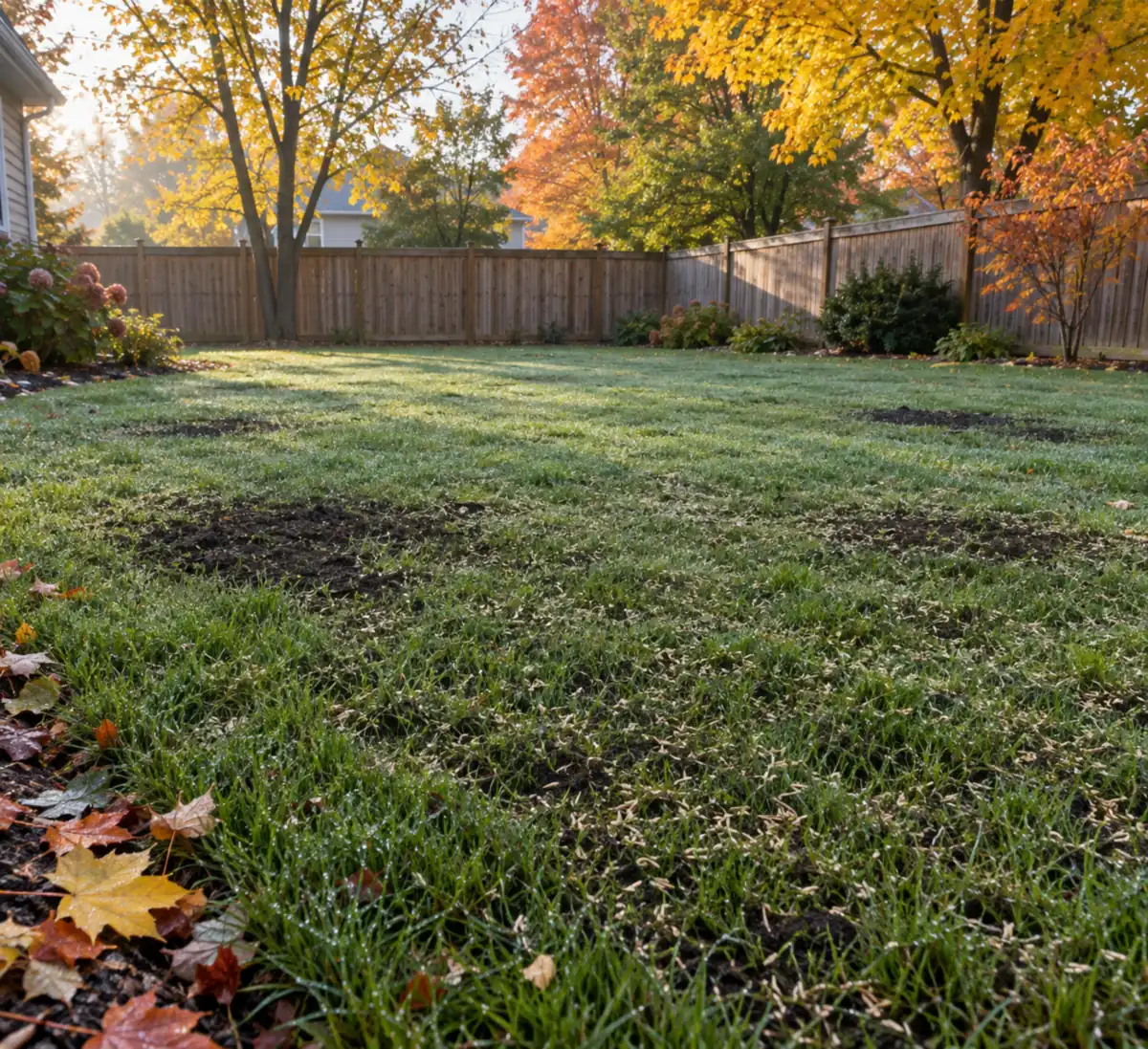
Set your ZIP to see dates for your area.
- 1Overseed cool-season lawns (tall fescue, Kentucky bluegrass, perennial ryegrass) in late summer to early fall. Seed Bermuda grass in late spring, once soil reaches about 65°F.
- 2Finish at least 45 days before your first hard freeze: about Sep 12 in Minneapolis, Sep 19 in Columbus and Oct 6 in Atlanta.
- 3Counting back from the 28°F hard freeze matches published extension windows in Nebraska, Indiana, Iowa and North Carolina within about four days.
- 4Earlier is better: Purdue Extension warns that a one-week delay can add two to four weeks before new grass matures.
- 5Overseed with 3–4 lb of tall fescue or about 2 lb of Kentucky bluegrass per 1,000 sq ft.
Overseed a cool-season lawn (tall fescue, Kentucky bluegrass or perennial ryegrass) in late summer to early fall, and finish at least 45 days before your area’s typical first hard freeze. In practice that is about September 12 in Minneapolis, September 19 in Columbus and October 6 in Atlanta. Warm-season lawns such as Bermuda grass work the other way round: seed them in late spring, once the soil has warmed to about 65°F.
Most guides stop at “early fall.” Below you will find the actual cut-off date for 21 US cities, computed from NOAA’s 1991–2020 climate normals, plus the method, so you can check the date for your own ZIP code.
Your last safe day to overseed, city by city
The rule extension specialists use is simple: new seedlings need about six weeks of growth before winter. A University of Illinois Extension release on choosing grass seed starts from the season:
Late summer or early fall is the best time to plant cool-season grass seed.
The same release adds that grass planted at least 45 days before the first fall frost can establish roots and be ready come spring.3
The catch is which “frost.” A 32°F night is a light frost; a 28°F hard freeze is a much stronger sign that the growing season is ending. We counted back 45 days from both, for every US ZIP code, using the NOAA weather station nearest to it.1 The 28°F version is your realistic last day. The 32°F version is about ten days earlier and gives you extra margin for a cold year.
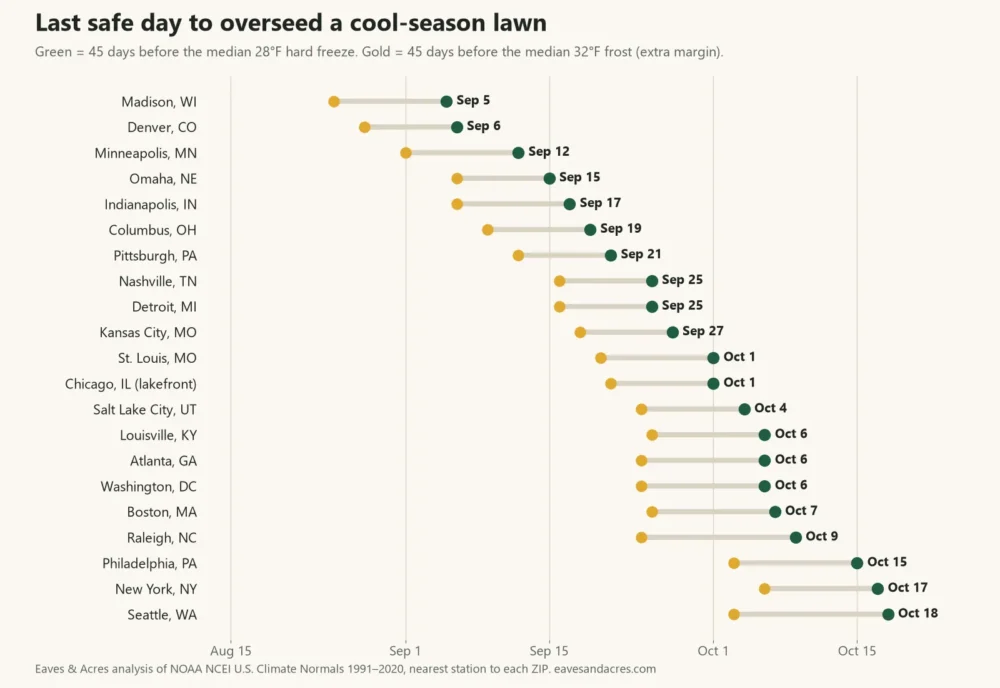
Here are the same numbers as a table. Each city uses the station nearest to the ZIP code shown; your own date can differ by a week or more if you live in a valley, on a hilltop or far from the city center.
| City (ZIP) | First frost (32°F, median) | Hard freeze (28°F, median) | Last safe day to overseed | With extra margin |
|---|---|---|---|---|
| Minneapolis, MN (55401) | Oct 16 | Oct 27 | Sep 12 | Sep 1 |
| Madison, WI (53703) | Oct 9 | Oct 20 | Sep 5 | Aug 25 |
| Denver, CO (80202) | Oct 12 | Oct 21 | Sep 6 | Aug 28 |
| Omaha, NE (68102) | Oct 21 | Oct 30 | Sep 15 | Sep 6 |
| Chicago, IL (60601) | Nov 5 | Nov 15 | Oct 1 | Sep 21 |
| Detroit, MI (48201) | Oct 31 | Nov 9 | Sep 25 | Sep 16 |
| Columbus, OH (43215) | Oct 24 | Nov 3 | Sep 19 | Sep 9 |
| Indianapolis, IN (46204) | Oct 21 | Nov 1 | Sep 17 | Sep 6 |
| Pittsburgh, PA (15222) | Oct 27 | Nov 5 | Sep 21 | Sep 12 |
| Boston, MA (02108) | Nov 9 | Nov 21 | Oct 7 | Sep 25 |
| New York, NY (10001) | Nov 20 | Dec 1 | Oct 17 | Oct 6 |
| Philadelphia, PA (19103) | Nov 17 | Nov 29 | Oct 15 | Oct 3 |
| Washington, DC (20001) | Nov 8 | Nov 20 | Oct 6 | Sep 24 |
| St. Louis, MO (63101) | Nov 4 | Nov 15 | Oct 1 | Sep 20 |
| Kansas City, MO (64105) | Nov 2 | Nov 11 | Sep 27 | Sep 18 |
| Louisville, KY (40202) | Nov 9 | Nov 20 | Oct 6 | Sep 25 |
| Salt Lake City, UT (84101) | Nov 8 | Nov 18 | Oct 4 | Sep 24 |
| Seattle, WA (98101) | Nov 17 | Dec 2 | Oct 18 | Oct 3 |
| Raleigh, NC (27601) | Nov 8 | Nov 23 | Oct 9 | Sep 24 |
| Nashville, TN (37201) | Oct 31 | Nov 9 | Sep 25 | Sep 16 |
| Atlanta, GA (30303) | Nov 8 | Nov 20 | Oct 6 | Sep 24 |
For any other ZIP code, look up your frost dates and their odds. The 10% first-frost date on that page is the one to watch in a year when you are running late.
Does the 45-day rule match local extension advice?
We checked our computed dates against five extension services that publish their own fall seeding windows. The 28°F version lands within about four days of each one:
| Place | Our last safe day | Extension recommendation |
|---|---|---|
| Omaha (eastern Nebraska) | Sep 15 | Aug 15 – Sep 15 (Nebraska Extension) |
| North Platte (western Nebraska) | Sep 4 | Aug 15 – Sep 5 (Nebraska Extension) |
| South Bend (northern Indiana) | Sep 19 | Aug 15 – Sep 15 (Purdue Extension) |
| Des Moines, IA | Sep 15 | Mid-August – mid-September (Iowa State Extension) |
| Raleigh, NC | Oct 9 | Seed out by mid-October (NC State Extension) |
Sources: Nebraska Extension’s fall overseeding guidance,4 Purdue’s Establishing Turfgrass Areas From Seed (AY-3-W),2 Iowa State’s overseeding guide7 and NC State TurfFiles.5 Where your state’s extension service publishes its own window, follow it; our dates help most where none exists.
Why late summer beats spring for cool-season grass
Late summer gives new grass three things at once: warm soil that speeds germination, cooling air that is easy on tender seedlings, and few weeds competing for light. Purdue and the University of Illinois call it the optimal time for all four main cool-season grasses: Kentucky bluegrass, perennial ryegrass, tall fescue and fine fescue.2
Starting early inside the window matters more than most people expect. The same Purdue publication is blunt about it:
It is critical to seed as early as possible within these windows.
Even inside the window, the authors warn, waiting one week to seed can mean the new stand takes two to four extra weeks to mature.2
Spring is a fallback, not an equal option. Purdue calls spring seeding difficult and often unsuccessful: seedlings face summer heat with shallow roots, and crabgrass germinates right alongside them. Spring seeding also rules out most crabgrass pre-emergents, which stop grass seed as well as weeds.
Cool-season vs. warm-season: which calendar is yours?
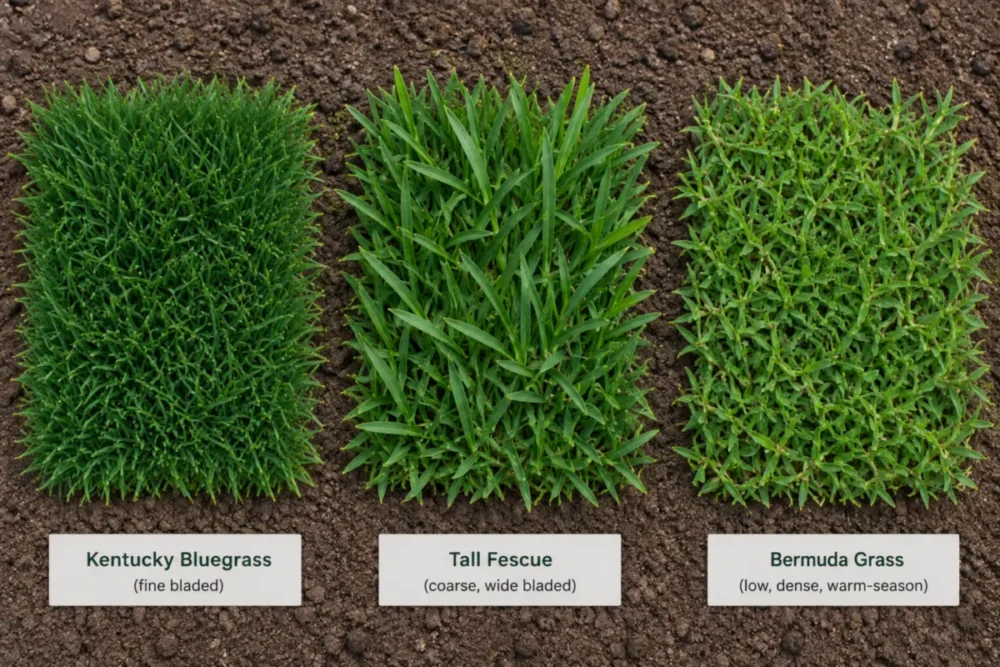
Your grass type decides your season, so check it before anything else. If you are unsure which you have, our guide to cool-season vs. warm-season grass explains how to tell them apart.
| Grass | Type | When to seed | Temperature cue |
|---|---|---|---|
| Tall fescue | Cool-season | Late summer to early fall | Air about 68–77°F; soil above 60°F |
| Kentucky bluegrass | Cool-season | Late summer to early fall | Air about 60–75°F |
| Perennial ryegrass | Cool-season | Late summer to early fall | Air about 60–75°F |
| Bermuda grass | Warm-season | Late spring to early summer | Soil at least 65°F |
The temperature cues come from NC State for tall fescue,5 Nebraska Extension for the cool-season air range4 and Oklahoma State University for Bermuda grass, whose seed does not germinate until the soil reaches about 65°F.6 Oklahoma State gives May 1 to June 15 as the optimum Bermuda seeding window there.
The temperatures that actually matter
Calendar dates are a proxy for temperature. Nebraska Extension says cool-season seed does best when air temperatures run about 60–75°F, and warns that above 80°F seed is more likely to fail.4 For tall fescue, NC State puts the optimum at 68–77°F air and soil above 60°F, with germination in 10 to 21 days when the seedbed stays moist.5
That gives you two practical tests. Too early: daytime highs are still in the mid-80s or above, so wait a week. Too late: you are past the date in Table 1 for your area, or past the 10% first-frost date for your ZIP. In between, earlier is better.
How much seed to buy for overseeding
Overseeding needs less seed than starting a lawn, because the existing grass already covers part of the ground. Nebraska Extension gives these rates:4
- Tall fescue: 3–4 lb per 1,000 sq ft for overseeding (5–8 lb for a new lawn).
- Kentucky bluegrass: about 2 lb per 1,000 sq ft for overseeding (1–3 lb for a new lawn).
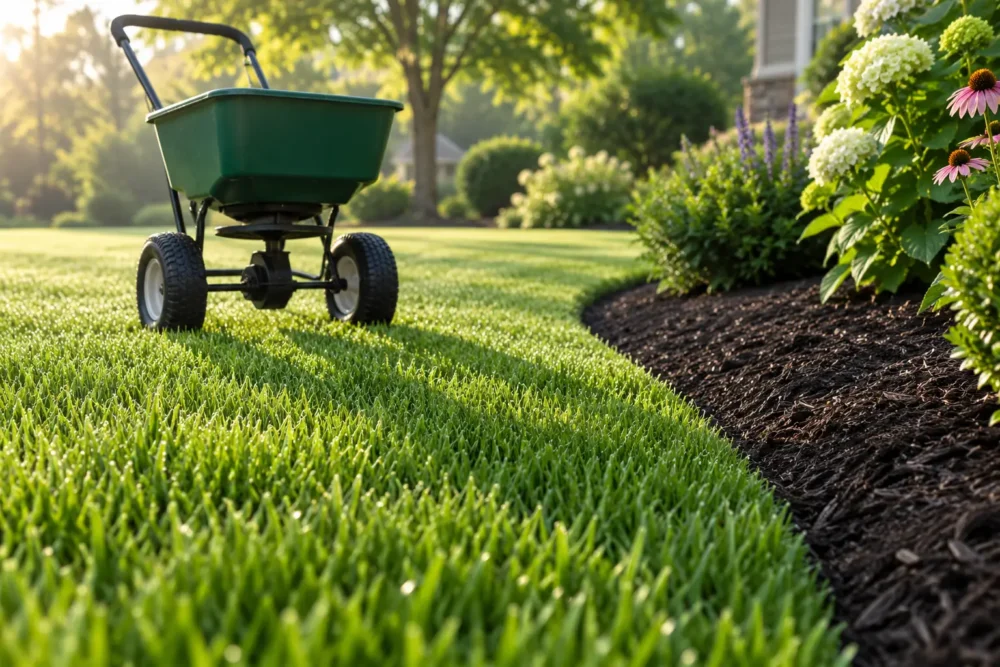
Measure the lawn area only: multiply length by width, then subtract beds, patios and the house footprint.
A 5,000 sq ft tall fescue lawn in Columbus, Ohio
- Scenario
- Thin, patchy turf after a hot summer. NOAA normals put the median hard freeze near Columbus on Nov 3, so the last safe day to overseed is about Sep 19, or Sep 9 with extra margin.
- Math
- 5,000 sq ft ÷ 1,000 = 5 units. 5 × 3–4 lb = 15–20 lb of tall fescue seed.
- Answer
- Buy a 20 lb bag and seed in the first half of September, which keeps you inside both the extension window and the extra-margin date.
How to overseed, step by step
Mow short and clear the debris
Mow lower than usual and bag the clippings so seed can reach the soil. Rake out dead grass and loose thatch. If insects caused the dead patches, read when to apply grub control before you reseed.
Core-aerate compacted or thatchy lawns
Hard, compacted soil and thick thatch keep seed from touching soil. Core aeration fixes both; leave the plugs to break down on their own. Our guide to when to aerate your lawn has the timing for your grass type.
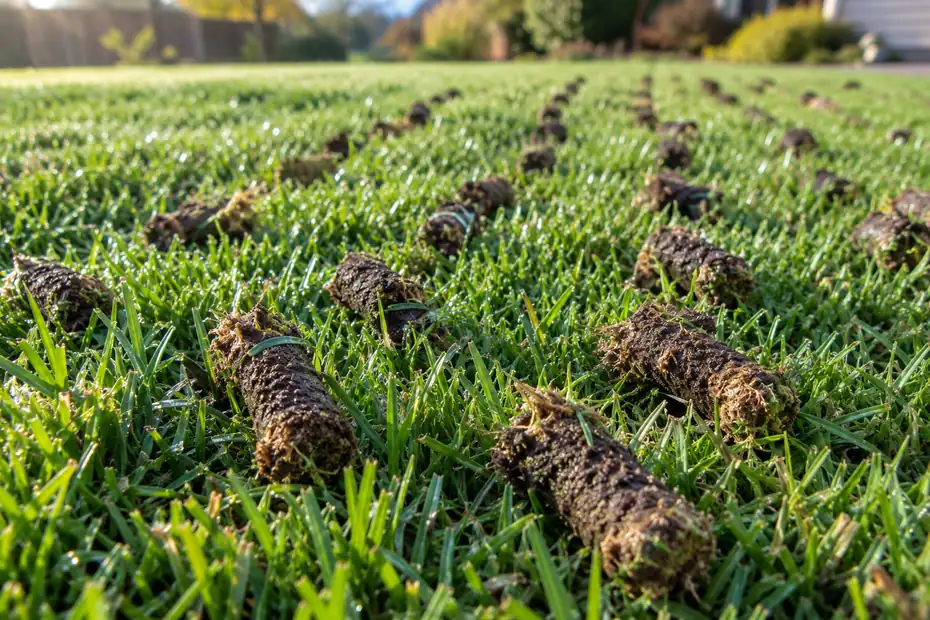
Core aeration leaves plugs on the surface and opens holes where seed can lodge. Spread seed in two directions
Purdue recommends a drop spreader set low: sow half the seed in one direction, then the other half at right angles to the first.2 This avoids the stripes a single pass leaves.
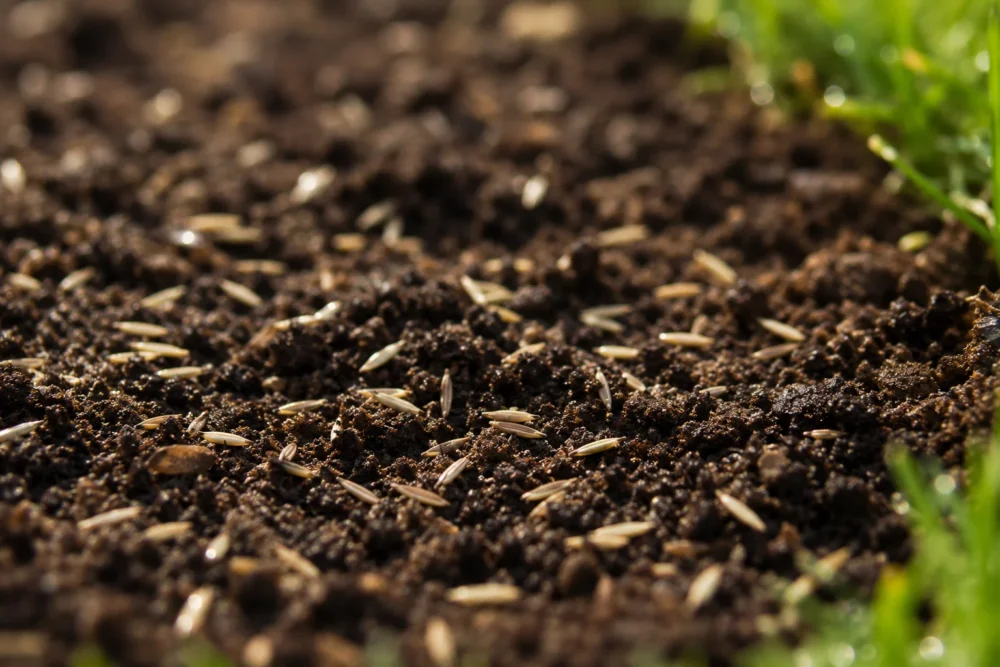
Seed needs firm contact with bare soil to germinate. Rake lightly and firm the seed in
Rake gently so seed settles into the soil, then roll lightly. Purdue suggests an empty lawn roller; seed-to-soil contact is what speeds germination.2
Feed based on a soil test
A soil test tells you whether the lawn needs phosphorus or lime; our guide to when to fertilize a lawn covers the feedings that follow. If it does, a starter fertilizer at seeding helps young roots. Purdue then suggests 0.75–1.0 lb of nitrogen per 1,000 sq ft four to six weeks after germination, and again at eight to ten weeks.2
Keep the top inch moist
Water two to four times a day, depending on the weather, to keep the top 0.5–1 inch of soil moist without puddling. Once seedlings reach about 2 inches, water less often and more deeply, working toward the schedule in our guide to how much to water a lawn.2
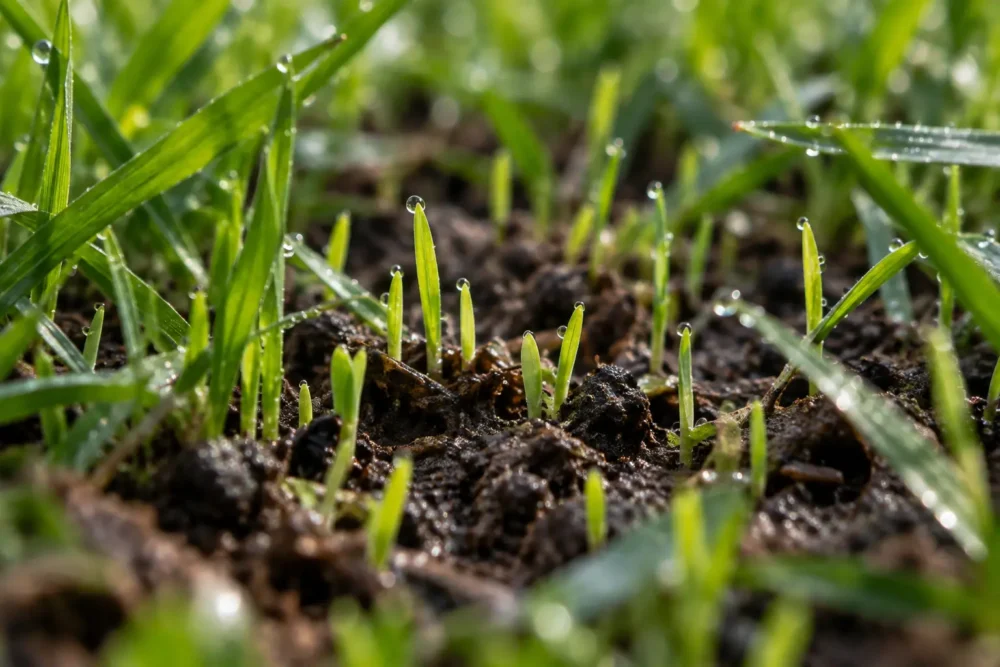
Seedlings need constant moisture until they are about 2 inches tall. Start mowing early
Mow as soon as the first seedlings are tall enough to cut, at about 2 inches for tall fescue and 1.5 inches for the other cool-season grasses. Then raise the mower to your normal height, and never remove more than a third of the blade at once.2
Mistakes that waste seed
- Seeding after your cut-off date. Late seedlings go into winter with few roots and thin out by spring.
- Letting the seedbed dry out. A single hot, dry afternoon can kill germinating seed.
- Using weed control too soon. Purdue advises waiting until new seedlings have been mowed at least three times before using a broadleaf herbicide.2 Pre-emergent crabgrass products stop grass seed too; the label says how long to wait.
Our weed control guides explain how to time crabgrass and broadleaf products around a new seeding.
If you missed the window this year
You have two options. In the North, you can also sow seed on cold, unfrozen soil in late fall or winter, too late for it to sprout until spring; this is called dormant seeding. The seed sits idle until spring, and freeze-thaw cracks work it into the soil. Purdue says dormant seeding can be done from about Thanksgiving to March in Indiana and Illinois, and works best in colder northern areas, where seed won’t sprout during a warm spell and then freeze.2 Otherwise, wait for next late summer and put the date in your calendar now.
For the rest of the year’s lawn work, see our lawn care guides, the seeding section and our fertilizing guides. The methodology page explains exactly how every frost date on this site is calculated, and the climate section holds the data behind it.
Frequently asked questions
Seed scattered onto thatch or hard soil rarely takes, because it never touches soil and dries out. Mow short, rake out debris or core-aerate, then rake the seed in lightly and keep it moist until it sprouts.
It depends on where you live. Mid-October is still inside the window in Philadelphia, New York and Seattle, but well past it in Minneapolis, Madison and Denver. Compare today with the last safe day for your ZIP; if you have missed it, consider dormant seeding or wait for late summer.
Not if the worst heat has passed. Nebraska Extension notes that cool-season seed is more likely to fail when air temperatures run above 80°F. Once highs settle below the mid-80s, earlier in the window is better.
Only if thatch or compacted soil keeps seed from reaching the ground. The goal is seed-to-soil contact; core aeration and firm raking are the usual ways to get it.
Tall fescue usually germinates in 10 to 21 days when the seedbed stays moist and the soil is warm enough, according to NC State Extension. Cooler soil late in the season slows it down.
As soon as the first seedlings are tall enough to cut. Purdue suggests starting at about 2 inches for tall fescue and 1.5 inches for other cool-season grasses, then raising the mower to your usual height.
Sources
- 1.U.S. Climate Normals 1991–2020. NOAA National Centers for Environmental Information, 2021. Used for: frost and hard-freeze dates for every ZIP and city Back to text
- 2.Establishing Turfgrass Areas From Seed (AY-3-W). Purdue Extension and University of Illinois Extension, 2006. Used for: seeding windows, method, watering, mowing, fertilizing, dormant seeding Back to text
- 3.Choose the right grass seed for a thriving lawn. University of Illinois Extension, 2020. Used for: the 45-day rule Back to text
- 4.Overseeding in the Fall. Nebraska Extension, 2024. Used for: Nebraska windows, overseeding rates, air temperatures Back to text
- 5.Time for Fall Seeding of Tall Fescue. NC State Extension (TurfFiles), 2025. Used for: North Carolina deadline, tall fescue germination Back to text
- 6.Choosing, Establishing, and Managing Bermudagrass Varieties in Oklahoma (PSS-2583). Oklahoma State University Extension, 2017. Used for: Bermuda grass germination temperature and seeding window Back to text
- 7.Overseeding a Lawn. Iowa State University Extension and Outreach, 2026. Used for: Iowa overseeding window (validation table) Back to text
How this guide was made
- Written by the Yard & Garden Desk and reviewed by the Data & Methodology Desk.
- Data: frost and hard-freeze dates from NOAA NCEI U.S. Climate Normals 1991–2020 for the station nearest each ZIP code; seeding windows, rates and care steps from Purdue, Illinois, Nebraska, Iowa State, NC State and Oklahoma State extension publications. See our methodology.
- AI use: AI tools help us research, draft and check this guide. Every figure is checked against the source cited for it, and calculated figures come from our own code, described on the methodology page.
- Spotted an error? Tell us — the form opens with this page’s address filled in.
Change log
- Oct 4, 2026Re-checked against today’s search results and sources. Added Iowa State Extension’s window to the validation table; the Illinois quote is now attributed to the Extension release itself rather than to a named specialist, and both quotes are now exact single sentences; table headers shortened for phones; links added to our pre-emergent, watering and grass-type guides.
- Oct 3, 2026Rewritten from verified sources. Cut-off dates for 21 cities computed from NOAA 1991–2020 normals and checked against Nebraska, Purdue and NC State windows; seeding rates corrected to Nebraska Extension’s overseeding rates.
- Oct 2, 2026Published.
Covers lawns, gardens, frost and planting. We write the guides and maintain the tools that tell you when to seed, feed and plant for your ZIP.
Keep reading
How Long Does Grass Seed Take to Grow? Germination Days by Grass and Season
Most lawn grass seed germinates in 3 to 30 days, from about a week for ryegrass to a month for Kentucky bluegrass and Bermuda grass. NOAA’s measured soil temperatures show why early-fall seed comes up so much faster than spring seed.
When to Plant Grass Seed in Spring: Soil Temperature Dates Where You Live
Get cool-season seed down before the top 2 inches of soil reach 50°F, and wait for 65°F soil for Bermuda grass. Typical dates for 48 US cities from NOAA’s measured soil temperatures and climate normals.
Dormant Seeding Your Lawn: When to Start Where You Live
Dormant seed a cool-season lawn once normal afternoon highs fall below about 40°F, and stop when they climb back. Winter windows for 23 Northern US cities from NOAA normals, checked against extension advice.
Seasonal reminders for your ZIP
Get a short email when it’s time to overseed, start seeds, open the pool or service your furnace — timed to your climate.