




How Much to Water Your Lawn, and How Much Your Rain Already Covers
About an inch a week, rain included. Here is how often to water, how long to run your sprinkler, and how much of the job normal summer rain already does where you live.
- Last reviewed Oct 4, 2026
- 8 cited sources
- 4 min read
- 1Most lawns need about 1 inch of water a week while growing, rain included (NC State); Purdue says 1 to 1½ inches in Indiana.
- 2Water when grass turns blue-green and footprints stay, in one soaking or two waterings 3–4 days apart, not on a fixed schedule.
- 3Normal July rain gives a typical US ZIP about 0.9 inch a week: almost none in Los Angeles, about 1.8 in Tampa.
- 4Time your sprinkler with the can test, and water between 4 and 8 a.m.
Most lawns need about 1 inch of water a week during the growing season, rain included.2 How much of that you supply depends on where you live: in a typical US ZIP code, normal July rain gives about 0.9 inch a week, but in Los Angeles or Las Vegas it gives almost none, and in Tampa nearly twice the need.5
How much water a lawn needs
NC State Extension’s rule of thumb is about 1 inch of water per week while grass is growing.2 Purdue Extension puts Indiana lawns at 1 to 1½ inches a week, depending on weather, soil type and slope.1 On Florida’s sandy soils, UF/IFAS recommends ½ to ¾ inch each time you water, and says that amount should stay the same all year while the number of waterings changes with the season.3
Soil changes how you split the water more than how much the lawn needs. In Washington State University’s lawn watering guide, about 1 inch per watering refills the root zone in silt, loam and clay soils, while sandy soils hold less and do better with about ½ inch at a time, more often.8 On clay and slopes, apply it in short rounds so it soaks in rather than running off (see below).
Wet the soil to the depth of the roots, then stop. Purdue warns that light, daily watering encourages shallow roots and crabgrass, and that overwatering can do more damage than drought.1
How much of that your rain already covers
To see how much is left for the sprinkler, we divided NOAA’s 1991–2020 monthly rainfall normals into weeks for the weather station nearest each of 40,904 US ZIP codes.5 In July, the median ZIP code gets 0.90 inch of rain a week. Only one ZIP code in three averages 1 inch or more, and in 42% every summer month from June to August falls short.
| City | June | July | August | July shortfall |
|---|---|---|---|---|
| Los Angeles, CA | 0.02 in | 0.00 in | 0.00 in | 1.00 in |
| Phoenix, AZ | 0.00 in | 0.20 in | 0.20 in | 0.80 in |
| Dallas, TX | 0.89 in | 0.38 in | 0.50 in | 0.62 in |
| Denver, CO | 0.40 in | 0.43 in | 0.41 in | 0.57 in |
| Chicago, IL | 0.93 in | 0.79 in | 0.90 in | 0.21 in |
| Indianapolis, IN | 1.26 in | 0.88 in | 0.81 in | 0.12 in |
| New York, NY | 1.05 in | 1.04 in | 1.04 in | none |
| Atlanta, GA | 0.89 in | 1.13 in | 0.90 in | none |
| Tampa, FL | 1.73 in | 1.76 in | 2.03 in | none |
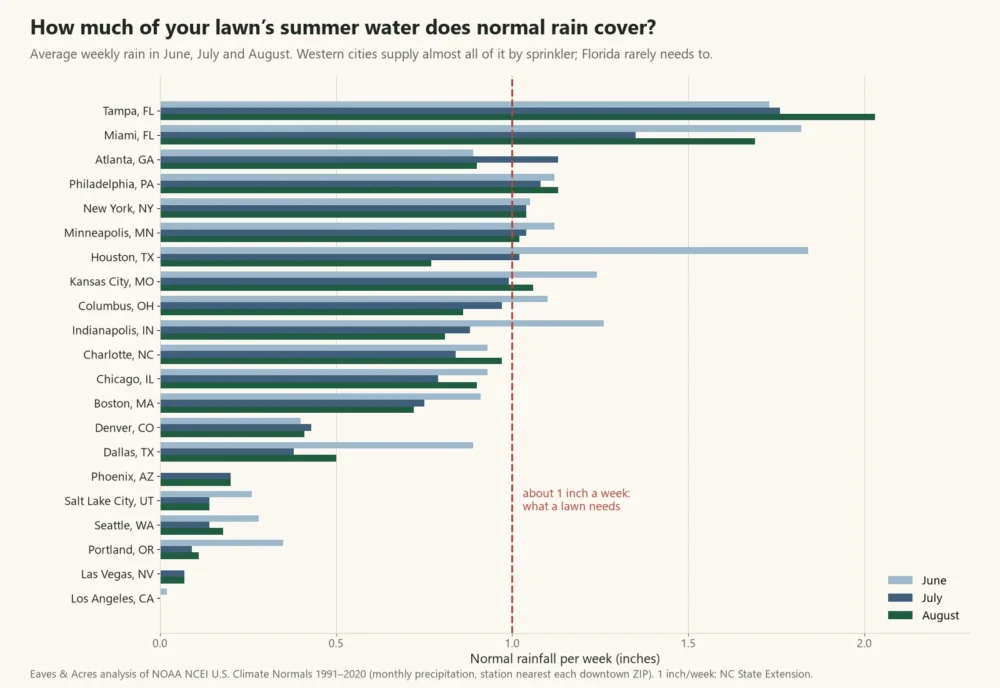
These are averages. Real rain arrives in storms, so even where July averages an inch, a dry fortnight can stress a lawn. Use the numbers to set expectations, and let the grass tell you when to water.
How often to water
Water when the lawn asks for it, not on a calendar.
Turf should not be watered by a set schedule.
The first signs of thirst are a blue-green color and footprints that stay visible after you walk across the lawn; Purdue says to water at that point.1 UF/IFAS adds leaf blades folded in half lengthwise.3 Give the week’s water in one thorough soaking, or in two equal waterings three to four days apart.1 If you have an automatic system, change its program through the season instead of leaving one setting all summer.1,3
How long to run your sprinkler
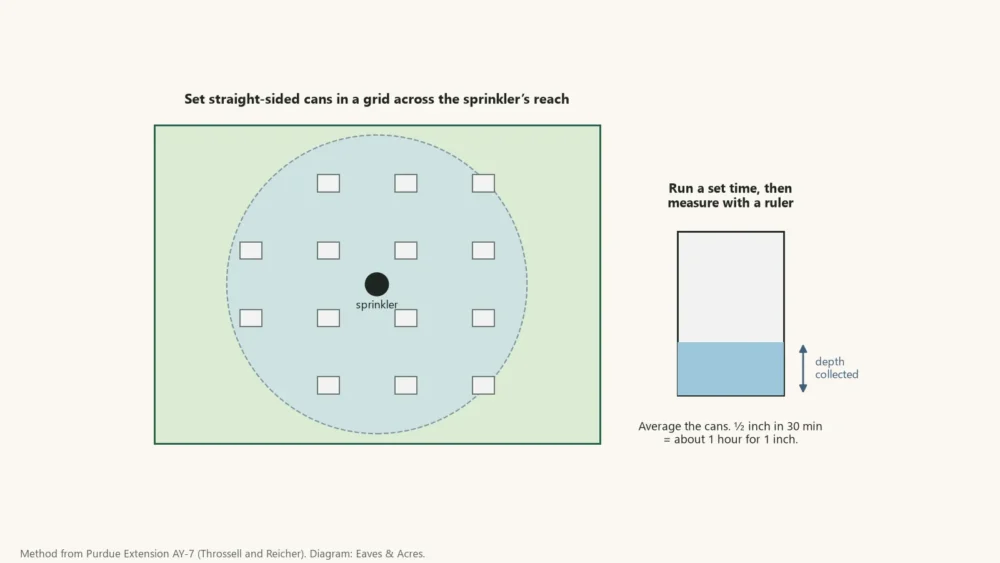
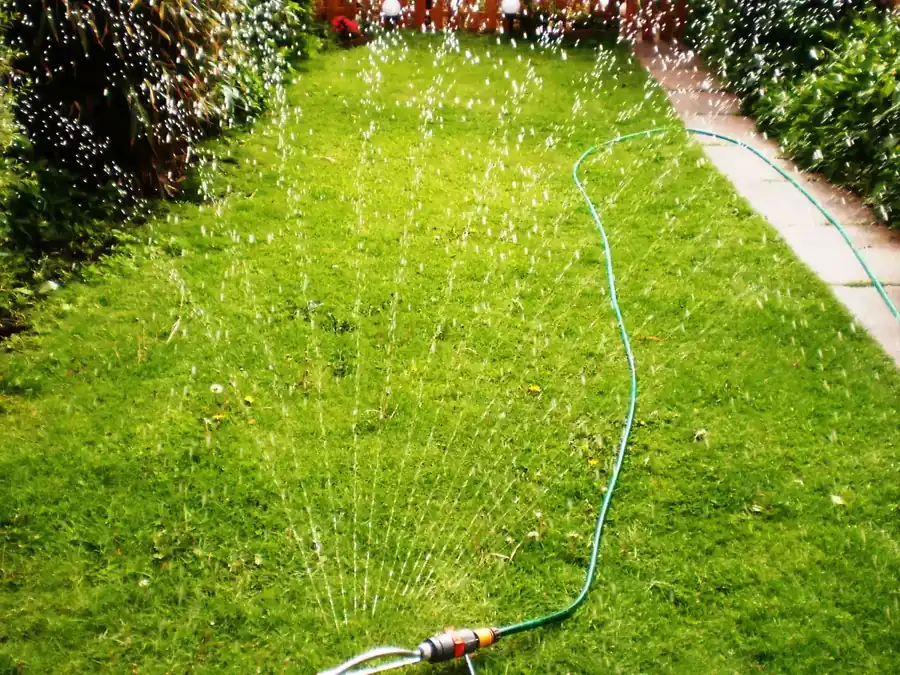
Run time depends entirely on the sprinkler. Purdue’s guide says spray-head systems can apply a large volume in 10 to 15 minutes, rotary heads need 30 to 40 minutes, and most hose-end sprinklers need two to three hours in one spot.1 To find your own number, set straight-sided cans such as tuna cans in a grid, run the sprinkler for a set time and measure the water in each with a ruler.1
The best time of day to water
Purdue rates 4 to 8 a.m. as ideal: water pressure is high, wind is low and little is lost to evaporation. Late morning is second best. Midday watering wastes much of the water, and evening watering can raise disease risk.1 Losses add up:
As much as 50 percent of the water we use outdoors is lost
EPA blames wind, evaporation and runoff from inefficient watering, and notes that outdoor use is more than 30% of household water on average, up to 60% in dry regions.4
Slopes, compacted soil and dry spells
On slopes and compacted spots, water until it just starts to run off, let it soak in, and repeat until the soil is wet about 6 inches down.1 Relieving compaction helps too; see when to aerate your lawn.
If you stop watering in a long drought, the lawn turns brown and goes dormant rather than dying. Purdue says turf can survive four to six weeks dormant; after that, give it 1 to 1½ inches in one thorough watering.1
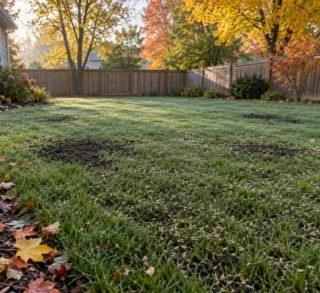 Related guideWhen to Overseed Your Lawn: The Last Safe Day Where You Live
Watering new seed, fertilizer and weed preventer
New seed needs light, frequent watering to keep the surface moist, which is the opposite of the routine above; our overseeding guide covers it. Granular fertilizer and crabgrass pre-emergent need watering in after you apply them; see when to fertilize your lawn and when to apply pre-emergent. Not sure whether you have cool- or warm-season grass? Our guide to cool-season vs warm-season grass explains how to tell. The lawn section has the rest of the year’s timing.
Frequently asked questions
It depends on the sprinkler. Purdue says spray-head systems can apply enough in 10–15 minutes, rotary heads need 30–40 minutes and hose-end sprinklers two to three hours. Use the can test to check yours.
There is no single answer: set cans in a grid, run the sprinkler 30 minutes and measure. If they average ½ inch, an hour gives about 1 inch.
Not if the water soaks in. Purdue says rotary heads typically need 30–40 minutes and hose-end sprinklers two to three hours. If water starts running off sooner, as on clay or a slope, stop, let it soak in, then finish the rest.
Usually not. Purdue recommends one thorough soaking a week, or two equal waterings three to four days apart, given when the lawn shows thirst.
Yes. Purdue lists more crabgrass, more disease and shallow roots among the results, and says it is better to err on the dry side.
Yes. The lawn needs about an inch of water from any source, so subtract what fell; a rain gauge or a straight-sided can on the lawn measures it.
Sources
- 1.Irrigation Practices for Homelawns (AY-7), Clark Throssell and Zac Reicher. Purdue University Cooperative Extension Service, 1998. Used for: 1–1½ inches a week in Indiana, signs of thirst, frequency, run times, can test, time of day, slopes, dormancy Back to text
- 2.AG-527 Landscape Management Calendar. NC State Extension, 2021. Used for: about 1 inch of water per week during the growing season Back to text
- 3.Watering Your Florida Lawn (LH025), Laurie E. Trenholm, J. Bryan Unruh and John L. Cisar. UF/IFAS Extension, 2022. Used for: ½–¾ inch per watering on sandy soil, seasonal frequency, folded leaf blades Back to text
- 4.Statistics and Facts. U.S. Environmental Protection Agency, WaterSense, 2026. Used for: outdoor water use and losses Back to text
- 5.U.S. Climate Normals 1991–2020. NOAA National Centers for Environmental Information, 2021. Used for: monthly rainfall normals for every ZIP code Back to text
- 6.Lawn Irrigation Ann Arbor Township Michigan (photo). Dwight Burdette, Wikimedia Commons, CC BY 3.0, accessed 2026. Used for: hero photo, cropped and resized
- 7.Oscillating Sprinkler (photo). steve p2008, Wikimedia Commons, CC BY 2.0, accessed 2026. Used for: photo, cropped and resized
- 8.Watering Lawns in Washington to Save Water, Save Money, and Have a Healthy, Green Lawn (FS362E), Troy Peters. Washington State University Extension, 2021. Used for: about 1 inch per watering on silt, loam and clay; about ½ inch, more often, on sand Back to text


How this guide was made
- Written by the Yard & Garden Desk and reviewed by the Data & Methodology Desk.
- Data: weekly rainfall is the NOAA NCEI 1991–2020 monthly normal for the station nearest each ZIP divided into weeks; the 1-inch weekly need is NC State Extension’s guideline. Rain varies from year to year and arrives in storms. See our methodology.
- AI use: AI tools help us research, draft and check this guide. Every figure is checked against the source cited for it, and calculated figures come from our own code, described on the methodology page.
- Spotted an error? Tell us — the form opens with this page’s address filled in.
Change log
- Oct 4, 2026Re-checked against today’s search results and sources (Purdue AY-7 PDF, UF/IFAS, EPA WaterSense). Added how soil type changes the amount per watering (Washington State University) and a FAQ on 45-minute run times.
- Oct 3, 2026Published. Watering amounts, frequency, timing and run times from Purdue AY-7, NC State AG-527 and UF/IFAS LH025; water-loss figures from EPA WaterSense; weekly summer rainfall for 40,904 ZIP codes from NOAA 1991–2020 normals.
Covers lawns, gardens, frost and planting. We write the guides and maintain the tools that tell you when to seed, feed and plant for your ZIP.
Keep reading
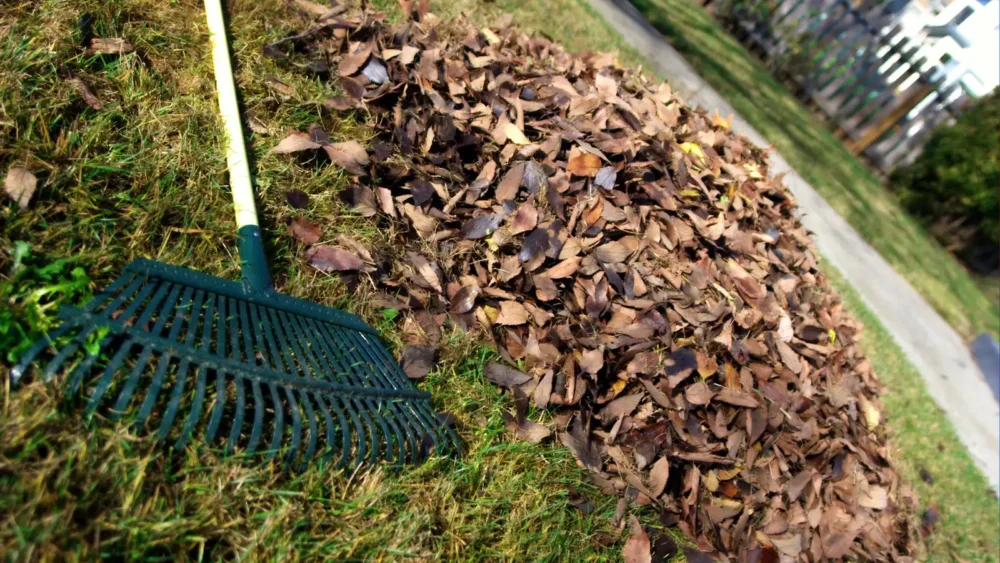
Should You Rake Leaves? When to Mulch, Rake or Leave Them
Usually not. Mow a light or moderate layer of leaves into the lawn until your last mow, and remove only what hides the grass. Extension thresholds, the research, and leaf deadlines for 20 US cities from NOAA normals.
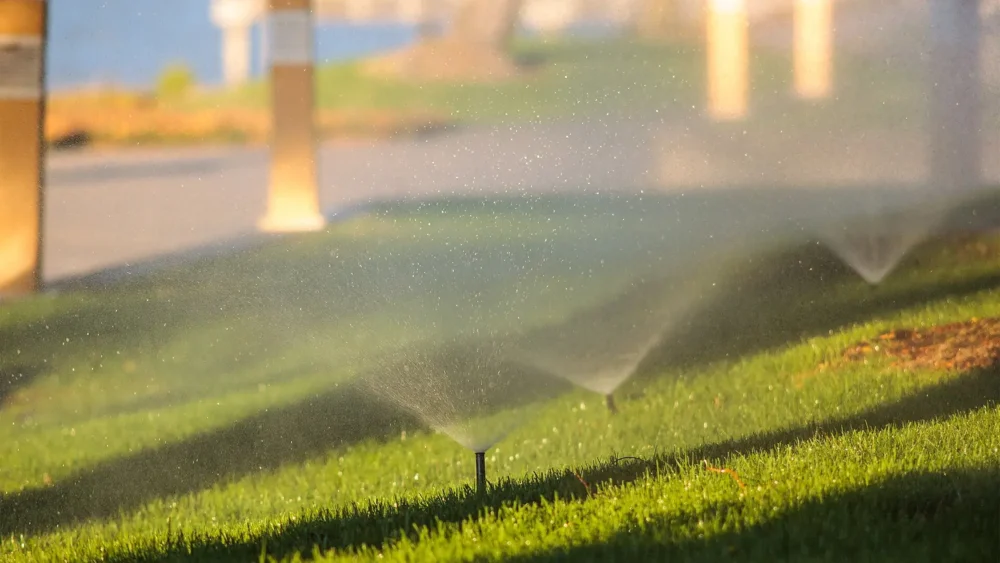
When to Winterize Your Sprinkler System: Freeze Dates Where You Live
Drain a sprinkler system before the first fall freeze and no later than the first 28°F hard freeze. Normal-year freeze dates for 31 US cities from NOAA, the three drain methods and backflow protection.
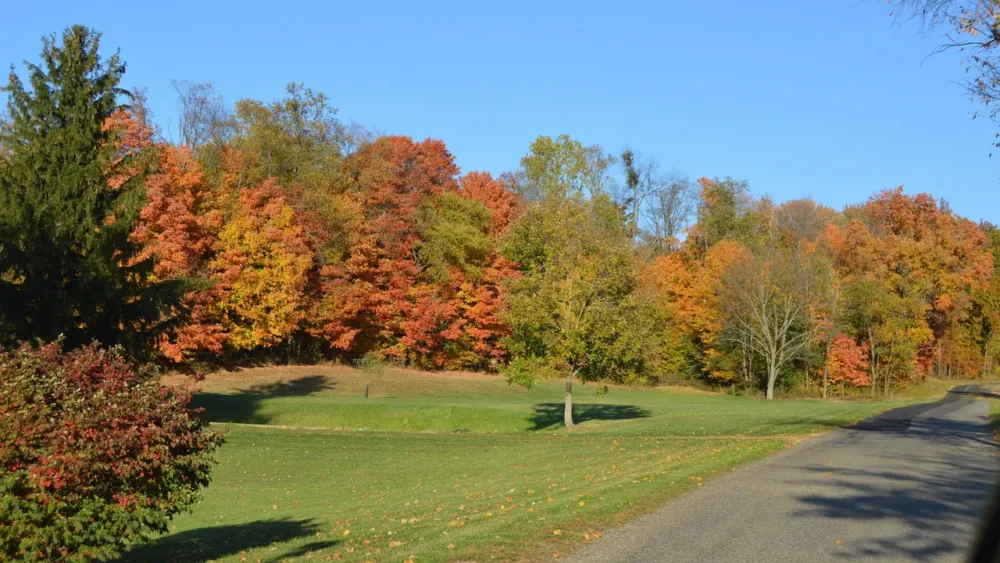
When to Stop Mowing Your Lawn in Fall: The Last Mow Where You Live
Cool-season lawns stop growing when daytime highs stay below about 50°F; warm-season lawns stop at the first frost. Normal-year dates for 40 US cities, checked against extension advice.
Seasonal reminders for your ZIP
Get a short email when it’s time to overseed, start seeds, open the pool or service your furnace — timed to your climate.