




Should You Rake Leaves? When to Mulch, Rake or Leave Them
Most lawns don’t need raking. Here is how much leaf cover the grass can take, what the research found about mowing leaves in, and when your leaf season really ends in 20 US cities, from NOAA climate normals.
- Last reviewed Oct 13, 2026
- 13 cited sources
- 6 min read
Set your ZIP to see dates for your area.
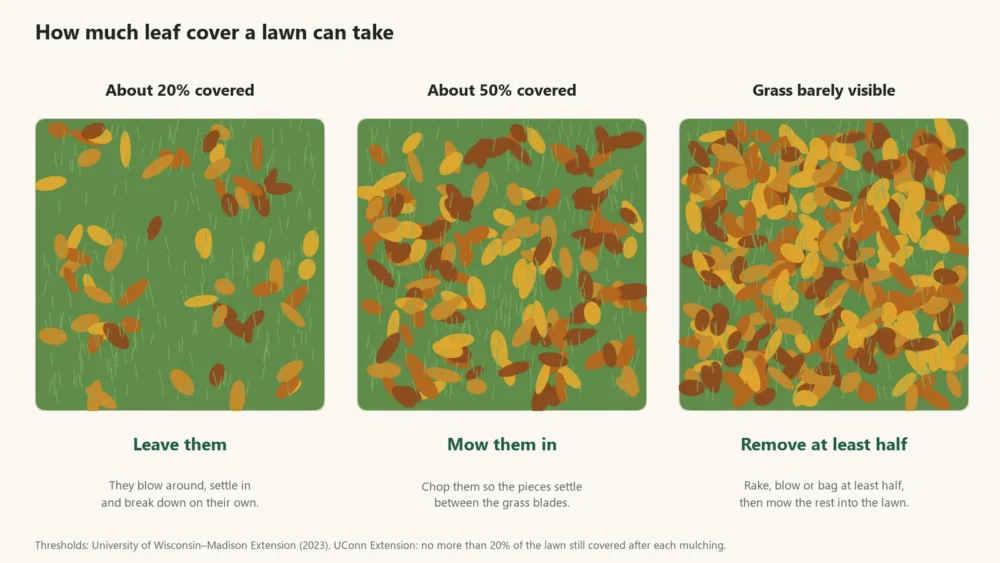
- 1You rarely need to rake. Wisconsin Extension says to leave about 20% leaf cover alone, mow in about 50%, and remove at least half only when you can barely see the grass.
- 2Mowing leaves into a lawn doesn’t add thatch or disease or change soil pH, in research Purdue summarized. In a Michigan State study, fewer dandelions after one application disappeared after a second.
- 3Leaves smother grass when they block sunlight. A thick layer left over winter can encourage snow mold and slow spring green-up, UConn Extension says.
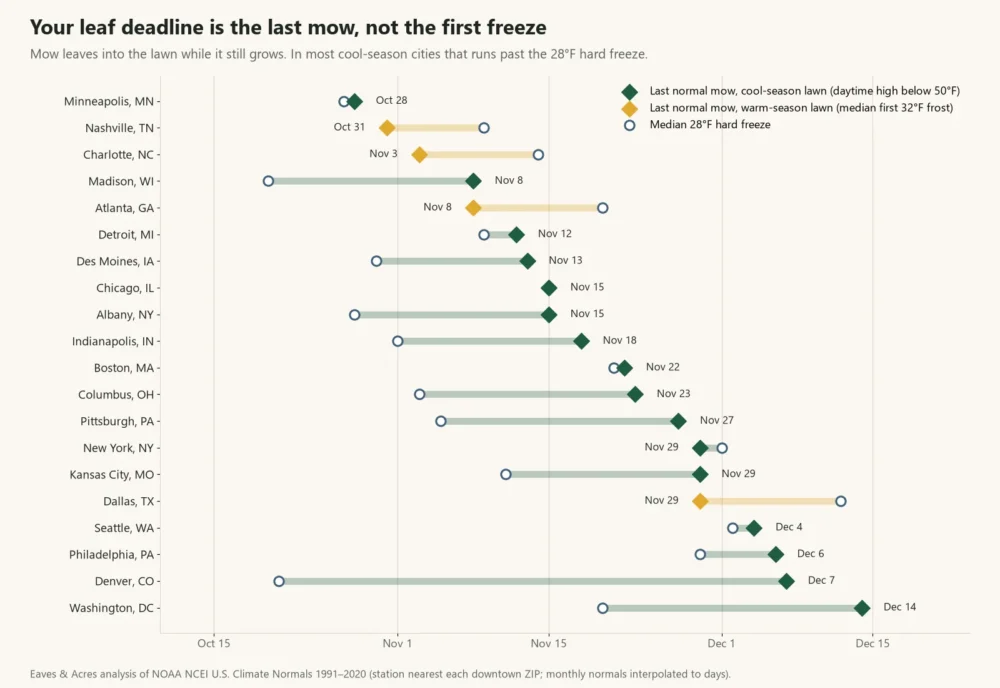
- 4Your deadline is the last mow: about Oct 28 in Minneapolis, Nov 15 in Chicago, Nov 23 in Columbus and Dec 6 in Philadelphia. In 96.6% of ZIP codes where that 50°F rule applies, it comes after the 28°F hard freeze.
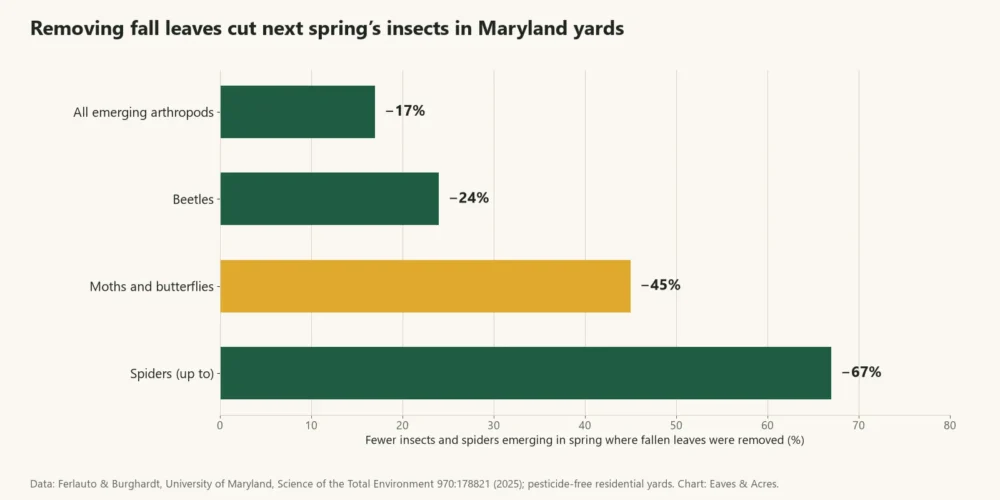
- 5Leave whole leaves in beds, not on the lawn. In Maryland yards, removing fall leaves cut the next spring’s moths and butterflies by 45%.
You usually don’t need to rake leaves off your lawn. Mow a light or moderate layer into the grass each time you cut it, and rake or bag only the leaves that would leave a mat. The deadline is your last mow of the season: in a normal year about Oct 28 in Minneapolis, Nov 15 in Chicago and Dec 6 in Philadelphia.
Below: five extension thresholds side by side, what the research found, and the leaf deadline for 20 US cities from NOAA climate normals.
How many leaves can stay on the lawn?
What matters is how much grass the leaves hide:
| Source | Leave them | Mow them in | Remove some first |
|---|---|---|---|
| University of Wisconsin–Madison Extension | About 20% of the lawn covered | About 50% covered | You can barely see the grass: remove at least half, then mow the rest |
| UConn Extension | — | No more than 20% of the lawn still covered after each mulching | The chopped layer is too thick for sunlight to get through |
| Penn State Extension | — | A shredded layer up to about ½ inch deep | — |
| Purdue University | — | A moderate number of leaves | So many you can’t see the turf |
| Nebraska Extension | — | Up to 6 inches at a time, depending on the mower: a mulching mower, or 2–3 passes with a regular one | A lot of leaves: alternate bagging and mulching |
The common test: after you mow, you should see grass, with the leaf bits settled between the blades.4,6 For a thick layer, Wisconsin’s horticulture educator is specific:
Rake or otherwise remove at least half of them.
What research says about mowing leaves into grass
Purdue turfgrass specialist Aaron Patton summarized research at Purdue and other universities: oak and maple leaves can be mulched into a lawn without harming the soil or grass, and they don’t change soil pH.2
Mulching leaves into the turf will not increase thatch or disease.
Many articles say mulched leaves sharply cut dandelions and crabgrass. Earlier research found fewer dandelions in turf kept at a low maintenance level to encourage weeds, so a Michigan State follow-up study tested properly maintained turf in East Lansing. One fall application of maple leaves cut dandelions by up to 84% the next year, but after a second application there was no measurable effect. Crabgrass tracked mowing height: the 1.5-inch cut had more of it.3 Treat fewer weeds as a possible bonus.
Leaves also carry nutrients. UConn Extension estimates that mulching in a 2-inch layer of leaves over one fall adds about 3.4 lb of nitrogen per 1,000 sq ft, and says mature lawns that get their leaves back every year may need less fall fertilizer, or none.4 Purdue’s summary found no measurable effect on nutrient availability.2 If you still feed late, see when to apply winterizer fertilizer.
When leaves smother the grass
Purdue says heavy layers can shade out, smother and kill turf.2 UConn explains why fall timing matters:
Sunlight must be able to penetrate through the fallen leaf layer
The harm continues after growth stops. A thick layer left over winter can encourage snow mold, which may thin or kill the turf, and leaves still there in spring slow green-up, so UConn advises an early spring cleanup.4 Arkansas Extension adds that heavy leaf cover can make spring damage from voles and mice worse.10
Your leaf deadline is the last mow
Mulching only works while you are still mowing. Penn State advises starting before all the leaves have fallen, while they are dry and not piled thickly.5 So the deadline is your last mow, worked out the same way as in our guide to when to stop mowing your lawn. Cool-season grass stops growing when daytime highs stay below about 50°F (Iowa State).11 Warm-season grass stops when the first frost starts its dormancy (Mississippi State).12
| City (ZIP) | Last normal mow | Median first frost (32°F) | Median hard freeze (28°F) |
|---|---|---|---|
| Minneapolis, MN (55401) | Oct 28 | Oct 16 | Oct 27 |
| Nashville, TN (37201) (warm-season) | Oct 31 | Oct 31 | Nov 9 |
| Charlotte, NC (28202) (warm-season) | Nov 3 | Nov 3 | Nov 14 |
| Madison, WI (53703) | Nov 8 | Oct 9 | Oct 20 |
| Atlanta, GA (30303) (warm-season) | Nov 8 | Nov 8 | Nov 20 |
| Detroit, MI (48201) | Nov 12 | Oct 31 | Nov 9 |
| Des Moines, IA (50309) | Nov 13 | Oct 20 | Oct 30 |
| Chicago, IL (60601) | Nov 15 | Nov 5 | Nov 15 |
| Albany, NY (12207) | Nov 15 | Oct 15 | Oct 28 |
| Indianapolis, IN (46204) | Nov 18 | Oct 21 | Nov 1 |
| Boston, MA (02108) | Nov 22 | Nov 9 | Nov 21 |
| Columbus, OH (43215) | Nov 23 | Oct 24 | Nov 3 |
| Pittsburgh, PA (15222) | Nov 27 | Oct 27 | Nov 5 |
| New York, NY (10001) | Nov 29 | Nov 20 | Dec 1 |
| Kansas City, MO (64105) | Nov 29 | Nov 2 | Nov 11 |
| Dallas, TX (75201) (warm-season) | Nov 29 | Nov 29 | Dec 12 |
| Seattle, WA (98101) | Dec 4 | Nov 17 | Dec 2 |
| Philadelphia, PA (19103) | Dec 6 | Nov 17 | Nov 29 |
| Denver, CO (80202) | Dec 7 | Oct 12 | Oct 21 |
| Washington, DC (20001) | Dec 14 | Nov 8 | Nov 20 |
A freeze doesn’t end leaf season on a cool-season lawn. Across 27,469 ZIP codes in the lower 48 states where both dates occur, the normal daytime high falls below 50°F after the median 28°F freeze in 96.6% of them, a median of 22 days later.1 For any other ZIP code, look up your frost and freeze dates; our methodology page explains the calculation.
Leaves that fall later land on grass that has stopped growing. If they cover more than a light scatter, bag them with the mower or move them to beds before winter, including on a dormant warm-season lawn.4
“Leave the leaves” belongs in the beds
The wildlife case comes from real yards. University of Maryland entomologists removed or kept fallen leaves in pesticide-free Maryland yards and counted what emerged the next spring. In their 2025 study, removing leaves cut emerging arthropods by 17%, moths and butterflies by 45%, beetles by 24% and spiders by up to 67%.8 Its disclosed funding includes the Xerces Society and the National Science Foundation.
That isn’t a case for a mat on the grass. UConn suggests a 4–6-inch layer of leaves around plants in beds, kept 6 inches from each crown.4 Arkansas suggests piling raked leaves in an out-of-the-way spot as habitat.10 Penn State warns against dumping extra leaves on a wooded area that already has a leaf layer used by firefly larvae, amphibians and small mammals.5
When to bag leaves or send them away
- Diseased leaves. Wisconsin Extension says to remove leaves from trees with serious fungal leaf diseases, since they carry spores into next year.6
- Black walnut. Keep them out of compost and gardens because of juglone, Nebraska Extension says.7
- Pavement. Sweep leaves off driveways and sidewalks; in storm drains they add nitrogen and phosphorus that feed algae, Arkansas Extension warns.10
If leaves leave the yard, compost beats the trash. The EPA estimates that Americans generated 35.4 million tons of yard trimmings (grass, leaves and brush) in 2018; 22.3 million tons were composted or mulched and about 10.5 million went to landfills.9
 Related guideWhen to Stop Mowing Your Lawn in Fall: The Last Mow Where You Live
Your next step
Mow leaves in until your last mow, then clear what’s left. Before dormant seeding thin spots, clear leaves so seed reaches the soil. More in our mowing and watering guides, including the last safe day to overseed.
Frequently asked questions
A light scatter breaks down on its own, and a moderate layer can be mowed in. A thick layer that hides the grass can smother it. Left over winter, it can encourage snow mold and slow spring green-up, UConn Extension says, and Arkansas Extension notes it can make vole and mouse damage worse.
Mow them while you can still see grass, up to about half the lawn covered, Wisconsin Extension says. If the grass is barely visible, rake or bag at least half first, then mow the rest. Nebraska Extension says a mulching mower, or two to three passes with a regular mower, chops them fine enough.
Deal with them as they fall rather than all at once; Penn State says not to wait until all the leaves are down. Finish by your last mow: in a normal year about Nov 12 in Detroit, Nov 18 in Indianapolis, Nov 29 in Kansas City and Dec 14 in Washington, DC.
Not a thick layer. UConn Extension says leaves left on the lawn through late fall and winter can encourage snow mold and slow green-up in spring. A light scatter is fine; move the rest into beds.
Research summarized by Purdue found oak and maple leaves can be mulched into turf without harming the soil or grass, without adding thatch or disease, and without changing soil pH. UConn Extension says mature lawns that get their leaves back each year may need less fall fertilizer.
It takes more frequent mowing and sometimes several passes, and a layer left too thick still blocks sunlight, UConn Extension says. UConn also advises mowing leaves only when the lawn is dry, wearing a dust mask, and notes that ash and maple leaves are harder to mulch than oak.
Over time, yes. Penn State says shredded leaves decay much faster than whole ones, adding organic matter and returning nutrients to the soil. UConn notes research showing mulched leaves raise organic matter at the soil surface without building up thatch.
Besides the work, raking removes habitat. In Maryland yards, removing fallen leaves cut the insects and spiders emerging the next spring by 17% overall and moths and butterflies by 45%. Bagged leaves that go to a landfill join the roughly 10.5 million tons of yard trimmings the EPA counted there in 2018.
Sources
- 1.U.S. Climate Normals 1991–2020. NOAA National Centers for Environmental Information, 2021. Used for: daily maximum temperature normals, first frost and hard-freeze dates for every city and ZIP Back to text
- 2.What To Do With All Those Falling Leaves?, Aaron Patton. Purdue University Turfgrass Science, 2013. Used for: research summary on mulching oak and maple leaves; heavy layers smother turf; no burning Back to text
- 3.Using Cultural Practices and Leaf Mulch to Control Weeds in Established Turfgrass, Alexander R. Kowalewski, Ronald N. Calhoun, Aaron D. Hathaway and John N. Rogers (Applied Turfgrass Science, doi:10.1094/ATS-2010-0416-01-RS). Michigan State University research, record via Crossref, 2010. Used for: dandelion and crabgrass results of mulching maple leaves into turf, East Lansing Back to text
- 4.Leaf Disposal & Mulch Mowing. UConn Extension, Integrated Pest Management Program, 2021. Used for: 20% cover rule, sunlight, snow mold, spring green-up and early spring cleanup, nutrient estimate, leaves in beds, dry mowing Back to text
- 5.Leaves Are Treasure, Not Trash, Annette MaCoy. Penn State Extension, 2025. Used for: ½-inch shredded layer; start before all leaves fall; leaf layers used by wildlife; decay of shredded leaves Back to text
- 6.Leave the Leaves. To rake or not to rake?, Diana Alfuth. University of Wisconsin–Madison Division of Extension, 2023. Used for: 20% / 50% / remove-half thresholds; diseased leaves Back to text
- 7.Don’t Let Leaves Smother the Turf, Elizabeth Exstrom. Nebraska Extension (UNL Water), 2023. Used for: mower passes and 6-inch limit; alternate bagging and mulching; black walnut Back to text
- 8.Removing autumn leaves in residential yards reduces the spring emergence of overwintering insects, Max Ferlauto and Karin T. Burghardt (Science of the Total Environment 970:178821). University of Maryland Department of Entomology, 2025. Used for: effect of leaf removal on spring emergence of arthropods, moths and butterflies, beetles and spiders Back to text
- 9.Yard Trimmings: Material-Specific Data. U.S. Environmental Protection Agency, 2026. Used for: 2018 yard trimmings generated, composted and landfilled Back to text
- 10.Do you really need to rake leaves?. University of Arkansas System Division of Agriculture, Cooperative Extension Service, undated. Used for: voles and mice under heavy leaf cover; habitat piles; storm drains Back to text
- 11.When can I stop mowing the lawn in the fall?. Iowa State University Extension and Outreach, Yard and Garden, 2021. Used for: 50°F daytime-high rule for the last mow Back to text
- 12.Fall Lawn Guide. Mississippi State University Extension, undated. Used for: warm-season grass grows until the first frost starts dormancy Back to text
- 13.Leaf rake and leaves (photo). David Goehring, via Wikimedia Commons, CC BY 2.0, accessed 2026. Used for: hero photo, cropped and resized

How this guide was made
- Written by the Yard & Garden Desk and reviewed by the Data & Methodology Desk.
- Data: leaf deadlines are the last normal mow. For cool-season lawns it is the first fall day the NOAA NCEI 1991–2020 normal daily maximum temperature falls below 50°F at the station nearest each ZIP (monthly normals interpolated to days; Iowa State rule); for warm-season lawns it is the median first 32°F frost (Mississippi State). Hard freeze = the station’s median first 28°F night. Same method as our guide to when to stop mowing. Real years vary by weeks. See our methodology.
- AI use: AI tools help us research, draft and check this guide. Every figure is checked against the source cited for it, and calculated figures come from our own code, described on the methodology page.
- Spotted an error? Tell us — the form opens with this page’s address filled in.
Change log
- Oct 13, 2026Michigan State study wording made exact: the earlier low-maintenance dandelion research is not attributed to Michigan State in the paper, and the abstract ties crabgrass to the 1.5-inch mowing height (it does not report a leaf effect either way). Added UConn’s early spring cleanup advice. Thresholds, quotes, EPA 2018 figures and the 2025 Maryland results re-checked at the source.
- Oct 7, 2026Published. Leaf-cover thresholds from Wisconsin, UConn, Penn State, Purdue and Nebraska Extension; mulching research from Purdue and Michigan State (Kowalewski et al. 2010); wildlife results from the University of Maryland (2025); leaf deadlines for 20 cities from NOAA 1991–2020 normals with the same last-mow method as our stop-mowing guide.
Covers lawns, gardens, frost and planting. We write the guides and maintain the tools that tell you when to seed, feed and plant for your ZIP.
Keep reading
When to Winterize Your Sprinkler System: Freeze Dates Where You Live
Drain a sprinkler system before the first fall freeze and no later than the first 28°F hard freeze. Normal-year freeze dates for 31 US cities from NOAA, the three drain methods and backflow protection.
When to Stop Mowing Your Lawn in Fall: The Last Mow Where You Live
Cool-season lawns stop growing when daytime highs stay below about 50°F; warm-season lawns stop at the first frost. Normal-year dates for 40 US cities, checked against extension advice.
How Much to Water Your Lawn, and How Much Your Rain Already Covers
Most lawns need about 1 inch of water a week, rain included. How often to water, how long to run a sprinkler, and how much normal summer rain covers in 21 US cities.
Seasonal reminders for your ZIP
Get a short email when it’s time to overseed, start seeds, open the pool or service your furnace — timed to your climate.