




When to Apply Winterizer Fertilizer: Dates by City and State Rules
The last feeding of a cool-season lawn goes down when the grass stops growing, which is weeks after the first frost. Here is that date for 17 cities from NOAA normals, the state rules that can end the season first, and why warm-season lawns skip it.
- Last reviewed Oct 7, 2026
- 22 cited sources
- 7 min read
Set your ZIP to see dates for your area.
- 1Cool-season lawns (bluegrass, tall fescue): apply the late-season “winterizer” feeding around the last mowing, while the grass is green but no longer growing.
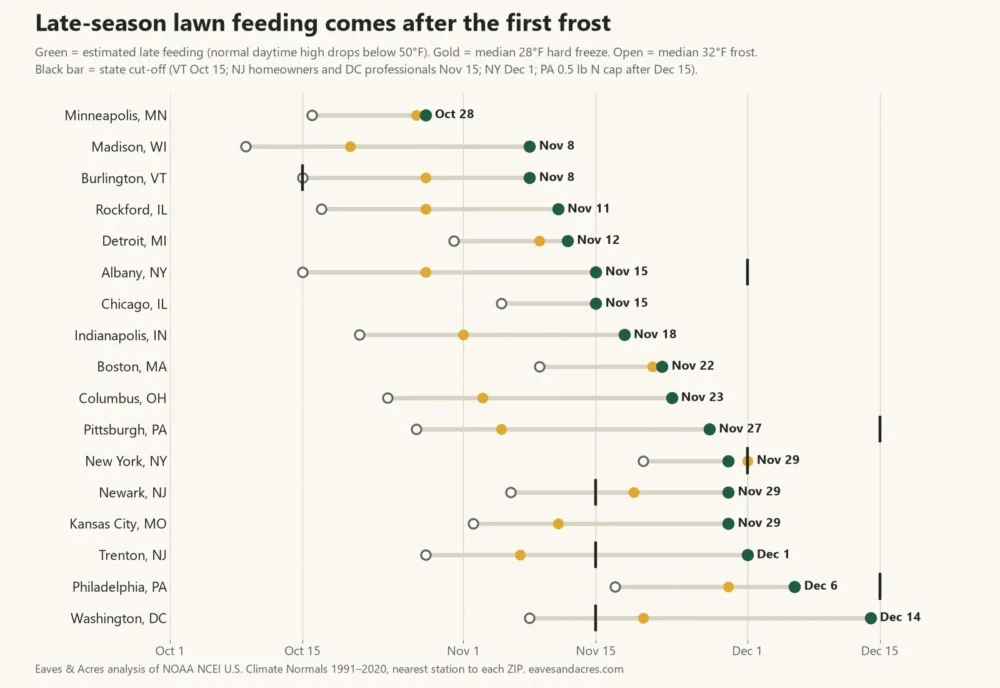
- 2That is about Nov 11 in Rockford, Nov 18 in Indianapolis and Nov 29 in Kansas City in NOAA normals, 9 to 36 days after the median first frost in all 17 cities we checked.
- 3Warm-season lawns (Bermuda grass, zoysia, St. Augustine, centipede) get no late-fall nitrogen; use a potassium-only product only if a soil test calls for it.
- 4Not every extension service still recommends it: Nebraska Extension has dropped the heavy late-fall feeding for thick, established lawns.
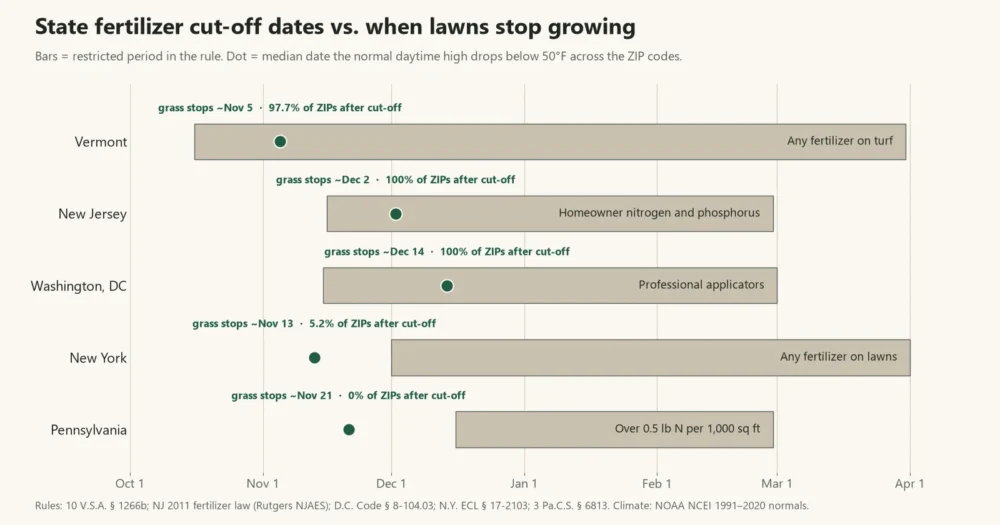
- 5Check your state: New Jersey bans homeowner nitrogen and phosphorus after Nov 15 and before Mar 1, Vermont bans turf fertilizer after Oct 15, and New York bans it Dec 1 to Apr 1.
Apply winterizer fertilizer to a cool-season lawn around the last mowing of the year, when the grass is still green but has stopped growing: usually November in the Midwest and Northeast, and always before your state’s cut-off date. Warm-season lawns (Bermuda grass, zoysia, St. Augustine, centipede) should not get late-fall nitrogen at all.
Below, we estimate that date for 17 cities from NOAA climate normals, check it against two extension calendars, and set it against five state rules that can end the season first.
What “winterizer” means on the bag
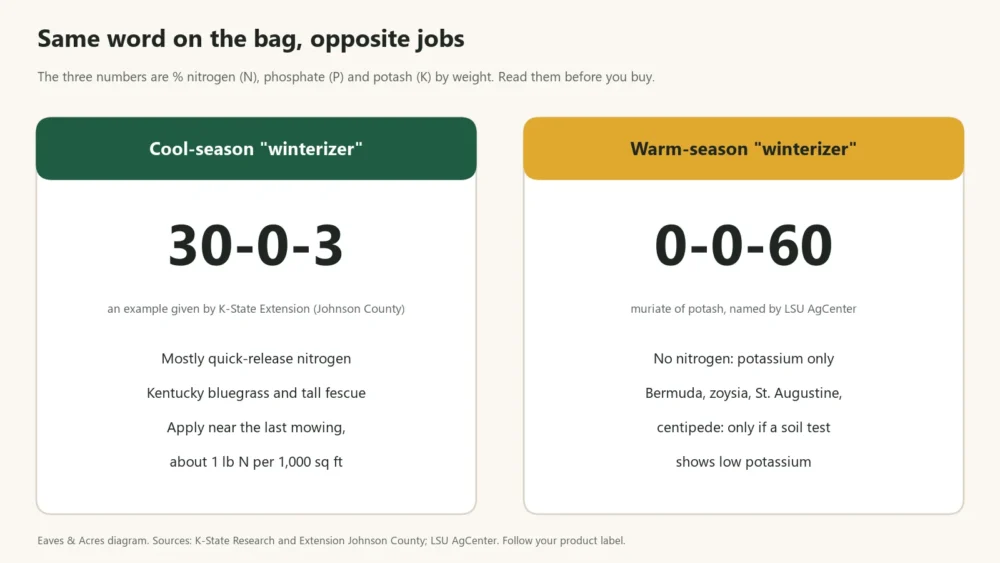
“Winterizer” is a marketing name for the season’s last feeding, so the bag’s three numbers tell you more than the word does. Illinois Extension describes these products as “typically high in nitrogen and potassium” and counts the late-season feeding of a cool-season lawn as the winterizer.3 The nitrogen is what the grass uses. UW–Madison Extension says the extra potassium is not needed in any significant amount unless a soil test shows a deficiency.7
In the South the word means almost the opposite. In 2005, LSU AgCenter horticulturist Tom Koske warned that many winterizers sold in Louisiana were made for northern grasses:8
Winterizing cool-season grass is opposite of winterizing our warm-season grasses.
Cool-season lawns: time it to the last mowing, not the first frost
For Kentucky bluegrass, tall fescue and ryegrass, the late feeding goes down after top growth stops but while the leaves are still green. Illinois Extension puts it about a week after the final mowing: late October to early November in northern Illinois, November in central Illinois and late November in southern Illinois.3 K-State Research and Extension in Johnson County, Kansas, says it the simplest way:
The final November fertilization is normally applied about the time of your last mowing.
In Kansas City that is mid-November through Thanksgiving, using about 1 lb of quick-release nitrogen per 1,000 sq ft.4 Purdue Extension prefers nearly all water-soluble nitrogen from early October until early December, or until the ground freezes.2
To turn “when growth stops” into a date, we used the same rule as our guide to when to stop mowing: the day the normal daytime high falls below 50°F, which Iowa State Extension gives as the point where bluegrass stops growing.19,1
| City | First frost (32°F) | Hard freeze (28°F) | Late feeding, about | State cut-off |
|---|---|---|---|---|
| Minneapolis, MN | Oct 16 | Oct 27 | Oct 28 | — |
| Burlington, VT | Oct 15 | Oct 28 | Nov 8 | Oct 15 |
| Madison, WI | Oct 9 | Oct 20 | Nov 8 | — |
| Rockford, IL | Oct 17 | Oct 28 | Nov 11 | — |
| Detroit, MI | Oct 31 | Nov 9 | Nov 12 | — |
| Chicago, IL | Nov 5 | Nov 15 | Nov 15 | — |
| Albany, NY | Oct 15 | Oct 28 | Nov 15 | Dec 1 |
| Indianapolis, IN | Oct 21 | Nov 1 | Nov 18 | — |
| Boston, MA | Nov 9 | Nov 21 | Nov 22 | — |
| Columbus, OH | Oct 24 | Nov 3 | Nov 23 | — |
| Pittsburgh, PA | Oct 27 | Nov 5 | Nov 27 | Dec 15* |
| Kansas City, MO | Nov 2 | Nov 11 | Nov 29 | — |
| Newark, NJ | Nov 6 | Nov 19 | Nov 29 | Nov 15 |
| New York, NY | Nov 20 | Dec 1 | Nov 29 | Dec 1 |
| Trenton, NJ | Oct 28 | Nov 7 | Dec 1 | Nov 15 |
| Philadelphia, PA | Nov 17 | Nov 29 | Dec 6 | Dec 15* |
| Washington, DC | Nov 8 | Nov 20 | Dec 14 | Nov 15† |
*Pennsylvania caps nitrogen rather than banning it. †D.C.’s rule covers people paid to apply fertilizer. For any other ZIP code, look up your frost dates.
In all 17 cities the estimated feeding date falls 9 to 36 days after the median 32°F frost, and in 15 of them after the 28°F hard freeze too. Advice to feed “before the first frost” would move this feeding weeks earlier than the extension calendars do. Purdue’s stop signal is frozen ground, which is not the same thing as a cold night: our explainer on frost vs. freeze covers the difference.
Do the dates match extension calendars?
We checked the estimate in 10 places with a published window. All 10 landed inside it or within five days.
| Place | Published window | Our estimate |
|---|---|---|
| Rockford, DeKalb, Chicago | Late Oct to early Nov (northern Illinois) | Nov 9–15 |
| Springfield, Champaign, Peoria | November (central Illinois) | Nov 18–24 |
| Carbondale, Marion | Late November (southern Illinois) | Dec 4 |
| Kansas City, MO; Overland Park, KS | Mid-November to Thanksgiving | Nov 27–29 |
Windows: Illinois Extension3 and K-State Johnson County.4 The rule does not fit the dry West. In Denver the normal high stays above 50°F until December 7, but Colorado State Extension’s window ends in early November at lower altitudes.6 West of the Plains, use your state’s calendar.
Some extension services now say skip it
Not everyone still recommends a winterizer. Nebraska Extension notes that turf takes in few nutrients in late fall, when nitrogen leaching risk is highest, so:
the recommendation for a heavy late fall application on well-established lawns has ended
If your grass is dark green, healthy and thick, it says, skip it. Young lawns, or lawns that pests damaged in summer, can still get 0.5 lb of quick-release nitrogen per 1,000 sq ft from October 15 to 30 in Nebraska.5 Colorado State Extension calls “lawn winterization” nothing magical: feed the bluegrass lawn with nitrogen from late September to early November.6 Nebraska adds that returning clippings all season supplies up to 1 lb of nitrogen per 1,000 sq ft. Our lawn fertilizer schedule shows how it fits into the year.
Warm-season lawns: no late-fall nitrogen
Bermuda grass, zoysia, St. Augustine and centipede grass go dormant for winter, and nitrogen late in the season works against that. UGA Extension in Forsyth County, Georgia, says to stop nitrogen by late August or very early September. Feeding later can delay dormancy, expose the grass to frost and freeze injury, and set it up for spring dead spot.11 Texas A&M AgriLife Extension allows a fall feeding but sets the last nitrogen at least six weeks before the expected autumn frost.12 Our warm-season feeding table turns that into dates for 20 Southern cities. LSU AgCenter adds that skipping fall nitrogen helps limit large patch disease in zoysia and St. Augustine.10
A “southern” winterizer is low in nitrogen, has little or no phosphorus, and is higher in potassium. If a soil test calls for potassium, LSU names muriate of potash (0-0-60) as one option; excess potassium can burn the grass.9 Not sure which kind of grass you have? Our cool-season vs. warm-season grass guide shows how to tell.
State cut-off dates that end the season early
Some states set the last day by law, whatever the grass is doing. We read the rule text for these five:
| Where | Rule | Applies to |
|---|---|---|
| Vermont | No fertilizer on turf before April 1 or after October 15, or on frozen ground. Fertilizer with less than 15% slow-release nitrogen is banned on turf. | Everyone (golf courses excluded) |
| New Jersey | No nitrogen or phosphorus fertilizer after November 15 and before March 1. Potassium-only products and lime are allowed. | Homeowners |
| Washington, DC | Fertilize only after March 1 and before November 15, and not on frozen ground. | Paid applicators |
| New York | No fertilizer on lawns between December 1 and April 1. | Everyone |
| Pennsylvania | No more than 0.5 lb of nitrogen per 1,000 sq ft after December 15 and before March 1. No nitrogen or phosphorus on ground frozen 2 inches deep or snow-covered. | Everyone |
Sources: 10 V.S.A. § 1266b;13 Rutgers on New Jersey’s 2011 fertilizer law;14 D.C. Code § 8-104.03;15 New York Environmental Conservation Law § 17-2103, summarized by Cornell Cooperative Extension;16 and 3 Pa.C.S. § 6813, published by the Pennsylvania Department of Agriculture.17,18
Set against our NOAA estimate, the law decides in two places. In all 723 New Jersey ZIP codes, lawns are normally still growing on November 15; the median estimate is December 2. In Vermont, 301 of 308 ZIP codes reach the end of growth after October 15. New York’s December 1 date catches only 112 of 2,154 ZIP codes, nearly all in New York City and on Long Island. No Pennsylvania ZIP code reaches December 15.1
How to apply a late-season feeding
- Read the label first. It sets the rate and spreader setting. Never put down more than 1 lb of quick-release nitrogen per 1,000 sq ft at once; Purdue suggests 0.5–0.75 lb per feeding from October to December.2 Our nitrogen math turns that into pounds of product.
- Green grass, unfrozen soil. Purdue says not to fertilize dormant turf or frozen soil.2
- Moist soil, no downpour. Colorado State says to fertilize moist soil, watering a day ahead if it is dry.6 Pennsylvania says not to apply if heavy rain is expected.18 See how much to water your lawn.
- Sweep it off pavement. New York and Pennsylvania law bar fertilizer on driveways and sidewalks.22,17
 Related guideWhen to Fertilize Your Lawn: A Schedule by Grass Type and Climate
Your next step
Mark two dates: your normal end of growth from the table above, and your state’s cut-off. Use whichever comes first. The fertilizing section has the rest of the year, and the methodology page explains our frost dates.
Frequently asked questions
Not for cool-season grass: Purdue Extension recommends feedings from early October to early December, and the late-season feeding usually comes in November. For warm-season grass it usually is, because UGA Extension stops nitrogen by early September and Texas A&M sets the last feeding six weeks before the autumn frost.
Once the grass has gone dormant or the soil is frozen: Purdue Extension says not to fertilize dormant turf or frozen soil. Your state’s cut-off can come first, such as Oct 15 in Vermont, Nov 15 for New Jersey homeowners and Dec 1 in New York.
Timing. Illinois Extension puts the main early-fall feeding at August 15 to September 15 in central Illinois and calls the later, late-season feeding the winterizer: November in central Illinois, about a week after the final mowing.
Granular products work best on moist soil. Colorado State Extension says to make sure the soil is moist so the nitrogen dissolves, and to water a day ahead if it is dry. Avoid spreading before heavy rain.
Not a high-nitrogen one. UGA Extension says fall nitrogen can delay dormancy and invite cold injury and spring dead spot, and LSU AgCenter says skipping fall nitrogen helps limit large patch. If a soil test shows low potassium, LSU names muriate of potash (0-0-60) as an option.
Not for every lawn. Nebraska Extension says a dark green, healthy, thick lawn needs no extra fertilizer in late fall, and that returning clippings supplies up to 1 lb of nitrogen per 1,000 sq ft over a season; young lawns and lawns damaged by pests can still benefit. UW–Madison adds that the extra potassium in winterizers is not needed unless a soil test shows a deficiency.
Extension advice ranges from a slightly shorter last cut to keeping about 3 inches, and all of it says not to scalp the lawn. Our guide to when to stop mowing compares the advice.
Sources
- 1.U.S. Climate Normals 1991–2020. NOAA National Centers for Environmental Information, 2021. Used for: frost, hard-freeze and daily temperature normals behind every city date and ZIP-code count Back to text
- 2.Fertilizing Established Cool-season Lawns (AY-22-W). Purdue Extension, 2013. Used for: October–December rates, water-soluble nitrogen until the ground freezes, no feeding of dormant turf or frozen soil Back to text
- 3.Fertilizing Your Lawn. University of Illinois Extension, accessed 2026. Used for: winterizer definition, late-season windows by region, one week after the final mowing Back to text
- 4.November: Fertilize Kansas City Cool Season Lawns One Last Time Before Winter. K-State Research and Extension, Johnson County, accessed 2026. Used for: last mowing timing, mid-November to Thanksgiving, 1 lb quick-release nitrogen, 30-0-3 example Back to text
- 5.Fall Landscape Playbook. Nebraska Extension in Lancaster County, accessed 2026. Used for: late-fall feeding no longer recommended for established lawns; young lawns 0.5 lb Oct 15–30; clippings Back to text
- 6.Fall Lawn Fertilization (PlantTalk 1523). Colorado State University Extension, accessed 2026. Used for: Colorado window late September to early November, moist soil Back to text
- 7.Ideal Timing for Fertilizing Lawns (Bruce Spangenberg). University of Wisconsin–Madison Division of Extension, 2025. Used for: potassium in winterizers not needed without a soil test Back to text
- 8.Beware Of Lawn Winterizers Cautions LSU AgCenter Horticulturist (Tom Koske). LSU AgCenter, 2005. Used for: northern winterizers wrong for warm-season grass Back to text
- 9.Winterizing Southern Lawns. LSU AgCenter, 2012. Used for: southern winterizer analysis, muriate of potash, excess potassium Back to text
- 10.Winter Lawn Management. LSU AgCenter, 2025. Used for: skip fall nitrogen against large patch, no winter feeding Back to text
- 11.Fall chores to ready warm-season lawns for winter (Heather N. Kolich). UGA Extension Forsyth County, 2025. Used for: stop nitrogen by early September; dormancy, cold injury, spring dead spot Back to text
- 12.Fertilizing Texas Lawns: 10-Point Checklist for Warm-Season Grasses (E-436). Texas A&M AgriLife Extension, 2007. Used for: last nitrogen at least 6 weeks before the autumn frost Back to text
- 13.10 V.S.A. § 1266b, Application of phosphorus fertilizer. Vermont General Assembly, current. Used for: no turf fertilizer before Apr 1 or after Oct 15 or on frozen ground; nitrogen fertilizer under 15% slow-release banned Back to text
- 14.NJ Fertilizer Law Restrictions on Home Lawn Applications. Rutgers NJAES, 2013. Used for: New Jersey homeowner blackout Nov 15 to Mar 1; potassium-only and lime allowed Back to text
- 15.D.C. Code § 8-104.03, Fertilizer application requirements. Council of the District of Columbia, current. Used for: paid applicators: after Mar 1 and before Nov 15, not on frozen ground Back to text
- 16.Lawn Fertilizer (New York State Nutrient Runoff Law, ECL § 17-2103). Cornell Cooperative Extension of Monroe County, accessed 2026. Used for: New York ban Dec 1 to Apr 1 (statute text read at nysenate.gov) Back to text
- 17.Pennsylvania Fertilizer Law, 3 Pa.C.S. § 6813. Pennsylvania Department of Agriculture, current. Used for: 0.5 lb nitrogen cap Dec 15 to Mar 1; frozen or snow-covered ground; impervious surfaces Back to text
- 18.Homeowners and Applicators. Pennsylvania Department of Agriculture, accessed 2026. Used for: do not apply if heavy rain is expected Back to text
- 19.When can I stop mowing the lawn in the fall?. Iowa State University Extension and Outreach, 2021. Used for: bluegrass stops growing when daytime highs stay below 50°F Back to text
- 20.Reif.Rasen (photo). Membeth, Wikimedia Commons, CC0, accessed 2026. Used for: hero photo, cropped and resized
- 21.Autumn backyard in Kleinburg (photo). Cinzia P., Wikimedia Commons, CC BY 2.0, 2014. Used for: lawn photo, cropped and resized
- 22.N.Y. Environmental Conservation Law § 17-2103, Restrictions on the use of fertilizer containing phosphorus. New York State Senate (NYS Open Legislation), current. Used for: no lawn fertilizer December 1 to April 1; no fertilizer on impervious surfaces including sidewalks Back to text

.jpg)
How this guide was made
- Written by the Yard & Garden Desk and reviewed by the Data & Methodology Desk.
- Data: end-of-growth dates estimated by Eaves & Acres from NOAA NCEI U.S. Climate Normals 1991–2020 for the station nearest each ZIP code: the first fall day the normal daily high falls below 50°F (Iowa State rule, monthly normals interpolated day by day, the same method as our mowing guide); median 32°F frost and 28°F hard-freeze dates from the same normals; feeding windows and rates from Purdue, Illinois, K-State, Nebraska, Colorado State, UW–Madison, UGA, Texas A&M and LSU extension publications; state rules from the cited statutes and agency or extension pages. Real years run earlier or later than normal. See our methodology.
- AI use: AI tools help us research, draft and check this guide. Every figure is checked against the source cited for it, and calculated figures come from our own code, described on the methodology page.
- Spotted an error? Tell us — the form opens with this page’s address filled in.
Change log
- Oct 7, 2026Re-checked against today’s search results and the cited sources (Illinois, K-State, Purdue, Nebraska, Colorado State, UW–Madison, LSU, UGA, Vermont, New Jersey, D.C., New York and Pennsylvania rule texts). The New York sidewalk rule is now cited to the statute itself; the FAQ on whether a winterizer is worth it now covers young and pest-damaged lawns and the potassium question; added links to our grub control and Bermuda grass guides.
- Oct 5, 2026Published. Late-season feeding dates for 17 cool-season cities estimated from NOAA 1991–2020 normals with the same 50°F rule as our mowing guide and checked against Illinois and K-State windows; Vermont, New Jersey, D.C., New York and Pennsylvania rules read in the rule text or the state’s extension summary and compared with every ZIP code in those states.
Covers lawns, gardens, frost and planting. We write the guides and maintain the tools that tell you when to seed, feed and plant for your ZIP.
Keep reading
When to Apply Lime to Your Lawn: Test First, Then Fall or Winter
Lime a lawn only when a soil test shows low pH, and spread it in fall or winter on dry, unfrozen turf so it has months to work. pH targets by grass, extension rates, NOAA freeze data for 22 cities, and where the West can skip it.
When to Fertilize Your Lawn: A Schedule by Grass Type and Climate
Cool-season lawns get their main feeding in early fall; warm-season lawns are fed after green-up and stop six weeks before frost. Schedule, bag math and dates for 20 cities.
Should You Rake Leaves? When to Mulch, Rake or Leave Them
Usually not. Mow a light or moderate layer of leaves into the lawn until your last mow, and remove only what hides the grass. Extension thresholds, the research, and leaf deadlines for 20 US cities from NOAA normals.
Seasonal reminders for your ZIP
Get a short email when it’s time to overseed, start seeds, open the pool or service your furnace — timed to your climate.