




When Does Bermuda Grass Turn Green? Spring Green-Up Dates Where You Live
Bermuda grass greens up between the last spring frost and the first 60°F nights. Here are normal-year dates for 33 Southern cities from NOAA normals, checked against 13 extension reports, plus why a lawn can lag behind.
- Last reviewed Oct 7, 2026
- 33 cited sources
- 14 min read

Set your ZIP to see dates for your area.
- 1Bermuda grass greens up as the soil warms toward 65°F (UGA) and grows steadily once nights stay near 60°F for about a week (University of Arkansas Extension).
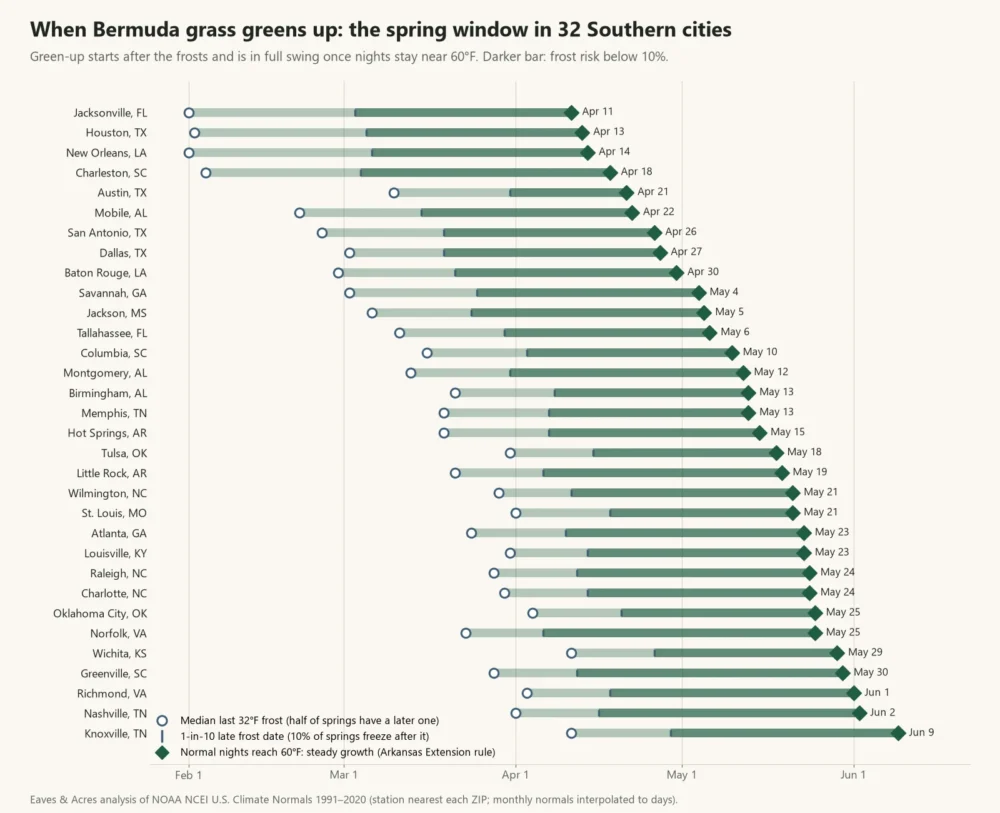
- 2In a normal year the lawn should be fully green by about Apr 18 in Charleston, May 10 in Columbia, May 23 in Atlanta, May 24 in Raleigh and Jun 2 in Nashville, by NOAA normals.
- 3Green-up is gradual: from the median last frost to 60°F nights takes a median 58 days across 12,312 Southern ZIP codes that get frost most years.
- 4Thirteen published extension timings, from Arizona and Florida to Kentucky and Kansas, all fall inside these normal-year windows.
- 5Late or patchy? Look for a freeze after early green-up, cold wet or shaded soil, overseeded ryegrass, thatch or early fertilizer, and check the rhizomes before you replant. Feed only once the lawn is fully green.
Bermuda grass turns green in spring once the soil warms to about 65°F and the nights stop dipping much below 60°F. In a normal year green-up runs from roughly the last frost until nights reach 60°F, so a healthy lawn is fully green by mid-April on the Gulf Coast and in Charleston, by mid-May in Columbia, Memphis and Little Rock, by late May in Atlanta, Raleigh and Oklahoma City, and not until early June in Richmond, Nashville and Knoxville.
Most answers stop at “March to May, depending on your region.” Below are the actual normal-year dates for 33 Southern and transition-zone cities, worked out from NOAA’s 1991–2020 climate normals and checked against 13 published extension observations, plus the reasons a lawn can lag weeks behind its neighbors.
What makes Bermuda grass turn green
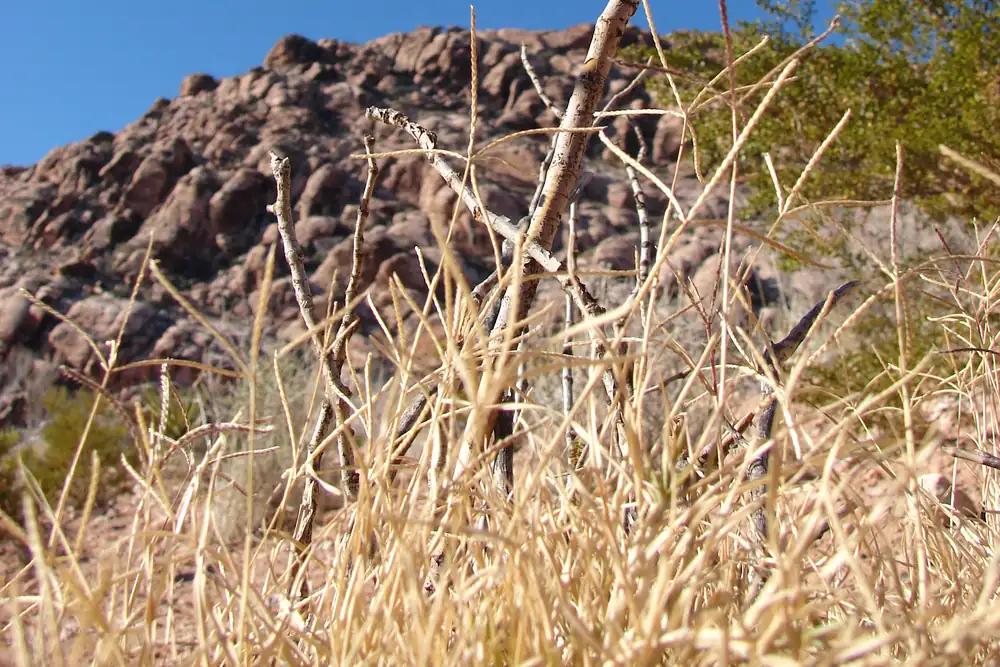
Bermuda grass is a warm-season grass. After fall frosts it goes dormant and stays brown until warm weather returns in spring.24 The leaves die back, but the plant regrows from its crowns and from the nodes on its runners (stolons) and underground stems (rhizomes).14 Soil temperature sets the pace. University of Georgia turfgrass specialist Clint Waltz puts it plainly:2
Warm-season turf green-up is dependent on the soil temperature reaching 65 degrees Fahrenheit.
Warm afternoons start the process, but cool nights hold it back. The University of Arkansas Cooperative Extension Service says Bermuda grass begins greening after warm days but never really3
produces significant growth until night temperatures are 60 degrees F for about a week
That is why green-up is gradual. In the low desert of Arizona, the University of Arizona sees the first green in February, while active growth resumes only in April, once 60°F soil temperatures are consistent.18 Wet soils warm more slowly, Waltz notes, because water buffers heat,2 and the University of Tennessee adds that Bermuda grass in wet or north-facing soils may be slow to recover from dormancy.14 UGA tracks soil temperature at a depth of four inches.2 You can check yours with a probe thermometer at that depth, or on a state network such as the Oklahoma Mesonet’s 4-inch soil temperature map.
When Bermuda grass turns green in 33 Southern cities
Neither soil temperature nor a week of warm nights shows up on a calendar, so we used the two air-temperature signals the extension sources tie to green-up and looked them up in NOAA’s 1991–2020 normals for the weather station nearest each city.1
- The window opens around the last frost. Clemson Extension warns that new green leaves can be frozen back by late frosts, so we list the median last 32°F frost (half of springs have a later one) and the 1-in-10 late date (only 10% of springs freeze after it).4
- It closes when normal nights reach 60°F. That is Arkansas Extension’s steady-growth signal.3 In every extension report we checked (Table 2), a healthy lawn was green by then.
| City (ZIP) | Median last frost (32°F) | 1-in-10 late frost | Normal nights reach 60°F |
|---|---|---|---|
| Tampa, FL (33602) | rare (34% of years) | — | Mar 20 |
| Jacksonville, FL (32202) | Feb 1 | Mar 3 | Apr 11 |
| Houston, TX (77002) | Feb 2 | Mar 5 | Apr 13 |
| New Orleans, LA (70112) | Feb 1 | Mar 6 | Apr 14 |
| Charleston, SC (29401) | Feb 4 | Mar 4 | Apr 18 |
| Austin, TX (78701) | Mar 10 | Mar 31 | Apr 21 |
| Mobile, AL (36602) | Feb 21 | Mar 15 | Apr 22 |
| San Antonio, TX (78205) | Feb 25 | Mar 19 | Apr 26 |
| Dallas, TX (75201) | Mar 2 | Mar 19 | Apr 27 |
| Baton Rouge, LA (70801) | Feb 28 | Mar 21 | Apr 30 |
| Savannah, GA (31401) | Mar 2 | Mar 25 | May 4 |
| Jackson, MS (39201) | Mar 6 | Mar 24 | May 5 |
| Tallahassee, FL (32301) | Mar 11 | Mar 30 | May 6 |
| Columbia, SC (29201) | Mar 16 | Apr 3 | May 10 |
| Montgomery, AL (36104) | Mar 13 | Mar 31 | May 12 |
| Birmingham, AL (35203) | Mar 21 | Apr 8 | May 13 |
| Memphis, TN (38103) | Mar 19 | Apr 7 | May 13 |
| Hot Springs, AR (71901) | Mar 19 | Apr 7 | May 15 |
| Tulsa, OK (74103) | Mar 31 | Apr 15 | May 18 |
| Little Rock, AR (72201) | Mar 21 | Apr 6 | May 19 |
| Wilmington, NC (28401) | Mar 29 | Apr 11 | May 21 |
| St. Louis, MO (63101) | Apr 1 | Apr 18 | May 21 |
| Atlanta, GA (30303) | Mar 24 | Apr 10 | May 23 |
| Louisville, KY (40202) | Mar 31 | Apr 14 | May 23 |
| Raleigh, NC (27601) | Mar 28 | Apr 12 | May 24 |
| Charlotte, NC (28202) | Mar 30 | Apr 14 | May 24 |
| Oklahoma City, OK (73102) | Apr 4 | Apr 20 | May 25 |
| Norfolk, VA (23510) | Mar 23 | Apr 6 | May 25 |
| Wichita, KS (67202) | Apr 11 | Apr 26 | May 29 |
| Greenville, SC (29601) | Mar 28 | Apr 12 | May 30 |
| Richmond, VA (23219) | Apr 3 | Apr 18 | Jun 1 |
| Nashville, TN (37201) | Apr 1 | Apr 16 | Jun 2 |
| Knoxville, TN (37902) | Apr 11 | Apr 29 | Jun 9 |
Expect the first green blades soon after the frosts end and a fully green lawn by the last column, earlier in a warm spring and later in a cold one. For any other ZIP code, look up your last frost date and its odds, or read what the 10%, 50% and 90% frost odds mean.
The regional picture
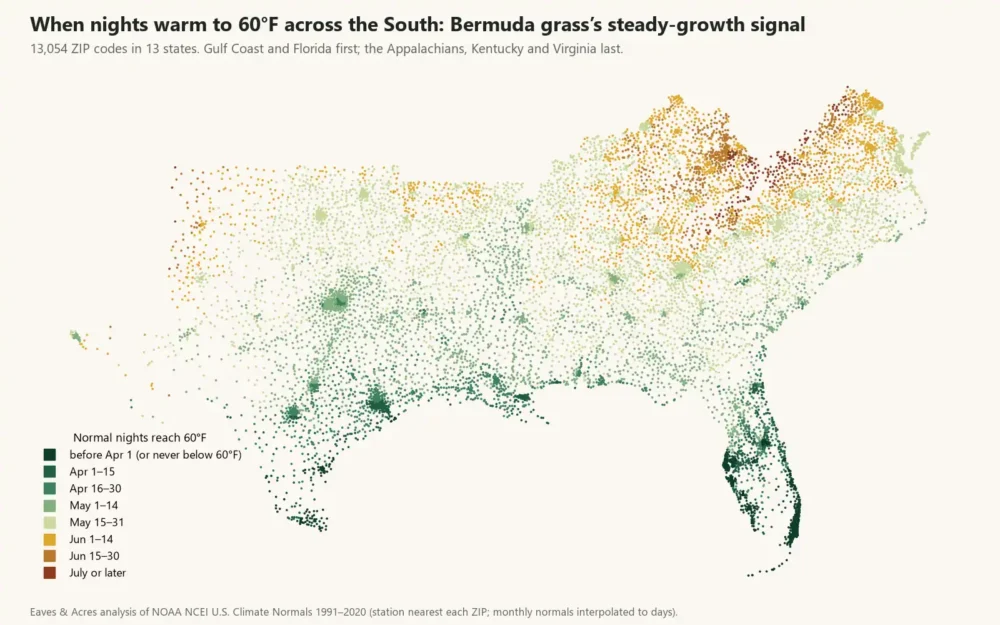
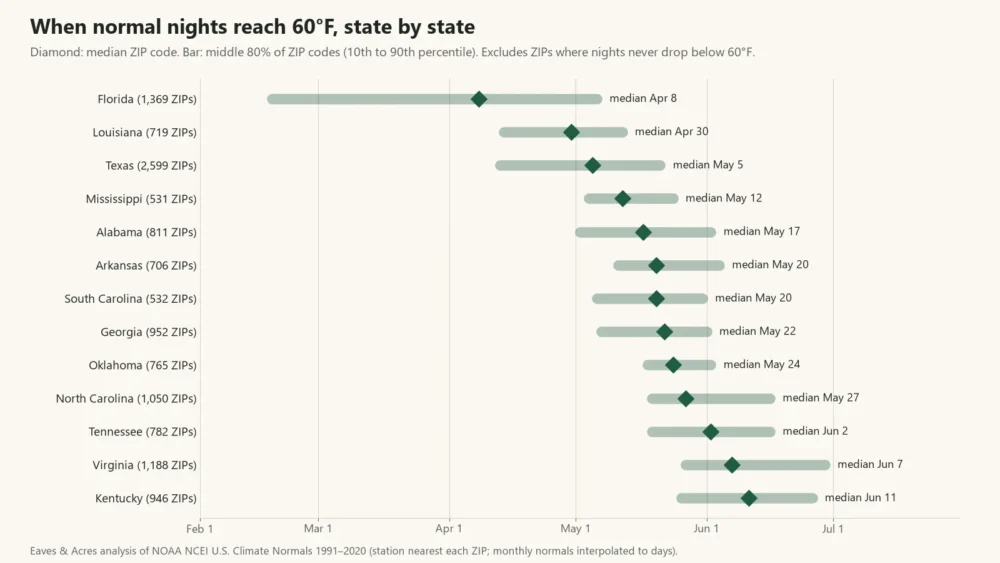
Across 13,054 ZIP codes in 13 humid Southern states, the 60°F-night date arrives first in Florida (state median April 8) and along the Gulf Coast, then in Louisiana (April 30) and Texas (May 5), and last in Tennessee (June 2), Virginia (June 7) and Kentucky (June 11).1 In the 12,312 of those ZIP codes that get a frost most years, the window from the median last frost to 60°F nights lasts a median 58 days, and half of them fall between 55 and 62 days. Green-up takes about eight weeks almost everywhere in the South; only its starting date moves.
One city in detail: Raleigh, North Carolina
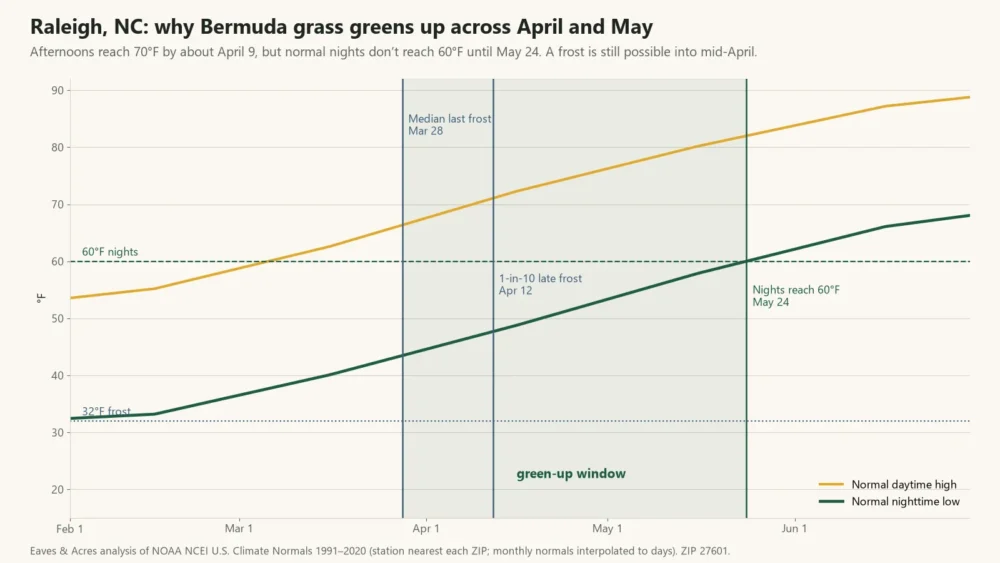
Raleigh shows why a lawn can look half-green for weeks. Normal afternoons reach 70°F by about April 9, yet the median last frost is March 28, the 1-in-10 late frost is April 12, and normal nights don’t reach 60°F until May 24.1 NC State Extension expects a Bermuda lawn to be fully green typically between early April and May,5 right inside that window.
Do the dates match what extension services see?
We compared our windows with every state-specific green-up timing we could find from a university extension service. Some describe Bermuda grass, some lawns in general; one is a single spring.
| Area | What the extension service reports | Our window: last frost → 60°F nights |
|---|---|---|
| Arizona, low desert | First green in February; active growth resumes in April with 60°F soil (University of Arizona)18 | Phoenix: frost rare → Apr 13 |
| South Florida | Growth is year-round (UF/IFAS)23 | Miami: frost rare → never below 60°F |
| South Louisiana | Lawns may show signs of green-up in late February (LSU AgCenter)21 | New Orleans: Feb 1 → Apr 14 Baton Rouge: Feb 28 → Apr 30 |
| East Texas | First feeding two weeks after green-up, mid-April to early May (Texas A&M, Gregg County)27 | Longview: Mar 7 → May 6 |
| Northwest Florida | Most years lawns improve only well into May (UF/IFAS Okaloosa County)22 | Crestview: Mar 21 → May 14 |
| Alabama | Dormant until warm temperatures return in mid-spring (Alabama Extension)24 | Montgomery: Mar 13 → May 12 Birmingham: Mar 21 → May 13 |
| Georgia | Lawns “just beginning” to green up on April 2, 2020 (UGA)2 | Griffin: Mar 20 → May 21 |
| South Carolina | Coast: sometime in April. Inland: as late as mid-May (Clemson)4 | Charleston: Feb 4 → Apr 18 Columbia: Mar 16 → May 10 Greenville: Mar 28 → May 30 |
| North Carolina | Fully green typically between early April and May (NC State)5 | Raleigh: Mar 28 → May 24 Charlotte: Mar 30 → May 24 |
| Arkansas | Dormant until March or April; in 2015 cool April nights held growth back (Arkansas)12,3 | Little Rock: Mar 21 → May 19 Hot Springs: Mar 19 → May 15 |
| Tennessee | Soil reaches 65°F typically late April through May (UT Extension)20 | Nashville: Apr 1 → Jun 2 Knoxville: Apr 11 → Jun 9 |
| Kentucky | Active growth from May to early September (University of Kentucky)25 | Louisville: Mar 31 → May 23 |
| Kansas | Trial plots first rated for spring green-up on May 4, 2017 (K-State)26 | Wichita: Apr 11 → May 29 |
None of the 13 contradicts the window. The published dates for the start of green-up sit near the last frost, and the dates for a fully green lawn sit at or before the 60°F-night date. Treat your city’s window as a guide to when to expect color, not as a promise. A warm March can start it early, and a cold April can stall it.
Why your Bermuda grass is late, or patchy
When one lawn is green and the one next door is still tan, the cause is usually one of these.
It greened up early, then froze
A warm spell can wake Bermuda grass before the frosts are over. Clemson Extension says it is4
not unusual for bermudagrass to green up and get burnt back several times
The University of Arkansas warns that winter injury usually follows when dormancy is interrupted by unseasonably warm weather and then by freezing temperatures.12 NC State saw exactly that in 2018: the worst-damaged Bermuda lawns had greened up in February and were hit by cold in March.10 In 2023, after early green-up and hard frosts in late March, NC State’s Fred Yelverton noted the grass was not dead but needed 4 to 6 weeks of hot weather to recover.11 Compare the date your lawn first greened with the 1-in-10 late frost date in Table 1: anything earlier was at risk.
Cool nights and cold, wet soil
A wet winter slows things down because wet soil warms slowly.2 In Arkansas’s cool, wet spring of 2015, the county agent reported that greening was delayed in March and cool April nights prevented much growth.3 In northwest Florida, UF/IFAS Extension says weak or injured lawns recover slowly in spring because frequent cool nights keep the root zone cool, and most years it is well into May before lawns improve.22 North-facing slopes and shade also lag.14 Bermuda grass is not shade tolerant, and Texas A&M says it may struggle in moderate to dense shade.6
Overseeded ryegrass is still in charge
If the lawn was overseeded with ryegrass for winter color, the ryegrass competes with the waking Bermuda grass for water, light and nutrients, and in a cool spring it can persist, says Clemson Extension.17 Clemson suggests mowing the ryegrass down to about an inch in spring to weaken it, without scalping the Bermuda.17 In Arizona, non-overseeded Bermuda grass transitions earlier and starts vigorous growth sooner.18 In Tennessee, UT Extension times herbicide transition aids from mid-April through mid-May, following the label.19
Thatch, leaves and last year’s growth
A thick thatch layer slows the spring transition, according to UGA.9 Dead leaf material shades the soil too. NC State says removing leaves in winter enables earlier and more consistent green-up,5 and Arkansas Extension suggests mowing slightly shorter before growth starts to reduce shading and warm the soil faster.33
It was fed too early
Fertilizer won’t make Bermuda grass green up sooner. UGA warns that late-winter or early-spring feeding can break dormancy early and leave the grass with no reserves when the inevitable late cold snap hits.9 Texas A&M says not to apply nutrients before full green-up.6
Round dead patches that don’t green up
Circular tan or straw-colored patches that stay dead while the rest of the lawn greens are often spring dead spot. NC State describes sunken patches from 2 inches to 3 feet across, usually on lawns 3 to 5 years old, appearing as Bermuda grass breaks dormancy.5 The fungus is active in fall but shows only the next spring.14 Map the patches. NC State times treatment for fall, not spring.5
Dead or just dormant? Two checks
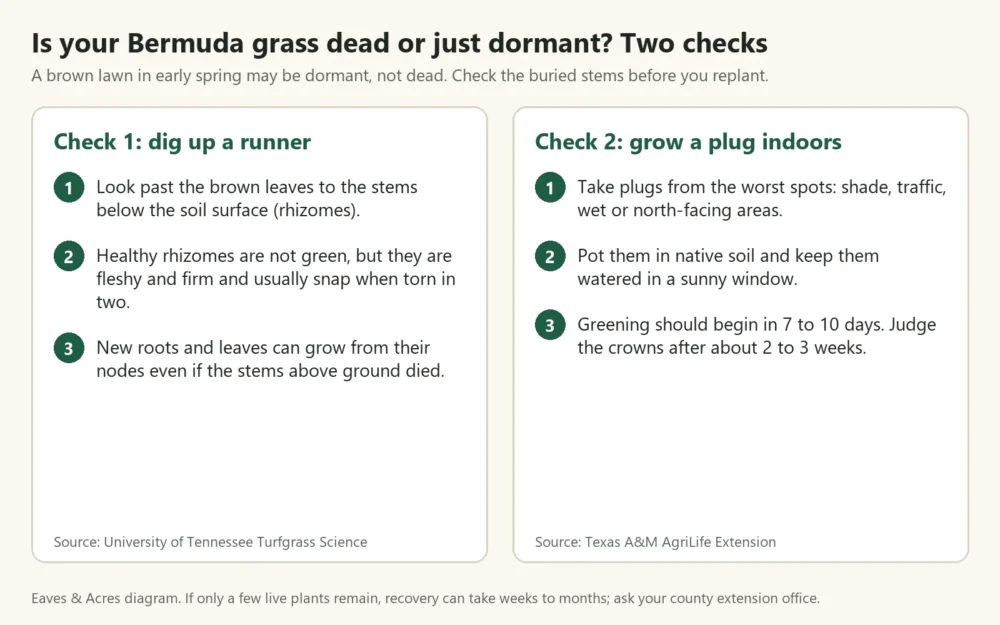
Before you replant, find out whether anything is alive underground. The University of Tennessee says recovery depends on the crowns and the nodes on the stems, and even when leaves and above-ground runners died, plants can regrow from rhizomes below the soil. Healthy rhizomes are not green, but they are fleshy and firm and usually snap when torn.14
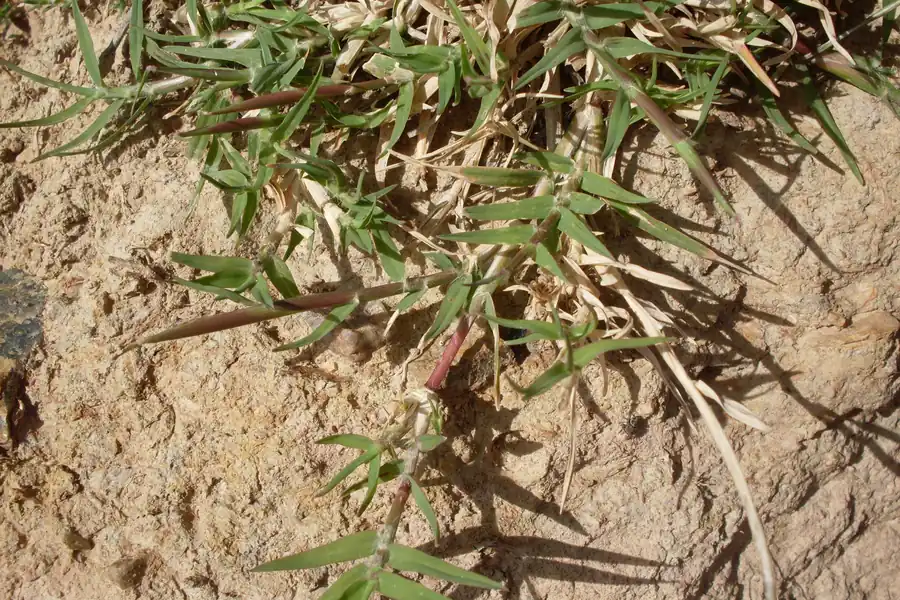
For a firmer answer, Texas A&M AgriLife suggests an indoor test: take plugs from the worst spots, pot them in native soil, keep them watered in a sunny window, and look for greening within 7 to 10 days. Judge the crowns after about two to three weeks.15
If only patches survived, there is still hope. The University of Kentucky’s Gregg Munshaw says Bermuda grass can rebound with adequate nitrogen if there is at least one live plant per square foot, though full recovery may take a couple of months.16 If you expect winterkill, the University of Arkansas advises skipping or delaying the spring pre-emergent and letting the lawn green up first.13
What to do while it greens up
Every spring task on a Bermuda lawn waits for the grass, so work through them in order.
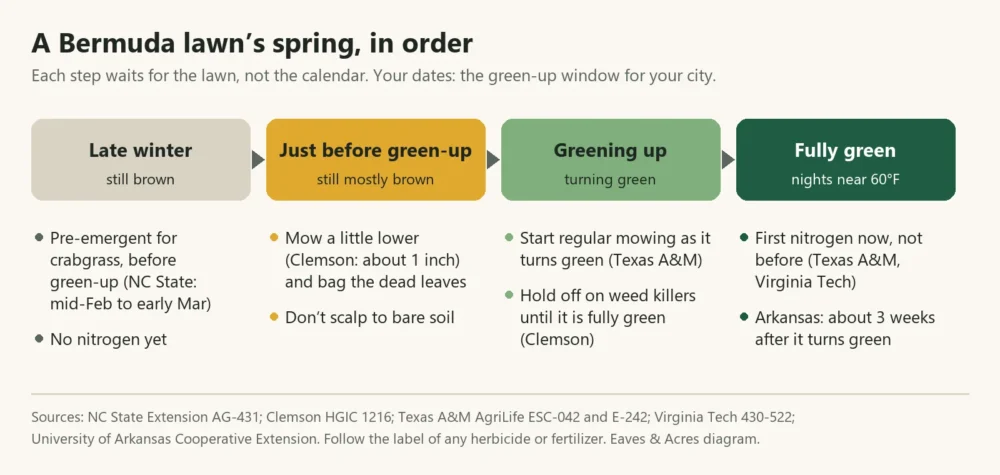
- Put down pre-emergent before green-up. NC State times it for mid-February to early March in North Carolina, while the lawn is still brown.5 See when to apply pre-emergent for Southern windows and the soil-temperature trigger.
- Mow low once, just before green-up. Clemson suggests about 1 inch, bagging or raking out the dead material, without scalping.4 Then start regular mowing as soon as the grass begins to turn green, says Texas A&M.7
- Wait for full green before the first nitrogen. Texas A&M says to fertilize after the grass turns green and there is little chance of a late frost.7 Arkansas suggests about three weeks after it turns green,33 and Texas A&M’s rule of thumb puts the first feeding about six weeks after the average last spring frost.8 Our guide to when to fertilize your lawn turns that rule into dates for 20 Southern cities.
- Hold the weed killers. Clemson advises waiting until the lawn has fully greened before a post-emergent herbicide,4 and Virginia Tech says not to apply post-emergent broadleaf herbicides during the spring transition.28
- Water only if it is dry. Texas A&M says not to irrigate dormant Bermuda grass in late fall, winter or early spring.6 Once it is growing, NC State suggests about an inch of water a week, including rain.5 Our lawn watering guide shows how much your normal rain already covers.
Core aeration comes later, once the lawn is growing hard; see when to aerate by grass type and city.
Where Bermuda grass barely goes dormant
In South Florida, UF/IFAS Extension’s Bermuda grass guide notes that growth is year-round,23 and normal nights in Miami never fall below 60°F.1 Tampa and Orlando get a frost in only about one year in three, so lawns there may stay partly green through winter. In north and central Florida, UF/IFAS puts the first fertilizer in early April (central) and mid-April (north).23
The desert West works differently: normal nights there stay cool for weeks after the afternoons turn hot. Our 60°F-night date fits Phoenix (April 13, matching Arizona’s April timing for active growth),18 but in inland Southern California and New Mexico normal lows reach 60°F only in June, and we found no extension timing there to check it against. So we left the West out of Table 1.
How we worked out these dates, and their limits
Each date uses NOAA NCEI’s 1991–2020 monthly normals for the station nearest the city’s downtown ZIP code.1 We placed each month’s normal low at mid-month, joined the months day by day, and took the first spring day the curve reaches 60°F. Frost dates are the station’s median and 1-in-10 dates for the last 32°F night in spring. The regional figures cover every ZIP code with normals in Alabama, Arkansas, Florida, Georgia, Kentucky, Louisiana, Mississippi, North Carolina, Oklahoma, South Carolina, Tennessee, Texas and Virginia.
Three limits matter. First, the dataset has no soil temperatures, so we can’t compute the 65°F soil date; the night-temperature signal and the frost dates stand in for it, and Table 2 is our check that they line up. Second, these are normals, not a forecast; a single spring can run weeks ahead or behind. Third, a station can sit miles away, and a yard in a valley, in shade or on a north slope will lag. The methodology page explains how the site calculates every date.
 Related guideWhen to Fertilize Your Lawn: A Schedule by Grass Type and Climate
Your next step
Not sure your lawn is Bermuda grass? Our guide to cool-season vs. warm-season grass shows how to tell. The same lawn goes dormant again at the first fall frost; when to stop mowing has those dates. For more on lawn species, browse our grass type guides.
Frequently asked questions
Usually it is waiting for warmer soil and nights. Other causes are a freeze after early green-up, wet or shaded soil, overseeded ryegrass still competing, thick thatch, and spring dead spot. If it is still brown after normal nights reach 60°F, check the rhizomes or pot a plug indoors.
March to May across most of the South, earlier near the Gulf and later inland. By NOAA normals, nights reach 60°F about Apr 13 in Houston, May 10 in Columbia, May 24 in Raleigh and Jun 9 in Knoxville. In Phoenix the first green shows in February.
At the first fall frost, usually in November across much of the South. The median first frost is about Nov 3 in Charlotte, Nov 8 in Atlanta and Raleigh, and Nov 29 in Dallas. Where frost is rare, as in South Florida, it keeps growing all year.
Dig up a few stems below the soil. The University of Tennessee says healthy rhizomes are fleshy and firm and usually snap when torn. Or pot a plug in a sunny window: Texas A&M AgriLife says live grass should start greening in 7 to 10 days.
Grass that is truly dead won’t, but Bermuda grass can regrow from surviving rhizomes. The University of Kentucky says it can rebound with nitrogen if at least one live plant per square foot survives, though full recovery may take a couple of months.
Yes. NC State suggests mowing in winter to remove leaves for an earlier, more even green-up, and Clemson suggests mowing at about 1 inch just before green-up and bagging the dead material. Avoid scalping it down to bare soil.
No. Texas A&M says not to irrigate dormant Bermuda grass in late fall, winter or early spring. Once it is growing, NC State suggests about 1 inch of water a week, including rain.
Never cut off more than a third of the blade at once. Texas A&M’s example: a lawn kept at 1 inch should be mowed again when it reaches 1.5 inches. In spring, start regular mowing as soon as the grass begins to turn green.
Sources
- 1.U.S. Climate Normals 1991–2020. NOAA National Centers for Environmental Information, 2021. Used for: normal daily lows and highs, last-frost dates and odds for every city and ZIP code in Tables 1–2 and the charts Back to text
- 2.Tips for turfgrass care leading into spring green up, Clint Waltz. University of Georgia College of Agricultural and Environmental Sciences, 2020. Used for: 65°F soil-temperature trigger, wet soils warm slowly, four-inch soil readings, herbicide injury during green-up, Griffin timing Back to text
- 3.Warm Nights Signal Time to Fertilize Bermudagrass, Jimmy Driggers. University of Arkansas System Division of Agriculture, Cooperative Extension Service, 2015. Used for: no significant growth until nights are 60°F for about a week; 2015 cool spring Back to text
- 4.Bermudagrass Yearly Maintenance Program (HGIC 1216). Clemson Cooperative Extension, Home & Garden Information Center, 2018. Used for: South Carolina green-up timing, burn-back by late frosts, 1-inch mowing before green-up, no early nitrogen, herbicides after full green-up Back to text
- 5.Bermudagrass Lawn Maintenance Calendar (AG-431), Grady Miller et al.. NC State Extension, 2021. Used for: fully green typically early April to May, winter leaf removal, pre-emergent timing, spring dead spot, watering Back to text
- 6.Bermudagrass Home Lawn Management Calendar (ESC-042), Casey Reynolds and Matt Elmore. Texas A&M AgriLife Extension, 2023. Used for: no nutrients before full green-up, no irrigation of dormant turf, shade tolerance, one-third rule Back to text
- 7.Maintaining Bermudagrass Lawns (E-242), David R. Chalmers, James A. McAfee and Roger Havlak. Texas A&M AgriLife Extension, 2006. Used for: mowing as the grass begins to turn green; fertilizing after green-up and little chance of late frost Back to text
- 8.Fertilizing Texas Lawns (E-436), David R. Chalmers and James A. McAfee. Texas A&M AgriLife Extension, accessed 2026. Used for: first feeding after the second mowing, about 6 weeks after the average last spring frost Back to text
- 9.Spring green-up problems in warm-season turf grass, Clint Waltz and Gil W. Landry. University of Georgia College of Agricultural and Environmental Sciences, 2004. Used for: early fertilizing breaks dormancy before a late cold snap; thatch slows spring transition Back to text
- 10.Cold Temperature Damage and Spring Green-Up of Warm-Season Grasses, Grady Miller. NC State Extension (TurfFiles), 2018, updated 2025. Used for: Bermuda lawns that greened up in February were damaged by March cold Back to text
- 11.Winter Injury on Warm-Season Grasses, Fred Yelverton. NC State Extension (TurfFiles), 2023. Used for: premature green-up then late-March frosts; 4–6 weeks of hot weather to recover Back to text
- 12.Winter Kill - 2010 - Part 1, Aaron Patton and Mike Richardson. University of Arkansas, Turfgrass Science, 2010. Used for: dormancy until March or April; warm spell then freeze causes winter injury Back to text
- 13.Winter Kill - 2010 - Part 2, Aaron Patton and Mike Richardson. University of Arkansas, Turfgrass Science, 2010. Used for: skip or delay pre-emergent when winterkill is expected; let the turf green up first Back to text
- 14.Winter Damage, Tom Samples, John Sorochan, Jim Brosnan et al.. University of Tennessee Turfgrass Science, 2016. Used for: recovery from crowns and nodes, healthy rhizomes fleshy and firm, wet and north-facing soils slow, spring dead spot Back to text
- 15.Turfgrass response to winter fury may take weeks to determine, Kay Ledbetter. Texas A&M AgriLife Today, 2021. Used for: indoor plug test steps (greening in 7–10 days, assess after 2–3 weeks) Back to text
- 16.Turf managers can help winter-damaged bermudagrass rebound, Katie Pratt. University of Kentucky College of Agriculture, Food and Environment, undated. Used for: rebound with one live plant per square foot; a couple of months to recover Back to text
- 17.Overseeding With Ryegrass (HGIC 1206). Clemson Cooperative Extension, Home & Garden Information Center, 2024. Used for: ryegrass competes with Bermuda in spring and can persist; mow ryegrass to 1 inch Back to text
- 18.A Turfgrass Maintenance Guide for Residential and Commercial Lawns in the Low Elevation Arizona Desert (AZ1817), Kai Umeda. University of Arizona Cooperative Extension, 2020. Used for: first green in February, active growth in April at 60°F soil, earlier transition without overseeding Back to text
- 19.Removing Overseeded Perennial Ryegrass from Bermudagrass Turf (W239), Greg Breeden, James T. Brosnan and Thomas J. Samples. University of Tennessee Extension, 2010. Used for: transition aids mid-April through mid-May in Tennessee Back to text
- 20.Timely Turfgrass Memo Spring 2025 – FAQs, Becky Bowling, Jim Brosnan, Greg Breeden and Celeste Scott. University of Tennessee Extension, 2025. Used for: soil reaches 65°F typically late April through May Back to text
- 21.From winter dormancy, lawns spring to life, Heather Kirk-Ballard. LSU AgCenter, 2024. Used for: signs of green-up in southern Louisiana in late February Back to text
- 22.Spring Lawn Problems Abound, Larry Williams. UF/IFAS Extension Okaloosa County, 2026. Used for: cool nights keep the root zone cool; lawns improve well into May in North Florida Back to text
- 23.Bermudagrass for Florida Lawns (ENH19/LH007), L. E. Trenholm et al.. UF/IFAS Extension, 2024. Used for: first fertilizer early April (central) and mid-April (north Florida); year-round growth in South Florida Back to text
- 24.Overseeding Dormant Bermudagrass, David Lawrence. Alabama Cooperative Extension System, 2021. Used for: dormant after frost until warm temperatures return in mid-spring Back to text
- 25.Optimizing Bermudagrass Athletic Field Winter Survival in the Transition Zone (AGR-228), Gregg Munshaw et al.. University of Kentucky Cooperative Extension, 2017. Used for: active growth May to early September in Kentucky Back to text
- 26.2013 NTEP Bermudagrass Test: 2017 Data, Parsons, Shelton, Griffin and Hoyle. Kansas State University Agricultural Experiment Station and Cooperative Extension, 2018. Used for: Wichita plots first rated for spring green-up on May 4, 2017 Back to text
- 27.Lawn Maintenance Guide For East Texas, Randy Reeves. Texas A&M AgriLife Extension, Gregg County, accessed 2026. Used for: feeding two weeks after green-up, mid-April to early May Back to text
- 28.Maintenance Calendar for Warm-Season Turfgrasses in Virginia (430-522), Goatley, Askew, McCall and Wilson. Virginia Cooperative Extension, Virginia Tech, 2025. Used for: nitrogen after spring greening is complete; no post-emergent broadleaf herbicides during spring transition Back to text
- 29.1-day average 4-inch soil temperature map. Oklahoma Mesonet, live. Used for: example of a public 4-inch soil temperature network
- 30.TifEagle bermudagrass over-seeded with Poa trivialis (photo K8039-2), Wayne Hanna. USDA Agricultural Research Service Image Gallery, public domain, accessed 2026. Used for: hero photo, cropped and resized
- 31.Starr 071222-0210 Cynodon dactylon (photo). Forest and Kim Starr, Wikimedia Commons, CC BY 3.0, 2007. Used for: dormant Bermuda grass photo, cropped and resized
- 32.Couch grass (photo). John Tann, Wikimedia Commons, CC BY 2.0, 2009. Used for: runner with new green leaves photo, cropped and resized
- 33.Bermudagrass – Lawn Care in Arkansas. University of Arkansas System Division of Agriculture, Cooperative Extension Service, accessed 2026. Used for: mow slightly shorter before growth to warm the soil; first nitrogen about three weeks after green-up Back to text

.jpg)
How this guide was made
- Written by the Yard & Garden Desk and reviewed by the Data & Methodology Desk.
- Data: green-up windows run from the station’s median last spring 32°F frost (and its 1-in-10 late date) to the first spring day the NOAA NCEI 1991–2020 normal daily low reaches 60°F, at the station nearest each ZIP code (monthly normals interpolated to days). The 60°F-night signal is from University of Arkansas Extension; the frost limit from Clemson and UGA. No soil temperatures are used. Real springs run earlier or later. See our methodology.
- AI use: AI tools help us research, draft and check this guide. Every figure is checked against the source cited for it, and calculated figures come from our own code, described on the methodology page.
- Spotted an error? Tell us — the form opens with this page’s address filled in.
Change log
- Oct 4, 2026Published. Green-up windows for 33 Southern cities computed from NOAA 1991–2020 normals (median and 1-in-10 last frost, date normal nights reach 60°F per University of Arkansas Extension), checked against 13 extension reports (Arizona, UF/IFAS, LSU, Texas A&M, Alabama, UGA, Clemson, NC State, Arkansas, UT, Kentucky, K-State).
Covers lawns, gardens, frost and planting. We write the guides and maintain the tools that tell you when to seed, feed and plant for your ZIP.
Keep reading
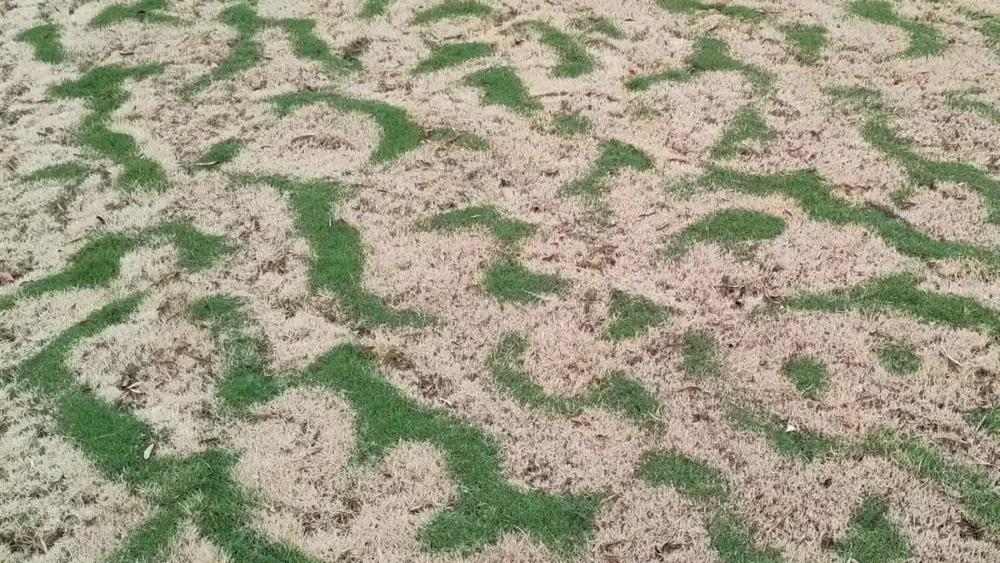
Cool-Season vs. Warm-Season Grass: How to Tell Them Apart and Where Each Grows
Cool-season grasses grow best at 60–75°F highs, warm-season grasses at 80–95°F. Three identification checks, the transition zone, and prime growing weeks for 24 cities from NOAA normals.
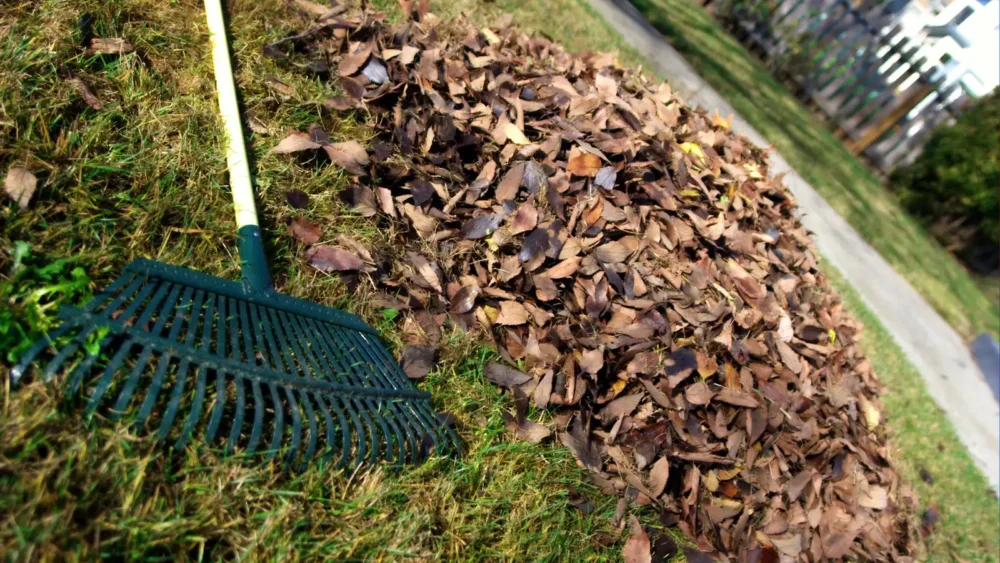
Should You Rake Leaves? When to Mulch, Rake or Leave Them
Usually not. Mow a light or moderate layer of leaves into the lawn until your last mow, and remove only what hides the grass. Extension thresholds, the research, and leaf deadlines for 20 US cities from NOAA normals.
When to Apply Lime to Your Lawn: Test First, Then Fall or Winter
Lime a lawn only when a soil test shows low pH, and spread it in fall or winter on dry, unfrozen turf so it has months to work. pH targets by grass, extension rates, NOAA freeze data for 22 cities, and where the West can skip it.
Seasonal reminders for your ZIP
Get a short email when it’s time to overseed, start seeds, open the pool or service your furnace — timed to your climate.