



Pool Volume Calculator: How Many Gallons Is My Pool?
Answers: how many gallons is my pool?
Enter your pool size, today’s salt reading and your cell’s target to get the pounds and bags to add. Checked against Hayward’s and Pentair’s own salt charts.
≈ 1/16 bag (40 lb bags)
Raises 3,175 ppm to 3,200 ppm in 12,500 gallons.
Each inch of rain you pump off lowers salt about 52 ppm in a pool averaging 5 ft deep.
8.34 is the weight of one US gallon of water in pounds (USGS). Assumes pool salt that is 99%+ sodium chloride. Rain: salt left = depth ÷ (depth + rain you pump off). Methodology
Pounds of salt to add = (target ppm − current ppm) × pool gallons × 8.34 ÷ 1,000,000. The target depends on your chlorinator: Hayward calls 3,200 ppm optimal for its AquaRite,1 while Pentair’s IntelliChlor guide recommends 3,600 ppm.2 A new 30,000-gallon pool needs about 800 lb, or 20 bags of 40 lb, to reach 3,200 ppm.
The table shows the total salt needed to bring fresh water with no salt in it up to each brand’s ideal. Our formula gives the same pounds as both manufacturers’ own charts: Hayward’s within 1 lb at every size we checked,1 and Pentair’s within 0.1%.2 The 8.34 is the weight of one US gallon of water in pounds.3 Many calculators divide by 120,000 instead, which is the same rule rounded: 1,000,000 ÷ 8.34 is about 119,900.
| Pool size | To 3,200 ppm | 40 lb bags | To 3,600 ppm | 40 lb bags | Per 100 ppm |
|---|---|---|---|---|---|
| 5,000 gal | 133 lb | 3 | 150 lb | 4 | 4.2 lb |
| 10,000 gal | 267 lb | 7 | 300 lb | 8 | 8.3 lb |
| 15,000 gal | 400 lb | 10 | 450 lb | 11 | 12.5 lb |
| 20,000 gal | 534 lb | 13 | 600 lb | 15 | 16.7 lb |
| 25,000 gal | 667 lb | 17 | 751 lb | 19 | 20.9 lb |
| 30,000 gal | 801 lb | 20 | 901 lb | 23 | 25.0 lb |
| 40,000 gal | 1,068 lb | 27 | 1,201 lb | 30 | 33.4 lb |
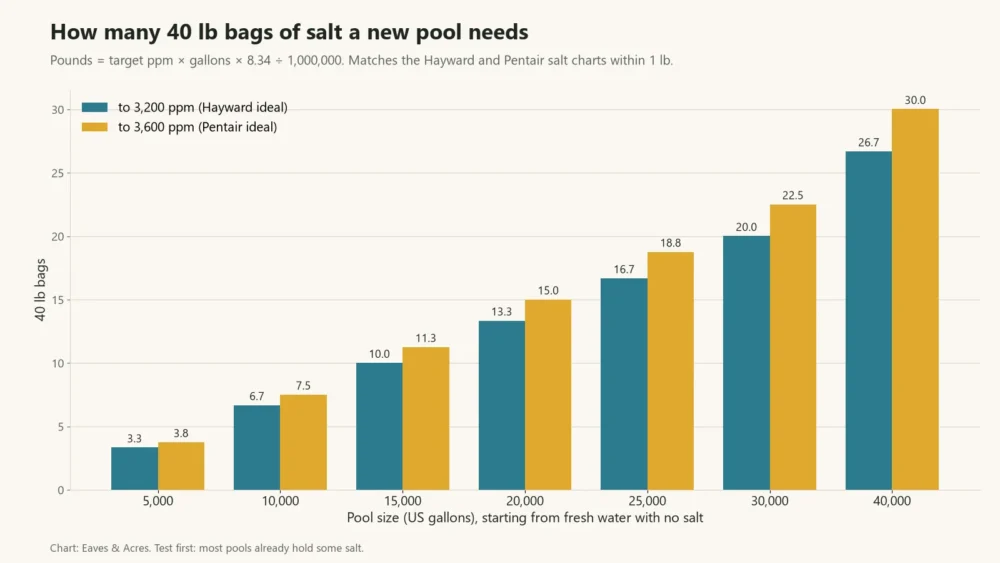
Most pools aren’t at zero. Both manuals say to test before adding anything, because water that has been chlorinated for a while already holds some salt.1,2 If you don’t know your gallons, the pool volume calculator works them out from length, width and depth and saves the number for this page.
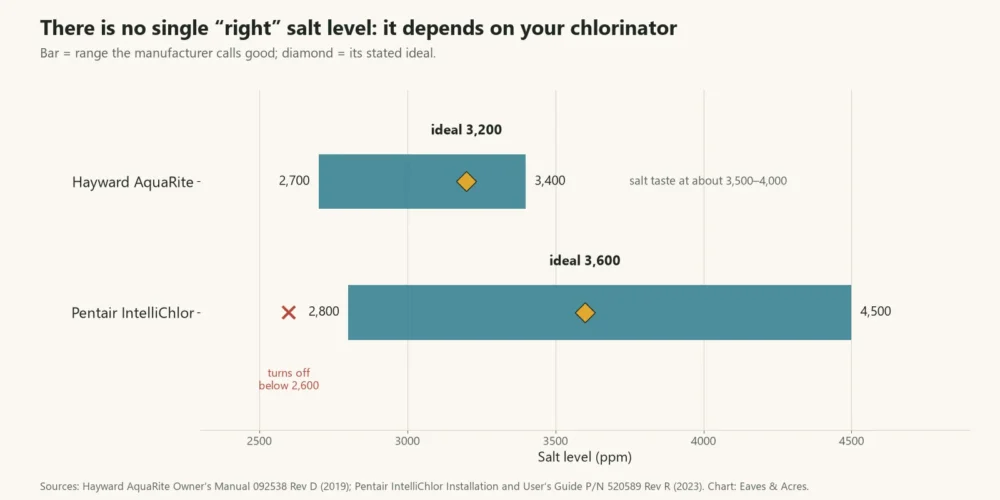
Use the number in your own chlorinator’s manual. The cell turns salt into chlorine, and each brand sets the range its cell works in. The manuals of two major brands don’t agree, which is why a single “ideal” figure can be wrong for your pool.
| Chlorinator | Ideal | Good range | Low salt | High salt |
|---|---|---|---|---|
| Hayward AquaRite | 3,200 ppm | 2,700–3,400 ppm | “Check salt” warning below 2,700; less chlorine | Cell can shut down; salty taste from about 3,500–4,000 |
| Pentair IntelliChlor (IC15–IC60) | 3,600 ppm | 2,800–4,500 ppm | Reduced output below 2,800; off below 2,600 | Above 4,500 risks corrosion of equipment and surfaces |
Hayward’s figures come from its AquaRite owner’s manual.1 Pentair’s come from the IntelliChlor installation and user’s guide.2 Pentair’s two-page quick-start sheet gives 3,200–3,400 ppm instead,4 so if you own an IntelliChlor, go by the full guide for your model. The calculator offers 3,000, 3,200, 3,400 and 3,600 ppm.
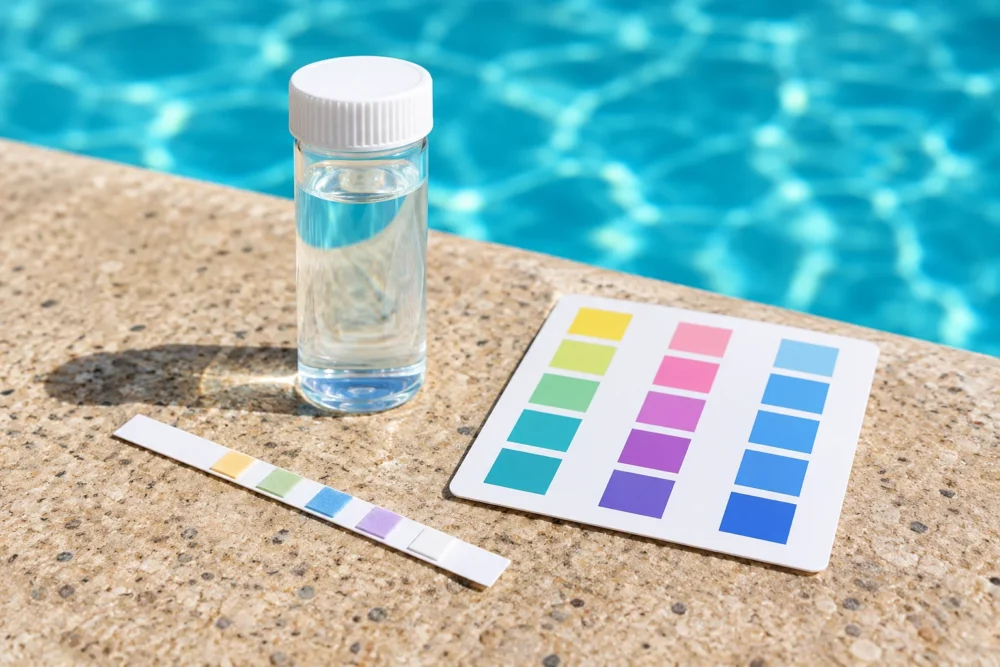
A reading off by a few hundred ppm can mean a bag too many, and extra salt can only come out by draining. Pentair notes that salt readings differ between test strips, electronic testers and titration, and rates its own cell’s sensor at ±500 ppm.2
Use plain sodium chloride: Hayward asks for more than 99% pure,1 Pentair at least 99.8%, food-quality and non-iodized.2 Skip rock salt, iodized salt, salt with anti-caking agents (yellow prussiate of soda), and calcium or potassium chloride. Pellets work but dissolve more slowly.1,2
Run the filter pump for 24 hours, drawing from the main drain if you have one, so the salt spreads evenly.1
Take the next reading only after that 24-hour mix.2 For outdoor pools, check stabilizer (cyanuric acid) at the same time: Hayward says the two usually drop together.1 Our guide to ideal pool chemical levels covers chlorine, pH and the rest.

Salt chlorinators recycle the salt: it becomes chlorine, then turns back into salt. You lose salt only when salty water leaves the pool, through splashing, backwashing, or draining after rain.1
Salt is not lost due to evaporation.
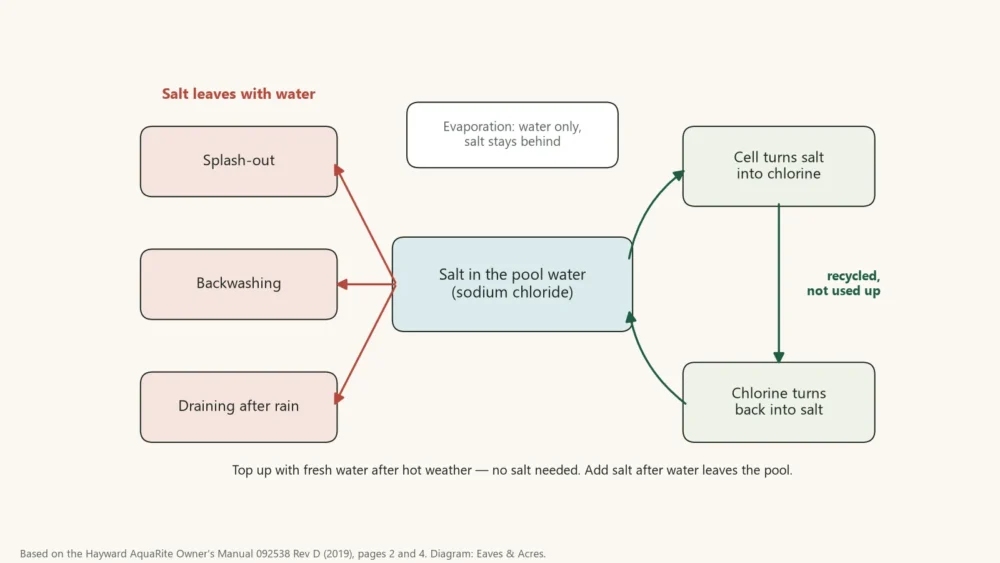
Rain is different. If the level rises and you pump the extra off, salt goes with it. The salt left is your average depth divided by your depth plus the rain you pump off, so one inch of rain removes about 1/61 of the salt in a pool averaging 5 ft deep (60 inches).
| Average water depth | Salt lost per inch of rain | After a 3-inch storm |
|---|---|---|
| 4 ft (many above-ground pools) | 65 ppm | 3,010 ppm |
| 5 ft | 52 ppm | 3,050 ppm |
| 6 ft | 44 ppm | 3,070 ppm |
To see how much this varies across the country, we took NOAA’s 1991–2020 monthly rainfall normals for the weather station nearest each of 40,904 US ZIP codes and found each one’s wettest month from May to September.5 The median wettest swim month brings 4.7 inches. If all of it were pumped off a 5-ft pool, salt would fall by up to 240 ppm. May is the wettest swim month in 36% of ZIP codes and June in 28%.
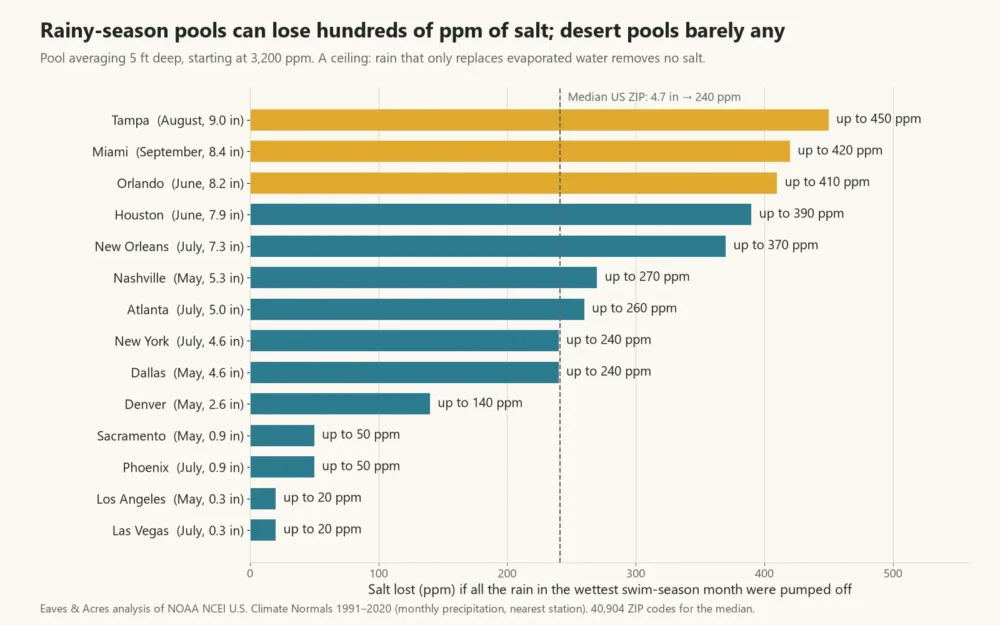
These are ceilings, not forecasts. In a hot month, evaporation takes back part of the rain before you ever reach for the pump, and a solid cover keeps rain out of the water. Still, the pattern is useful. In Phoenix or Las Vegas, salt drops mostly through splashing and backwashing. In Tampa, Orlando or Houston, test after every big storm in the rainy season. Save your ZIP code and this page shows your own wettest month under the result.
Salt can’t be filtered or treated out. The only way to lower it is to drain part of the pool and refill with fresh water.1 The share to drain is (current − target) ÷ current: to bring 4,000 ppm down to 3,200 ppm, replace about 20% of the water. The calculator does this automatically when your reading is above the target.
In metric the math is simpler, because one liter of water weighs about one kilogram.3 Kilograms of salt = (target ppm − current ppm) × liters ÷ 1,000,000. A 50,000-liter pool raised from 2,800 to 3,200 ppm needs 20 kg. Some cells can show salt in grams per liter instead: Hayward’s display reads 3.20 for 3,200 ppm in metric mode.1
The calculator uses the formula above, with 8.34 lb per gallon. It assumes the salt is pure sodium chloride and fully dissolved. The bag count rounds to a practical fraction of a bag, so pour slightly less and top up after retesting rather than overshooting. The rain line uses the depth you saved in the volume calculator, or 5 ft if you didn’t. Every constant and rule is listed on our methodology page.
Starting from fresh water, about 7 bags per 10,000 gallons to reach 3,200 ppm (267 lb). For a pool that already has salt, test first and enter the reading above: you only add the difference.
About 267 lb of dissolved salt at 3,200 ppm (Hayward’s ideal) or 300 lb at 3,600 ppm (Pentair’s). Every 100 ppm you want to add takes 8.3 lb.
About 800 lb, or 20 bags of 40 lb, to bring fresh water to 3,200 ppm. If the pool already reads 2,800 ppm, you need only about 100 lb, or 2½ bags.
Pounds = (target ppm − current ppm) × gallons × 8.34 ÷ 1,000,000, where 8.34 is the weight of a gallon of water in pounds. In metric, kilograms = (target − current) × liters ÷ 1,000,000.
Only when salty water leaves the pool. If rain raises the level and you pump the extra off, each inch removes about 52 ppm from a pool averaging 5 ft deep. Evaporation doesn’t remove salt, so refilling after hot weather doesn’t call for more.
A Hayward cell can shut down, and people generally start to taste salt at about 3,500–4,000 ppm. Pentair warns that above 4,500 ppm salt raises the risk of corrosion. The only fix is to drain part of the water and refill with fresh water.
Whatever your chlorinator’s manual says. Hayward rates its AquaRite best at 3,200 ppm within 2,700–3,400; Pentair’s IntelliChlor guide recommends 3,600 ppm within 2,800–4,500.
Plain sodium chloride: Hayward asks for more than 99% pure, Pentair at least 99.8%, food-quality and non-iodized. Avoid rock salt, iodized salt, salt with anti-caking additives, and calcium or potassium chloride.
Answers: how many gallons is my pool?
Get a short email when it’s time to overseed, start seeds, open the pool or service your furnace — timed to your climate.