




Ideal Pool Chemical Levels: The Ranges and Who Sets Them
One table of pool chemistry targets, each tied to CDC’s pool code or a manufacturer’s manual, plus where those sources disagree and why.
- Last reviewed Oct 4, 2026
- 9 cited sources
- 8 min read
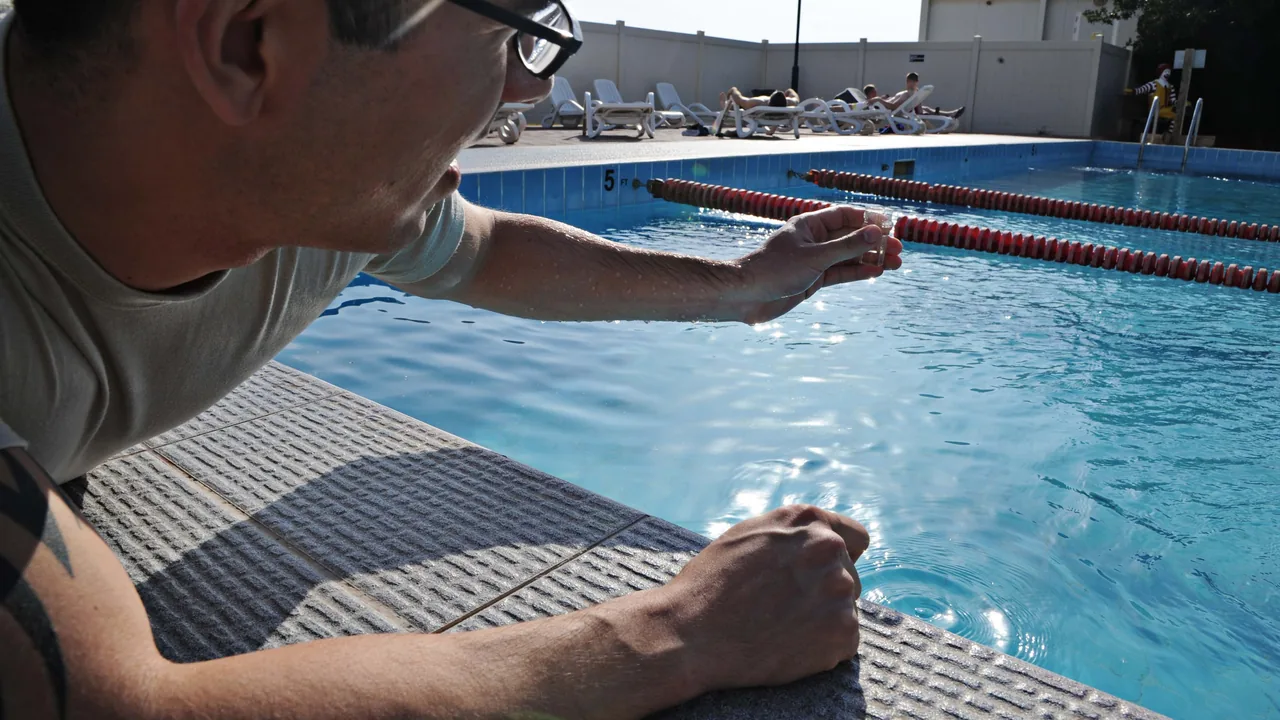
- 1For an outdoor home pool, these ranges satisfy CDC and the Hayward, Pentair and Jandy manuals: free chlorine 2–3 ppm, pH 7.4–7.6, alkalinity 80–120 ppm, calcium 200–400 ppm.
- 2Never let free chlorine fall below CDC’s minimums: 1 ppm, or 2 ppm if the pool uses stabilizer (cyanuric acid).
- 3Stabilizer shields chlorine from sunlight but also weakens it; CDC’s code caps it at 90 ppm in public pools and advises none in hot tubs.
- 4Salt pools follow the chlorinator’s manual: Hayward calls 3,200 ppm salt optimal, Pentair recommends 3,600 ppm and Jandy 3,000–3,500 ppm.
- 5CDC tells home pool owners to test free chlorine and pH at least twice a day.
For an outdoor home pool, aim for free chlorine of 2–3 ppm, pH 7.4–7.6, total alkalinity 80–120 ppm, calcium hardness 200–400 ppm and cyanuric acid (stabilizer) of 30–50 ppm. Those are the bands that satisfy both the CDC and the manuals of the three big salt-chlorinator brands. If you have a salt system, the salt level and sometimes the stabilizer target come from your own chlorinator’s manual, and the brands don’t agree.
Most charts give one set of numbers with no source. Below, every range names the document it comes from, and where the official numbers differ we show both and explain why.
Ideal pool chemical levels at a glance
Chlorine and pH are the first defense against germs that can make swimmers sick.
The “home target” column is the range that every source we checked accepts. The “limits” column shows the floors and ceilings that public pools must meet under CDC’s Model Aquatic Health Code (MAHC),2 which many health departments build on.
| Test | Home target | Official limits | What it protects |
|---|---|---|---|
| Free chlorine | 2–3 ppm | At least 1 ppm, or 2 ppm with stabilizer (CDC); 2–4 ppm advised for public pools | Kills germs |
| Combined chlorine | 0 ppm | Act above 0.4 ppm (MAHC) | Eyes and air: chloramines irritate |
| pH | 7.4–7.6 | 7.0–7.8 (CDC) | Chlorine strength, comfort, pipes |
| Total alkalinity | 80–120 ppm | 60–180 ppm (MAHC) | Keeps pH steady |
| Calcium hardness | 200–400 ppm | Up to 2,500 ppm (MAHC) | Plaster and equipment |
| Cyanuric acid | 30–50 ppm outdoors, 0 indoors | Up to 90 ppm; none in hot tubs (CDC) | Shields chlorine from sunlight |
| Salt | Your chlorinator’s range | As the manufacturer specifies (MAHC) | Feeds the salt cell |
| Total dissolved solids | Under 1,500 ppm above your fill water | No proven maximum (MAHC Annex) | Clarity and chlorine efficiency |
The free-chlorine floors come from CDC’s page for home pool and hot tub owners, which also gives pH 7.0–7.8 and at least 3 ppm in hot tubs.1 The other limits are from the 2024 MAHC, 5th edition (sections 5.7.3 and 5.7.4.4) and its Annex.2,3 For salt, use our pool salt calculator, which lists each brand’s target.
Where the official numbers disagree, and why
We lined up CDC’s numbers with the water-chemistry tables in three salt-chlorinator manuals. All three manufacturers say their tables follow the Association of Pool and Spa Professionals (APSP), now the Pool & Hot Tub Alliance (PHTA).4,5,6 We also added Trouble Free Pool, an owner forum whose numbers rank highly in search.9
| Test | CDC / MAHC | Hayward AquaRite | Pentair IntelliChlor | Jandy AquaPure | Trouble Free Pool |
|---|---|---|---|---|---|
| Free chlorine | Min 1 (2 with stabilizer); 2–4 advised | 1.0–3.0 | 2.0–4.0 | 1.0–3.0 | Set by stabilizer level |
| pH | 7.0–7.8 | 7.2–7.8 | 7.2–7.8 (ideal 7.4–7.6) | 7.4–7.6 | 7.6–7.8 ideal |
| Total alkalinity | 60–180 | 80–120 | 80–120 | 80–120 | 60–80 ideal |
| Calcium hardness | 200–400 preferred | 200–400 | 200–400 | 175–400 | 350–550 plaster and fiberglass |
| Cyanuric acid | Max 90 | 30–50 outdoors | 30–50 | 50–75 | 40–50; 70–80 with salt |
| Salt | Maker’s range | 2,700–3,400 | 3,600–4,500 | 3,000–3,500 | Maker’s range |
| Saturation index | Check monthly | −0.2 to +0.2 | −0.3 to +0.3 | Not given | Not given |
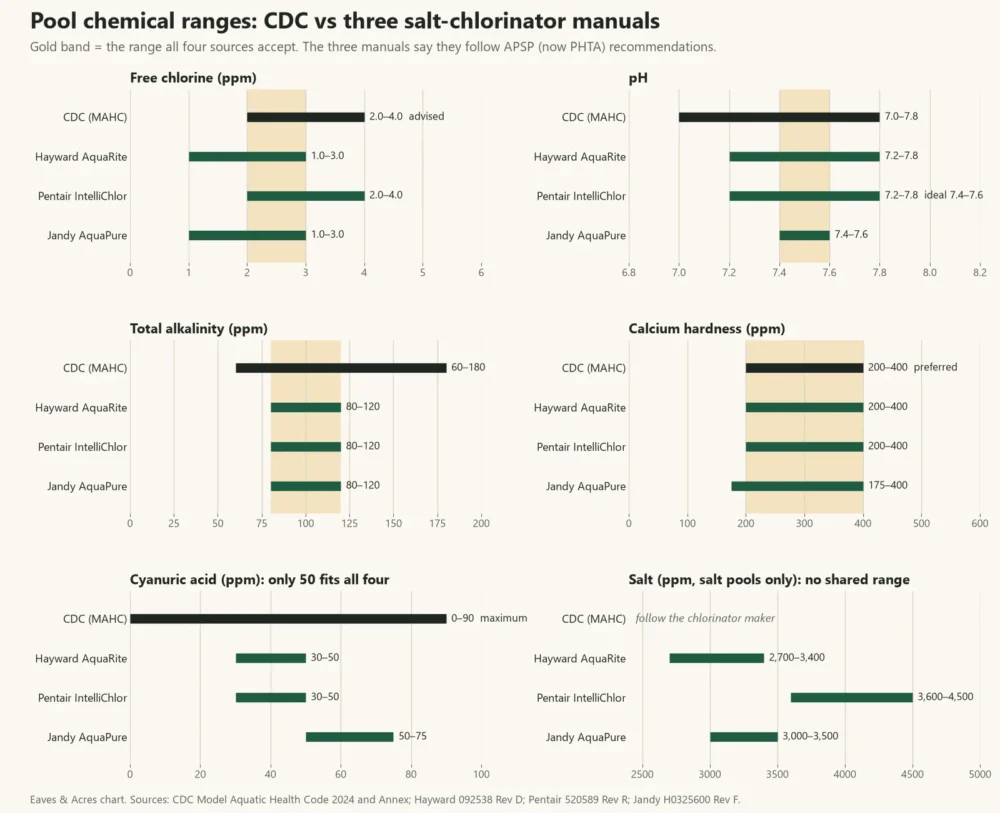
Three differences matter in practice.
Public pools vs. your backyard pool
The MAHC is written for pools open to the public, such as those at hotels, apartment complexes and clubs. Its limits are legal floors and ceilings for a crowded pool, not targets: total alkalinity anywhere from 60 to 180 ppm meets the code.2 The manuals give narrower bands meant to protect their equipment and your pool surface. For a home pool, aim inside the manuals’ bands while never dropping below CDC’s chlorine floor.
Same “APSP” label, different chlorine ranges
Hayward and Jandy print 1.0–3.0 ppm free chlorine, and Jandy warns that continuous exposure above 3.0 ppm may corrode pool metals.6 Pentair prints 2.0–4.0 ppm and puts its corrosion warning above 4.0.5 CDC’s Annex advises 2–4 ppm for public pools so the minimum is never missed.3 The manuals don’t say which APSP document or edition they used, and we could not read the standard itself: PHTA sells it, and its online copy is a page-image flipbook. The overlap, 2–3 ppm, meets every source at once.
Salt pools: the cell sets salt and stabilizer
The only special requirements for the AquaRite are the salt level and stabilizer.
Salt targets barely overlap: Hayward calls 3,200 ppm optimal, Pentair recommends 3,600 ppm and Jandy 3,000–3,500 ppm.4,5,6 PHTA’s fact sheet on chlorine generators confirms that different units need different salt levels and tells owners to follow the manufacturer.7 Stabilizer splits the same way: Hayward and Pentair say 30–50 ppm, while Jandy asks for 50–75 ppm, rising to 75–85 ppm when the water runs above 85°F.6 Use the number in your own cell’s manual, and the salt calculator to turn it into bags.
What each number protects
Free and combined chlorine
Free chlorine is the sanitizer still available to kill germs. At 1 ppm, pH 7.5 and 77°F with no stabilizer, CDC says it kills E. coli O157:H7 in under a minute, but Cryptosporidium takes about 10.6 days.1 Combined chlorine is chlorine already tied up with sweat and urine as chloramines; the MAHC tells public pools to act when it passes 0.4 ppm,2 and the manuals want none.5,6 Your test kit shows it as total chlorine minus free chlorine.
pH
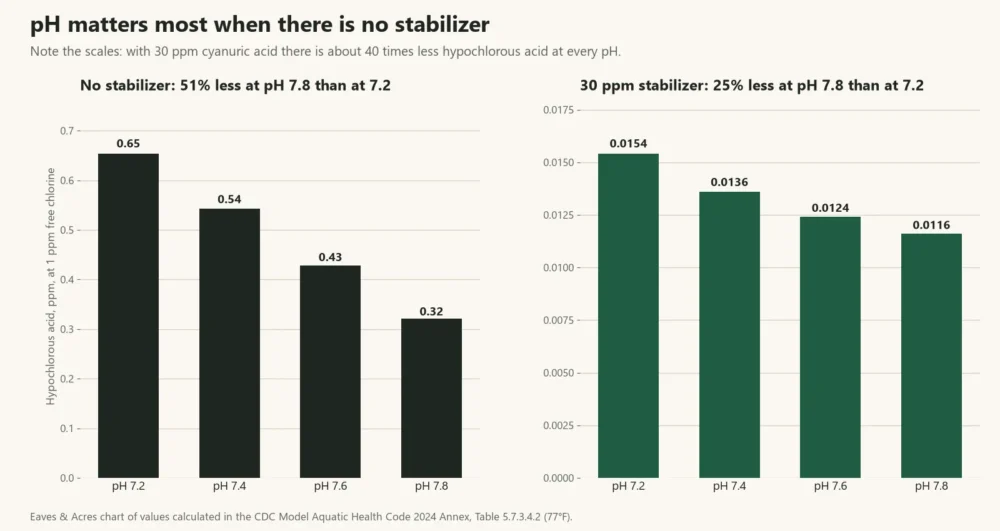
CDC says 7.0–7.8 best balances germ-killing, pipe life and swimmer comfort: chlorine weakens as pH rises, especially above 8.0, while pipes corrode more below 7.0.1 In an unstabilized pool, raising pH from 7.2 to 7.8 roughly halves hypochlorous acid, the fast-acting form of chlorine.3
Cyanuric acid (stabilizer)
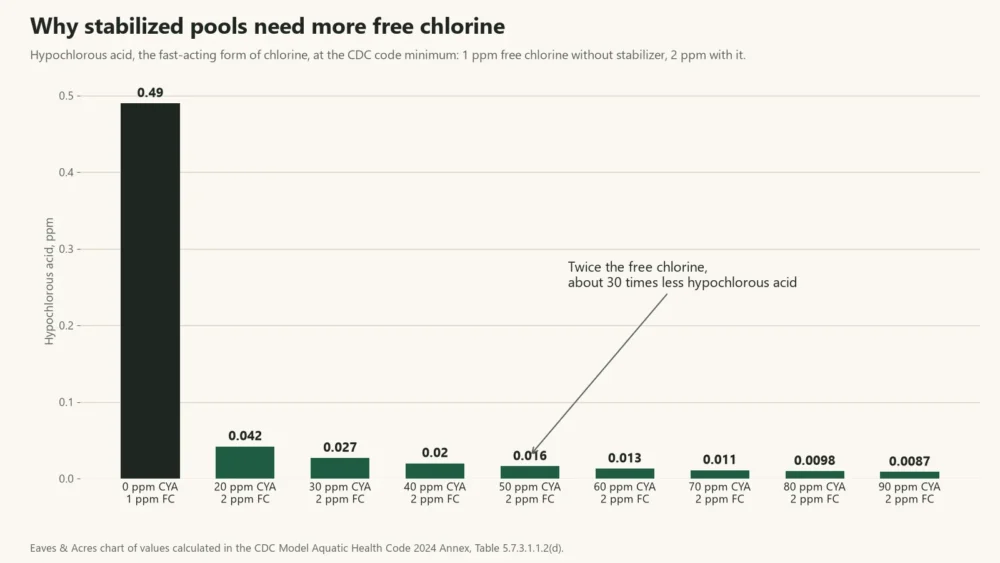
Pentair’s guide says sunlight destroys 90% of unstabilized chlorine within two hours, which is why outdoor pools use cyanuric acid.5 The trade-off is that stabilizer binds chlorine. The MAHC Annex calculates about 30 times less hypochlorous acid at 2 ppm free chlorine with 50 ppm stabilizer than at 1 ppm with none, which is why CDC doubles the chlorine floor for stabilized pools.3 Public pools must stay at or below 90 ppm, and CDC advises no stabilizer in hot tubs.2,1 Chlorine tablets (trichlor) and dichlor add stabilizer every time you use them.3
Total alkalinity, calcium hardness and balance
Total alkalinity is the buffer that stops pH from bouncing; too low and pH swings, too high and pH is hard to bring down.3 Calcium hardness of 200–400 ppm is preferred, says the Annex: too much causes cloudiness and scale, too little makes water that eats plaster and metal. For water above 90°F, as in a hot tub, it suggests 100–200 ppm.3 The saturation index combines pH, temperature, calcium, alkalinity and dissolved solids into one number; Hayward wants it between −0.2 and +0.2.4
Total dissolved solids
Everything that dissolves and never leaves, from minerals to sunscreen, adds to TDS. The Annex and PHTA use 1,500 ppm above the fill water as the point to partly drain and refill.3,7 It is a convention, not a proven limit:
there are no known scientific data that substantiates any value as a maximum
Salt counts as TDS, so a salt pool’s baseline is the reading taken after the salt goes in; Pentair lists 3,000 to about 6,000 ppm including salt.7,5
How often to test pool water
Here the sources differ most, because they are written for different situations.
| Test | CDC, home pools | MAHC, public pools | Pentair | Jandy |
|---|---|---|---|---|
| Free chlorine and pH | At least twice a day | Before opening, then every 2–4 hours | Weekly | Daily |
| Total alkalinity | Not stated | Weekly | Weekly | Daily |
| Calcium hardness | Not stated | Monthly | Monthly | Daily |
| Cyanuric acid | Not stated | Monthly; weekly with stabilized chlorine | Monthly | Monthly |
| Salt | Not stated | Weekly or per maker | Monthly | Monthly |
| TDS | Not stated | Quarterly | Monthly | Not stated |
CDC’s home-pool advice is the strictest: chlorine and pH at least twice a day, more often when many people swim.1 The Annex also calls for a manual test after a major weather event at outdoor public pools.3
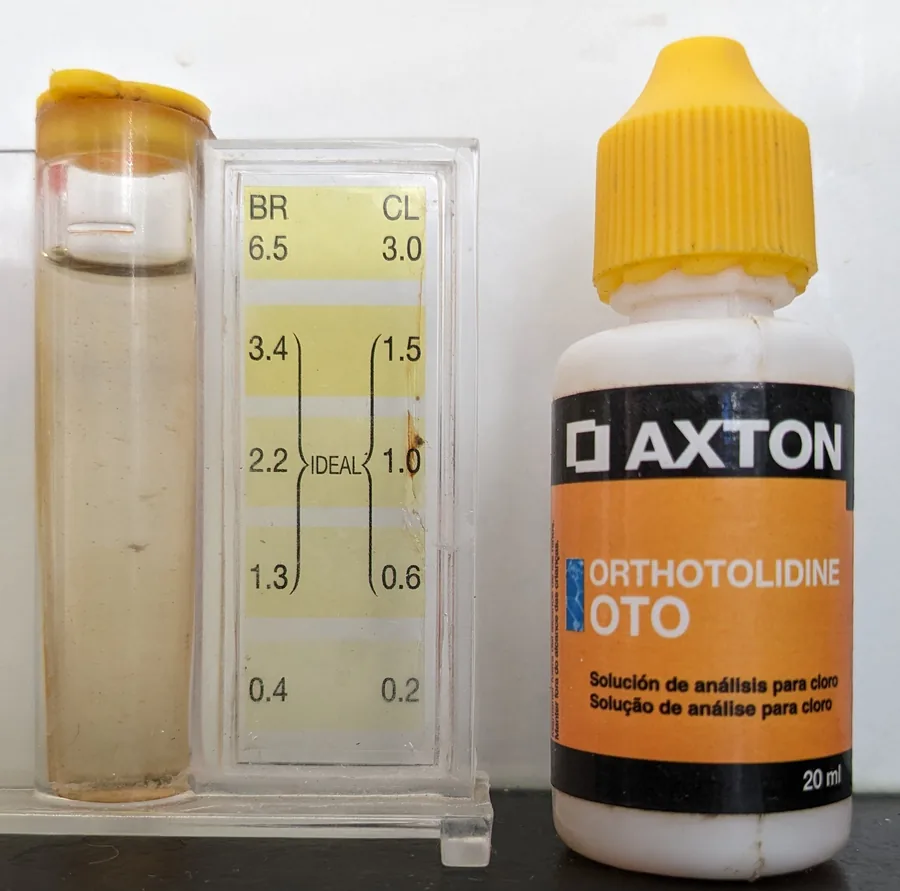
Use a DPD test kit if you can. CDC calls it the most accurate home option, says strips are less accurate, and warns that above 10 ppm chlorine the DPD color can bleach out and read falsely low.1
Reading one test result
- Scenario
- Outdoor stabilized pool: free chlorine 1.5 ppm, stabilizer 45 ppm, pH 7.9, total alkalinity 140 ppm, calcium 250 ppm.
- Math
- Free chlorine is under CDC’s 2 ppm floor for stabilized pools. pH is above every source’s 7.8 ceiling. Alkalinity is inside the MAHC’s 60–180 ppm but above the manuals’ 80–120 ppm. Calcium and stabilizer are fine.
- Answer
- Lower alkalinity first, which also lowers pH, then retest and raise chlorine to 2–3 ppm. The MAHC Annex gives this order: add acid for alkalinity, then retest and adjust pH.
Adjusting levels safely
Which product moves which number is set by the label and your equipment maker. Pentair’s and Jandy’s manuals name muriatic acid to lower pH and soda ash to raise it.5,6 Hayward discourages dry acid (sodium bisulfate) for adjusting pH with its salt cells, especially in arid regions, because its by-products can build up and damage the cell.4
Doses depend on your pool’s volume, so find your gallons with the pool volume calculator before you add anything. Retest after the water has circulated rather than guessing a second dose. At the end of the season, our guide to when to close your pool explains why to balance the water before the cover goes on, and the pool and spa section has the rest of the season.
Frequently asked questions
It is above every manual's range. Pentair warns that more than 4.0 ppm may corrode metal parts, and Jandy's limit is 3.0 ppm. CDC's code sets no fixed maximum for public pools: the ceiling is the product label.
Usually alkalinity. It is the buffer that decides how easily pH moves, and acid that lowers alkalinity lowers pH too. CDC's MAHC Annex has operators add acid for alkalinity, then retest and adjust pH.
Yes. CDC and the manuals all top out at 7.8. CDC says chlorine kills germs less well as pH rises, especially above 8.0; without stabilizer, the MAHC Annex calculates the active share of chlorine falling from 48.6% at pH 7.5 to 23.0% at pH 8.0.
Total chlorine is free plus combined chlorine, so ideally it matches your free chlorine reading. When the gap passes 0.4 ppm, CDC's code tells public pools to act to reduce chloramines.
The same pH, alkalinity and calcium targets as any pool, plus the salt and stabilizer levels in your chlorinator's manual: 2,700–3,400 ppm salt for Hayward AquaRite, 3,600–4,500 ppm for Pentair IntelliChlor and 3,000–3,500 ppm for Jandy AquaPure. Jandy also asks for 50–75 ppm stabilizer.
CDC advises home pool owners to test free chlorine and pH at least twice a day, and more often with many swimmers. The manuals add weekly or daily alkalinity tests and monthly checks of stabilizer and salt.
Yes. It is below CDC's public-pool floor of 60 ppm and well below the 80–120 ppm that the Hayward, Pentair and Jandy manuals list. Low alkalinity lets pH swing; raise it with a product made for the job, following its label for your gallons, and retest.
No. Hayward and Pentair say indoor pools need no cyanuric acid, and CDC recommends against stabilizer or stabilized chlorine in hot tubs, which need at least 3 ppm free chlorine.
Sources
- 1.Home Pool and Hot Tub Water Treatment and Testing. Centers for Disease Control and Prevention, 2024. Used for: home-pool chlorine and pH minimums, hot tubs, kill times, testing twice a day, DPD kits vs strips Back to text
- 2.Model Aquatic Health Code, 5th Edition (2024 MAHC Code). Centers for Disease Control and Prevention, 2024. Used for: public-pool limits (sections 5.7.3, 5.7.4.4) and testing frequency (5.7.5) Back to text
- 3.Model Aquatic Health Code Annex, 5th Edition (2024 MAHC Annex). Centers for Disease Control and Prevention, 2025. Used for: 2–4 ppm chlorine advice, hypochlorous acid tables, alkalinity, calcium, TDS, testing after storms Back to text
- 4.AquaRite Electronic Chlorine Generator Owner’s Manual (092538 Rev D). Hayward Pool Products, 2019. Used for: APSP-based water chemistry table, saturation index, salt and stabilizer Back to text
- 5.IntelliChlor Salt Chlorine Generator Installation and User’s Guide, IC15/IC20/IC40/IC60 (P/N 520589 Rev R). Pentair, 2023. Used for: APSP-based ranges (p. 10), maintenance schedule, sunlight loss, TDS including salt Back to text
- 6.AquaPure Electronic Salt Water Chlorinator and PureLink Installation and Operation Manual (H0325600 Rev F). Zodiac Pool Systems (Jandy), 2021. Used for: APSP-based ranges, stabilizer in hot water, salt range, maintenance schedule Back to text
- 7.Fact Sheet: Electrolytic Chlorine Generators. Pool & Hot Tub Alliance, 2021. Used for: salt levels vary by unit, TDS after adding salt, stabilizer Back to text
- 8.Thousands Sent to Emergency Room by Preventable Pool Chemical Injuries. Centers for Disease Control and Prevention, 2014. Used for: pool chemical safety rules Back to text
- 9.What Are My Ideal Pool Levels?. Trouble Free Pool, 2024. Used for: owner-forum ranges by pool type Back to text
How this guide was made
- Written by the Pool Desk and reviewed by the Data & Methodology Desk.
- Data: ranges transcribed from CDC’s 2024 Model Aquatic Health Code and Annex, CDC’s home-pool guidance, the Hayward AquaRite, Pentair IntelliChlor and Jandy AquaPure manuals, PHTA’s chlorine-generator fact sheet and Trouble Free Pool; charts plot values calculated in the MAHC Annex. This guide uses no NOAA climate data. See our methodology.
- AI use: AI tools help us research, draft and check this guide. Every figure is checked against the source cited for it, and calculated figures come from our own code, described on the methodology page.
- Spotted an error? Tell us — the form opens with this page’s address filled in.
Change log
- Oct 4, 2026Review: re-checked CDC’s home-pool figures and quote, and the Pentair, Jandy and Hayward chemistry tables; added which products the manuals name for raising and lowering pH (and Hayward’s caution on dry acid), and an FAQ on low alkalinity from the current People also ask.
- Oct 3, 2026Published. Target ranges reconciled from CDC’s 2024 Model Aquatic Health Code and Annex, CDC’s home-pool guidance, PHTA and the Hayward, Pentair and Jandy manuals.
Covers pool and hot tub water chemistry, opening and closing. We maintain the dosing calculators and check every rate against product chemistry and public health guidance.
Keep reading
Saltwater vs Chlorine Pool: What Changes and What It Costs
A saltwater pool is a chlorine pool: a salt cell makes the chlorine. Cell electricity and wear per gallon of liquid chlorine replaced, upkeep and corrosion from the manuals, and the stabilizer tablets add in 19 US cities.
How Much Shock to Add to a Pool: Doses, SLAM and CYA
One label shock dose adds about 5–10 ppm free chlorine. Label doses for liquid chlorine, cal-hypo, dichlor and non-chlorine shock, SLAM levels by stabilizer, and the CYA that weekly dichlor adds by city.
How to Winterize a Hot Tub, and When to Keep It Running
Hot tub makers say a tub kept full, heated and covered protects itself from freezing. When to drain and winterize instead, with NOAA freeze dates and winter running costs for 21 US cities.
Seasonal reminders for your ZIP
Get a short email when it’s time to overseed, start seeds, open the pool or service your furnace — timed to your climate.