




How Much Shock to Add to a Pool: Doses, SLAM and CYA
Shock doses from EPA-registered labels converted to ppm, a dose table by pool size, the SLAM level for your stabilizer reading, and the stabilizer weekly dichlor leaves behind in 19 US cities.
- Last reviewed Oct 7, 2026
- 16 cited sources
- 12 min read
- 1One label shock dose raises free chlorine about 5–10 ppm: 64–128 fl oz of 10% liquid chlorine or 9–18 oz of 73% cal-hypo per 10,000 gallons.
- 2“One pound per 10,000 gallons” is not one dose: a pound adds 4.8 ppm (dichlor) to 8.8 ppm (73% cal-hypo), and a gallon of 12.5% liquid adds about 12 ppm.
- 3Algae needs a SLAM: free chlorine held at about 40% of your stabilizer reading (16 ppm at 40 ppm CYA) until the water clears.
- 4Dichlor adds 0.9 ppm stabilizer per ppm chlorine; by our NOAA analysis, a season of weekly dichlor shock adds 62 ppm in the median US ZIP code.
- 5Swim only when free chlorine is back to 4 ppm or less, the limit printed on the EPA-registered labels.
For a routine shock, add one label dose for your pool’s gallons. On the EPA-registered labels we read, that is 64–128 fluid ounces of 10% liquid chlorine or 9–18 ounces of 73% calcium hypochlorite (cal-hypo) per 10,000 gallons, which raises free chlorine by about 5 to 10 ppm. Green water needs more. The SLAM method holds free chlorine at about 40% of your stabilizer (cyanuric acid, or CYA) reading until the algae is gone, and nobody swims until chlorine is back to 4 ppm or less.
Many guides repeat “one pound per 10,000 gallons.” But a pound of shock is not a fixed dose. We converted each label’s directions into parts per million (ppm): the same pound adds anywhere from 4.8 ppm (dichlor) to 8.8 ppm (73% cal-hypo), and dichlor adds almost as much stabilizer as chlorine. Below are the label doses, a table by pool size, SLAM targets by stabilizer level and, from NOAA climate data, how much stabilizer a season of weekly dichlor shock leaves behind in 19 US cities.
What one shock dose adds, product by product
EPA treats the word “shock” as a pesticide claim, so chlorine shocks are registered pesticides; a product that does not kill germs must be sold as a “shock oxidizer” or “oxidizing shock.”11 That makes every chlorine shock label public in EPA’s label database. We read six labels, one per common product type (five EPA-registered chlorine labels and one non-chlorine shock label), and turned each shock dose into the free chlorine it adds.
| Product (label) | Strength | Shock dose per 10,000 gal | Chlorine added | Also adds | Swim again |
|---|---|---|---|---|---|
| 10% liquid chlorine (EPA Reg. 7616-45) | 10% sodium hypochlorite | 64–128 fl oz | 5–10 ppm (label) | No stabilizer or calcium | Below 4 ppm |
| 12.5% liquid chlorine (Surchlor, 9359-2) | 12.5% sodium hypochlorite | 52–104 fl oz | 5–10 ppm (label) | No stabilizer or calcium | Per label |
| 73% cal-hypo (HTH Granular 73, 1258-1239) | 73% calcium hypochlorite | 9–18 oz | 5–10 ppm (label) | Calcium hardness | 4 ppm or less |
| 56% cal-hypo (HTH Shock Advanced, 1258-1343) | 56.44% calcium hypochlorite | 12 oz (1 lb per 13,500 gal) | About 5 ppm (our math) | Calcium hardness | 1–4 ppm |
| Dichlor (Clorox Pool&Spa Shock XtraBlue+, 67262-46) | 72% dichlor; 40% available chlorine | 13.4 oz bag (1 lb per 12,000 gal) | 4.0 ppm (our math) | 3.6 ppm stabilizer per dose | 15 minutes, then 1–4 ppm |
| Non-chlorine shock (MPS) | 42.8% MPS | 1 lb weekly; 2 lb to start | 0 ppm | May lower pH and alkalinity over time | 15 minutes |
Sources for each row: the two liquid chlorine labels,3,4 the two HTH labels,5,6 the dichlor label,7 the non-chlorine shock label8 and PHTA’s fact sheet on monopersulfate.9 Every “our math” figure uses one formula: ppm added = pounds of available chlorine × 1,000,000 ÷ (gallons × 8.34). The labels confirm it. HTH Granular 73’s chart lists 8.75 ppm for one pound in 10,000 gallons, which is exactly 0.73 × 1,000,000 ÷ 83,400.5 The 10% liquid label says 13 fluid ounces per 10,000 gallons adds 1 ppm.3
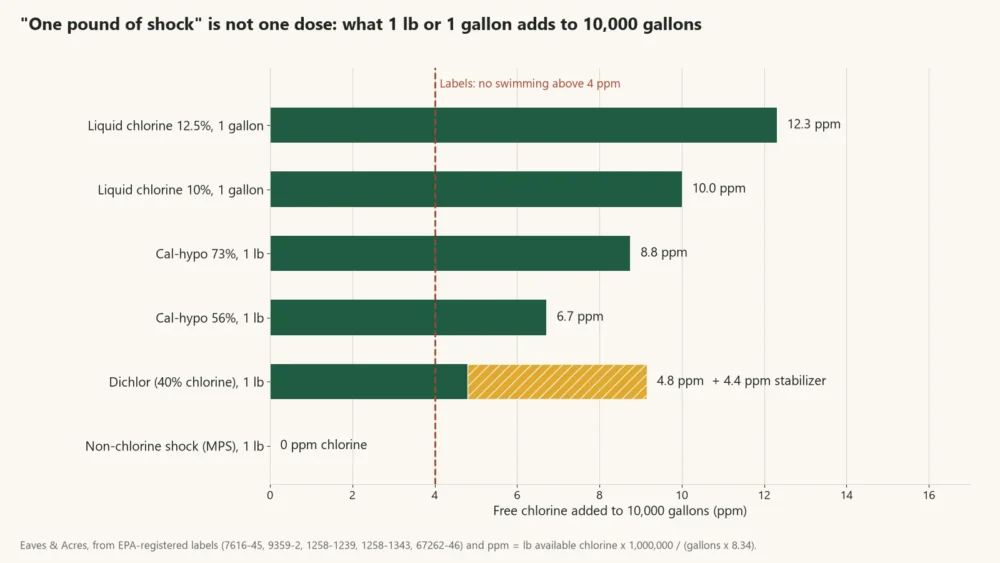
So “one pound per 10,000 gallons” can mean a 4.8 ppm dose or an 8.8 ppm dose, and Google’s AI answer treats one pound of granular shock and one gallon of liquid as the same dose when a gallon of 12.5% liquid adds about 12 ppm. The labels also agree on when swimmers can return:
Re-entry into treated pools is prohibited above 4 ppm due to risk of bodily harm.
CDC’s pool code annex adds that EPA has not approved any pool product for use above 4 ppm free chlorine while swimmers are present.2
How much shock for your pool size
Doses scale with gallons, so a 5,000-gallon pool takes half the 10,000-gallon dose and a 20,000-gallon pool takes double. If you don’t know your gallons, measure them with our pool volume calculator first: a 20% error in volume becomes a 20% error in every dose.
| Pool size | 10% liquid chlorine (10 ppm) | 12.5% liquid chlorine (10 ppm) | 73% cal-hypo (10 ppm) | Dichlor (4 ppm, plus 3.6 ppm stabilizer) |
|---|---|---|---|---|
| 1,000 gal | 12.8 fl oz | 10.4 fl oz | 1.8 oz | 1.3 oz |
| 5,000 gal | 64 fl oz (½ gal) | 52 fl oz | 9.1 oz | 6.7 oz |
| 10,000 gal | 1 gal | 104 fl oz (0.8 gal) | 18.3 oz (1.1 lb) | 13.3 oz |
| 15,000 gal | 1.5 gal | 1.2 gal | 1.7 lb | 1.25 lb |
| 20,000 gal | 2 gal | 1.6 gal | 2.3 lb | 1.7 lb |
| 25,000 gal | 2.5 gal | 2 gal | 2.9 lb | 2.1 lb |
| 30,000 gal | 3 gal | 2.4 gal | 3.4 lb | 2.5 lb |
The liquid and cal-hypo columns use each label’s top shock rate; half of each amount gives the bottom of the range, about 5 ppm.3,4,5 The dichlor column is that label’s single dose.7 For HTH Pool Care Shock Advanced, the label’s own chart gives 12 ounces for 10,000 gallons, 24 ounces for 20,000 and 36 ounces for 30,000.6
Small and above-ground pools
Pre-measured bags are sized for big pools, so check the label’s small-pool line instead. HTH Pool Care Shock Advanced gives 1.2 ounces per 1,000 gallons for pools up to 10,000 gallons.6 The dichlor label gives 3.5 teaspoons per 500 gallons, or 1.3 ounces per 1,000 gallons, for small vinyl pools.7 By the formula above, a whole 1-pound bag of 73% cal-hypo in a 1,000-gallon pool would add about 88 ppm.
Routine shock or SLAM: which one you need
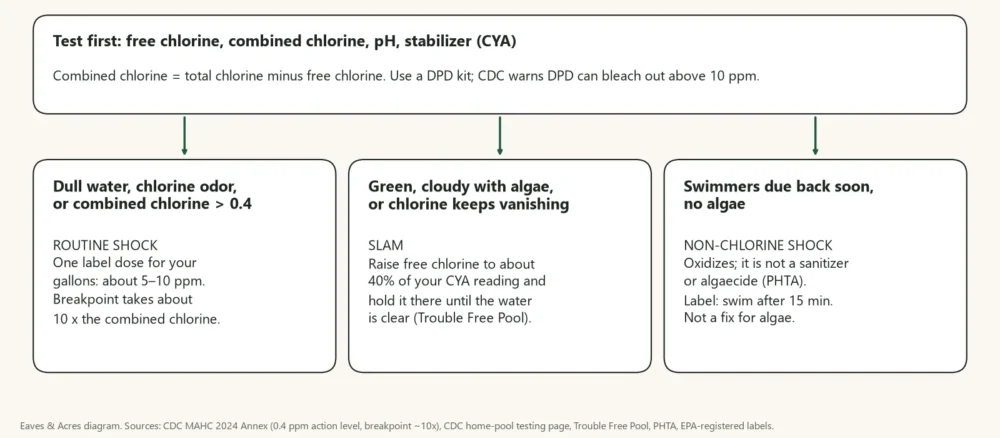
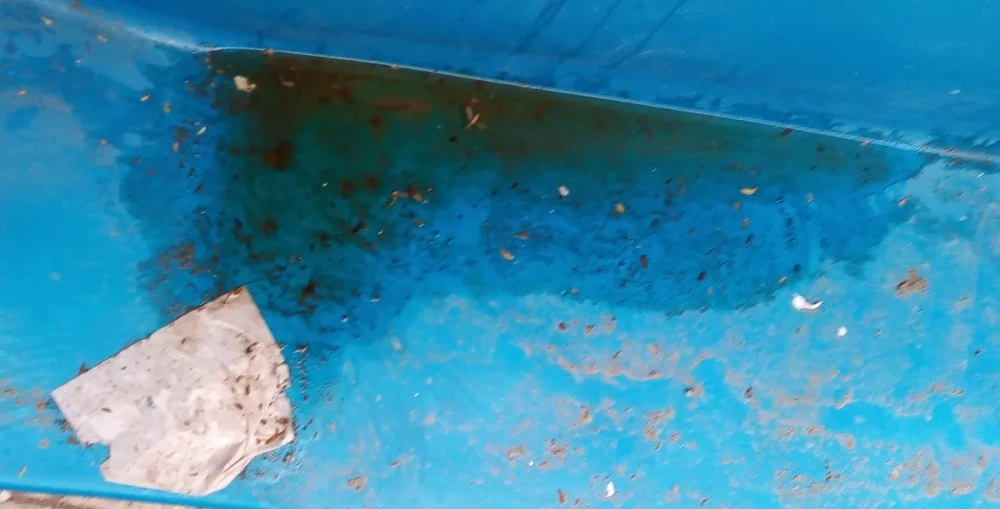
“Shock” covers two different jobs. A routine shock burns off the chloramines that swimmers and debris leave behind. A SLAM kills an algae bloom by holding chlorine high for as long as it takes. Your test results tell you which one you need.
Routine shock clears combined chlorine
The labels call for a shock every week and after heavy swimming, rain, wind, cloudy water, odors or eye irritation.6 The number to watch is combined chlorine: total chlorine minus free chlorine. CDC’s Model Aquatic Health Code (MAHC) Annex sets 0.4 ppm as the level where public pools should act.2 To get there, the shock has to pass “breakpoint,” which the Annex says takes:
approximately 10 times the amount of combined chlorine in the water
Sizing a routine shock
- Scenario
- 15,000-gallon pool; free chlorine 2.5 ppm, total chlorine 3.1 ppm, so combined chlorine is 0.6 ppm. Shock with 10% liquid chlorine.
- Math
- Breakpoint needs about 0.6 × 10 = 6 ppm. The label adds 1 ppm per 13 fl oz per 10,000 gallons: 6 × 13 × 1.5 = 117 fl oz.
- Answer
- About 117 fl oz (just under 1 gallon) in the evening with the pump running. That is inside the label’s 5–10 ppm shock range. Retest the next morning.
SLAM: hold shock level until the algae is gone
SLAM stands for Shock Level And Maintain, a method from Trouble Free Pool, a large pool-owner forum. Its chart sets the shock level at about 40% of your stabilizer reading: 12 ppm at 30 ppm CYA, 20 ppm at 50 and 31 ppm at 80.12 You hold that level, testing and topping up through the day, until the water is clear, combined chlorine is 0.5 ppm or less and the pool loses no more than 1 ppm overnight.16 Trouble Free Pool calls SLAM levels safe for swimmers;12 the labels do not, so keep everyone out until chlorine is 4 ppm or less.5
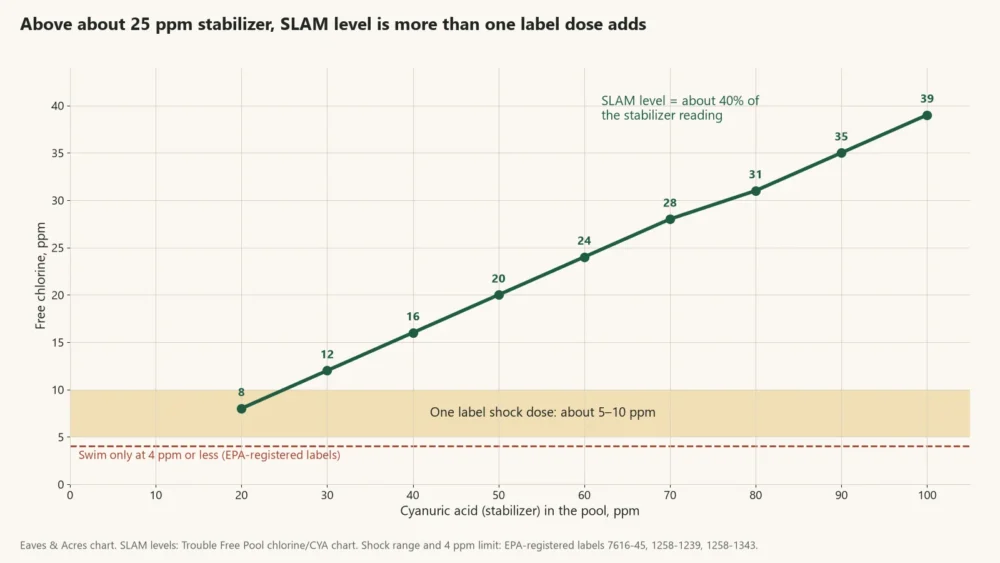
Above about 25 ppm stabilizer, the SLAM level is higher than one label dose adds, so a SLAM means repeated doses. Table 3 shows the first top-up for a 10,000-gallon pool starting at 3 ppm.
| Stabilizer (CYA) | SLAM free chlorine | 10% liquid chlorine | 73% cal-hypo |
|---|---|---|---|
| 20 ppm | 8 ppm | 65 fl oz | 9.1 oz |
| 30 ppm | 12 ppm | 117 fl oz (0.9 gal) | 16.5 oz |
| 40 ppm | 16 ppm | 169 fl oz (1.3 gal) | 1.5 lb |
| 50 ppm | 20 ppm | 221 fl oz (1.7 gal) | 1.9 lb |
| 60 ppm | 24 ppm | 273 fl oz (2.1 gal) | 2.4 lb |
| 70 ppm | 28 ppm | 325 fl oz (2.5 gal) | 2.9 lb |
| 80 ppm | 31 ppm | 364 fl oz (2.8 gal) | 3.2 lb |
| 90 ppm | 35 ppm | 416 fl oz (3.3 gal) | 3.7 lb |
Two cautions before you start. CDC warns that DPD test kits can bleach out above 10 ppm and read falsely low, so a SLAM needs a test that reads high levels.1 And every pound of cal-hypo adds calcium too: about 0.7 ppm of calcium hardness per ppm of chlorine, by our calculation from its formula, which builds up over a long SLAM.14
Why stabilizer sets the shock dose
Cyanuric acid shields chlorine from sunlight, but it also holds chlorine in a weaker form. That is why CDC asks for at least 2 ppm free chlorine in stabilized pools instead of 1 ppm.1 The MAHC Annex goes further: chlorine should rise in proportion to stabilizer.2 Its superchlorination table shows how much: at the same 5 ppm free chlorine, the fast-acting form, hypochlorous acid, falls from 2.42 ppm with no stabilizer to 0.043 ppm at 50 ppm CYA, about 56 times less.2 That is the logic behind a CYA-based shock level.
Dichlor and trichlor add stabilizer with every dose
PHTA, the pool industry’s trade association, says trichlor adds 0.6 ppm of cyanuric acid for each ppm of chlorine.10 Dichlor adds more. From the molecular weights in PubChem, the dichlor dihydrate in our label adds 0.91 ppm of stabilizer per ppm of chlorine; the same math gives 0.61 for trichlor, matching PHTA’s figure.14 Liquid chlorine and non-chlorine shock add none.9,14 So the more you shock with dichlor, the higher your SLAM target climbs.
How much stabilizer a season of dichlor shock adds where you live
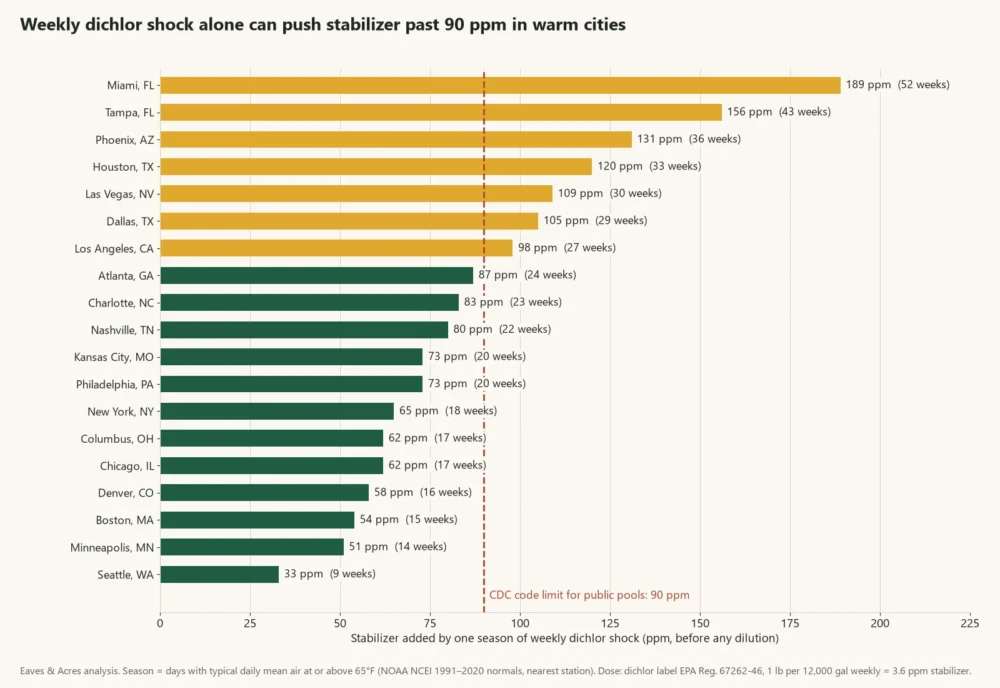
The dichlor label says to apply it weekly, and each dose adds 3.6 ppm of stabilizer.7 How many weeks that adds up to depends on your climate. We counted the days when the typical daily mean air temperature is at or above 65°F, the same threshold our guide to when to close your pool uses, from NOAA’s 1991–2020 normals for the station nearest each ZIP code.15
| City | Days at or above 65°F mean | Weekly doses | Stabilizer added |
|---|---|---|---|
| Seattle, WA | Jul 1–Sep 2 | 9 | 33 ppm |
| Minneapolis, MN | Jun 5–Sep 7 | 14 | 51 ppm |
| Boston, MA | Jun 7–Sep 17 | 15 | 54 ppm |
| Denver, CO | Jun 1–Sep 18 | 16 | 58 ppm |
| Chicago, IL | May 27–Sep 21 | 17 | 62 ppm |
| Columbus, OH | May 24–Sep 19 | 17 | 62 ppm |
| New York, NY | May 23–Sep 27 | 18 | 65 ppm |
| Philadelphia, PA | May 13–Oct 2 | 20 | 73 ppm |
| Kansas City, MO | May 11–Sep 29 | 20 | 73 ppm |
| Nashville, TN | May 6–Oct 3 | 22 | 80 ppm |
| Charlotte, NC | May 1–Oct 7 | 23 | 83 ppm |
| Atlanta, GA | Apr 29–Oct 10 | 24 | 87 ppm |
| Los Angeles, CA | May 5–Nov 6 | 27 | 98 ppm |
| Dallas, TX | Apr 8–Oct 27 | 29 | 105 ppm |
| Las Vegas, NV | Apr 5–Oct 29 | 30 | 109 ppm |
| Houston, TX | Mar 24–Nov 7 | 33 | 120 ppm |
| Phoenix, AZ | Mar 11–Nov 16 | 36 | 131 ppm |
| Tampa, FL | Feb 18–Dec 15 | 43 | 156 ppm |
| Miami, FL | All year | 52 | 189 ppm |
Across 40,906 ZIP codes, the median season is 17 weeks, which adds 62 ppm. Weekly dichlor alone would push stabilizer past 50 ppm in 73% of ZIP codes and past 90 ppm, the MAHC limit for public pools, in 19%.2 At 90 ppm the SLAM level is 35 ppm, about 3½ gallons of 10% liquid chlorine in a 10,000-gallon pool starting from zero.
Non-chlorine shock: an oxidizer, not a sanitizer
Non-chlorine shock is potassium monopersulfate (MPS). It burns off organic waste without raising chlorine, which is why the label lets you swim 15 minutes later.8 It doesn’t replace chlorine:
Potassium monopersulfate is not a sanitizer or algaecide
The label we read calls for 1 pound per 10,000 gallons weekly and 2 pounds for the first treatment, and twice a week when the water is above 86°F or the pool sees heavy use.8 Two catches: leftover MPS reads as combined chlorine on DPD tests, so test before you add it,9 and the MAHC Annex notes it may not reduce the inorganic chloramines that a chlorine shock destroys.2
How to add shock safely
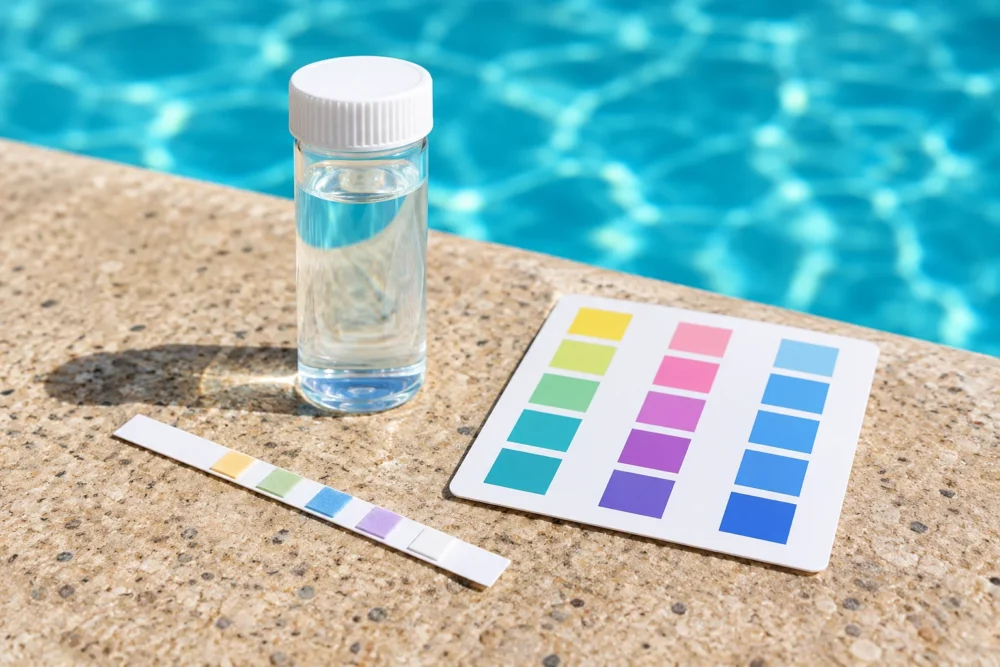
- Test first. Free and total chlorine, pH and stabilizer decide the dose; see our ideal pool chemical levels for the targets.
- Adjust pH. The dichlor and liquid labels both ask for pH 7.2–7.6.7,3
- Measure the dose for your gallons from your own label, using Table 2 as a cross-check.
- Add it in the evening with the pump running. The 10% liquid label says to add it at night while running the pump and filter.3 Broadcast granules over the deep end and brush any that settle.6
- Use the skimmer only if your label allows it. The dichlor label rules out the skimmer and chemical feeders because other chemicals there could cause a violent reaction.7 HTH’s label allows slow skimmer addition only with the skimmer emptied and no feeder in the system.6
- Circulate and retest. Run the filter 4–8 hours after a routine dose and 24 hours for algae, then test before anyone swims.7
Shock at opening, at closing and in salt pools
At opening, the 10% liquid label uses its shock rate, 64–128 fluid ounces per 10,000 gallons, for start-up.3 HTH’s label says to balance the water, add a shock dose and repeat as needed until free chlorine reads 1–4 ppm.6
Closing doses vary more than any other. For water that is already clear, the 10% liquid label adds 40 fluid ounces per 10,000 gallons for 3 ppm,3 HTH Granular 73 uses 27 ounces for 15 ppm,5 and the dichlor label uses 1 pound per 6,000 gallons.7 Our guide to closing your pool covers timing.
Salt pools can be shocked with any of these. The MAHC Annex notes that a salt cell may not make chlorine fast enough to reach shock levels, so a separate chlorine product may be needed.2 Remember that cal-hypo adds calcium and dichlor adds stabilizer, and check salt with our pool salt calculator.
Before you buy more shock
If chlorine keeps vanishing or the water stays green after a full SLAM, test stabilizer before buying more shock: a high CYA reading raises the target every time. For the full set of target ranges, see ideal pool chemical levels, and find more guides in our water chemistry section.
Frequently asked questions
Yes. Above the label dose you waste product and keep the pool closed longer, because the labels prohibit swimming above 4 ppm chlorine. Repeated dichlor raises stabilizer and repeated cal-hypo raises calcium, so test before adding a second dose.
When a test shows free chlorine at 4 ppm or less, the limit on the EPA-registered labels. The dichlor and non-chlorine shock labels we read allow swimming 15 minutes after a dose, because their doses add little or no chlorine.
Yes, if your test shows chlorine has dropped and your label allows a repeat. HTH's label says to repeat the dose as needed, and the dichlor label allows a second algae treatment after 72 hours. A SLAM tops up chlorine several times a day until the water clears.
Yes. The labels say to add shock with the pump and filter running. The dichlor label calls for 4–8 hours of filtering after a routine dose and 24 hours after an algae dose; the 10% liquid label says to add it at night and check in the morning.
In a 10,000-gallon pool, yes for a routine shock. By the label math, a gallon of 10% liquid chlorine adds about 10 ppm, the top of the label's 5–10 ppm shock range, and a gallon of 12.5% adds about 12 ppm. In 20,000 gallons the same gallon adds only 5–6 ppm, and green water needs a SLAM level instead, such as 16 ppm at 40 ppm stabilizer.
There is no fixed time. Trouble Free Pool keeps a SLAM going until three tests pass: the water is clear, combined chlorine is 0.5 ppm or less, and the pool loses no more than 1 ppm of chlorine overnight. Keep brushing and running the filter in the meantime.
The 10% liquid chlorine label we read gives 64–128 fl oz (½ to 1 gallon) per 10,000 gallons for 5–10 ppm. A 12.5% label gives 52–104 fl oz for the same result. Check the strength on your bottle, because the dose scales with it.
Yes. Liquid chlorine labels carry superchlorination (shock) directions, and sodium hypochlorite adds no stabilizer or calcium. Trouble Free Pool recommends plain, unscented liquid chlorine for a SLAM whenever possible, because cal-hypo adds calcium and dichlor adds stabilizer.
Sources
- 1.Home Pool and Hot Tub Water Treatment and Testing. Centers for Disease Control and Prevention, 2024. Used for: chlorine minimums with and without stabilizer, DPD test bleach-out above 10 ppm Back to text
- 2.Model Aquatic Health Code Annex, 5th Edition (2024 MAHC Annex). Centers for Disease Control and Prevention, 2025. Used for: breakpoint (about 10× combined chlorine), 0.4 ppm combined-chlorine action level, EPA 4 ppm with bathers, chlorine proportional to CYA, superchlorination table (5 ppm FC), 90 ppm CYA limit, salt pools, non-chlorine oxidizers Back to text
- 3.Chlorinating Liquid label, 10% sodium hypochlorite (EPA Reg. No. 7616-45). KIK Pool Additives / U.S. EPA, 2024. Used for: 13 fl oz per 10,000 gal = 1 ppm; shock and start-up 64–128 fl oz; re-entry below 4 ppm; winterizing 40 fl oz; pH 7.2–7.6; add at night Back to text
- 4.Surchlor 12.5% sodium hypochlorite label (EPA Reg. No. 9359-2). Surpass Chemical Company / U.S. EPA, 2017. Used for: superchlorination 52–104 oz per 10,000 gal for 5–10 ppm Back to text
- 5.HTH Granular 73 label, 73% calcium hypochlorite (EPA Reg. No. 1258-1239). Innovative Water Care / U.S. EPA, 2025. Used for: shock 9–18 oz per 10,000 gal for 5–10 ppm; dose chart (8.75 ppm per lb in 10,000 gal); re-entry above 4 ppm prohibited; winterizing 27 oz = 15 ppm Back to text
- 6.HTH Pool Care Shock Advanced label, 56.44% calcium hypochlorite (EPA Reg. No. 1258-1343). Innovative Water Care / U.S. EPA, 2021. Used for: 1 lb per 13,500 gal, dose chart by pool size, small-pool rate, opening, when to shock, skimmer method, re-entry 1–4 ppm Back to text
- 7.T-0072 dichlor shock label, sold as Clorox Pool&Spa Shock XtraBlue+ (EPA Reg. No. 67262-46). Recreational Water Products / U.S. EPA, 2025. Used for: 72% dichlor dihydrate, 40% available chlorine; 1 lb per 12,000 gal weekly; 15-minute swim wait; no skimmer or feeder; filter 4–8 h / 24 h; closure 1 lb per 6,000 gal Back to text
- 8.Non-Chlorine Shock oxidizing treatment label (REV052024). Alliance Trading, Inc., 2024. Used for: 42.8% potassium peroxymonosulfate; 1 lb per 10,000 gal weekly, 2 lb initial, twice weekly above 86°F; swim after 15 minutes Back to text
- 9.Potassium monopersulfate: Non-chlorine shock. PHTA Recreational Water Quality Committee, ICC Building Safety Journal, 2020. Used for: not a sanitizer or algaecide; reads as combined chlorine on DPD tests; no stabilizer or calcium; may lower pH and alkalinity Back to text
- 10.Trichlor: The dependable pool performer. PHTA Recreational Water Quality Committee, ICC Building Safety Journal, 2020. Used for: trichlor adds 0.6 ppm cyanuric acid per ppm chlorine Back to text
- 11.Use of the term “shock” on non-pesticide labeling (letter to DuPont). U.S. Environmental Protection Agency, Antimicrobials Division, 2008. Used for: “shock” is a pesticide claim; non-pesticide products must say “Shock Oxidizer” or “Oxidizing Shock” Back to text
- 12.CYA Chlorine Relationship (chlorine/CYA chart). Trouble Free Pool, n.d. Used for: SLAM level about 40% of CYA, chart values, SLAM finish criteria Back to text
- 13.Use Pool Chemicals Safely (poster CS317109-B). Centers for Disease Control and Prevention, n.d. Used for: never mix chlorine with acid or different chlorine products; add chemical to water; pre-dissolve only if the label says Back to text
- 14.Cyanuric acid (CID 7956); sodium dichloroisocyanurate dihydrate (CID 23667638); trichloroisocyanuric acid (CID 6909); calcium hypochlorite (CID 24504). National Library of Medicine, PubChem, 2026. Used for: molecular weights for stabilizer per ppm chlorine (dichlor 0.91, trichlor 0.61) and calcium from cal-hypo (about 0.7 ppm per ppm) Back to text
- 15.U.S. Climate Normals 1991–2020. NOAA National Centers for Environmental Information, 2021. Used for: monthly mean temperatures behind the season length for 19 cities and 40,906 ZIP codes Back to text
- 16.SLAM: Shock Level and Maintain. Trouble Free Pool, 2018. Used for: SLAM finish criteria (CC 0.5 ppm or lower, overnight chlorine loss 1.0 ppm or less, clear water); plain liquid chlorine preferred for a SLAM Back to text
How this guide was made
- Written by the Pool Desk and reviewed by the Data & Methodology Desk.
- Data: shock doses transcribed from the EPA-registered labels for EPA Reg. Nos. 7616-45, 9359-2, 1258-1239, 1258-1343 and 67262-46 and one non-chlorine shock label; ppm = lb available chlorine × 1,000,000 ÷ (gallons × 8.34), checked against the HTH Granular 73 and 10% liquid label charts; stabilizer and calcium per ppm from PubChem molecular weights; SLAM levels from Trouble Free Pool; season length = days with typical daily mean air at or above 65°F from NOAA NCEI U.S. Climate Normals 1991–2020 (station nearest each ZIP code), an air-temperature estimate that ignores dilution. See our methodology.
- AI use: AI tools help us research, draft and check this guide. Every figure is checked against the source cited for it, and calculated figures come from our own code, described on the methodology page.
- Spotted an error? Tell us — the form opens with this page’s address filled in.
Change log
- Oct 4, 2026Published. Shock doses read from five EPA-registered labels and one non-chlorine shock label and converted to ppm; SLAM levels from Trouble Free Pool; stabilizer build-up from weekly dichlor computed for 19 cities and 40,906 ZIP codes from NOAA 1991–2020 normals.
- Oct 7, 2026Re-checked doses, quotes and limits against the labels, CDC and the MAHC Annex; added an FAQ on whether one gallon of liquid chlorine is enough to shock; the SLAM finish tests now cite Trouble Free Pool’s SLAM page instead of its chlorine/CYA chart.
Covers pool and hot tub water chemistry, opening and closing. We maintain the dosing calculators and check every rate against product chemistry and public health guidance.
Keep reading
Saltwater vs Chlorine Pool: What Changes and What It Costs
A saltwater pool is a chlorine pool: a salt cell makes the chlorine. Cell electricity and wear per gallon of liquid chlorine replaced, upkeep and corrosion from the manuals, and the stabilizer tablets add in 19 US cities.
Ideal Pool Chemical Levels: The Ranges and Who Sets Them
Free chlorine 2–3 ppm, pH 7.4–7.6, alkalinity 80–120 ppm, calcium 200–400 ppm, stabilizer 30–50 ppm: every range tied to CDC or a manufacturer’s manual.
How to Winterize a Hot Tub, and When to Keep It Running
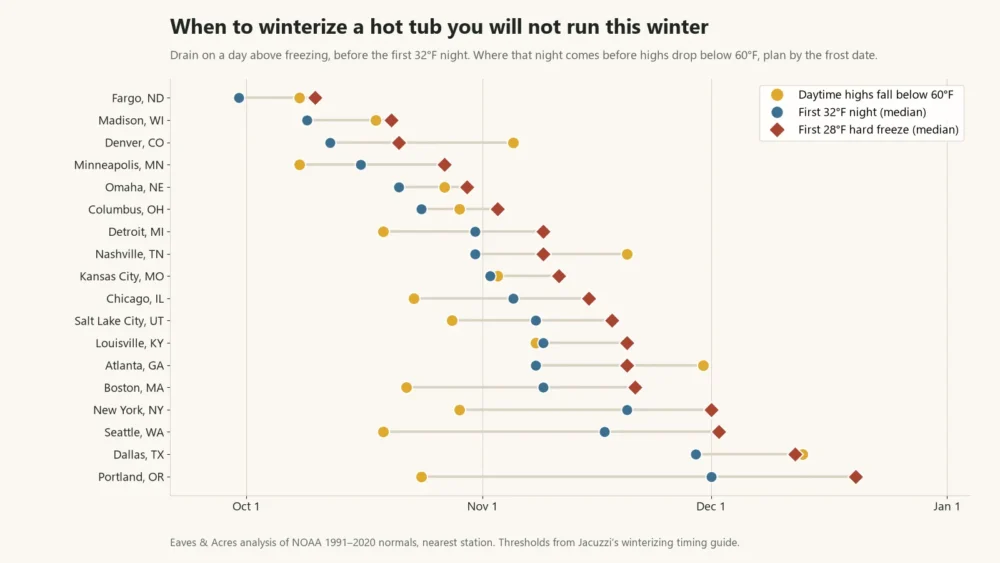
Hot tub makers say a tub kept full, heated and covered protects itself from freezing. When to drain and winterize instead, with NOAA freeze dates and winter running costs for 21 US cities.
Seasonal reminders for your ZIP
Get a short email when it’s time to overseed, start seeds, open the pool or service your furnace — timed to your climate.