




When to Open Your Pool: Estimated Dates for Your City and State
Open before the water warms past 60°F and after freezing nights end. Here is when that typically happens in 49 cities, estimated from NOAA climate normals, and how the popular 70°F rule compares.
- Last reviewed Oct 7, 2026
- 15 cited sources
- 11 min read
Set your ZIP to see dates for your area.
- 1Open before the water reaches 60°F, while algae still grows slowly, and after freezing nights end.
- 2The common rule, daytime highs of 70°F, lands within about a week of the 60°F daily-mean date in most inland cities, but later near cool water: May 31 in Atlantic City, Jun 9 in Seattle.
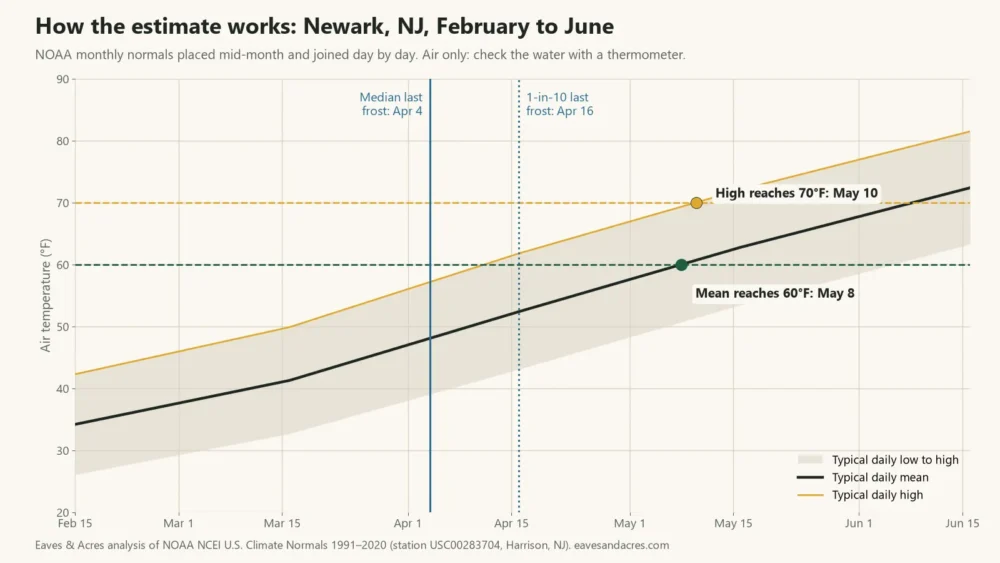
- 3In NOAA normals the typical daily mean air reaches 60°F around Apr 9 in Atlanta, Apr 28 in Philadelphia, May 8 in Newark and May 22 in Boston.
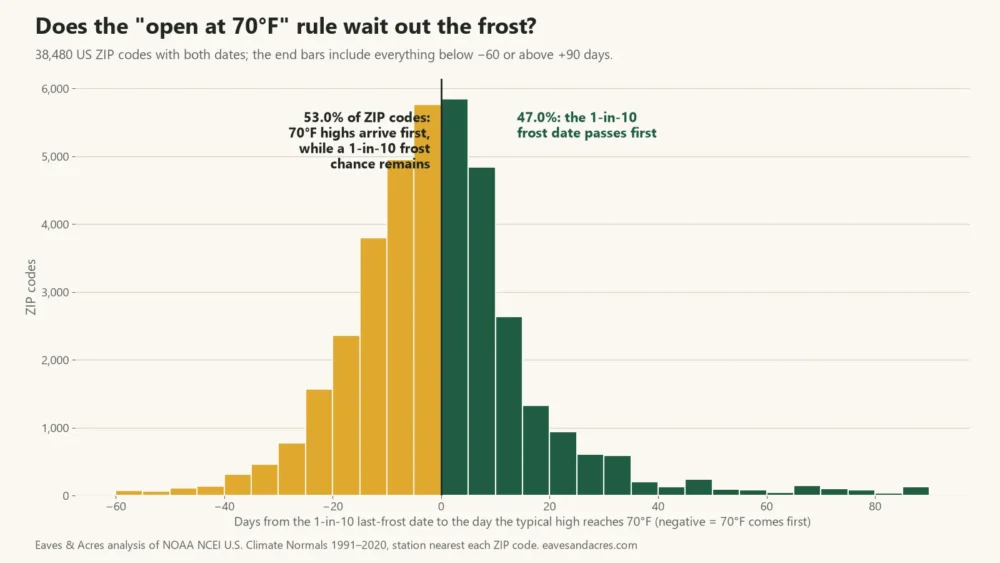
- 4In 53% of 38,480 US ZIP codes, 70°F highs arrive before the 1-in-10 last-frost date, mostly in the South and the Mountain West, so plan for a cold night after opening.
- 5Salt cells shut off in cold water (below 50°F for Hayward’s AquaRite, about 52°F for Pentair’s IntelliChlor), so add chlorine yourself at an early opening.
Open your pool before the water warms past about 60°F, when algae starts to grow faster, and after the freezing nights that can crack pipes and equipment are over. Most guides shorten this to “when daytime highs stay above 70°F.” In NOAA climate normals, that falls in March in much of Texas, in April across the Southeast and Mid-Atlantic, and from mid-May into early June in New England, the Great Lakes and the Pacific Northwest.
We added dates. Using NOAA’s 1991–2020 climate normals and the same method as our pool-closing guide, we found three dates for 49 US cities: when freezing nights usually end, when the typical daily mean air temperature reaches 60°F, and when the typical high reaches 70°F. These are air-temperature estimates, so treat each date as the day to start reading your pool thermometer.
The opening temperature: water below 60°F, air at 70°F
The rule that matters is about the water. Trouble Free Pool’s Pool School opening guide puts it in one line:
Open your pool before the water temperature reaches 60°F.
Its reason: algae grows much slower in cold water, so an early opening greatly reduces the risk of a green pool.2 It is the mirror of the closing rule, where Trouble Free Pool waits until the water is solidly below 60°F.
Most pool brands give an air-temperature rule instead. Clorox Pool&Spa writes:
It’s time to open your pool when daytime temperatures consistently rise above 70 degrees.
River Pools and Pool Operation Management, a pool-operator training company, use the same 70°F figure.4,5 Other guides use lower triggers, and Table 1 shows how they differ.
| Cue | Who publishes it | What it protects against |
|---|---|---|
| Water still below 60°F | Trouble Free Pool | Algae, which grows much slower in cold water |
| Daytime air consistently above 70°F | Clorox Pool&Spa, River Pools, Pool Operation Management | Algae and pollen building up under the cover |
| Water consistently above 50°F | Hometown Pools (New Jersey) | Getting the water treated before it reaches 60°F |
| Air consistently above 50°F | Neave Outdoor (New York, Connecticut) | Algae growth in a pool left closed too long |
| No more freezing temperatures | Pool Operation Management | Water freezing in the lines and cracking them |
The water rule decides when to open; the freeze rule decides how early you can. Opening late costs time and money: Hometown Pools says green water from a delayed opening adds at least a week to the job.12 Build in lead time too: Swim University suggests opening 2–3 weeks before you plan to swim, so there is time to fix equipment and balance the water.11
When to open your pool: estimated dates by city
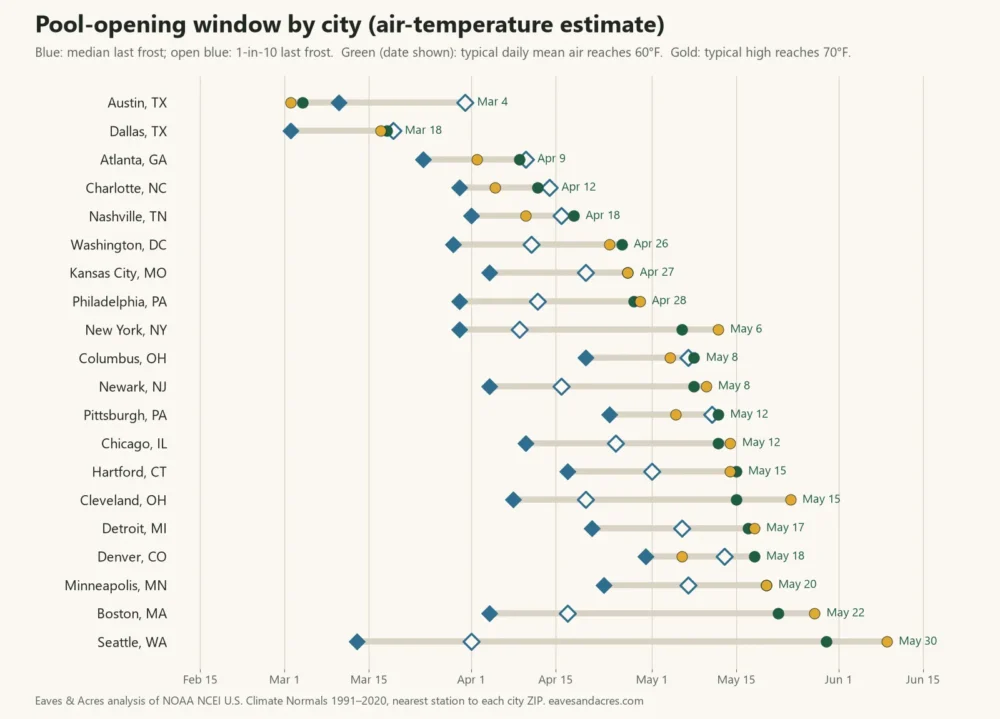
We placed each NOAA monthly normal at the middle of its month, joined the months day by day, and found the first spring day the typical daily mean air reaches 60°F and the typical high reaches 70°F.1 The frost columns come from NOAA’s frost normals for the nearest station: the median last 32°F night, and the date after which only 1 year in 10 still sees one.
| City (ZIP) | Median last frost (32°F) | 1-in-10 last frost | Air mean reaches 60°F | Typical high reaches 70°F |
|---|---|---|---|---|
| Minneapolis, MN (55401) | Apr 23 | May 7 | May 20 | May 20 |
| Detroit, MI (48201) | Apr 21 | May 6 | May 17 | May 18 |
| Boston, MA (02108) | Apr 4 | Apr 17 | May 22 | May 28 |
| Denver, CO (80202) | Apr 30 | May 13 | May 18 | May 6 |
| Salt Lake City, UT (84101) | Mar 31 | Apr 19 | May 10 | May 10 |
| Seattle, WA (98101) | Mar 13 | Apr 1 | May 30 | Jun 9 |
| Portland, OR (97204) | Feb 25 | Mar 21 | May 26 | May 29 |
| New York, NY (10001) | Mar 30 | Apr 9 | May 6 | May 12 |
| St. Louis, MO (63101) | Apr 1 | Apr 18 | Apr 23 | Apr 24 |
| Kansas City, MO (64105) | Apr 4 | Apr 20 | Apr 27 | Apr 27 |
| Louisville, KY (40202) | Mar 31 | Apr 14 | Apr 22 | Apr 21 |
| Washington, DC (20001) | Mar 29 | Apr 11 | Apr 26 | Apr 24 |
| Richmond, VA (23219) | Apr 3 | Apr 18 | Apr 22 | Apr 15 |
| Nashville, TN (37201) | Apr 1 | Apr 16 | Apr 18 | Apr 10 |
| Las Vegas, NV (89101) | Feb 1 | Feb 24 | Mar 13 | Mar 5 |
| Sacramento, CA (95814) | Jan 12 | Feb 8 | Apr 6 | Mar 28 |
| Phoenix, AZ (85004) | Rare | Rare | Feb 16 | Feb 8 |
Seattle is the clearest case against a calendar rule. Its median last frost is Mar 13, but the typical high doesn’t reach 70°F until Jun 9, so freezing risk is long gone by the time the 70°F rule says to open. Denver is the reverse: highs reach 70°F on May 6, a week before its 1-in-10 frost date. For any other ZIP code, look up your last-frost date and its odds.
Why your water and the air don’t agree
The USGS explains that water takes longer to heat up and longer to cool down than land, which is also why cities near oceans and lakes warm more slowly in spring.15 That shows in the table: near the water, highs are slow to reach 70°F, 16 days after the 60°F mean in Atlantic City and 9 in Cleveland, against 2 in Newark. Sunshine, especially through a mesh cover, also warms a pool, so the water can run ahead of or behind the air.
Plan with the table, then let a thermometer decide. Once your last-frost date has passed, check the water every few days and open before it reaches 60°F.
The other limit: late freezes
Pool Operation Management advises against opening while temperatures can still freeze, because freezing water in the lines can crack them.5 Hayward’s salt-cell manual adds that freezing water damages the cell and flow switch just as it does pool plumbing.6 Our guide to frost-date odds explains the 1-in-10 date. If temperatures drop sharply after you open, Swim University’s advice is to keep the pump running and put the cover back on until it warms up.11 Pentair’s manual also says continuous pumping prevents freeze damage to its cell.7
Does the 70°F rule wait out the frost?
In about half the country, no. We ran the same comparison for every ZIP code with both dates, 38,480 in all. In 53.0% of them, the typical high reaches 70°F before the 1-in-10 last-frost date. The median ZIP code reaches 70°F two days before that date and 15 days after its median last frost.
When to open a pool in NJ, PA, OH, TX and six more states
These ten states lead Google’s suggestions and related searches for this question. Inland and higher ground usually runs later than a coastal or big-city station.
| City (ZIP) | Median last frost (32°F) | 1-in-10 last frost | Air mean reaches 60°F | Typical high reaches 70°F |
|---|---|---|---|---|
| New Jersey | ||||
| Morristown, NJ (07960) | Apr 18 | May 6 | May 12 | May 10 |
| Newark, NJ (07102) | Apr 4 | Apr 16 | May 8 | May 10 |
| Cherry Hill, NJ (08002) | Apr 15 | May 1 | May 8 | May 7 |
| Atlantic City, NJ (08401) | Mar 26 | Apr 6 | May 15 | May 31 |
| Pennsylvania | ||||
| Erie, PA (16501) | Apr 26 | May 13 | May 20 | May 22 |
| Pittsburgh, PA (15222) | Apr 24 | May 11 | May 12 | May 5 |
| Harrisburg, PA (17101) | Apr 15 | May 2 | May 13 | May 12 |
| Philadelphia, PA (19103) | Mar 30 | Apr 12 | Apr 28 | Apr 29 |
| Ohio | ||||
| Cleveland, OH (44114) | Apr 8 | Apr 20 | May 15 | May 24 |
| Columbus, OH (43215) | Apr 20 | May 7 | May 8 | May 4 |
| Cincinnati, OH (45202) | Apr 16 | May 3 | May 4 | Apr 28 |
| Texas | ||||
| Dallas, TX (75201) | Mar 2 | Mar 19 | Mar 18 | Mar 17 |
| Austin, TX (78701) | Mar 10 | Mar 31 | Mar 4 | Mar 2 |
| San Antonio, TX (78205) | Feb 25 | Mar 19 | Mar 6 | Feb 27 |
| Houston, TX (77002) | Feb 2 | Mar 5 | Feb 27 | Mar 2 |
| Connecticut | ||||
| Hartford, CT (06103) | Apr 17 | May 1 | May 15 | May 14 |
| New Haven, CT (06510) | Apr 17 | May 1 | May 21 | May 25 |
| Stamford, CT (06901) | Apr 17 | May 2 | May 13 | May 10 |
| North Carolina | ||||
| Asheville, NC (28801) | Apr 6 | Apr 24 | Apr 27 | Apr 21 |
| Charlotte, NC (28202) | Mar 30 | Apr 14 | Apr 12 | Apr 5 |
| Raleigh, NC (27601) | Mar 28 | Apr 12 | Apr 14 | Apr 9 |
| Florida | ||||
| Jacksonville, FL (32202) | Feb 1 | Mar 3 | Feb 18 | Feb 21 |
| Orlando, FL (32801) | Rare | Rare | Year-round | Year-round |
| Tampa, FL (33602) | Rare | Rare | Year-round | Year-round |
| Miami, FL (33130) | Rare | Rare | Year-round | Year-round |
| Oklahoma | ||||
| Oklahoma City, OK (73102) | Apr 4 | Apr 20 | Apr 19 | Apr 12 |
| Tulsa, OK (74103) | Mar 31 | Apr 15 | Apr 14 | Apr 9 |
| Georgia | ||||
| Atlanta, GA (30303) | Mar 24 | Apr 10 | Apr 9 | Apr 2 |
| Savannah, GA (31401) | Mar 2 | Mar 25 | Mar 16 | Mar 10 |
| Illinois | ||||
| Rockford, IL (61101) | Apr 24 | May 8 | May 15 | May 13 |
| Chicago, IL (60601) | Apr 10 | Apr 25 | May 12 | May 14 |
| Springfield, IL (62701) | Apr 15 | Apr 30 | May 7 | May 5 |
New Jersey
Newark and Cherry Hill reach the 60°F air mark around May 8, Morristown around May 12, after a 1-in-10 frost date of May 6. Atlantic City is the odd one: its frost risk ends by early April, but the ocean holds back the air, and highs reach 70°F only on May 31.
Pennsylvania
Philadelphia is earliest, reaching 60°F around Apr 28. Harrisburg and Pittsburgh follow about two weeks later and Erie around May 20. Pittsburgh’s highs reach 70°F on May 5, before its 1-in-10 frost date of May 11.
Ohio
Cincinnati reaches 60°F around May 4, Columbus May 8 and Cleveland May 15. On the Cleveland lakefront the frost risk ends by Apr 20, but highs reach 70°F only on May 24.
Texas
Houston, Austin and San Antonio reach 60°F between Feb 27 and Mar 6, Dallas around Mar 18. The 1-in-10 frost dates run from Mar 5 in Houston to Mar 31 at Austin’s frost station, so early-March openings there need a freeze plan.
Connecticut
Hartford, New Haven and Stamford all have a 1-in-10 frost date of May 1 or 2. The air reaches 60°F between May 13 and May 21, latest at the New Haven shore.
North Carolina
Charlotte and Raleigh reach 60°F around Apr 12–14; Asheville, in the mountains, around Apr 27. In all three, highs reach 70°F before the 1-in-10 frost date.
Florida
In Orlando, Tampa and Miami the typical daily mean stays above 60°F all year and frost is rare, so the question there is less when to open than whether to close at all. Jacksonville reaches 60°F around Feb 18, with a 1-in-10 frost date of Mar 3.
Oklahoma
Tulsa reaches 60°F around Apr 14 and Oklahoma City around Apr 19. Both see 70°F highs about a week before their 1-in-10 frost dates of Apr 15 and Apr 20.
Georgia
Savannah reaches 60°F around Mar 16 and Atlanta around Apr 9, with 1-in-10 frost dates of Mar 25 and Apr 10.
Illinois
Springfield reaches 60°F around May 7, Chicago May 12 and Rockford May 15. Chicago’s temperatures come from Midway airport and its frost dates from a lakefront station, where frost ends earlier than in inland suburbs.
Do the dates match published regional advice?
Broadly, yes. The New Jersey and Virginia windows end close to our 60°F dates. The New York and Connecticut window starts in late March, before the frost risk ends there, and closes in early May, before the air reaches 60°F at most of its stations. None of these guides gives a date for a specific city.
| Region and source | Published window | Our estimate: 1-in-10 last frost; air mean reaches 60°F |
|---|---|---|
| Central New Jersey (Hometown Pools) | Late April to mid-May | Apr 16–May 6; May 8–12 |
| New York and Connecticut (Neave Outdoor) | Late March to early May | Apr 9–May 2; May 6–21 |
| Virginia (Perkinson Homes) | Mid-April to early May | Apr 11–18; Apr 22–24 |
| Most US owners (Swim University survey) | May 1–15 | Apr 6–May 13; Apr 28–May 22 (21 cities, Minnesota to New England) |
Sources: Hometown Pools, Neave Outdoor, Perkinson Homes and Swim University’s survey of 1,900 owners.12,13,14,11 The Virginia row uses Richmond and Virginia Beach; the New Jersey row uses Newark, Morristown and Cherry Hill.
Salt pools: the cell waits for warmer water
A salt chlorine generator won’t chlorinate cold water at opening. Hayward’s AquaRite manual says:
The AquaRite automatically stops generating when the pool water temperatures drops below 50°F.
Pentair’s IntelliChlor shuts off at 52°F, plus or minus 3°F.7 Hayward says not to turn the cell on until the water chemistry is in range. Pentair says to super-chlorinate from an outside source at start-up, then wait until chlorine is back to 2.0–4.0 ppm before switching the cell on.6,7 Trouble Free Pool starts its cell once the water is above 60°F and the salt has circulated for a day.2 Test salt at opening and work out any top-up with the pool salt calculator.
Opening steps at a glance
Every pool and equipment pad is different, so treat this as an overview and follow your equipment manuals and product labels.
Inspect the equipment
Clorox starts with a safety inspection of the equipment pad and says to call a service professional for loose wires or cracked lines.3
Test the water
CDC recommends at least 1 ppm free chlorine, or 2 ppm with stabilizer, and pH 7.0–7.8.8 Our ideal pool chemical levels guide covers the other ranges.
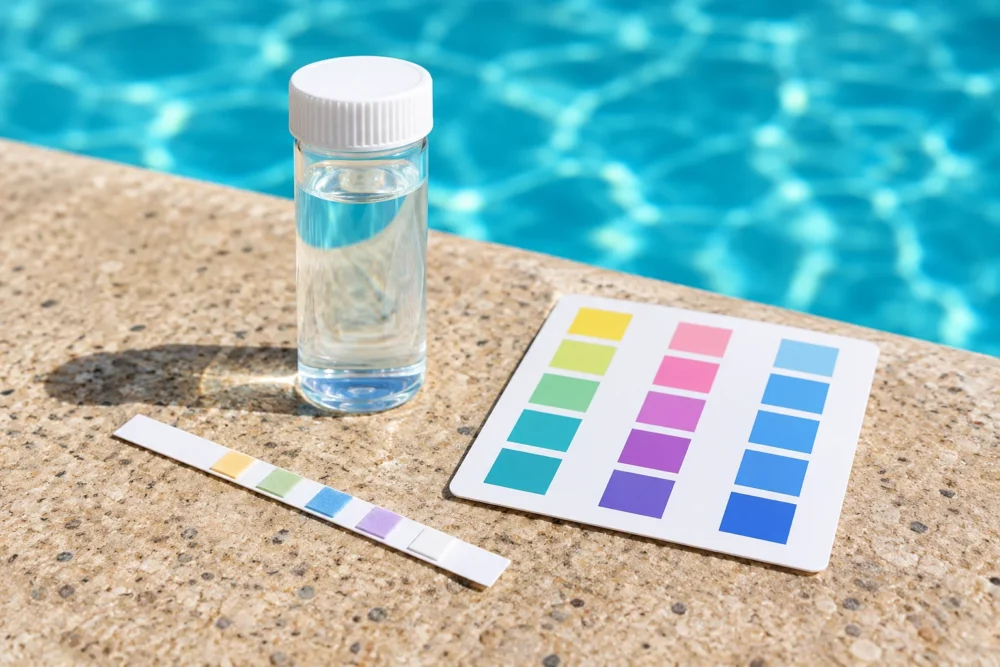
Test chlorine, pH, stabilizer, alkalinity and calcium before adding chemicals. Illustration: Eaves & Acres. Add chlorine first
Trouble Free Pool notes that most pools open with zero chlorine.2 One 10% liquid chlorine label gives 64–128 fl oz per 10,000 gallons for start-up, with no swimming until chlorine is below 4 ppm.10 Size the dose with the pool volume calculator and our guide to how much shock to add, which also covers green water.
This guide is general information, not professional advice; your manuals and product labels come first. See our estimates and safety disclaimer.
Next steps
Set your ZIP code above to see your last-frost date, and put two reminders in your calendar: your 1-in-10 frost date, to start checking the water, and your 60°F date. Then see the opening and closing section and the rest of Pool & Spa; our methodology page explains the numbers.
Frequently asked questions
It depends on your climate. In NOAA normals the typical daily mean air reaches 60°F between late February and mid-March in Houston, Austin and Dallas; in April across the Southeast, Oklahoma and the Mid-Atlantic; and in May from Ohio and New Jersey to New England and Minnesota. Open before your water reaches 60°F.
Not in much of Texas, Georgia and the desert Southwest: Dallas, Austin, Savannah and Las Vegas reach a 60°F daily mean in March, and Phoenix in February. Farther north it usually is, because median last frosts run to late April and the air reaches 60°F in late April or May.
Before it reaches 60°F. Trouble Free Pool says to open before then because algae grows much slower in cold water; Hometown Pools in New Jersey starts once the water is consistently above 50°F. A floating thermometer read every few days tells you where you are.
Swim University's survey of 1,900 pool owners found most open between May 1 and May 15, ahead of Memorial Day weekend. That fits the 21 cities from Minnesota to New England in our tables, which reach a 60°F daily mean between Apr 28 and May 22, but it is weeks late for the South.
Clear the cover before you lift it: pump standing water off a solid cover and remove leaves and debris so they don't fall into the pool. Then inspect the equipment, reconnect it, refill to the middle of the skimmer opening and start the pump.
Test first, then add chlorine, because most pools open with zero chlorine (Trouble Free Pool). The 10% liquid chlorine label we read gives 64–128 fl oz per 10,000 gallons for start-up. Then balance pH to CDC's 7.0–7.8 and the other levels, one product at a time.
Keep the pump running. Swim University advises leaving the pump on and putting the cover back on until it warms up, and Pentair's manual says running the pump continuously prevents freeze damage to its salt cell.
Sources
- 1.U.S. Climate Normals 1991–2020. NOAA National Centers for Environmental Information, 2021. Used for: monthly temperature normals and last-frost dates behind every city date and the ZIP-code analysis Back to text
- 2.Opening your pool: an easy to follow guide. Trouble Free Pool, Pool School, 2019. Used for: open before the water reaches 60°F; zero chlorine at opening; cover, circulation and salt-cell start-up steps Back to text
- 3.How to Open Your Swimming Pool for the Season. Clorox Pool&Spa, 2020. Used for: 70°F daytime rule; equipment safety inspection; opening steps Back to text
- 4.When is the Best Time to Open My Swimming Pool?. River Pools, 2026. Used for: 70°F daytime rule; algae and pollen Back to text
- 5.Certified Pool and Spa Operator Tips: When Should I Open My Pool?. Pool Operation Management, 2020. Used for: 70°F rule; do not open while temperatures can freeze Back to text
- 6.AquaRite Electronic Chlorine Generator Owner’s Manual (092538 Rev D). Hayward Pool Products, 2019. Used for: cell stops generating below 50°F water; freeze damage to cell; spring start-up Back to text
- 7.IntelliChlor Salt Chlorine Generator Installation and User’s Guide (P/N 520589 Rev R). Pentair, 2023. Used for: cell off at 52°F ± 3°F; super-chlorinate at start-up, then 2.0–4.0 ppm; continuous pumping against freeze damage Back to text
- 8.Home Pool and Hot Tub Water Treatment and Testing. Centers for Disease Control and Prevention, 2024. Used for: chlorine at least 1 ppm (2 ppm with stabilizer), pH 7.0–7.8 Back to text
- 9.Thousands Sent to Emergency Room by Preventable Pool Chemical Injuries. Centers for Disease Control and Prevention, 2014. Used for: pool chemical injury figures and safety rules Back to text
- 10.Chlorinating Liquid label, 10% sodium hypochlorite (EPA Reg. No. 7616-45). KIK Pool Additives / U.S. EPA, 2024. Used for: start-up dose 64–128 fl oz per 10,000 gal (5–10 ppm); no swimming above 4 ppm Back to text
- 11.When To Open Your Pool (Based On Where You Live). Swim University, 2026. Used for: owner survey (May 1–15); open 2–3 weeks before swimming; keep the pump running in a cold snap Back to text
- 12.Pool Opening Season: When New Jersey Pools Should Open. Hometown Pools, 2026. Used for: water 50°F and 60°F cues; central New Jersey window; cost of a late opening Back to text
- 13.When to Start Your Pool Opening in NY and CT. Neave Outdoor, 2025. Used for: 50°F air cue; New York and Connecticut window Back to text
- 14.How and When to Open Your Pool for the Season. Perkinson Homes, 2025. Used for: Virginia opening window Back to text
- 15.Specific Heat Capacity and Water. U.S. Geological Survey, Water Science School, 2026. Used for: why water and coastal air warm slowly in spring Back to text
How this guide was made
- Written by the Pool Desk and reviewed by the Data & Methodology Desk.
- Data: air-temperature opening estimates computed by Eaves & Acres from NOAA NCEI U.S. Climate Normals 1991–2020 monthly means, interpolated day by day between mid-month values, for the station nearest each ZIP code (the same method as our pool-closing guide); median and 1-in-10 last-frost (32°F) dates from the same normals; opening thresholds from Trouble Free Pool, Clorox Pool&Spa, River Pools and Pool Operation Management. Pool water warms on its own schedule, so these dates are a starting point for checking a thermometer, not an opening day. See our methodology.
- AI use: AI tools help us research, draft and check this guide. Every figure is checked against the source cited for it, and calculated figures come from our own code, described on the methodology page.
- Spotted an error? Tell us — the form opens with this page’s address filled in.
Change log
- Oct 4, 2026Published. Opening dates for 49 cities computed from NOAA 1991–2020 monthly normals with the same method as our pool-closing guide; the 70°F rule checked against 1-in-10 last-frost dates in 38,480 ZIP codes; opening cues read from Trouble Free Pool, Clorox Pool&Spa, River Pools, Pool Operation Management and the Hayward and Pentair salt-cell manuals.
- Oct 7, 2026Re-checked the opening cues, quotes and safety figures against Trouble Free Pool, Clorox, Pool Operation Management, Hometown Pools, Neave Outdoor, Perkinson Homes, Swim University, Hayward and CDC; added Swim University’s 2–3 week lead time; updated the Neave Outdoor link to its new address.
Covers pool and hot tub water chemistry, opening and closing. We maintain the dosing calculators and check every rate against product chemistry and public health guidance.
Keep reading
When to Close Your Pool: Estimated Dates for Your City and State
Close once the water stays below 65°F, or 60°F to be safer, and before freezing nights. Estimated dates for 46 cities from NOAA climate normals.
How to Winterize a Hot Tub, and When to Keep It Running
Hot tub makers say a tub kept full, heated and covered protects itself from freezing. When to drain and winterize instead, with NOAA freeze dates and winter running costs for 21 US cities.
How Much Does It Cost to Run a Hot Tub? The Math by City
The median hot tub certified in California costs about $25 a month to keep hot at the US average electricity price. Standby cost by month for 21 cities from CEC test data, NOAA normals and EIA prices.
Seasonal reminders for your ZIP
Get a short email when it’s time to overseed, start seeds, open the pool or service your furnace — timed to your climate.