



Pool Salt Calculator: How Much Salt Do I Add?
Answers: how much salt do I add?
Measure length, width and depth to get your pool’s volume in gallons and liters, then send it straight to the salt calculator.
83,400 liters · 2,944 cubic feet
Surface 512 sq ft × average depth 5.75 ft.
Saved on this device. Open the pool salt calculator and your size is already filled in.
One US gallon is exactly 231 cubic inches, so a cubic foot (1,728 cubic inches) holds 7.4805 gallons; one gallon is 3.785 liters. A sloped floor is averaged as (shallow + deep) ÷ 2, which is exact for an even slope and slightly high for a steep “hopper” deep end. Methodology
Pool volume is surface area times average depth times 7.4805, because one cubic foot holds 7.4805 US gallons. A 16 × 32 ft in-ground pool that slopes from 3.5 to 8 ft holds about 22,000 gallons; a 24 ft round above-ground pool with 4 ft of water holds about 13,500.
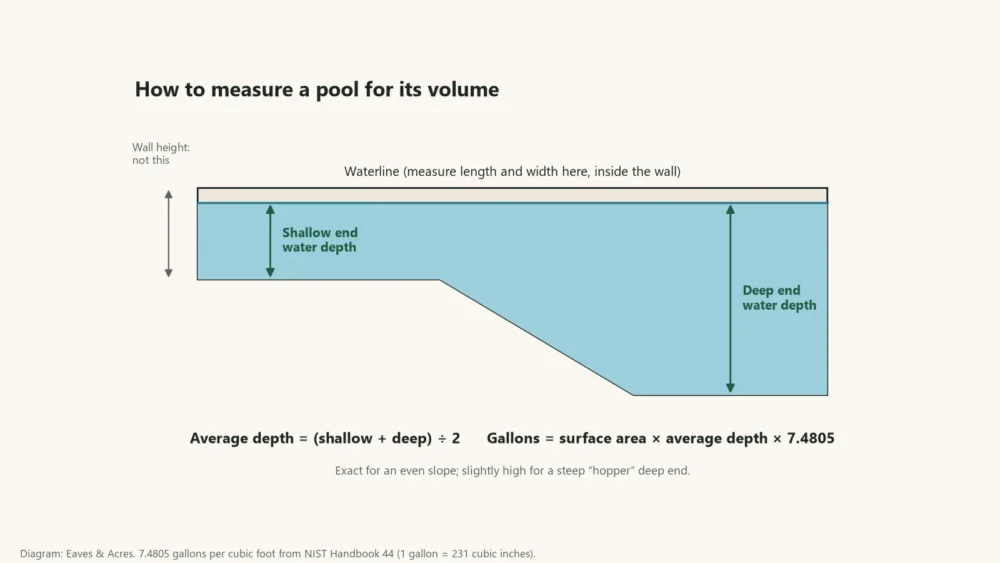
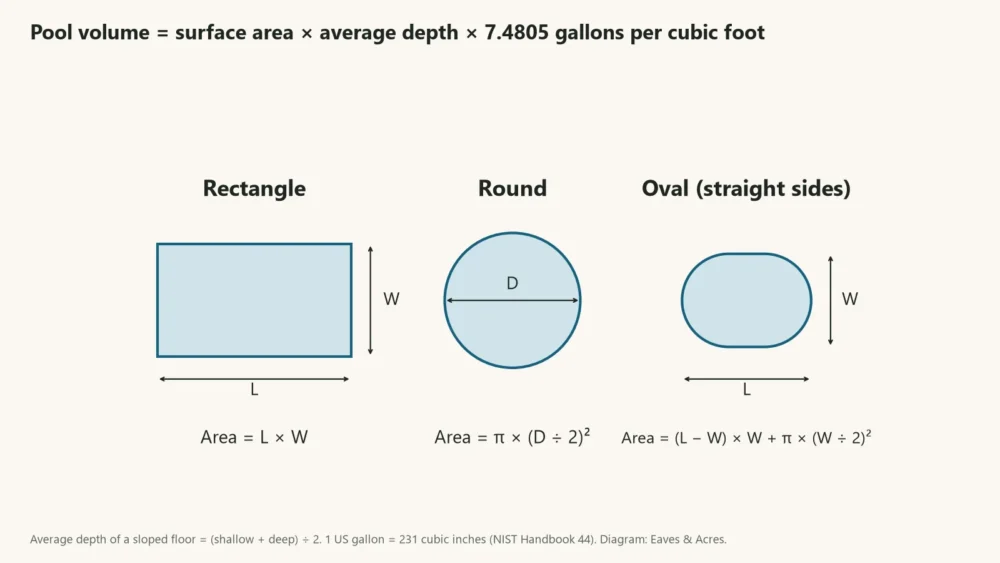
One US gallon is defined as exactly 231 cubic inches, and a cubic foot is 1,728 cubic inches, so a cubic foot holds 1,728 ÷ 231 = 7.4805 gallons.1 Many calculators round that to 7.5, which adds 0.3%. Every shape uses the same last step: area × average depth × 7.4805.
4 quarts = 1 gallon (gal) = 231 cubic inches
| Shape | Surface area | Gallons |
|---|---|---|
| Rectangle | length × width | area × average depth × 7.4805 |
| Round | π × (diameter ÷ 2)² | area × depth × 7.4805 |
| Oval with straight sides | (length − width) × width + π × (width ÷ 2)² | area × depth × 7.4805 |
| Kidney, L-shape, freeform | add up rectangles and circles | sum of sections × average depth × 7.4805 |
For a floor with an even slope, the average depth is (shallow + deep) ÷ 2. That is exact for a straight slope and slightly high for a pool with a steep “hopper” deep end, so treat the result as an upper bound in that case.
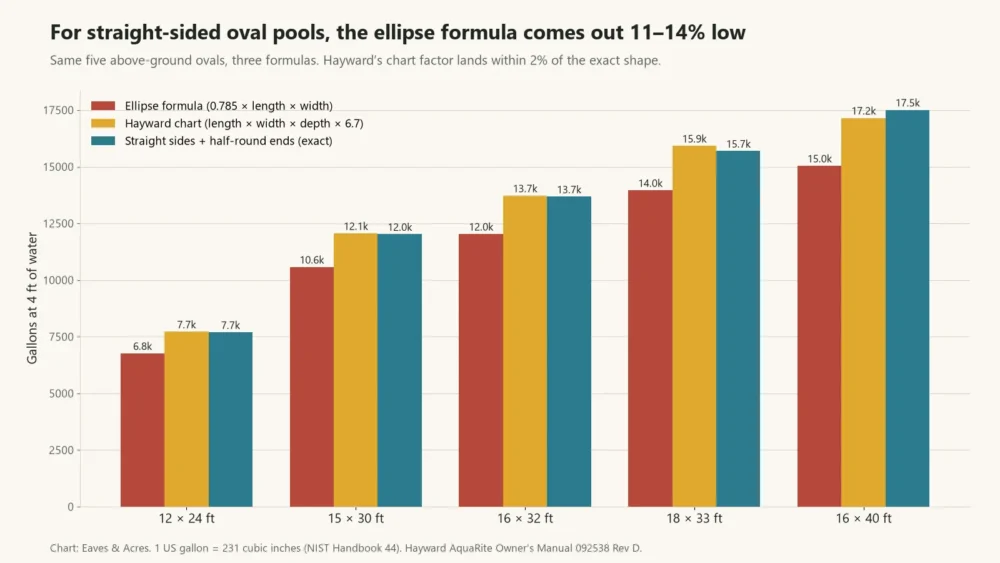
Many calculators, and Google’s own AI summary for this search, treat an oval pool as a true ellipse: length × width × 0.785, or length × width × depth × 5.9 with the gallon factor folded in. That 5.9 is the round-pool factor: Hayward’s chart uses it for diameter × diameter.2 Most oval pools sold for backyards have straight sides and half-round ends, which hold noticeably more water than an ellipse of the same length and width. For the 15 × 30 ft pool above, the ellipse formula gives about 10,575 gallons, roughly 1,445 gallons or 12% too low. Every chemical dose based on that number would be 12% short.
Pool equipment makers size it differently. The volume chart in Hayward’s AquaRite salt-system manual gives oval pools as length × width × average depth × 6.7,2 which works out to 0.893 of the rectangle instead of the ellipse’s 0.785. That is the same answer our straight-sided formula gives for a pool twice as long as it is wide.
| Pool | Ellipse (0.785) | Hayward chart (6.7) | Exact shape | Ellipse is low by |
|---|---|---|---|---|
| 12 × 24 ft | 6,768 | 7,718 | 7,693 | 12% |
| 15 × 30 ft | 10,575 | 12,060 | 12,020 | 12% |
| 16 × 32 ft | 12,032 | 13,722 | 13,676 | 12% |
| 18 × 33 ft | 13,959 | 15,919 | 15,693 | 11% |
| 16 × 40 ft | 15,040 | 17,152 | 17,506 | 14% |
The sizes people ask about most, worked through with the formulas above. Rectangles are shown at an even 4 ft and at a 5.5 ft average (for example, a floor sloping from 3.5 to 7.5 ft); ovals at 4 ft of water, typical of an above-ground pool.
| Size | Rectangle, 4 ft | Rectangle, 5.5 ft average | Straight-sided oval, 4 ft |
|---|---|---|---|
| 12 × 24 ft | 8,618 | 11,849 | 7,693 |
| 15 × 30 ft | 13,465 | 18,514 | 12,020 |
| 16 × 32 ft | 15,320 | 21,065 | 13,676 |
| 20 × 40 ft | 23,938 | 32,914 | 21,369 |
Your own depths will differ, which is why the calculator asks for them. A 6-inch difference in average depth on a 20 × 40 ft pool is about 3,000 gallons.
Salt, chlorine, shock and balancing chemicals are all dosed per gallon, so an error in volume becomes the same percentage error in every dose. Measure once, then press “Use in my pool tools”: the result is saved on your device and the pool salt calculator fills it in automatically. Our guides to ideal pool chemical levels and opening and closing a pool build on the same number, including when to close your pool for winter.

For the full method and its limits, see our methodology page.
About 13,500 gallons with 4 ft of water: π × 12² × 4 × 7.4805. Use your actual water depth; with 4.5 ft of water it is about 15,200 gallons.
About 22,000 gallons if the floor slopes evenly from 3.5 to 8 ft deep (average 5.75 ft). A pool that is 4 ft deep throughout holds about 15,300 gallons.
Add the shallow-end and deep-end water depths and divide by 2. For an evenly sloped floor that is exact; with a steep hopper-shaped deep end, the true volume is a little lower.
Split it into simple pieces, such as two circles or a rectangle and a circle, measure each one and add the areas. Choose “Other” in the calculator to add up to three sections.
Gallons = surface area in square feet × average depth in feet × 7.4805. The factor comes from the definition of the US gallon as 231 cubic inches.
Multiply gallons by 3.785. A 20,000-gallon pool holds about 75,700 liters.
About 23,900 gallons with an even 4 ft of water, or about 32,900 gallons at a 5.5 ft average depth: 800 sq ft × average depth × 7.4805.
A rectangle with 4 ft of water holds about 13,500 gallons. A straight-sided oval of the same size holds about 12,000; the ellipse formula many calculators use would say about 10,600.
About 8,600 gallons for a rectangle with 4 ft of water, or about 7,700 gallons for a straight-sided oval above-ground pool with 4 ft of water.
Answers: how much salt do I add?
Get a short email when it’s time to overseed, start seeds, open the pool or service your furnace — timed to your climate.