



Planting Zone by ZIP Code: What Zone Am I In?
Answers: what planting zone am I in?
Last spring and first fall frost for your ZIP at 10%, 30%, 50% and 90% odds, plus the 28°F hard-freeze dates, from the NOAA station nearest you, with its distance, elevation and your USDA zone.
| Chance | Last spring frost | First fall frost |
|---|
Nearest NOAA station: . 1991–2020 normals, 32°F threshold.
Your average last spring frost date is the day after which a 32°F night happens in only half of years. The safer date for tender plants comes about two weeks later: across 39,232 US ZIP codes, the 10% date falls a median 16 days after the average one.
Every result above shows four levels of odds for spring and fall, taken from NOAA’s 1991–2020 climate normals for the weather station nearest your ZIP code.1 Spring dates are the last 32°F night; fall dates are the first.
| Level | Spring (last frost) | Fall (first frost) | Use it for |
|---|---|---|---|
| 90% | Frost still comes after this date in 9 years out of 10 | Frost has already come by this date in 9 years out of 10 | Shows how early the frost-free season can start in a mild year |
| 50% (median) | Half of years have frost after it | Half of years have frost before it | Hardy crops, timing rules that cite the “average” date |
| 30% | 3-in-10 chance of a later frost | 3-in-10 chance of an earlier frost | The level many frost calculators show by default |
| 10% | Only a 1-in-10 chance of a later frost | Only a 1-in-10 chance of an earlier frost | Tender transplants and the last safe day for fall jobs |
The University of Maryland Extension explains the same logic with a Frederick, Maryland, example: a 32°F night is still likely after March 29 (90% odds) but unlikely after April 19 (10%), which it calls the “safer” planting date.2
An average frost date hides a wide window. We measured it for every ZIP code with full NOAA odds:
| Measure | Median | Middle half of ZIP codes |
|---|---|---|
| Spring window, 90% to 10% date | 31 days | 28–35 days |
| Fall window, 10% to 90% date | 28 days | 25–30 days |
| Safer 10% date after the median last frost | 16 days | 14–19 days |
| Last 32°F night after the last 28°F hard freeze | 12 days | — |
| First 28°F hard freeze after the first 32°F night (fall) | 11 days | 10–13 days |
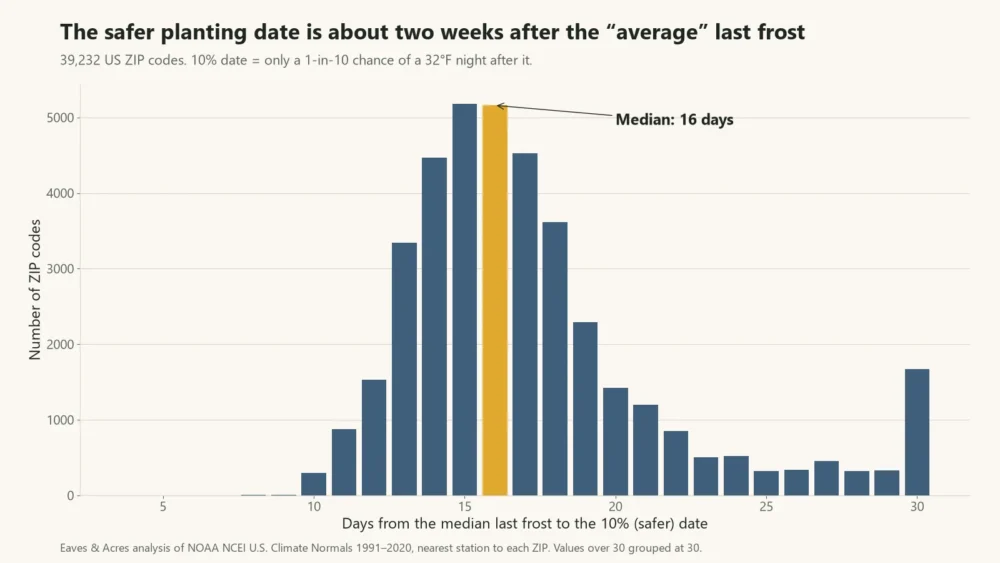
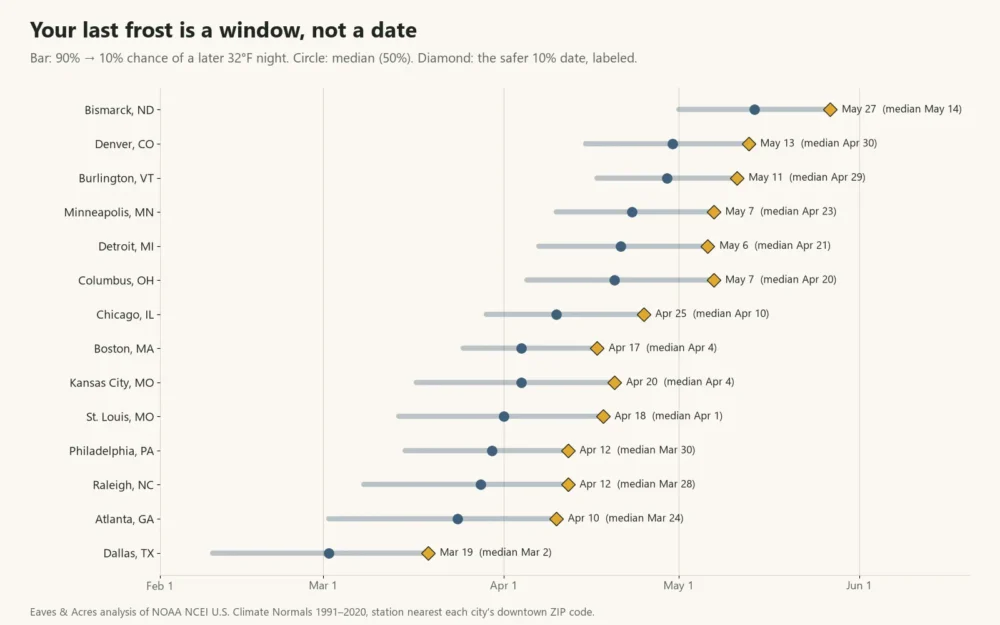
In practice: planting tender crops on the average date means a frost-damage gamble in one year out of two. Waiting about two more weeks cuts the odds to one in ten. For tomatoes, warm nights matter as much as frost; our guide on when to plant tomatoes shows that most ZIP codes should wait even longer.
The dates here use a 32°F air temperature, the standard freeze threshold in NOAA’s normals. Light frost can form on plants on clear, calm nights even when the official reading stays a few degrees above freezing, which is why the National Weather Service office in Memphis publishes separate “frost” dates at 36°F alongside its 32°F freeze dates.3 The 28°F hard freeze, which ends the season for most hardy plants, comes a median 11 days after the first 32°F night in fall (Table 2). It is the date our overseeding deadline counts back from, and our frost vs. freeze guide explains all three thresholds and the weather alerts for each.
Each ZIP code is matched to the nearest NOAA station with freeze statistics. The median distance is 7 miles, and 72% of ZIP codes are within 10 miles of their station. The result names the station and shows how far it is from your ZIP code. If the nearest station is more than 50 miles away, we don’t publish a date. Our methodology page lists every rule.
The likelihood of frost will vary between landscapes in the same town
Low spots where cold air pools, open ground away from buildings, and higher elevation all run colder than the station; south-facing walls and city centers run warmer. Treat your dates as a starting point and adjust a few days for your yard.

Your saved ZIP code fills in the dates on every guide on this site. Start with the garden guides for planting by frost date (seed starting counts back from the day each crop goes outside; garlic and tulip bulbs both go in around your first fall frost), our guide to when to cover plants for frost, the lawn guides for fall seeding and feeding, or the climate section for the data behind them.
Enter your ZIP code above. You get the median (50%) date and the safer 10% date from the NOAA weather station nearest you, with how far it is from your ZIP code, so you can judge how well it matches your yard.
The last frost date is the final 32°F night of spring; the first frost date is the first 32°F night of fall. The days between them are your frost-free growing season.
No. Across US ZIP codes the spring frost window from 90% to 10% odds spans a median 31 days, so in some years frost ends weeks earlier or later than average.
There is a 3-in-10 chance of a frost after that spring date, or before that fall date. Many calculators show only this level; we show 10%, 30%, 50% and 90% so you can choose your own margin.
No. USDA hardiness zones measure the coldest winter night, not when spring frost ends, so places in the same zone can have last frost dates weeks apart.
Either frost happens in fewer than half of years at the nearest station, so an average date isn’t meaningful, or no NOAA station with freeze records lies within 50 miles. Your state extension service is the best local source in that case.
Answers: what planting zone am I in?
Get a short email when it’s time to overseed, start seeds, open the pool or service your furnace — timed to your climate.