




When to Plant Tomatoes Outdoors: Dates for Where You Live
Waiting for the last frost is not enough: tomatoes also need warm nights. Here is the plant-out date for 26 US cities, computed from NOAA climate normals and checked against extension advice.
- Last reviewed Oct 4, 2026
- 17 cited sources
- 8 min read
Set your ZIP to see dates for your area.
- 1Plant when frost risk is down to one year in ten, nights average 50°F or warmer and the soil is about 60°F.
- 2In most of the US that is three to four weeks after the median last frost: about Apr 26 in Philadelphia, May 11 in Columbus and May 19 in Minneapolis.
- 3In 86% of 38,123 US ZIP codes, nights reach 50°F after frost risk has faded, so warm nights, not frost, set the planting date.
- 4Start seeds indoors about six weeks before your plant-out date, not your frost date.
- 5In Florida, Texas and the Arizona low desert, plant in early spring and again in late summer; fruit stops setting when nights stay above 70°F.
Plant tomatoes outdoors once the risk of frost has dropped to about one year in ten, nights average at least 50°F and the soil is about 60°F. For most of the US that is three to four weeks after the average last frost: about April 26 in Philadelphia, May 11 in Columbus and May 19 in Minneapolis.
Most guides stop at “after the last frost.” We tested that against NOAA’s 1991–2020 climate normals for 38,123 ZIP codes. In 86% of them, nights reach 50°F only after frost risk has faded, so warm nights, not frost, set the planting date.
Tomato planting dates for 26 US cities
Each plant-out date is the later of two dates: the 10% last-frost date (after it, a 32°F night comes in about one spring in ten) and the day the normal low reaches 50°F. Seed dates are six weeks earlier. Data come from the NOAA station nearest each ZIP code.1
| City (ZIP) | Plant tomatoes out | Start seeds indoors | Median last frost | 10% last frost | Average low reaches 50°F |
|---|---|---|---|---|---|
| Jacksonville, FL (32202) | Mar 3 | Jan 20 | Feb 1 | Mar 3 | Feb 13 |
| Houston, TX (77002) | Mar 5 | Jan 22 | Feb 2 | Mar 5 | Feb 21 |
| Dallas, TX (75201) | Mar 19 | Feb 5 | Mar 2 | Mar 19 | Mar 18 |
| Austin, TX (78701) | Mar 31 | Feb 17 | Mar 10 | Mar 31 | Mar 5 |
| Atlanta, GA (30303) | Apr 17 | Mar 6 | Mar 24 | Apr 10 | Apr 17 |
| Charlotte, NC (28202) | Apr 18 | Mar 7 | Mar 30 | Apr 14 | Apr 18 |
| Raleigh, NC (27601) | Apr 19 | Mar 8 | Mar 28 | Apr 12 | Apr 19 |
| St. Louis, MO (63101) | Apr 21 | Mar 10 | Apr 1 | Apr 18 | Apr 21 |
| Nashville, TN (37201) | Apr 24 | Mar 13 | Apr 1 | Apr 16 | Apr 24 |
| Kansas City, MO (64105) | Apr 25 | Mar 14 | Apr 4 | Apr 20 | Apr 25 |
| Philadelphia, PA (19103) | Apr 26 | Mar 15 | Mar 30 | Apr 12 | Apr 26 |
| Washington, DC (20001) | Apr 26 | Mar 15 | Mar 29 | Apr 11 | Apr 26 |
| New York, NY (10001) | Apr 29 | Mar 18 | Mar 30 | Apr 9 | Apr 29 |
| Newark, NJ (07102) | May 5 | Mar 24 | Apr 4 | Apr 16 | May 5 |
| Cleveland, OH (44113) | May 7 | Mar 26 | Apr 8 | Apr 20 | May 7 |
| Salt Lake City, UT (84101) | May 7 | Mar 26 | Mar 31 | Apr 19 | May 7 |
| Chicago, IL (60601) | May 9 | Mar 28 | Apr 10 | Apr 25 | May 9 |
| Columbus, OH (43215) | May 11 | Mar 30 | Apr 20 | May 7 | May 11 |
| Boston, MA (02108) | May 14 | Apr 2 | Apr 4 | Apr 17 | May 14 |
| Detroit, MI (48201) | May 16 | Apr 4 | Apr 21 | May 6 | May 16 |
| Pittsburgh, PA (15222) | May 17 | Apr 5 | Apr 24 | May 11 | May 17 |
| Minneapolis, MN (55401) | May 19 | Apr 7 | Apr 23 | May 7 | May 19 |
| Portland, OR (97204) | May 20 | Apr 8 | Feb 25 | Mar 21 | May 20 |
| Seattle, WA (98101) | May 20 | Apr 8 | Mar 13 | Apr 1 | May 20 |
| Madison, WI (53703) | May 23 | Apr 11 | May 1 | May 17 | May 23 |
| Denver, CO (80202) | May 28 | Apr 16 | Apr 30 | May 13 | May 28 |
Valleys, hilltops and gardens far from the station can run a week or more off. For any other ZIP code, look up your frost dates and their odds.
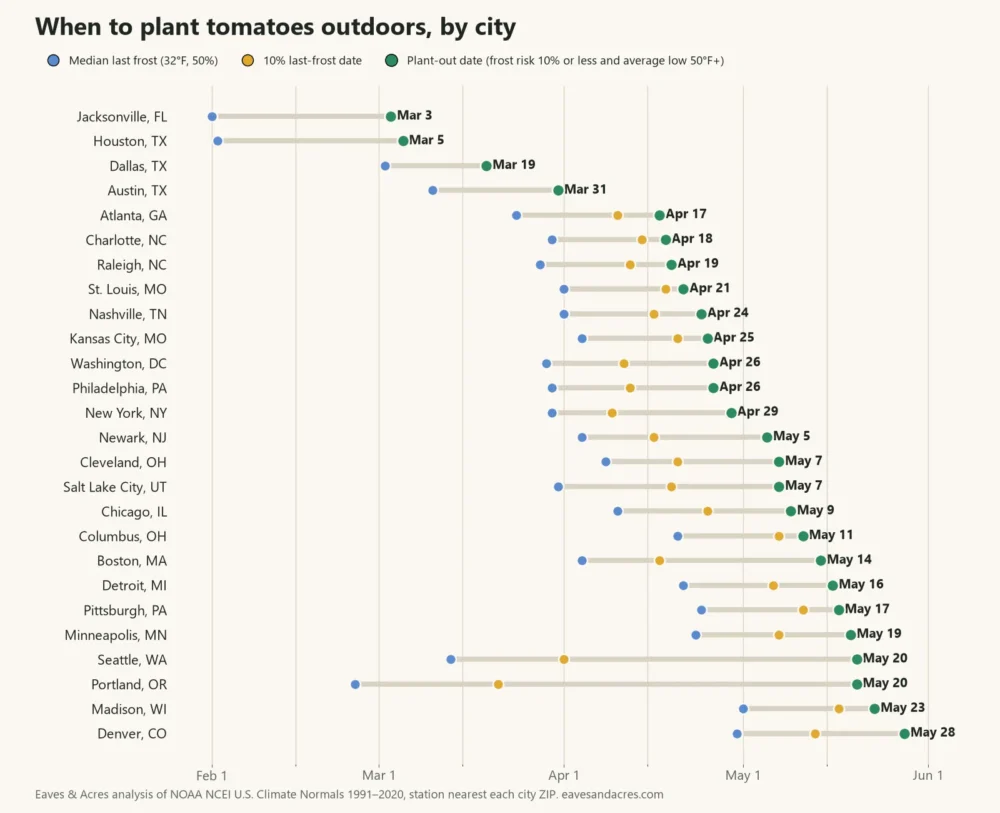
Why “after the last frost” is usually too early
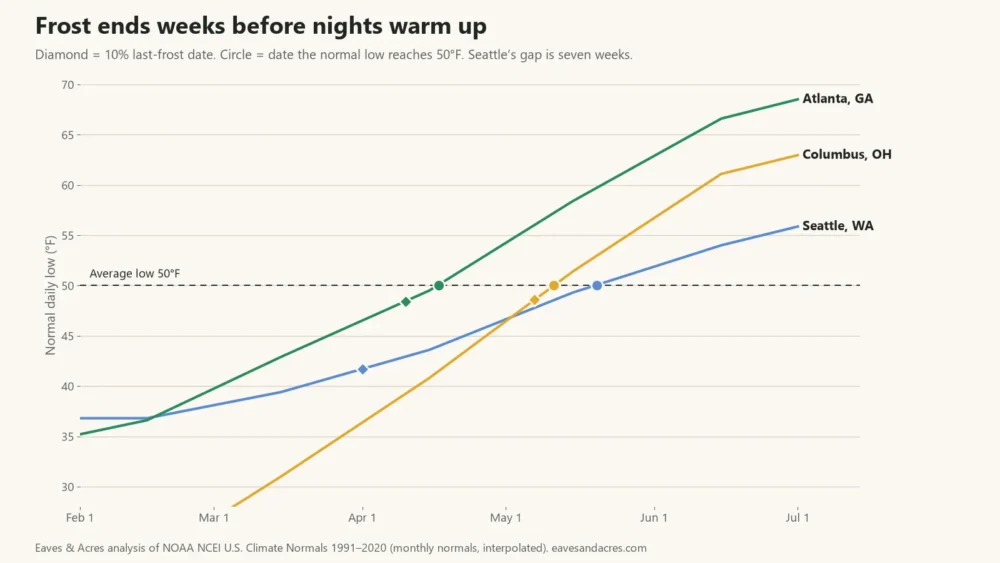
A frost date tells you when tomatoes stop being killed, not when they start growing well. Utah State University Extension notes that fruit does not set when nights fall below 50°F,4 and Penn State Extension warns of blossom drop below 55°F.5 West Virginia University Extension describes the 55°F limit this way:
Below this temperature, tomatoes experience chilling injury, which can delay their growth
The gap between frost and warm nights is widest on the Pacific coast. Seattle’s 10% frost date is April 1, but its normal low reaches 50°F only on May 20. In Boston the gap is 27 days; in Columbus, four.
How long to wait after your average last frost
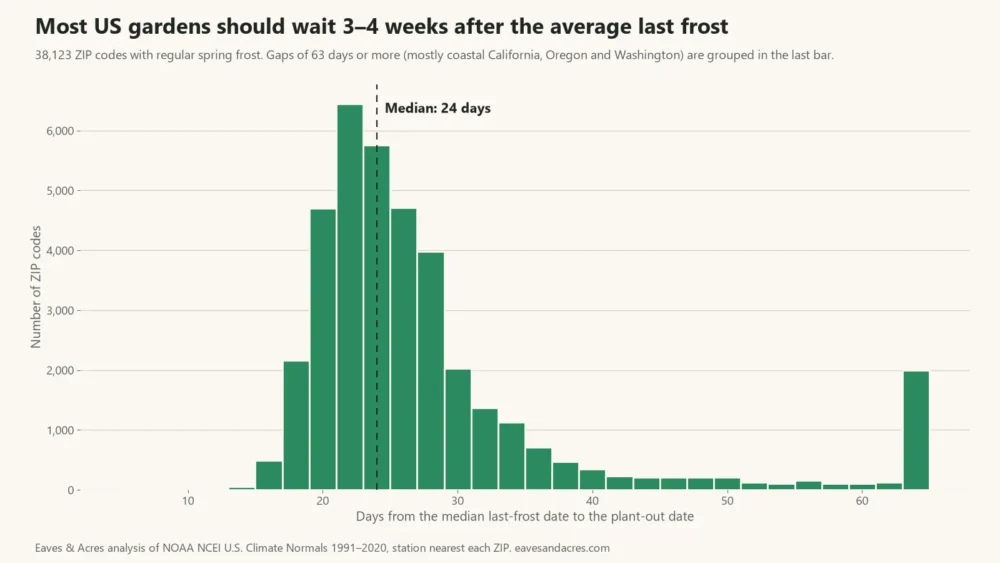
Across all 38,123 ZIP codes, the plant-out date falls a median 24 days after the median last frost. Half fall between 21 and 29 days, and fewer than 1% could plant within two weeks. So if you start from the “average” (50%) last-frost date, add three to four weeks, not the one to two weeks many calendars suggest.
Method: frost dates are NOAA’s 32°F spring probabilities; night temperatures are each station’s monthly normal minimum, interpolated day by day. Normals describe a typical year, so a warm or cold spring can shift the window. The methodology page has the details.
Three signals that it is time to plant
- Frost is unlikely. You are past your 10% date and the 10-day forecast shows no night near freezing.
- Nights stay at 50°F or warmer. 55°F is better: the University of Arizona says tomatoes need nights above 55°F to set fruit.8
- The soil is about 60°F. WVU and Utah State both use 60°F soil as the cue.2,4 Check it with a soil thermometer.
How our dates compare with extension advice
We checked the computed dates against extension advice in six states. Most agree within about a week; Ohio State’s central Ohio date is nine days later than ours:
| Place | Our plant-out date | Extension guidance |
|---|---|---|
| Minneapolis, MN | May 19 | Start seeds in mid-April, 5–6 weeks before planting out (University of Minnesota) |
| Charleston, WV | May 5 | Mother’s Day weekend is usually safe (WVU Extension) |
| Morgantown, WV | May 18 | Northern and higher areas may wait a week or two longer (WVU Extension) |
| Columbus, OH | May 11 | Typically May 20 in central Ohio; a week or so earlier only with frost protection (Ohio State) |
| Pittsburgh, PA | May 17 | Late May and early June soil is ideal (Penn State Extension) |
| Oregon City, OR | May 26 | Late May or early June, when soil reaches 60°F (OSU Extension, Clackamas County) |
| Tallahassee, FL | Mar 30 | North Florida: late March to April (UF/IFAS) |
Sources: University of Minnesota Extension,3 WVU Extension,2 Ohio State’s Growing Tomatoes in the Home Garden,17 Penn State,5 OSU Extension’s Clackamas County Master Gardeners12 and the UF/IFAS Florida Vegetable Gardening Guide.6 Where your state publishes a date, follow it.
When to plant tomatoes in Florida, Texas and other warm areas
Where frost is rare, plant early enough for fruit to set before summer nights get too warm. UF/IFAS says tomatoes will not set fruit if nighttime temperatures are above 70°F, although cherry tomatoes sometimes keep producing.7
| Area | Spring planting | Fall planting | Average low passes 70°F (NOAA) |
|---|---|---|---|
| North Florida (Jacksonville, Tallahassee) | Late Mar – Apr | Aug | May 22 (Jacksonville) |
| Central Florida (Orlando, Tampa) | Jan – Feb | Aug – Sep | May 24 (Orlando), May 12 (Tampa) |
| South Florida | Aug – Feb | — | |
| Southern Arizona low desert (Phoenix) | From mid-March | September | May 17 (Phoenix) |
| Los Angeles County | April | — | Not reached (Pasadena) |
| Texas (Houston, Austin, Dallas) | Table 1 dates | Jun 1 – Aug 1, by region | May 22 (Houston), May 31 (Austin, Dallas) |
Windows: UF/IFAS,6 University of Arizona,8 UC Master Gardeners11 and Texas A&M AgriLife.10 The last column is our NOAA calculation; aim to have plants flowering well before it.
Fall tomatoes: count back from the first frost
Texas A&M AgriLife’s rule is to transplant fall tomatoes about 100 days before the first expected frost.9
Fall tomatoes in Dallas, Texas
- Scenario
- NOAA normals put the median first frost near downtown Dallas on November 29, and the 10% (early-frost) date on November 10.
- Math
- Nov 29 − 100 days = Aug 21. Nov 10 − 100 days = Aug 2.
- Answer
- Transplant in early August for a safe margin, and no later than about August 21. AgriLife’s average fall dates run June 1 to August 1 across Texas regions.
When to start tomato seeds indoors
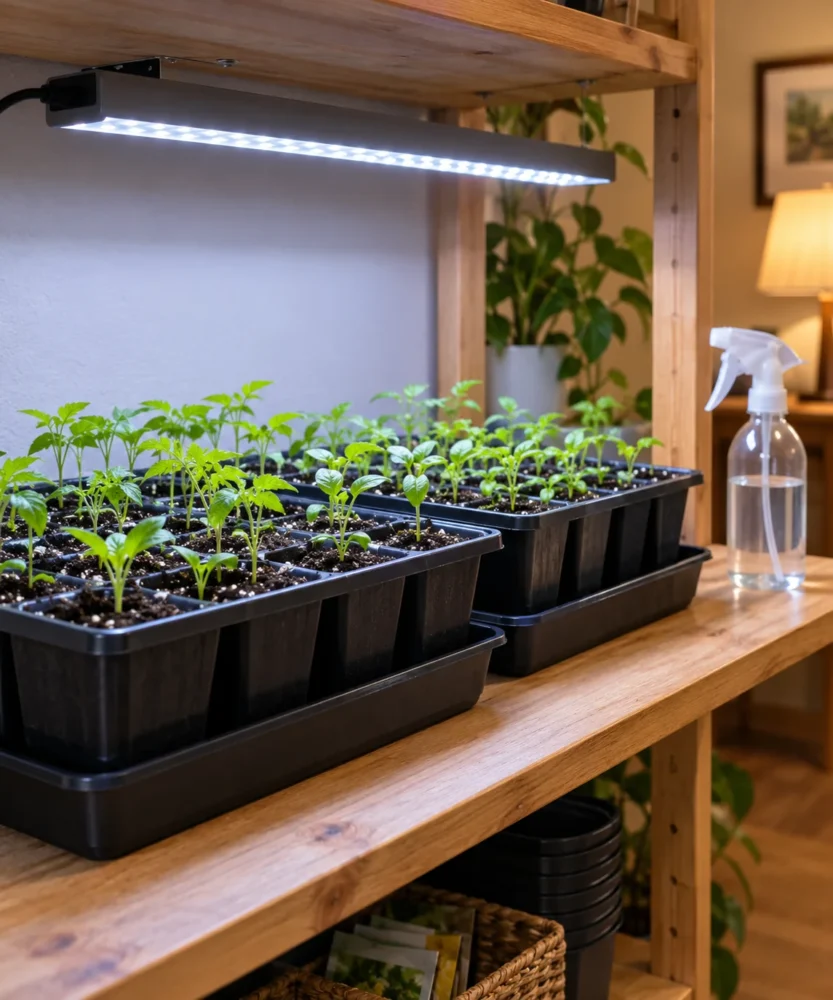
Count back six weeks from your plant-out date, not your frost date. The University of Minnesota allows five to six weeks; WVU and Utah State give six to eight.3,2,4 Earlier starts don’t help. Plants started earlier, says the University of Minnesota:
do not necessarily lead to better or earlier harvests
Seed-starting date for Columbus, Ohio
- Scenario
- Table 1 puts the Columbus plant-out date at May 11.
- Math
- May 11 − 6 weeks = March 30. With a 6–8 week range: March 16 to March 30.
- Answer
- Sow seeds in the second half of March. A mid-February start, as one online calendar suggests for Columbus, means about 12 weeks indoors.
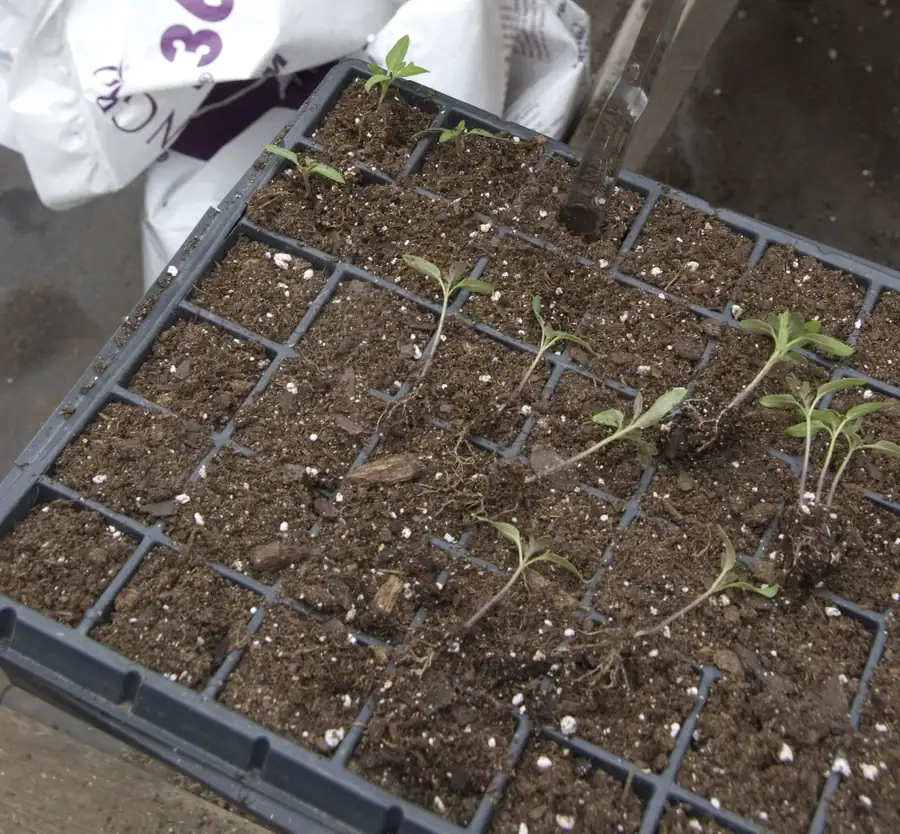
Our guide to when to start seeds indoors has sowing dates for other crops, and the seed-starting guides cover lights and trays.
Planting earlier with protection
Utah State Extension says that with black plastic mulch and row covers, plants can go out several weeks before the last frost date. Vent covers above 80°F, because fruit aborts above 90°F, and wait to add straw or clippings until the soil is warmer than 75°F.4
How to transplant tomatoes
Harden plants off
Starting about 10 days ahead, set plants outside for a few more hours each day. Bring them in at night and on days below 55°F.2
Plant deep
On a cloudy, calm day or in late afternoon, strip the lowest leaves and bury part of the stem, or lay leggy plants in a trench three to four inches deep.3
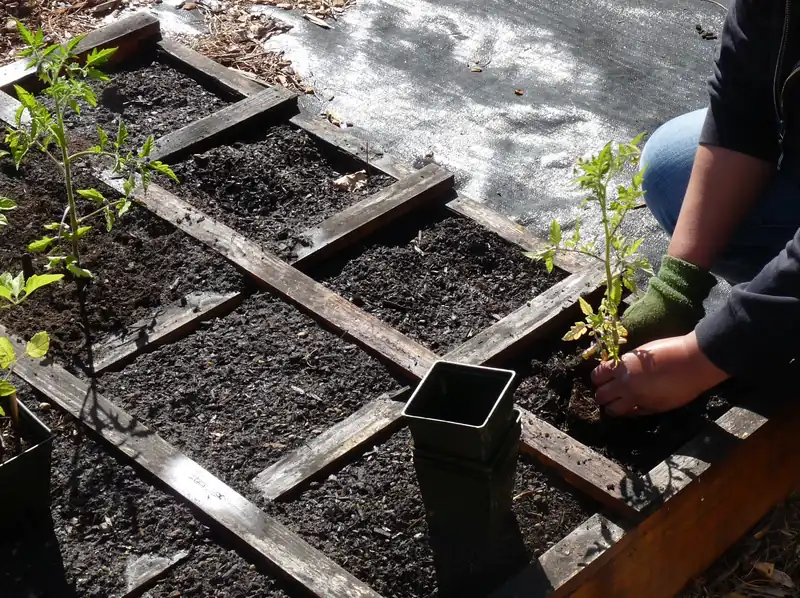
Tomatoes grow roots along any buried stem. Photo: USDA Forest Service, public domain (cropped). Stake and water
Set stakes or cages at planting, then water well. About an inch of water a week is ideal; uneven moisture invites blossom-end rot.3
Running late? See the FAQ below, and check your first-frost odds in our frost and freeze guides. Planting zones won’t give you a date: USDA hardiness zones are based on the average coldest winter night, not spring frost (see planting zone vs frost date).13 For more, see our vegetable guides (such as when to plant potatoes), the garden section and the climate data behind these dates.
Frequently asked questions
Often not. Compare the days left before your 10% first-frost date with the days to maturity on the plant tag. In Columbus, Ohio, July 1 leaves 104 days, enough for a 70-day variety; in Minneapolis it leaves 93.
Frost kills them, but harm starts well above freezing. WVU Extension says tomatoes suffer chilling injury below 55°F, and Utah State says fruit does not set when nights fall below 50°F.
The same rules apply, but pots can move. UF/IFAS suggests lightweight containers so you can shift tomatoes to a protected spot when a late frost threatens.
Count from your plant-out date instead: about six weeks before it. For a typical US ZIP code that means sowing roughly 2½ to 4½ weeks before the median last-frost date.
Your zone can’t tell you. USDA hardiness zones measure the coldest winter night, not spring frost, so last-frost dates inside one zone can differ by weeks. Use your ZIP code’s frost dates instead.
In the South, yes. Florida gardeners plant again in August or September, and Texas A&M AgriLife advises transplanting fall tomatoes about 100 days before the first expected frost.
Sources
- 1.U.S. Climate Normals 1991–2020. NOAA National Centers for Environmental Information, 2021. Used for: last-frost probabilities and normal monthly low temperatures for every ZIP and city Back to text
- 2.Growing Tomatoes (WV Garden Guide), Lewis W. Jett and Brandy Brabham. West Virginia University Extension, n.d. Used for: 60°F soil, 55°F chilling injury, hardening off, seed-starting lead time, West Virginia planting dates Back to text
- 3.Growing tomatoes in home gardens, Cindy Tong, Marissa Schuh and Jill MacKenzie. University of Minnesota Extension, 2024. Used for: seed-starting lead time, transplanting method, supports, watering Back to text
- 4.How to Grow Tomatoes in Your Garden, Daniel Drost. Utah State University Extension, 2020. Used for: 60°F soil, fruit set below 50°F nights, transplant age, plastic mulch and row covers Back to text
- 5.Tomatoes: From Seedlings to Fruit, Susan Marquesen. Penn State Extension, 2026. Used for: blossom drop below 55°F nights, planting time in the Pittsburgh area Back to text
- 6.Florida Vegetable Gardening Guide (SP 103/VH021). UF/IFAS Extension, 2024. Used for: Florida tomato planting windows by region Back to text
- 7.Summer Vegetables in Florida. UF/IFAS Solutions for Your Life, 2025. Used for: no fruit set above 70°F nights Back to text
- 8.Growing Tomatoes (AZ2078). University of Arizona Cooperative Extension, 2024. Used for: low-desert planting windows, 55°F nights for fruit set, days to maturity Back to text
- 9.Easy Gardening: Tomatoes, Sam Cotner. Texas A&M AgriLife Extension, n.d. Used for: fall tomatoes 100 days before first frost Back to text
- 10.Fall Vegetable Gardening Guide for Texas, Larry Stein and Joe Masabni. Texas A&M AgriLife Extension, n.d. Used for: fall tomato planting dates by Texas region Back to text
- 11.Spring & Summer Gardening Basics for Los Angeles County. UC Master Gardener Program, Los Angeles County, 2011. Used for: Los Angeles tomato timing Back to text
- 12.Growing Tomatoes in the Home Garden (10-Minute University). OSU Extension Service and Clackamas County Master Gardeners, n.d. Used for: Portland-area planting time, 60°F soil Back to text
- 13.USDA Plant Hardiness Zone Map. USDA Agricultural Research Service, 2023. Used for: how hardiness zones are defined Back to text
- 14.Photo: Volunteer planting heirloom tomato. USDA Forest Service Pacific Southwest Region (public domain), 2010. Used for: planting photo
- 15.Photo: Tomato seedlings, Dwight Sipler (CC BY 2.0). Wikimedia Commons, 2007. Used for: seedling photo
- 16.Tomatoes. UF/IFAS Gardening Solutions, n.d. Used for: containers to dodge late frost
- 17.Growing Tomatoes in the Home Garden (HYG-1624), Gary Y. Gao, Brad Bergefurd and Bob Precheur. Ohio State University Extension, 2017. Used for: central Ohio planting date (May 20) and its frost odds Back to text
.jpg)
.jpg)
How this guide was made
- Written by the Yard & Garden Desk and reviewed by the Data & Methodology Desk.
- Data: frost dates and normal night temperatures from NOAA NCEI U.S. Climate Normals 1991–2020 for the station nearest each ZIP code; temperature cues and planting windows from WVU, Utah State, Minnesota, Ohio State, Penn State, Oregon State, UF/IFAS, Arizona, UC and Texas A&M extension publications. See our methodology.
- AI use: AI tools help us research, draft and check this guide. Every figure is checked against the source cited for it, and calculated figures come from our own code, described on the methodology page.
- Spotted an error? Tell us — the form opens with this page’s address filled in.
Change log
- Oct 4, 2026Re-checked against today’s search results and sources (WVU, Minnesota, Utah State, UF/IFAS, Texas A&M). Added Ohio State Extension’s central Ohio date to the comparison table, which now says “most agree within about a week” instead of “all within about a week”; the Columbus calendar note now cites Ohio State instead of naming a commercial site; table headers shortened for phones.
- Oct 3, 2026Published. Plant-out dates for 26 cities and 38,123 ZIP codes computed from NOAA 1991–2020 normals and checked against extension advice in Minnesota, West Virginia, Pennsylvania, Oregon and Florida.
Covers lawns, gardens, frost and planting. We write the guides and maintain the tools that tell you when to seed, feed and plant for your ZIP.
Keep reading
When to Plant Onions: Fall in the South, Spring in the North
Plant onion sets and transplants in the four weeks before your last frost, or in fall and winter in the Deep South. Dates for 27 cities and the onion type for every ZIP code's latitude.
When to Plant a Fall Vegetable Garden: Planting Dates by City
Count back from your first fall frost: days to maturity plus a 14-day fall factor, and 14 more for tender crops. Last planting dates for 20 US cities from NOAA normals.
When to Plant Potatoes: Spring Dates and Soil Temperature by City
Plant potatoes two to four weeks before your last frost, once 4-inch soil reaches 45°F. Dates for 22 cities from NOAA normals and 12 springs of measured soil data.
Seasonal reminders for your ZIP
Get a short email when it’s time to overseed, start seeds, open the pool or service your furnace — timed to your climate.