




When to Plant Potatoes: Spring Dates and Soil Temperature by City
Two rules decide when potatoes go in: weeks before the last frost, and soil temperature. We checked them against 12 springs of NOAA soil data and give a two-week window for 22 US cities.
- Last reviewed Oct 7, 2026
- 26 cited sources
- 11 min read
Set your ZIP to see dates for your area.
- 1Plant potatoes about two to four weeks before your median last frost, once the soil 4 inches down reaches about 45°F.
- 2Examples: about Mar 7 in St. Louis and Washington, D.C., Mar 28 in Chicago, Apr 12 in Minneapolis and Apr 18 in Fargo.
- 3At 28 NOAA soil stations, 4-inch soil reached 45°F a median 26 days before the last frost, but the date moved by more than five weeks from spring to spring.
- 4The 50°F soil rule used by Utah State and Texas A&M comes later: a median 17 days before the last frost.
- 5On the Gulf Coast and in Florida, plant in winter; Texas and Louisiana also grow a fall crop, planted about 110 days before the first frost.
Plant potatoes about two to four weeks before your average last spring frost, once the soil 4 inches down has reached about 45°F. In most of the US that falls between early March and late April: about March 7 in St. Louis and Washington, D.C., March 28 in Chicago and April 12 in Minneapolis.
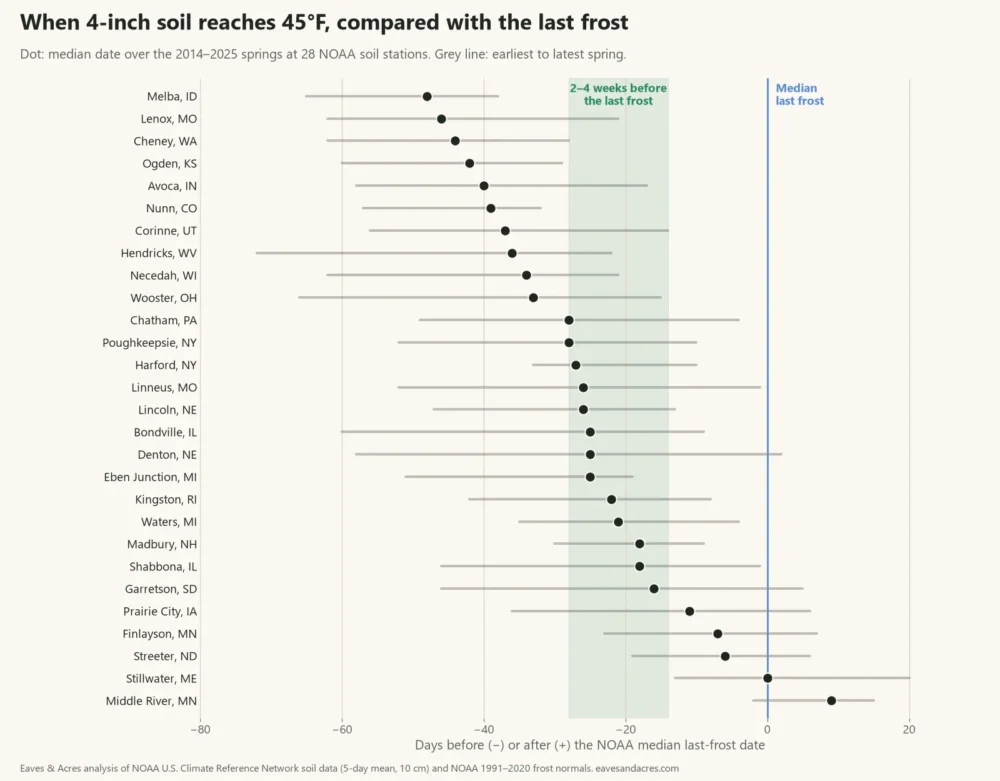
Most guides give one of those two rules and stop. We tested them against each other with 12 springs of measured soil temperature from 28 NOAA stations. At the typical station, 4-inch soil reached 45°F 26 days before the median last frost, so the rules usually agree. But at a single station the soil date moved by a median of more than five weeks from one spring to the next, which is why a soil thermometer beats the calendar.
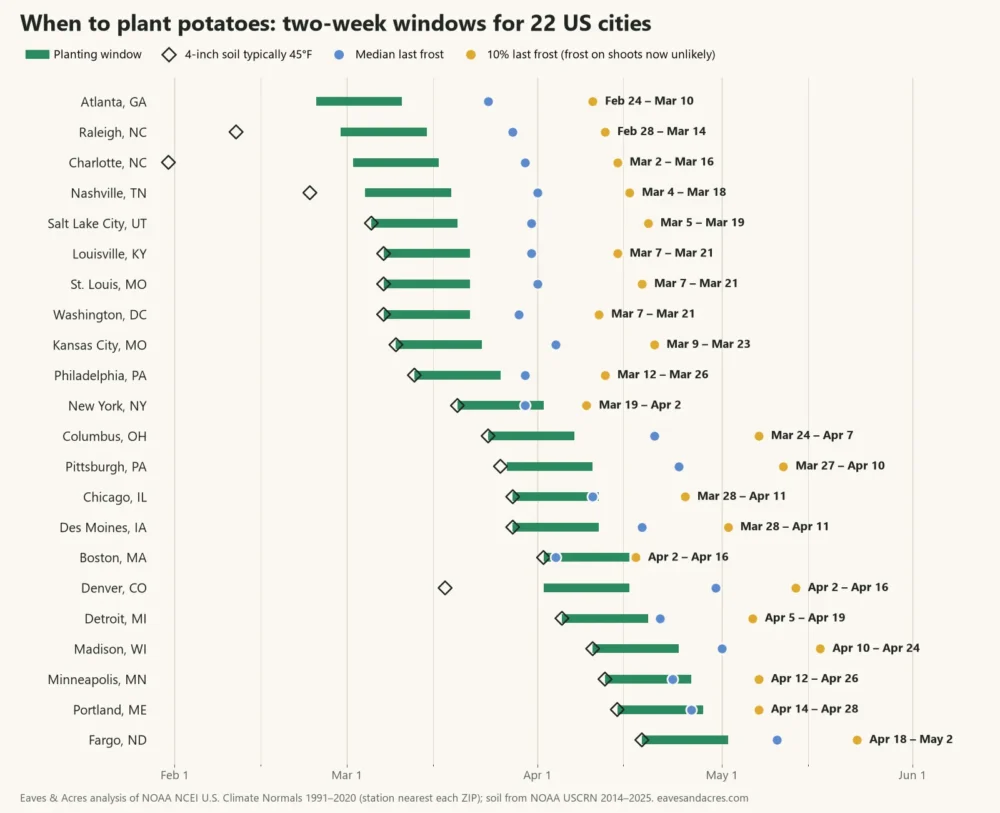
Potato planting dates for 22 US cities
Each window starts on the later of two dates: four weeks before the median last frost, or the day the soil 4 inches down typically reaches 45°F. It runs for two weeks. Frost dates come from NOAA’s 1991–2020 normals for the station nearest each ZIP code.1 The soil date is our estimate from those normals, explained in the next section.
| City (ZIP) | Plant potatoes | Median last frost | 4-inch soil reaches 45°F | 10% last frost |
|---|---|---|---|---|
| Atlanta, GA (30303) | Feb 24 – Mar 10 | Mar 24 | All winter | Apr 10 |
| Raleigh, NC (27601) | Feb 28 – Mar 14 | Mar 28 | Feb 11 | Apr 12 |
| Charlotte, NC (28202) | Mar 2 – Mar 16 | Mar 30 | Jan 31 | Apr 14 |
| Nashville, TN (37201) | Mar 4 – Mar 18 | Apr 1 | Feb 23 | Apr 16 |
| Salt Lake City, UT (84101) | Mar 5 – Mar 19 | Mar 31 | Mar 5 | Apr 19 |
| Washington, DC (20001) | Mar 7 – Mar 21 | Mar 29 | Mar 7 | Apr 11 |
| St. Louis, MO (63101) | Mar 7 – Mar 21 | Apr 1 | Mar 7 | Apr 18 |
| Louisville, KY (40202) | Mar 7 – Mar 21 | Mar 31 | Mar 7 | Apr 14 |
| Kansas City, MO (64105) | Mar 9 – Mar 23 | Apr 4 | Mar 9 | Apr 20 |
| Philadelphia, PA (19103) | Mar 12 – Mar 26 | Mar 30 | Mar 12 | Apr 12 |
| New York, NY (10001) | Mar 19 – Apr 2 | Mar 30 | Mar 19 | Apr 9 |
| Columbus, OH (43215) | Mar 24 – Apr 7 | Apr 20 | Mar 24 | May 7 |
| Pittsburgh, PA (15222) | Mar 27 – Apr 10 | Apr 24 | Mar 26 | May 11 |
| Des Moines, IA (50309) | Mar 28 – Apr 11 | Apr 18 | Mar 28 | May 2 |
| Chicago, IL (60601) | Mar 28 – Apr 11 | Apr 10 | Mar 28 | Apr 25 |
| Denver, CO (80202) | Apr 2 – Apr 16 | Apr 30 | Mar 17 | May 13 |
| Boston, MA (02108) | Apr 2 – Apr 16 | Apr 4 | Apr 2 | Apr 17 |
| Detroit, MI (48201) | Apr 5 – Apr 19 | Apr 21 | Apr 5 | May 6 |
| Madison, WI (53703) | Apr 10 – Apr 24 | May 1 | Apr 10 | May 17 |
| Minneapolis, MN (55401) | Apr 12 – Apr 26 | Apr 23 | Apr 12 | May 7 |
| Portland, ME (04101) | Apr 14 – Apr 28 | Apr 26 | Apr 14 | May 7 |
| Fargo, ND (58102) | Apr 18 – May 2 | May 10 | Apr 18 | May 23 |
The last column matters because potato shoots come up two to four weeks after planting, depending on soil temperature, according to Cornell.5 Until the 10% date, there is still about a one-in-ten chance of a frost on them. For any other ZIP code, look up your frost dates and their odds, then count back four weeks from the median date.
Loads from YouTube (privacy-enhanced mode) only when you press play.
The two rules: weeks before frost, or soil temperature
Extension services agree on the idea but not the numbers. On the calendar, Cornell says two to four weeks before the last frost,5 Utah State says 14 to 21 days6 and Texas A&M says about three weeks.3 On soil temperature, Cornell’s minimum is 40°F,5 the University of Maryland, South Dakota State and UGA Extension in Colquitt County use 45°F,7,12,13 and Utah State and Texas A&M use 50°F. The Texas A&M fact sheet gives the depth too:
Plant potatoes when the soil temperature 4 inches deep reaches about 50 degrees F
The same fact sheet offers “about 3 weeks before the last spring frost” as the alternative, as if the two dates were the same. Our measurements say they often aren’t.
What 12 springs of measured soil show
NOAA’s U.S. Climate Reference Network records soil temperature at 4 inches (10 cm) at open, rural sites.2 We took 2014–2025 data from 42 stations and found the first day each spring that the five-day average reached 40, 45 and 50°F, then compared it with the NOAA median last frost for the nearest ZIP code. At 45°F, 28 stations had usable dates. Thirteen, from Kentucky and Virginia south, were left out because their soil was already that warm in early February in at least one spring, and one in Alabama had too few complete springs.
| Soil threshold (who uses it) | Stations | Median date vs. last frost | Springs warm by 3 weeks before | Springs warm by 2 weeks before |
|---|---|---|---|---|
| 40°F (Cornell) | 24 | 42 days before | 92% | 100% |
| 45°F (Maryland, South Dakota State) | 28 | 26 days before | 67% | 83% |
| 50°F (Utah State, Texas A&M) | 35 | 17 days before | 33% | 58% |
Three findings stand out:
- The 45°F rule and the calendar rule usually agree. The median station reached 45°F 26 days before the median last frost, and 23 of 28 stations reached it at least two weeks ahead.
- The 50°F rule is later. At the typical station, the soil had reached 50°F three weeks before the frost date in only one spring in three. Planting “about three weeks before frost” usually means planting before Texas A&M’s 50°F.
- The far north is the exception. In northern Minnesota, North Dakota and Maine, 4-inch soil reached 45°F within about a week of the median last frost, and one Minnesota station did so after it. There, wait for the soil.
Across 30,706 ZIP codes with regular spring frost, our estimate puts 45°F soil at or before the middle of the two-to-four-week window in 76% of them. It lags by more than a week in about 7%, mostly in New York, Maine, Minnesota, Massachusetts and New Jersey, where cool springs follow a fairly early frost date.
How to check your own soil
Push a soil thermometer to planting depth, about 4 inches. Our dates use a five-day average, so one warm afternoon doesn’t count. Normals describe a typical spring, and the soil date at a single station moved by a median of 37 days between its earliest and latest springs. Cold, wet soil is the real risk: seed pieces can rot if planted into prolonged cold weather, warns the University of Maryland.7 The same soil-warming method drives our guide to when to plant grass seed in spring, and the methodology page explains the frost data.
Why frost still matters after planting
Potato tops can’t take frost, though the plants often recover. Cornell notes that late spring frosts can damage the foliage, but growth usually rebounds.5 LSU AgCenter says light frosts won’t harm the plants, while hard freezes may hurt the tops and delay harvest.17 Recovery has limits. Texas A&M warns that plants killed by a late frost will not come back if the seed piece has rotted,3 and organic grower Alley Swiss told A Way To Garden that each regrowth means a smaller, later harvest.20
That is why Table 1 shows the 10% last-frost date. Plant at the start of the window and shoots typically appear around the median last frost, when a frost is still a coin flip. If one is forecast once they are up, cover them for the night.
How our dates compare with local extension calendars
We lined our windows up against 12 published local calendars. Seven fall fully or mostly inside the published window: all three Iowa regions, central Illinois, Maryland, Dallas and north Florida. The misses go both ways:
| Place | Local extension guidance | Our window | NOAA median last frost |
|---|---|---|---|
| Minneapolis, MN | Early April in the Twin Cities (UMN) | Apr 12 – Apr 26 | Apr 23 |
| Burlington, IA (south) | Late March or early April (Iowa State) | Mar 25 – Apr 8 | Apr 15 |
| Des Moines, IA (central) | Early to mid-April (Iowa State) | Mar 28 – Apr 11 | Apr 18 |
| Mason City, IA (north) | Mid to late April (Iowa State) | Apr 12 – Apr 26 | Apr 29 |
| Champaign, IL (central) | Late March or early April (Illinois) | Mar 25 – Apr 8 | Apr 15 |
| College Park, MD | March 15 to May 1, by location (UMD) | Mar 17 – Mar 31 | Apr 10 |
| Chester, SC | Late February, early March (Clemson) | Mar 6 – Mar 20 | Apr 3 |
| Burgaw, NC (Pender Co.) | February (NC Extension) | Mar 5 – Mar 19 | Apr 2 |
| Salem, OR (Willamette Valley) | Late March through May (Oregon State) | Mar 6 – Mar 20 | Apr 3 |
| Dallas, TX | February or early March (Texas A&M) | Feb 2 – Feb 16 | Mar 2 |
| New Orleans, LA (south) | Mid-January through February; Jan. 15 to Feb. 15 recommended (LSU AgCenter) | Jan 4 – Jan 18 | Feb 1 |
| Tallahassee, FL (north) | January or February (UF/IFAS) | Feb 11 – Feb 25 | Mar 11 |
Sources: University of Minnesota,4 Iowa State,8 Illinois,11 Maryland,7 Clemson,15 NC Extension in Pender County,16 Oregon State,19 Texas A&M,3 LSU AgCenter17 and UF/IFAS.18 Where your county publishes a date, follow it.
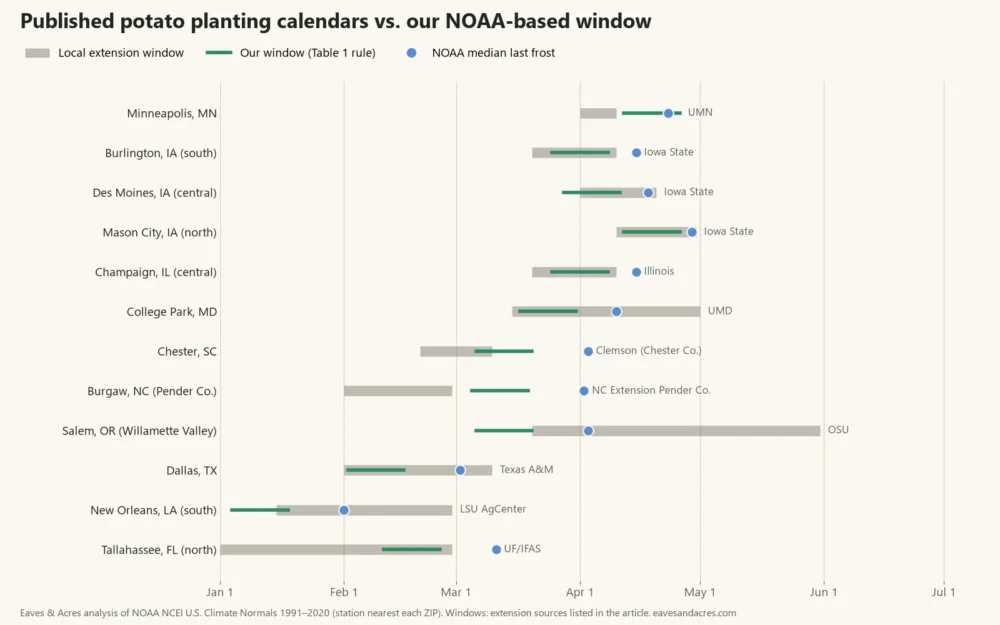
Two patterns explain most of the gaps. In the Southeast, calendars plant five to seven weeks before the median last frost, when the soil is already warm and only the tops are at risk. In the Pacific Northwest, Oregon State waits for daytime temperatures of 60°F, so its Willamette Valley window runs late March through May, after the median frost date.19 Minnesota is the third gap. The University of Minnesota’s advice is simple:
Plant tuber pieces as soon as the soil warms
It puts that at early April in the Twin Cities, a week or more before our April 12 soil estimate for downtown Minneapolis. NOAA’s soil stations sit on open, rural ground, and a sheltered city garden can differ.
Southern winter planting and fall potatoes
Where winters are mild, extension services plant in winter so the crop finishes before summer heat. Tubers stop forming when the soil reaches 80°F, says the University of Illinois.10 Texas A&M and LSU AgCenter also recommend a fall crop; Clemson advises against one in South Carolina because of pests and disease.14
| Area | Spring or winter planting | Fall planting | NOAA median last frost | NOAA: 110 days before 10% and median first frost |
|---|---|---|---|---|
| Dallas, TX | February or early March | About 110 days before first frost; mid-August in most areas | Mar 2 | Jul 23 – Aug 11 |
| Austin, TX | February or early March | Same rule | Mar 10 | Jul 14 – Jul 30 |
| Houston, TX | February or early March | Same rule | Feb 2 | Aug 9 – Sep 6 |
| New Orleans, LA | Mid-January through February | Mid-August to mid-September | Feb 1 | Aug 13 – Sep 12 |
| North Florida (Tallahassee) | January or February | — | Mar 11 | — |
| Central Florida (Orlando, Tampa) | January or February | — | Frost in about 35% of years | — |
| South Florida | October to January | — | — | — |
| South Carolina (Columbia) | Late winter | Not recommended | Mar 16 | — |
Windows: Texas A&M,3 LSU AgCenter,17 UF/IFAS,18 Clemson14 and NC Extension.16 The NOAA columns are our calculation.
Fall potatoes: count back 110 days from the first frost
Texas A&M’s rule is to plant a fall crop about 110 days before the first expected frost, or mid-August in most of Texas, using small, uncut potatoes because they resist rotting in hot weather better than cut pieces.3 It notes that many gardeners buy extra seed potatoes in spring and hold them for fall planting. The same count-back from the first frost sets the deadline for other fall crops; see our fall vegetable garden planting dates.
Fall potatoes in Dallas, Texas
- Scenario
- NOAA normals put the median first fall frost near downtown Dallas on November 29, and the 10% (early-frost) date on November 10.
- Math
- Nov 29 − 110 days = Aug 11. Nov 10 − 110 days = Jul 23.
- Answer
- Plant whole seed potatoes between late July and about August 11. In New Orleans the same rule gives August 13 to September 12, which matches LSU AgCenter’s mid-August to mid-September window.
How late can you plant potatoes?
Later than most calendars suggest, if the crop has time to finish before heat or frost. The University of Illinois says midseason and late varieties may be planted as late as July 1, and that medium-early plantings in dried, warmed soil may do as well as very early ones.10 New potatoes can be dug about seven to eight weeks after planting, says the University of Minnesota.4 For a late crop, straw mulch keeps the soil about 10°F cooler, according to Illinois.10
How to plant seed potatoes
Buy certified seed potatoes
Grocery potatoes may be treated to stop sprouting or may carry disease, say the University of Minnesota and Iowa State.4,9 Small potatoes can go in whole.
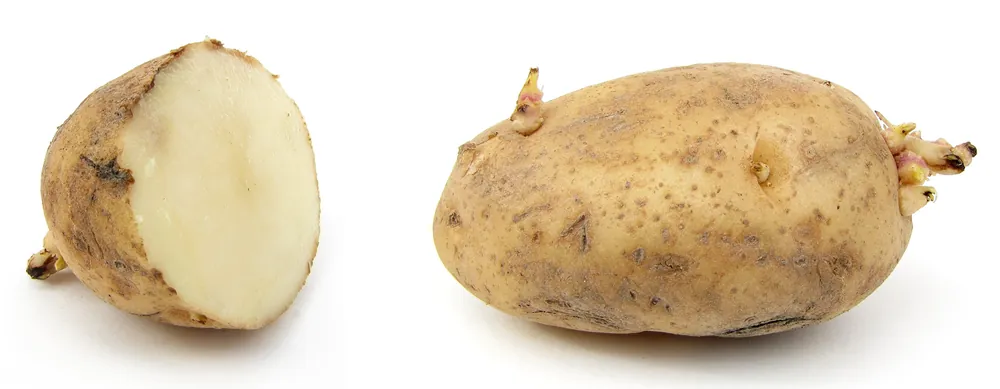
Each seed piece needs at least one eye, the bud a new shoot grows from. Photo: ZooFari, public domain, via Wikimedia Commons (cropped). Cut and cure larger tubers
Cut big seed potatoes into chunks of about 1¼ inches, each with at least one eye and preferably two or three. Leave them at 60–70°F for a few days so the cut surface dries and toughens.4
Plant 3 to 5 inches deep
Set pieces cut side down, 10 to 12 inches apart, in rows 30 to 36 inches apart, and cover with about 4 inches of soil.4
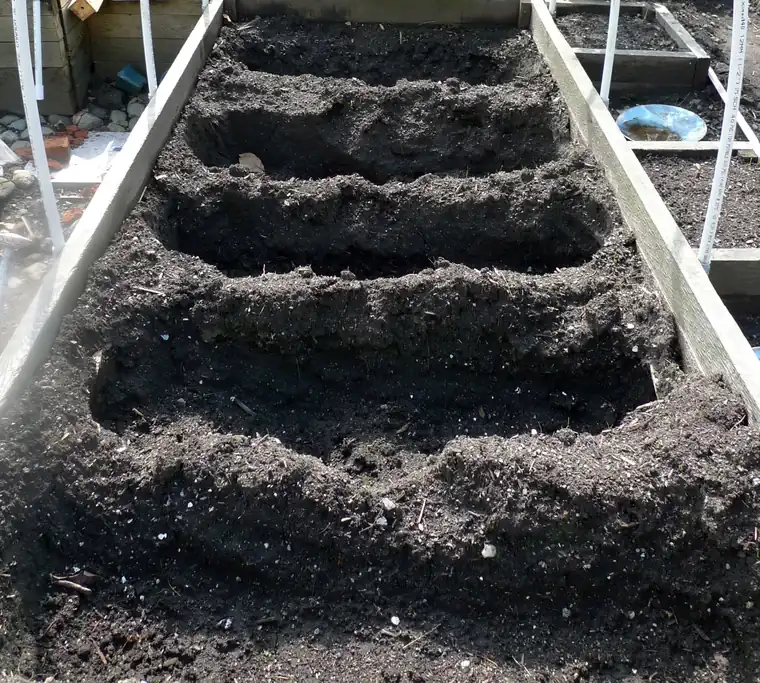
Trenches dug for spring potatoes in a raised bed. Photo: Ruth Hartnup, CC BY 2.0, via Wikimedia Commons (cropped). Hill as they grow
Once shoots emerge, pull soil up around the stems. Hilling keeps shallow tubers out of the light, which turns them green.4
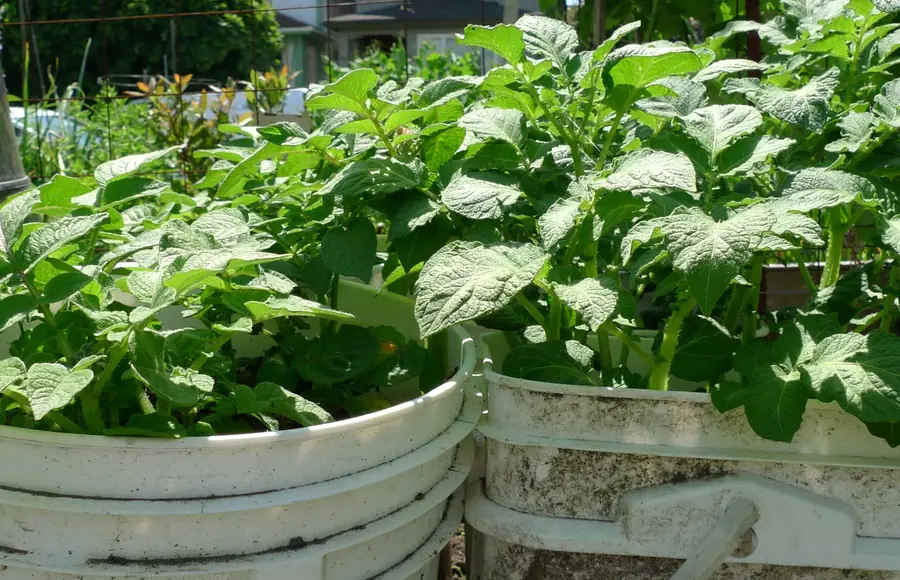
Potatoes are one of the earliest crops in the garden. For the rest of the spring plan, see when to start seeds indoors and when to plant tomatoes, which go out weeks after your potatoes. In fall, garlic goes in around the time late potatoes come out. Our guide to what a last frost date means explains the 10%, 50% and 90% odds, and the vegetable guides cover more crops.
Frequently asked questions
It depends on where you live. In most of the US, spring planting runs from early March to late April. Along the Gulf Coast, LSU AgCenter plants from mid-January through February, and UF/IFAS plants in January across Florida and from October to January in South Florida. Texas and Louisiana add a fall crop in August and September.
Cornell says not to plant until the soil reaches 40°F, and most extension services wait for 45°F at planting depth; Utah State and Texas A&M use 50°F. Cold, wet soil is the main risk: the University of Maryland warns that seed pieces can rot if planted during prolonged cold weather.
Extension services advise against it. Store potatoes may be treated to keep them from sprouting and can carry disease, say the University of Minnesota and Iowa State. Buy certified seed potatoes; small ones can be planted whole.
New potatoes can be dug about seven to eight weeks after planting, says the University of Minnesota. Full-size potatoes take about three to four months: the University of Maryland lists 90 to 120 days to maturity, and Texas A&M says most varieties are ready to dig 95 to 110 days after planting. In a Clemson Extension demonstration garden in Chester County, South Carolina, potatoes planted in late February or early March are mostly harvested in June.
Your zone can’t tell you. USDA hardiness zones are based on the average coldest winter night, not on spring frost, so last-frost dates inside one zone can differ by weeks. Use the median last frost for your ZIP code and count back two to four weeks, then check the soil.
In parts of the South, yes. Texas A&M plants a fall crop about 110 days before the first expected frost, mid-August in most of Texas, using small whole potatoes. LSU AgCenter plants from mid-August to mid-September. Clemson does not recommend fall planting in South Carolina. Farther north, Illinois says midseason and late varieties can go in as late as July 1.
Iowa State calls Good Friday planting folklore: the holiday moves, so it can fall too early or too late. St. Patrick’s Day (March 17) lands inside our window in St. Louis, Washington and Kansas City, but it is 11 days early for Chicago and nearly four weeks early for Minneapolis.
Sources
- 1.U.S. Climate Normals 1991–2020. NOAA National Centers for Environmental Information, 2021. Used for: median, 10% and 90% last-frost dates, first-frost dates and monthly mean temperatures for every ZIP and city Back to text
- 2.U.S. Climate Reference Network (daily01 soil temperature, 10 cm). NOAA National Centers for Environmental Information, 2025. Used for: measured 4-inch soil temperature at 42 stations, springs 2014–2025 Back to text
- 3.Easy Gardening: Irish Potatoes (E-511), Joseph Masabni. Texas A&M AgriLife Extension, 2010. Used for: 50°F soil at 4 inches or about 3 weeks before the last frost; February or early March in Texas; fall crop 110 days before first frost, mid-August; whole seed for fall; late-frost damage; most varieties ready to dig 95–110 days after planting Back to text
- 4.Growing potatoes in home gardens, Marissa Schuh and Cindy Tong. University of Minnesota Extension, 2026. Used for: plant as soon as the soil warms (early April in the Twin Cities), cutting and curing, depth, spacing, hilling, new potatoes, grocery potatoes Back to text
- 5.Growing Guide: Potatoes. Cornell University Home Gardening, n.d. Used for: plant 2–4 weeks before the last frost; soil at least 40°F; emergence in 2–4 weeks; foliage rebounds after late frost Back to text
- 6.How to Grow Potatoes in Your Home Garden. Utah State University Extension, 2020. Used for: 14–21 days before the last frost; soil at least 50°F Back to text
- 7.Growing Potatoes in a Home Garden. University of Maryland Extension, 2026. Used for: March 15 to May 1; soil at least 45°F; seed pieces rot in prolonged cold; new potatoes; 90–120 days to maturity Back to text
- 8.When should I plant potatoes in the garden?. Iowa State University Extension and Outreach, n.d. Used for: planting times for southern, central and northern Iowa Back to text
- 9.Growing Potatoes in the Home Garden. Iowa State University Extension and Outreach, n.d. Used for: grocery potatoes, whole seed, Good Friday folklore Back to text
- 10.Potato (Watch Your Garden Grow). University of Illinois Extension, n.d. Used for: tubers fail to form at 80°F soil; plant as late as July 1; straw keeps soil about 10°F cooler Back to text
- 11.Planting potatoes (The Garden Scoop). University of Illinois Extension, 2018. Used for: central Illinois: late March or early April Back to text
- 12.Potatoes: How to Grow It. South Dakota State University Extension, 2024. Used for: plant once soil reaches 45°F Back to text
- 13.How do I plant my potatoes?. UGA Cooperative Extension, Colquitt County, 2023. Used for: plant early potatoes when the soil reaches 45°F Back to text
- 14.Potato (HGIC 1317), Bob Polomski, Joey Williamson and Rob Last. Clemson Cooperative Extension Home & Garden Information Center, 2021. Used for: late-winter planting; 3–5 inch depth; fall planting not recommended in South Carolina Back to text
- 15.Growing Potatoes in South Carolina, Paul Thompson (video and transcript). Clemson Cooperative Extension, 2020. Used for: Chester County: late February to early March; emergence in 3–4 weeks; June harvest Back to text
- 16.Time to Plant Potatoes, Charlotte Glen. N.C. Cooperative Extension, Pender County, 2025. Used for: southeastern North Carolina: February planting Back to text
- 17.It’s spud season in Louisiana, Heather Kirk-Ballard. LSU AgCenter, 2024. Used for: mid-January through February (Jan. 15 to Feb. 15 recommended); light frost vs hard freeze; fall crop mid-August to mid-September Back to text
- 18.Potatoes. UF/IFAS Gardening Solutions, n.d. Used for: Florida: January statewide, February in North and Central Florida, October to January in South Florida Back to text
- 19.Potatoes. Oregon State University Extension Service, n.d. Used for: plant when daytime temperatures reach 60°F; Willamette Valley late March through May Back to text
- 20.Growing potatoes organically: when and how to plant, hill and harvest (Margaret Roach with Alley Swiss of Filaree Farm). A Way To Garden, 2023. Used for: repeated frost damage gives a smaller, later harvest Back to text
- 21.USDA Plant Hardiness Zone Map. USDA Agricultural Research Service, 2023. Used for: what hardiness zones measure
- 22.Photo: Potato flowers 2016 G1, George Chernilevsky (public domain). Wikimedia Commons, 2016. Used for: hero photo
- 23.Photo: Trenches ready for planting, Ruth Hartnup (CC BY 2.0). Wikimedia Commons, 2011. Used for: planting-trench photo
- 24.Photo: Growing potatoes in buckets, Ruth Hartnup (CC BY 2.0). Wikimedia Commons, 2011. Used for: bucket photo
- 25.Photo: Russet potato cultivar with sprouts, ZooFari (public domain). Wikimedia Commons, 2009. Used for: seed-potato photo
- 26.Photo: Solanum tuberosum (in garden), Forest & Kim Starr (CC BY 3.0). Wikimedia Commons, 2008. Used for: potato-bed photo

.jpg)
.jpg)


How this guide was made
- Written by the Yard & Garden Desk and reviewed by the Data & Methodology Desk.
- Data: frost dates and monthly mean temperatures from NOAA NCEI U.S. Climate Normals 1991–2020 for the station nearest each ZIP code; measured 4-inch soil temperatures from 42 NOAA U.S. Climate Reference Network stations, springs 2014–2025; soil-temperature rules and planting windows from Texas A&M, Minnesota, Cornell, Utah State, Maryland, Iowa State, Illinois, South Dakota State, UGA, Clemson, NC State, LSU, UF/IFAS and Oregon State extension publications. See our methodology.
- AI use: AI tools help us research, draft and check this guide. Every figure is checked against the source cited for it, and calculated figures come from our own code, described on the methodology page.
- Spotted an error? Tell us — the form opens with this page’s address filled in.
Change log
- Oct 7, 2026Re-checked the Texas A&M, Minnesota, Cornell, Maryland, Illinois, Iowa State and LSU guidance against the live pages. The FAQ on how long potatoes take to grow now gives days to maturity from Maryland and Texas A&M; Table 3 adds LSU AgCenter's recommended Jan. 15 to Feb. 15 planting; the Texas A&M fact-sheet link points to its current address; the fall-potato section links to our fall vegetable planting dates.
- Oct 4, 2026Published. Planting windows for 22 cities computed from NOAA 1991–2020 normals and 12 springs of NOAA soil-temperature data (2014–2025), and checked against 12 local extension calendars.
Covers lawns, gardens, frost and planting. We write the guides and maintain the tools that tell you when to seed, feed and plant for your ZIP.
Keep reading
When to Plant Onions: Fall in the South, Spring in the North
Plant onion sets and transplants in the four weeks before your last frost, or in fall and winter in the Deep South. Dates for 27 cities and the onion type for every ZIP code's latitude.
When to Plant a Fall Vegetable Garden: Planting Dates by City
Count back from your first fall frost: days to maturity plus a 14-day fall factor, and 14 more for tender crops. Last planting dates for 20 US cities from NOAA normals.
When to Plant Garlic: Fall Planting Dates Where You Live
Plant garlic in the two weeks either side of your first fall frost. Dates for 22 US cities from NOAA normals, checked against 11 local extension calendars.
Seasonal reminders for your ZIP
Get a short email when it’s time to overseed, start seeds, open the pool or service your furnace — timed to your climate.