




When to Plant Garlic: Fall Planting Dates Where You Live
Plant cloves in the weeks around your first fall frost, so they root before the ground freezes. Dates for 22 US cities from NOAA normals, checked against 11 local extension calendars.
- Last reviewed Oct 4, 2026
- 22 cited sources
- 10 min read
Set your ZIP to see dates for your area.
- 1Plant garlic in fall, within about two weeks either side of your median first fall frost (32°F).
- 2Examples: Madison Sep 25–Oct 23, Des Moines Oct 6–Nov 3, Chicago Oct 22–Nov 19, New York Nov 6–Dec 4.
- 3In 7 of 11 published local garlic calendars, the middle of the window falls within 5 days of the NOAA median first frost.
- 4Minnesota plants 1–2 weeks after the first killing frost; Penn State, Illinois and UW Extension count back 3 to 8 weeks from when the ground freezes.
- 5Where frost is rare, follow the local calendar, from mid-October into early winter.
Plant garlic in the fall, within about two weeks either side of your area’s typical first frost, so the cloves grow roots before the ground freezes. That works out to late September to late October in Madison and Minneapolis, early October to early November in Des Moines and Columbus, late October to late November in Chicago, Atlanta and Boston, and November in New York, Philadelphia and Seattle. In mild-winter areas where frost is rare, plant from mid-October into early winter.
Extension rules for garlic sound contradictory: one waits until after the first frost, another counts back from when the ground freezes. We compared 11 published local garlic calendars with NOAA’s 1991–2020 frost normals. In 7 of them, the middle of the recommended window falls within 5 days of the median first fall frost.1 This guide uses that anchor for 22 cities.
Garlic planting dates for 22 US cities
The window runs from two weeks before to two weeks after the median first 32°F frost at the NOAA station nearest each city. In a mild fall, don’t wait for the frost to arrive late: when the first frost came weeks behind schedule in 2021, University of Minnesota specialists advised sticking to the usual planting dates.3
| City (ZIP) | Median first frost, 32°F | Garlic planting window |
|---|---|---|
| Madison, WI (53703) | Oct 9 | Sep 25 – Oct 23 |
| Denver, CO (80202) | Oct 12 | Sep 28 – Oct 26 |
| Portland, ME (04101) | Oct 15 | Oct 1 – Oct 29 |
| Minneapolis, MN (55401) | Oct 16 | Oct 2 – Oct 30 |
| Des Moines, IA (50309) | Oct 20 | Oct 6 – Nov 3 |
| Columbus, OH (43215) | Oct 24 | Oct 10 – Nov 7 |
| Pittsburgh, PA (15222) | Oct 27 | Oct 13 – Nov 10 |
| Detroit, MI (48201) | Oct 31 | Oct 17 – Nov 14 |
| Nashville, TN (37201) | Oct 31 | Oct 17 – Nov 14 |
| Kansas City, MO (64105) | Nov 2 | Oct 19 – Nov 16 |
| Charlotte, NC (28202) | Nov 3 | Oct 20 – Nov 17 |
| St. Louis, MO (63101) | Nov 4 | Oct 21 – Nov 18 |
| Chicago, IL (60601) | Nov 5 | Oct 22 – Nov 19 |
| Washington, DC (20001) | Nov 8 | Oct 25 – Nov 22 |
| Salt Lake City, UT (84101) | Nov 8 | Oct 25 – Nov 22 |
| Atlanta, GA (30303) | Nov 8 | Oct 25 – Nov 22 |
| Boston, MA (02108) | Nov 9 | Oct 26 – Nov 23 |
| Louisville, KY (40202) | Nov 9 | Oct 26 – Nov 23 |
| Philadelphia, PA (19103) | Nov 17 | Nov 3 – Dec 1 |
| Seattle, WA (98101) | Nov 17 | Nov 3 – Dec 1 |
| New York, NY (10001) | Nov 20 | Nov 6 – Dec 4 |
| Portland, OR (97204) | Dec 1 | Nov 17 – Dec 15 |
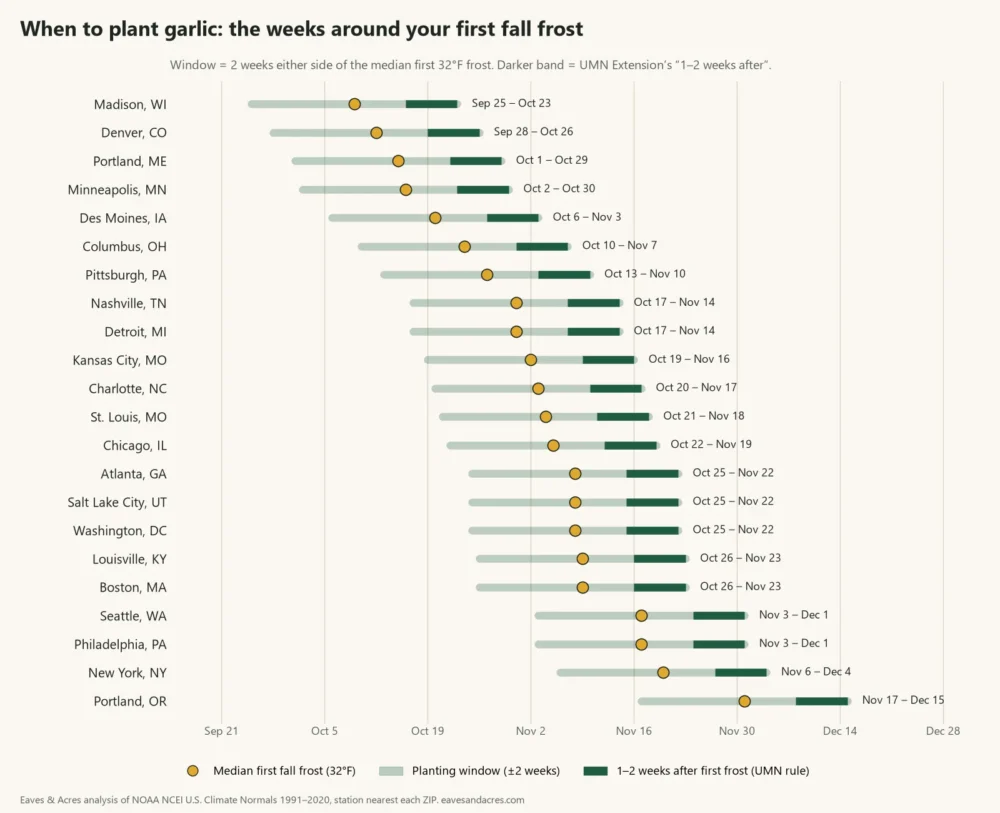
Each city uses one weather station, so your garden’s dates can differ by a week or more in a valley, on a hilltop or far from the city center. For your own ZIP code, look up your first fall frost date and its odds, then plant in the two weeks either side of the median.
How the window compares with local extension calendars
We checked NOAA dates against every local garlic calendar we found from extension services, Master Gardener programs and a state growers’ group:8,5,7,11,12,9,13,14,15,16,17
| Place | Published planting window | NOAA median first frost | Our window |
|---|---|---|---|
| Washburn, WI (Bayfield Co.) | Late September or early October (UW Extension, Bayfield County) | Oct 2 | Sep 18 – Oct 16 |
| Colorado Springs, CO | Before October 15 (CSU Extension, El Paso County) | Oct 8 | Sep 24 – Oct 22 |
| Augusta, ME | Before November (MOFGA) | Oct 16 | Oct 2 – Oct 30 |
| Des Moines, IA | October to early November (Iowa State) | Oct 20 | Oct 6 – Nov 3 |
| Springfield, IL | October through early November in central Illinois (Illinois Extension) | Oct 22 | Oct 8 – Nov 5 |
| Hendersonville, NC | Mid-October to early November (NC Extension, Henderson County) | Oct 25 | Oct 11 – Nov 8 |
| Fairfax, VA | November to early December (Fairfax Master Gardeners) | Oct 29 | Oct 15 – Nov 12 |
| College Park, MD | Mid to late October (University of Maryland Extension) | Nov 1 | Oct 18 – Nov 15 |
| Raleigh, NC | Late October to November (NC State Extension) | Nov 8 | Oct 25 – Nov 22 |
| Atlanta, GA | Late September through November (UGA Extension) | Nov 8 | Oct 25 – Nov 22 |
| San Jose, CA | Mid-October to end of November (UC Master Gardeners, Santa Clara County) | Dec 25 | Dec 11 – Jan 8 |
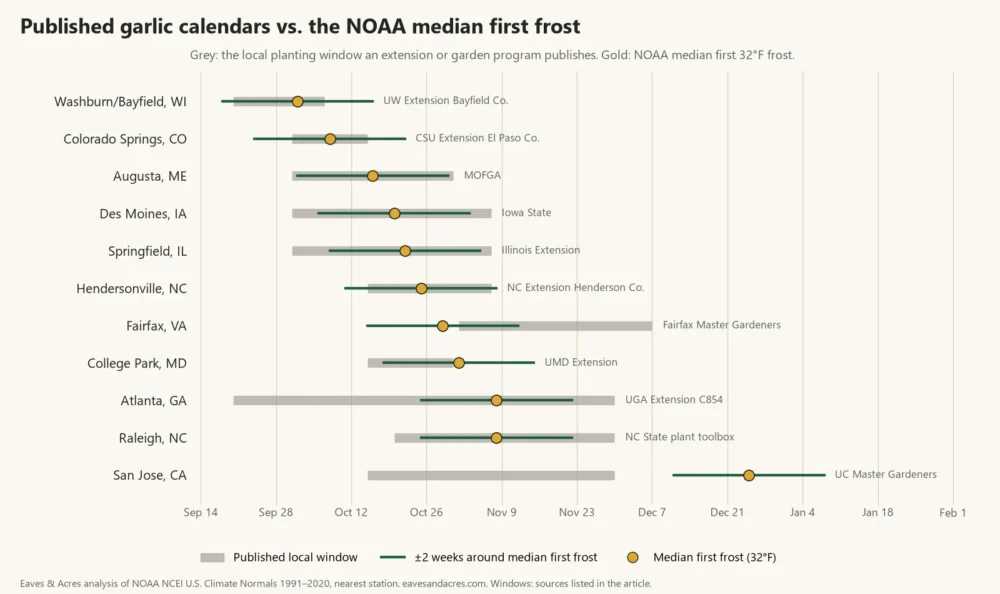
Seven calendars, from northern Wisconsin to central North Carolina, center within 5 days of the median first frost. Their windows open a median 15 days before it and close 15 days after it. That is where our two-week margin comes from.
The other four differ. Maryland Extension plants one to two weeks earlier, in mid to late October, so cloves can grow roots and a few leaves before cold weather.9 Fairfax Master Gardeners plant later, from November to early December.13 Georgia’s window is very wide, late September through November.16 In San Jose, where frost is rare, UC Master Gardeners plant from mid-October through November, at least two weeks before the first frost.17 Where your state’s extension service publishes its own window, use it.
After the first frost, or before the ground freezes?
Extension guidance for garlic is written in two ways. Cold-climate programs count forward from frost. The University of Minnesota puts it in one line:
Plant cloves in the fall, usually one or two weeks after the first killing frost.
Others count back from the day the soil freezes. Penn State puts it this way:
a good three weeks prior to the ground freezing
Illinois Extension and NC State give 4 to 6 weeks,4,15 and UW Extension in Bayfield County gives 6 to 8 weeks, adding that the ground there usually freezes around Thanksgiving.7 Google’s AI Overview repeated the 4-to-6-week figure for “when to plant garlic,” then said 2 to 4 weeks when we searched for zone 6.
Both rules aim at roots in cool soil before winter. They differ on top growth: Minnesota says shoots usually don’t emerge until spring,2 while Ohio State would like the first leaves up before freezing weather.10
We can’t turn “before the ground freezes” into a date, because NOAA’s climate normals don’t include soil freezing, so we don’t estimate one. As a rough signal of how often the rule even applies, in 52% of the 40,563 US ZIP codes we checked, not even the coldest month has a normal mean air temperature below 32°F.1 Where the ground rarely freezes solid, a frost-based or local calendar date is easier to act on.
Why a zone chart gives only a rough date
Many garlic calendars are sorted by USDA hardiness zone. The zone map is based on the average coldest winter night, not on fall frost.21 We looked up the 2023 zone for a random sample of US ZIP codes22 and compared their NOAA first-frost dates:
| USDA zone | ZIP codes sampled | Median first frost, middle 80% | Spread |
|---|---|---|---|
| 5a | 136 | Sep 24 – Oct 16 | 22 days |
| 5b | 147 | Sep 28 – Oct 21 | 23 days |
| 6a | 268 | Oct 4 – Oct 24 | 20 days |
| 6b | 295 | Oct 7 – Oct 29 | 22 days |
| 7a | 243 | Oct 15 – Nov 4 | 20 days |
| 7b | 208 | Oct 24 – Nov 14 | 21 days |
| 8a | 168 | Oct 31 – Nov 15 | 15 days |
| 8b | 167 | Nov 6 – Nov 22 | 16 days |
Inside each half-zone, the median first frost still varies by two to three weeks, so a zone chart can be a week or two off for many gardens. Our guide to planting zone vs. frost date and our hardiness zone guides explain what the zones do measure.
Garlic in warm-winter areas
In the South and coastal West, plant on the local calendar: late September through November in Georgia,16 October in Austin,19 mid-October through November in the San Jose area,17 and late fall to early winter in Florida, where UF/IFAS suggests softneck types such as Artichoke and Creole.18
The real limit there is winter cold, not frost. Maryland Extension says cloves must spend about two months at 32–50°F before the bulbs form,9 and UGA gives 6 to 8 weeks below 40°F after planting.16 We counted the months between October and April whose normal mean air temperature falls in Maryland’s 32–50°F band. This is air, not soil, so treat it as a rough guide:
| City (ZIP) | Median first frost, 32°F | Months with a normal mean of 32–50°F |
|---|---|---|
| Atlanta, GA (30303) | Nov 8 | 3 |
| Dallas, TX (75201) | Nov 29 | 2 |
| Austin, TX (78701) | Nov 17 | 0 |
| Houston, TX (77002) | Dec 25 | 0 |
| Orlando, FL (32801) | Rare | 0 |
| Phoenix, AZ (85004) | Rare | 0 |
| Sacramento, CA (95814) | Dec 16 | 2 |
| San Jose, CA (95113) | Dec 25 | 0 |
| Los Angeles, CA (90012) | Rare | 0 |
Fewer than two such months is the case in about 14% of US ZIP codes, where garlic gets the least winter cold. That doesn’t rule garlic out. UC and Texas A&M programs recommend it for San Jose and Austin, which have none.17,19 Illinois suggests about 8 weeks in the refrigerator for cloves planted in spring;4 we found no extension source giving a chilling period for fall planting in the South, so we don’t give one.
How to plant garlic cloves
Depth and spacing vary a little by source; all want well-drained soil and a straw or leaf mulch:
| Source | Depth | Spacing in the row | Mulch |
|---|---|---|---|
| University of Minnesota | Base of clove 2–3 in below the surface | 6 in, double rows | 3–4 in of leaves or straw |
| Illinois Extension | 1–2 in deep | 4–5 in; rows 15–18 in apart | Straw, against frost heaving |
| Iowa State | 1–1.5 in deep | 3–5 in; rows 18–24 in apart | 4–6 in of weed-free straw in November |
| Ohio State | 2 in deep | 4–5 in; rows 18–24 in apart | 4 in of clean straw, not hay |
| Penn State | At least 2 in below the surface | 4–8 in | About 4 in of straw or shredded leaves |
Buy seed garlic, not grocery garlic
Iowa State, Ohio State, Penn State and Maryland all advise against planting store-bought garlic. It may be treated against sprouting, carry disease, or be a softneck type from a warmer region.8,10,6,9 Order from a seed garlic supplier.
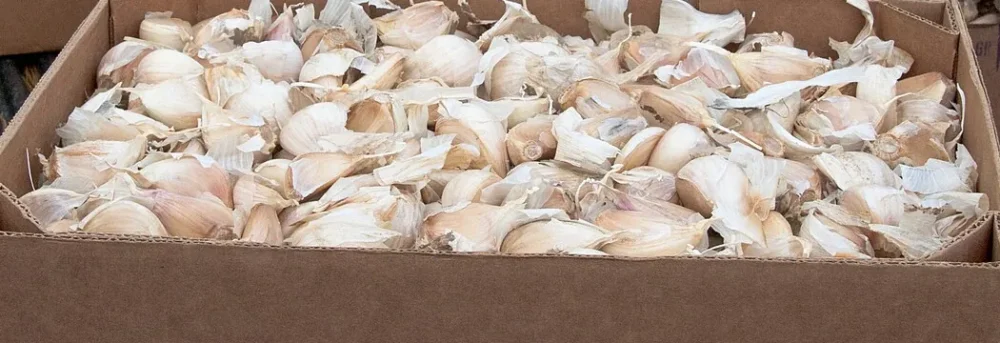
Garlic heads split into cloves for planting. Photo: Dwight Sipler, CC BY 2.0, via Wikimedia Commons (cropped). Plant pointed end up
Set each clove with the flat base down and the tip up, at the depth and spacing in Table 5. Ohio State notes that cloves planted upside down or sideways give small or misshapen bulbs.10
Feed from a soil test
Ohio State suggests half of the recommended fertilizer at planting and the rest when growth resumes in spring.10 Follow your soil test and the product label for amounts.
Mulch, then uncover in spring
Cover the bed with straw or shredded leaves after planting, or in November in Iowa.8 In spring, rake the mulch from the rows so shoots can come through, and leave it between rows to hold back weeds.10
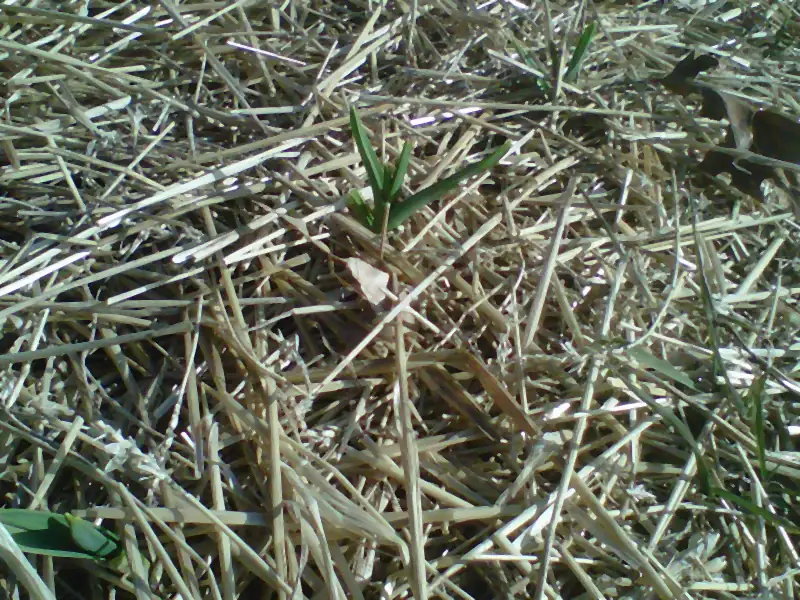
A garlic shoot coming up through straw mulch in March. Photo: Dwight Sipler, CC BY 2.0, via Wikimedia Commons.
Hardneck garlic is hardier and suits cold winters; softneck stores longer but is less cold hardy.4,10
Planted too early, too late, or not at all
Too early: warm soil invites top growth that winter can damage.10 Iowa State says foliage is likely to be hurt below 20°F, but the garlic usually regrows, though the crop is often smaller.8
Too late: cloves need time to root before the soil freezes. Penn State wants at least three weeks;6 NC State says 4 to 6.15
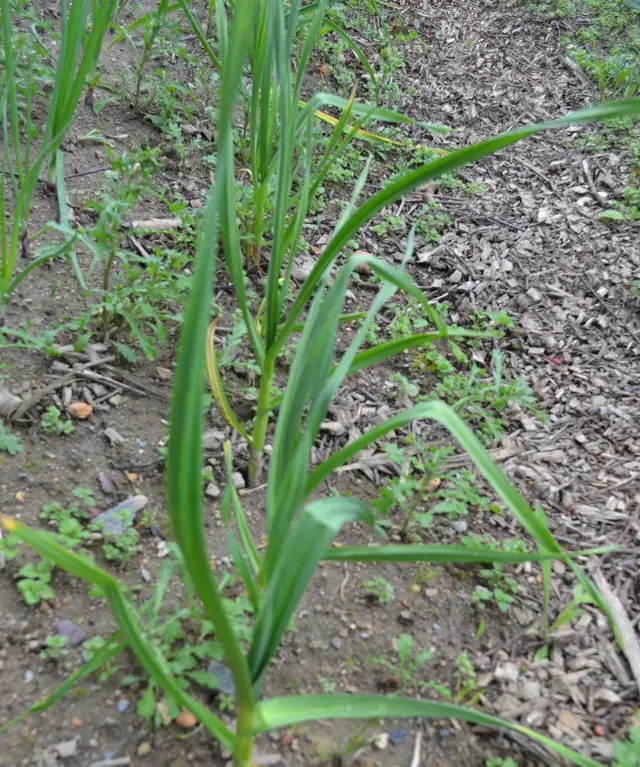
Missed fall: plant as early in spring as you can work the soil, late March to early April in central Iowa.8 Chill the cloves in the refrigerator for about 8 weeks first,4 and expect smaller bulbs than from a fall planting.10,9
Fall bulbs share the season: our guides on when to plant tulip bulbs and when to plant daffodil bulbs have dates for 24 cities. For the rest of the season, see our vegetable planting guides, including when to plant potatoes, and frost and freeze guides. Our methodology page explains how every frost date here is calculated. More in the garden section and the climate data.
Frequently asked questions
Cloves need time to root before the soil freezes: at least three weeks, says Penn State, or 4 to 6 weeks according to Illinois and NC State. In most northern cities that means finishing within about two weeks after the median first frost. If you miss it, plant in early spring.
Warm soil pushes up leaves that winter can damage, Ohio State warns. Iowa State says damaged garlic usually regrows, but the crop is often smaller.
Yes, as soon as the soil can be worked, after about 8 weeks in the refrigerator, says Illinois Extension. Expect smaller bulbs than from a fall planting.
Extension services advise against it. It may be treated to stop sprouting, carry disease, or be a softneck type that does poorly in cold winters.
About 1 to 3 inches deep, pointed end up and 3 to 8 inches apart, depending on the source. Cover the bed with 3 to 6 inches of straw or shredded leaves.
Garlic is a hardy perennial, but it is grown as an annual, says the University of Maryland: dig the bulbs in summer and save the largest to replant in fall. Left in the ground too long, the bulbs split and the cloves pop out, the University of Minnesota warns.
The next summer, usually between late June and late July, says the University of Minnesota. Illinois Extension harvests when about half the leaves have turned yellow.
Sources
- 1.U.S. Climate Normals 1991–2020. NOAA National Centers for Environmental Information, 2021. Used for: first-frost and hard-freeze dates, monthly mean temperatures for every ZIP and city Back to text
- 2.Growing garlic in home gardens. University of Minnesota Extension, 2024. Used for: plant 1–2 weeks after the first killing frost, depth, spacing, mulch, harvest Back to text
- 3.Tips for garlic planting season. University of Minnesota Extension, 2021. Used for: when the killing frost typically falls in Minnesota; stick to the usual schedule in a mild fall Back to text
- 4.Growing Garlic info sheet. University of Illinois Extension, 2020. Used for: 4–6 weeks before the ground freezes, depth, spacing, spring planting after 8 weeks of chilling, hardneck vs softneck Back to text
- 5.Garlic goes in the ground now for a savory summer. University of Illinois Extension, 2020. Used for: central Illinois window: October through early November Back to text
- 6.Growing Garlic - Fall Planting. Penn State Extension, 2026. Used for: three weeks before the ground freezes, depth, spacing, mulch, splitting cloves Back to text
- 7.Garlic – Fall is the Time to Plant. University of Wisconsin–Madison Division of Extension, Bayfield County, n.d. Used for: 6–8 weeks before the ground freezes; late September or early October in Bayfield County Back to text
- 8.Growing Garlic in the Home Garden. Iowa State University Extension and Outreach, n.d. Used for: Iowa window October to early November, depth, spacing, mulch, spring planting, cold damage Back to text
- 9.Growing Garlic in a Home Garden. University of Maryland Extension, 2023. Used for: Maryland window mid to late October; 32–50°F for two months before bulbing Back to text
- 10.Growing Garlic in the Garden (HYG-1627). Ohio State University Extension, 2018. Used for: depth, spacing, mulch, clove orientation, split fertilizer, planting too early Back to text
- 11.It’s Time to Plant Garlic. Colorado State University Extension, El Paso County, 2018. Used for: plant before October 15 Back to text
- 12.Growing Garlic the Easy Way. Maine Organic Farmers and Gardeners Association, 2021. Used for: Maine: plant cloves before November Back to text
- 13.Growing Garlic. Fairfax County Master Gardeners (Virginia Cooperative Extension), 2025. Used for: Northern Virginia window: November to early December Back to text
- 14.It’s Time for Garlic!. N.C. Cooperative Extension, Henderson County, 2025. Used for: mid-October to early November in zone 7 Back to text
- 15.Allium sativum (Garlic). NC State Extension Gardener Plant Toolbox, n.d. Used for: North Carolina: late October to November; 4–6 weeks before the ground freezes Back to text
- 16.Garlic Production for the Gardener (C854). University of Georgia Extension, 2021. Used for: Georgia window late September through November; 6–8 weeks below 40°F Back to text
- 17.Garlic. UC Master Gardeners of Santa Clara County (UC ANR), n.d. Used for: mid-October through November, at least two weeks before the first frost Back to text
- 18.Garlic. UF/IFAS Gardening Solutions, n.d. Used for: Florida: late fall through early winter; softneck Artichoke and Creole types Back to text
- 19.In Austin’s October Vegetable Garden. Texas A&M AgriLife Extension, Travis County, 2023. Used for: Austin: plant garlic cloves in October Back to text
- 20.Glossary: Hard Freeze. NOAA National Weather Service, n.d. Used for: 28°F hard freeze definition Back to text
- 21.USDA Plant Hardiness Zone Map. USDA Agricultural Research Service, 2023. Used for: what hardiness zones measure Back to text
- 22.2023 USDA Plant Hardiness Zone Map, ZIP-code table. PRISM Climate Group, Oregon State University, for USDA ARS, 2023. Used for: zone for each sampled ZIP code (looked up via phzmapi.org, which mirrors this table; all looked-up ZIP codes present in the table match it, checked 2026-10-03) Back to text
How this guide was made
- Written by the Yard & Garden Desk and reviewed by the Data & Methodology Desk.
- Data: first-frost and hard-freeze dates and monthly mean temperatures from NOAA NCEI U.S. Climate Normals 1991–2020 for the station nearest each ZIP code; planting windows, depths and spacings from UMN, Illinois, Penn State, UW, Iowa State, UMD, Ohio State, NC State, UGA, UC and UF/IFAS publications; USDA 2023 hardiness zones from the PRISM Climate Group ZIP-code table, looked up via phzmapi.org. See our methodology.
- AI use: AI tools help us research, draft and check this guide. Every figure is checked against the source cited for it, and calculated figures come from our own code, described on the methodology page.
- Spotted an error? Tell us — the form opens with this page’s address filled in.
Change log
- Oct 4, 2026Re-checked the Minnesota, Penn State, Maryland, Iowa State and Ohio State guidance against the live pages; the FAQ on whether garlic comes back now cites Maryland and adds Minnesota’s warning about harvesting too late.
- Oct 3, 2026Hardiness-zone source now cited to the PRISM Climate Group’s official 2023 ZIP-code table; every looked-up ZIP code in it matches.
- Oct 2, 2026Published. Planting windows for 22 cities computed from NOAA 1991–2020 normals and checked against 11 published local garlic calendars; extension timing rules, depth and spacing read from UMN, Illinois, Penn State, UW, Iowa State, UMD, Ohio State, NC State, UGA, UC and UF/IFAS.
Covers lawns, gardens, frost and planting. We write the guides and maintain the tools that tell you when to seed, feed and plant for your ZIP.
Keep reading
When to Plant Onions: Fall in the South, Spring in the North
Plant onion sets and transplants in the four weeks before your last frost, or in fall and winter in the Deep South. Dates for 27 cities and the onion type for every ZIP code's latitude.
When to Plant a Fall Vegetable Garden: Planting Dates by City
Count back from your first fall frost: days to maturity plus a 14-day fall factor, and 14 more for tender crops. Last planting dates for 20 US cities from NOAA normals.
When to Plant Potatoes: Spring Dates and Soil Temperature by City
Plant potatoes two to four weeks before your last frost, once 4-inch soil reaches 45°F. Dates for 22 cities from NOAA normals and 12 springs of measured soil data.
Seasonal reminders for your ZIP
Get a short email when it’s time to overseed, start seeds, open the pool or service your furnace — timed to your climate.