




When to Plant Onions: Fall in the South, Spring in the North
Northern onions go in during the four weeks before the last frost; Southern onions go in during fall and winter. We matched the onion type to the latitude of every ZIP code and checked the published windows against NOAA frost dates for 27 cities.
- Last reviewed Oct 13, 2026
- 26 cited sources
- 11 min read
Set your ZIP to see dates for your area.
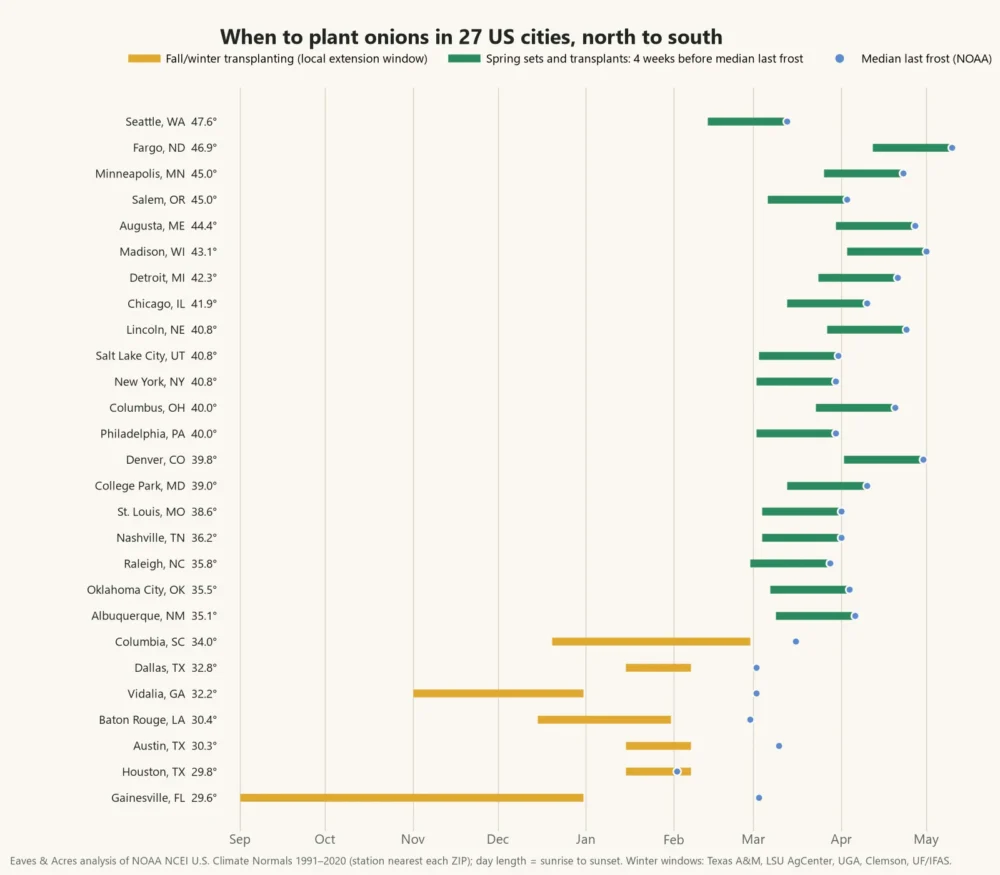
- 1Plant onion sets and transplants in the four weeks before your median last frost: about Mar 13 to Apr 10 in Chicago and Mar 26 to Apr 23 in Minneapolis.
- 2In the Deep South, plant in fall and winter instead: Texas A&M transplants from mid-January to early February, LSU AgCenter from mid-December through January, and UGA in November and December.
- 3Choose the onion type by latitude: short-day below about 36°N (University of Maryland Extension), long-day above it. That line puts 30% of lower-48 ZIP codes in short-day country.
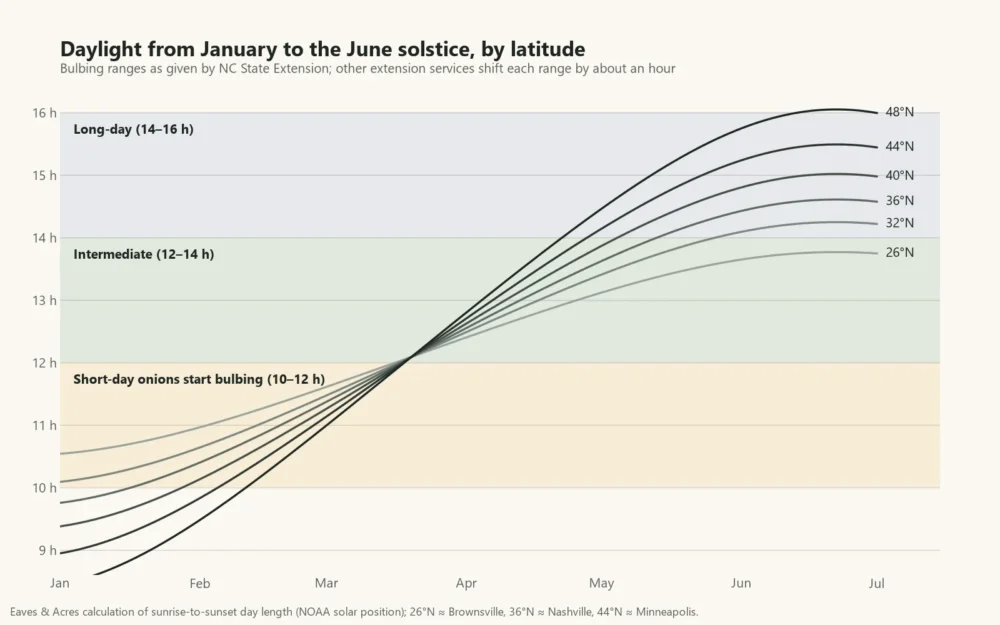
- 4Treat the hour labels as rough: daylight reaches 16 hours only north of about 47.7°N, so a long-day onion that needed 16 hours could not bulb in most of the North.
- 5In Minnesota, Nebraska and Utah, extension calendars set transplants out at or just after the median last frost; follow them there.
Plant onion sets and transplants in the four weeks before your average last spring frost, unless you live in the Deep South, where onions go in during fall and winter. That puts spring planting around March 13 to April 10 in Chicago and March 26 to April 23 in Minneapolis, while Texas A&M sets transplants out in mid-January to early February. Which onions you buy depends on your latitude, not your frost date.
Most guides give the three onion types and a list of hours, and stop there. We computed the day-length type for 40,567 ZIP codes in the lower 48 states from their latitude, checked the hour labels against the actual length of the day, and put the published Southern and Northern planting windows next to NOAA frost dates for 27 cities.
Onion planting dates for 27 US cities
For spring planting, each window runs from four weeks before the median last frost to the median date itself. That four-week count-back is the same plant-out date our guide to starting onion seeds indoors uses, so start seeds 8 to 10 weeks before the first date. Frost dates come from NOAA’s 1991–2020 normals for the station nearest each ZIP code.1 Where a local extension service publishes a fall or winter window, the table shows that window instead.
| City (ZIP) | Latitude | Onion type | Plant sets and transplants | Median last frost |
|---|---|---|---|---|
| Minneapolis, MN (55401) | 45.0° | Long-day | Mar 26 – Apr 23 | Apr 23 |
| Fargo, ND (58102) | 46.9° | Long-day | Apr 12 – May 10 | May 10 |
| Augusta, ME (04330) | 44.4° | Long-day | Mar 30 – Apr 27 | Apr 27 |
| Madison, WI (53703) | 43.1° | Long-day | Apr 3 – May 1 | May 1 |
| Detroit, MI (48201) | 42.3° | Long-day | Mar 24 – Apr 21 | Apr 21 |
| Chicago, IL (60601) | 41.9° | Long-day | Mar 13 – Apr 10 | Apr 10 |
| Lincoln, NE (68508) | 40.8° | Long-day | Mar 27 – Apr 24 | Apr 24 |
| Denver, CO (80202) | 39.8° | Long-day | Apr 2 – Apr 30 | Apr 30 |
| Salt Lake City, UT (84101) | 40.8° | Long-day | Mar 3 – Mar 31 | Mar 31 |
| Columbus, OH (43215) | 40.0° | Long-day | Mar 23 – Apr 20 | Apr 20 |
| Philadelphia, PA (19103) | 40.0° | Long-day | Mar 2 – Mar 30 | Mar 30 |
| New York, NY (10001) | 40.8° | Long-day | Mar 2 – Mar 30 | Mar 30 |
| College Park, MD (20742) | 39.0° | Long-day | Mar 13 – Apr 10 | Apr 10 |
| St. Louis, MO (63101) | 38.6° | Long-day | Mar 4 – Apr 1 | Apr 1 |
| Salem, OR (97301) | 45.0° | Long-day | Mar 6 – Apr 3 | Apr 3 |
| Seattle, WA (98101) | 47.6° | Long-day | Feb 13 – Mar 13 | Mar 13 |
| Nashville, TN (37201) | 36.2° | Long-day | Mar 4 – Apr 1 | Apr 1 |
| Raleigh, NC (27601) | 35.8° | Short-day | Feb 28 – Mar 28 | Mar 28 |
| Oklahoma City, OK (73102) | 35.5° | Short-day | Mar 7 – Apr 4 | Apr 4 |
| Albuquerque, NM (87102) | 35.1° | Short-day | Mar 9 – Apr 6 | Apr 6 |
| Columbia, SC (29201) | 34.0° | Short-day | Seed in early fall; transplants late December through February Clemson | Mar 16 |
| Vidalia, GA (30474) | 32.2° | Short-day | Direct-seed from mid-October; transplants November and December UGA | Mar 2 |
| Dallas, TX (75201) | 32.8° | Short-day | Seed in October; transplants mid-January to early February Texas A&M | Mar 2 |
| Baton Rouge, LA (70802) | 30.4° | Short-day | Transplants mid-December through January LSU AgCenter | Feb 28 |
| Austin, TX (78701) | 30.3° | Short-day | Seed in October; transplants mid-January to early February Texas A&M | Mar 10 |
| Houston, TX (77002) | 29.8° | Short-day | Seed in October; transplants mid-January to early February Texas A&M | Feb 2 |
| Gainesville, FL (32601) | 29.6° | Short-day | Plant September through December UF/IFAS | Mar 3 |
Onions are hardy plants that can take heavy spring frosts, according to the University of Maryland Extension,17 so the median frost date is not a hard limit. For any other ZIP code, look up your frost dates and their odds.
Loads from YouTube (privacy-enhanced mode) only when you press play.
Short-day, intermediate or long-day: go by latitude
An onion starts forming its bulb when the days reach a certain length, and that length differs by type. NC State Extension puts short-day onions at about 10 to 12 hours of daylight, intermediate-day onions at 12 to 14 and long-day onions at 14 to 16.4 Because summer days get longer the farther north you are, the type has to match your latitude. The University of Maryland Extension’s garden blog draws the line here:
Short-day onions are grown in the South, generally below latitude 36° N.
Long-day onions do best north of that line, it adds. Johnny’s Selected Seeds gives overlapping bands instead: short-day at 25 to 35°, intermediate at 32 to 42° and long-day at 37 to 47°.3 We placed every ZIP code in the lower 48 on those bands.
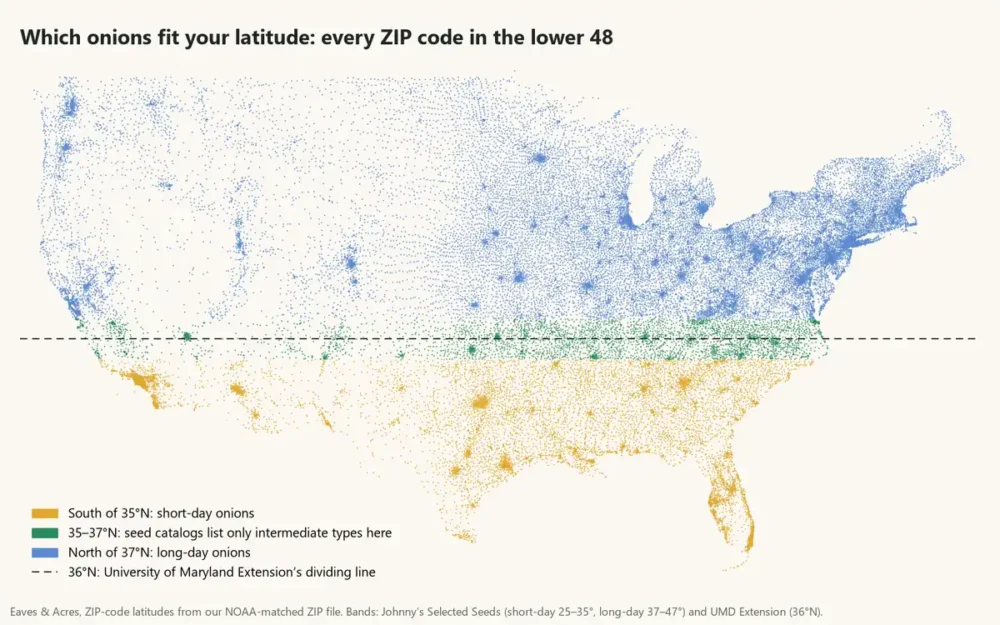
- 30% of ZIP codes lie south of 36°N. That covers Florida, the Gulf Coast, most of Texas and Georgia, and the southern deserts.
- 10% sit between 35 and 37°N, where Johnny’s lists only intermediate types. That band crosses 13 states, including Arkansas, Kentucky, North Carolina, Oklahoma, Tennessee and Virginia.
- 66% fall inside Johnny’s intermediate band of 32 to 42°, so intermediate onions are the safe choice for most of the country. The University of Maryland finds them the most reliable in Maryland.2
Seven states straddle the 36°N line: Arkansas, California, Nevada, New Mexico, North Carolina, Oklahoma and Tennessee. In those states the right type can change within the state.
| Latitude | Places near it | Longest day | Daylight passes 13 h | Passes 14 h | Passes 15 h | Onion type |
|---|---|---|---|---|---|---|
| 26°N | Brownsville, TX; Fort Myers, FL | 13 h 46 min | Apr 26 | Never | Never | Short-day |
| 28°N | Tampa, FL; Corpus Christi, TX | 13 h 55 min | Apr 23 | Never | Never | Short-day |
| 30°N | Houston, Austin, New Orleans | 14 h 05 min | Apr 20 | Jun 7 | Never | Short-day |
| 32°N | Dallas, Savannah, Tucson | 14 h 15 min | Apr 18 | May 27 | Never | Short-day |
| 34°N | Atlanta, Columbia (SC), Los Angeles | 14 h 25 min | Apr 16 | May 20 | Never | Short-day |
| 36°N | Nashville, Raleigh, Las Vegas | 14 h 36 min | Apr 14 | May 14 | Never | Long-day |
| 38°N | St. Louis, Washington (D.C.), Sacramento | 14 h 48 min | Apr 12 | May 9 | Never | Long-day |
| 40°N | Columbus (OH), Denver, Philadelphia | 15 h 01 min | Apr 10 | May 5 | Jun 17 | Long-day |
| 42°N | Chicago, Boston, Detroit | 15 h 15 min | Apr 9 | May 2 | Jun 1 | Long-day |
| 44°N | Minneapolis, Augusta (ME) | 15 h 29 min | Apr 7 | Apr 28 | May 24 | Long-day |
| 46°N | Fargo, Portland (OR), Duluth | 15 h 45 min | Apr 6 | Apr 25 | May 18 | Long-day |
| 48°N | Seattle, northern Minnesota | 16 h 03 min | Apr 5 | Apr 23 | May 13 | Long-day |
Why the hour labels don’t add up
Extension services don’t agree on the hours. We collected the ranges from twelve sources:
| Source | Short-day | Intermediate-day | Long-day |
|---|---|---|---|
| NC State Extension | 10–12 h | 12–14 h | 14–16 h |
| Texas A&M AgriLife | 11–12 h | 12–13 h | 14–16 h |
| Ohio State | 11–12 h | 13–14 h | 16 h or more |
| UGA (George Boyhan) | 11–12 h | 13–14 h | 15 h or more |
| Nebraska Extension | 11–12 h | 12–14 h | 14 h or more |
| University of Maryland (fact sheet) | About 12 h | Listed, no hours | 15–16 h |
| University of Maryland (Maryland Grows) | 10–12 h | 12–15 h | 14–16 h |
| University of Minnesota | — | — | 14 h or more |
| Oregon State | — | — | About 14 h |
| Clemson | About 12 h | — | — |
| MOFGA | — | — | More than 15 h |
| Johnny’s Selected Seeds | 10–12 h | 12–14 h | 14–16 h |
Sources: NC State,4 Texas A&M,5 Ohio State,15 UGA,8 Nebraska,13 University of Maryland,17,2 Minnesota,11 Oregon State,16 Clemson,9 MOFGA19 and Johnny’s.3
Some of those numbers can’t be literal. We computed day length from latitude, sunrise to sunset, and our figure for Rockville, Maryland matches the University of Maryland’s: 14 hours 55 minutes at the June solstice.2
By that calculation, daylight never reaches 16 hours south of about 47.7°N, which is only 1.6% of lower-48 ZIP codes. Columbus tops out at 15 hours 1 minute, yet Ohio State, which gives long-day onions 16 or more hours, recommends long-day cultivars for Ohio.15 Daylight reaches 15 hours only north of about 39.8°N. Read the hours as catalog labels; the latitude bands above are the practical guide.
Southern onions: plant in fall and winter
In the Deep South, short-day onions grow through the mild winter and bulb as the days lengthen in spring. Extension calendars there follow the season, not the last frost:
- Texas: Texas A&M seeds bulb onions in October and plants sets or transplants from mid-January to early February.6 Onions seeded from October to December or transplanted in January and February should make bulbs from May to July.5
- Louisiana: LSU AgCenter plants bulb-onion transplants from mid-December through January, for harvest around May.7
- Georgia: UGA’s George Boyhan advises home gardeners who direct-seed to wait until mid-October, and says transplants are sold in November and December.8
- South Carolina: Clemson sows seed in early fall and sets transplants from late December through February.9
- Florida: UF/IFAS plants from September through December.10
| Place | Published window | Median last frost | Weeks before median frost |
|---|---|---|---|
| Dallas, TX | Mid-January to early February (Texas A&M) | Mar 2 | 6.6 to 3.3 |
| Austin, TX | Mid-January to early February (Texas A&M) | Mar 10 | 7.7 to 4.4 |
| Houston, TX | Mid-January to early February (Texas A&M) | Feb 2 | 2.6 before to 0.7 after |
| Baton Rouge, LA | Mid-December through January (LSU AgCenter) | Feb 28 | 10.7 to 4 |
| Vidalia, GA | November and December (UGA) | Mar 2 | 17.3 to 8.7 |
| Columbia, SC | Late December through February (Clemson) | Mar 16 | 12.3 to 2.3 |
| Gainesville, FL | September through December (UF/IFAS) | Mar 3 | 26.1 to 8.9 |
Measured against NOAA frost dates, those windows open anywhere from a few weeks to six months before the median last frost. Google’s AI Overview for Texas says transplants go in about 4 to 6 weeks before the last spring freeze. That roughly fits Dallas and Austin, but in Houston the Texas A&M window runs from about two and a half weeks before the median last frost to five days after it. Use the local calendar; a frost count-back doesn’t work here.
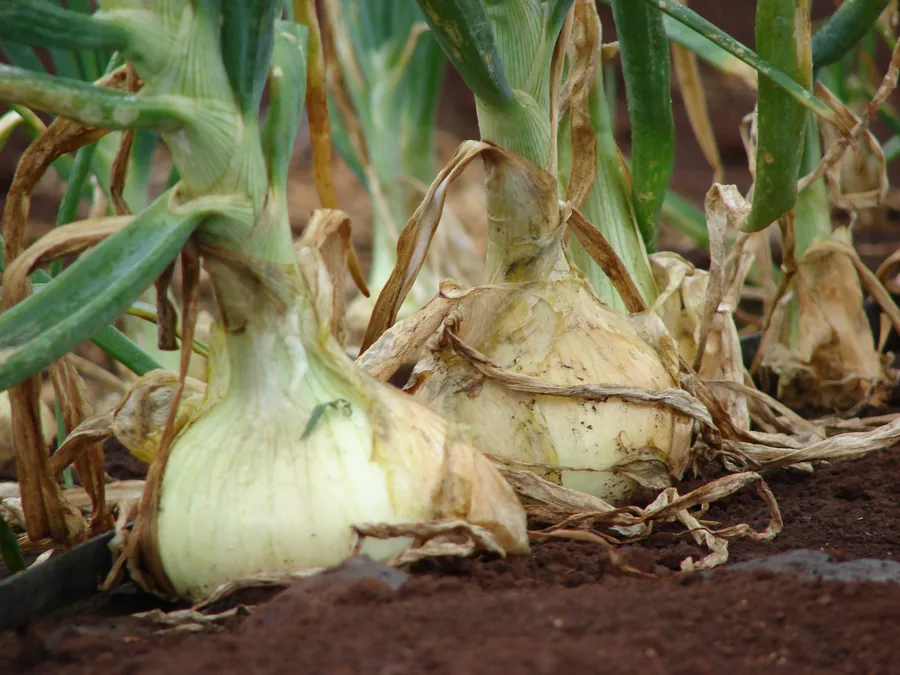
Too early in fall makes onions bolt
Fall planting has its own risk. NC State warns that planting too early in the fall can increase bolting, the premature flower stalk that leaves small bulbs with thick necks.4 Size at planting matters too. LSU AgCenter says transplants that are too large are likely to bolt, and too-small ones may not survive; it suggests plants thinner than a pencil.7
Northern onions: plant in spring, about four weeks before the last frost
North of the Gulf states, onions go in early in spring. The University of Maryland says to plant as soon as you can cultivate the garden.17 Early planting buys leaves, and leaves make the bulb. Texas A&M says each leaf forms a ring in the bulb.5 Oregon State’s vegetable breeder puts it this way:
The size of the bulb is dependent on the size of the plant when bulbing begins
The plants handle cold. Our frost-cover guide lists onions with the hardy crops, which take the mid to low 20s°F. That matters because at the start of the four-week window, a hard freeze of 28°F is still likely. Across 37,564 ZIP codes, the median last 28°F night comes 16 days after the window opens; our explainer on frost versus freeze covers the difference.
How the four-week rule compares with Northern calendars
We checked our window against five published Northern calendars. Two agree. Three of the coldest-region calendars start later, at or just after the median last frost:
| Place | Published guidance | Our window | Median last frost | Comparison |
|---|---|---|---|---|
| Minneapolis, MN | Transplant in May (University of Minnesota) | Mar 26 – Apr 23 | Apr 23 | Starts 8 days after the median frost |
| Lincoln, NE | Transplants in early May (Nebraska Extension, Lancaster County) | Mar 27 – Apr 24 | Apr 24 | Starts 7 days after the median frost |
| Salt Lake City, UT | Sets and transplants in April; storage onions in late April (Utah State) | Mar 3 – Mar 31 | Mar 31 | Starts 1 day after the median frost |
| Columbus, OH | Direct seed late March to April (Ohio State) | Mar 23 – Apr 20 | Apr 20 | Overlaps ours by 29 days |
| Salem, OR | March and April are prime (Oregon State) | Mar 6 – Apr 3 | Apr 3 | Overlaps ours by 29 days |
The 50°F rule explains part of the gap. The University of Minnesota says transplants can go in when temperatures reach 50°F,11 and Nebraska Extension says daytime temperatures.13 The two readings give very different dates.
Across 28,209 ZIP codes where winter highs drop below 50°F, the normal daily high reaches 50°F a median 39 days before the median last frost, earlier than our window opens. The normal daily mean reaches 50°F a median 11 days before the frost date, near the end of the window. In Minneapolis the mean reaches 50°F on April 25, just ahead of Minnesota’s May. In the Upper Midwest and Plains, follow the later date.
Sets, transplants or seed
The form you plant changes the timing a little and the result a lot:
- Sets (small dry bulbs) are the easiest, but Nebraska Extension says plants from sets often bloom in midsummer and stop growing their bulbs, because a set is already in its second season.12 Small sets bolt less. Illinois prefers sets smaller than a dime,18 and Utah State says sets over ⅝ inch bolt more often.14 Check the type on the bag, too. The University of Minnesota notes that most sets sold in Minnesota are short-day onions.11
- Transplants (bundles of young plants) give the best results for most Maryland gardeners, according to the University of Maryland.17 Utah State sets out sets and transplants at the same time, in April.14
- Seed sown directly in the garden goes in as soon as the soil can be worked: late March to April in Ohio15 and mid to late March around Lincoln, Nebraska.12
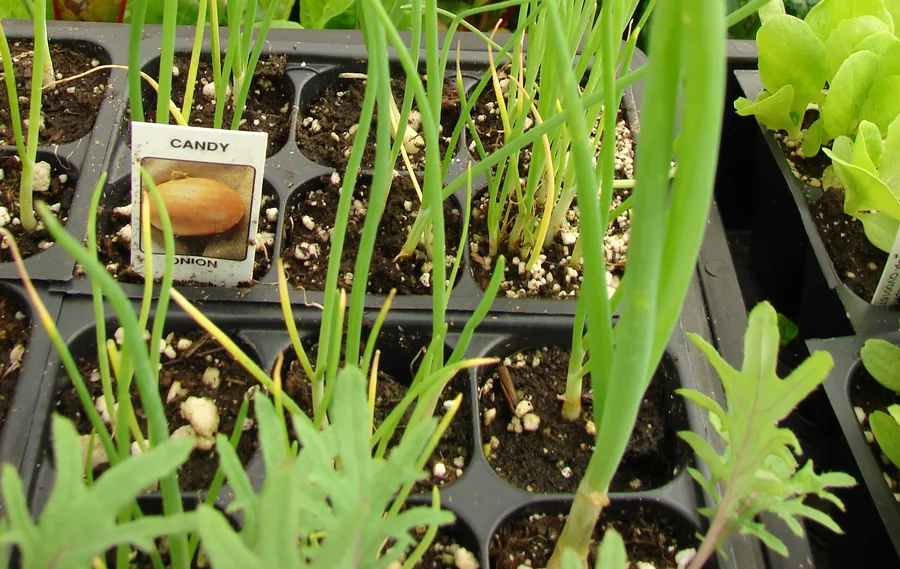
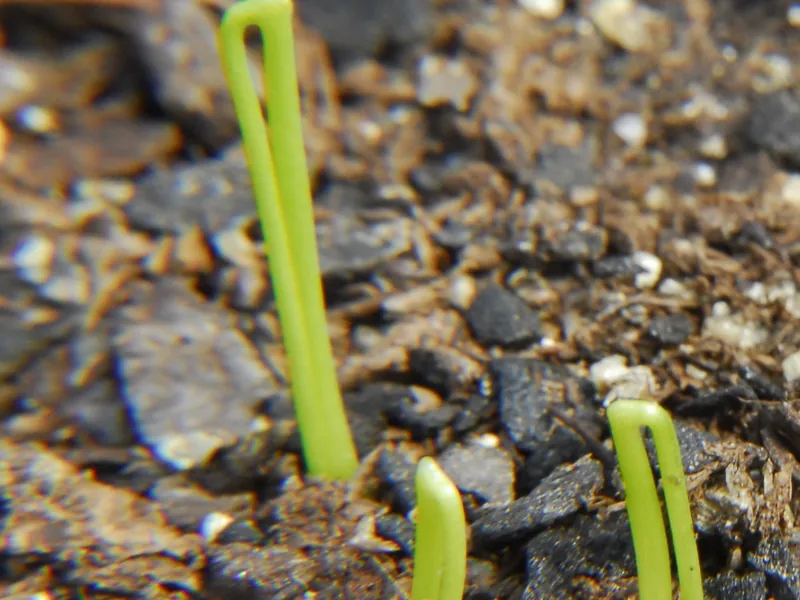
Planting too early has a cost of its own. The University of Maryland warns that exposure to cold after planting can trigger a seed stalk,17 and Utah State says sets and transplants often bolt if planted too early.14 Clemson explains why: onions bolt after a prolonged cold period that follows good growth, and the larger the plants, the higher the rate of bolting.9 That is why the window opens four weeks before the median frost and not earlier.
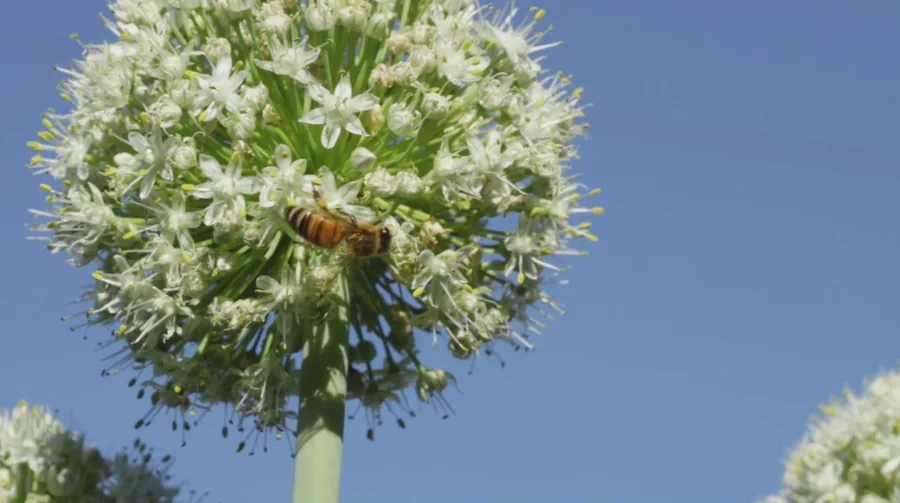
Garlic follows a different rule: it goes in around the first fall frost, as our garlic planting guide explains. Potatoes go in about when onions do, timed by soil temperature in our potato guide. For the rest of the fall garden, see fall vegetable planting dates and the other vegetable guides.
Frequently asked questions
It depends on your latitude. In most of the North, plant sets in March or April, in the four weeks before your median last frost; in Minnesota and Nebraska, extension calendars wait until early May. In the Deep South, onions go in during fall and winter: Texas A&M plants sets and transplants from mid-January to early February, and LSU AgCenter from mid-December through January.
In the South, fall is the season: Texas A&M sows onion seed in October, UGA direct-seeds from mid-October, and UF/IFAS plants through December. In the North, bulb onions wait for spring. Fall planting there is for multiplier onions, which the University of Maryland plants in September or October; for Egyptian walking onions, which Illinois plants in August; and for special overwintering varieties, which Utah State sows in mid to late August.
Your hardiness zone can’t decide it alone. USDA zones are based on the coldest winter night, not on day length or spring frost. Johnny’s Selected Seeds says short-day onions need mild winters, zone 7 and warmer, but they also need a latitude below about 35 to 36°N. Choose the type by latitude and the date by your ZIP code’s median last frost or your local extension calendar.
They bulb too soon. Nebraska Extension says short-day onions start forming bulbs before the plant has grown enough leaves, which gives disappointingly small bulbs; the University of Minnesota says the same for Minnesota. The reverse fails too: UGA says long-day onions planted in Georgia make green tops but no bulb, so harvest them as green onions.
From planting to dry bulbs, about four to five months in Florida, according to UF/IFAS. In Texas, onions seeded from October to December or transplanted in January and February make bulbs between May and July, says Texas A&M. For green onions, Clemson says sets and transplants are ready to eat in six to eight weeks.
Bulb onions don’t. The University of Maryland says they are biennials grown as annuals: they make a bulb in the first season and flower in the second, says Nebraska Extension. Egyptian walking onions, multiplier onions and shallots are hardy perennials that you can replant from their own bulbs.
In October, from seed: Texas A&M sows bulb-onion seed in October, ¼ inch deep. Sets and transplants wait until mid-January to early February. Choose short-day or intermediate-day varieties; Texas A&M lists TX 1015Y and Granex among its short-day onions.
Plant early. Bulb size depends on how big the plant is when bulbing starts, says Oregon State, and Texas A&M notes that each leaf forms a ring in the bulb. Match the type to your latitude, and use small sets and transplants thinner than a pencil, which bolt less often, according to Illinois Extension and LSU AgCenter.
Sources
- 1.U.S. Climate Normals 1991–2020. NOAA National Centers for Environmental Information, 2021. Used for: median last-frost, 28°F hard-freeze and monthly temperature normals for every ZIP and city Back to text
- 2.Onions and day length (Maryland Grows), Erica Smith, Montgomery County Master Gardener. University of Maryland Extension, Home and Garden Information Center, 2018. Used for: short-day onions below about 36°N, long-day north of it; hour ranges; Rockville longest day 14 h 55 min; intermediate types most reliable in Maryland Back to text
- 3.Onion Bulb Formation, Daylength & Latitude. Johnny’s Selected Seeds, n.d. Used for: latitude bands: short-day 25–35°, intermediate 32–42°, long-day 37–47°; short-day onions need zone 7 and warmer Back to text
- 4.Bulb Onions, Emmanuel Torres Quezada and Chris Gunter. NC State Extension, 2025. Used for: daylength groups 10–12, 12–14 and 14–16 hours; eastern North Carolina seeding and transplant windows; planting too early in fall increases bolting Back to text
- 5.Onions (Easy Gardening). Texas A&M AgriLife Extension Service, 2023. Used for: Texas varieties by day length (11–12, 12–13, 14–16 hours); onions seeded October to December or transplanted January to February bulb May to July; each leaf forms a ring Back to text
- 6.How to Grow Onions (Onion Growing Guide). Texas A&M AgriLife Extension Service, 2019. Used for: seed in October; sets or transplants mid-January to early February Back to text
- 7.Plant at the Right Time to Grow Garlic and Bulb Onions, Mary Helen Ferguson. LSU AgCenter, 2024. Used for: bulb-onion transplants mid-December through January; transplant size and bolting Back to text
- 8.Choose the right Vidalia onion to sow in garden, George E. Boyhan. University of Georgia CAES, 2004. Used for: hour ranges; direct-seed from mid-October; transplants November and December; long-day onions in Georgia make green onions Back to text
- 9.Onion, Leek, Shallot & Garlic (HGIC 1314). Clemson Cooperative Extension Home & Garden Information Center, 2023. Used for: seed in early fall; transplants late December through February; bolting after prolonged cold; green onions in 6–8 weeks Back to text
- 10.Onions and Shallots. UF/IFAS Gardening Solutions, n.d. Used for: Florida: plant September through December; short-day varieties; harvest in four to five months Back to text
- 11.Growing onions in home gardens, Marissa Schuh and Cindy Tong. University of Minnesota Extension, 2024. Used for: transplant in May when temperatures reach 50°F; long-day onions need 14 or more hours; most sets sold in Minnesota are short-day Back to text
- 12.Growing Onions: Sets, Plants or Seeds?, Sarah Browning. Nebraska Extension in Lancaster County, 2020. Used for: transplants outdoors in early May; direct seed mid to late March; sets bloom in midsummer Back to text
- 13.Onions: Long Day, Short Day or Neutral?, Sarah Browning. Nebraska Extension in Lancaster County, 2022. Used for: hour ranges; short-day onions give small bulbs in the North; transplant when daytime temperatures reach 50°F Back to text
- 14.Onions in the Garden, Dan Drost. Utah State University Extension, 2020. Used for: transplants and sets in April, storage onions late April; early planting and sets over 5/8 inch bolt more; overwintering seed in August Back to text
- 15.Growing Onions in the Garden (HYG-1616). The Ohio State University Extension, 2018. Used for: hour groups 11–12, 13–14 and 16 or more; cultivars for Ohio; direct seed late March to April Back to text
- 16.Plant onions early for bigger summer bulbs, Kym Pokorny (quoting Jim Myers). Oregon State University Extension Service, 2019 (updated 2025). Used for: March and April planting; long-day bulbing at about 14 hours; bulb size depends on plant size Back to text
- 17.Growing Onions in a Home Garden. University of Maryland Extension, 2026. Used for: hardy to heavy spring frosts; plant as soon as the garden can be cultivated; cold exposure causes seed stalks; transplants best for most Maryland gardeners; long-day 15–16 hours; perennial and multiplier onions Back to text
- 18.Onion (Watch Your Garden Grow). University of Illinois Extension, n.d. Used for: sets smaller than a dime rarely bolt; Egyptian onions planted in August Back to text
- 19.Growing Onions in Northern New England, John Fuchs. Maine Organic Farmers and Gardeners Association, 2011. Used for: long-day onions need more than 15 hours of light Back to text
- 20.USDA Plant Hardiness Zone Map. USDA Agricultural Research Service, 2023. Used for: what hardiness zones measure
- 21.How to properly plant onions (Get It Growing video), Kiki Fontenot. LSU AgCenter, 2018. Used for: embedded video
- 22.Photo: Starr 070313-5655 Allium cepa, Forest & Kim Starr (CC BY 3.0). Wikimedia Commons, 2007. Used for: hero photo
- 23.Photo: Starr 070313-5653 Allium cepa, Forest & Kim Starr (CC BY 3.0). Wikimedia Commons, 2007. Used for: bulb photo
- 24.Photo: Starr 080117-1585 Allium cepa, Forest & Kim Starr (CC BY 3.0). Wikimedia Commons, 2008. Used for: transplant photo
- 25.Photo: Onions 070405, Dwight Sipler (CC BY 2.0). Wikimedia Commons, 2007. Used for: seedling photo
- 26.Photo: Onion flowers with a honey bee, USDA (public domain). Wikimedia Commons, 2021. Used for: bolted onion photo


.jpg)

How this guide was made
- Written by the Yard & Garden Desk and reviewed by the Data & Methodology Desk.
- Data: median last-frost dates, 28°F hard-freeze dates and monthly mean temperatures from NOAA NCEI U.S. Climate Normals 1991–2020 for the station nearest each ZIP code; day length computed from each ZIP code's latitude (sunrise to sunset) and checked against the University of Maryland Extension's published Rockville figure; latitude bands from University of Maryland Extension and Johnny's Selected Seeds; planting windows from Texas A&M, LSU AgCenter, UGA, Clemson, UF/IFAS, NC State, Minnesota, Nebraska, Utah State, Ohio State and Oregon State extension publications. See our methodology.
- AI use: AI tools help us research, draft and check this guide. Every figure is checked against the source cited for it, and calculated figures come from our own code, described on the methodology page.
- Spotted an error? Tell us — the form opens with this page’s address filled in.
Change log
- Oct 13, 2026Re-checked the Maryland Grows and Oregon State quotes and the Texas A&M, LSU AgCenter, UGA, Clemson, UF/IFAS, University of Minnesota, Ohio State, Illinois and Utah State windows against the live pages (all unchanged); updated the University of Minnesota source to its current address.
- Oct 12, 2026Published. Spring planting windows for 27 cities from NOAA 1991–2020 normals, Southern windows from Texas A&M, LSU AgCenter, UGA, Clemson and UF/IFAS, and the onion day-length type for 40,567 lower-48 ZIP codes from their latitude.
Covers lawns, gardens, frost and planting. We write the guides and maintain the tools that tell you when to seed, feed and plant for your ZIP.
Keep reading
When to Plant a Fall Vegetable Garden: Planting Dates by City
Count back from your first fall frost: days to maturity plus a 14-day fall factor, and 14 more for tender crops. Last planting dates for 20 US cities from NOAA normals.
When to Plant Potatoes: Spring Dates and Soil Temperature by City
Plant potatoes two to four weeks before your last frost, once 4-inch soil reaches 45°F. Dates for 22 cities from NOAA normals and 12 springs of measured soil data.
When to Plant Garlic: Fall Planting Dates Where You Live
Plant garlic in the two weeks either side of your first fall frost. Dates for 22 US cities from NOAA normals, checked against 11 local extension calendars.
Seasonal reminders for your ZIP
Get a short email when it’s time to overseed, start seeds, open the pool or service your furnace — timed to your climate.