




When to Plant a Fall Vegetable Garden: Planting Dates by City
Count back from your first fall frost with the extension formula. Last planting dates for beans, broccoli, spinach and radishes in 20 US cities from NOAA normals, checked against seven local calendars.
- Last reviewed Oct 7, 2026
- 15 cited sources
- 12 min read
Set your ZIP to see dates for your area.
- 1Count back from your median first fall frost: days to maturity, plus about 14 days for slower fall growth, plus 14 more for frost-tender crops such as beans and squash.
- 2Last bush bean and spinach dates: Minneapolis Jul 30 and Aug 18, Columbus Aug 7 and Aug 26, Atlanta Aug 22 and Sep 10, Dallas Sep 12 and Oct 1.
- 3The 14-day frost-tender factor equals the median gap between the average and the 1-in-10 early frost date in 39,024 US ZIP codes, so don’t also count from a “safe” date.
- 4The formula’s bush bean dates fall within 2 days of four of seven local extension calendars; most of those calendars allow spinach 2 to 4 weeks later.
- 5On the Pacific coast and in much of California, days drop below 10 hours before the first frost; Oregon State’s Portland-area dates run 2½ to 6½ weeks earlier for beans, broccoli and radishes.
Plant a fall vegetable garden by counting back from your area’s median first fall frost: take each crop’s days to maturity, add about 14 days because growth slows in fall, and add 14 more for frost-tender crops such as beans and squash. From Madison to Boston that means bush beans by late July to late August, broccoli transplants a few days later, spinach by mid-August to mid-September and radishes by about September 1 to October 1. Atlanta and New York can sow beans until late August or early September, Dallas until mid-September.
Every top guide and Google’s AI Overview give that rule but no date for any place. We ran the extension formula on NOAA’s 1991–2020 frost normals for 20 cities1 and checked it against seven published local calendars. We also tested the 14-day frost-tender allowance against frost odds in 39,024 ZIP codes.
How to calculate your fall planting date
Nebraska Extension, Virginia Cooperative Extension and Oregon State all use the same count-back.2,3,4 Add up:
- Days to maturity from the seed packet, for the earliest variety you can find.
- Days to grow your own transplants, if you start seedlings yourself.
- The harvest period you want, if you plan to pick for weeks rather than once.
- A fall factor of about 14 days for slower growth in cooler, shorter days.
- A frost-tender factor of 14 days for crops a light frost kills.
The total is the number of days to count back from the first expected fall frost. Nebraska’s NebGuide G1343 explains the last step for beans, corn, cucumbers, tomatoes and squash: they
must mature at least two weeks before frost in order to produce a reasonable harvest
The Old Farmer’s Almanac uses a smaller fall factor, a week or two, and adds 7 to 10 days if you want to harvest over time.13
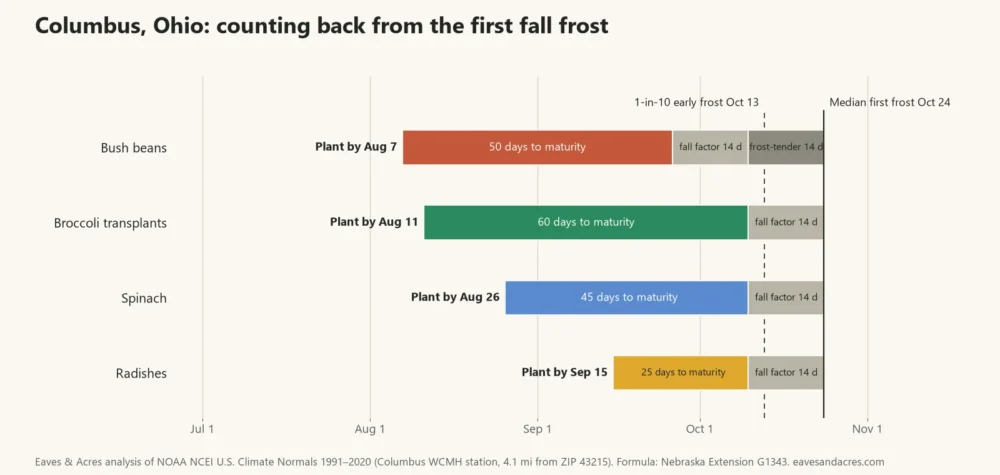
Bush beans in Columbus, Ohio
- Scenario
- Median first fall frost: Oct 24 (NOAA, Columbus WCMH station). Early bush bean: 50 days to maturity.
- Math
- 50 days + 14-day fall factor + 14-day frost-tender factor = 78 days. Oct 24 minus 78 days = Aug 7. For three weeks of picking, count back 21 days more: Jul 17.
- Answer
- Sow bush beans by about Aug 7 for one picking, or by mid-July for a longer harvest.
Days to maturity: from seed or from transplant
For tomatoes, peppers, eggplant, melons, broccoli, cabbage, cauliflower and Brussels sprouts, the number on the packet usually counts from transplanting, says the University of Maryland; for other crops it counts from direct seeding.7 If you grow your own brassica transplants, add the time to raise them. Nebraska says seedlings can be grown in five to six weeks,2 and Iowa State sows them indoors six to eight weeks before the fall planting date.5 Our seed-starting guide covers lights and trays.
Homegrown broccoli transplants in Denver
- Scenario
- Median first fall frost: Oct 12. Broccoli: 60 days from transplanting (low end of Iowa State’s range). Seedlings: 5–6 weeks (Nebraska).
- Math
- 60 + 14-day fall factor = 74 days. Oct 12 minus 74 days = Jul 30 to transplant. Minus 5–6 weeks = Jun 18–25 to sow indoors.
- Answer
- Sow broccoli seeds in the third or fourth week of June and set the plants out by the end of July.
Loads from YouTube (privacy-enhanced mode) only when you press play.
Fall planting dates for 20 US cities
The table counts back from the median first 32°F frost at the NOAA station nearest each city. It uses the low end of Iowa State’s days-to-maturity ranges: 50 days for bush beans, 60 from transplanting for broccoli, 45 for spinach and 25 for radishes.5
| City (ZIP) | Median first frost | Bush beans | Broccoli transplants | Spinach | Radishes |
|---|---|---|---|---|---|
| Madison, WI (53703) | Oct 9 | Jul 23 | Jul 27 | Aug 11 | Aug 31 |
| Denver, CO (80202) | Oct 12 | Jul 26 | Jul 30 | Aug 14 | Sep 3 |
| Minneapolis, MN (55401) | Oct 16 | Jul 30 | Aug 3 | Aug 18 | Sep 7 |
| Des Moines, IA (50309) | Oct 20 | Aug 3 | Aug 7 | Aug 22 | Sep 11 |
| Columbus, OH (43215) | Oct 24 | Aug 7 | Aug 11 | Aug 26 | Sep 15 |
| Pittsburgh, PA (15222) | Oct 27 | Aug 10 | Aug 14 | Aug 29 | Sep 18 |
| Detroit, MI (48201) | Oct 31 | Aug 14 | Aug 18 | Sep 2 | Sep 22 |
| Nashville, TN (37201) | Oct 31 | Aug 14 | Aug 18 | Sep 2 | Sep 22 |
| Kansas City, MO (64105) | Nov 2 | Aug 16 | Aug 20 | Sep 4 | Sep 24 |
| Charlotte, NC (28202) | Nov 3 | Aug 17 | Aug 21 | Sep 5 | Sep 25 |
| St. Louis, MO (63101) | Nov 4 | Aug 18 | Aug 22 | Sep 6 | Sep 26 |
| Chicago, IL (60601) | Nov 5 | Aug 19 | Aug 23 | Sep 7 | Sep 27 |
| Washington, DC (20001) | Nov 8 | Aug 22 | Aug 26 | Sep 10 | Sep 30 |
| Salt Lake City, UT (84101) | Nov 8 | Aug 22 | Aug 26 | Sep 10 | Sep 30 |
| Atlanta, GA (30303) | Nov 8 | Aug 22 | Aug 26 | Sep 10 | Sep 30 |
| Boston, MA (02108) | Nov 9 | Aug 23 | Aug 27 | Sep 11 | Oct 1 |
| Louisville, KY (40202) | Nov 9 | Aug 23 | Aug 27 | Sep 11 | Oct 1 |
| Philadelphia, PA (19103) | Nov 17 | Aug 31 | Sep 4 | Sep 19 | Oct 9 |
| New York, NY (10001) | Nov 20 | Sep 3 | Sep 7 | Sep 22 | Oct 12 |
| Dallas, TX (75201) | Nov 29 | Sep 12 | Sep 16 | Oct 1 | Oct 21 |
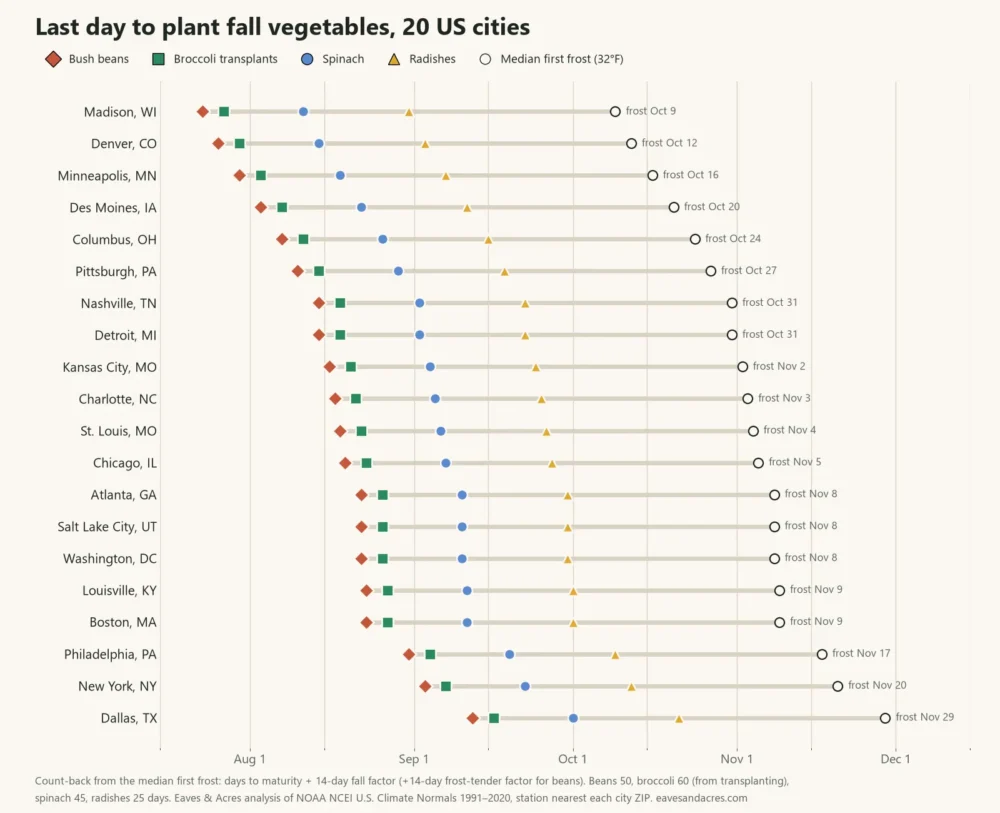
A different variety changes the date one for one: a 60-day bean instead of a 50-day bean moves the deadline 10 days earlier. Gardens in a valley, on a hilltop or far from the station can differ by a week or more, so look up the first fall frost for your ZIP code and count back the same way. Seattle, Portland, Sacramento and Houston are left out of this table on purpose; see short days and warm-winter gardens.
Which frost date to count back from
A median frost date is a coin flip: in half of years the first 32°F night comes earlier. Our guide to what frost-date odds mean explains the probabilities.
Sources pick different dates. Nebraska, Iowa State and the Almanac count from the average first frost.2,5,13 Piedmont Master Gardeners in central Virginia put the average first frost there at October 10 to 15 and pick October 10 “to be on the safe side.”9 NOAA’s normals for the Free Union station near Charlottesville put the median at October 24, so October 10 is in fact the 10% date there.1 Cornell Cooperative Extension in Warren County, New York, counts from the 28°F killing frost and adds no fall factor.8
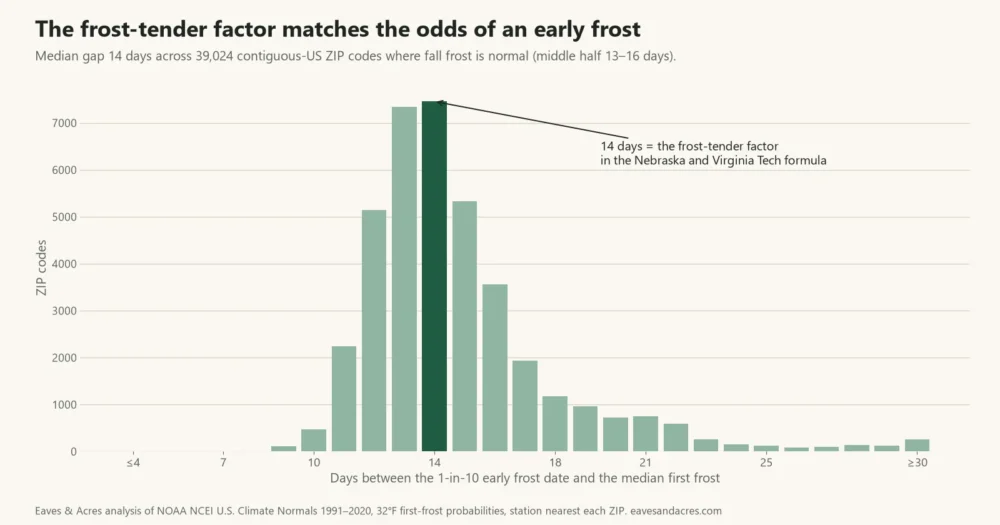
We checked what the frost-tender factor really buys. Across 39,024 contiguous-US ZIP codes where fall frost is normal, the 10% first-frost date falls a median 14 days before the median date (middle half: 13–16 days).1 So “average frost minus 14 days” is, in a typical ZIP code, the date with only a 1-in-10 chance of an earlier frost.
Frost-tolerant crops get a bonus at the other end. The 28°F hard freeze, which the National Weather Service says kills most vegetation,15 comes a median 11 days after the first 32°F night (middle half 10–13 days).1 Our guides on frost vs. freeze and when to cover plants for frost cover that window.
Hardy, semi-hardy and tender fall crops
Iowa State Extension sorts fall vegetables into three groups. Tender crops are hurt by a light frost; semi-hardy crops take the upper 20s°F; hardy crops survive the mid to low 20s.5 Nebraska puts the hardy limit near 20°F and the semi-hardy limit at a light frost of 30 to 32°F.2
| Crop | Frost group | Days to maturity | Days to count back |
|---|---|---|---|
| Bush beans | Tender | 50–70 | 78 |
| Cucumbers | Tender | 55–65 | 83 |
| Summer squash | Tender | 50–60 | 78 |
| Sweet corn | Tender | 70–105 | 98 |
| Radishes | Semi-hardy | 25–40 | 39 |
| Spinach | Semi-hardy | 45–60 | 59 |
| Leaf lettuce | Semi-hardy | 45–60 | 59 |
| Beets | Semi-hardy | 50–70 | 64 |
| Carrots | Semi-hardy | 60–80 | 74 |
| Swiss chard | Semi-hardy | 60–65 | 74 |
| Turnips | Hardy | 45–70 | 59 |
| Kale | Hardy | 55–75 | 69 |
| Broccoli (from transplants) | Hardy | 60–65 | 74 |
| Cauliflower (from transplants) | Hardy | 55–80 | 69 |
| Cabbage (from transplants) | Hardy | 60–90 | 74 |
| Brussels sprouts (from transplants) | Hardy | 80–90 | 94 |
Days to maturity are Iowa State’s ranges; the count-back adds the 14-day fall factor to the low end, plus 14 days for tender crops.5,2 The groups don’t always agree: Iowa State lists carrots as semi-hardy, while Nebraska lists them with the hardy crops, along with turnips and rutabagas.5,2
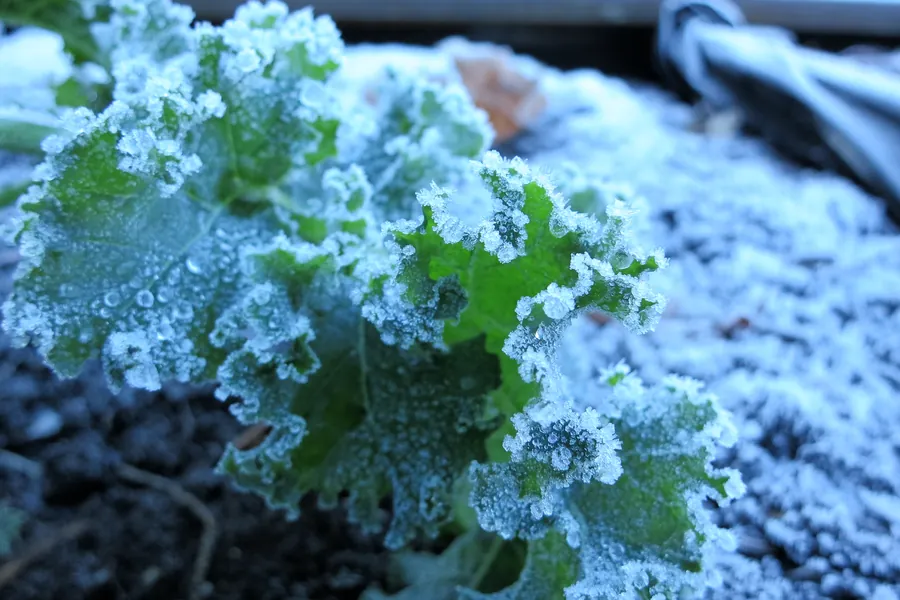
Hardy crops can be harvested after the first frost, and some, Iowa State says, as late as November.5 Virginia Cooperative Extension notes that cabbage, broccoli, spinach and Brussels sprouts don’t need to be picked the moment frost comes.3 Tender crops are the opposite: pick ripe tomatoes, squash, peppers and cucumbers when the first frost is forecast.3
How the formula compares with local calendars
We ran the formula for seven places that publish their own fall planting dates and compared the latest date each calendar gives.5,6,7,4,8
| Place (calendar) | NOAA median first frost | Bush beans: calendar | Bush beans: formula | Spinach: calendar | Spinach: formula |
|---|---|---|---|---|---|
| Ames, IA (Iowa State) | Oct 8 | mid-July | Jul 22 | mid-Aug to early Sep | Aug 10 |
| Rockford, IL (Illinois Ext., north) | Oct 17 | Jun 25–Jul 5* | Jul 31 | Aug 11–20 | Aug 19 |
| Springfield, IL (Illinois Ext., central) | Oct 22 | Jul 10–20* | Aug 5 | Aug 25–Sep 5 | Aug 24 |
| Carbondale, IL (Illinois Ext., south) | Oct 22 | Jul 24–Aug 3* | Aug 5 | Sep 8–17 | Aug 24 |
| Frederick, MD (Univ. of Maryland) | Nov 6 | first week of Aug | Aug 20 (Aug 8 from Oct 25) | early Sep | Sep 8 (Aug 27 from Oct 25) |
| Portland, OR (Oregon State) | Dec 1 | through July | Sep 14 | September | Oct 3 |
| Warrensburg, NY (CCE Warren Co.) | Oct 16 | 10 weeks before frost (Jul 31) | Jul 30 | 4 weeks before frost (Sep 11) | Aug 18 |
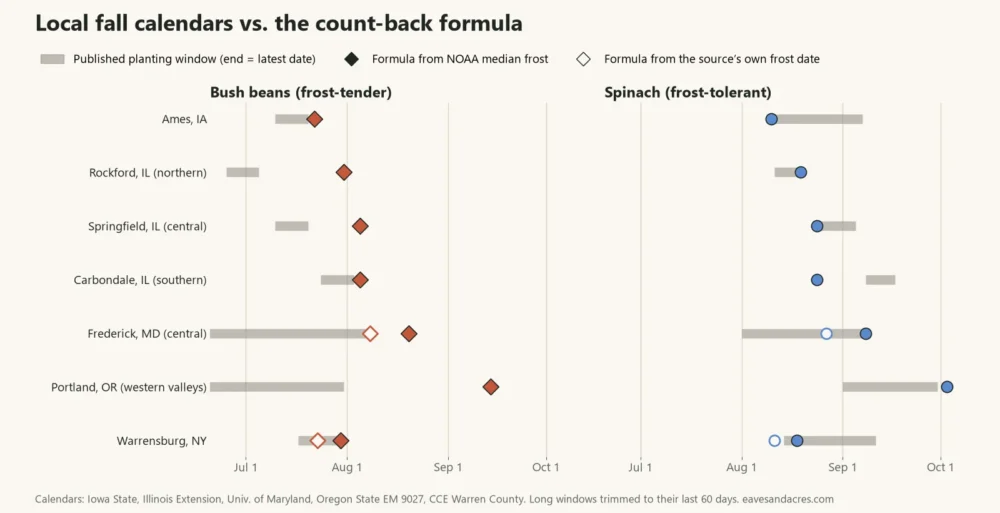
Frost-tender beans: the formula lands within 2 days of the calendar in Ames, Carbondale and Warren County, New York. In Maryland it matches within a day when we use the October 25 frost date that the University of Maryland built its central-Maryland calendar on;7 NOAA’s Frederick median, November 6, would allow 13 more days. Northern and central Illinois list snap beans with slower crops such as broccoli, cabbage and carrots, so their bean dates (marked * in Table 3) run 2 to 4 weeks earlier.6
Frost-tolerant spinach: four of the seven calendars let you sow 12 to 28 days later than the formula; Rockford, Frederick and Portland are within 3 days. That fits Iowa State’s note that semi-hardy crops are often harvested after the first frost.5 Treat the spinach and radish dates in Table 1 as safe dates for a full crop, and push them a week or two later if you’re happy to harvest small leaves or cover the bed.
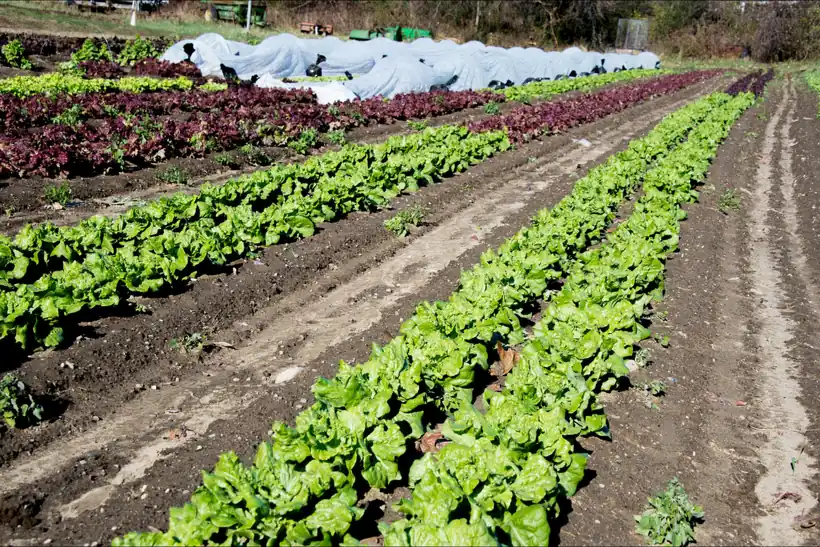
One more check: an Ohio State educator in Hocking County put the frost-free date “around the middle of October,” with “a little under 100 days” left on July 9.14 NOAA’s median for Logan, Ohio, is October 14, which is 97 days after July 9.1
Short days: the second deadline
Frost isn’t the only thing that ends a fall garden. Oregon State uses the same formula but warns that crops need
time to mature before cold weather and short days curtail growth
The UC Master Gardeners of Contra Costa County use Eliot Coleman’s “Persephone period,” the weeks when daylight is under 10 hours, because
most plants need more than 10 hours of daily sunlight for growth
They give November 20 to January 22 for Contra Costa, from the US Naval Observatory’s tables.10 Our day-length calculation gives November 20 to January 23 there, so we used it for every ZIP code.
| City (ZIP) | Median first frost | Daylight that day | Daylight under 10 hours from | Which comes first |
|---|---|---|---|---|
| Seattle, WA (98101) | Nov 17 | 9.3 h | Nov 2 | short days |
| Portland, OR (97204) | Dec 1 | 9.0 h | Nov 5 | short days |
| Sacramento, CA (95814) | Dec 16 | 9.5 h | Nov 19 | short days |
| San Jose, CA (95113) | Dec 25 | 9.6 h | Nov 23 | short days |
| New York, NY (10001) | Nov 20 | 9.8 h | Nov 14 | short days |
| Philadelphia, PA (19103) | Nov 17 | 9.9 h | Nov 16 | short days |
| Minneapolis, MN (55401) | Oct 16 | 11.0 h | Nov 6 | frost |
| Spokane, WA (99201) | Oct 12 | 11.1 h | Nov 2 | frost |
| Atlanta, GA (30303) | Nov 8 | 10.6 h | Dec 8 | frost |
| Dallas, TX (75201) | Nov 29 | 10.2 h | Dec 17 | frost |
| Houston, TX (77002) | Dec 25 | 10.2 h | never | frost (days stay above 10 h) |
Nationally, days drop below 10 hours before the median first frost in 7% of ZIP codes where fall frost is normal, but in 75% of California ZIP codes and about 40% in Washington, Oregon and Nevada. In Texas, Florida, Georgia and Louisiana it never happens: frost comes first.1
That is why the frost count-back runs late on the Pacific coast. For Oregon’s western valleys, Oregon State lists snap beans through July, broccoli through August, and spinach and radishes in September.4 With Portland’s December 1 median frost, the formula gives September 14 for beans, September 18 for broccoli and October 23 for radishes: 2½ to 6½ weeks later. Spinach (October 3) is the only close match. West of the Cascades and in California’s valleys, use your county’s extension calendar.
Warm-winter gardens: Texas, the Gulf Coast and Florida
Where frost comes in December or not at all, fall is a second main season and heat sets the start. Frost is rare at 4% (1,540 of 40,564) of contiguous-US ZIP codes.1 Texas A&M AgriLife publishes fall dates for five regions: the last optimum date for tomato, pepper and eggplant transplants runs from June 25 in Region I to September 1 in Region V, and for broccoli, cabbage, cauliflower and Brussels sprouts from August 1 to November 20.11 It also says fall crops generally do better from transplants, and that tomatoes and peppers should always be transplanted.11
In Louisiana, LSU AgCenter makes August and September the main months and starts tomatoes, pumpkins, peas and okra a month or two earlier. Tomatoes, peppers and eggplant can take two to two and a half months from transplanting to the first fruit, it notes.12 For spring tomato timing, see when to plant tomatoes. Texas A&M and LSU AgCenter also recommend a fall potato crop, planted from mid-August; see when to plant potatoes.
Getting fall seeds up in summer heat
Fall gardens are sown in the hottest, driest weeks, so germination is the hard part.
- Water first. Plant after a rain or soak the bed the day before; Virginia Cooperative Extension suggests a shallow trench to hold moisture.3
- Sow deeper. Cover seeds about twice as deep as in spring.2,3
- Cool the soil. Lettuce, peas and spinach germinate poorly above 85°F soil. Shade the row with a raised board or a light mulch and remove it when sprouts appear.2
- Pre-sprout. Sprouting seeds indoors first can save two to five days.3
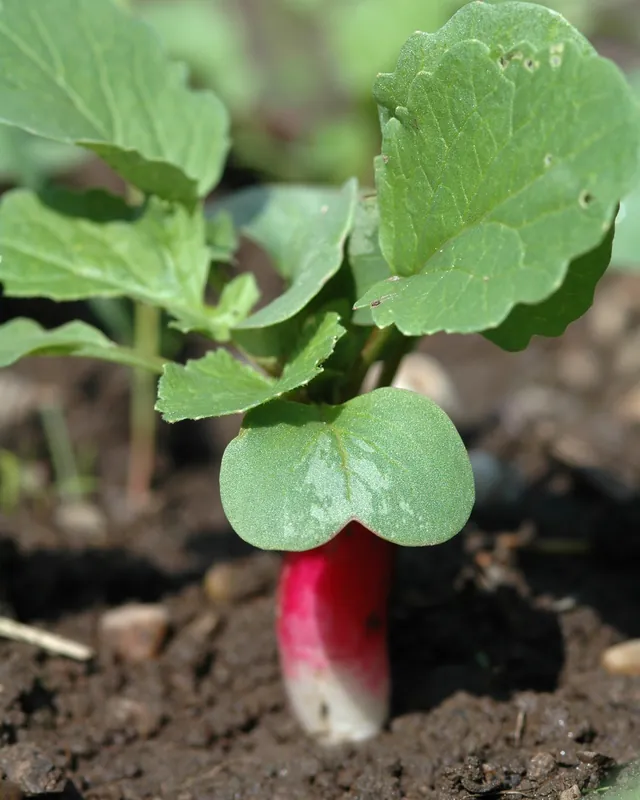
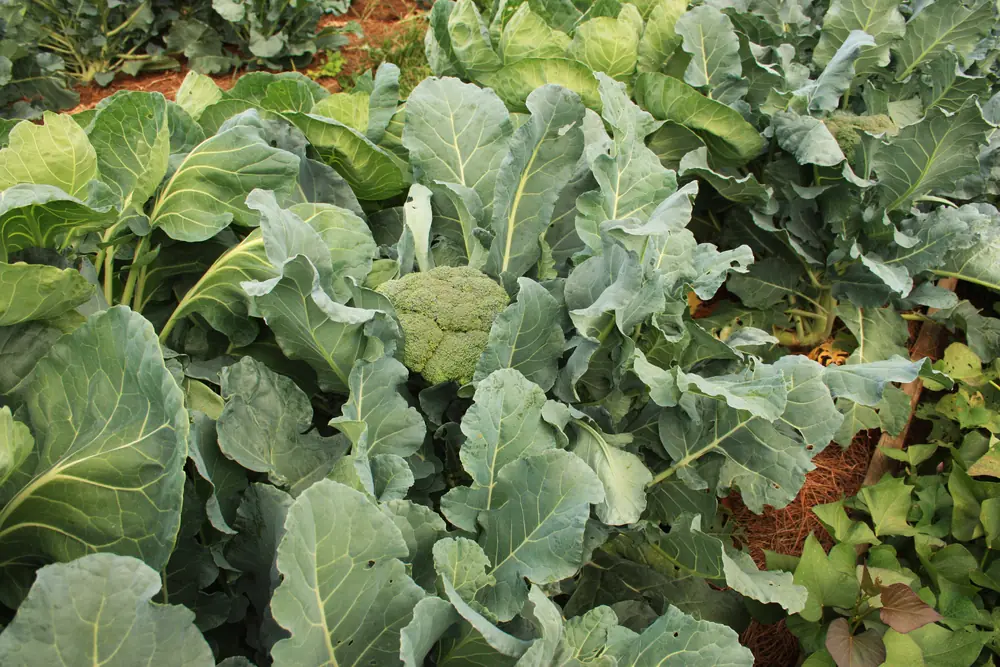
Insects don’t take the fall off. Nebraska warns that cabbage worms and cabbage loopers can strip new brassica transplants, and that cucumber beetles and squash bugs peak in August; a lightweight floating row cover over new plantings keeps many of them out.2
Next steps
Find your median first fall frost with our frost dates by ZIP code tool, then count back with Table 2. Garlic goes in later, around the first frost: see when to plant garlic. More in our vegetable guides, frost and freeze guides and the methodology page.
Frequently asked questions
Not for fast, frost-tolerant crops. On September 1, 14 of our 20 cities still have time for spinach by the formula and 19 for radishes (Madison’s deadline is August 31); local calendars often allow greens even later. For bush beans, only New York and Dallas still have time.
No. July is when most northern fall gardens start: bush beans by late July in Madison and Minneapolis, and broccoli transplants by late July to early August. Sow broccoli seeds indoors five to eight weeks before that.
Long-season, frost-tender crops started late. Texas A&M lists tomatoes, eggplant, melons, winter squash and pumpkins among its late-season (80+ day) frost-susceptible crops, and LSU notes that tomatoes, peppers and eggplant can take two to two and a half months from transplanting to the first fruit.
Spinach and radishes almost everywhere, and beans and broccoli in the warmer half of the country. In our 20-city table, on August 1 every city still has time for spinach and radishes, 18 for broccoli transplants and 17 for bush beans. By August 15 that is 18 for spinach, 14 for broccoli and 12 for beans; radishes fit in all 20 through August 31.
Count the days to your median first frost. With at least 78 days, early bush beans still fit; 74 days, broccoli transplants; 59 days, spinach, leaf lettuce or turnips; 39 days, radishes. These use the low end of Iowa State’s days to maturity plus the fall factors.
About 14 extra days added to days to maturity, because plants grow more slowly in the cooler, shorter days of fall. Nebraska, Virginia Tech and Oregon State use two weeks; the Old Farmer’s Almanac says a week or two.
The extension formula uses the average first frost (32°F). Hardy crops survive into the 20s, and the 28°F hard freeze comes a median 11 days later, but slower growth uses much of that time. Cornell Cooperative Extension in Warren County counts from the 28°F date and drops the fall factor instead.
For broccoli, cabbage, cauliflower, Brussels sprouts, tomatoes, peppers, eggplant and melons, the packet number usually counts from transplanting, says the University of Maryland; for other crops, from direct seeding. Add five to six weeks if you grow your own transplants (Nebraska).
Sources
- 1.U.S. Climate Normals 1991–2020. NOAA National Centers for Environmental Information, 2021. Used for: median and 10% first-frost dates and 28°F hard-freeze dates for every ZIP code and city Back to text
- 2.Fall Vegetable Gardening (G1343). University of Nebraska–Lincoln Extension (David Lott, Dale Lindgren), 2012. Used for: count-back formula with the fall factor and frost-tender factor; semi-hardy and hardy limits; transplant time; summer sowing; insects Back to text
- 3.Fall Vegetable Gardening (426-334). Virginia Cooperative Extension (Diane Relf; reviewed by Edward Olsen), n.d. Used for: the same count-back formula; harvesting tender and cool-season crops at frost; sowing in dry soil; presprouting Back to text
- 4.Growing Your Own (EM 9027). Oregon State University Extension (Gail Langellotto), 2022. Used for: count-back formula; short days; planting months for Oregon’s western valleys Back to text
- 5.Fall Planting of Vegetables. Iowa State University Extension and Outreach (Aaron Steil, Kim Hilgers), 2024. Used for: frost groups, days to maturity, latest planting times, transplant timing Back to text
- 6.Start your fall garden. University of Illinois Extension, 2020. Used for: fall planting windows for northern, central and southern Illinois Back to text
- 7.When to Plant Vegetables. University of Maryland Extension (Jon Traunfeld), 2026. Used for: central-Maryland fall calendar built on an Oct 25 first frost; days to maturity from transplanting Back to text
- 8.Fall Planting for the Vegetable Garden. Cornell Cooperative Extension of Warren County (Shellie Wise), 2021. Used for: weeks-before-frost schedule counted from the 28°F killing frost Back to text
- 9.Planning the Fall Vegetable Garden. Piedmont Master Gardeners, Virginia (Cleve Campbell), n.d. Used for: average first frost Oct 10–15; formula worked from Oct 10 “to be on the safe side” Back to text
- 10.The Period of Persephone. UC Master Gardener Program of Contra Costa County (UC ANR), 2024. Used for: 10-hour day rule; Contra Costa dates from the US Naval Observatory Back to text
- 11.Fall Vegetable Gardening Guide for Texas. Texas A&M AgriLife Extension (Larry Stein, Joe Masabni), 2025. Used for: regional fall planting dates; transplants for fall crops; frost-susceptible crops Back to text
- 12.Fall Vegetable Garden in Louisiana. LSU AgCenter (Dan Gill, Thomas J. Koske), 2009. Used for: Louisiana fall planting months; time from transplanting to first fruit Back to text
- 13.What to Plant in a Fall Garden: A Step-by-Step Guide. The Old Farmer’s Almanac (Robin Sweetser), 2025. Used for: fall factor of a week or two; extra days for a longer harvest Back to text
- 14.Fall Vegetable Planting Timeline. Ohio State University Extension, Hocking County (Timothy McDermott), 2017. Used for: Hocking County frost date and days left on July 9 Back to text
- 15.Glossary: Hard Freeze. NOAA National Weather Service, n.d. Used for: 28°F hard freeze definition Back to text
How this guide was made
- Written by the Yard & Garden Desk and reviewed by the Data & Methodology Desk.
- Data: median and 10% first-frost dates and 28°F hard-freeze dates from NOAA NCEI U.S. Climate Normals 1991–2020 for the station nearest each ZIP code; day length computed from latitude (sunrise to sunset) and checked against US Naval Observatory dates published by UC Master Gardeners; count-back formula from Nebraska, Virginia and Oregon State Extension; days to maturity and frost groups from Iowa State Extension; local calendars from Iowa State, Illinois, Maryland, Oregon State and Cornell Cooperative Extension. See our methodology.
- AI use: AI tools help us research, draft and check this guide. Every figure is checked against the source cited for it, and calculated figures come from our own code, described on the methodology page.
- Spotted an error? Tell us — the form opens with this page’s address filled in.
Change log
- Oct 7, 2026Re-checked the Nebraska, Oregon State, Iowa State, UC Master Gardener, Ohio State, Piedmont Master Gardener and NWS sources against the live pages. Clarified that Piedmont Master Gardeners put central Virginia's average first frost at October 10 to 15 (NOAA's median for Charlottesville is October 24); added an FAQ on what to plant in August, from Table 1, and a pointer to fall potatoes.
- Oct 4, 2026Published. Last fall planting dates for 20 cities and the national frost-odds and day-length checks computed from NOAA 1991–2020 normals; formula from Nebraska, Virginia and Oregon State Extension; checked against Iowa State, Illinois, Maryland, Oregon State and Cornell Cooperative Extension calendars.
Covers lawns, gardens, frost and planting. We write the guides and maintain the tools that tell you when to seed, feed and plant for your ZIP.
Keep reading
When to Plant Onions: Fall in the South, Spring in the North
Plant onion sets and transplants in the four weeks before your last frost, or in fall and winter in the Deep South. Dates for 27 cities and the onion type for every ZIP code's latitude.
When to Plant Potatoes: Spring Dates and Soil Temperature by City
Plant potatoes two to four weeks before your last frost, once 4-inch soil reaches 45°F. Dates for 22 cities from NOAA normals and 12 springs of measured soil data.
When to Plant Garlic: Fall Planting Dates Where You Live
Plant garlic in the two weeks either side of your first fall frost. Dates for 22 US cities from NOAA normals, checked against 11 local extension calendars.
Seasonal reminders for your ZIP
Get a short email when it’s time to overseed, start seeds, open the pool or service your furnace — timed to your climate.