




Frost vs. Freeze: What Each Means, the NWS Alerts and Your Growing Season
Frost and freeze are not the same night. Here is the physical difference, what each National Weather Service alert means, and how much counting from 36°F, 32°F or 28°F changes the growing season where you live.
- Last reviewed Oct 4, 2026
- 22 cited sources
- 7 min read
Set your ZIP to see dates for your area.
- 1Frost is ice on cold surfaces. A freeze is air at 32°F or colder over a wide area, frost or not. A hard freeze, 28°F or colder for an extended time, kills most vegetation.
- 2Frost often forms while the official thermometer, about 5 to 6 feet up, reads in the mid-30s.
- 3NWS frost advisories cover lows of about 33–36°F, freeze warnings widespread 32°F or colder. Since October 2024 the freeze warning also covers hard freezes; criteria vary by office.
- 4Across 37,743 ZIP codes, the median season is 166 days between 36°F nights, 188 between 32°F freezes and 212 between 28°F hard freezes.
- 5About 1 in 5 ZIP codes in California and Florida gets a 36°F night most years but a freeze in fewer than half.
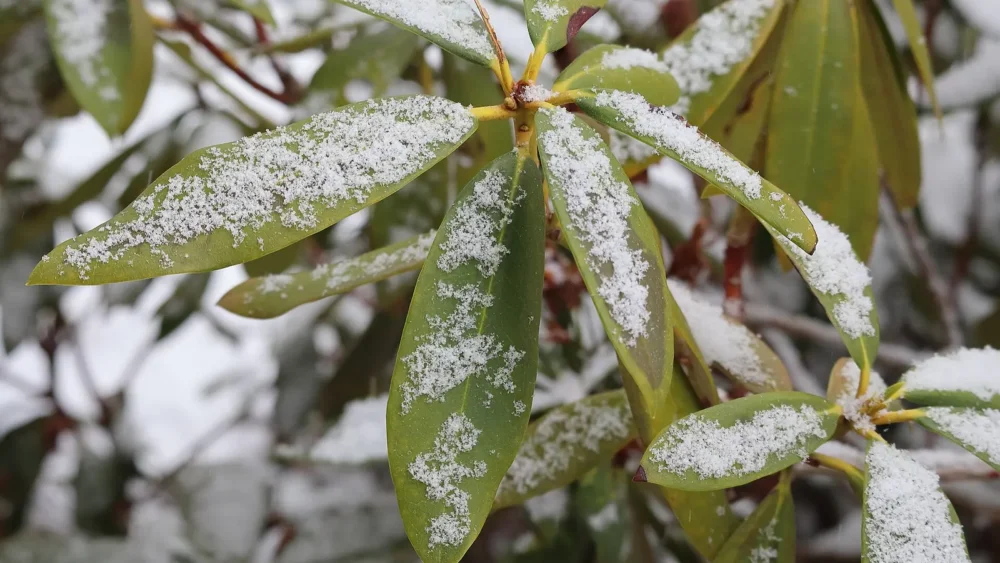
Frost is ice that forms on cold surfaces such as grass, leaves and car roofs. A freeze is the air itself at 32°F or colder over a wide area, whether or not ice crystals form. Frost often forms while the official thermometer reads in the mid-30s, so a frosty night isn’t always a freeze. A hard freeze, 28°F or colder for an extended time, kills most vegetation.2,3
The word you pick also changes your growing season. In NOAA’s 1991–2020 normals for 37,743 US ZIP codes, the median season is 166 days between 36°F “frost” nights, 188 days between 32°F freezes and 212 days between 28°F hard freezes.1
Frost and freeze, defined side by side
| Term | Temperature | What it means |
|---|---|---|
| Frost | Surfaces below 32°F; air often in the mid-30s | Thin ice crystals form on the ground and objects |
| Freeze | Air at 32°F or below, widespread | A cold air mass; can happen without any frost |
| Light freeze | Often 32–30°F | Kills some, but not all, annual plants |
| Hard freeze | 28°F or below for an extended time | Kills most types of vegetation |
| Killing frost | No fixed number | Cold severe enough to end or delay the growing season |
| Black frost | Below freezing, no visible frost | Plants freeze inside and the leaves turn black |
Sources: the National Weather Service (NWS) glossary entries for frost and freeze,2,3 and the American Meteorological Society (AMS) glossary.14,15
Why frost forms when the thermometer reads above 32°F
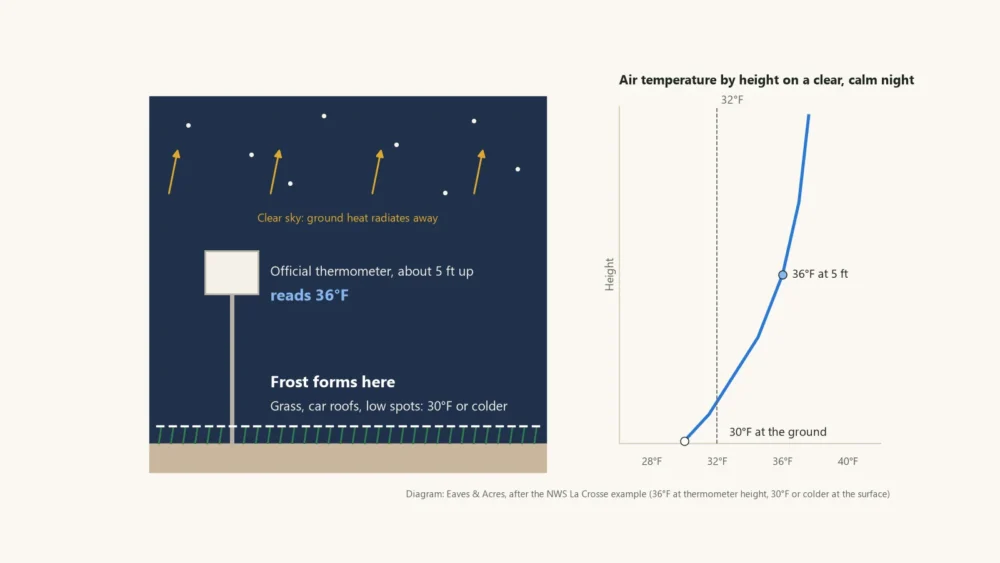
Official temperatures are measured about 5 to 6 feet above the ground.8,17 On a clear, calm night the ground loses heat to the sky, so the air near the ground gets colder than the air a few feet up.16 As the NWS glossary puts it, frost
frequently occurs with a thermometer level temperature in the mid-30s
NWS La Crosse, Wisconsin, says air at the surface can be up to 10 degrees colder than at thermometer height: 36°F on the thermometer, 30°F or colder at the ground.12
Frost also needs little wind and some moisture. NWS Tampa Bay notes that a 3–5 mph breeze can keep the air mixed and prevent widespread frost, and that cars and rooftops can frost at thermometer readings as high as 38°F.7
That still-night kind is a radiation frost.18 The NWS uses “freeze” mostly when a cold air mass moves in or wind prevents frost:3 frosts happen close to the ground, freezes come with deeper cold air.16
How the definition changes your growing season
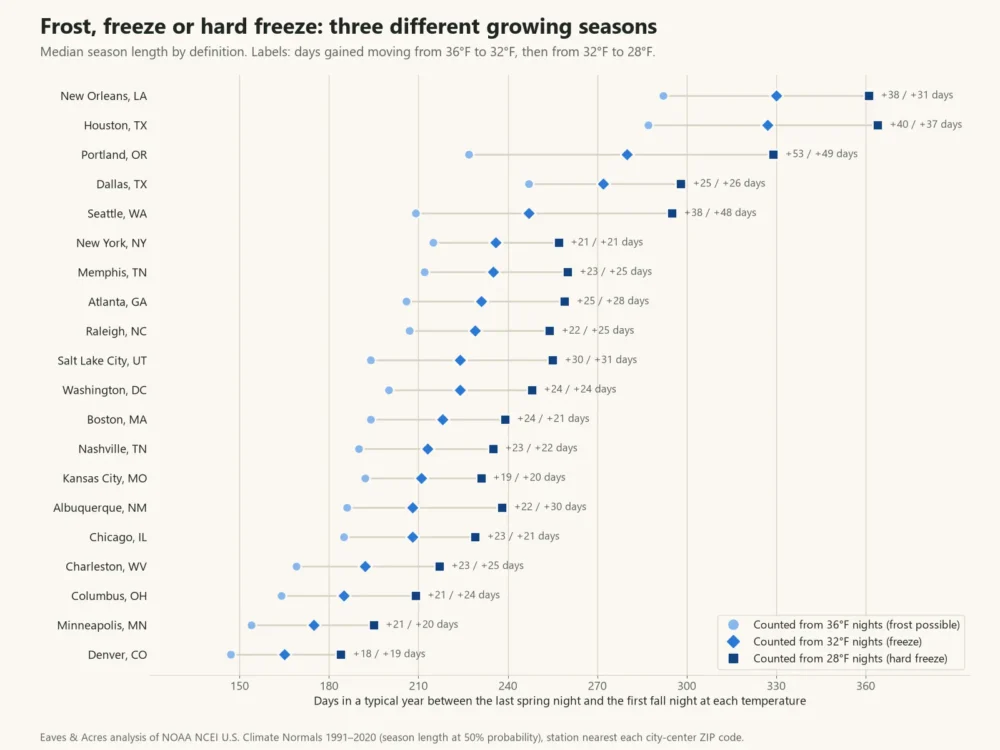
Which “frost” a garden calendar counts from moves the answer by weeks. We measured the season three ways for every US ZIP code with a NOAA station within 50 miles, using NOAA’s season-length figures for the 36°F, 32°F and 28°F thresholds.1
| City (ZIP) | Between 36°F nights | Between 32°F freezes | Between 28°F hard freezes | Nights at or below 32°F a year |
|---|---|---|---|---|
| Denver, CO (80202) | 147 days | 165 days | 184 days | 150 |
| Minneapolis, MN (55401) | 154 days | 175 days | 195 days | 147 |
| Columbus, OH (43215) | 164 days | 185 days | 209 days | 113 |
| Chicago, IL (60601) | 185 days | 208 days | 229 days | 97 |
| Kansas City, MO (64105) | 192 days | 211 days | 231 days | 93 |
| Boston, MA (02108) | 194 days | 218 days | 239 days | 92 |
| Salt Lake City, UT (84101) | 194 days | 224 days | 255 days | 81 |
| Washington, DC (20001) | 200 days | 224 days | 248 days | 84 |
| Atlanta, GA (30303) | 206 days | 231 days | 259 days | 52 |
| Memphis, TN (38103) | 212 days | 235 days | 260 days | 58 |
| New York, NY (10001) | 215 days | 236 days | 257 days | 67 |
| Seattle, WA (98101) | 209 days | 247 days | 295 days | 30 |
| Dallas, TX (75201) | 247 days | 272 days | 298 days | 23 |
| Portland, OR (97204) | 227 days | 280 days | 329 days | 18 |
Nationally, counting from 36°F instead of 32°F trims a median 23 days from the season (21 to 25 days for the middle half of ZIP codes). The last 36°F night of spring comes a median 12 days after the last freeze, and the first 36°F night of fall 10 days before the first freeze. Counting to the 28°F hard freeze instead adds another 24 days.1
NWS Memphis’s own “frost” (36°F) and freeze (32°F) averages put the two seasons 21 days apart;13 our normals for the station nearest downtown give 23.
Look up your ZIP code’s frost and hard-freeze dates; your planting zone won’t give you these dates.
Where frost comes without a freeze
Of 40,911 ZIP codes with a station within 50 miles, 930 (2.3%) get a 36°F night in most years but a 32°F freeze in fewer than half. That is about 1 in 5 ZIP codes in California and Florida, and 1 in 9 in Arizona.1
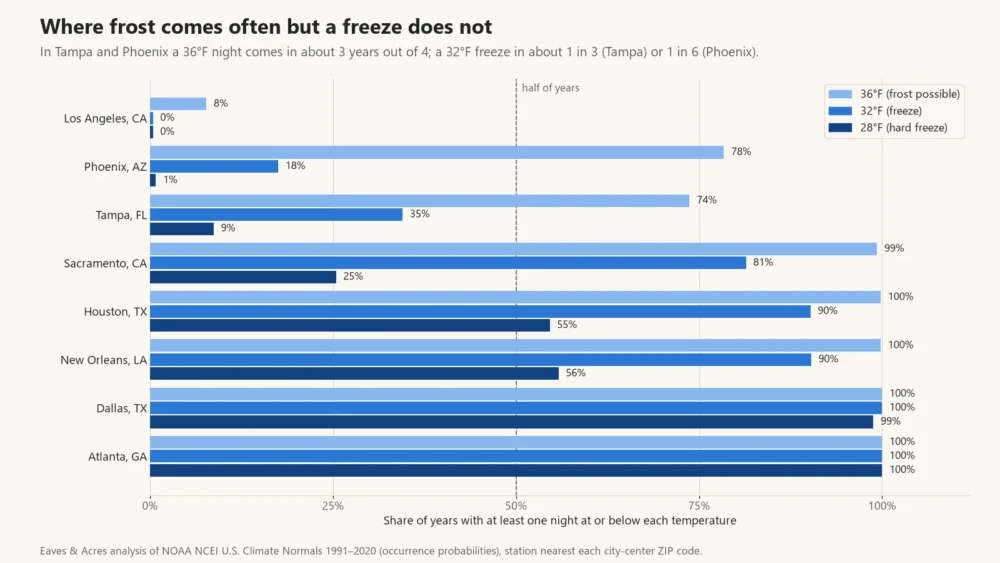
At Tampa’s airport station, a 36°F night comes in 74% of years, a freeze in 35% and a hard freeze in 9%. At Phoenix Sky Harbor the figures are 78%, 18% and 1%. In these places, frost-possible nights, not freezes, are the usual cold threat.
Which is worse for plants?
A freeze usually does more harm. Frost damage stays mostly on the leaf surface; in a longer freeze, ice forms inside the plant and breaks the cell walls. A brief dip to 32°F may do little, while hours below freezing can kill tender plants.17,4
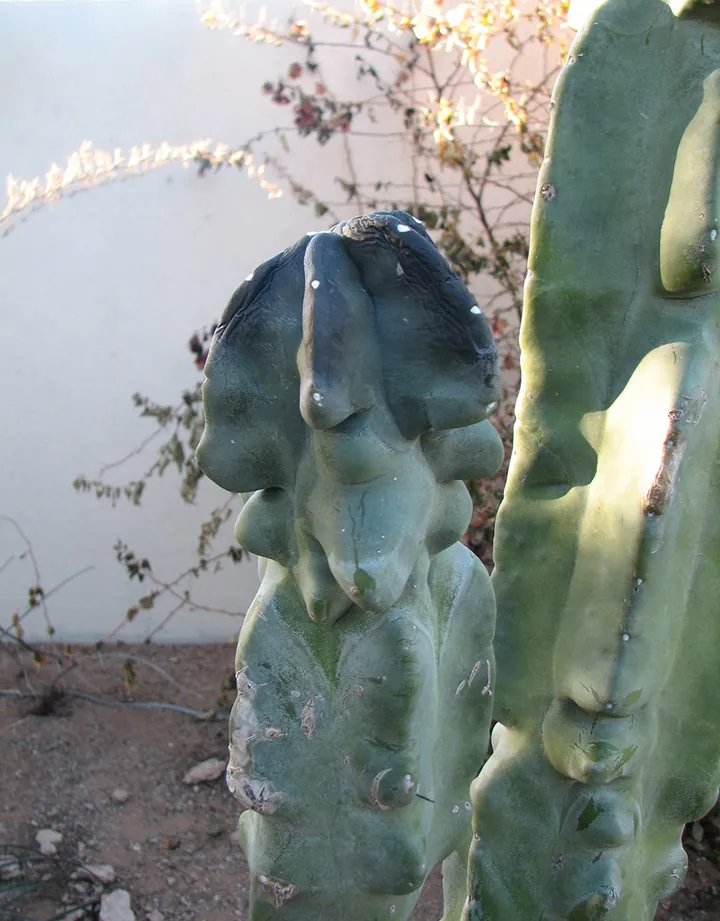
In dry air, plants can even freeze inside with no frost on the outside. The AMS calls this a dry freeze, or black frost, after the blackened leaves:14
A black frost is always a killing frost
Frost advisory, freeze watch and freeze warning
The NWS issues three alerts for plant-killing cold during the growing season:4,5,8
| Alert | Issued when | What to do |
|---|---|---|
| Frost Advisory | Lows of about 33–36°F forecast on clear, calm nights | Cover sensitive plants or move them inside before sunset |
| Freeze Watch | Widespread freezing possible in the next 24–36 hours | Get covers ready |
| Freeze Warning | Below 32°F expected for an extended time over a wide area | Cover plants before sunset; unprotected tender plants will likely die |
The freeze warning is the more serious alert (“Take Action!” against the advisory’s “Be Aware”), and it is issued whether or not frost forms.4,3
What happened to the hard freeze warning
Many offices, from Raleigh to Tampa, used to issue a separate Hard Freeze Warning at about 28°F.19 On October 1, 2024, the NWS merged it into the Freeze Warning nationwide.6 NWS Tampa Bay says
specific Hard Freeze Warning/Watch products are no longer issued
Instead, its freeze warnings mention a hard freeze when lows of 27°F or colder are likely for two hours or more.7 Some office pages still describe the old product, so read the warning text for the expected low and duration.9,10
Why your local office’s criteria may differ
Each NWS office sets its own criteria:
- Tampa Bay, FL: freeze warning for 32°F or lower for at least 2 hours.7
- Charleston, WV: freeze warning for lows of 29–32°F.8
- Grand Forks, ND: the low must cover the whole county or zone.9
- South Florida: no frost advisory; frost is mentioned in the forecast.10
Alerts also stop for the year: NWS Charleston after a killing freeze,8 NWS Binghamton on fixed dates in a test it was running in fall 2023 (October 11 for most of its area).11 After that, watch the forecast low yourself.
What to do with each forecast
Cover sensitive plants before sunset at 36°F or below. At 28°F or below, NWS Charleston warns there is little you can do for plants left outside.8 Our guide to covering plants for frost explains how.
The 28°F hard freeze also sets the last day to overseed, and our garlic guide decodes “killing frost” advice. See all our frost and freeze guides and the methodology page.
Frequently asked questions
A freeze warning. It means temperatures below 32°F for an extended time over a wide area, frost or not. A frost advisory means lows around 33–36°F on a clear, calm night.
There is no single number. Frost forms when surfaces cool below 32°F, often while the thermometer reads in the mid-30s. NWS frost advisories usually use lows of 33–36°F.
Sometimes, in patches. NWS La Crosse cites a local study linking lows of 38–42°F to patchy frost, and NWS Tampa Bay notes frost on cars and rooftops at readings as high as 38°F.
Frost or freezing cold severe enough to end the growing season in fall or delay it in spring, per the NWS glossary. It has no fixed temperature, so check which number a source means.
Weather glossaries define the freeze terms instead. The AMS calls air below 32°F that kills some, but not all, annual plants a light freeze, often at 32–30°F. The NWS calls 28°F or lower for an extended time a hard freeze, which kills most vegetation.
Yes. In dry air plants can freeze inside with no ice on the outside. This dry freeze, or black frost, is always a killing frost.
Sources
- 1.U.S. Climate Normals 1991–2020. NOAA National Centers for Environmental Information, 2021. Used for: 36°F, 32°F and 28°F season lengths and dates, occurrence odds and freeze nights for every ZIP code and city Back to text
- 2.NWS Glossary: Frost, Frost Advisory, Hoar Frost. National Weather Service, n.d. Used for: frost definition, mid-30s thermometer readings, killing frost, hoarfrost Back to text
- 3.NWS Glossary: Freeze, Freeze Warning, Freeze Watch, Hard Freeze. National Weather Service, n.d. Used for: freeze and 28°F hard freeze definitions; freeze warning issued with or without frost Back to text
- 4.Understanding Cold Weather Alerts. National Weather Service, n.d. Used for: freeze warning, freeze watch (24–36 hours), frost advisory; 32°F and 28°F plant thresholds Back to text
- 5.Watch/Warning/Advisory Definitions. National Weather Service, Baltimore/Washington office, n.d. Used for: frost advisory at 33–36°F on clear, calm nights; growing-season issuance Back to text
- 6.Cold Criteria & Frost/Freeze Changes in Effect October 1, 2024. National Weather Service, Amarillo office, 2024. Used for: Hard Freeze Watch and Warning merged into Freeze Watch and Warning nationwide Back to text
- 7.Cold Weather DSS. National Weather Service, Tampa Bay office, n.d. Used for: local freeze criteria (32°F for 2+ hours), hard freeze mention at 27°F, frost on cars at 38°F, wind mixing Back to text
- 8.NWS Charleston Frost-Freeze Climatology/Information. National Weather Service, Charleston, WV office, n.d. Used for: thermometer height, 29–32°F freeze warning, what to do for each alert, end of season Back to text
- 9.WFO FGF Watch, Warning, Advisory Criteria. National Weather Service, Grand Forks office, n.d. Used for: whole-zone criteria and end of the growing season Back to text
- 10.Cold Weather Hazards: Freezes and Wind Chill. National Weather Service, Miami–South Florida office, n.d. Used for: no frost advisory in South Florida; frost in the mid-30s Back to text
- 11.Frost/Freeze Program. National Weather Service, Binghamton office, 2023. Used for: fixed closing dates for frost/freeze alerts Back to text
- 12.What Causes Frost?. National Weather Service, La Crosse office, n.d. Used for: surface air up to 10 degrees colder than thermometer height; patchy frost at 38–42°F; valleys Back to text
- 13."Frost" and Freeze Dates. National Weather Service, Memphis office, 2021. Used for: 36°F "frost" and 32°F freeze average dates used to check our season gap Back to text
- 14.Glossary of Meteorology: black frost. American Meteorological Society, n.d. Used for: black frost (dry freeze) definition Back to text
- 15.Glossary of Meteorology: light freeze. American Meteorological Society, n.d. Used for: light freeze, often 32–30°F Back to text
- 16.What's the difference between a frost and a freeze?. University of Illinois Extension (All About Weather blog, Duane Friend), 2024. Used for: frost forms near the ground; freezes come with deeper cold air Back to text
- 17.Frost and freeze: what is the difference?. University of Georgia Viticulture, 2023. Used for: frost damage on the surface vs ice inside cells; duration; thermometer at about 6 feet Back to text
- 18.Glossary of Meteorology: radiation frost. American Meteorological Society, n.d. Used for: radiation frost on clear, calm nights Back to text
- 19.Frost Freeze Maps. National Weather Service, Raleigh office, n.d. Used for: hard freeze warning at 28°F or less (pre-2024 product) Back to text
- 20.Photo: Frost on red dwarf birch leaves, NPS (public domain). National Park Service via Wikimedia Commons, 2013. Used for: hero photo
- 21.Photo: Blackberry leaves with frost crystals, NPS (public domain). National Park Service via Wikimedia Commons, 2011. Used for: frost crystals photo
- 22.Photo: Saguaro with freeze damage, NPS (public domain). National Park Service via Wikimedia Commons, 2019. Used for: freeze-damaged cactus photo
.JPG)
.jpg)
.jpg)
How this guide was made
- Written by the Data & Methodology Desk and reviewed by the Yard & Garden Desk.
- Data: growing-season lengths, first and last 36°F, 32°F and 28°F dates, occurrence probabilities and nights at or below 32°F from NOAA NCEI U.S. Climate Normals 1991–2020 for the station nearest each ZIP code (within 50 miles); definitions from the National Weather Service and American Meteorological Society glossaries; alert criteria from National Weather Service national and local office pages. See our methodology.
- AI use: AI tools help us research, draft and check this guide. Every figure is checked against the source cited for it, and calculated figures come from our own code, described on the methodology page.
- Spotted an error? Tell us — the form opens with this page’s address filled in.
Change log
- Oct 4, 2026Re-checked the NWS (glossary, Tampa Bay, Amarillo, Charleston WV, Binghamton) and AMS wording against the live pages; added a FAQ on light vs. hard frost; Binghamton’s fixed alert end dates now described as the test it was running in fall 2023.
- Oct 3, 2026Published. Definitions checked against the NWS and AMS glossaries; alert criteria against NWS national, Baltimore/Washington, Amarillo, Tampa Bay, Charleston WV, Grand Forks, South Florida, Binghamton, La Crosse, Memphis and Raleigh pages; season lengths at 36°F, 32°F and 28°F for 37,743 ZIP codes and occurrence odds for 40,911 ZIP codes computed from NOAA 1991–2020 normals.
Maintains the climate dataset behind every ZIP lookup, documents each tool’s formula, and reviews every guide’s numbers before publication.
Keep reading
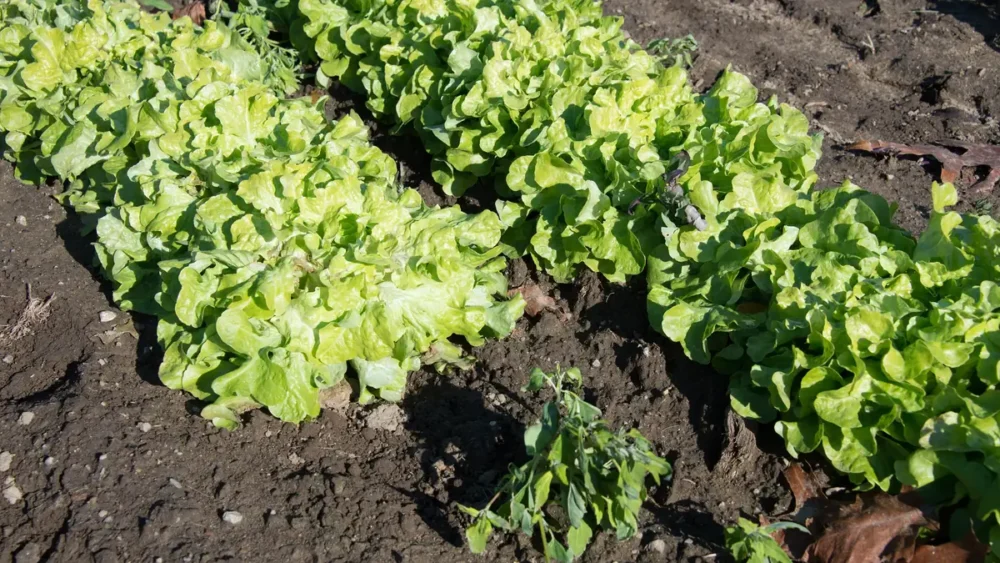
What Is a Last Frost Date? What the 10%, 30%, 50% and 90% Odds Mean
A last frost date is a probability, not a deadline. What NOAA’s 10%, 30%, 50% and 90% dates mean, and a test of how often they held up at 967 airport stations.
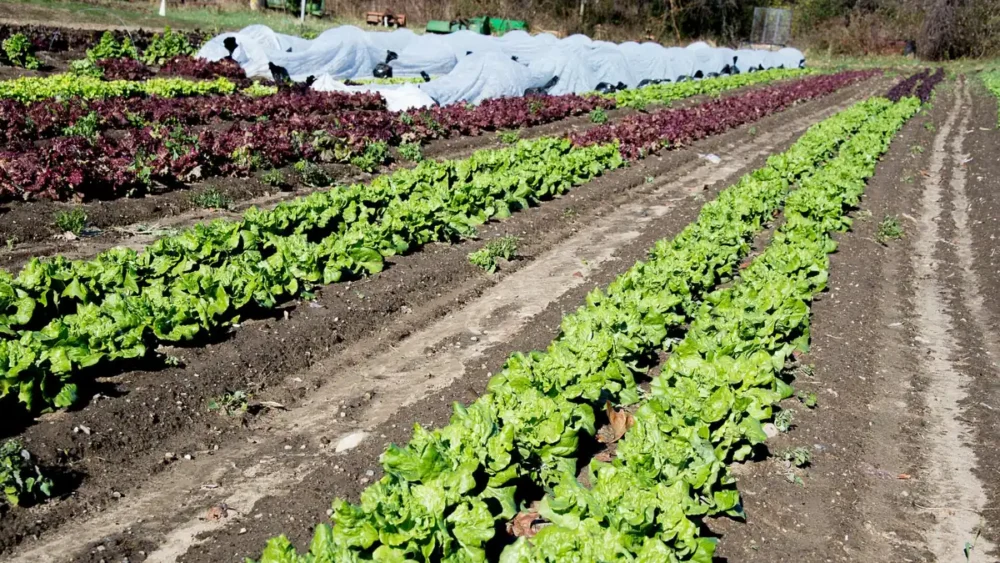
When to Cover Plants for Frost: Temperatures, Timing and City Dates
Cover tender plants at 36°F on clear, calm nights and always at 32°F; below about 28°F covers stop working. Thresholds, NWS alerts, how to cover, and fall frost dates for 24 cities.
2023 USDA Hardiness Zone Map Changes: Did Your Zone Change, and Why?
What changed on the 2023 USDA hardiness zone map and why, with the 2012-to-2023 change for 39,899 ZIP codes by state and city.
Seasonal reminders for your ZIP
Get a short email when it’s time to overseed, start seeds, open the pool or service your furnace — timed to your climate.