



Generator Size Calculator: What Size Generator Do I Need?
Tick what you need to run in an outage. Get running and starting watts, and a generator size adjusted for your elevation and summer heat.
Your result
Choose a portable generator rated at least 5,000 running watts.
Rated at sea level and normal temperatures: no derating applied.
| Appliance | Running | Starting |
|---|---|---|
| Total |
- Only one motor starts at a time; the others are already running.
- Defaults are the top of the ranges in Champion Power Equipment’s wattage chart. Your appliance labels win.
- Altitude: portables lose about 3.5% per 1,000 ft (Honda owner’s manual); standby units 3% per 1,000 ft above 600 ft and 1.7% per 10°F above 77°F (Generac spec sheets, naturally aspirated models). Your generator’s own spec sheet wins.
- The 5% margin is our own allowance for small loads you forgot, like phone chargers.
- 1Add the running watts of everything you’ll run at once, then add the single biggest starting surge.
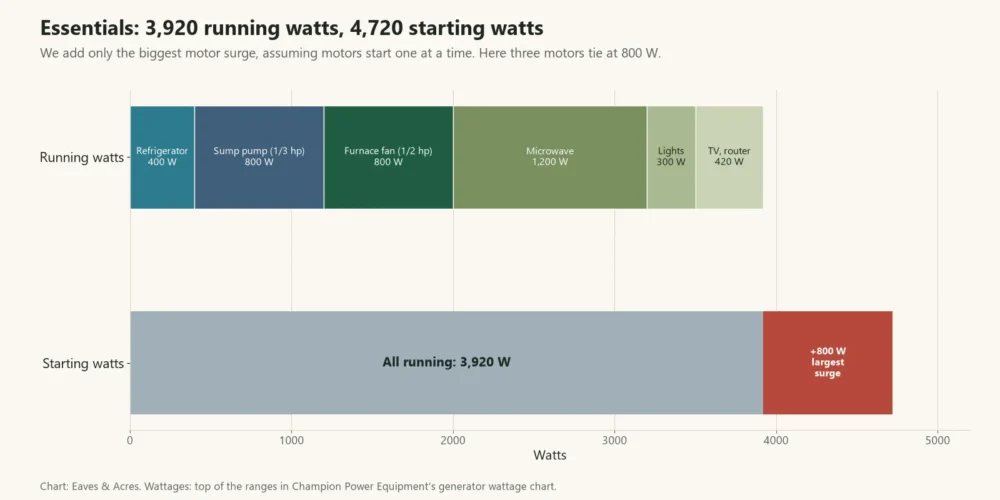
- 2A typical essentials list (fridge, sump pump, furnace fan, microwave, lights, TV) needs about 3,920 running and 4,720 starting watts: a 5,000 W portable at sea level.
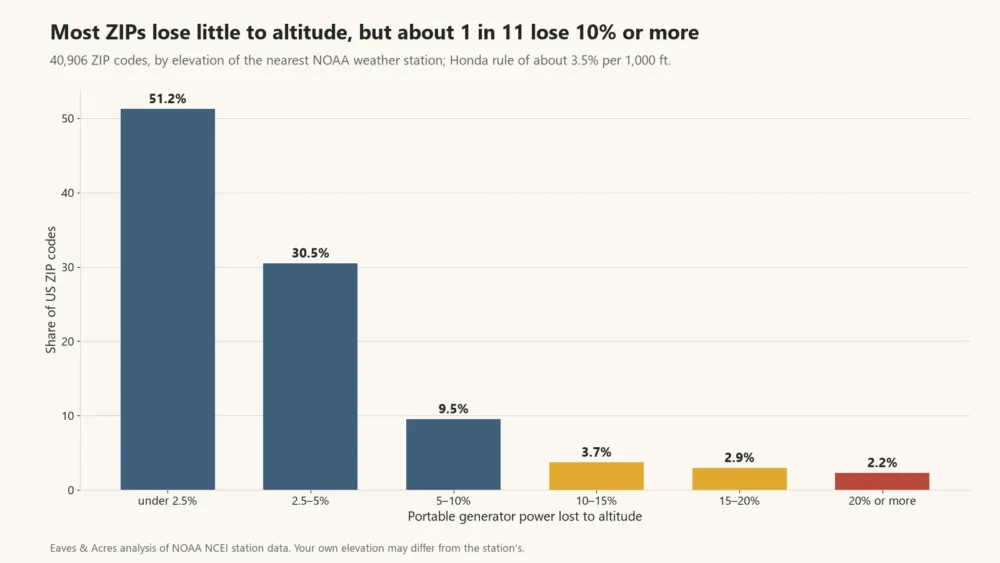
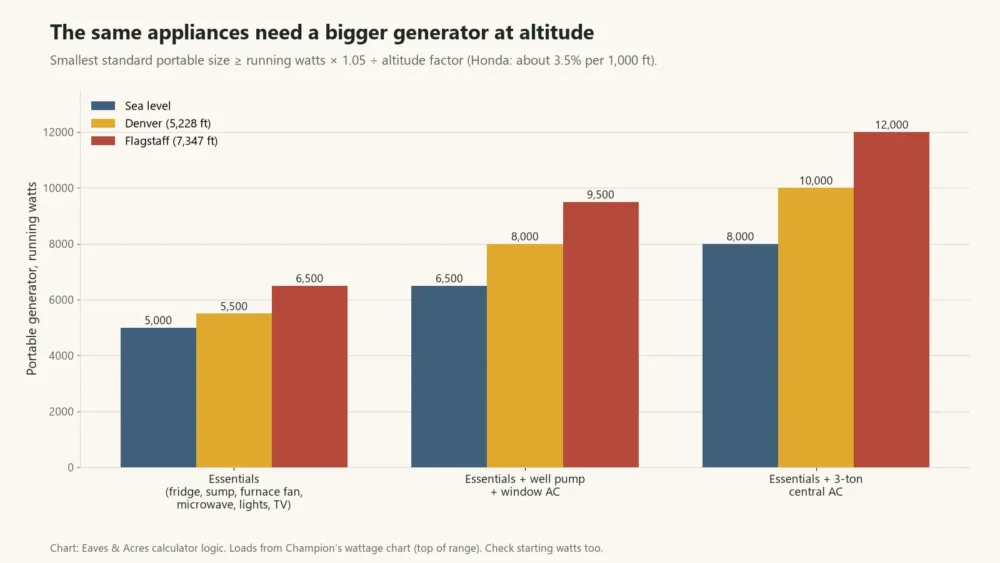
- 3Engines lose about 3.5% of their power per 1,000 ft (Honda). In 1 of 11 US ZIP codes that is 10% or more; Denver needs 5,500 W for the same list.
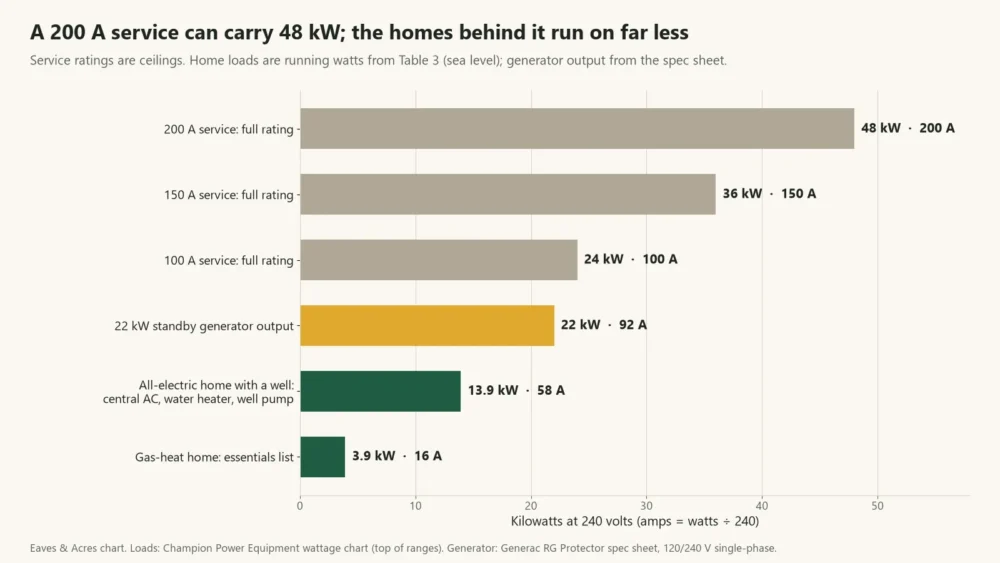
- 4A 100, 150 or 200 A service rating is a ceiling (24, 36 or 48 kW at 240 V), not your load: even an all-electric home with a well draws about 58 A.
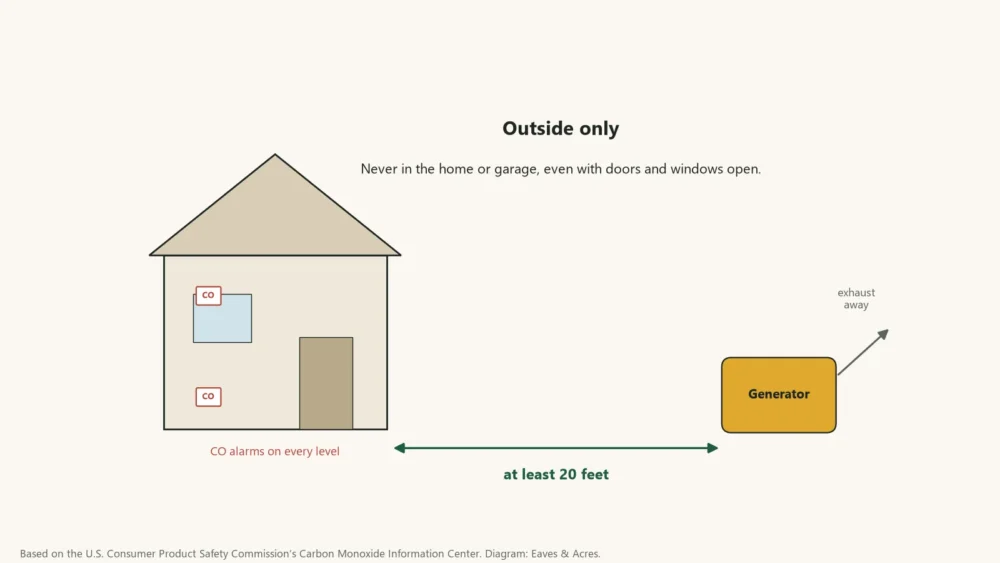
- 5Run a portable generator outside only, at least 20 feet from the house (CPSC), and connect it to home wiring only through a transfer switch installed by a licensed electrician.
To size a generator, add the running watts of everything you will run at the same time, then add the single biggest starting surge on top. A typical essentials list (fridge, sump pump, furnace fan, microwave, lights, TV and router) comes to 3,920 running and 4,720 starting watts, which a 5,000-watt portable covers at sea level. At Denver’s altitude, the same list needs a 5,500-watt unit: engines lose power in thin air.2
How many watts your appliances need
Every motor-driven appliance has two numbers. Running watts is what it draws once it is going. Starting watts is the short burst a motor needs to get moving. Appliances without a motor, such as lights or a microwave, start at their running watts. The table shows the ranges in Champion Power Equipment’s wattage chart. The calculator uses the top of each range, so it errs on the high side.1
| Appliance | Running watts | Starting watts |
|---|---|---|
| Refrigerator | 150–400 | 800–1,200 |
| Freezer | 100–500 | 500–1,000 |
| Sump pump (1/3 hp) | 500–800 | 1,000–1,600 |
| Well pump (1/2 hp) | 750–1,000 | 1,500–2,000 |
| Furnace fan (1/2 hp) | 300–800 | 800–1,600 |
| Window AC (10,000 BTU) | 900–1,200 | 1,800–2,400 |
| Central AC (3-ton) | 3,000–3,500 | 5,000–6,000 |
| Washing machine | 500–1,000 | 1,000–2,300 |
| Electric water heater | 3,000–4,500 | no surge |
| Microwave | 600–1,200 | no surge |
| Space heater | 750–1,500 | no surge |
| CPAP with heated humidifier | 60–120 | no surge |
These are typical figures, not your appliance’s. The label or the manual on your own fridge or pump is the better number, and you can type it into the calculator above.
Running watts, starting watts and the generator’s label
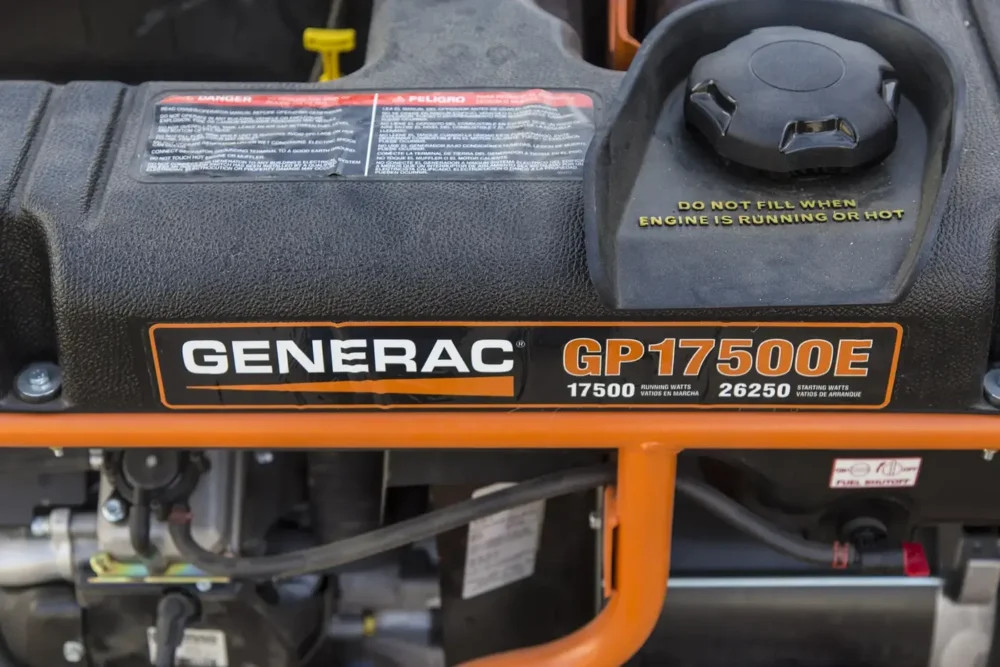
Generators carry two ratings as well. The bigger “starting” or “maximum” number is what the engine can deliver for a short time; the smaller “running” or “rated” number is what it can supply hour after hour. Honda’s owner’s manual for its EG5000X sets the rule plainly:2
For continuous operation, do not exceed the rated power.
The same manual says to limit operation at maximum power to 30 minutes.2 So size on running watts, then check that the generator’s starting rating covers your starting total. Our calculator adds only the largest single surge, because it assumes motors start one at a time while everything else is already running. If two big motors could start together, such as a well pump and an AC compressor, add both surges yourself.
Altitude and heat: why the same generator makes less power
A gasoline engine burns air as well as fuel, and air thins with height. Honda’s manual puts a number on it, even after the carburetor has been adjusted for altitude:2
engine horsepower will decrease about 3.5% for each 1,000-foot (300-meter) increase in altitude
Without that adjustment, the loss is greater, and Honda advises having a dealer modify the carburetor if you always run the generator above 5,000 feet.2 Standby generators lose power too. Generac’s spec sheet for its 22–38 kW Protector models lists 3% per 1,000 feet above 600 feet for the naturally aspirated models (above 3,000 feet for the turbocharged ones), and 1.7% per 10°F above 77°F.3 Your own model’s spec sheet may differ, and it wins.
To see what that means across the country, we applied both rules to the NOAA weather station nearest each of 40,906 US ZIP codes, using the station’s elevation and its hottest-month average high from the 1991–2020 normals.5 For half of ZIP codes, a portable loses less than 2.5% to altitude. But in about 1 in 11 (8.8%), it loses 10% or more, and in 2.2% it loses at least a fifth.
| City | Station elevation | Portable loses | Standby loses (altitude + hottest month) | Portable size for the essentials list |
|---|---|---|---|---|
| Miami, FL | 10 ft | under 1% | 1.9% (Aug, 88°F) | 5,000 W |
| Houston, TX | 19 ft | under 1% | 2.9% (Aug, 94°F) | 5,000 W |
| Atlanta, GA | 840 ft | 2.9% | 2.9% (Jul, 90°F) | 5,000 W |
| Phoenix, AZ | 1,107 ft | 3.9% | 6.5% (Jul, 107°F) | 5,000 W |
| Las Vegas, NV | 1,898 ft | 6.6% | 8.6% (Jul, 106°F) | 5,000 W |
| Boise, ID | 3,885 ft | 13.6% | 11.5% (Jul, 88°F) | 5,000 W |
| Salt Lake City, UT | 4,280 ft | 15.0% | 13.2% (Jul, 91°F) | 5,000 W |
| Reno, NV | 4,987 ft | 17.5% | 15.5% (Jul, 93°F) | 5,000 W |
| Denver, CO | 5,228 ft | 18.3% | 16.0% (Jul, 91°F) | 5,500 W |
| Albuquerque, NM | 5,310 ft | 18.6% | 16.2% (Jul, 91°F) | 5,500 W |
| Colorado Springs, CO | 6,181 ft | 21.6% | 18.1% (Jul, 87°F) | 5,500 W |
| Flagstaff, AZ | 7,347 ft | 25.7% | 21.1% (Jul, 84°F) | 6,500 W |
In Boise, Salt Lake City and Reno the essentials list still fits a 5,000-watt unit, but only just: the margin that covers forgotten loads is gone. Check the starting watts too. In Denver, a generator has to be rated for at least 5,777 starting watts to deliver the 4,720 the list needs. The calculator applies these rules when you enter a ZIP code or an elevation, and it tells you how much it took off.
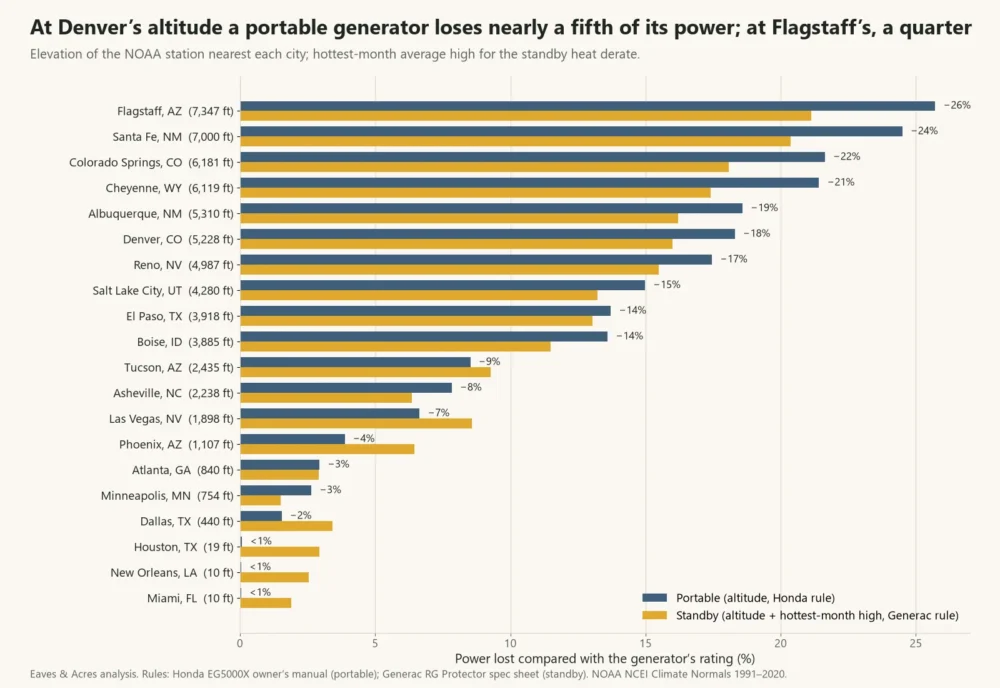
Two limits are worth knowing. The elevation is the weather station’s, which sits a median 7 miles from the ZIP code’s center; type your own if your home is higher or lower. And the heat rule uses the hottest month’s average high, a typical summer afternoon, not a record heat wave.
Three worked examples
Summer storm in Houston, portable
- Scenario
- Keep the fridge, a 10,000 BTU window AC, lights, TV and router, and the microwave going. Station elevation 19 ft, so altitude barely matters.
- Math
- 400 + 1,200 + 300 + 420 + 1,200 = 3,520 running W. Largest surge: window AC, 2,400 − 1,200 = 1,200 W. Starting = 4,720 W. Size: 3,520 × 1.05 = about 3,700 W.
- Answer
- A 4,000-watt portable whose starting rating is at least 4,720 W.
Winter outage in Denver, portable
- Scenario
- The essentials list: fridge, sump pump, furnace fan, microwave, lights, TV and router. Station elevation 5,228 ft.
- Math
- 3,920 running W and 4,720 starting W. Altitude factor = 1 − 0.035 × 5.228 = 0.817. Size: 3,920 × 1.05 ÷ 0.817 = 5,038 W; starting 4,720 ÷ 0.817 = 5,777 W.
- Answer
- A 5,500-watt portable rated for at least 5,777 starting watts. At sea level, 5,000 W would do.
Whole-house standby in Phoenix with central air
- Scenario
- Fridge, freezer, microwave, lights, TV and router, a washer and a 3-ton central AC. Station elevation 1,107 ft; July average high 106.5°F.
- Math
- 7,320 running W; the AC adds a 2,500 W surge, so 9,820 starting W. Factor = (1 − 0.03 × 0.507) × (1 − 0.017 × 2.95) = 0.935. Size: 7,320 × 1.05 ÷ 0.935 = 8,217 W; starting 9,820 ÷ 0.935 = 10,498 W.
- Answer
- A 10 kW standby unit, if its spec sheet shows it can handle 10,498 starting watts. If not, ask the installer about the next size up.
Why square footage doesn’t size a generator
Charts that map home size to generator size skip the step that matters: a 2,000 sq ft house doesn’t draw power, its appliances do. Two homes of the same size can need generators three times apart. Using the Table 1 figures:
| Home | What runs in an outage | Running / starting watts | Size |
|---|---|---|---|
| Gas heat, gas water heater | Fridge, sump pump, furnace fan, microwave, lights, TV and router | 3,920 / 4,720 | 5,000 W portable |
| All-electric with a well | The same, plus a 3-ton central AC, an electric water heater, a 1/2 hp well pump and a washer | 13,920 / 16,420 | 17 kW standby |
The difference is almost entirely three loads: the central AC, the water heater and the well pump. That is why the calculator asks what you want to run rather than how big the house is. If you are deciding between keeping the water heater on or the AC, tick one at a time and watch the size change.
100, 150 or 200 amp service: what it means for generator size
Your home’s electrical service rating, usually 100, 150 or 200 amps, is the most the service can carry, not what the house draws, so it doesn’t set the generator size. At 240 volts, watts are volts times amps: a fully loaded 100 A service would be 24 kW, 150 A would be 36 kW and 200 A would be 48 kW. Real loads sit far below those ceilings. The all-electric home in Table 3, running a central AC, an electric water heater, a well pump and the essentials at the same time, draws 13,920 watts. That is about 58 amps at 240 volts, under a third of a 200 A service.
Generator ratings convert the same way. Generac’s spec sheet lists its 22 kW standby model at 92 amps on a 120/240-volt home service and its 38 kW model at 158 amps.3 By the same arithmetic, a 12,000-watt generator supplies 50 amps at 240 volts.
| Model and fuel | Output | Current |
|---|---|---|
| 22 kW, propane or natural gas | 22 kW | 92 A |
| 27 kW, propane | 27 kW | 113 A |
| 27 kW, natural gas | 25 kW | 104 A |
| 32 kW, propane or natural gas | 32 kW | 133 A |
| 38 kW, propane or natural gas | 38 kW | 158 A |
Whole service or selected circuits: what the code requires
How the generator is connected decides how much it has to cover. A home backup generator is an “optional standby system” in the National Electrical Code (NFPA 70): one that supplies power where life safety doesn’t depend on it, including in homes.7 In the 2023 edition, section 702.4 sizes these systems three ways:6,7
- Loads connected by hand, through a manual transfer switch or by plugging in: the generator must supply everything you intend to run at the same time. That is the number this calculator estimates.
- An automatic transfer switch with no load management: the generator must be able to supply the full load the switch connects, worked out with the code’s Article 220 load calculation or another approved method. If the switch carries the whole service, that is the whole house.
- An automatic switch with an energy management system: the generator must cover the largest load the system will let on at once. The system delays or drops chosen loads, for milliseconds or indefinitely, so heavy motors don’t all start together and overload the generator.
North Carolina’s Office of State Fire Marshal, in a formal interpretation of the 2023 code, adds that with an automatic switch the load management must be automatic too: an undersized generator can’t rely on someone switching loads off by hand.6 Each state adopts its own code edition and the local inspector has the final word, so for a whole-house standby unit, the installer’s load calculation sets the minimum size, not this estimate. Transfer switches, panels and service equipment are work for a licensed electrician.
Portable or standby
A portable generator powers what you plug into it, or a set of circuits through a transfer switch. It needs refueling and has to be set up outside each time. A standby unit is installed permanently, runs on natural gas or propane, and starts on its own. Generac’s spec sheets, for example, list fuel options of propane or natural gas for its Protector series.3 The fuel can change the rating: in the same spec sheet, the 27 kW model is rated 27 kW on propane but 25 kW on natural gas, so compare your load with the rating for the fuel you will actually use.3
What pushes a home into standby sizes is usually one of the big loads in Table 1: a central AC, an electric water heater, or electric heat. If you are replacing a water heater, our tankless vs. tank comparison shows how much power each type needs. Essentials plus a 3-ton central AC already need 7,420 running and 9,920 starting watts: an 8,000-watt portable at sea level, or a standby unit. If your home heats with a heat pump, its draw matters too; our guide to heat pump vs furnace running costs compares the two by city.

Running a generator safely
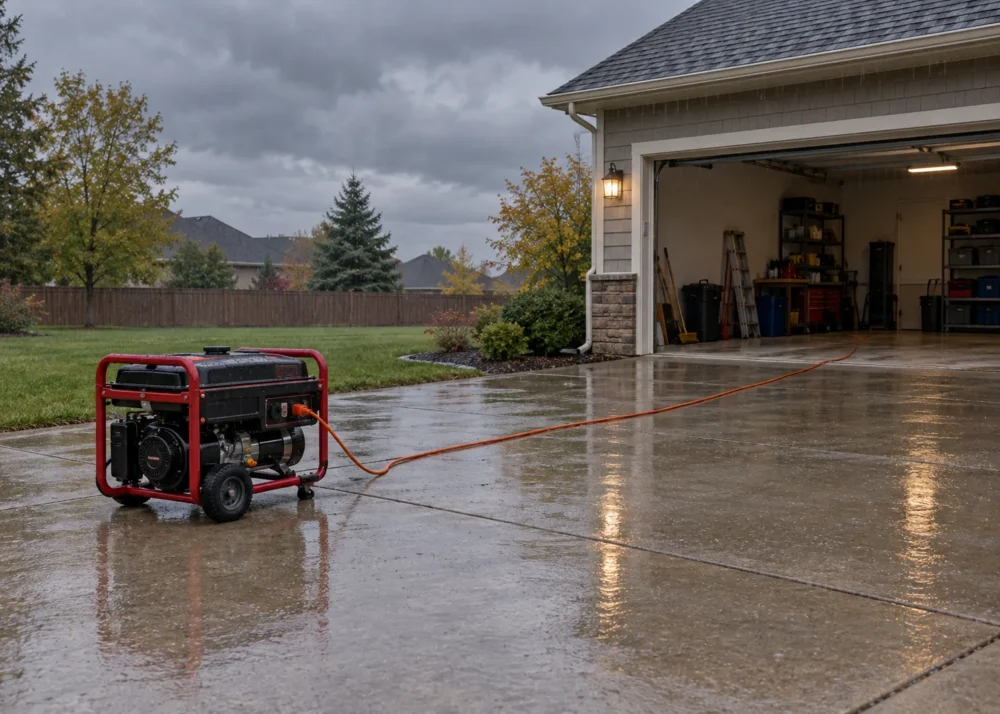
Never use portable generators inside homes or garages, even if doors and windows are open.
Never connect a generator to your home’s wiring yourself. Honda’s manual warns that improper connections to a building’s wiring can backfeed utility lines, which may electrocute utility workers or others who touch the lines during an outage.2 Connecting to home wiring calls for a transfer switch installed by a licensed electrician; this page is a sizing estimate, not electrical advice. Our portable generator safety guide covers placement, CO alarms and refueling, with CPSC’s data on generator deaths.
Sizing mistakes to avoid
- Buying on the big number. The starting watts on the box is short-term power. Compare your running total with the running rating.
- Forgetting a pump. Well and sump pumps can need twice their running watts to start (Table 1). Leave one off the list and the generator may not keep up.
- Ignoring altitude. Above about 3,000 feet, the loss reaches 10% for a portable (3.5% × 3), which can eat the whole safety margin.
- Running everything at once. You can run the microwave and the space heater one after the other instead of together, and choose a smaller generator.
How this calculator works
Running watts are the sum of what you tick. Starting watts add the largest single surge. The recommended size is the smallest standard size at or above running watts × 1.05 (our own allowance for small forgotten loads) ÷ the altitude and heat factor, and the starting rating should be at least starting watts ÷ that factor. Defaults are the top of Champion’s ranges. Elevation and summer heat come from NOAA data for your ZIP code, or from the elevation you type. Every rule and source is on our methodology page; the home energy section has the rest of our heating, cooling and backup-power guides.
Frequently asked questions
Add the running watts of everything you will run at the same time, then add the largest single starting surge. Size the generator on running watts with a little margin, and check that its starting rating covers your starting total. At altitude, divide both by the derate factor.
At sea level, a fridge, sump pump, furnace fan, microwave, lights, TV and router, plus a 1/2 hp well pump and a 10,000 BTU window AC: 6,120 running and 7,320 starting watts using Champion’s figures. That leaves room to spare if its starting rating is at least 7,320 W.
It is a rule of thumb, not a figure from the manufacturer documents we read. Honda’s manual says not to exceed the rated (running) power in continuous use and to limit operation at maximum power to 30 minutes. Generac’s standby spec sheet sets a related limit: average output over 24 hours should not exceed 70% of the standby rating. Our calculator adds a 5% margin above your running total.
It depends on what runs, not on the square footage. With gas heat and a gas water heater, essentials need about 5,000 W. The same size home with central AC, an electric water heater and a well pump needs a 17 kW standby unit.
The amp rating doesn’t decide it. A 200 A service tops out at 48 kW at 240 volts, but homes draw far less: an all-electric home with central AC, an electric water heater and a well pump needs about 13,920 running watts (58 A), a 17 kW standby unit at sea level. If an automatic transfer switch carries the whole service, the 2023 electrical code requires a generator that covers the full calculated load, unless an automatic load-management system limits it.
Usually only the essentials. A fridge, sump pump, furnace fan, microwave, lights and TV need 3,920 running watts, which fits. Adding a 3-ton central AC brings it to 7,420 running and 9,920 starting watts, which needs an 8,000-watt unit at sea level.
At sea level, 15 kW can run the essentials plus a 3-ton central AC, a washer and an electric water heater together (12,920 running watts), if its spec sheet covers 15,420 starting watts. Electric heat or a second AC would push it higher.
Yes. Honda says engine horsepower falls about 3.5% for each 1,000 feet, even with a high-altitude carburetor. Generac lists 3% per 1,000 ft above 600 ft for its naturally aspirated standby models, plus 1.7% per 10°F above 77°F.
At full load, Generac’s spec sheet lists 316 cubic feet of natural gas per hour for its 22 kW Protector model. At the sheet’s 1,036 BTU per cubic foot, that is about 327,000 BTU per hour; on propane it is 3.4 gallons per hour, about 311,000 BTU. At half load, natural gas use drops to 190 cubic feet per hour, about 197,000 BTU. Gas line and meter sizing is a job for the installer and your gas utility.
Yes, to connect a generator to home wiring. Honda warns that improper connections can backfeed utility lines and electrocute line workers. A licensed electrician should install the switch. Appliances plugged straight into the generator’s own outlets don’t go through home wiring.
Sources
- 1.Generator Wattage Chart: Common Appliances & Tools. Champion Power Equipment, n.d. Used for: running and starting watts for household appliances Back to text
- 2.Owner’s Manual, Generator EG5000X. Honda Motor Co., 2009. Used for: altitude derate, rated vs maximum power, backfeed and carbon monoxide warnings Back to text
- 3.Spec Sheet, RG Protector Series 22–38 kW Standby Generators. Generac Power Systems, 2025. Used for: standby altitude and temperature derates, fuel options, output current at 120/240 V, fuel consumption, 24-hour average load limit Back to text
- 4.Carbon Monoxide Information Center. U.S. Consumer Product Safety Commission, n.d. Used for: generator placement and CO alarm guidance Back to text
- 5.U.S. Climate Normals 1991–2020. NOAA National Centers for Environmental Information, 2021. Used for: station elevation and hottest-month average high for every ZIP code Back to text
- 6.Interpretation: Optional Standby Systems, Stand-Alone Systems & Energy Storage Systems (2023 Electrical Code, Articles 702, 705, 706, 710). North Carolina Office of State Fire Marshal, 2024. Used for: text of 2023 NEC section 702.4(A)(2): full-load and energy-management sizing with automatic transfer; no manual load shedding Back to text
- 7.NEC Requirements for Emergency and Standby Systems. EC&M (Mike Holt), 2025. Used for: optional standby systems under NEC Article 702; section 702.4 sizing for manual and automatic load connection Back to text
How this page was made
- Built by the Home Systems Desk and reviewed by the Data & Methodology Desk.
- Data: appliance wattages from Champion Power Equipment’s wattage chart; derating rules from Honda and Generac documents; elevation and summer highs from NOAA Climate Normals 1991–2020 (nearest station to each ZIP). Every rule is on our methodology page.
- AI use: AI tools help us research, draft and check this page. The calculator runs our own code; every figure in the text is checked against the source cited for it.
- Spotted an error? Tell us. The form opens with this page’s address filled in.
Change log
- Oct 12, 2026Added a section on 100, 150 and 200 amp service: what the rating means, standby generator output in amps (Table 4, Generac spec sheet), a chart, and how section 702.4 of the 2023 National Electrical Code sizes whole-service and selected-circuit setups; new FAQs on service amps and a 22 kW generator’s BTU use; re-checked the Honda, Generac, Champion and CPSC figures.
- Oct 12, 2026The 80% rule answer now notes Generac’s limit of 70% average output over 24 hours, which appears in the spec sheet we cite.
- Oct 4, 2026Review: re-tested the calculator with ZIP 86001 (Flagstaff), ZIP 85004 standby (Phoenix) and a typed 5,228 ft elevation against the Honda and Generac rules; re-checked the Champion, Honda and Generac figures; added that the Generac 27 kW model is rated 25 kW on natural gas; the square-footage FAQ now covers 1,500 sq ft homes.
- Oct 3, 2026Rebuilt: appliance defaults now from Champion’s wattage chart; added altitude and heat derating (Honda, Generac) with ZIP-code elevation and summer highs from NOAA; national derating analysis and city table; CPSC safety guidance; removed an unsourced size range.
- Oct 2, 2026Published.
Seasonal reminders for your ZIP
Get a short email when it’s time to overseed, start seeds, open the pool or service your furnace — timed to your climate.