




What Size Generator to Run a Furnace? Watts for Gas, Oil and Electric Heat
What gas, propane, oil and electric furnaces and heat pumps really draw, from generator makers’ charts and furnace spec sheets, with the altitude derate for 15 cold-winter cities.
- Last reviewed Oct 7, 2026
- 17 cited sources
- 11 min read
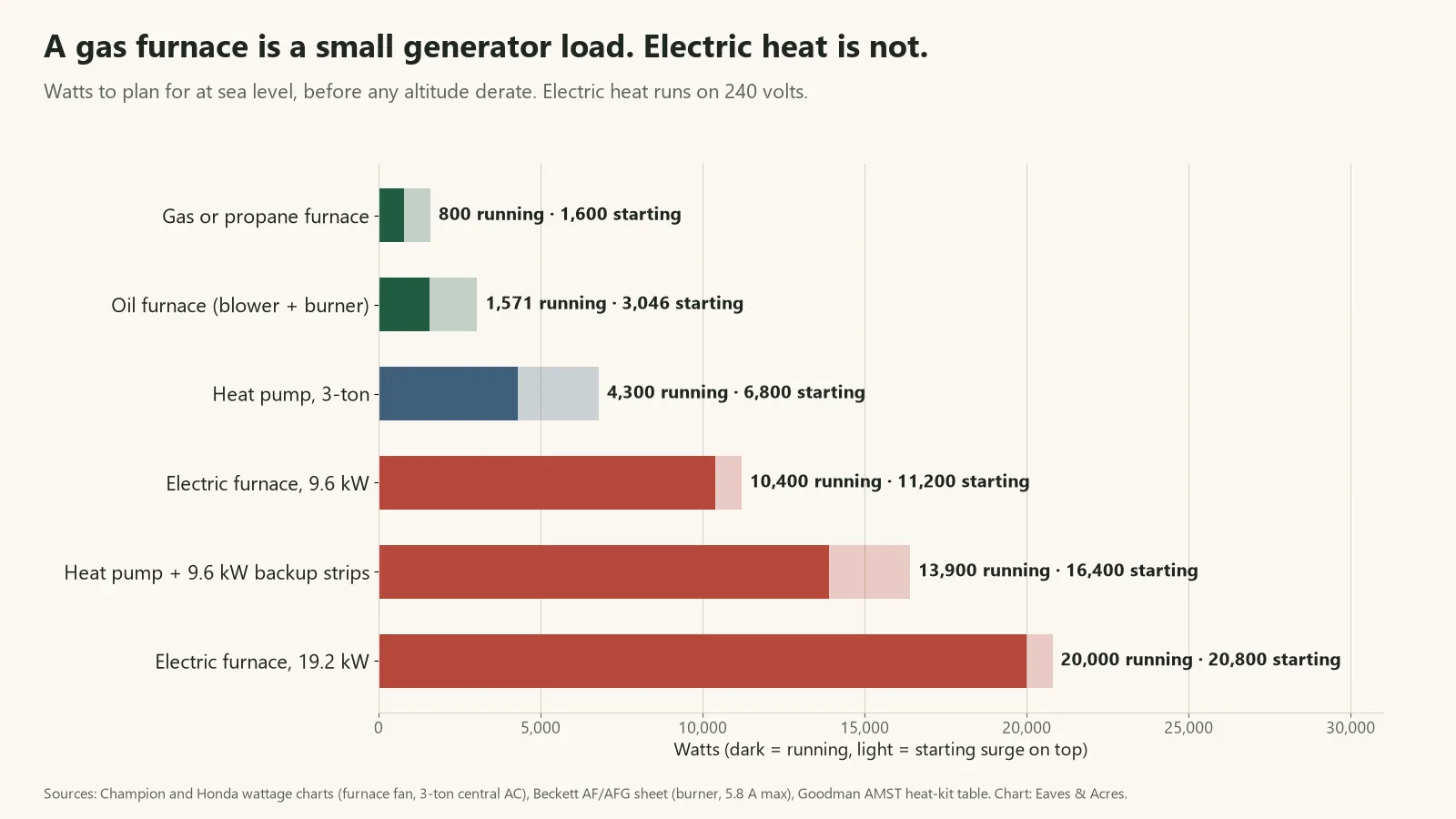
- 1A gas or propane furnace’s blower needs about 300–875 running and 1,600–2,350 starting watts (Champion, Honda); with a fridge, lights and TV, a 3,000 W generator covers it at sea level.
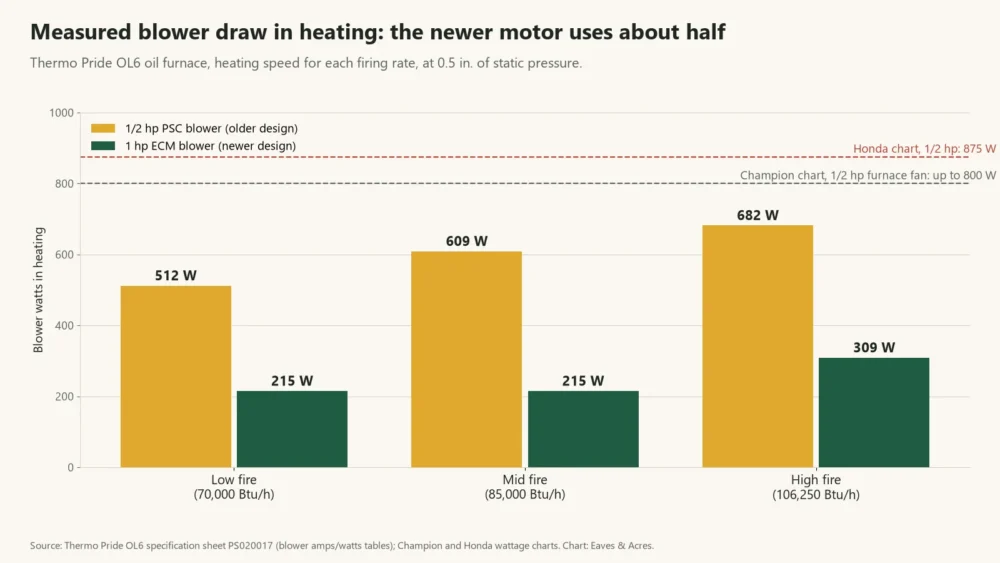
- 2Nameplate amps × volts is a ceiling, not the draw: Thermo Pride’s ECM blower uses 215–309 W in heating against 512–682 W for its PSC model.
- 3Electric furnaces and heat pumps run on 240 volts; a 9.6 kW electric furnace needs a 12 kW generator.
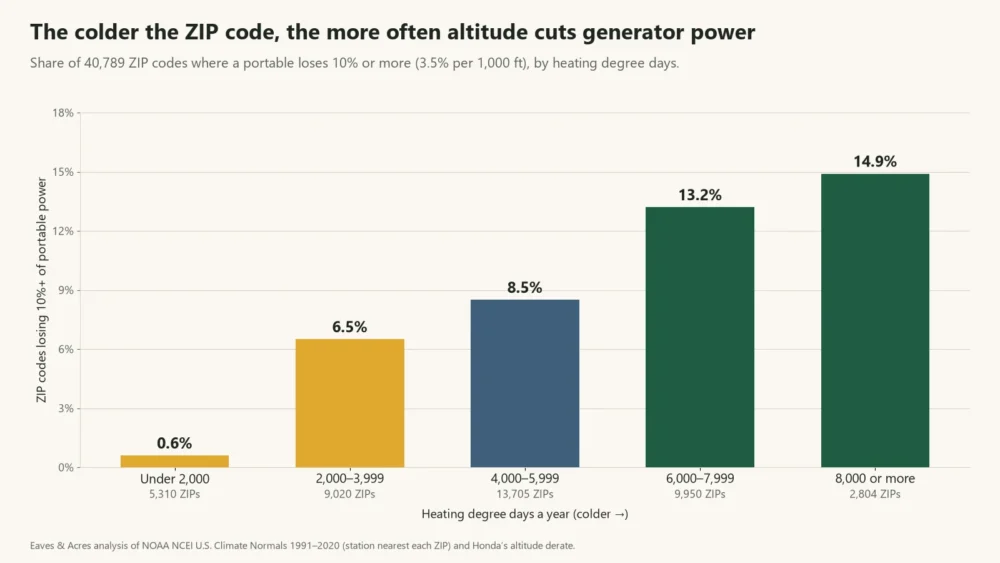
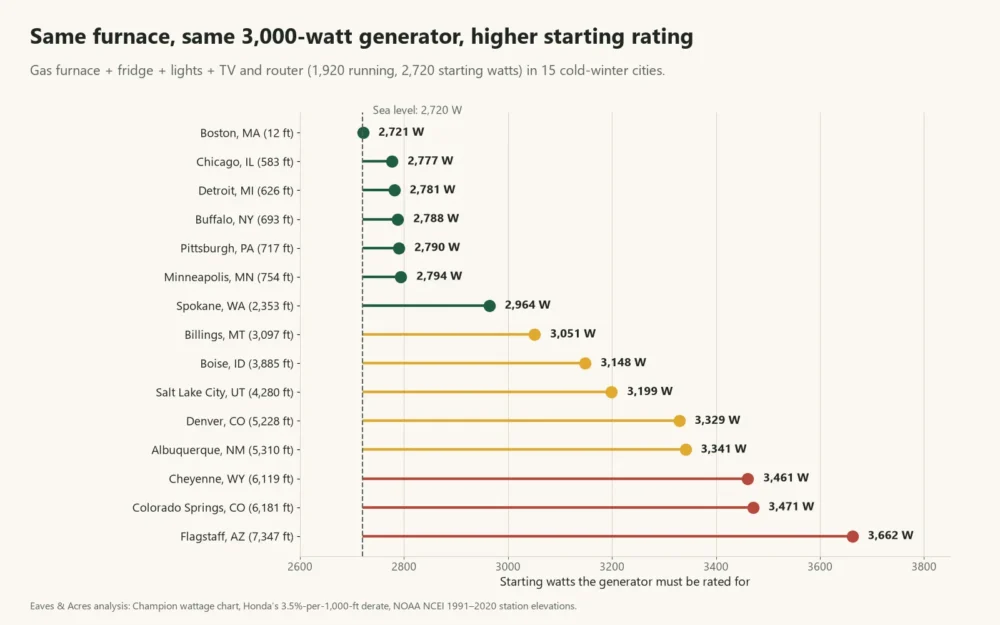
- 4Altitude costs about 3.5% per 1,000 ft (Honda). In the coldest 31% of ZIP codes, 1 in 7 lose 10%+; Flagstaff needs 3,662 starting watts for the same furnace load.
- 5Lennox asks for generator power under 5% THD. A licensed electrician installs the transfer switch, and the generator runs outside, 20+ feet away (CPSC).
A gas or propane furnace needs only enough generator power for its blower, inducer fan, igniter and controls: about 300 to 875 running watts, plus a short surge to 1,600–2,350 watts as the blower starts, according to Champion’s and Honda’s wattage charts.1,2 The furnace alone fits a 2,000-watt generator whose starting rating covers that surge, and a 3,000-watt unit runs it with a fridge, lights and a TV at sea level. An oil furnace adds its burner. An electric furnace or a heat pump is a different class of load: about 4,300 to 25,000 running watts, on 240 volts.
Below, we check those chart numbers against furnace makers’ own blower data and add our NOAA altitude analysis: in the coldest third of US ZIP codes, about 1 in 7 lose 10% or more of a portable generator’s output.
How many watts each type of furnace draws
The fuel makes the heat. Electricity runs what moves the air and lights the burner. In a gas furnace, that means the circulating blower, the inducer fan that pulls combustion gases through, a hot-surface igniter and the control board.8,9 Propane furnaces are the same machines: Carrier approves its 58SC models for natural gas or propane, converted with a gas kit.8
| Heating system | What runs on electricity | Running watts | Starting watts | Volts |
|---|---|---|---|---|
| Gas or propane furnace | Blower, inducer fan, igniter, controls | 300–800 (Champion, 1/2 hp fan); 875 (Honda, 1/2 hp) | 800–1,600 (Champion); 2,350 (Honda) | 115–120 |
| Oil furnace | Blower, plus the oil burner’s motor, igniter and control | Blower + up to about 700 for the burner (5.8 A maximum) | The blower’s surge | 120 |
| Heat pump, 3-ton | Compressor and outdoor fan, indoor blower | 3,000–3,500 for the compressor, plus the blower | 5,000–6,000 | 208–240 |
| Electric furnace or heat strips | Resistance elements, blower | 3,000–24,000 for the elements, plus the blower | No surge from the elements | 208–240 |
For a gas furnace the blower is nearly the whole load; an oil burner adds up to 5.8 amps.11 Honda’s wattage estimation guide lists furnace fans for gas or fuel oil by size, from 300 running and 500 starting watts for a 1/8 hp fan up to 875 and 2,350 for a 1/2 hp fan.2 Champion’s wattage chart gives a 1/2 hp furnace fan 300–800 running and 800–1,600 starting watts.1 Our generator size calculator uses Champion’s top figures. If you don’t know your blower’s size, Honda’s 2,350 is the safer starting number.
Even Honda’s own pages differ: one lists a 1/4 hp furnace fan at 1,600 starting watts, another at 1,000.2,3 Plan on the top of a range.
How to read your own furnace’s numbers
Spec sheets and rating labels give volts and amps. Multiplied, they give a ceiling, not the running draw. Carrier’s 58SC gas furnaces list maximum unit amps of 5.6 to 13.4 at 115 volts, depending on size: about 640 to 1,540 watts.8 Thermo Pride’s OL6 oil furnace lists a total current of 8.7 amps with its 1/2 hp PSC blower, about 1,040 watts at 120 volts. Its own blower table shows 512 to 682 watts at the heating speeds.10
Skip the “minimum circuit ampacity” line. Goodman defines it as 1.25 times the blower amps plus the inducer amps, a wire-sizing figure.9 And none of the Carrier, Goodman, Lennox or Thermo Pride documents we read gives a starting figure for the blower, so the generator makers’ charts are the only published surge numbers.
Older PSC blowers and newer ECM blowers
What a blower really draws depends on its motor. Thermo Pride publishes watts for two versions of its OL6 oil furnace. At 0.5 inch of static pressure, the 1/2 hp PSC (permanent split capacitor) blower draws 512 to 682 watts at the heating speeds, and the 1 hp ECM version draws 215 to 309 watts.10 On the top (cooling) speed the two are close: 869 and 855 watts.
Federal rules push the same way. Furnace fans made on or after July 3, 2019 must meet DOE’s fan energy rating limits.14 For the 3-ton gas furnace in DOE’s 2012 analysis, which moves 1,158 cubic feet of air a minute, the limit works out to about 233 watts per 1,000 cfm, against 380 for the old PSC baseline. DOE put that baseline blower at 382 watts in heating.14,15
A furnace made since 2019 may run well under the chart figures, but no document we read says how much less it needs to start, so keep the chart’s starting watts.
Worked examples: gas and oil furnaces
Each example uses our calculator’s rule: running watts plus 5%, divided by the altitude factor (Honda: about 3.5% less power per 1,000 feet),4 and a starting rating of at least the starting total divided by the same factor. Elevations are for the NOAA station nearest each city.17
Gas furnace in a Chicago outage
- Scenario
- Furnace (800 running, 1,600 starting), fridge (400, 1,200), lights (300) and a TV with router (420). NOAA station elevation 583 ft.
- Math
- Running: 800 + 400 + 300 + 420 = 1,920 W. Largest surge: the furnace or the fridge, 800 W each. Starting: 2,720 W. Altitude factor: 1 − 0.035 × 0.583 = 0.980. Size: 1,920 × 1.05 ÷ 0.980 = 2,058 W. Starting: 2,720 ÷ 0.980 = 2,777 W.
- Answer
- A 3,000-watt generator rated for at least 2,777 starting watts.
Oil furnace in Boston
- Scenario
- 1/2 hp blower (Honda: 875 running, 2,350 starting), oil burner (up to 5.8 A × 120 V = 696 W), fridge, lights and a TV with router. Station elevation 12 ft.
- Math
- Running: 875 + 696 + 400 + 300 + 420 = 2,691 W. Largest surge: the blower, 2,350 − 875 = 1,475 W. Starting: 4,166 W. Altitude barely matters (factor 0.9996). Size: 2,691 × 1.05 ÷ 0.9996 = 2,827 W. Starting: 4,166 ÷ 0.9996 = 4,168 W.
- Answer
- A 3,000-watt generator rated for at least 4,168 starting watts.
The same gas furnace in Flagstaff
- Scenario
- The Chicago list in Flagstaff, Arizona. Station elevation 7,347 ft.
- Math
- Altitude factor: 1 − 0.035 × 7.347 = 0.743. Size: 1,920 × 1.05 ÷ 0.743 = 2,714 W. Starting: 2,720 ÷ 0.743 = 3,662 W.
- Answer
- Still a 3,000-watt generator, but one rated for at least 3,662 starting watts, about a third more than in Chicago.
Staggering loads shrinks these numbers. Honda’s guide puts it plainly:3
it is not necessary to power everything at the same time.
In Honda’s example, a 3,000-watt generator runs a fridge, furnace, lights, TV and microwave easily, and as little as 1,600 watts can do if the furnace and fridge run at separate times and the lights and TV go off whenever one of them starts.3
Altitude: cold places lose more generator power
Engines make less power in thin air, and many places that lean hardest on a furnace are high. We applied Honda’s 3.5%-per-1,000-ft rule to the NOAA station nearest each of 40,789 ZIP codes with both an elevation and a heating degree day normal.4,17 Nationally, 8.6% lose 10% or more of a portable’s power. In the coldest 31% (6,000 heating degree days or more), 13.6% do, about 1 in 7; in the mildest band, under 2,000 degree days, 0.6%. About half of all the ZIP codes losing 10% or more are in that cold group.
| City | Station elevation | January average low | Heating degree days | Portable power lost | Furnace, fridge, lights, TV: size (starting rating) | Plus sump pump and microwave: size (starting rating) |
|---|---|---|---|---|---|---|
| Boston, MA | 12 ft | 23.1°F | 5,545 | under 0.1% | 3,000 W (2,721) | 5,000 W (4,722) |
| Chicago, IL | 583 ft | 19.4°F | 6,018 | 2.0% | 3,000 W (2,777) | 5,000 W (4,818) |
| Detroit, MI | 626 ft | 19.8°F | 6,106 | 2.2% | 3,000 W (2,781) | 5,000 W (4,826) |
| Buffalo, NY | 693 ft | 19.0°F | 6,466 | 2.4% | 3,000 W (2,788) | 5,000 W (4,837) |
| Pittsburgh, PA | 717 ft | 20.5°F | 5,379 | 2.5% | 3,000 W (2,790) | 5,000 W (4,841) |
| Minneapolis, MN | 754 ft | 8.1°F | 7,699 | 2.6% | 3,000 W (2,794) | 5,000 W (4,848) |
| Spokane, WA | 2,353 ft | 24.7°F | 6,463 | 8.2% | 3,000 W (2,964) | 5,000 W (5,144) |
| Billings, MT | 3,097 ft | 14.4°F | 6,955 | 10.8% | 3,000 W (3,051) | 5,000 W (5,294) |
| Boise, ID | 3,885 ft | 23.5°F | 6,167 | 13.6% | 3,000 W (3,148) | 5,000 W (5,463) |
| Salt Lake City, UT | 4,280 ft | 27.6°F | 4,724 | 15.0% | 3,000 W (3,199) | 5,000 W (5,552) |
| Denver, CO | 5,228 ft | 21.3°F | 5,262 | 18.3% | 3,000 W (3,329) | 5,500 W (5,777) |
| Albuquerque, NM | 5,310 ft | 26.4°F | 3,996 | 18.6% | 3,000 W (3,341) | 5,500 W (5,797) |
| Cheyenne, WY | 6,119 ft | 18.0°F | 7,028 | 21.4% | 3,000 W (3,461) | 5,500 W (6,006) |
| Colorado Springs, CO | 6,181 ft | 18.5°F | 5,888 | 21.6% | 3,000 W (3,471) | 5,500 W (6,023) |
| Flagstaff, AZ | 7,347 ft | 16.9°F | 6,526 | 25.7% | 3,000 W (3,662) | 6,500 W (6,354) |
A 3,000-watt generator covers the furnace, fridge, lights and TV in every city; only the starting rating climbs, from 2,720 watts at sea level to 3,329 in Denver. Add a sump pump and a microwave, as in our calculator’s default list, and Denver needs a 5,500-watt generator and Flagstaff a 6,500.
Heat doesn’t trim a generator in winter: Generac’s temperature derate starts above 77°F,5 and the warmest January average high in Table 2 is 48.5°F (Denver). It matters in summer, as the Denver example below shows. The calculator applies both rules to your ZIP code.
Electric furnaces and heat pumps are a different class of load
An electric furnace makes its heat with resistance elements. Goodman’s AMST air handler takes heat kits from 3 to 25 kW; its “10 kW” kit is rated 9.6 kW and draws 40 amps at 240 volts.12 Resistance heat has no starting surge (Champion lists none for an electric water heater or space heater),1 but it carries the whole house’s heat.
A heat pump’s compressor is the same machine that cools in summer. Goodman’s 3-ton GSZ14 heat pump is rated 36,000 Btu/h for both cooling and heating. Its compressor’s rated load is 15.4 amps at 208–230 volts, about 3,540 watts at 230 volts, close to Champion’s 3,000–3,500 running watts for a 3-ton central AC. As it starts, it draws 83.9 amps (locked-rotor current), more than five times that.13,1 In deep cold, backup electric strips can add their kilowatts on top; our guide to heat pumps in cold weather explains when they come on.
| System (plus an 800 W blower) | Running watts | Starting watts | Portable size | Standby size |
|---|---|---|---|---|
| Heat pump, 3-ton | 4,300 | 6,800 | 5,000 W (starting rating 6,800+) | 10 kW |
| Heat pump + 4.8 kW strips | 9,100 | 11,600 | 10,000 W | 10 kW |
| Heat pump + 9.6 kW strips | 13,900 | 16,400 | 15,000 W | 17 kW |
| Electric furnace, 4.8 kW | 5,600 | 6,400 | 6,500 W | 10 kW |
| Electric furnace, 9.6 kW | 10,400 | 11,200 | 12,000 W | 12 kW |
| Electric furnace, 14.4 kW | 15,200 | 16,000 | 17,500 W | 17 kW |
| Electric furnace, 19.2 kW | 20,000 | 20,800 | Above our largest portable size | 22 kW |
| Electric furnace, 24 kW | 24,800 | 25,600 | Above our largest portable size | 30 kW |
Sizes come from the calculator’s standard list, with its 5% margin; check each unit’s starting rating too. Both systems run on 208/240 volts,12,13 so the generator must supply 240 volts at those wattages.
Heat pump home in Denver, standby generator
- Scenario
- Winter: 3-ton heat pump (3,500 running, 6,000 starting), blower (800), 9.6 kW backup strips, fridge, lights and a TV with router, all at once. Summer: the same unit cooling, without strips. Station elevation 5,228 ft; January average high 48.5°F, July 91.4°F (NOAA).
- Math
- Winter: 15,020 running and 17,520 starting watts. Generac factor: 1 − 0.03 × 4.628 = 0.861 (no heat derate). Size: 15,020 × 1.05 ÷ 0.861 = 18,314 W; starting 20,345 W. Summer: 5,420 running and 7,920 starting watts. Factor: 0.861 × (1 − 0.017 × 1.44) = 0.840. Size: 6,774 W; starting 9,428 W.
- Answer
- A 20 kW standby unit for winter, whose spec sheet covers 20,345 starting watts. Summer alone would need only 10 kW: for a heat pump home, winter sets the size.
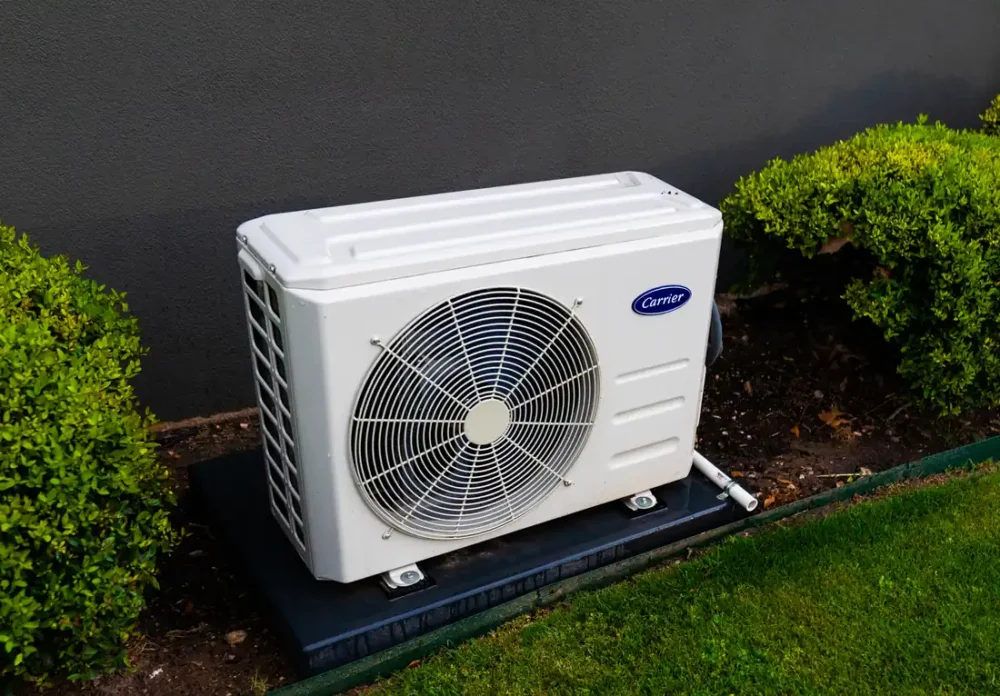
For backup power, a gas furnace is the far smaller load; our heat pump vs furnace comparison covers what each costs to run by city.
Inverter or conventional generator for furnace electronics
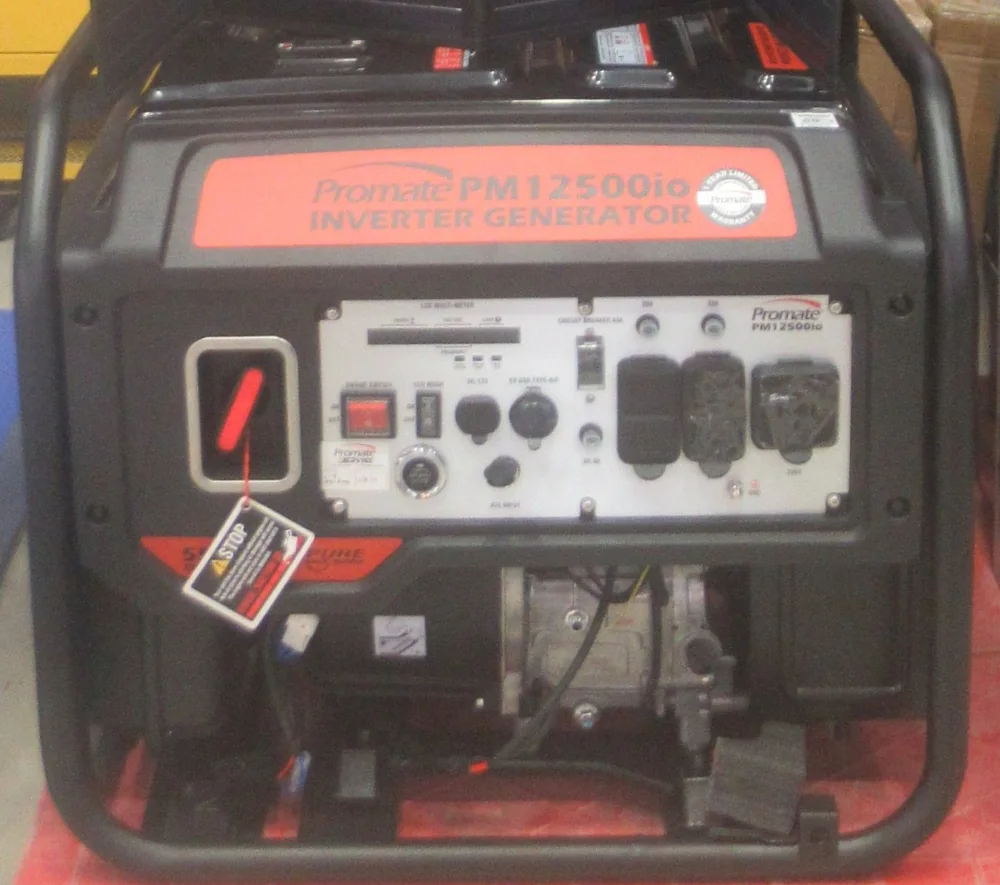
Furnaces run on control boards, and Lennox sets generator limits in its SL280DFNV gas furnace instructions: 120 volts (102 to 132), 60 Hz within 5% (57 to 63 Hz), correct polarity and a proper ground, both checked before the furnace runs on temporary power.7 They add:
Generator should have a wave form distortion of less than 5% THD
THD (total harmonic distortion) measures how far power departs from a clean wave. Generac says standard portable generators typically run 9% to 15% THD, some up to 30%, while several of its non-inverter lines (XD, XG, XC, XT-EFI and GP-EFI) stay under 6%.6
Generac inverter generators produce ≤3% THD, making them ideal for use with sensitive electronics.
So on paper an inverter generator meets Lennox’s limit and a typical conventional portable doesn’t. “Under 6%” doesn’t prove “under 5%”, so compare the spec sheet’s THD figure with your furnace manual. Not every manual sets one: the Goodman and Carrier sheets we read say nothing about generators.8,9
Polarity and ground matter too. Goodman’s wiring diagram has the control board flash rapidly for reversed polarity and tells the technician to verify the ground.9 If a furnace won’t light on generator power, that is a job for the electrician who made the connection, not for an adapter.
Getting generator power to the furnace
The Goodman and Carrier spec sheets show a furnace wired to a 115-volt supply with its own fuse or breaker,8,9 so it doesn’t plug into a generator. Honda’s manual says connections to a building’s electrical system must be made by a qualified electrician, through a transfer switch that isolates generator power from utility power. Improper connections can backfeed the utility lines and electrocute line workers.4 Search results for this question include videos of homemade cords and breaker-box hookups; Honda’s warning is why we don’t repeat them.
Carbon monoxide: where the generator goes
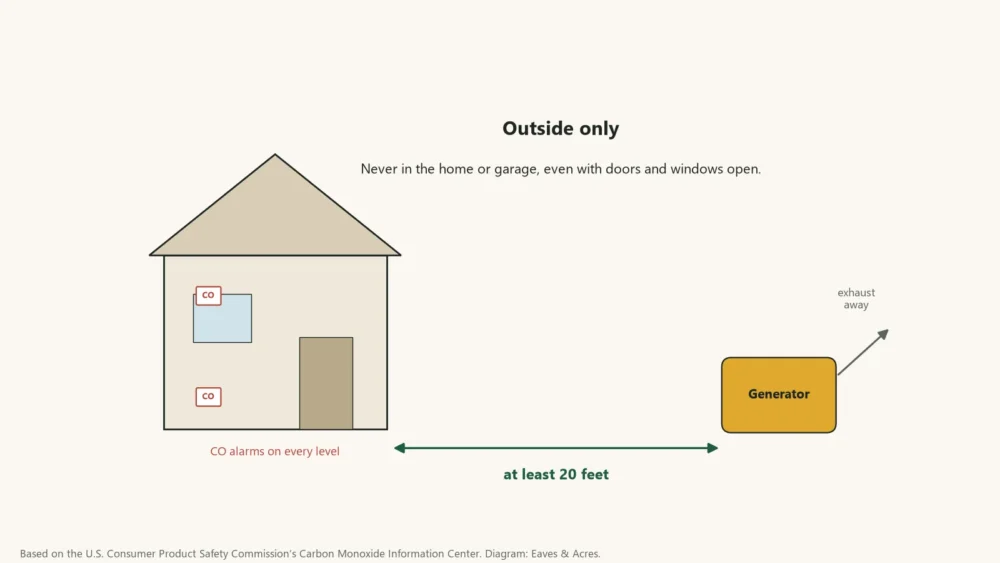
Our portable generator safety guide covers placement, alarms, cords and refueling, with CPSC’s records of generator deaths.
Next step
Note your furnace’s volts, amps and blower size, list what else must run, and enter it with your ZIP code in the generator size calculator. Its rules are on our methodology page; the generators section has our other backup-power guides.
Frequently asked questions
Yes, if the generator covers the blower’s running and starting watts and a licensed electrician makes the connection. Gas, propane and oil furnaces are wired to their own 115–120-volt circuit, so they need a transfer switch, not a plug. Electric furnaces need much bigger, 240-volt generators.
For the furnace alone, about 2,000 watts with a starting rating of 1,600 to 2,350 watts, by Champion’s and Honda’s charts. With a fridge, lights and a TV, 3,000 watts at sea level, rated for about 2,720 starting watts, and more starting watts at altitude.
Only a small one. A 4.8 kW electric furnace with its blower needs about 5,600 running watts. A 9.6 kW model needs 10,400, more than 10,000 before any margin. The generator must also supply 240 volts.
At sea level, the furnace plus a fridge, sump pump, microwave, lights and TV: 3,920 running and 4,720 starting watts. In Denver the same list needs 5,500 watts, and in Flagstaff 6,500, because of altitude.
Not on your own. Furnaces are wired to their own circuit, and Honda warns that improper connections to a building’s wiring can backfeed utility lines and electrocute line workers. A licensed electrician installs the transfer switch.
Check your furnace manual. Lennox asks for less than 5% THD on generator power. Generac says its inverter models produce 3% or less and standard portables typically 9% to 15%. A conventional generator qualifies only if its spec sheet shows a low enough figure.
We found no official rule by that name. CPSC’s rule is to run a portable generator outside only, at least 20 feet from the house, with the exhaust facing away.
Sources
- 1.Generator Wattage Chart: Common Appliances & Tools. Champion Power Equipment, 2026. Used for: furnace fan (1/2 HP) 300–800 running and 800–1,600 starting watts; 3-ton central AC; no surge for resistance heaters Back to text
- 2.What Wattage Generator Do I Need? (wattage estimation guide). American Honda Motor Co., n.d. Used for: furnace fan, gas or fuel oil, 1/8–1/2 hp: running and starting watts Back to text
- 3.What Size Generator Do I Need? (power management). American Honda Motor Co., n.d. Used for: furnace (1/4 hp fan) 600/1,600 W example; staggering loads; quote Back to text
- 4.Owner’s Manual, Generator EG5000X. Honda Motor Co., 2009. Used for: altitude derate (about 3.5% per 1,000 ft); connections to a building by a qualified electrician through a transfer switch; backfeed warning Back to text
- 5.Spec Sheet, RG Protector Series 22–38 kW Standby Generators. Generac Power Systems, 2025. Used for: standby derates: 3% per 1,000 ft above 600 ft; 1.7% per 10°F above 77°F Back to text
- 6.What Is Total Harmonic Distortion (THD)?. Generac Power Systems, 2026. Used for: standard portables typically 9–15% THD (up to 30%); inverters 3% or less; XD, XG, XC, XT-EFI and GP-EFI under 6%; quote Back to text
- 7.SL280DFNV Installation Instructions (508150-02). Lennox Industries, 2024. Used for: generator use: 120 V (102–132), 60 Hz ±5%, polarity and ground, under 5% THD; quote Back to text
- 8.Comfort 80 Gas Furnace 58SC0A/58SC1A Product Data. Carrier Corporation, 2020. Used for: 115-60-1 supply, maximum unit amps 5.6–13.4, blower motor hp and full-load amps, hot-surface igniter, inducer, natural gas or propane Back to text
- 9.GMS8 Gas Furnace Specification Sheet (SS-GMS8, 9/18). Goodman Manufacturing, 2018. Used for: 115 VAC supply, minimum circuit ampacity definition, circulator and inducer blowers, reversed-polarity/ground fault code Back to text
- 10.OL6 Oil Fired Upflow Furnace Specifications (PS020017). Thermo Pride (copy hosted by F.W. Webb), 2023. Used for: 120/60/1, total current 8.7 / 13.2 A, blower watts by speed tap for 1/2 hp PSC and 1 hp ECM models Back to text
- 11.AF/AFG Oil and Biofuel Burner Product Sheet (Form 6578, R07). R.W. Beckett Corporation, 2023. Used for: operating load 5.8 A maximum, 1/7 hp PSC motor, solid-state igniter Back to text
- 12.AMST Series Air Handler Specification Sheet (SS-GAMST-R32). Goodman Manufacturing, 2025. Used for: electric heat kits 3–25 kW, kW and heater amps at 208/240 V Back to text
- 13.GSZ14 Split System Heat Pump Specification Sheet (SS-GSZ14, 2/18). Goodman Manufacturing, 2018. Used for: 3-ton model: 36,000 Btu/h cooling and heating, compressor RLA 15.4 and LRA 83.9 at 208–230 V Back to text
- 14.10 CFR 430.32(y), energy conservation standards for residential furnace fans. U.S. Department of Energy, via eCFR, 2026. Used for: fan energy rating limits for furnace fans made on or after July 3, 2019 Back to text
- 15.Furnace Fan Preliminary Analysis TSD, Appendix 7-C: Calculation of Furnace Blower Fan Energy Consumption. U.S. Department of Energy, 2012. Used for: 3-ton PSC baseline gas furnace fan: 1,158 cfm, 382 W heating, FER 380 Back to text
- 16.Carbon Monoxide Information Center. U.S. Consumer Product Safety Commission, n.d. Used for: more than 100 deaths a year linked to portable generators; placement and CO alarm guidance Back to text
- 17.U.S. Climate Normals 1991–2020. NOAA National Centers for Environmental Information, 2021. Used for: station elevation, heating degree days and monthly normals for every ZIP code and the 15 cities Back to text
How this guide was made
- Written by the Home Systems Desk and reviewed by the Data & Methodology Desk.
- Data: blower, burner, heat-kit and compressor figures transcribed from Champion’s and Honda’s wattage charts and from Beckett, Carrier, Goodman, Lennox and Thermo Pride documents. Sizes use our generator calculator’s rule (running watts plus 5%, plus the largest single surge for starting) with Honda’s portable derate (about 3.5% per 1,000 ft) and Generac’s standby derate (3% per 1,000 ft above 600 ft; 1.7% per 10°F above 77°F). Station elevations, heating degree days and monthly normals come from NOAA NCEI U.S. Climate Normals 1991–2020 (station nearest each ZIP code; 40,789 ZIP codes have both an elevation and a degree-day normal). Real blowers often draw less than the charts; no document we read gives a blower’s starting watts. See our methodology.
- AI use: AI tools help us research, draft and check this guide. Every figure is checked against the source cited for it, and calculated figures come from our own code, described on the methodology page.
- Spotted an error? Tell us — the form opens with this page’s address filled in.
Change log
- Oct 7, 2026Re-checked the Champion and Honda wattage charts, Honda's power-management example, the Lennox and Generac THD statements and CPSC's generator guidance against the live pages; the Honda staggering example now states its conditions as Honda gives them (furnace and fridge run at separate times; lights and TV off at each start).
- Oct 5, 2026Published. Furnace blower, oil burner, electric heat-kit and heat pump loads from Champion’s and Honda’s wattage charts and Beckett, Carrier, Goodman, Lennox and Thermo Pride documents; altitude derate for 40,789 ZIP codes and 15 cold-winter cities from NOAA 1991–2020 normals; generator power-quality limits from Lennox and Generac.
Covers heating, cooling, generators and water heaters. We maintain the sizing calculators and the guides that explain what a number means before you call a contractor.
Keep reading
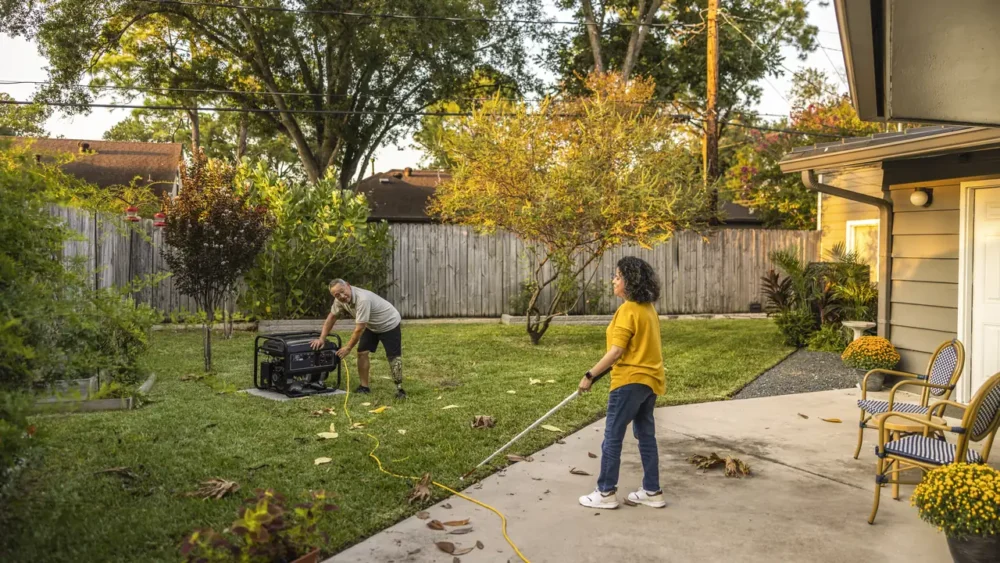
Portable Generator Safety: The Rules and the CPSC Data Behind Them
Outdoors only, 20 feet from the house, exhaust away, CO alarms on every level. CPSC records of 789 generator CO deaths show why each rule exists.

What Humidity Should a House Be in Winter? 30–40%, Lower on Cold Nights
About 30–40% relative humidity, inside EPA’s 30–50% range, and lower on the coldest nights. Our NOAA estimate of when windows fog in 20 US cities, plus signs of air that is too dry or too damp.
How Much Does It Cost to Run a Space Heater? Costs by State and City
A 1,500-watt space heater costs about 27¢ an hour at the 2026 US average electricity price. Costs by state and in 20 cities, and how its heat compares with a furnace or heat pump.
Seasonal reminders for your ZIP
Get a short email when it’s time to overseed, start seeds, open the pool or service your furnace — timed to your climate.