




Heat Pump vs Furnace: Which Is Cheaper to Run Where You Live
Efficiency is only half the story; your electricity and gas rates are the other half. Here is the break-even math, estimated heating costs for 20 cities, and a table for your own bill.
- Last reviewed Oct 4, 2026
- 23 cited sources
- 9 min read
- 1A heat pump is cheaper to run than a gas furnace only if its seasonal COP beats your break-even: electricity $/kWh × 29.31 × AFUE ÷ gas $/therm.
- 2At 2026 state-average prices, a 95% gas furnace was cheaper in 13 of 20 cities we modeled, including Chicago, Detroit, Minneapolis and Boston.
- 3An efficient heat pump (seasonal COP 3.1) was cheaper in Seattle, Portland, Atlanta, Dallas, Phoenix, Kansas City and Louisville.
- 4Against an electric furnace, a heat pump uses about 58–68% less electricity for the same heat.
- 5The federal 25C credit ended for heat pumps installed after December 31, 2025; check state and utility rebates instead.
A heat pump is cheaper to run than a gas furnace only when its efficiency beats a break-even number set by your local electricity and gas prices. At 2026 state-average prices, a 95% efficient gas furnace costs less to run in 13 of the 20 US cities we modeled. An efficient heat pump wins in Seattle, Portland, Atlanta, Dallas, Phoenix, Kansas City and Louisville. Against an electric furnace, a heat pump wins everywhere.
Below: the math, a city-by-city estimate from NOAA climate normals and EIA prices, and a lookup table for the rates on your own bill.
The short answer: two prices and one efficiency number
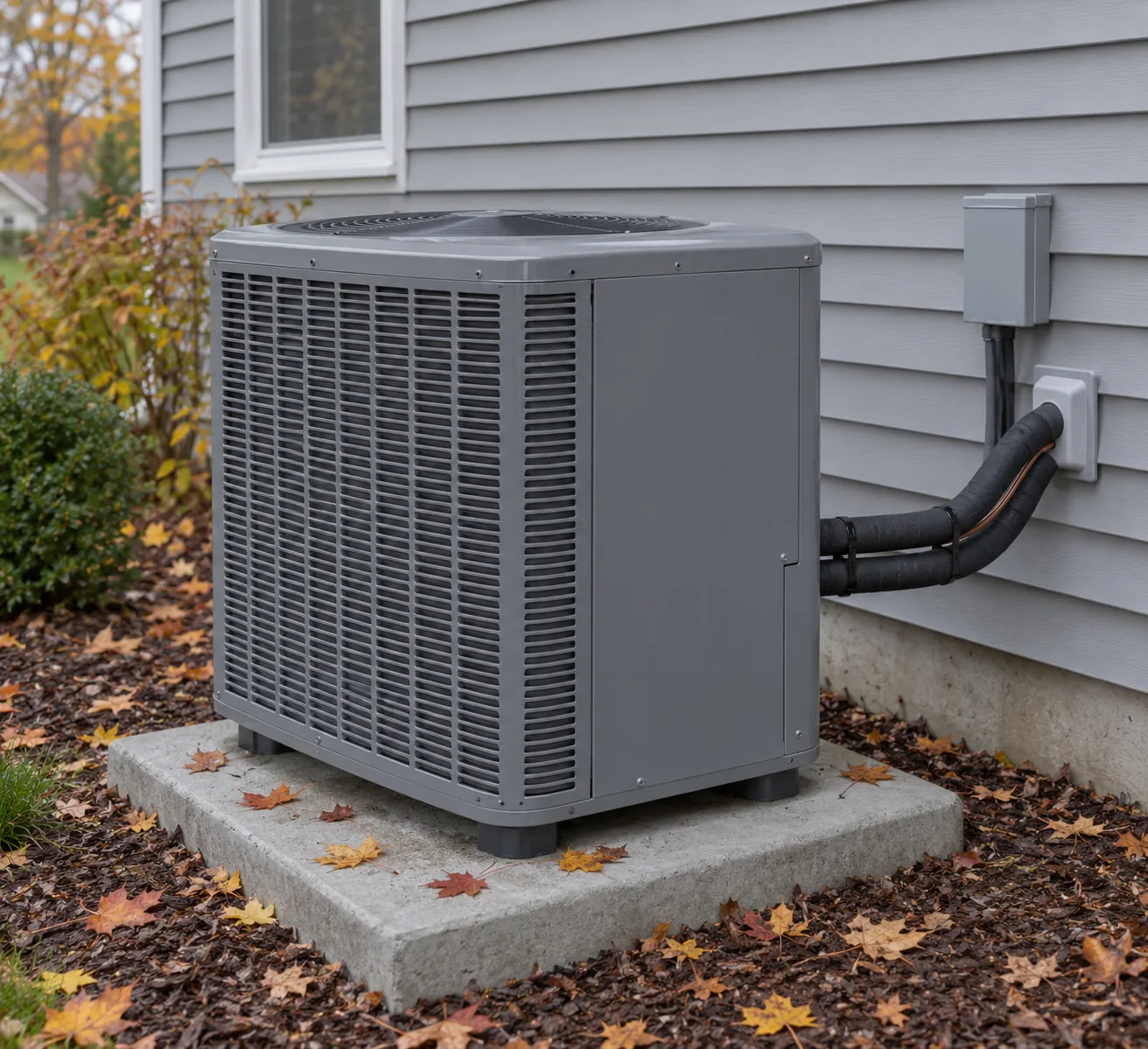
A gas furnace burns fuel; its efficiency (AFUE) tops out just under 100%. A heat pump moves heat from outdoor air, so it can deliver up to three times more heat than the electricity it uses, says ENERGY STAR.8 That ratio is the coefficient of performance (COP). But electricity usually costs more per unit of energy than gas, so efficiency alone does not settle it.
The efficiency rating alone does not determine operating cost.
What decides it is the break-even COP: the seasonal COP at which both systems cost the same for the same heat. With EIA’s conversions (1 kWh = 3,412 Btu; 1 therm = 100,000 Btu):5
Break-even COP = electricity price ($/kWh) × 29.31 × furnace AFUE ÷ gas price ($/therm)
If your heat pump’s seasonal COP is above that number, it is the cheaper heat.
Heat pump vs. gas furnace at a glance
| Factor | Air-source heat pump | Gas furnace |
|---|---|---|
| How it heats | Moves heat from outdoor air with electricity | Burns natural gas |
| Cooling | Yes, the same unit | No; needs a separate AC |
| Efficiency rating | HSPF2 (heating), SEER2 (cooling) | AFUE; Bryant lists 80% to 98.5% |
| ENERGY STAR benchmark | Cold-climate: HSPF2 ≥ 8.1 ducted | ≥ 97% AFUE North, ≥ 95% South |
| Air at the vents (Trane) | Warm, gentler airflow at a lower temperature | Hotter air; Trane calls it “intense and dry” |
| Cold weather | COP and capacity fall as it gets colder | Output does not depend on outdoor temperature |
| Lifespan (EnergySage) | About 15 years | 15–20 years |
Sources: ENERGY STAR,9 PNNL,7 Bryant,17 Trane23 and EnergySage.18 Our glossary explains what HSPF2 measures.
Loads from YouTube (privacy-enhanced mode) only when you press play.
Heating cost by city: our 20-city estimate
We priced the same example home in 20 cities. Its heat need scales with heating degree days (HDD): each degree the daily mean falls below 65°F adds one.4 HDD come from NOAA 1991–2020 normals for the station nearest each ZIP code, the same data behind our climate guides.1 Prices are EIA residential state averages: electricity from Electric Power Monthly Table 5.6.B for January–July 2026,2 gas for 2025.3
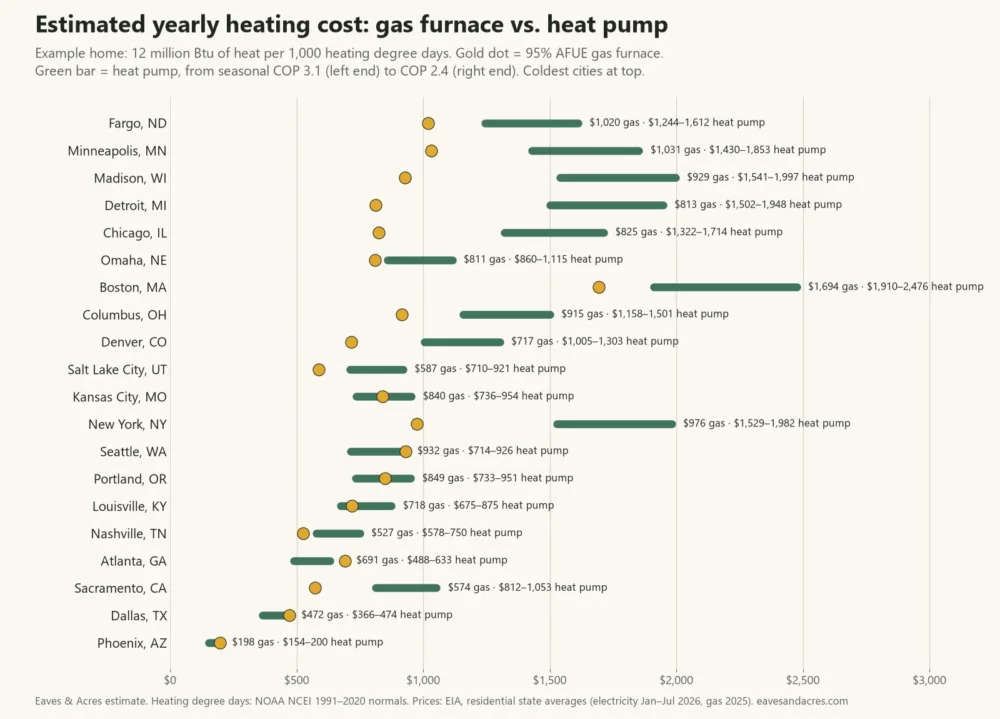
| City (ZIP) | HDD | Power | Gas/therm | Furnace | Heat pump | Break-even (cheaper at COP 3.1) |
|---|---|---|---|---|---|---|
| Fargo, ND (58102) | 8,806 | 12.4¢ | $0.92 | $1,020 | $1,244–1,612 | 3.8 (gas) |
| Minneapolis, MN (55401) | 7,699 | 16.2¢ | $1.06 | $1,031 | $1,430–1,853 | 4.3 (gas) |
| Madison, WI (53703) | 7,096 | 19.0¢ | $1.04 | $929 | $1,541–1,997 | 5.1 (gas) |
| Detroit, MI (48226) | 6,106 | 21.5¢ | $1.05 | $813 | $1,502–1,948 | 5.7 (gas) |
| Chicago, IL (60602) | 6,018 | 19.2¢ | $1.09 | $825 | $1,322–1,714 | 4.9 (gas) |
| Omaha, NE (68102) | 5,833 | 12.9¢ | $1.10 | $811 | $860–1,115 | 3.3 (gas) |
| Boston, MA (02108) | 5,545 | 30.1¢ | $2.42 | $1,694 | $1,910–2,476 | 3.5 (gas) |
| Columbus, OH (43215) | 5,417 | 18.7¢ | $1.34 | $915 | $1,158–1,501 | 3.9 (gas) |
| Denver, CO (80202) | 5,262 | 16.7¢ | $1.08 | $717 | $1,005–1,303 | 4.3 (gas) |
| Salt Lake City, UT (84101) | 4,724 | 13.2¢ | $0.98 | $587 | $710–921 | 3.7 (gas) |
| Kansas City, MO (64106) | 4,613 | 14.0¢ | $1.44 | $840 | $736–954 | 2.7 (heat pump) |
| New York, NY (10001) | 4,553 | 29.4¢ | $1.70 | $976 | $1,529–1,982 | 4.8 (gas) |
| Seattle, WA (98101) | 4,340 | 14.4¢ | $1.70 | $932 | $714–926 | 2.4 (heat pump) |
| Portland, OR (97204) | 4,167 | 15.4¢ | $1.61 | $849 | $733–951 | 2.7 (heat pump) |
| Louisville, KY (40202) | 4,141 | 14.3¢ | $1.37 | $718 | $675–875 | 2.9 (heat pump) |
| Nashville, TN (37201) | 3,648 | 13.9¢ | $1.14 | $527 | $578–750 | 3.4 (gas) |
| Atlanta, GA (30303) | 2,775 | 15.4¢ | $1.97 | $691 | $488–633 | 2.2 (heat pump) |
| Sacramento, CA (95814) | 2,138 | 33.2¢ | $2.12 | $574 | $812–1,053 | 4.4 (gas) |
| Dallas, TX (75201) | 1,992 | 16.1¢ | $1.88 | $472 | $366–474 | 2.4 (heat pump) |
| Phoenix, AZ (85004) | 874 | 15.4¢ | $1.79 | $198 | $154–200 | 2.4 (heat pump) |
The example home needs 12 million Btu of heat per 1,000 HDD (a heat loss of 500 Btu per hour per °F), about 72 million Btu a year in Chicago. The heat pump range uses seasonal COP 2.4 (HSPF2 8.1, the ENERGY STAR cold-climate minimum for ducted systems)7 and 3.1 (HSPF2 10.5, Bryant’s rating for its Evolution Extreme 23).17 COP = HSPF2 ÷ 3.412.
Why the North still favors gas at today’s prices
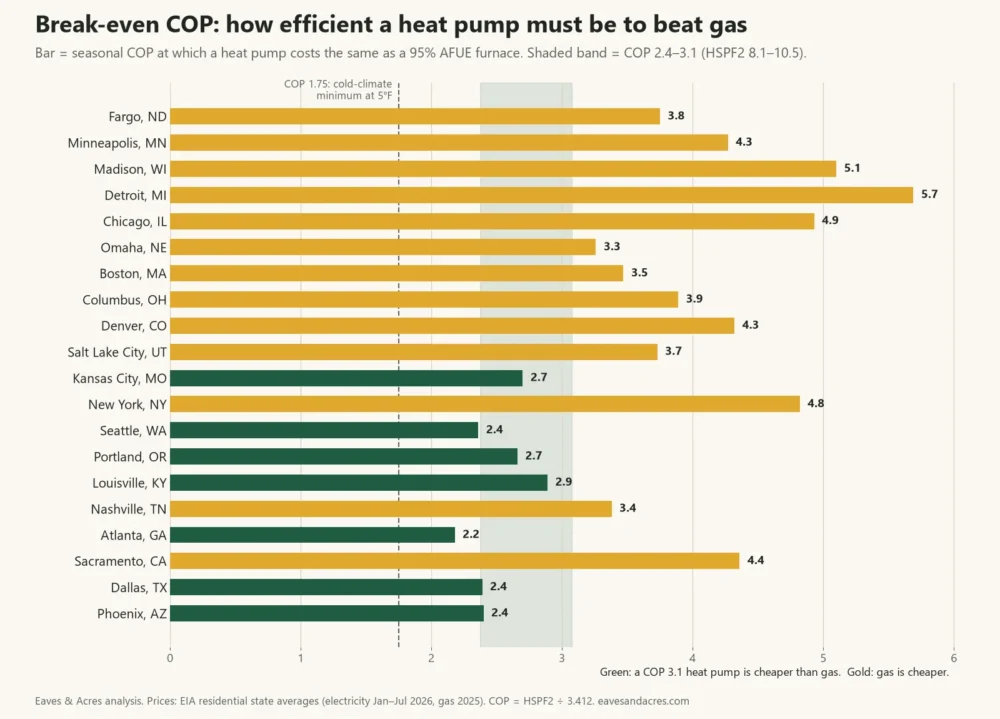
Detroit (5.7), Madison (5.1) and Chicago (4.9) pair cheap gas, about $1.04–$1.09 a therm, with electricity at 19–22¢. No air-source heat pump averages a COP near 5 through a Midwest winter. Seattle (2.4) and Atlanta (2.2) are the reverse. Cold alone does not decide it: Omaha is colder than Nashville but has a lower break-even, 3.3 against 3.4, because Nebraska power costs 12.9¢.
Limits: state averages hide local rates, real homes need less heat on mild days than the 65°F base assumes, and cooling is left out. Treat the dollars as a comparison, not a bill forecast.
Find your own break-even COP
Read the per-kWh and per-therm charges off your bills (a CCF of gas is roughly one therm) and find the closest cell:
| Electricity | Gas $0.80/therm | Gas $1.20/therm | Gas $1.60/therm | Gas $2.00/therm | Gas $2.40/therm |
|---|---|---|---|---|---|
| 10¢ per kWh | 3.5 | 2.3 | 1.7 | 1.4 | 1.2 |
| 14¢ per kWh | 4.9 | 3.2 | 2.4 | 1.9 | 1.6 |
| 18¢ per kWh | 6.3 | 4.2 | 3.1 | 2.5 | 2.1 |
| 22¢ per kWh | 7.7 | 5.1 | 3.8 | 3.1 | 2.6 |
| 26¢ per kWh | 9.0 | 6.0 | 4.5 | 3.6 | 3.0 |
| 30¢ per kWh | 10.4 | 7.0 | 5.2 | 4.2 | 3.5 |
For an older 80% furnace, multiply by 0.84. Then compare the result with the seasonal COP of the heat pump you are quoted (HSPF2 ÷ 3.412).
Chicago, Illinois: furnace vs. heat pump for the example home
- Scenario
- NOAA normals give 6,018 heating degree days at the Northerly Island station downtown. EIA prices: 19.22¢ per kWh; $11.25 per Mcf of gas, about $1.09 per therm.
- Math
- Heat: 6,018 × 12,000 Btu = 72.2 million Btu. Furnace: 72.2 ÷ 0.95 = 760 therms × $1.086 = about $825. Heat pump: 72.2 million Btu = 21,160 kWh of heat ÷ COP 3.1 = 6,880 kWh × $0.1922 = about $1,320 ($1,710 at COP 2.4). Break-even: 0.1922 × 29.31 × 0.95 ÷ 1.086 = 4.9.
- Answer
- At Illinois average rates, gas heats this home for roughly $500–$900 less a year.
Better still, use your own history: last winter’s heating therms × your furnace’s AFUE ÷ 10 is your home’s heat need in millions of Btu. Multiply by 293 and divide by a heat pump’s COP for the kilowatt-hours it would use.
What seasonal COP to expect
NEEP’s cold-climate specification requires ducted heat pumps to reach HSPF2 7.7 (about COP 2.3) and a COP of at least 1.75 at 5°F.6 ENERGY STAR’s cold-climate label asks for HSPF2 8.1 ducted, 8.5 ductless, and 70% of rated capacity at 5°F.7 COP is highest in mild weather and lowest in deep cold, which is why NEEP’s cold-climate heat pump list reports it at 47°F, 17°F and 5°F. HSPF2 is calculated for a standard climate region, so in much colder places expect a lower seasonal COP than the label implies.
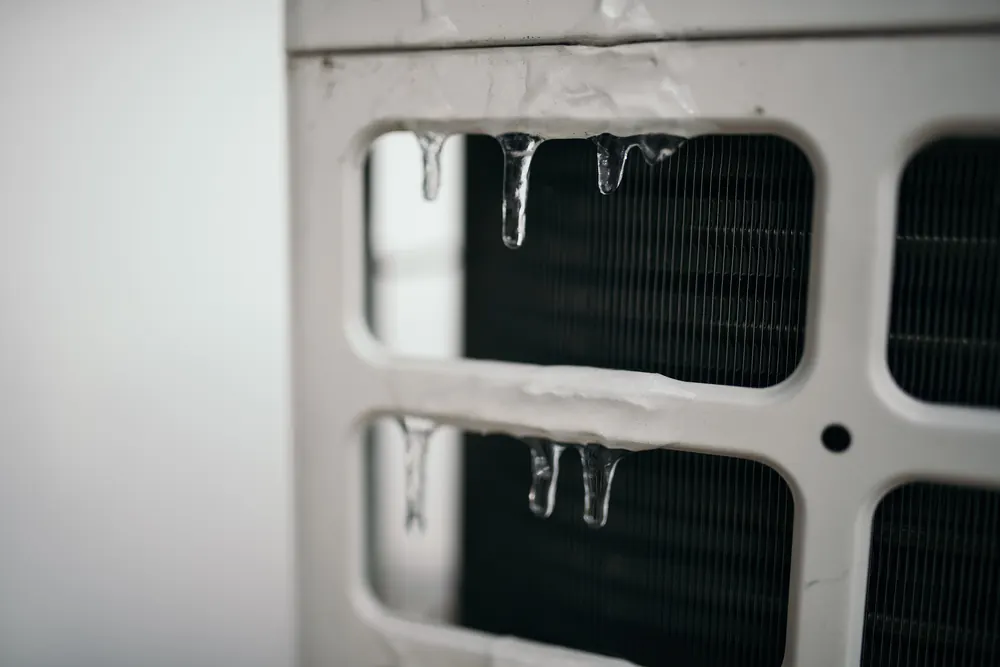
The real money leak in cold weather is backup heat. Heat pumps have traditionally been installed with electric resistance backup, PNNL notes, and resistance heat has a COP of 1.
This electric resistance backup is an inefficient and typically expensive form of heat
The same math settles heat pump vs. electric furnace: a COP 2.4 heat pump cuts the bill by about 58%, a COP 3.1 unit by about 68%. How much heat a heat pump still delivers below freezing is covered in our guide to heat pumps in cold weather.
Heat pump vs. furnace and AC
A heat pump is one system doing both jobs; a furnace needs a separate AC.17 If your air conditioner is due at the same time as your furnace, replacing two machines with one can narrow the upfront gap even where gas heat is cheaper. Our running costs cover heating only.
Dual fuel: a heat pump and a furnace together
A dual-fuel (hybrid) system pairs a heat pump with a gas furnace. Carrier describes it using the heat pump on mild days and the furnace on freezing nights.16 On price alone, the switchover belongs where the heat pump’s COP falls below your break-even. With a break-even of 2.7, a Kansas City heat pump can carry much of the season; at 4.9, Chicago’s average rates hand most of the winter back to gas.
Ductwork: what both systems share
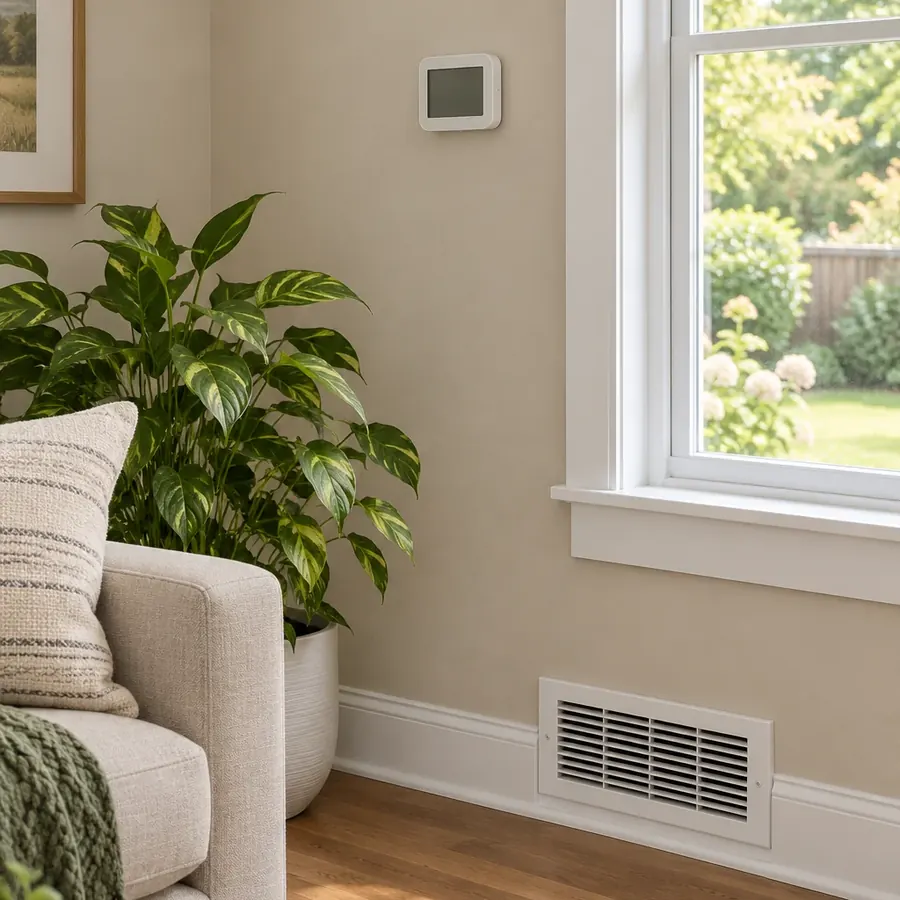
Central heat pumps and furnaces use the same ducts, so leaks cost you either way. ENERGY STAR says a typical house loses about 20 to 30% of the air moving through its ducts to leaks, holes and poor connections.10 Homes without ducts can use ductless (mini-split) heat pumps.8
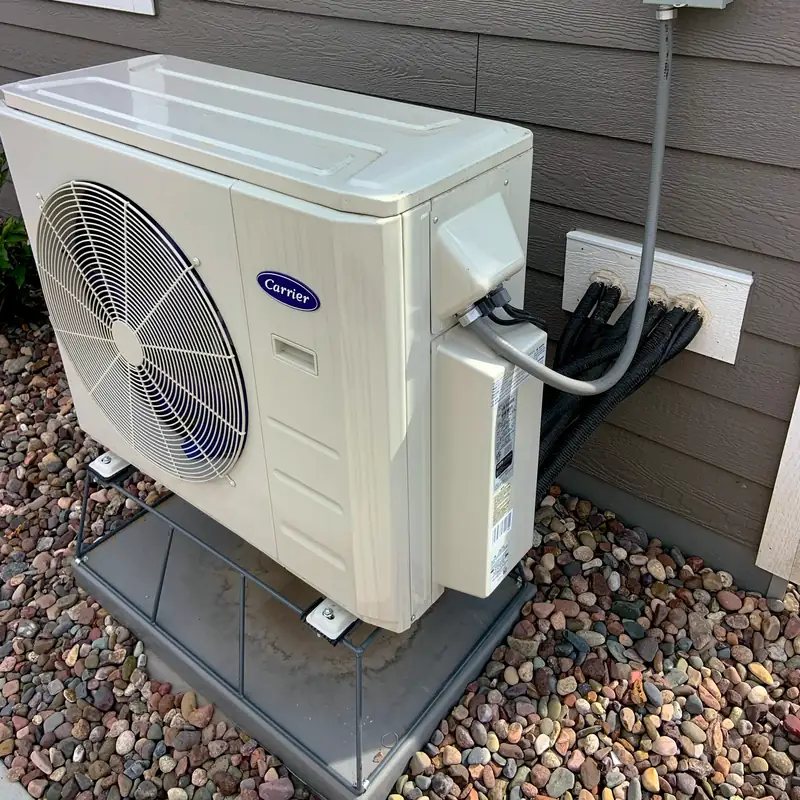
Size is a separate decision from type. A contractor should run an ACCA Manual J load calculation before quoting either system;14 see our glossary entry on Manual J.
Upfront cost and incentives in 2026
Published installed-cost ranges disagree widely, so get several quotes. The American Gas Association (January 2024) puts heat pumps at $2,500–$10,000 and gas furnaces at $700–$3,300, plus $2–$4 per square foot if a gas home needs more electrical capacity.19 EnergySage (July 2026) lists $10,500–$24,000 for heat pumps after state and local incentives, and $2,000–$15,000 for furnaces.18
The federal credit many guides still mention, section 25C (up to $2,000 a year for heat pumps), has ended for new installations:
You can claim the credit for improvements made through December 31, 2025.
The section 25D credit for geothermal heat pumps also ended for property placed in service after December 31, 2025.12 The Department of Energy says its Home Energy Rebates are available in select states through state energy offices,13 and ENERGY STAR’s rebate finder lists rebates its partners sponsor on certified products.8 Confirm on the IRS credit page before counting on any credit.
Maintenance, safety and lifespan
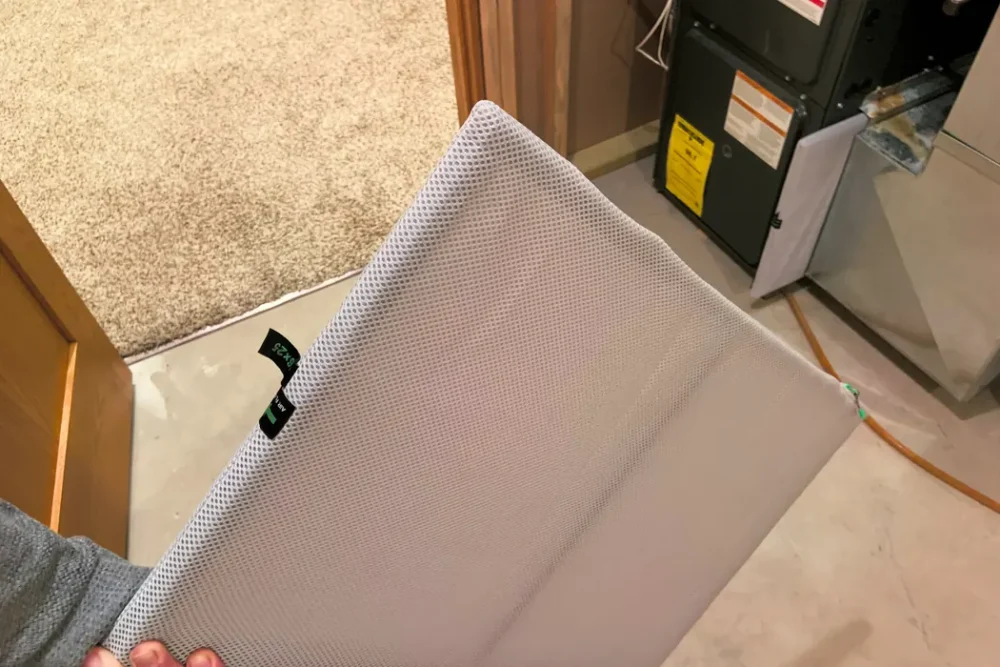
Because a heat pump also cools, EnergySage suggests professional service twice a year, against once per heating season for a furnace.18 For fuel-burning systems, the EPA advises a yearly professional inspection, cleaning and tune-up of the furnace, flue and chimney to limit carbon monoxide risk.15 Both stop in a power outage, since a furnace’s blower runs on electricity; size a backup unit with our generator size calculator, which adjusts for your elevation.
Next step
Find your break-even COP in Table 3 from your own bills, then ask each installer for the HSPF2 and 5°F COP of the heat pump they quote. More in our heating and cooling guides and the home energy section; our methodology page explains how we use NOAA station data.
Frequently asked questions
It depends on your rates. At 2026 state averages, a 95% gas furnace was cheaper in 13 of our 20 cities, including Chicago and Minneapolis, while an efficient heat pump won in cities such as Seattle and Atlanta, where gas costs more relative to power. Your own bills decide it.
Often it is backup heat. Electric resistance backup has a COP of 1, so every hour on backup costs two to three times as much as heat pump heat. COP also falls in cold weather. Ask a contractor to check the backup settings and the system's sizing.
Where power is expensive relative to gas it can cost more to run, it loses efficiency and capacity in deep cold, and EnergySage lists a shorter typical life: about 15 years against 15–20 for furnaces.
There is no reliable single figure. Published installed ranges run from $2,500–$10,000 (American Gas Association, 2024) to $10,500–$24,000 after incentives (EnergySage, 2026). Get quotes based on an ACCA Manual J load calculation, not square footage.
Compare your break-even COP with the quoted unit's seasonal COP (HSPF2 ÷ 3.412). If your AC is also due, or your break-even is near 3 or lower, price a heat pump or dual fuel. At a break-even of 4 or more, gas stays cheaper to run.
Not for new installations. The IRS says the Energy Efficient Home Improvement Credit (25C) covers improvements made through December 31, 2025. Some states offer DOE-funded Home Energy Rebates, and many utilities run their own.
Yes. An electric furnace turns each kilowatt-hour into 3,412 Btu (COP 1), so a heat pump with a seasonal COP of 2.4 uses about 58% less electricity for the same heat.
Yes, one heat pump heats and cools. In cold climates it is often paired with a furnace (dual fuel) or backup heat.
Sources
- 1.U.S. Climate Normals 1991–2020. NOAA National Centers for Environmental Information, 2021. Used for: annual heating degree days for every ZIP and city Back to text
- 2.Electric Power Monthly, Table 5.6.B: Average Price of Electricity to Ultimate Customers by End-Use Sector, by State, Year-to-Date through July 2026. U.S. Energy Information Administration, 2026. Used for: residential electricity prices by state Back to text
- 3.Natural Gas Prices: Average Residential Price by State, Annual (release 9/30/2026). U.S. Energy Information Administration, 2026. Used for: 2025 residential natural gas prices by state Back to text
- 4.Units and calculators explained: Degree days. U.S. Energy Information Administration, accessed 2026. Used for: degree-day definition, 65°F base Back to text
- 5.Units and calculators explained: British thermal units. U.S. Energy Information Administration, accessed 2026. Used for: 1 kWh = 3,412 Btu; 1 cubic foot of gas = 1,036 Btu; 1 therm = 100,000 Btu Back to text
- 6.Cold Climate Air Source Heat Pump Specification, Version 4.0. Northeast Energy Efficiency Partnerships (NEEP), 2023. Used for: ducted HSPF2 7.7, COP 1.75 at 5°F, COP reported at 47/17/5°F Back to text
- 7.Cold Climate Heat Pump Sizing and Selection. Pacific Northwest National Laboratory, Building America Solution Center, accessed 2026. Used for: ENERGY STAR cold-climate criteria, electric resistance backup, Manual J/S Back to text
- 8.Air-Source Heat Pumps. ENERGY STAR (U.S. EPA), accessed 2026. Used for: heat delivered vs. electricity used, cooling, ductless option, rebate finder Back to text
- 9.Furnaces Key Product Criteria. ENERGY STAR (U.S. EPA), accessed 2026. Used for: 95% / 97% AFUE gas furnace criteria Back to text
- 10.
- 11.Energy Efficient Home Improvement Credit. Internal Revenue Service, checked 2026-10-02. Used for: section 25C limits and end date
- 12.Residential Clean Energy Credit. Internal Revenue Service, checked 2026-10-02. Used for: section 25D end date (geothermal heat pumps) Back to text
- 13.Home Energy Rebates Program. U.S. Department of Energy, checked 2026-10-02. Used for: rebate availability in select states Back to text
- 14.Manual J: Residential Load Calculation. Air Conditioning Contractors of America (ACCA), accessed 2026. Used for: load calculation standard Back to text
- 15.Carbon Monoxide's Impact on Indoor Air Quality. U.S. Environmental Protection Agency, accessed 2026. Used for: yearly furnace, flue and chimney inspection Back to text
- 16.Heat Pump vs Furnace: Which System is Right for You?. Carrier, accessed 2026. Used for: operating-cost quote, dual fuel description Back to text
- 17.Heat Pump vs Furnace: Which Is Right for Your Home?. Bryant, accessed 2026. Used for: AFUE range, HSPF2 10.5 model, separate AC with a furnace Back to text
- 18.Heat pumps vs. furnaces: What you need to know. EnergySage, 2026. Used for: installed-cost ranges, lifespans, maintenance Back to text
- 19.Natural Gas or a Heat Pump? Where You Live Matters. American Gas Association, 2024. Used for: installed-cost ranges, electrical upgrade cost Back to text
- 20.Ice on the heat pump closeup (photo). Shixart1985, Wikimedia Commons, CC BY 2.0, 2023. Used for: photo, resized
- 21.Heat pump unit (photo). Wikideas1, Wikimedia Commons, CC0, 2023. Used for: photo, cropped
- 22.HVAC air filter (photo). Wikideas1, Wikimedia Commons, CC0, 2025. Used for: photo, cropped
- 23.Furnace Heat vs Heat Pump Heat: Understanding the Difference. Trane, 2025. Used for: how the air from each system feels at the vents Back to text
How this guide was made
- Written by the Home Systems Desk and reviewed by the Data & Methodology Desk.
- Data: heating degree days from NOAA NCEI U.S. Climate Normals 1991–2020 for the station nearest each ZIP code; electricity prices from EIA Electric Power Monthly Table 5.6.B (residential, January–July 2026); natural gas prices from EIA’s 2025 average residential prices, converted at 1,036 Btu per cubic foot; efficiency benchmarks from NEEP, ENERGY STAR and PNNL; federal credit status from IRS.gov, checked 2026-10-02. Costs are estimates for an example home, not a bill forecast. See our methodology.
- AI use: AI tools help us research, draft and check this guide. Every figure is checked against the source cited for it, and calculated figures come from our own code, described on the methodology page.
- Spotted an error? Tell us — the form opens with this page’s address filled in.
Change log
- Oct 4, 2026Review: re-checked the Carrier, PNNL and IRS quotes, ENERGY STAR, EnergySage, AGA and Bryant figures against the live pages; added how each system's air feels (Trane), a Lennox explainer video and a link to our cold-weather heat pump guide.
- Oct 2, 2026Published. Heating-cost estimates for 20 cities from NOAA 1991–2020 heating degree days and EIA residential prices (electricity January–July 2026, gas 2025); federal credit status checked on IRS.gov.
Covers heating, cooling, generators and water heaters. We maintain the sizing calculators and the guides that explain what a number means before you call a contractor.


Keep reading

What Humidity Should a House Be in Winter? 30–40%, Lower on Cold Nights
About 30–40% relative humidity, inside EPA’s 30–50% range, and lower on the coldest nights. Our NOAA estimate of when windows fog in 20 US cities, plus signs of air that is too dry or too damp.

How Much Does It Cost to Run a Space Heater? Costs by State and City
A 1,500-watt space heater costs about 27¢ an hour at the 2026 US average electricity price. Costs by state and in 20 cities, and how its heat compares with a furnace or heat pump.
What Temperature to Set Your Thermostat in Winter: 68°F, Then Lower at Night
About 68°F while you are awake and 7–10°F lower at night for a furnace or boiler; a heat pump stays steady. What a setback saves in 20 US cities, plus the 55°F and health floors.
Seasonal reminders for your ZIP
Get a short email when it’s time to overseed, start seeds, open the pool or service your furnace — timed to your climate.