




What Temperature to Set Your Thermostat in Winter: 68°F, Then Lower at Night
About 68°F while you are awake, 7–10°F lower at night for a furnace or boiler, and one steady setting for a heat pump. Here is what DOE and ENERGY STAR really say, what a setback saves in your climate, and the floors for pipes and health.
- Last reviewed Oct 13, 2026
- 20 cited sources
- 9 min read
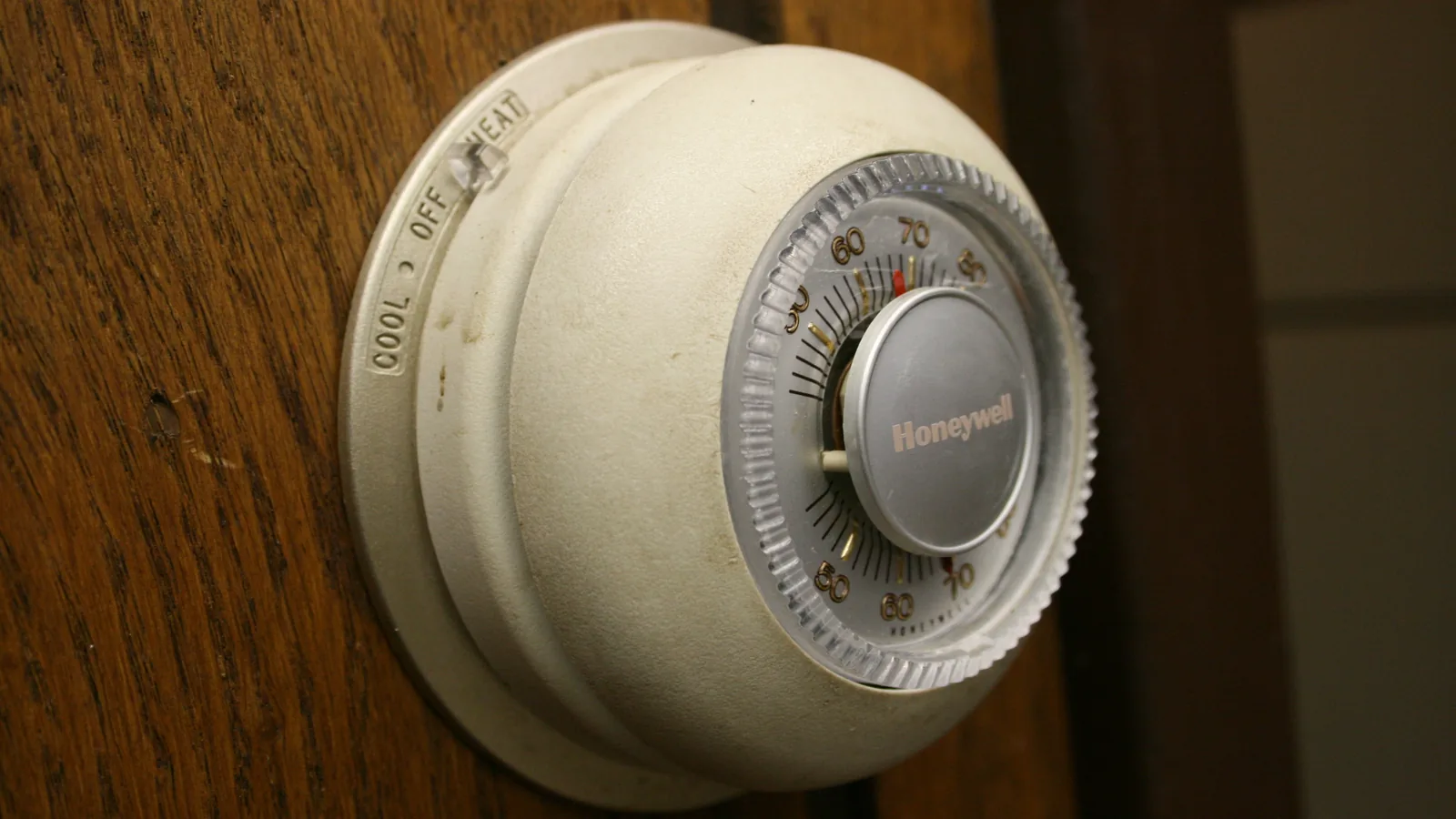
- 1Set the thermostat to about 68°F while you are home and awake; DOE’s last web wording said 68–70°F, and ENERGY STAR’s schedule says below 70°F.
- 2With a furnace or boiler, turn it down 7–10°F for 8 hours a night or while you are out; DOE says that can save as much as 10% a year on heating and cooling.
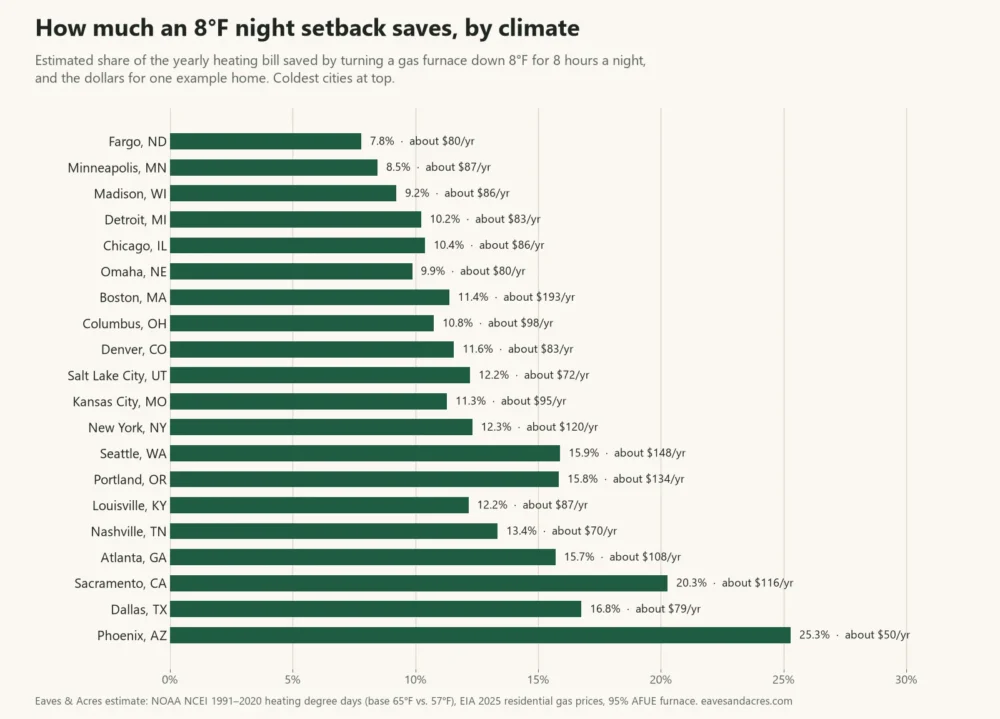
- 3Our NOAA estimate: an 8°F night setback saves about 8% of a gas heating bill in Fargo, 10% in Chicago and 16% in Atlanta, roughly $50–$190 a year for an example home.
- 4Keep a heat pump at one steady setting: ENERGY STAR says heat pumps don’t save by turning down, and recovery can run costly backup heat.
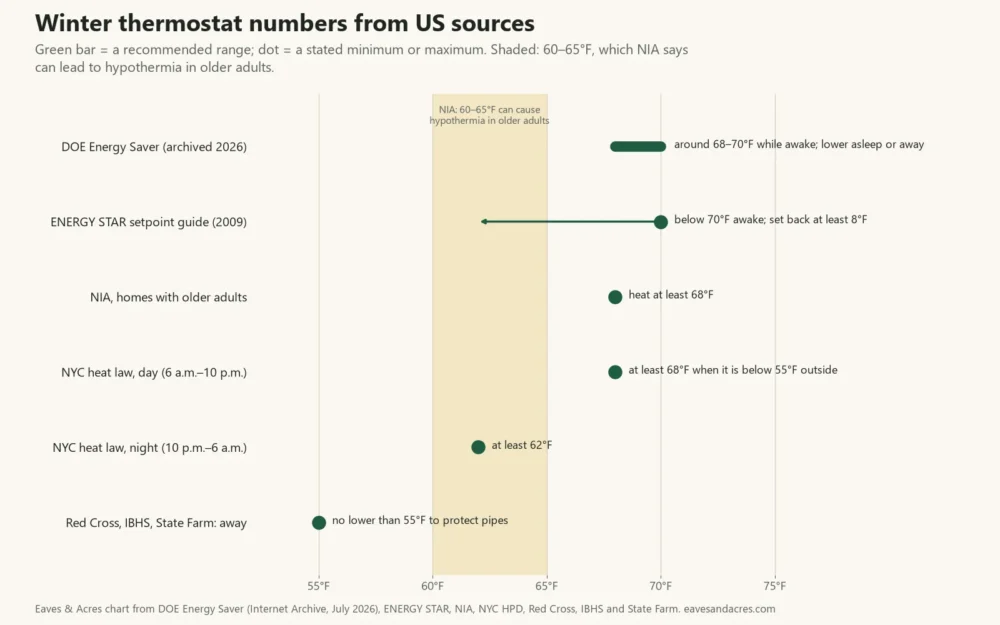
- 5Floors: never below 55°F when you are away, no setback on a hard-freeze night, and at least 68°F in homes with older adults, as the National Institute on Aging advises.
Set your thermostat to about 68°F in winter while you are home and awake. If you heat with a furnace or boiler, set it 7–10°F lower while you sleep or are away. The U.S. Department of Energy (DOE) says that setback can save as much as 10% a year on heating and cooling.2 Two exceptions: a heat pump does best at one steady setting, and a home with older adults should stay at 68°F or warmer.
Below: what DOE and ENERGY STAR say, what a night setback saves in 20 US cities, and the floors for heat pumps, pipes and health.
Loads from YouTube (privacy-enhanced mode) only when you press play.
Winter thermostat settings at a glance
| Situation | Setting | Source |
|---|---|---|
| Home and awake | About 68°F (DOE’s last web wording: 68–70°F) | DOE; ENERGY STAR: below 70°F |
| Asleep, furnace or boiler | 7–10°F lower, about 58–61°F from 68°F | DOE; ENERGY STAR: at least 8°F lower |
| Out at work, furnace or boiler | The same 7–10°F setback | DOE; ENERGY STAR |
| Heat pump, day and night | One steady, comfortable setting | ENERGY STAR; DOE |
| Older adult at home | At least 68°F | National Institute on Aging |
| Baby’s room | No set number; avoid overheating | AAP; NIH Safe to Sleep |
| Away on a trip | No lower than 55°F | Red Cross, IBHS, State Farm |
| Hard freeze in the forecast | Same setting day and night | Red Cross |
What DOE and ENERGY STAR actually say
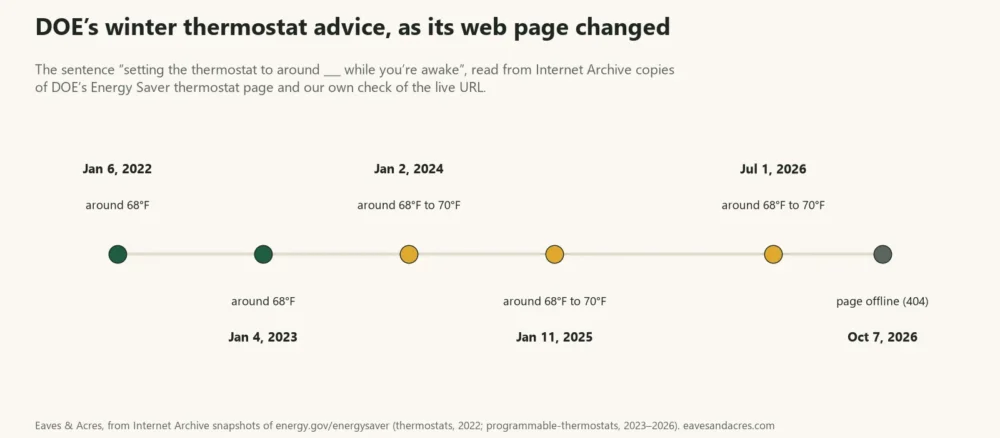
Many top results credit “68°F” to DOE, and that was its wording for years. Archived copies of its Energy Saver thermostat page say “around 68°F” while awake through January 2023;3 by January 2024 the sentence read “around 68°F to 70°F,” and it stayed that way until the page went offline. It returned 404 when we checked on October 7, 2026, so we cite the archived copy of July 1, 2026.2 DOE’s video still says about 68°F,5 and a live DOE Office of Indian Energy article repeats the rule: 7–10 degrees lower for 8 hours a day while you are away or asleep.4
ENERGY STAR’s heating and cooling guide (2009) gives a schedule: below 70°F at 6 a.m. and 6 p.m., and a setback of at least 8°F at 8 a.m. and 10 p.m.7 Today it points to certified smart thermostats, which can learn your schedule and drop to energy-saving temperatures when you are asleep or away.8
A setback saves because a cooler house loses heat more slowly. DOE calls the idea that the furnace “works harder” to warm back up a misconception.2 It adds a detail most guides skip:
The percentage of savings from setback is greater for buildings in milder climates
How much a night setback saves where you live
DOE gives no numbers by climate, so we estimated them. Heating need tracks heating degree days (HDD): each degree the day’s average falls below 65°F adds one.16 The 65°F base is the usual stand-in for a house kept near 68–70°F; turn the thermostat down 8°F and the house needs heat as if the base were 57°F. NOAA’s 1991–2020 normals publish HDD at both bases for each station,1 so for 8 hours a night:
Share saved ≈ (8 ÷ 24) × (HDD at 65°F − HDD at 57°F) ÷ HDD at 65°F
Dollars use the example home and prices from our heat pump vs. furnace cost guide: 12 million Btu of heat per 1,000 HDD, a 95% efficient gas furnace, and EIA’s 2025 residential gas price for each state.15
| City (ZIP) | HDD, 65°F base | HDD, 57°F base | Yearly gas heating | 8°F night setback saves | Each 1°F lower all day |
|---|---|---|---|---|---|
| Fargo, ND (58102) | 8,806 | 6,744 | $1,020 | 7.8% (about $80) | 3.0% |
| Minneapolis, MN (55401) | 7,699 | 5,744 | $1,031 | 8.5% (about $87) | 3.3% |
| Madison, WI (53703) | 7,096 | 5,131 | $929 | 9.2% (about $86) | 3.6% |
| Detroit, MI (48226) | 6,106 | 4,232 | $813 | 10.2% (about $83) | 4.0% |
| Chicago, IL (60602) | 6,018 | 4,142 | $825 | 10.4% (about $86) | 4.0% |
| Omaha, NE (68102) | 5,833 | 4,105 | $811 | 9.9% (about $80) | 3.8% |
| Boston, MA (02108) | 5,545 | 3,652 | $1,694 | 11.4% (about $193) | 4.4% |
| Columbus, OH (43215) | 5,417 | 3,670 | $915 | 10.8% (about $98) | 4.2% |
| Denver, CO (80202) | 5,262 | 3,435 | $717 | 11.6% (about $83) | 4.5% |
| Salt Lake City, UT (84101) | 4,724 | 2,992 | $587 | 12.2% (about $72) | 4.8% |
| Kansas City, MO (64106) | 4,613 | 3,052 | $840 | 11.3% (about $95) | 4.4% |
| New York, NY (10001) | 4,553 | 2,870 | $976 | 12.3% (about $120) | 4.8% |
| Seattle, WA (98101) | 4,340 | 2,271 | $932 | 15.9% (about $148) | 6.3% |
| Portland, OR (97204) | 4,167 | 2,187 | $849 | 15.8% (about $134) | 6.3% |
| Louisville, KY (40202) | 4,141 | 2,630 | $718 | 12.2% (about $87) | 4.8% |
| Nashville, TN (37201) | 3,648 | 2,187 | $527 | 13.4% (about $70) | 5.2% |
| Atlanta, GA (30303) | 2,775 | 1,468 | $691 | 15.7% (about $108) | 6.3% |
| Sacramento, CA (95814) | 2,138 | 837 | $574 | 20.3% (about $116) | 8.2% |
| Dallas, TX (75201) | 1,992 | 990 | $472 | 16.8% (about $79) | 6.8% |
| Phoenix, AZ (85004) | 874 | 211 | $198 | 25.3% (about $50) | 10.9% |
DOE’s milder-climate point holds: the share saved runs from 7.8% in Fargo to 15.7% in Atlanta and 25% in Phoenix, where 8°F wipes out most of the heating need on many nights. Dollars don’t follow. Phoenix saves a quarter of a $198 bill, about $50; Minneapolis saves 8.5% of $1,031, about $87. Boston saves the most, about $193, because Massachusetts gas is the priciest in the table.
Chicago: an 8°F setback from 10 p.m. to 6 a.m.
- Scenario
- NOAA normals for the Chicago Northerly Island station: 6,018 HDD at a 65°F base and 4,142 at 57°F. Illinois gas averaged $11.25 per thousand cubic feet in 2025, about $1.09 a therm.
- Math
- Share saved: 8 ÷ 24 × (6,018 − 4,142) ÷ 6,018 = 0.333 × 0.312 = 10.4%. Yearly heat: 6,018 × 12,000 Btu = 72.2 million Btu ÷ 0.95 = 760 therms × $1.09 = $825. Saving: 10.4% × $825 = about $86.
- Answer
- Close to DOE's "as much as 10%", from a schedule a programmable thermostat runs every night.
These are upper-end estimates: a real house cools slowly after the setback starts, and the model ignores the extra cold of night hours. Use the table to compare climates, not to forecast a bill. The last column shows what each degree lower all day saves: about 4% in Chicago, 3% in Fargo, 6% in Atlanta.
How low to go at night
From 68°F, DOE’s 7–10°F setback means 58–61°F; ENERGY STAR’s “at least 8°F” means 60°F or lower. Neither names one sleeping temperature. The “65°F at night” some blogs credit to DOE is not on its page, and we found no US agency source for the 60–65°F “sleep range” either. Pick the lowest setting you sleep comfortably at, within these floors:
- Older adults: the National Institute on Aging advises at least 68°F (see below).
- Renters in New York City: the city’s heat law makes landlords keep apartments at 68°F or more from 6 a.m. to 10 p.m. when it is below 55°F outside, and at least 62°F overnight, from October 1 to May 31.10 Other cities set their own rules.
- Foggy windows: a cooler room raises relative humidity, so air at 40% in a 68°F room reads about 53% at 60°F. If your glass fogs overnight, see what humidity to keep in winter.
- Hard freeze coming: skip the setback (see below).
Heat pumps: keep one steady setting
Setback advice is written for furnaces and boilers. For an air-source heat pump, ENERGY STAR says the opposite:
heat pumps do not save energy by turning it down when you’re away or asleep
Its heat pump page says to pick a comfortable temperature, leave it there, and use “heat” rather than “auto” mode.6 DOE’s archived page explains: setting back a heat pump in heating mode can make it run inefficiently and cancel the savings, so a moderate, steady setting is most cost-effective. Some thermostats made for heat pumps use special algorithms to limit backup electric resistance heat, which makes a setback pay.2 Carrier tells heat pump owners to follow the setback guidance for their own system and thermostat rather than applying 7–10°F automatically.14
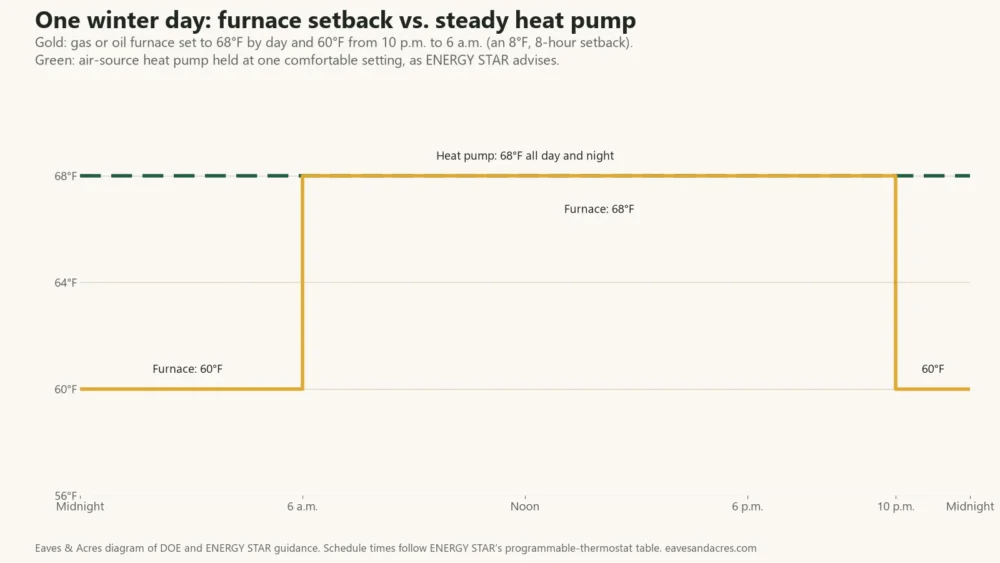
Backup cost is the reason. Electric resistance heat makes one unit of heat per unit of electricity, two to three times the cost of heat pump heat, as our heat pump vs. furnace estimates show. Our guide to heat pumps in cold weather covers balance points, defrost and the backup switchover setting. If you want a schedule anyway, ask your installer whether your thermostat recovers without backup heat. We give no wiring or control-board steps here.
Electric baseboard, radiant floors and boilers
Electric baseboard heat can be set back like a furnace, but DOE notes it needs a line-voltage thermostat for 120- or 240-volt circuits, and only a few companies make programmable ones.2 Replacing one is a job for a licensed electrician.
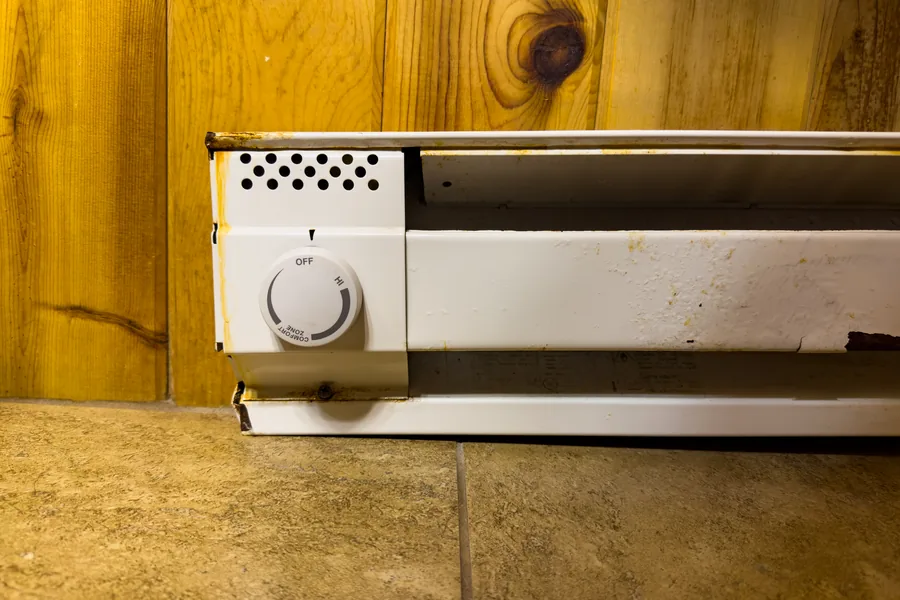
Steam and radiant floor heat can take several hours to respond; DOE says some thermostats now learn when to start so the house is warm on time.2 With these systems, a shorter, shallower setback is the practical choice.
When you are away, or a hard freeze is coming
Leaving for a trip, the floor is 55°F. The Red Cross says to leave the heat on at no lower than 55°F,11 IBHS advises at least 55°F even when no one is home,12 and State Farm agrees.13 DOE’s video says “around 55 degrees.”5 Some online answers go as low as 50°F; we found no US source for that.
A deep freeze changes the night setting too: the Red Cross advises keeping the thermostat at the same temperature day and night to protect pipes.11 Our guide to what temperature pipes freeze at explains why 20°F outside is the alert point and how often your ZIP code gets there; on those nights, hold your daytime setting. For a trip longer than a week in subfreezing weather, IBHS suggests shutting off the water at the main valve.12 Furnace blowers and heat pumps both stop in a power outage; our generator size calculator sizes a backup unit.
The other thermostat in the house needs no winter change: our water heater temperature guide explains why 120°F suits most homes year-round.
Health floors: older adults and others at risk
Set your heat to at least 68°F.
NIA warns that even mildly cool homes, 60 to 65°F, can lead to hypothermia in older adults.9 That overlaps the range many guides suggest for sleeping, so if an older adult lives with you, keep the house at 68°F or more and use small setbacks, if any.
For babies, neither the American Academy of Pediatrics nor NIH’s Safe to Sleep campaign names a room temperature. Both warn that overheating raises SIDS risk; AAP advises dressing a baby in one layer more than you wear.19,20
Your next step
Note how your home is heated, then set a schedule: about 68°F awake, 7–10°F lower overnight for a furnace or boiler, one steady setting for a heat pump, never below 55°F, and no setback on a hard-freeze night. More in our heating and cooling guides; our methodology page explains how ZIP codes are matched to NOAA stations.
Frequently asked questions
Yes. It is DOE’s long-standing figure for when you are home and awake (its last web version said 68–70°F), it sits inside ENERGY STAR’s below-70°F schedule, and it is the minimum the National Institute on Aging advises for older adults.
Yes. It is the top of DOE’s last web wording (68–70°F while awake), although ENERGY STAR’s schedule says below 70°F. It costs a little more than 68°F: by our NOAA estimate about 8% more heat in Chicago, at roughly 4% a degree.
With a furnace or boiler, no: DOE says a setback saves energy because a cooler house loses heat more slowly. With a heat pump, yes: ENERGY STAR says to pick a comfortable temperature and leave it. On a hard-freeze night, keep any system steady to protect the pipes.
With a furnace or boiler, 7–10°F below your daytime setting, or about 58–61°F from 68°F. Keep a heat pump steady, and keep homes with older adults at 68°F or more. In New York City, landlords must keep apartments at 62°F or more overnight in heat season.
Not for comfort, but it costs more. By our NOAA estimate each degree warmer all day adds about 3–6% to the heating bill, about 4% in Chicago, so 72°F uses roughly 16% more heat there than 68°F.
DOE’s pages we checked give no per-degree figure, only up to 10% a year for 7–10°F over 8 hours a day. Our estimate for 1°F lower all day: about 3% in Fargo, 4% in Chicago and 6% in Atlanta. For a setback of 8 hours a night, divide by about three.
For a workday, use the same 7–10°F setback as at night (furnace or boiler). For a trip, no lower than 55°F, as the Red Cross, IBHS and State Farm advise; for more than a week of subfreezing weather, IBHS suggests also shutting off the water at the main valve.
Usually not. ENERGY STAR says heat pumps don’t save energy by turning down when you are away or asleep, and DOE notes that a setback can cancel its own savings. Some thermostats made for heat pumps limit backup heat during recovery; ask your installer whether yours does.
For the house, 55°F: the Red Cross, IBHS and State Farm say not to go lower, to keep pipes from freezing. For people, the National Institute on Aging advises at least 68°F for older adults and warns that 60–65°F can lead to hypothermia.
Sources
- 1.U.S. Climate Normals 1991–2020 (annual heating degree days, bases 65°F, 60°F, 57°F and 55°F). NOAA National Centers for Environmental Information, 2021. Used for: heating degree days at 65°F and 57°F bases for the station nearest each city ZIP code Back to text
- 2.Programmable Thermostats (archived copy; page no longer online). U.S. Department of Energy, Energy Saver, via Internet Archive, archived 2026-07-01. Used for: around 68°F to 70°F while awake; as much as 10% a year for 7°–10°F over 8 hours a day; milder climates; setback misconception; heat pump, electric resistance, steam and radiant limitations Back to text
- 3.Programmable Thermostats (archived copy, January 2023). U.S. Department of Energy, Energy Saver, via Internet Archive, archived 2023-01-04. Used for: earlier wording "around 68°F" while awake (same on the Thermostats page archived 2022-01-06; "68°F to 70°F" from the copy of 2024-01-02) Back to text
- 4.Six Simple Steps To Save Energy and Money This Winter. U.S. Department of Energy, Office of Indian Energy Policy and Programs, 2022. Used for: 7–10 degrees lower for 8 hours a day while away or asleep; up to 10% per year Back to text
- 5.Energy Saver: Setting Your Thermostat for Comfort and Savings (video). U.S. Department of Energy, 2017. Used for: about 68°F when home and awake; lower at night; around 55°F on vacation Back to text
- 6.Air-Source Heat Pumps (saving tips). ENERGY STAR (U.S. EPA), accessed 2026-10-07. Used for: steady temperature, no saving from turning a heat pump down; heat rather than auto mode Back to text
- 7.A Guide to Energy-Efficient Heating and Cooling. ENERGY STAR (U.S. EPA), 2009. Used for: programmable thermostat table: below 70°F at wake and evening, setback at least 8°F by day and at sleep Back to text
- 8.Smart Thermostats. ENERGY STAR (U.S. EPA), accessed 2026-10-07. Used for: smart thermostats learn schedules and adjust when asleep or away Back to text
- 9.Cold Weather Safety for Older Adults. National Institute on Aging, NIH, reviewed 2024-01-03. Used for: heat at least 68°F; 60–65°F can lead to hypothermia in older adults Back to text
- 10.Heat and Hot Water Information. NYC Department of Housing Preservation and Development, checked 2026-10-07. Used for: heat season October 1–May 31; 68°F by day when below 55°F outside; 62°F at night Back to text
- 11.Preventing & Thawing Frozen Pipes. American Red Cross, checked 2026-10-07. Used for: heat no lower than 55°F when away; same temperature day and night Back to text
- 12.IBHS Winter Weather Ready guide provides easy-to-do actions to help prevent property damage from colder temperatures. Insurance Institute for Business & Home Safety, 2024. Used for: thermostat at least 55°F even when no one is home; shut off water for trips longer than a week Back to text
- 13.Winter prep 101: Essential tips to prevent frozen pipes and avoid costly repairs. State Farm, 2024. Used for: thermostat no lower than 55°F on vacation Back to text
- 14.What Temperature Should I Set My Thermostat?. Carrier, accessed 2026-10-07. Used for: heat pump owners should follow system-specific setback guidance Back to text
- 15.Natural Gas Prices: Average residential price by state, annual (release 9/30/2026). U.S. Energy Information Administration, 2026. Used for: 2025 residential natural gas prices by state Back to text
- 16.Units and calculators explained: Degree days. U.S. Energy Information Administration, accessed 2026-10-07. Used for: degree-day definition, 65°F base Back to text
- 17.Honeywell round thermostat (photo). Flickr user midnightcomm, Wikimedia Commons, CC BY 2.0, 2007. Used for: photo, cropped
- 18.Electric Baseboard Heater (photo). Tony Webster, Wikimedia Commons, CC BY 2.0, 2022. Used for: photo, cropped
- 19.How to Keep Your Sleeping Baby Safe: AAP Policy Explained. American Academy of Pediatrics (HealthyChildren.org), updated 2026-09-11. Used for: no room temperature given; avoid overheating; one layer more than an adult wears Back to text
- 20.Ways to Reduce Baby’s Risk. Safe to Sleep campaign, NICHD (NIH), checked 2026-10-13. Used for: no room temperature given; overheated babies at higher risk for SIDS; dress baby for the room temperature Back to text
How this guide was made
- Written by the Home Systems Desk and reviewed by the Data & Methodology Desk.
- Data: annual heating degree days at 65°F and 57°F bases from NOAA NCEI U.S. Climate Normals 1991–2020 for the station nearest each city ZIP code (the same stations as our heat pump vs. furnace guide); the setback share is (8 ÷ 24) × (HDD65 − HDD57) ÷ HDD65, an upper-end estimate that ignores how slowly a house cools; dollars use the same example home (12 million Btu per 1,000 HDD), a 95% AFUE gas furnace and EIA’s 2025 residential gas prices. Thermostat guidance is quoted from DOE (Internet Archive copies where the page is offline), ENERGY STAR, NIA and NYC HPD. Estimates, not a bill forecast. See our methodology.
- AI use: AI tools help us research, draft and check this guide. Every figure is checked against the source cited for it, and calculated figures come from our own code, described on the methodology page.
- Spotted an error? Tell us — the form opens with this page’s address filled in.
Change log
- Oct 13, 2026Re-checked DOE (archived page), ENERGY STAR, NIA, NYC HPD, Red Cross, IBHS, State Farm and Carrier against the live sources. Added what the AAP and NIH Safe to Sleep say about a baby's room (no set temperature; avoid overheating), a note that DOE's page names no 65°F night setting, and a FAQ on 70°F.
- Oct 12, 2026Added a note on how a night setback raises indoor humidity, with a link to the winter humidity guide.
- Oct 7, 2026Published. DOE Energy Saver wording read from Internet Archive copies (2022–2026; the live page now returns 404) and the live DOE video and Office of Indian Energy article; ENERGY STAR, NIA, NYC HPD, Red Cross, IBHS, State Farm and Carrier checked on the live pages; setback savings for 20 cities from NOAA 1991–2020 heating degree days at 65°F and 57°F bases and EIA 2025 gas prices.
Covers heating, cooling, generators and water heaters. We maintain the sizing calculators and the guides that explain what a number means before you call a contractor.


Keep reading

What Humidity Should a House Be in Winter? 30–40%, Lower on Cold Nights
About 30–40% relative humidity, inside EPA’s 30–50% range, and lower on the coldest nights. Our NOAA estimate of when windows fog in 20 US cities, plus signs of air that is too dry or too damp.
How Much Does It Cost to Run a Space Heater? Costs by State and City
A 1,500-watt space heater costs about 27¢ an hour at the 2026 US average electricity price. Costs by state and in 20 cities, and how its heat compares with a furnace or heat pump.
At What Temperature Do Pipes Freeze? The 20°F Threshold and Where It Hits
Pipes in unheated spaces are most at risk at about 20°F outside, per a University of Illinois study. How often 20 US cities get there, and what to do before a freeze.
Seasonal reminders for your ZIP
Get a short email when it’s time to overseed, start seeds, open the pool or service your furnace — timed to your climate.