




What Temperature Should a Water Heater Be Set At? 120°F, and When to Go Higher
Most homes should run a water heater at 120°F. Here is what DOE, CDC, CPSC, EPA and OSHA each say, how fast hotter water burns, what a lower setting really saves, and why winter makes the same tank feel smaller.
- Last reviewed Oct 7, 2026
- 18 cited sources
- 9 min read
- 1Set most home water heaters to 120°F: DOE’s FEMP, ENERGY STAR and CPSC all name that setting.
- 2CPSC says most adults suffer third-degree burns in about 5 minutes at 120°F, 30 seconds at 130°F, 6 seconds at 140°F and 2 seconds at 150°F.
- 3CDC says 130–140°F can kill germs like Legionella. Above 120°F it advises thermostatic mixing valves at the taps, and it asks people at higher risk to talk to a healthcare provider first.
- 4Most 140°F rules (OSHA, CDC’s building toolkit, the Department of Defense) are for large buildings and workplaces, not a home setting.
- 5Going from 140°F to 120°F cuts standby heat loss by about 28% and the energy for unmixed hot water by 22–35% in our 12 cities; mixed showers use about the same energy either way.
- 6Dials are approximate: A. O. Smith gives each gas setting ±10°F and warns of up to 30°F overshoot, so measure at the farthest tap.
Set most home water heaters to 120°F. The Department of Energy, ENERGY STAR and the Consumer Product Safety Commission all name that setting because it limits scalds and wasted heat. A higher setting of 130–140°F is mainly a health decision. CDC says it can kill germs like Legionella, but water that hot can burn an adult in seconds, so it belongs with mixing valves at the taps.
The short answer for your household
DOE’s Federal Energy Management Program puts it in one line:
For most residential applications, set the temperature at 120°F.
ENERGY STAR’s home-saving guide says the same, and adds that most water heaters are set at 140°F, which wastes energy through standby heat loss.2 The exceptions in official guidance are specific, and each comes with a caution:3,4,5,7,10
| Your situation | Setting the sources point to | Source |
|---|---|---|
| Most homes | 120°F | DOE FEMP, ENERGY STAR, CPSC |
| Young children, older adults, anyone slow to react | 120°F; above that, thermostatic mixing valves at the taps | CPSC, CDC |
| Someone at higher risk of Legionnaires’ disease | Ask a healthcare provider whether 130°F or above is right; mixing valves if above 120°F | CDC |
| Dishwasher without a booster heater | 130–140°F may be needed (check its manual) | DOE Energy Saver |
| Vacation rental owner | At or above 120°F; mixing valves if higher; flush the heater | CDC rental fact sheet |
| Large building with a water management program | Store above 140°F, keep circulating hot water at 120°F or more | CDC toolkit (ASHRAE Guideline 12) |
What DOE, CDC, CPSC, EPA and OSHA actually say
The numbers differ because the audiences differ: the 120°F figures are for homes, while most 140°F figures come from Legionella control in large buildings and workplaces.
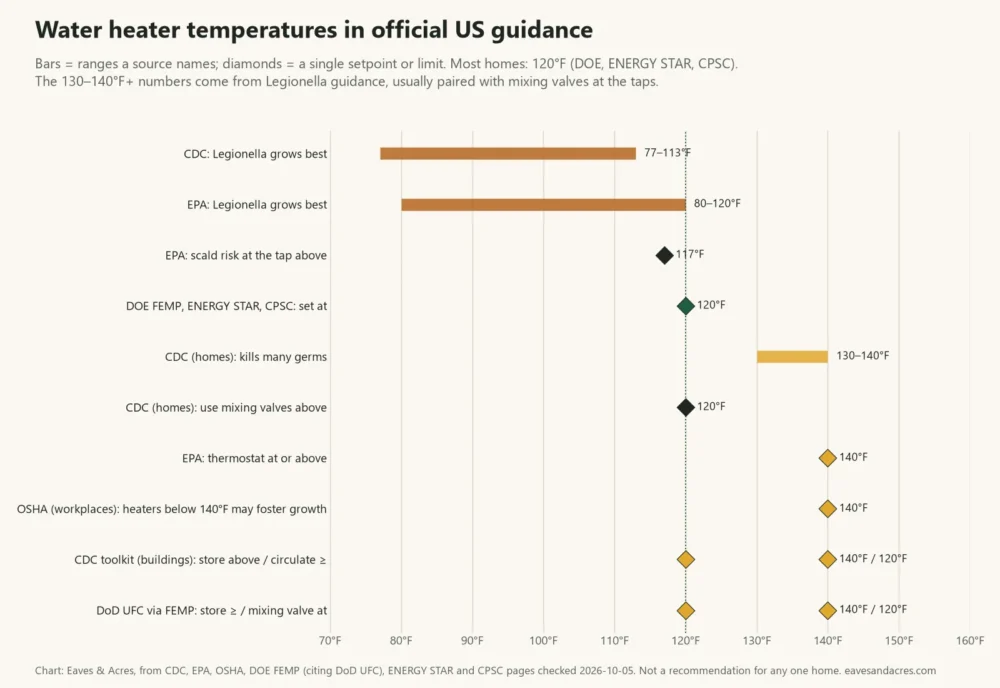
- CPSC urges everyone to lower water heaters to 120°F, noting that most tap water scald injuries and deaths happen to older adults and children under five.3
- CDC says a home heater at 130–140°F can kill germs like Legionella but raises the burn risk; above 120°F, it advises thermostatic valves that mix hot and cold water at the tap.4
- EPA says Legionella grows best at 80–120°F, that a thermostat at or above 140°F can often keep plumbing above 124°F, and that water at the tap can scald above 117°F. It also says to check state and local codes before raising the setting.8
- OSHA writes for workplaces and multi-family buildings: water heaters kept below 140°F that contain scale and sediment may foster Legionella growth, and its design examples include keeping hot water lines at 122°F or more.9 Some home guides cite this as an OSHA “minimum” for your tank; OSHA’s page describes building systems, not a home setting.
- The Department of Defense requires its service water heaters to store water at 140°F or more, with a tempering valve downstream that FEMP says to set at 120°F in residential use.1
Factory settings vary too. Against ENERGY STAR’s 140°F,2 A. O. Smith says its current heaters come preset at 120°F;12 and A. O. Smith’s gas-control technical bulletin says the dial ships at its lowest setting unless state rules say otherwise.11 Don’t assume: measure.
How fast hot water burns
Scald risk climbs steeply with each 10°F. CPSC’s tap water scald sheet puts it simply:
Never take hot water temperature for granted.
Most adults suffer third-degree burns after about five minutes at 120°F, 30 seconds at 130°F, six seconds at 140°F and two seconds at 150°F.3 A. O. Smith’s table puts 140°F at “less than 5 seconds”; the two tables agree within a second or two.11
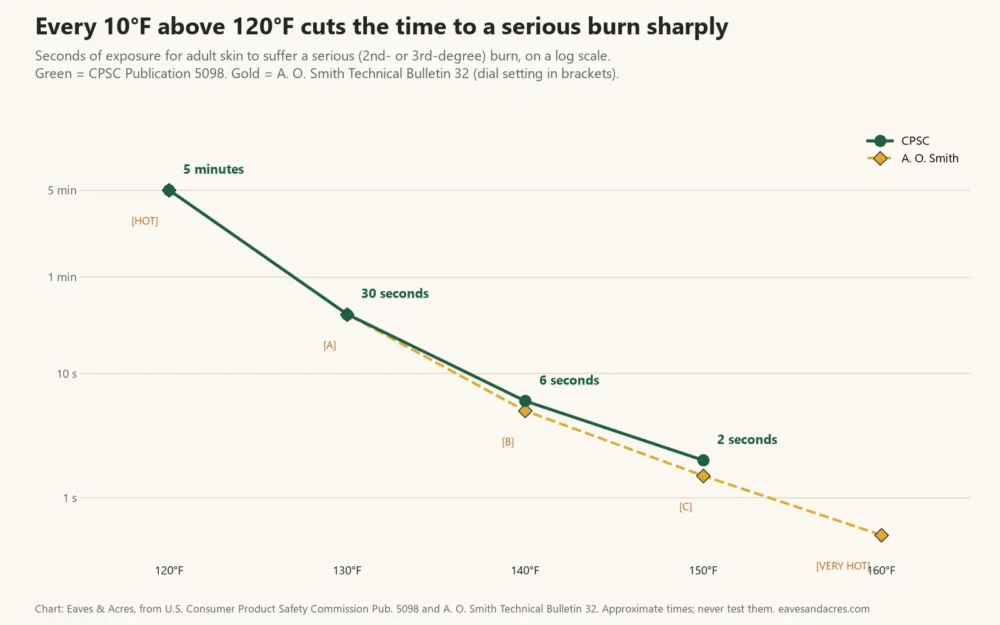
The dial is also less exact than it looks. A. O. Smith’s gas-control bulletin gives each setting a tolerance of ±10°F, and warns that short, repeated heating cycles from small hot water draws can push the water at the tap up to 30°F above the setting.11 That bulletin also explains the letters many gas dials use:
| Dial setting | Approximate water temperature | Time to a 2nd- or 3rd-degree burn, adult skin |
|---|---|---|
| VERY HOT | about 160°F | About 1/2 second |
| C | about 150°F | About 1-1/2 seconds |
| B | about 140°F | Less than 5 seconds |
| A | about 130°F | About 30 seconds |
| HOT | about 120°F | More than 5 minutes |
| LOW | 80°F | No hazard |
When a hotter setting makes sense: Legionella
Legionnaires’ disease is a serious pneumonia caused by breathing in mist that contains Legionella bacteria, for example from a shower. CDC says the bacteria grow best at 77–113°F, may grow as low as 68°F, and thrive where water sits still, disinfectant runs low, or sediment and biofilm build up.5,7 Most healthy people exposed don’t get sick. CDC lists those at higher risk: people 50 or older, current or former smokers, and people with chronic lung disease, cancer, diabetes, kidney or liver failure, or a weak immune system.6

For homes, CDC’s advice is a conversation, not a number:
Ask your healthcare provider about your risk of getting sick from Legionella
CDC then suggests discussing whether 130°F or above is right for you.4 DOE’s Energy Saver page described the risk at 120°F as very slight and safe for most people, and suggested 140°F for someone with a suppressed immune system or chronic respiratory disease, with mixing valves on taps used for washing or bathing.10 CDC also recommends regular flushing as the manufacturer directs, and notes that many manufacturers advise it yearly and after plumbing work.4
Mixing valves: what the sources describe
A thermostatic mixing valve blends cold water into hot so the tap delivers a steady, lower temperature. EPA says to place them as close as possible to the outlets and to follow the maker’s instructions or have a professional install them.8 CDC’s building toolkit says valves near fixtures prevent scalding while circulating hot water stays above 120°F.7 A. O. Smith adds that the valves can increase the amount of usable hot water.12
What turning 140°F down to 120°F saves
DOE’s Energy Saver page, now offline, said a heater set at 140°F can waste $36 to $61 a year in standby heat loss, put the savings at 4%–22%, and said savings on the hot water you use may amount to more than $400.10 It did not show the math, so here is how the parts work, using only the federal test’s own constants.13
- Standby loss roughly follows the gap between the tank and the room. At the test’s 67.5°F room, 140°F leaves a 72.5°F gap and 120°F a 52.5°F gap: about 28% less heat leaking out of the tank.
- Water used straight from the tank (a washer’s hot fill, a dishwasher without a heater) takes 8.24 Btu per gallon for every degree of rise. Cutting the rise by 20°F saves 22–35% of that energy in our 12 cities, more where tap water is warm. A. O. Smith’s “nearly 25% less energy,” which assumes 60°F cold water, is the same arithmetic.12
- Mixed water (showers, baths, sinks) saves almost nothing: you still mix the shower you like, so a hotter tank only means less hot and more cold in the same mix.
Chicago: where the saving comes from
- Scenario
- Yearly average tap water is about 58°F (NREL/DOE mains model applied to NOAA normals for the downtown station); February water about 46°F. A shower is mixed to 110°F.
- Math
- Straight hot water: 8.24 × (140 − 58) = 676 Btu/gal at 140°F vs. 8.24 × (120 − 58) = 511 Btu/gal at 120°F, 24% less. February shower: 8.24 × (110 − 46) = 527 Btu per gallon at the showerhead at either setting; the tank supplies 86% of it at 120°F and 68% at 140°F.
- Answer
- The saving comes from standby loss and unmixed hot water, not from showers, which helps explain why DOE's 4%–22% range is so wide.
EPA notes that a setting at or above 140°F may raise your energy use, and suggests insulating pipes to limit the extra loss.8
Why your hot water runs out sooner in winter
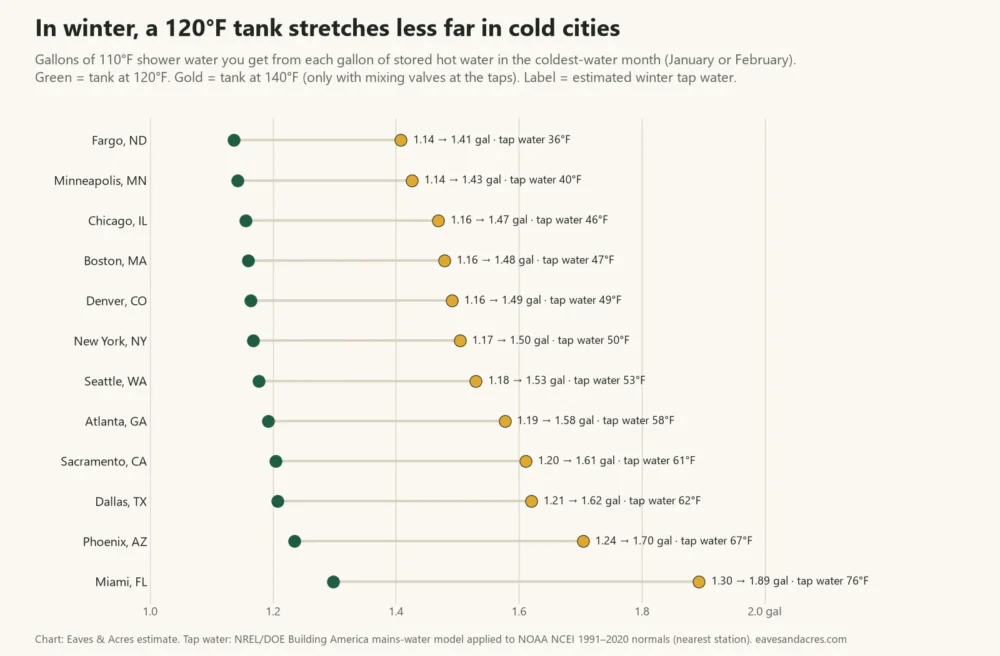
No source we found recommends a different setting for winter. What changes is your tap water. We estimated each city’s incoming water temperature month by month with the mains-water model in DOE’s Building America House Simulation Protocols,14 using NOAA’s 1991–2020 climate normals for the station nearest each ZIP code,15 the same numbers behind our tankless vs. tank water heater guide. The colder the incoming water, the more of each 110°F shower must come from the tank.
| City (ZIP) | Coldest tap water (month) | Share of a 110°F shower from a 120°F tank | Shower gallons per stored gallon at 120 / 130 / 140°F | Energy cut, unmixed hot water, 140→120°F* |
|---|---|---|---|---|
| Fargo, ND (58102) | 36°F (Feb) | 88% | 1.14 / 1.27 / 1.41 | 22% |
| Minneapolis, MN (55401) | 40°F (Feb) | 88% | 1.14 / 1.28 / 1.43 | 23% |
| Chicago, IL (60602) | 46°F (Feb) | 86% | 1.16 / 1.31 / 1.47 | 24% |
| Boston, MA (02108) | 47°F (Feb) | 86% | 1.16 / 1.32 / 1.48 | 24% |
| Denver, CO (80202) | 49°F (Feb) | 86% | 1.16 / 1.33 / 1.49 | 25% |
| New York, NY (10001) | 50°F (Feb) | 86% | 1.17 / 1.34 / 1.50 | 26% |
| Seattle, WA (98101) | 53°F (Feb) | 85% | 1.18 / 1.35 / 1.53 | 25% |
| Atlanta, GA (30303) | 58°F (Feb) | 84% | 1.19 / 1.38 / 1.58 | 28% |
| Sacramento, CA (95814) | 61°F (Feb) | 83% | 1.20 / 1.41 / 1.61 | 28% |
| Dallas, TX (75201) | 62°F (Jan) | 83% | 1.21 / 1.41 / 1.62 | 30% |
| Phoenix, AZ (85004) | 67°F (Jan) | 81% | 1.23 / 1.47 / 1.70 | 34% |
| Miami, FL (33130) | 76°F (Jan) | 77% | 1.30 / 1.60 / 1.89 | 35% |
*At each city’s yearly average tap water temperature. Higher settings need thermostatic mixing valves at the taps (see above).
In Fargo in February, about 88% of a 110°F shower comes from a 120°F tank, so each stored gallon makes only 1.14 gallons of shower water; in Miami in January it makes 1.30. Raising the tank to 140°F stretches each gallon about 24% further in Fargo and 46% in Miami, which is the capacity gain A. O. Smith describes, but only with mixing valves at the taps.12
How to check your temperature without opening anything
- Wait until hot water hasn’t been used for at least two hours, or test first thing in the morning, as CPSC suggests.3
- Run hot water at the tap farthest from the heater and hold a cooking thermometer in the stream; DOE notes that thermostat dials are often inaccurate.10
- Compare with your target. If you change the setting, re-measure a couple of hours later; several rounds may be needed.10
We don’t give adjustment steps. On an electric tank the thermostats sit behind access panels, where A. O. Smith warns of electric shock, and on a gas tank the dial is part of the gas control valve.12 Follow your owner’s manual, or have a licensed plumber make the change and check the result. On a tankless heater, which stores no water, the setting mainly changes winter flow: see our tankless winter flow table.
Next step
Measure your hot water at the farthest tap tonight. If it reads well above 120°F and no one at home needs a hotter tank for health reasons, ask a plumber to bring it down. If someone does, talk to their healthcare provider first and plan for mixing valves. More in our water heater guides and the home energy section. The generator size calculator shows what an electric water heater adds to an outage load, and our methodology page explains how we match ZIP codes to NOAA stations.
Frequently asked questions
Not for every home, but it raises the scald risk: CPSC puts a third-degree burn at about 30 seconds at 130°F, against about 5 minutes at 120°F. CDC names 130–140°F as a range that can kill germs like Legionella and advises thermostatic mixing valves at the taps whenever a heater is set above 120°F.
For most homes, yes: DOE’s FEMP, ENERGY STAR and CPSC all recommend it. DOE’s Energy Saver page called the Legionella risk at 120°F very slight and safe for most people. A dishwasher without a booster heater may need 130–140°F, so check its manual.
For water reaching the taps, it is far above the 120°F that DOE’s FEMP, ENERGY STAR and CPSC recommend. CPSC puts third-degree burns at about 6 seconds at 140°F and 2 seconds at 150°F, so 145°F falls between them. CDC advises thermostatic mixing valves at the taps for any setting above 120°F.
For water reaching the taps, yes: CPSC says 150°F water gives most adults third-degree burns in about two seconds. On the gas dial in A. O. Smith’s Technical Bulletin 32, setting C is about 150°F. A tank that hot needs mixing valves at the taps.
Tank size doesn’t change the official guidance we found: the sources set temperatures by household and health needs, not by gallons. Start at 120°F, and if a larger household keeps running out, ask a plumber about the options, including a higher setting paired with mixing valves.
No source we found recommends a different winter setting. Colder tap water means each 110°F shower draws more from the tank: in Minneapolis in February about 88% of the shower comes from a 120°F tank, so the tank runs out sooner than in summer.
On the dial in A. O. Smith’s Technical Bulletin 32, HOT is about 120°F, A about 130°F, B about 140°F, C about 150°F and VERY HOT about 160°F, each within ±10°F. Other brands use other markings, so check your owner’s manual.
CDC says Legionella grows best at 77–113°F and may grow at temperatures as low as 68°F. EPA gives 80–120°F as its best growth range and says keeping plumbing above 124°F helps control it.
CDC says 130–140°F can kill many harmful germs like Legionella. DOE’s FEMP adds that at 140°F the bacteria can survive for less than a minute. CDC also recommends flushing the water heater as its manufacturer directs.
Sources
- 1.Purchasing Energy-Efficient Residential Water Heaters. U.S. Department of Energy, Federal Energy Management Program, checked 2026-10-05. Used for: 120°F setpoint for most residential applications; DoD Unified Facilities Criteria 140°F storage with a tempering valve; 120°F mixing-valve setting; bacteria survival at 140°F Back to text
- 2.How to Save Energy at Home. ENERGY STAR (U.S. EPA), 2024. Used for: lower the water heater thermostat to 120°F; most heaters set at 140°F; standby loss and scalding Back to text
- 3.Avoiding Tap Water Scalds (Publication 5098). U.S. Consumer Product Safety Commission, checked 2026-10-05. Used for: 120°F recommendation; burn times at 120, 130, 140 and 150°F; who is most often scalded; how to measure at the tap Back to text
- 4.Preventing Waterborne Germs at Home. Centers for Disease Control and Prevention, 2024. Used for: 130–140°F kills germs like Legionella; thermostatic valves above 120°F; ask a healthcare provider; flushing Back to text
- 5.Legionnaires’ Disease Prevention: Providing a Home for Guests, not Legionella. Centers for Disease Control and Prevention, 2024. Used for: rental water heaters at or above 120°F; mixing valves if higher; growth at 77–113°F; conditions that help Legionella grow Back to text
- 6.How Legionella Spreads (causes and risk factors). Centers for Disease Control and Prevention, 2025. Used for: groups at increased risk of Legionnaires’ disease; growth at 77–113°F Back to text
- 7.Controlling Legionella in Potable Water Systems (Legionella Control Toolkit). Centers for Disease Control and Prevention, checked 2026-10-05. Used for: building water management per ASHRAE Guideline 12: store hot water above 140°F, circulate at 120°F or more; growth as low as 68°F; mixing valves near fixtures Back to text
- 8.Legionella in the Indoor Environment. U.S. Environmental Protection Agency, updated 2026-08-06. Used for: growth at 80–120°F; 124°F in plumbing; thermostat at or above 140°F; scald risk above 117°F; mixing valves; codes; energy use Back to text
- 9.Legionellosis: Control and Prevention. Occupational Safety and Health Administration, checked 2026-10-05. Used for: workplace and multi-family domestic hot water: heaters below 140°F with scale and sediment; hot water lines at 122°F or more Back to text
- 10.Do-It-Yourself Savings Project: Lower Water Heating Temperature (archived copy; page no longer online). U.S. Department of Energy, Energy Saver, via Internet Archive, archived 2026-07-02. Used for: $36–$61 standby loss at 140°F; 4%–22% savings; dishwasher 130–140°F; 140°F for suppressed immune systems; measuring at the farthest tap Back to text
- 11.Technical Bulletin 32: Temperature Adjustment, Residential Gas. A. O. Smith, accessed 2026-10-05. Used for: dial settings and approximate temperatures, ±10°F tolerance, up to 30°F overshoot, burn times, factory setting Back to text
- 12.How to Adjust Temperature on Gas Water Heater Safely. A. O. Smith, accessed 2026-10-05. Used for: 120°F factory preset; thermostat locations; mixing valves increase usable hot water Back to text
- 13.10 CFR Part 430, Subpart B, Appendix E: Uniform Test Method for Measuring the Energy Consumption of Water Heaters. eCFR, U.S. Department of Energy, current as of 2026-10-01. Used for: 67.5°F test room, 58°F supply, 125°F outlet, 8.24 lb per gallon, 1.00 Btu per lb per °F Back to text
- 14.Building America House Simulation Protocols (Hendron and Engebrecht). National Renewable Energy Laboratory for the U.S. Department of Energy, 2010. Used for: mains water temperature model (Eq. 29–30), 110°F mixed shower temperature Back to text
- 15.U.S. Climate Normals 1991–2020. NOAA National Centers for Environmental Information, 2021. Used for: monthly mean air temperatures for each city Back to text
- 16.Water heater test facility (photo 9068736714). Oak Ridge National Laboratory, Wikimedia Commons, CC BY 2.0, n.d. Used for: photo, cropped
- 17.Legionella pneumophila (SEM) (photo). Janice Haney Carr, CDC, Wikimedia Commons, public domain, n.d. Used for: photo, cropped
- 18.Handyman project to disassemble hot water heater 15 (photo). Tomwsulcer, Wikimedia Commons, CC0, n.d. Used for: photo, cropped
How this guide was made
- Written by the Home Systems Desk and reviewed by the Data & Methodology Desk.
- Data: monthly mean temperatures from NOAA NCEI U.S. Climate Normals 1991–2020 for the station nearest each city ZIP code, turned into incoming (mains) water temperatures with Equations 29–30 of the NREL/DOE Building America House Simulation Protocols (2010), the same model used in our tankless vs. tank guide; shower shares assume a 110°F mixed shower (same protocols); energy per gallon uses 8.24 lb per gallon and 1.00 Btu per lb per °F, and standby loss is scaled by the tank-to-room difference at the federal test’s 67.5°F room (10 CFR 430 Appendix E). Shares are estimates, not a bill forecast; temperature guidance is quoted from the named agencies. See our methodology.
- AI use: AI tools help us research, draft and check this guide. Every figure is checked against the source cited for it, and calculated figures come from our own code, described on the methodology page.
- Spotted an error? Tell us — the form opens with this page’s address filled in.
Change log
- Oct 5, 2026Published. Guidance from DOE FEMP, ENERGY STAR, CPSC, CDC, EPA and OSHA and A. O. Smith documents checked on the live pages (DOE Energy Saver read from its July 2026 archived copy, the page now being offline); winter tap water for 12 cities from the NREL/DOE Building America mains-water model applied to NOAA 1991–2020 normals; energy shares from the federal test constants (10 CFR 430 Appendix E).
- Oct 7, 2026Re-checked the FEMP, CPSC, CDC, EPA, OSHA and A. O. Smith figures and quotes on the live pages; added an FAQ on 145°F and A. O. Smith’s 25% energy figure as a cross-check of our math.
Covers heating, cooling, generators and water heaters. We maintain the sizing calculators and the guides that explain what a number means before you call a contractor.
.jpg)
.jpg)

Keep reading
Tankless vs Tank Water Heater: Real Savings and Winter Flow Where You Live
Gas tankless beats a minimum-efficiency tank by $90–$210 a year but an ENERGY STAR tank by only $18–$42, and its flow drops with cold winter water. Estimates for 22 cities.

What Humidity Should a House Be in Winter? 30–40%, Lower on Cold Nights
About 30–40% relative humidity, inside EPA’s 30–50% range, and lower on the coldest nights. Our NOAA estimate of when windows fog in 20 US cities, plus signs of air that is too dry or too damp.
How Much Does It Cost to Run a Space Heater? Costs by State and City
A 1,500-watt space heater costs about 27¢ an hour at the 2026 US average electricity price. Costs by state and in 20 cities, and how its heat compares with a furnace or heat pump.
Seasonal reminders for your ZIP
Get a short email when it’s time to overseed, start seeds, open the pool or service your furnace — timed to your climate.