




How Much Does It Cost to Run a Space Heater? Costs by State and City
We priced a space heater’s hour, day and month at each state’s 2026 electricity rate and compared its heat with a gas furnace and heat pump in 20 cities.
- Last reviewed Oct 13, 2026
- 14 cited sources
- 6 min read
- 1A 1,500 W heater on high uses 1.5 kWh an hour: about 27¢ at the 2026 US average price, $2.18 for 8 hours, $65 for a month of 8-hour days.
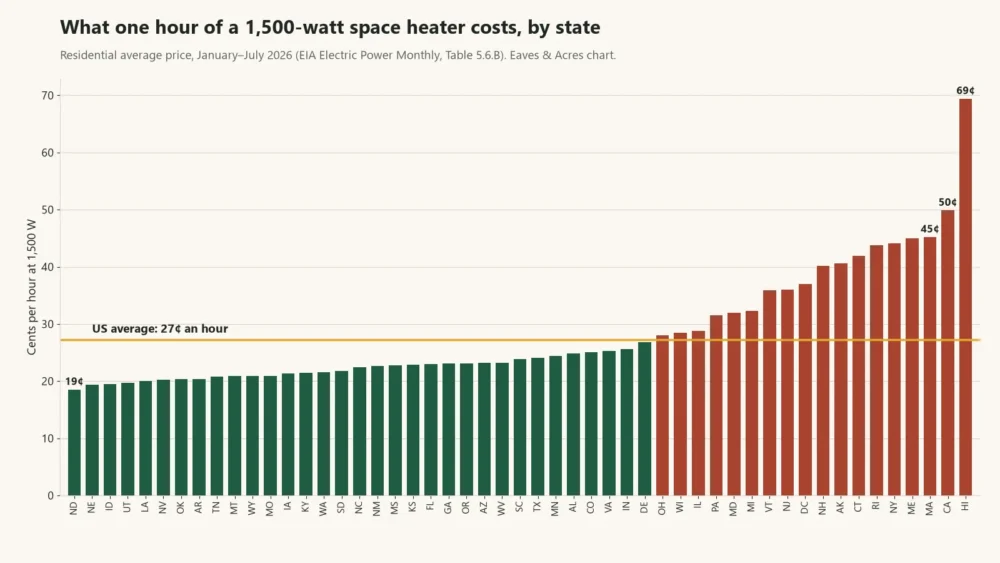
- 2That hour costs 19¢ in North Dakota and 69¢ in Hawaii; the month runs $44 in Fargo to $120 in Sacramento.
- 3Space heater heat costs 2.2–5.7 times as much as gas-furnace heat and 2.4–3.1 times heat pump heat.
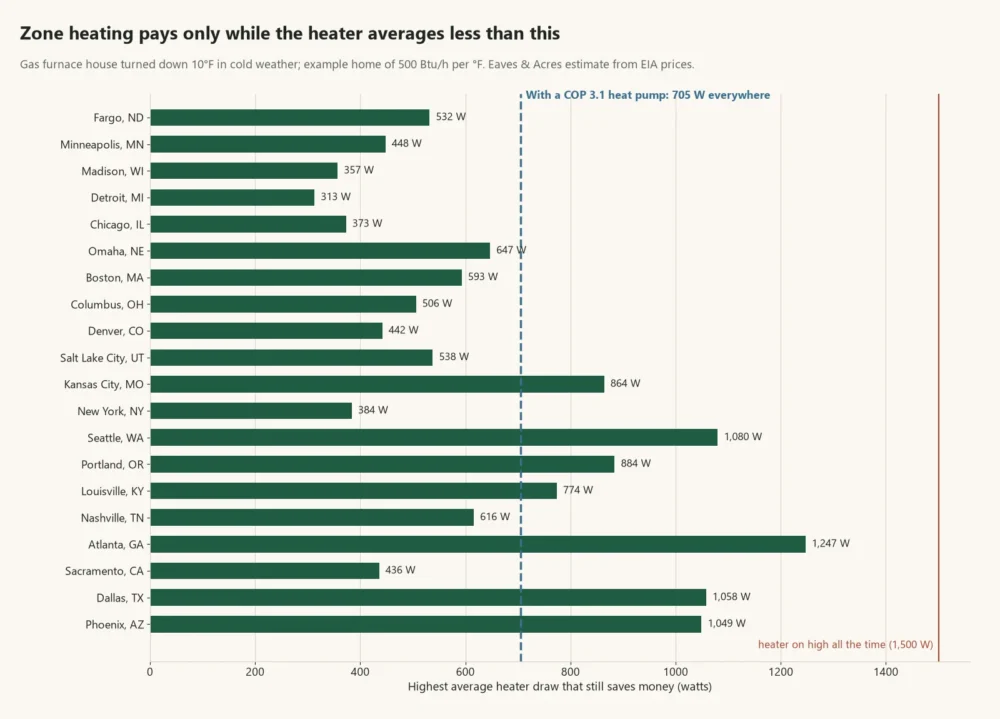
- 4Zone heating pays only while the heater’s average draw stays low: under about 370 W in Chicago with gas and a 10°F setback.
A 1,500-watt space heater on high uses 1.5 kilowatt-hours of electricity an hour, which costs about 27¢ at the 2026 US average price, $2.18 for an 8-hour day and $65 for a month of 8-hour days. By state, the same hour costs 19¢ in North Dakota and 69¢ in Hawaii.
Below: the formula, costs by state and city, and what the same heat costs from a furnace or heat pump, priced as in our heat pump vs. furnace guide.
Loads from YouTube (privacy-enhanced mode) only when you press play.
The formula: watts × hours × your price
Ceramic, oil-filled, quartz or infrared, every electric space heater is resistance heat, which the U.S. Department of Energy calls 100% efficient because
all the incoming electric energy is converted to heat.
So cost depends only on watts and hours: watts ÷ 1,000 × hours = kWh, and kWh × your price = dollars. Our state averages come from the Energy Information Administration’s Electric Power Monthly, Table 5.6.B, January–July 2026, the same prices behind our hot tub running costs.1
| Heater draw | 1 hour | 8 hours | 24 hours | 30 days, 8 h/day | 30 days, 24/7 |
|---|---|---|---|---|---|
| 750 W 0.75 kWh/h | 14¢ | $1.09 | $3.27 | $33 | $98 |
| 1,000 W 1 kWh/h | 18¢ | $1.46 | $4.37 | $44 | $131 |
| 1,500 W 1.5 kWh/h | 27¢ | $2.18 | $6.55 | $65 | $196 |
A heater with a thermostat draws full power only while its element is on, so it costs less than the table once the room is warm.
What a space heater costs in 20 US cities
Table 2 prices one 1,500 W heater on high in the 20 cities of our heat pump vs. furnace estimates, at each state’s average rate.1 A month of 8-hour days runs from $44 in Fargo to $120 in Sacramento; Boston and New York, at about 30¢ per kWh, cost more than twice what Fargo or Omaha do.
| City (state price) | 1 hour / 8-hour day | Month at 8 h a day |
|---|---|---|
| Fargo, ND 12.36¢ per kWh | 19¢ / $1.48 | $44 24/7: $133 |
| Omaha, NE 12.90¢ per kWh | 19¢ / $1.55 | $46 24/7: $139 |
| Salt Lake City, UT 13.16¢ per kWh | 20¢ / $1.58 | $47 24/7: $142 |
| Nashville, TN 13.87¢ per kWh | 21¢ / $1.66 | $50 24/7: $150 |
| Kansas City, MO 13.96¢ per kWh | 21¢ / $1.68 | $50 24/7: $151 |
| Louisville, KY 14.27¢ per kWh | 21¢ / $1.71 | $51 24/7: $154 |
| Seattle, WA 14.40¢ per kWh | 22¢ / $1.73 | $52 24/7: $156 |
| Portland, OR 15.40¢ per kWh | 23¢ / $1.85 | $55 24/7: $166 |
| Atlanta, GA 15.40¢ per kWh | 23¢ / $1.85 | $55 24/7: $166 |
| Phoenix, AZ 15.44¢ per kWh | 23¢ / $1.85 | $56 24/7: $167 |
| Dallas, TX 16.06¢ per kWh | 24¢ / $1.93 | $58 24/7: $173 |
| Minneapolis, MN 16.25¢ per kWh | 24¢ / $1.95 | $58 24/7: $176 |
| Denver, CO 16.72¢ per kWh | 25¢ / $2.01 | $60 24/7: $181 |
| Columbus, OH 18.70¢ per kWh | 28¢ / $2.24 | $67 24/7: $202 |
| Madison, WI 19.00¢ per kWh | 28¢ / $2.28 | $68 24/7: $205 |
| Chicago, IL 19.22¢ per kWh | 29¢ / $2.31 | $69 24/7: $208 |
| Detroit, MI 21.53¢ per kWh | 32¢ / $2.58 | $78 24/7: $233 |
| New York, NY 29.38¢ per kWh | 44¢ / $3.53 | $106 24/7: $317 |
| Boston, MA 30.14¢ per kWh | 45¢ / $3.62 | $108 24/7: $326 |
| Sacramento, CA 33.25¢ per kWh | 50¢ / $3.99 | $120 24/7: $359 |
Space heater vs. furnace or heat pump: the price of the same heat
One kWh gives 3,412 Btu,10 so we can price 100,000 Btu from each source. Against a 95% efficient gas furnace at each state’s 2025 residential gas price,2 space heater heat costs 2.2 times as much in Atlanta and 5.7 times as much in Detroit. Against a heat pump with a seasonal COP of 2.4–3.1, it costs 2.4–3.1 times as much. Baseboards and electric furnaces are resistance heat too; DOE adds that electric furnaces cost more to run than other resistance systems because of duct heat losses.4
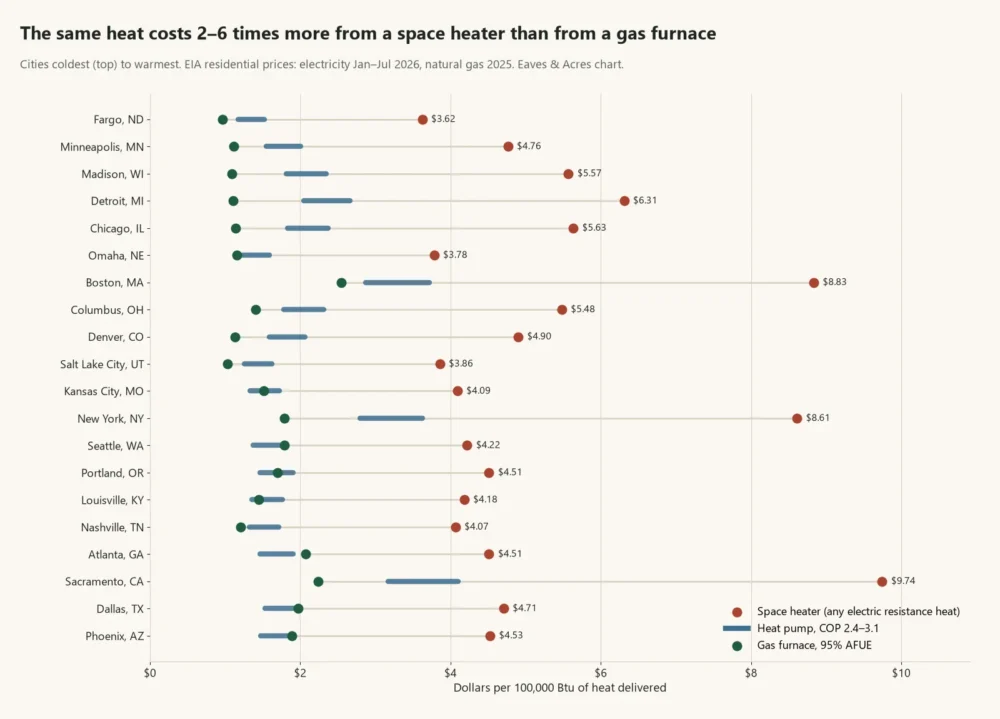
That ratio equals the break-even COP in our furnace comparison, since it compares the same two prices. It also shows why space heaters can’t replace central heat: that guide’s example home (500 Btu an hour per °F of indoor-outdoor difference) would need 3.8 heaters running nonstop through a normal Chicago January (26°F average, NOAA 1991–2020).3 Heated all winter that way, it would cost about $4,068 a year against $825 with gas.
When a space heater actually saves money
A space heater is economical only if you use it judiciously.
Zone heating means turning the thermostat down and warming only the room you’re in. The heater’s heat stays in the house and replaces some furnace heat, but at 4.9 times the price in Chicago. So each kWh it uses must save about 16,800 Btu of furnace heat: 3,412 from the heater itself, about 13,400 from the cooler rest of the house.
Zone heating in a Chicago January
- Scenario
- The example home with a 95% gas furnace at Illinois prices (19.22¢ per kWh, $1.09 per therm), thermostat down 10°F while a space heater warms one room.
- Math
- A 10°F setback saves at most 500 × 10 = 5,000 Btu of furnace heat an hour. Break-even draw = 5,000 ÷ (4.93 − 1) ÷ 3,412 = 0.37 kWh an hour.
- Answer
- The heater saves money only while it averages under about 370 W, roughly a quarter of the time on high.
By city, the gas-heat break-even runs from 313 W in Detroit to 1,247 W in Atlanta; with a COP 3.1 heat pump it is about 700 W everywhere. With baseboard or electric furnace heat, any setback elsewhere saves money, because both heats cost the same per Btu. These are upper limits, since the heated room stays warm. Our winter thermostat guide estimates setback savings by city; heat pump owners should first check how backup heat behaves in the cold, and rooms you let cool must stay above our pipe-freezing thresholds.
Does the type of heater change the cost?
Not per kWh: all types turn electricity into heat one for one. DOE recommends a thermostatically controlled heater “because they avoid the energy waste of overheating a room,” sized for the room, and calls radiant heaters more efficient when you stay in their line of sight for a few hours.5 Many heaters Consumer Reports tested claim to heat only about 150 to 200 square feet.9 For outages, our generator size calculator counts a space heater as a 750–1,500 W load.
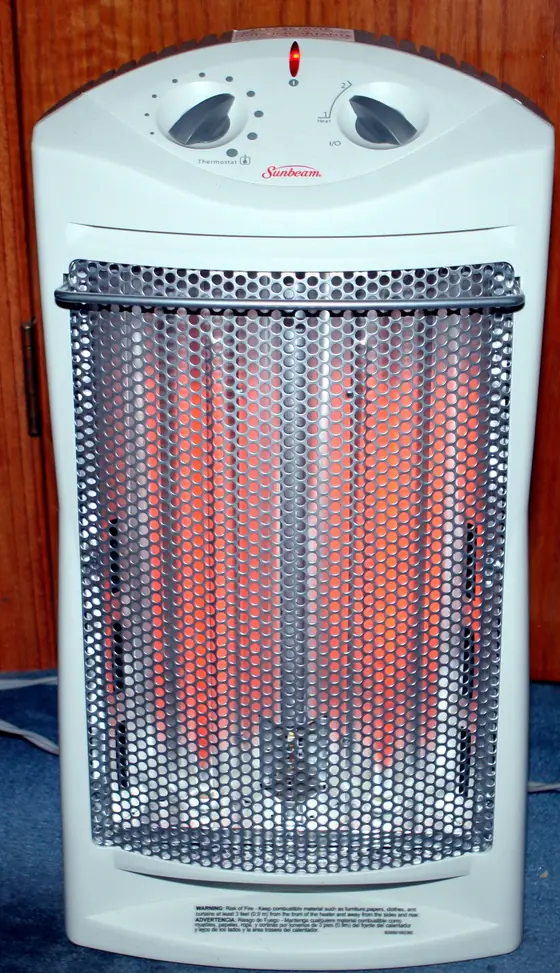
Space heater safety: what CPSC and NFPA count
Portable heaters, including electric space heaters, were involved in an average of 1,600 fires, 70 deaths and 150 injuries a year in 2020–2022, CPSC estimates.6 In NFPA’s 2020–2024 averages, space heaters and heating stoves caused 30% of home heating equipment fires but 73% of the deaths, and 46% of those fires came in December through February.7 NFPA’s tip sheet wants a testing-lab seal, overheat and tip-over protection, 3 feet from anything that can burn, including people, and the heater off and unplugged when you leave the room or go to bed.8 Check it against CPSC recalls too.6
Plug the heater directly into the wall outlet. Never use an extension cord.
Your next step
Multiply your heater’s label watts by your hours and your bill’s price per kWh. Heating several rooms this way? Check our break-even COP method first.
Frequently asked questions
On high, a 1,500 W heater costs about 27¢ at the 2026 US average price: 19¢ in North Dakota, 69¢ in Hawaii. A 750 W setting costs half.
36 kWh: about $6.55 at the US average, $4.45 in North Dakota and $12 in California, if it never cycles off.
For one appliance, yes: 1.5 kWh an hour on high, or 360 kWh for a month of 8-hour days. That is about 40% of an average US home's monthly use (899 kWh in 2022, EIA) and about $65 at the US average ($44–$120 in our cities).
Not per unit of heat with gas or a heat pump: space heater heat costs 2.2–5.7 times gas-furnace heat in our cities. It pays only for one room with the rest turned down.
None per kWh: DOE says resistance heat turns all its electricity into heat. Cost follows watts and hours, so use a thermostat and the lowest setting that keeps you warm.
Only while you are in the room: NFPA says turn it off and unplug it when you leave or go to bed. CPSC adds three feet of clearance and a wall outlet, never an extension cord.
Sources
- 1.Electric Power Monthly, Table 5.6.B: Average Price of Electricity to Ultimate Customers by End-Use Sector, by State, Year-to-Date through July 2026. U.S. Energy Information Administration, 2026. Used for: residential prices by state and US average (18.19¢), January–July 2026 Back to text
- 2.Natural Gas Prices: average price of natural gas delivered to residential consumers, annual 2025 (release 9/30/2026). U.S. Energy Information Administration, 2026. Used for: state residential gas prices for the 95% furnace comparison Back to text
- 3.U.S. Climate Normals 1991–2020. NOAA National Centers for Environmental Information, 2021. Used for: heating degree days and January mean temperature, station nearest each city ZIP code Back to text
- 4.Energy Saver: Electric Resistance Heating (archived copy of 2026-01-01; the live page has been removed). U.S. Department of Energy, 2026. Used for: resistance heat is 100% efficient; electric furnaces cost more than other resistance systems (duct losses) Back to text
- 5.Energy Saver: Small Space Heaters (archived copy of 2026-06-29; the live page has been removed). U.S. Department of Energy, 2025. Used for: thermostatically controlled heaters, sizing, radiant heaters in line of sight Back to text
- 6.Keep Warm and Safe This Winter: Tips for Using Generators, Furnaces and Space Heaters (release 26-217). U.S. Consumer Product Safety Commission, 2026. Used for: 1,600 fires, 70 deaths, 150 injuries a year (2020–2022); three feet; wall outlet, no extension cord or power strip; off when sleeping; recalls Back to text
- 7.Home Heating Safety: statistics on heating fires (2020–2024 annual averages). National Fire Protection Association, 2026. Used for: space heaters and heating stoves: 30% of home heating equipment fires, 73% of deaths; 46% in December–February Back to text
- 8.Electric Portable Space Heater Safety (tip sheet). National Fire Protection Association, 2018. Used for: testing-laboratory seal, thermostat, overheat and tip-over protection, 3 feet, wall outlet, off and unplugged when leaving or sleeping Back to text
- 9.Will Using a Space Heater Save You Money?. Consumer Reports, 2025 (updated October 12). Used for: "economical only if you use it judiciously"; tested heaters claimed to heat about 150 to 200 square feet Back to text
- 10.Units and calculators explained: British thermal units. U.S. Energy Information Administration, accessed 2026-10-08. Used for: 1 kWh = 3,412 Btu; 1 therm = 100,000 Btu; 1 cubic foot of gas = 1,036 Btu Back to text
- 11.Space Heater Safety: The 3-Foot Rule That Prevents Fires (video page). U.S. Consumer Product Safety Commission, 2026 (February 12). Used for: embedded CPSC safety video and its description
- 12.Electric Ceramic Space Heater (photo). Tony Webster, Wikimedia Commons, CC BY 2.0, 2018. Used for: hero photo, cropped
- 13.Space heater (photo). Hardyplants, Wikimedia Commons, CC0, 2013. Used for: photo, resized
- 14.How much electricity does an American home use? (FAQ). U.S. Energy Information Administration, 2022 data (updated January 8, 2024). Used for: average residential customer bought 899 kWh a month in 2022
.jpg)

How this guide was made
- Written by the Home Systems Desk and reviewed by the Data & Methodology Desk.
- Data: electricity prices from EIA Electric Power Monthly Table 5.6.B (residential, January–July 2026; the same file as our hot tub and heat pump guides); natural gas from EIA’s 2025 average residential prices at 1,036 Btu per cubic foot; 1 kWh = 3,412 Btu (EIA); resistance heat converts all electricity to heat (DOE). Costs assume the heater draws its rated watts the whole time; a month is 30 days. Furnace and heat pump comparisons use the example home of our heat pump vs. furnace guide (12,000 Btu per heating degree day, 95% AFUE, seasonal COP 2.4–3.1) with NOAA NCEI 1991–2020 normals for the station nearest each city ZIP code. The zone-heating break-even is our estimate: a 10°F setback saves at most 500 Btu per hour per °F in cold weather, an upper limit because the heated room stays warm. See our methodology.
- AI use: AI tools help us research, draft and check this guide. Every figure is checked against the source cited for it, and calculated figures come from our own code, described on the methodology page.
- Spotted an error? Tell us — the form opens with this page’s address filled in.
Change log
- Oct 13, 2026Re-checked EIA Table 5.6.B (still January–July 2026, the latest release), EIA gas and Btu figures, DOE, CPSC, NFPA and Consumer Reports against the live or archived sources; no figure changed. The FAQ now answers whether space heaters use a lot of electricity, compared with EIA's average home use.
- Oct 7, 2026Published. Space heater running cost from watts × hours × EIA residential prices (Table 5.6.B, January–July 2026) for every state and 20 cities, compared with a 95% gas furnace and a heat pump by the method of our heat pump vs. furnace guide (EIA 2025 gas prices, NOAA 1991–2020 normals); safety guidance from CPSC (2026) and NFPA.
Covers heating, cooling, generators and water heaters. We maintain the sizing calculators and the guides that explain what a number means before you call a contractor.
Keep reading

What Humidity Should a House Be in Winter? 30–40%, Lower on Cold Nights
About 30–40% relative humidity, inside EPA’s 30–50% range, and lower on the coldest nights. Our NOAA estimate of when windows fog in 20 US cities, plus signs of air that is too dry or too damp.
What Temperature to Set Your Thermostat in Winter: 68°F, Then Lower at Night
About 68°F while you are awake and 7–10°F lower at night for a furnace or boiler; a heat pump stays steady. What a setback saves in 20 US cities, plus the 55°F and health floors.
At What Temperature Do Pipes Freeze? The 20°F Threshold and Where It Hits
Pipes in unheated spaces are most at risk at about 20°F outside, per a University of Illinois study. How often 20 US cities get there, and what to do before a freeze.
Seasonal reminders for your ZIP
Get a short email when it’s time to overseed, start seeds, open the pool or service your furnace — timed to your climate.