




At What Temperature Do Pipes Freeze? The 20°F Threshold and Where It Hits
Where the 20°F rule comes from, how often your city reaches it in NOAA’s climate normals, and the freeze-prevention steps the Red Cross, IBHS, State Farm and extension services agree on.
- Last reviewed Oct 7, 2026
- 18 cited sources
- 10 min read
- 1Water freezes at 32°F, but pipes in unheated spaces are most at risk at about 20°F outside, the “temperature alert threshold” of a 1996 University of Illinois study.
- 2Isolated freezing can still happen between 20°F and 32°F, often where gaps in the walls let cold air in.
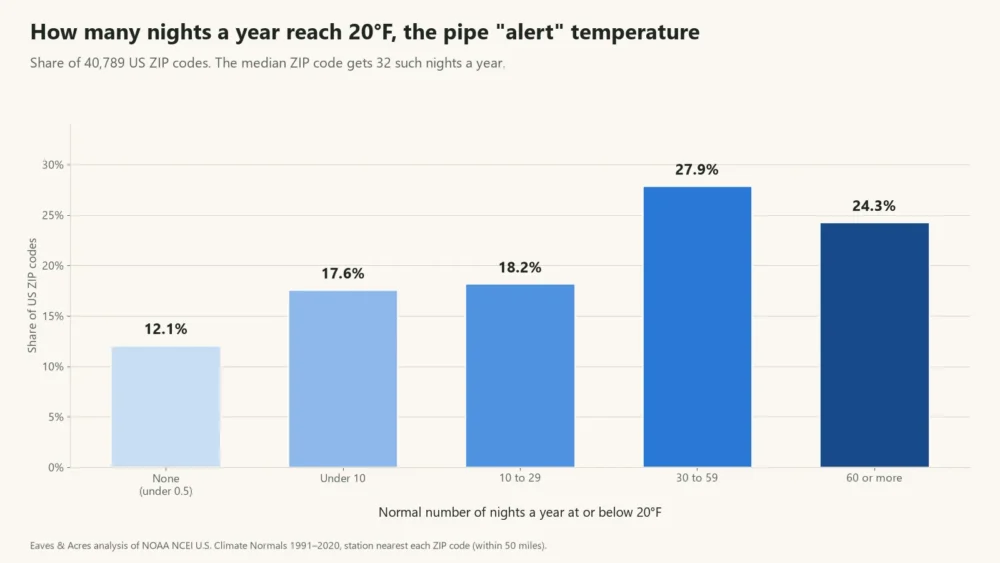
- 3In NOAA’s 1991–2020 normals, the median US ZIP code gets 32 nights a year at or below 20°F, and in 84% of ZIP codes a 20°F night comes in most years.
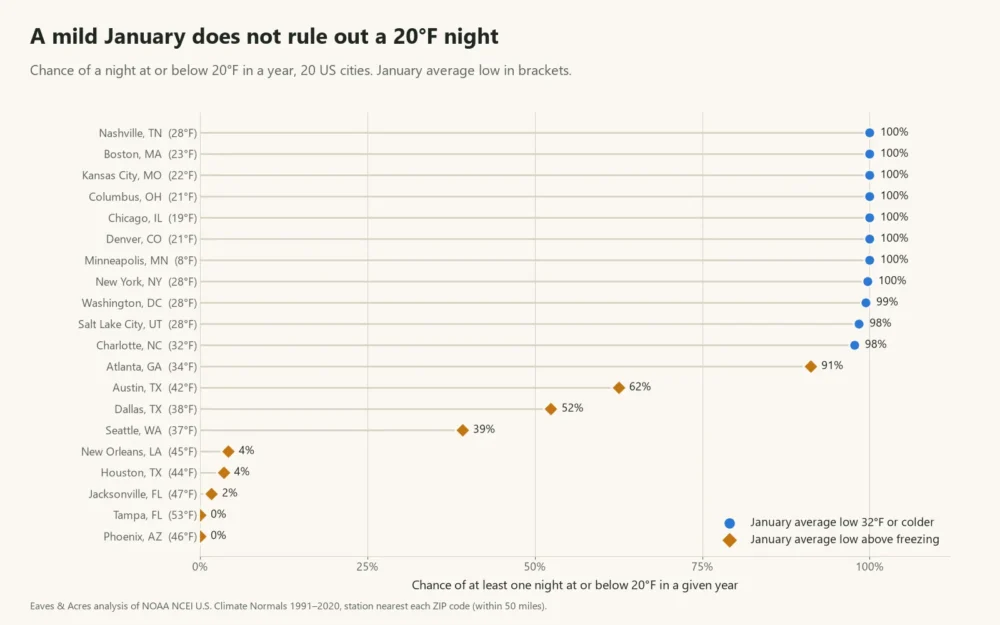
- 4In 59% of ZIP codes whose January average low is above freezing, a 20°F night still comes at least 1 year in 10. Texas has 26% of them.
- 5Before a freeze: drain outdoor faucets, insulate exposed pipes, open sink cabinets, drip faucets, keep the heat at 55°F or more. If a pipe freezes, call a plumber; never use a flame.
Water freezes at 32°F, but pipes in unheated parts of a house are most at risk once it is about 20°F or colder outside. That is the “temperature alert threshold” a University of Illinois study set for the southern US, after an uninsulated attic pipe started to freeze each time the outdoor temperature fell to about 20°F.1 Pipes can still freeze between 20°F and 32°F, especially where wind or gaps in the walls let cold air reach them.
We checked how often US ZIP codes reach that number in NOAA’s 1991–2020 climate normals. The median ZIP code gets 32 nights a year at or below 20°F. And in 59% of the ZIP codes whose average January low stays above freezing, a 20°F night still comes at least 1 year in 10, more than half of them in Texas and the other Gulf states.
Pipe freeze temperatures: 32°F, 28°F and 20°F
| Temperature | What it means for pipes | Source |
|---|---|---|
| 32°F outside | Water freezes. Below this, pipes can freeze and burst, plastic or copper. | State Farm |
| 28°F outside | A hard freeze: 28°F or lower for an extended time. NWS Eureka said its hard freeze warnings meant a bigger threat to exposed pipes. | National Weather Service |
| 20°F outside | The “temperature alert threshold”: an uninsulated attic pipe started to freeze at or just below 20°F. | University of Illinois, 1996 |
| 20–32°F outside | Isolated, infrequent freezing, often where holes in the house shell let cold in. | University of Illinois, 1996 |
| 55°F inside | The lowest thermostat setting while you are away. | Red Cross, IBHS, State Farm |
Sources: State Farm,5 NWS,9,10 University of Illinois,1 Red Cross and IBHS.2,3 A Texas A&M AgriLife article gives the same 20°F figure, and Joel Pigg of AgriLife Extension advises precautions whenever temperatures dip below freezing.7
Google’s AI Overview for this question also repeats a rule of 28°F or colder for four hours. That line comes from a FOX 8 New Orleans explainer, which calls it a rule of thumb.14 We found no study behind the four hours, so we don’t use it.
Where the 20°F number comes from
Most pages that answer this question give 20°F without a source. It comes from Research Report 96-1 by Jeffrey Gordon of the University of Illinois Building Research Council, sponsored by an insurance industry institute.1
In field tests in the winter of 1995, Gordon ran pipes through an unheated, vented attic. The most exposed one, uninsulated and on the cold side of R-30 fiberglass attic insulation, started to freeze 11 times, each when it was 15.4°F to 20.1°F outside. The attic was only about 3°F warmer than the outdoor air. Gordon called this the worst case and based his threshold on it:1
a temperature alert threshold could be established at 20°F for the southern United States.
It has two limits. It was set for the South, where building practices, the report says, do not protect pipes from occasional severe cold. And Gordon expected isolated freezing between 20°F and 32°F, with holes in a house’s shell playing a major role.1
Why a frozen pipe bursts
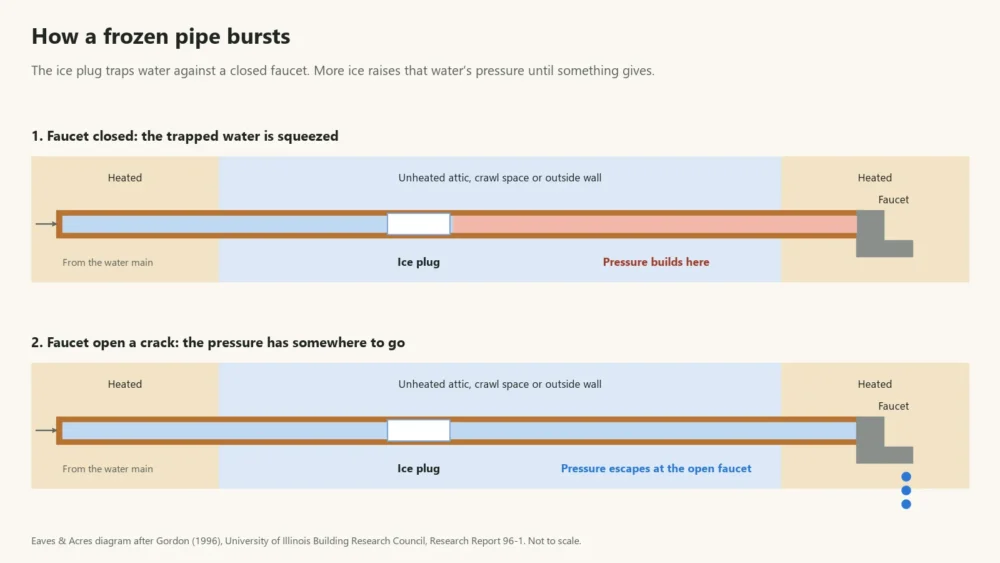
The ice doesn’t simply push the pipe wall out. First, ice blocks the pipe. Then more ice forms in the water trapped between that blockage and a closed faucet, and its pressure can climb to thousands of pounds per square inch. The pipe then fails at its weakest point anywhere downstream, which can be a joint or a fixture, not necessarily where the ice is.1
Insulation buys time. On a 14°F night in the same tests, the uninsulated pipe was blocked by about 5:30 a.m. One inch of pipe insulation delayed the blockage by 9.5 hours and 1.5 inches by 23 hours. A pipe with 2 inches of insulation thawed before it ever blocked.1
Which pipes freeze first
The Red Cross lists the pipes that freeze most often:2
- pipes exposed to severe cold, such as outdoor hose bibs, swimming pool supply lines and sprinkler lines;
- supply pipes in unheated areas: basements, crawl spaces, attics, garages and kitchen cabinets;
- pipes against exterior walls with little or no insulation.
IBHS says plumbing along exterior walls is common in warmer areas, including much of the South, and that homes built before 2010 typically lack frost-proof outdoor faucets.3 Nebraska Extension adds that with severe wind chill, a tiny opening can let in enough cold air to freeze a pipe.8
How often your area reaches 20°F (NOAA data)
For each of 40,789 ZIP codes with a NOAA station within 50 miles, we read that station’s 1991–2020 normals: the average number of nights a year at or below 32°F and 20°F, the chance of at least one 20°F night in a year, and the median dates.12,13
In 84% of ZIP codes, a 20°F night comes in most years, and in 69% it comes essentially every year. The median ZIP code gets 32 nights a year at or below 20°F, and a quarter get 60 or more. Only 12% average less than half a night.
| City (ZIP) | January average low | Nights at or below 32°F a year | Nights at or below 20°F a year | Chance of a 20°F night in a year | First 28°F hard freeze | First 20°F night |
|---|---|---|---|---|---|---|
| Minneapolis, MN (55401) | 8°F | 147 | 84 | 100% | Oct 27 | Nov 12 |
| Denver, CO (80202) | 21°F | 150 | 56 | 100% | Oct 21 | Nov 9 |
| Chicago, IL (60601) | 19°F | 97 | 35 | 100% | Nov 15 | Dec 1 |
| Columbus, OH (43215) | 21°F | 113 | 33 | 100% | Nov 3 | Nov 28 |
| Kansas City, MO (64105) | 22°F | 93 | 31 | 100% | Nov 11 | Nov 29 |
| Boston, MA (02108) | 23°F | 92 | 29 | 100% | Nov 21 | Dec 11 |
| Nashville, TN (37201) | 28°F | 76 | 18 | 100% | Nov 9 | Dec 5 |
| New York, NY (10001) | 28°F | 67 | 17 | >99% | Dec 1 | Dec 26 |
| Washington, DC (20001) | 28°F | 84 | 17 | 99% | Nov 20 | Dec 26 |
| Salt Lake City, UT (84101) | 28°F | 81 | 14 | 98% | Nov 18 | Dec 11 |
| Charlotte, NC (28202) | 32°F | 58 | 7 | 98% | Nov 14 | Dec 20 |
| Atlanta, GA (30303) | 34°F | 52 | 4 | 91% | Nov 20 | Jan 1 |
| Austin, TX (78701) | 42°F | 29 | 1 | 62% | Dec 1 | Jan 4 |
| Dallas, TX (75201) | 38°F | 23 | 2 | 52% | Dec 12 | Jan 7 |
| Seattle, WA (98101) | 37°F | 30 | 2 | 39% | Dec 2 | Fewer than half of years |
| New Orleans, LA (70112) | 45°F | 7 | Under 1 | 4% | Jan 8 | About 1 year in 24 |
| Houston, TX (77002) | 44°F | 5 | Under 1 | 4% | Jan 5 | About 1 year in 29 |
| Jacksonville, FL (32202) | 47°F | 4 | Under 1 | 2% | Fewer than half of years | About 1 year in 59 |
| Tampa, FL (33602) | 53°F | 1 | Under 1 | 0% | Fewer than half of years | None, 1991–2020 |
| Phoenix, AZ (85004) | 46°F | 1 | Under 1 | 0% | Fewer than half of years | None, 1991–2020 |
Dates are medians in years when that temperature is reached. Our frost date lookup shows the first 28°F hard freeze for any ZIP code.
Mild winters, rare hard freezes: the riskier mix
Gordon found burst pipes a bigger problem in the South than in the North, where pipes are better protected.1 IBHS says arctic outbreaks still freeze pipes, especially where extreme cold is rare.3 Our data shows how wide that zone is. In 10,524 ZIP codes (26%), the average January low is above 32°F. Yet in 6,165 of them, 59%, a 20°F night still comes at least 1 year in 10, and in 5,202 at least 1 year in 4. Texas has 26% of those ZIP codes, followed by Georgia (12%), Alabama (10%), Louisiana (10%), Washington (7%) and Mississippi (6%).
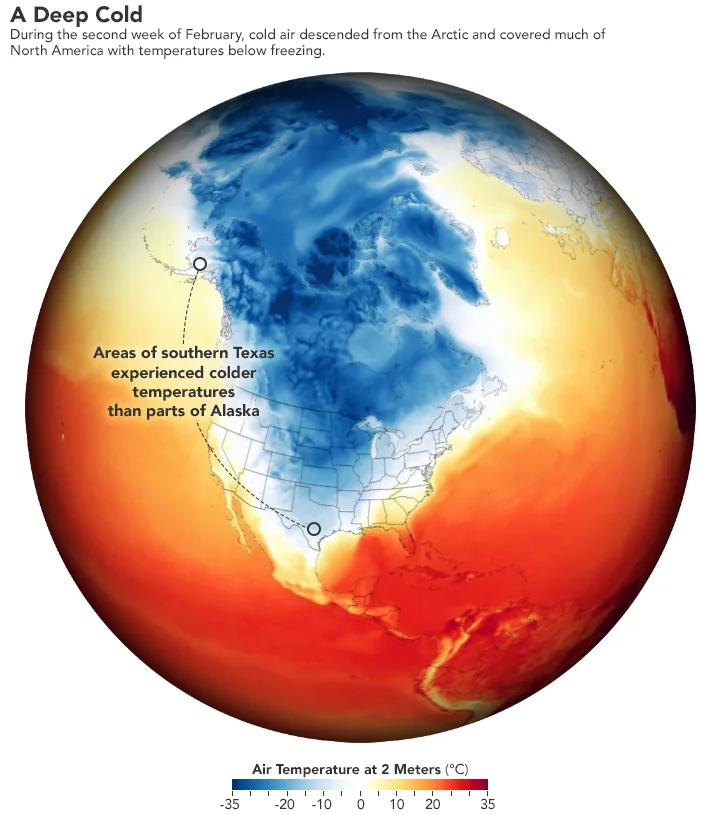
February 2021 showed the cost. The NWS Houston/Galveston office lists broken pipes among the impacts of that week, which it called potentially the costliest weather disaster in Texas history. Its forecasts had warned:11
Pipes (including sprinkler systems) will be subject to bursting if not adequately insulated
When the pipe-freeze season starts
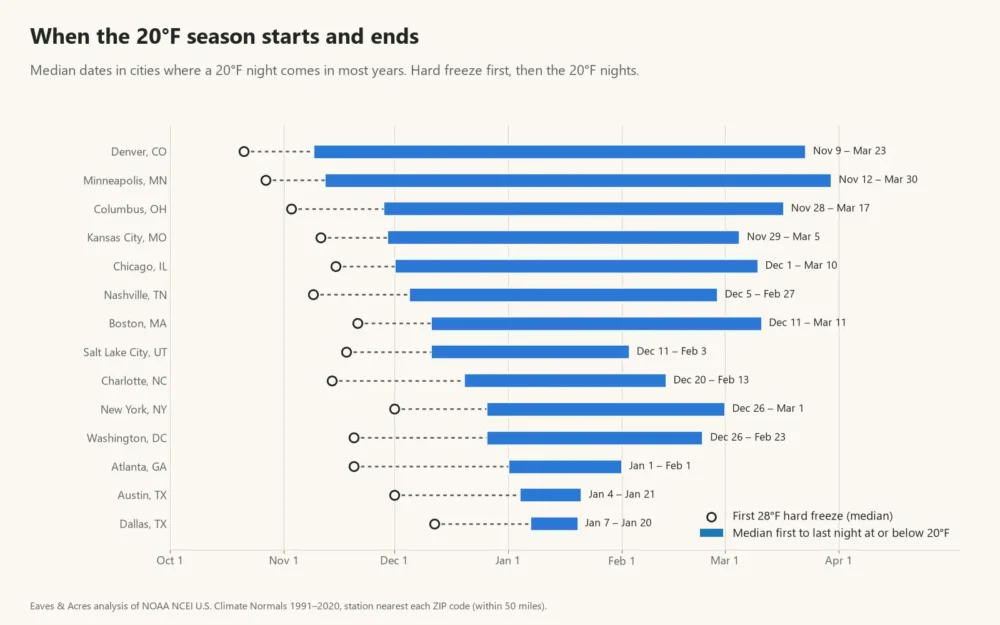
Where a 20°F night comes in most years (34,349 ZIP codes), the median first one arrives Nov. 25 and the last Mar. 15. The first 20°F night comes a median 24 days after the first 28°F hard freeze; for the middle half of those ZIP codes, the gap is 21 to 28 days.
Our guides to frost vs. freeze and covering plants for frost explain the 28°F hard freeze, and pool owners should finish closing the pool before freezing nights put its plumbing at risk.
Before a freeze: what the sources tell you to do
| Step | What the sources say | Source |
|---|---|---|
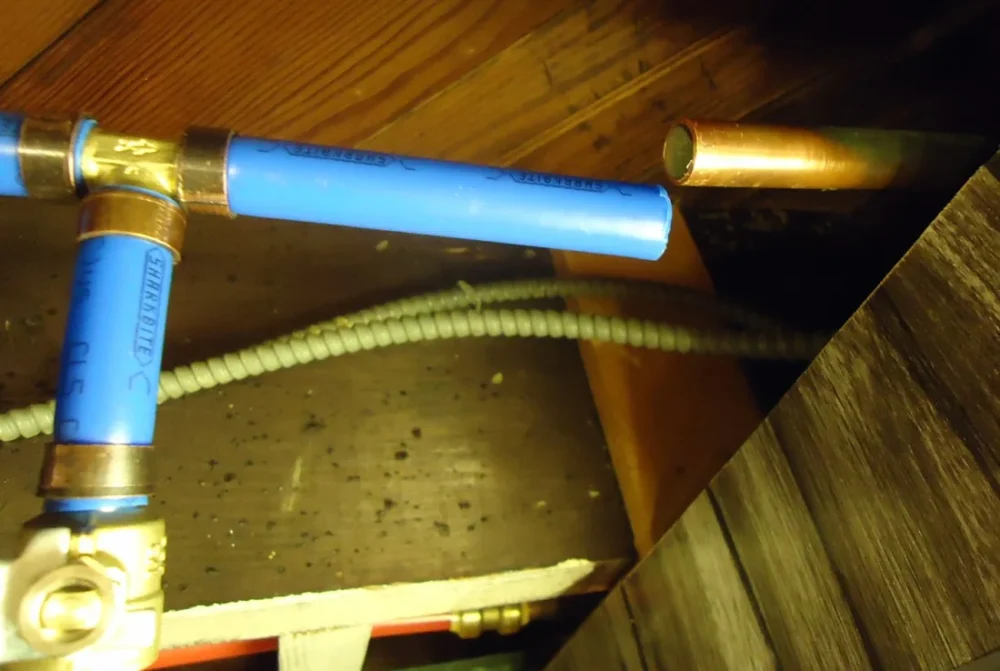
| Outdoor hoses and faucets | Remove, drain and store hoses. Close the inside valve to each outdoor faucet, then open the outside faucet to drain and leave it open. Without frost-proof faucets, shut off and insulate the valves. | Red Cross, IBHS |
| Insulate exposed pipes | Attics, crawl spaces and exterior walls, hot and cold lines. Pipe sleeves, or UL-listed heat tape or cable used as the maker directs. Thicker commercial insulation outperforms thin hardware-store sleeves. | Red Cross, IBHS, Nebraska Extension, University of Illinois |
| Seal drafts | Caulk cracks and gaps, and air leaks around wiring, dryer vents and pipes. | IBHS, State Farm, Nebraska Extension |
| Open cabinet doors | Let warm air reach pipes under sinks. Move cleaners out of children’s reach. | Red Cross |
| Drip faucets | A trickle from the faucet served by exposed pipes, when it is very cold. | Red Cross, Mississippi State Extension |
| Keep the heat steady | The same setting day and night. Away from home: no lower than 55°F. | Red Cross, IBHS, State Farm |
| Know the main shut-off | Learn where it is and how to operate it. For trips of more than a week in freezing weather, IBHS suggests closing it slowly and draining a couple of faucets on the lowest floor. | IBHS, State Farm |
| Garage | Keep the doors closed if water lines run there. | Red Cross |
Sources: Red Cross,2 IBHS,3,4 State Farm,5 Mississippi State,6 Nebraska Extension8 and University of Illinois.1 State Farm adds a warning: if your house has a fire sprinkler system, shutting off the water may deactivate it.5
Drip hot or cold? The sources disagree
The Red Cross and Mississippi State Extension say to drip cold water.2,6 State Farm and Nebraska Extension say warm water, preferably from a faucet on an outside wall.5,8 Gordon’s report notes that hot and cold lines are separate pipes, so each one needs its own flow. It also advises leaving the faucet slightly open even if the drip stops, because the open tap relieves the pressure that bursts pipes.1
Water flow will delay freezing, but it may not prevent it in all cases.
A drip is cheap: about a gallon an hour, or 2 cents a night, says Mississippi State Extension, and dripping the faucet farthest from the water meter draws water through the whole house.6
When the power goes out
IBHS warns that plumbing may freeze in extreme cold, particularly during power outages.4 Heat tape stops working then too.1 Our guide to the generator size to run a furnace and the generator size calculator cover backup heat; read our portable generator safety guide before running one. If you heat with a heat pump, see how heat pumps handle cold weather.
If a pipe freezes anyway
If you turn on a faucet and only a trickle comes out, suspect a frozen pipe, and check your other faucets, because other pipes may be frozen too.2 State Farm’s advice is to leave the faucet on and call your plumber.5 If a pipe has burst, State Farm says to turn off the water at the main shut-off valve.5
Next step
Look up your ZIP code’s first hard freeze in the frost date lookup, and finish the outdoor faucets and insulation before then. Methods are on our methodology page; more cold-weather guides are in heating and cooling.
Frequently asked questions
No source gives one number. The Red Cross says to drip when it is very cold outside; Mississippi State Extension, when lows will stay below freezing for several days. The University of Illinois alert threshold is 20°F.
We found no measured figure for 30°F. The University of Illinois study expected only isolated freezing between 20°F and 32°F, and in its tests 1 inch of insulation delayed an ice blockage by 9.5 hours on a 14°F night.
Keep the same setting day and night, and no lower than 55°F when you are away, say the Red Cross, IBHS and State Farm. Insulate pipes in unheated spaces too.
They can if they run through unheated spaces. The Red Cross says pipes in attics, crawl spaces, garages and poorly insulated outside walls freeze most often.
Water left in them can. The University of Illinois study says shutting the main valve and opening the faucets drains most of the water and removes the risk of bursting. State Farm notes this may disable a fire sprinkler system.
There is no separate burst temperature. A pipe bursts after ice blocks it and more ice pressurizes the water trapped between the blockage and a closed faucet, so the same 20°F and 32°F guidance applies.
Yes. State Farm says pipes can freeze and burst below 32°F whether they are plastic or copper, and Nebraska Extension says both plastic and copper pipes can freeze.
Sources
- 1.An Investigation into Freezing and Bursting Water Pipes in Residential Construction (Research Report 96-1, Jeffrey R. Gordon). University of Illinois Building Research Council, sponsored by the Insurance Institute for Property Loss Reduction, 1996. Used for: 20°F temperature alert threshold from attic field tests (pp. 46–47); burst mechanism (pp. 17–18); insulation delays (p. 21); dripping, insulation, heat tape, thermostat and shut-off advice (p. 46); quotes Back to text
- 2.Preventing & Thawing Frozen Pipes. American Red Cross, n.d. Used for: pipes that freeze most often; hoses, hose bibs, insulation, cabinets, cold-water drip, thermostat (55°F away); open-flame warning; licensed plumber Back to text
- 3.IBHS Winter Weather Ready guide provides easy-to-do actions to help prevent property damage from colder temperatures. Insurance Institute for Business & Home Safety, 2024. Used for: exterior-wall plumbing in the South; frost-proof faucets (homes before 2010); arctic outbreaks; 55°F thermostat; main valve for long trips Back to text
- 4.Winter Weather Ready. Insurance Institute for Business & Home Safety, n.d. Used for: plumbing may freeze in extreme cold, particularly during power outages; insulation; heating system tune-up Back to text
- 5.Winter prep 101: Essential tips to prevent frozen pipes and avoid costly repairs. State Farm, 2024. Used for: pipes can freeze and burst below 32°F, plastic or copper; warm-water drip; 55°F away; sprinkler-system warning; call a plumber; no torch or open flame; main shut-off after a burst Back to text
- 6.How to Properly Drip a Water Faucet. Mississippi State University Extension Service, n.d. Used for: cold-water drip, farthest faucet from the meter, about 2 cents a night Back to text
- 7.How To Prepare For Winter Weather. Texas A&M AgriLife (Adam Russell; Joel Pigg, AgriLife Extension), 2024. Used for: 20°F figure with precautions below freezing; northern exposure; well houses Back to text
- 8.Problematic frozen pipes can be prevented with routine, prewinter maintenance. University of Nebraska–Lincoln Extension (UNL Water, Becky Schuerman), 2025. Used for: plastic and copper pipes freeze; wind chill through tiny openings; warm-water drip; sealing leaks; UL or NSF/ANSI 61 products Back to text
- 9.NWS Glossary: Freeze, Hard Freeze. National Weather Service, n.d. Used for: hard freeze = 28°F or lower for an extended period Back to text
- 10.The North Coast Observer, Fall 2018. National Weather Service, Eureka office, 2018. Used for: hard freeze warnings indicate a more substantial threat to exposed pipes Back to text
- 11.Valentine’s Week Winter Outbreak 2021: Snow, Ice, & Record Cold. National Weather Service, Houston/Galveston office, 2021. Used for: broken pipes and costliest-disaster note; forecast warning on pipe bursts; quote Back to text
- 12.U.S. Climate Normals 1991–2020. NOAA National Centers for Environmental Information, 2021. Used for: nights at or below 32°F and 20°F, yearly chance of a 20°F or 28°F night, first and last 20°F and 28°F dates, January average lows for every ZIP code and city Back to text
- 13.Annual/Seasonal Normals Documentation, 1991–2020. NOAA National Centers for Environmental Information, 2021. Used for: definitions of the day counts, occurrence probabilities and dates used Back to text
- 14.When pipes actually freeze: It’s not at 32 degrees. FOX 8 WVUE New Orleans, 2026. Used for: origin of the 28°F-for-four-hours rule of thumb in Google’s AI Overview Back to text
- 15.Photo: Frozen water tap (Paul van de Velde, CC BY 2.0). Wikimedia Commons, 2018. Used for: hero photo
- 16.Photo: Water Pipe Santa Clara California (Tomwsulcer, CC0). Wikimedia Commons, 2012. Used for: above-ground water pipe photo
- 17.Map: February 15, 2021 North American temperature map (NASA, public domain). NASA via Wikimedia Commons, 2021. Used for: February 2021 cold map
- 18.Photo: PEX pipes and valves in basement ceiling for exterior water spigot (Tomwsulcer, CC0). Wikimedia Commons, 2012. Used for: outdoor-faucet supply line photo
.jpg)


How this guide was made
- Written by the Home Systems Desk and reviewed by the Data & Methodology Desk.
- Data: nights a year at or below 32°F and 20°F, the yearly chance of at least one 20°F or 28°F night, the median first and last 20°F nights and the median first 28°F hard freeze come from NOAA NCEI U.S. Climate Normals 1991–2020 for the station nearest each ZIP code (within 50 miles; the same station our frost date lookup uses), and January average lows from the nearest station with monthly normals; 40,789 ZIP codes have all of these. Dates are medians in years when the temperature is reached. The 20°F threshold is from the University of Illinois Building Research Council’s 1996 report; prevention steps are from the Red Cross, IBHS, State Farm and university extension services. See our methodology.
- AI use: AI tools help us research, draft and check this guide. Every figure is checked against the source cited for it, and calculated figures come from our own code, described on the methodology page.
- Spotted an error? Tell us — the form opens with this page’s address filled in.
Change log
- Oct 7, 2026Re-checked the Red Cross, State Farm, Mississippi State, Texas A&M and NWS Houston/Galveston sources against the live pages; the 20°F line from Texas A&M is now attributed to the AgriLife article itself, with Joel Pigg credited for the below-freezing precaution.
- Oct 5, 2026Published. The 20°F threshold checked against the University of Illinois report itself; prevention steps against the Red Cross, IBHS, State Farm and Mississippi State, Texas A&M and Nebraska extension pages; nights at or below 32°F and 20°F, occurrence odds and dates for 40,789 ZIP codes and 20 cities computed from NOAA 1991–2020 normals.
Covers heating, cooling, generators and water heaters. We maintain the sizing calculators and the guides that explain what a number means before you call a contractor.
Keep reading
What Humidity Should a House Be in Winter? 30–40%, Lower on Cold Nights
About 30–40% relative humidity, inside EPA’s 30–50% range, and lower on the coldest nights. Our NOAA estimate of when windows fog in 20 US cities, plus signs of air that is too dry or too damp.
How Much Does It Cost to Run a Space Heater? Costs by State and City
A 1,500-watt space heater costs about 27¢ an hour at the 2026 US average electricity price. Costs by state and in 20 cities, and how its heat compares with a furnace or heat pump.
What Temperature to Set Your Thermostat in Winter: 68°F, Then Lower at Night
About 68°F while you are awake and 7–10°F lower at night for a furnace or boiler; a heat pump stays steady. What a setback saves in 20 US cities, plus the 55°F and health floors.
Seasonal reminders for your ZIP
Get a short email when it’s time to overseed, start seeds, open the pool or service your furnace — timed to your climate.