




When to Winterize Your Sprinkler System: Freeze Dates Where You Live
Drain the system before the first freeze. Here is when that normally comes in 31 US cities, from NOAA climate normals checked against local utility advice, plus the three drain methods and how to protect the backflow preventer.
- Last reviewed Oct 7, 2026
- 17 cited sources
- 11 min read
Set your ZIP to see dates for your area.
- 1Winterize before the first fall freeze (32°F) and no later than the first hard freeze (28°F), the deadlines Hunter, Rain Bird, Salt Lake City and Broomfield use.
- 2In a normal year the first freeze comes about Oct 12 in Denver, Oct 16 in Minneapolis, Oct 31 in Detroit, Nov 5 in Chicago and Nov 9 in Boston, with about a 1-in-10 chance of a freeze two weeks or more before that.
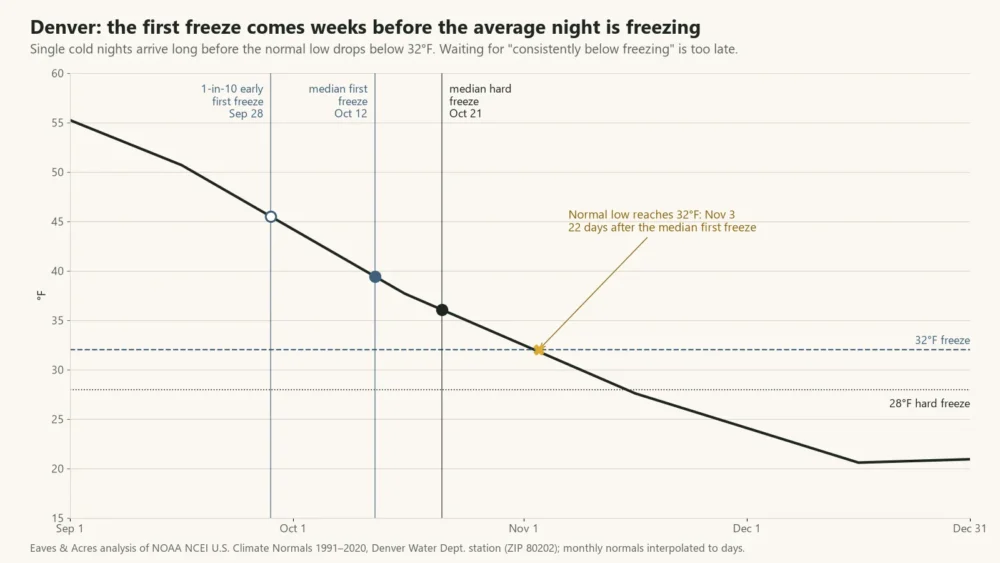
- 3Don’t wait for nights to stay below 32°F: by NOAA normals the average night gets there a median 29 days after the median first freeze.
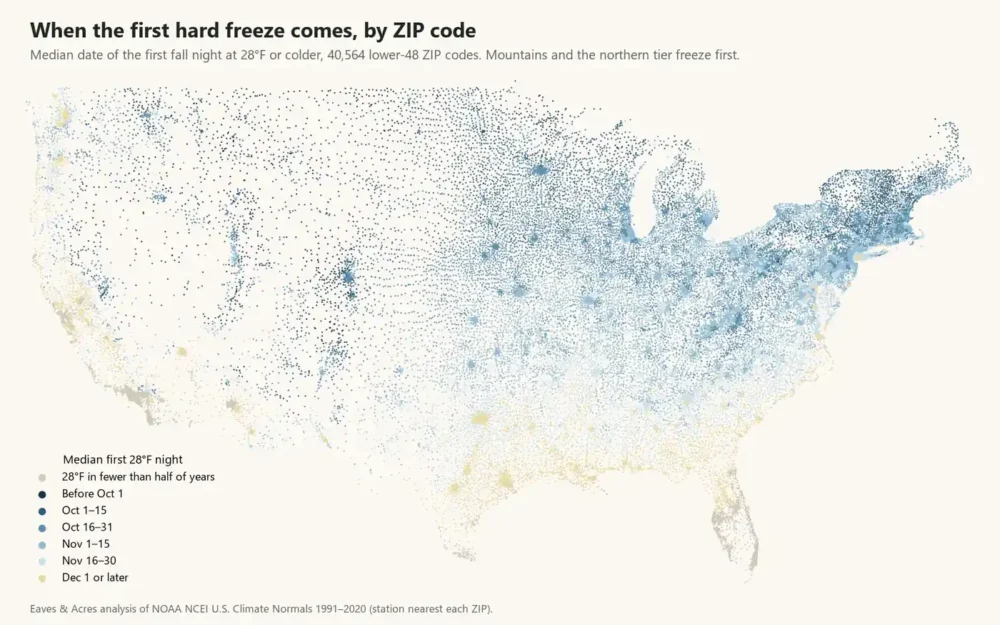
- 4A hard freeze comes in most years in 93% of lower-48 ZIP codes, but blow-outs are for ground that freezes to pipe depth. Texas A&M says most Texas systems aren’t designed for one.
- 5Leave the blow-out to a licensed irrigation contractor, as Hunter, Toro, Rain Bird and the University of Minnesota advise, and set the backflow preventer’s valves half open at 45°.
Winterize your sprinkler system before the first fall freeze, and no later than the first hard freeze of 28°F. In a normal year the first freeze comes about October 12 in Denver, October 16 in Minneapolis, October 31 in Detroit, November 5 in Chicago and November 9 in Boston, and in half of years it comes earlier.
Most guides give one month for a whole region. Below are freeze dates for 31 US cities from NOAA’s 1991–2020 climate normals, checked against local advice, plus the three ways to drain a system and how to protect the backflow preventer.
First freeze or hard freeze: which date to plan around
Hunter Industries says the blow-out comes “before the first freeze”9 and Rain Bird’s homeowner guide says water should be removed “before freezing occurs”.6 Salt Lake City Public Utilities says before the first frost,14 and Broomfield, Colorado, says before the first hard frost.13 The National Weather Service defines a hard freeze as 28°F or lower for an extended time,2 the colder night that separates a hard freeze from an ordinary frost or freeze.
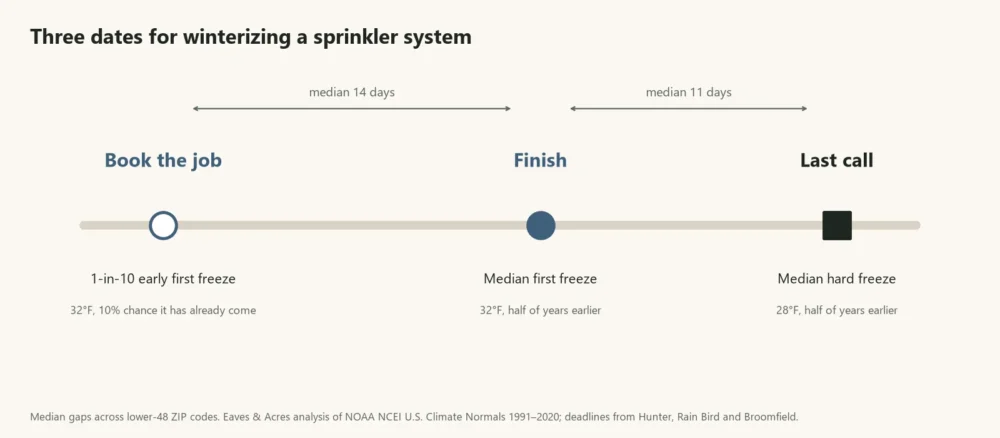
Across 37,570 ZIP codes in the lower 48 states that get both in most years, the median hard freeze comes a median 11 days after the median first freeze.1 A median is a coin flip, though. The 1-in-10 early date, when there is already a 10% chance of a first freeze, falls a median 14 days before the median date.1 So a practical plan has three dates:
- Book the job by the 1-in-10 early freeze date. Rain Bird notes that many irrigation specialists offer winterization services at this time of year.7
- Finish by the median first freeze, the deadline most of the sources use.
- Treat the median hard freeze as the last call. By then, half of years have already had one.
Exposed parts are most at risk. The University of Minnesota flags above-ground pipes around backflow preventers,4 and Hunter warns that ice in a backflow assembly can crack its brass body.9
Loads from YouTube (privacy-enhanced mode) only when you press play.
When to winterize sprinklers in your city
Each city uses the weather station nearest a downtown ZIP code, sorted by median first freeze.1
| City (ZIP) | Book by (1-in-10) | Finish by (median) | Hard freeze (median) |
|---|---|---|---|
| Billings, MT (59101) | Sep 19 | Oct 1 | Oct 12 |
| Colorado Springs, CO (80903) | Sep 26 | Oct 8 | Oct 16 |
| Madison, WI (53703) | Sep 26 | Oct 9 | Oct 20 |
| Grand Rapids, MI (49503) | Sep 29 | Oct 10 | Oct 23 |
| Denver, CO (80202) | Sep 28 | Oct 12 | Oct 21 |
| Boise, ID (83702) | Sep 27 | Oct 12 | Oct 24 |
| Albany, NY (12207) | Oct 3 | Oct 15 | Oct 28 |
| Minneapolis, MN (55401) | Oct 2 | Oct 16 | Oct 27 |
| Omaha, NE (68102) | Oct 6 | Oct 21 | Oct 30 |
| Worcester, MA (01608) | Oct 6 | Oct 21 | Nov 1 |
| Indianapolis, IN (46204) | Oct 7 | Oct 21 | Nov 1 |
| Columbus, OH (43215) | Oct 13 | Oct 24 | Nov 3 |
| Pittsburgh, PA (15222) | Oct 13 | Oct 27 | Nov 5 |
| Reno, NV (89501) | Oct 10 | Oct 27 | Nov 8 |
| Detroit, MI (48201) | Oct 17 | Oct 31 | Nov 9 |
| Nashville, TN (37201) | Oct 18 | Oct 31 | Nov 9 |
| Kansas City, MO (64105) | Oct 21 | Nov 2 | Nov 11 |
| Chicago, IL (60601) | Oct 24 | Nov 5 | Nov 15 |
| Newark, NJ (07102) | Oct 25 | Nov 6 | Nov 19 |
| Salt Lake City, UT (84101) | Oct 23 | Nov 8 | Nov 18 |
| Washington, DC (20001) | Oct 26 | Nov 8 | Nov 20 |
| Atlanta, GA (30303) | Oct 27 | Nov 8 | Nov 20 |
| Raleigh, NC (27601) | Oct 28 | Nov 8 | Nov 23 |
| Boston, MA (02108) | Oct 29 | Nov 9 | Nov 21 |
| Hempstead, NY (Long Island) (11550) | Oct 31 | Nov 12 | Nov 25 |
| Philadelphia, PA (19103) | Nov 4 | Nov 17 | Nov 29 |
| Austin, TX (78701) | Nov 1 | Nov 17 | Dec 1 |
| Seattle, WA (98101) | Nov 1 | Nov 17 | Dec 2 |
| New York, NY (10001) | Nov 6 | Nov 20 | Dec 1 |
| Dallas, TX (75201) | Nov 10 | Nov 29 | Dec 12 |
| Houston, TX (77002) | Nov 27 | Dec 25 | Jan 5 |
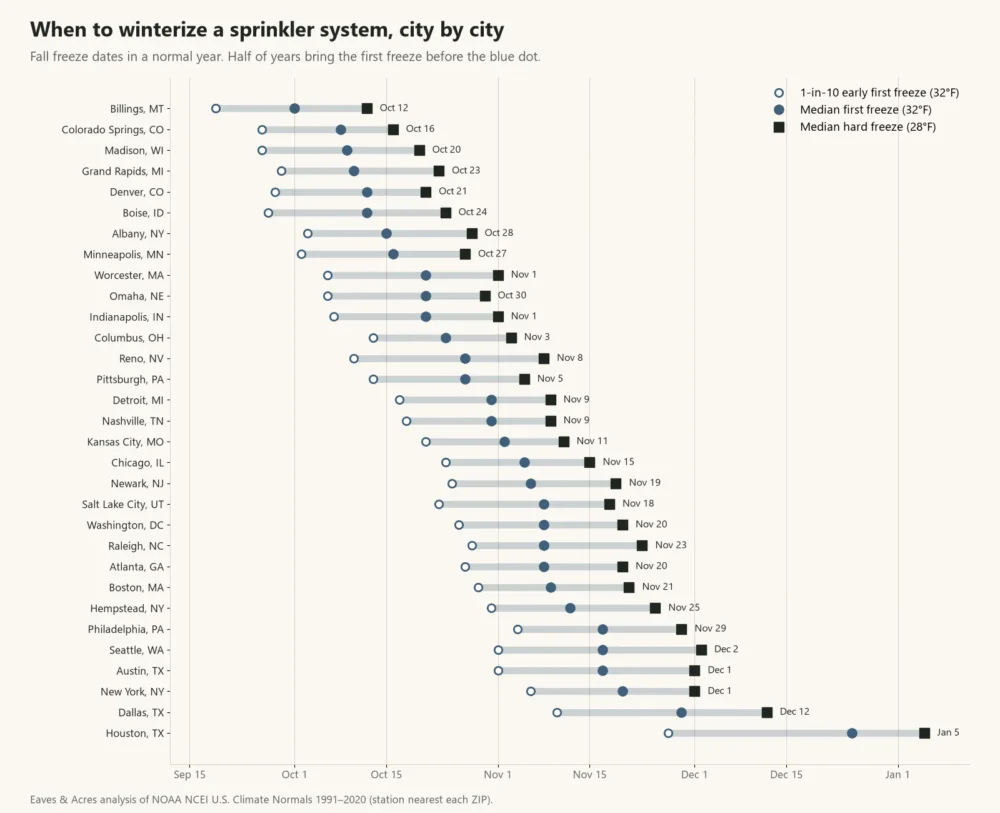
Denver, Boise and Colorado Springs reach their median first freeze in the first half of October, New York and Philadelphia not until mid- to late November, and Dallas and Houston later still. For any other place, look up your ZIP code’s first frost and hard-freeze dates.
Do the dates match local utility advice?
Four Colorado and Utah cities and utilities publish their own timing. We compared it with the computed dates:
| Place (ZIP) | Published advice | 1-in-10 early freeze | Median first freeze | Median hard freeze |
|---|---|---|---|---|
| Greeley, CO (80631) | First freeze usually in October; winterize mid-month (City of Greeley) | Sep 26 | Oct 8 | Oct 18 |
| Colorado Springs, CO (80903) | In October; earlier at higher elevation (Colorado Springs Utilities) | Sep 26 | Oct 8 | Oct 16 |
| Broomfield, CO (80020) | Stop lawn watering before Oct 30; winterize before the first hard frost (City and County of Broomfield) | Sep 26 | Oct 11 | Oct 21 |
| Salt Lake City, UT (84101) | Before the first frost (Salt Lake City Public Utilities) | Oct 23 | Nov 8 | Nov 18 |
Greeley’s mid-October advice lands between its median first freeze and median hard freeze.12 Colorado Springs Utilities’ “in October” covers both medians,11 though one year in ten the first freeze comes in late September. Broomfield’s October 30 date is a watering cutoff, 9 days after the area’s median hard freeze, not a winterizing date.13
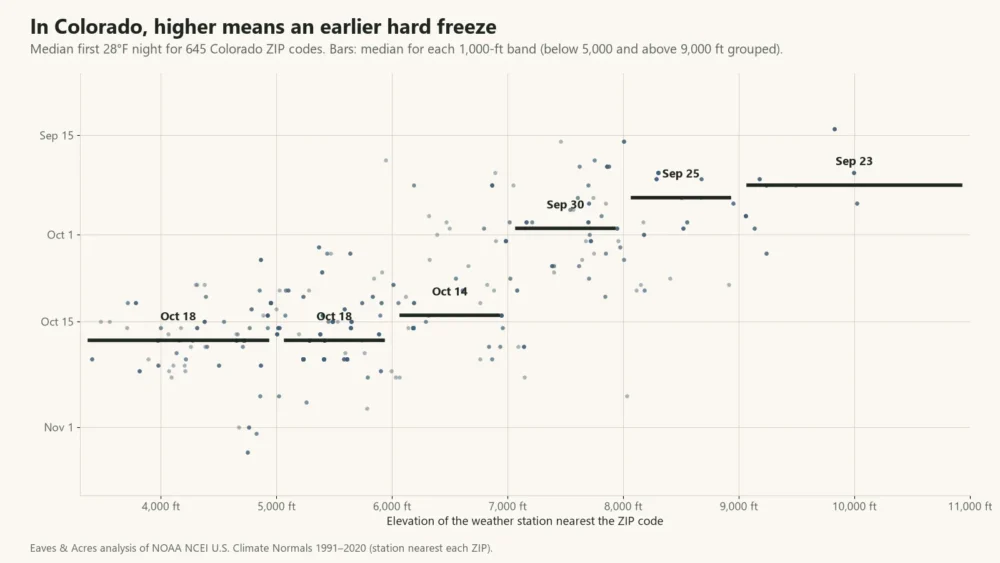
Colorado Springs Utilities also says that the higher the elevation, the earlier you should winterize.11 The data agrees. Across 645 Colorado ZIP codes, the median hard freeze comes about October 18 where the nearest station is below 6,000 feet, September 30 at 7,000 to 8,000 feet and September 23 above 9,000 feet.1
Why waiting for freezing nights is too late
A common rule says to winterize once nighttime temperatures stay below 32°F. By then the first freeze has usually come and gone. In the 30,031 lower-48 ZIP codes where the normal nightly low does drop below 32°F, it does so a median 29 days after the median first freeze.1 In 8,992 more, a freeze still comes in most years, but the normal low never reaches 32°F at all.
Do you need to winterize where you live?
Almost everyone gets a hard freeze. In 92.6% of lower-48 ZIP codes a 28°F night comes in at least half of years, including 94.8% of Texas ZIP codes.1 Another 3.6% get a 32°F freeze most years but a hard freeze less often, and 3.8% rarely freeze at all, mostly in California and Florida, plus the Phoenix area.
A cold night on the thermometer is not the same as frozen ground at pipe depth, and that decides how far you go. Hunter describes the blow-out as the priority where the frost level extends below the depth of the pipes.9 The Texas A&M School of Irrigation says the method is most common in the northern US, where the ground freezes down to buried pipelines, and adds:5
Most landscape irrigation systems in Texas are not designed for a blow out.
For most of Texas, its steps for light to mild freezes are to turn off the controller and the irrigation water supply, insulate PVC pipe above ground, and drain above-ground parts such as the backflow assembly.5
Manual drain, automatic drain or blow-out
Rain Bird’s homeowner guide names three ways to get the water out:6
| Method | How it works | What the sources warn |
|---|---|---|
| Manual drain | Drain valves at the lowest points of the mainline, opened by hand after the water supply is shut off (Rain Bird) | Use it only if you can confirm drain valves at the ends and low points of the piping (Hunter). The valve is under pressure: relieve the pressure first and wear eye protection (Rain Bird) |
| Automatic drain | Spring-loaded valves at the low points of the lines after the zone valves; they open every time the system shuts off (Rain Bird) | Not for the mainline (Rain Bird). They can stick open or closed (Medford Water) |
| Blow-out | Compressed air pushes the remaining water out through the sprinkler heads (Rain Bird) | The most thorough method (CSU Extension, Medford Water), and the one the manufacturers recommend leaving to a professional (Hunter, Toro, Rain Bird) |
In freezing Colorado, CSU Extension’s fact sheet on preparing a home sprinkler system for winter doesn’t rely on drains at all:3
Do not trust manual or automatic drain valves.
Buried pipe shifts over time, the lines can’t be inspected afterward, and electric valves can only be emptied with air, it explains.3 If you don’t know how your system was built, Hunter says to use the blow-out method.9
Blow-outs: what the manufacturers’ safety notes say
Rain Bird and Hunter warn that compressed air can cause injury from flying debris. Their safety notes, with CSU’s and Toro’s:
- Wear eye protection and never stand over pipes, sprinklers or valves during a blow-out.6,9
- Pressure limits differ by source. Rain Bird’s guide and Toro’s installation guide say not to exceed 50 psi.6,10 Hunter and CSU allow up to 80 psi for rigid PVC but 50 psi for flexible polyethylene pipe.9,3 A 2025 Rain Bird blog post gives both 50 psi and 75–85 psi.8 Hunter adds that pressure must stay below the rating of the lowest-rated part in the zone.9
- Rain Bird warns that air heats the pipes, so no zone should be blown for more than 2 minutes at a time.6
- Never blow air through the backflow preventer; Hunter and CSU say to blow out the lines downstream of it.9,3
Hunter says it is best for a qualified licensed contractor to do it,9 Toro recommends hiring a professional for any compressed-air winterizing,10 and Rain Bird recommends a local irrigation specialist because of the safety risks.7 The University of Minnesota is the most direct:4
we strongly recommend you leave this step in the hands of a professional.
It suggests a WaterSense or Irrigation Association certified professional;4 the EPA keeps a directory of WaterSense certified professionals.16
Protecting the backflow preventer
The sources agree on the winter position for the backflow preventer’s valves:
- Leave the ball valves half open, at about 45° to the pipe. CSU says fully open or fully closed valves tend to trap water.3,4,9
- Open the test cocks. The University of Minnesota says to turn their screws a quarter turn, to 45°.4,9
- Insulate it if it is above ground, without blocking its air vents and drain outlets, Rain Bird says.7
- Don’t use its valves as the system’s main shutoff; Medford Water says they need to stay partly open so they can drain.15
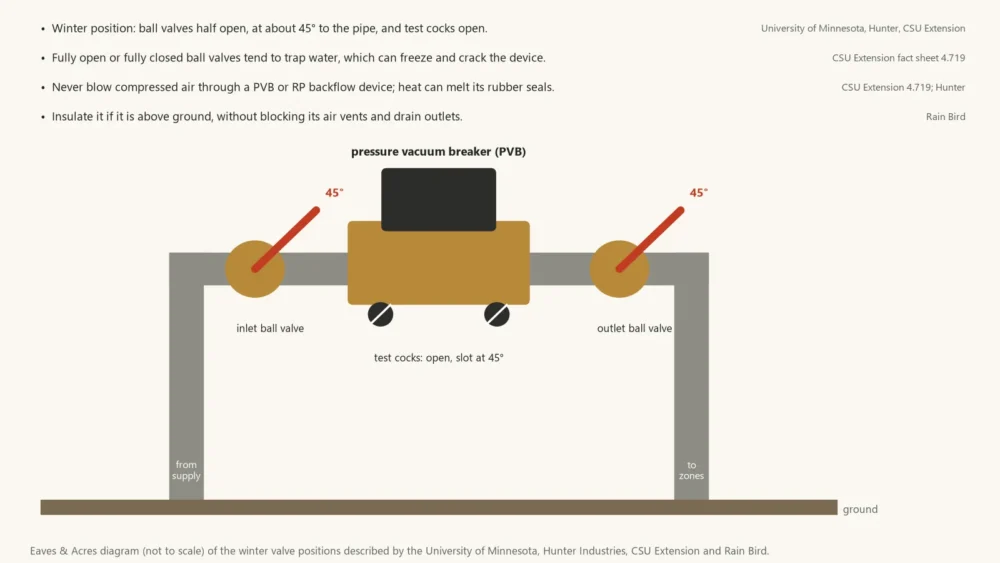
CSU gives separate steps for pressure vacuum breakers and reduced pressure assemblies, and Rain Bird says to check with your device’s manufacturer.3,6
The controller, and your lawn after shutdown
Rain Bird and Hunter describe leaving the controller powered but set to off or rain mode, which keeps the program and keeps the box warm enough to avoid condensation; CSU also says not to unplug it.7,9,3 Systems with a pump need extra steps, so check the manual.6
Your lawn usually keeps growing after the sprinkler is drained. By the 50°F daytime-high rule in our guide to when lawns stop growing in fall, normal highs stay above 50°F for a median 22 more days after the hard freeze in 96.7% of the ZIP codes where both happen.1 If you shut the system off early, Colorado Springs Utilities says to water with a hose rather than stop for the rest of the year.11 It suggests fertilizing just before winterizing, or watering it in with a hose-end sprinkler;11 see when to apply winterizer fertilizer and how much to water your lawn.
Next steps
Look up your dates, book the work for the 1-in-10 early freeze date, and watch the forecast. Pool plumbing needs its own freeze protection; see when to close your pool. For the house’s own pipes and outdoor faucets, see at what temperature pipes freeze.
 Related guideHow Much to Water Your Lawn, and How Much Your Rain Already Covers
How we got the dates
All dates come from NOAA NCEI’s 1991–2020 U.S. Climate Normals for the station nearest each ZIP code.1 Freeze dates are NOAA’s 10% and 50% probability dates for the first fall night at 32°F and 28°F in the air, not at pipe depth. We show a hard-freeze date only where a 28°F night comes in at least half of years. For normal lows and highs, we placed each monthly normal at mid-month and joined them day by day, as our mowing guide does. Real years vary.
Frequently asked questions
Before your first freeze. In a normal year that is early to mid-October in Denver, Colorado Springs, Boise and Minneapolis, the second half of October in Omaha, Indianapolis and Detroit, early November in Chicago, Newark and Boston, and late November or later in Dallas. Look up your ZIP code for your own dates.
Exposed parts can. A 29°F night is below freezing, one degree short of the National Weather Service’s 28°F hard freeze. The University of Minnesota says above-ground pipes around backflow preventers are the main concern, and Hunter says ice can crack a backflow body. Buried pipes are at risk where the ground freezes to their depth. If a freeze is forecast before you winterize, Colorado Springs Utilities says to drain and cover exposed backflow devices and pipes.
Plan by date rather than by one night’s temperature. The sources’ deadlines are the first freeze (32°F) or, at the latest, the first hard freeze (28°F). Waiting until nights stay below 32°F is too late: by NOAA normals that comes a median 29 days after the median first freeze.
The first steps, yes. The University of Minnesota says homeowners can check the zones, shut off the water and release the pressure. For the compressed-air blow-out, Hunter says it is best done by a qualified licensed contractor, Toro recommends a professional, and the University of Minnesota strongly recommends leaving it to one.
Usually only partly. A 28°F night comes in most years in 94.8% of Texas ZIP codes, but Texas A&M says most Texas systems aren’t designed for a blow-out. Its steps for light to mild freezes are to turn off the controller and the water supply, insulate exposed PVC pipe and drain above-ground parts such as the backflow assembly. The median first freeze is about Nov 29 in Dallas and Dec 25 in Houston.
Only if it was built for it. Rain Bird describes manual drain valves at the low points of the mainline and automatic drain valves on the lines after the zone valves, and Hunter says to use the manual method only if you can confirm drains at the ends and low points. CSU Extension, in Colorado, says not to trust drain valves and to blow the system out.
In October along the Front Range, earlier in the mountains. The median first freeze comes about Oct 8 in Colorado Springs and Greeley and Oct 12 in Denver, with the median hard freeze 8 to 10 days later. Colorado Springs Utilities says to winterize in October, and earlier at higher elevation; above 9,000 feet the median hard freeze is Sep 23.
Not by simply opening the valve. For a pressure vacuum breaker, CSU Extension says to close the test cocks and ball valves before pressurizing the system, then open the ball valves slowly to avoid water hammer. Follow your system manufacturer’s start-up steps.
Sources
- 1.U.S. Climate Normals 1991–2020. NOAA National Centers for Environmental Information, 2021. Used for: 10% and 50% first-freeze (32°F) and 50% hard-freeze (28°F) dates, monthly low and high normals, station elevations for every ZIP and city Back to text
- 2.Glossary: Hard Freeze. NOAA National Weather Service, undated. Used for: 28°F hard-freeze definition Back to text
- 3.Home Sprinkler Systems: Preparing Your Sprinkler System for Winter (Fact Sheet 4.719), C.E. Swift and M. Higgins. Colorado State University Extension, 2014, reviewed 2025. Used for: drain valves vs blow-out, pressure limits, never blow air through a PVB or RP, half-open valves, controller, spring start-up Back to text
- 4.Properly preparing irrigation systems for winter, Dan Sandor. University of Minnesota Turfgrass Science, 2018. Used for: exposed backflow pipes, homeowner first steps, professional blow-out, 45° ball valves and test cocks, WaterSense pros Back to text
- 5.Irrigation Winterization Resources. Texas A&M AgriLife, School of Irrigation, 2022. Used for: Texas light-freeze steps; blow-out a northern method; most Texas systems not designed for it Back to text
- 6.Homeowner’s Guide to Winterization. Rain Bird, undated. Used for: three drain methods, manual and automatic drain valves, blow-out safety notes and 50 psi limit, backflow and pump notes Back to text
- 7.How Do I “Winterize” My Irrigation System?. Rain Bird, undated. Used for: rain mode, insulating backflow preventers without blocking vents, local irrigation specialist recommended Back to text
- 8.Fall is Blow-Out Season: Tips for Winterizing Your Sprinkler System. Rain Bird, 2025. Used for: blow-out pressure figures (50 psi and 75–85 psi) Back to text
- 9.Winterizing Your Irrigation System. Hunter Industries, undated. Used for: before the first freeze; frost below pipe depth; licensed contractor; 50/80 psi; no air through backflow; 45° valves; controller; manual drains Back to text
- 10.Do-It-Yourself Sprinkler Planning & Installation Guide. The Toro Company, undated. Used for: winterization for cold climates, 50 psi limit, professional recommended for compressed air Back to text
- 11.Fall landscape Q&A. Colorado Springs Utilities, 2026. Used for: winterize in October, earlier at higher elevation, cold-snap backflow protection, hose watering and fertilizing Back to text
- 12.Time to Winterize: 4 Things to Add to Your To-Do List. City of Greeley Water and Sewer, 2024. Used for: first freeze usually in October; winterize mid-month Back to text
- 13.How To Winterize Your Sprinklers (video). City and County of Broomfield, The Broomfield Channel, 2016. Used for: stop lawn watering before Oct 30; winterize before the first hard frost Back to text
- 14.Fall conservation tips: Winterizing your sprinklers. Salt Lake City Public Utilities, undated. Used for: winterize before the first frost Back to text
- 15.Winterizing. Medford Water, 2025. Used for: backflow valves are not a main shutoff; automatic drains can stick Back to text
- 16.WaterSense: Find a Pro. U.S. Environmental Protection Agency, undated. Used for: directory of WaterSense certified professionals Back to text
- 17.Sprinklers + good light + 400mm lens (photo). Angelo DeSantis, via Wikimedia Commons, CC BY 2.0, accessed 2026. Used for: hero photo, cropped and resized
.jpg)
How this guide was made
- Written by the Yard & Garden Desk and reviewed by the Data & Methodology Desk.
- Data: freeze dates are the NOAA NCEI 1991–2020 probability dates for the first fall 32°F night (10% and 50%) and 28°F night (50%) at the station nearest each ZIP; a hard-freeze date is shown only where 28°F comes in at least half of years. Normal lows and highs are monthly normals interpolated to days. Deadlines from Hunter, Rain Bird, Salt Lake City and Broomfield. Real years vary. See our methodology.
- AI use: AI tools help us research, draft and check this guide. Every figure is checked against the source cited for it, and calculated figures come from our own code, described on the methodology page.
- Spotted an error? Tell us — the form opens with this page’s address filled in.
Change log
- Oct 5, 2026Published. Freeze dates for 31 cities (1-in-10 and median 32°F, median 28°F) from NOAA 1991–2020 normals, checked against Greeley, Colorado Springs Utilities, Broomfield and Salt Lake City; drain methods and backflow steps from CSU Extension, the University of Minnesota, Texas A&M, Rain Bird, Hunter and Toro.
Covers lawns, gardens, frost and planting. We write the guides and maintain the tools that tell you when to seed, feed and plant for your ZIP.
Keep reading
Should You Rake Leaves? When to Mulch, Rake or Leave Them
Usually not. Mow a light or moderate layer of leaves into the lawn until your last mow, and remove only what hides the grass. Extension thresholds, the research, and leaf deadlines for 20 US cities from NOAA normals.
When to Stop Mowing Your Lawn in Fall: The Last Mow Where You Live
Cool-season lawns stop growing when daytime highs stay below about 50°F; warm-season lawns stop at the first frost. Normal-year dates for 40 US cities, checked against extension advice.
How Much to Water Your Lawn, and How Much Your Rain Already Covers
Most lawns need about 1 inch of water a week, rain included. How often to water, how long to run a sprinkler, and how much normal summer rain covers in 21 US cities.
Seasonal reminders for your ZIP
Get a short email when it’s time to overseed, start seeds, open the pool or service your furnace — timed to your climate.