




When to Stop Mowing Your Lawn in Fall: The Last Mow Where You Live
Keep mowing while the grass grows. Here is when that normally ends in 40 US cities, from NOAA climate normals and two extension temperature rules, plus how short to cut the last mow.
- Last reviewed Oct 4, 2026
- 14 cited sources
- 10 min read
Set your ZIP to see dates for your area.
- 1Keep mowing until the grass stops growing. Cool-season lawns stop when daytime highs stay below about 50°F (Iowa State); growth slows earlier, when the daily mean falls below 50°F (Cornell).
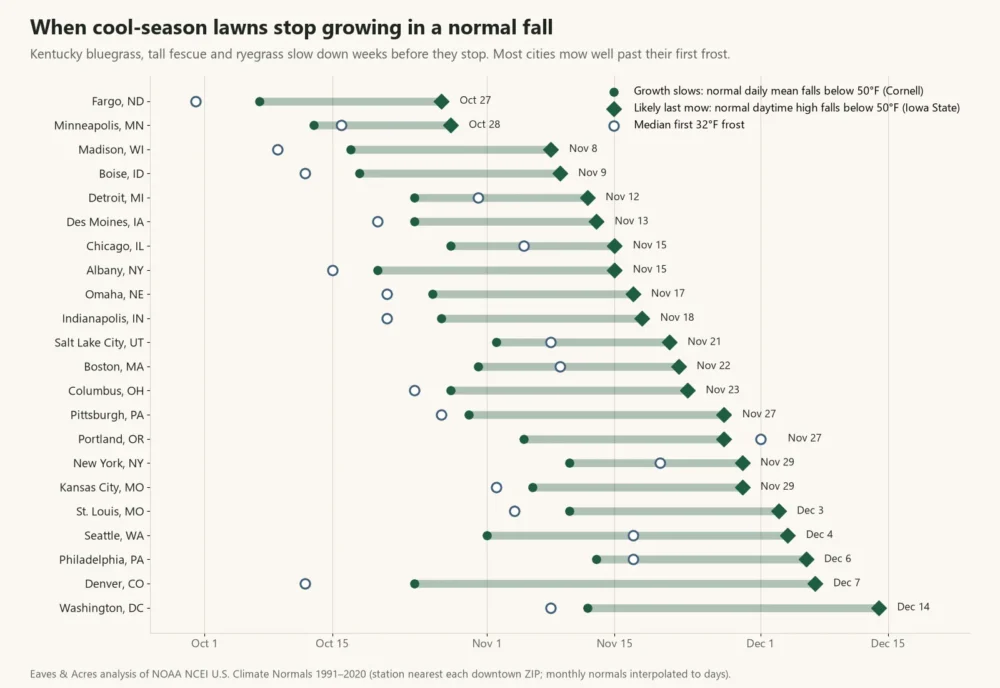
- 2In a normal year the last mow comes about Oct 28 in Minneapolis, Nov 15 in Chicago, Nov 23 in Columbus and Dec 6 in Philadelphia.
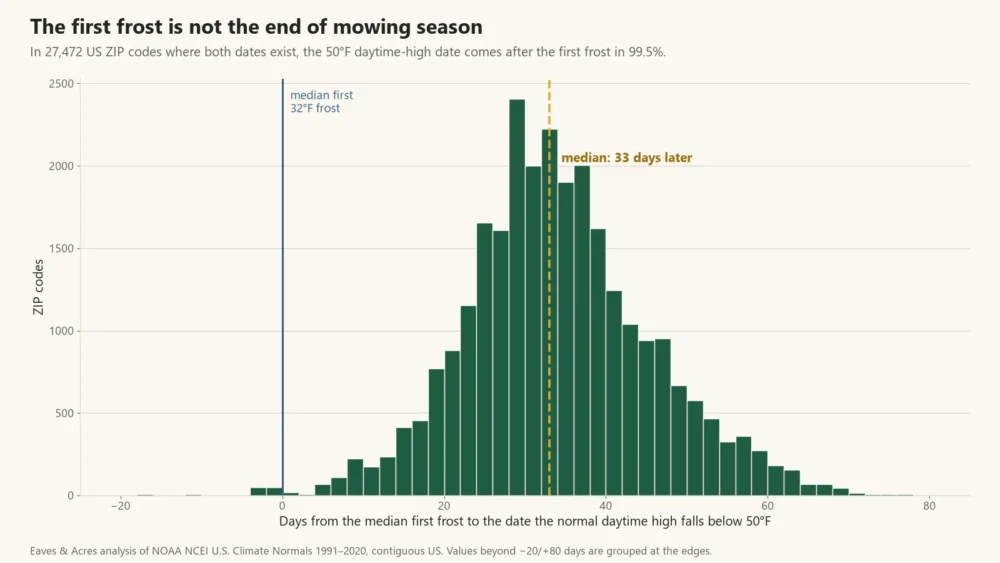
- 3The first frost is not the stop signal for cool-season grass: in 99.5% of ZIP codes the 50°F daytime high comes later, a median of 33 days after it.
- 4Warm-season lawns (Bermuda, zoysia, centipede, St. Augustine) stop at the first frost: about Nov 8 in Atlanta and Nov 29 in Dallas.
- 5Don’t scalp the last mow, and mulch light leaf cover with the mower instead of raking it.
Stop mowing your lawn in fall when the grass stops growing. For cool-season lawns that is when daytime highs stay below about 50°F, which in a normal year means late October in Minneapolis, mid-November in Chicago and Des Moines, and early December in Philadelphia. Warm-season lawns such as Bermuda grass and zoysia stop when the first frost sends them into dormancy.
Most guides give a month for your whole state. Below are normal-year dates for 22 cool-season and 18 warm-season cities, worked out from NOAA’s 1991–2020 climate normals and checked against what three extension services say about their own states.
Two temperature signals that end the mowing season
Cool-season grasses, which include Kentucky bluegrass, tall fescue, perennial ryegrass and the fine fescues, slow down as fall cools and then stop. Extension services describe the stopping point in two slightly different ways. Iowa State University Extension ties it to the daytime high: the foliage of cool-season grasses such as Kentucky bluegrass2
stops growing when daytime high temperatures are consistently below 50 degrees Fahrenheit
Cornell University’s turfgrass program uses the average of day and night instead:3
Top growth continues until the average daily temperature is consistently below 50°F.
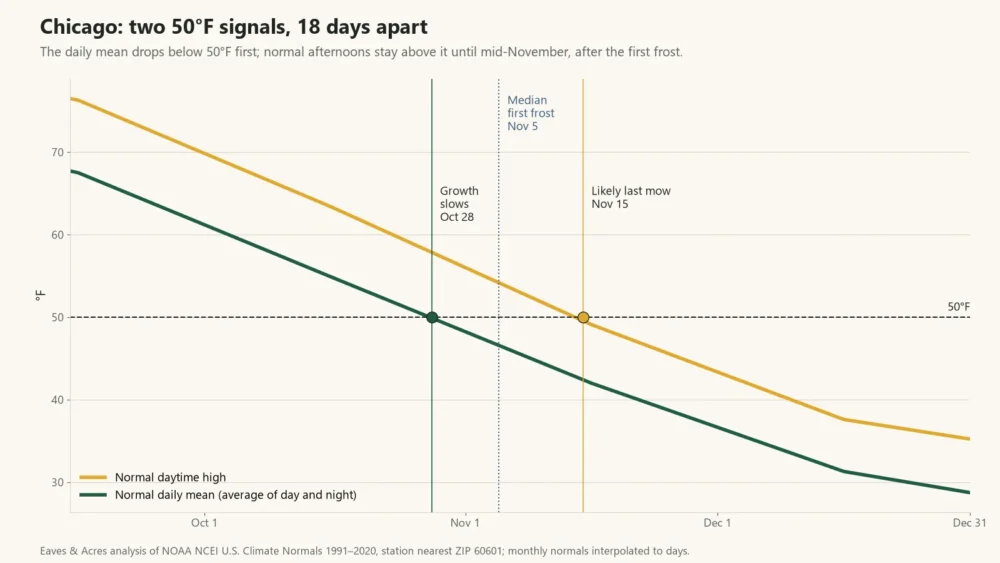
Both are useful, but they don’t mark the same day. The daily mean drops below 50°F first, a median of 26 days before the daytime high does.1 Read the earlier date as the point where growth slows and you can mow less often. The later date is when the last mow usually comes. Keep mowing in between whenever the grass needs it; Purdue’s advice is to continue as long as the grass is growing.4
When lawns stop growing in your city
We placed NOAA’s monthly normal temperatures at the middle of each month, joined them day by day, and found the first fall day each signal drops below 50°F at the weather station nearest each ZIP code.1 The frost column is the median date of the first 32°F night at that station; half of years bring it earlier.
| City (ZIP) | Growth slows (daily mean below 50°F) | Likely last mow (daytime high below 50°F) | Median first frost (32°F) |
|---|---|---|---|
| Fargo, ND (58102) | Oct 7 | Oct 27 | Sep 30 |
| Minneapolis, MN (55401) | Oct 13 | Oct 28 | Oct 16 |
| Madison, WI (53703) | Oct 17 | Nov 8 | Oct 9 |
| Boise, ID (83702) | Oct 18 | Nov 9 | Oct 12 |
| Detroit, MI (48201) | Oct 24 | Nov 12 | Oct 31 |
| Des Moines, IA (50309) | Oct 24 | Nov 13 | Oct 20 |
| Chicago, IL (60601) | Oct 28 | Nov 15 | Nov 5 |
| Albany, NY (12207) | Oct 20 | Nov 15 | Oct 15 |
| Omaha, NE (68102) | Oct 26 | Nov 17 | Oct 21 |
| Indianapolis, IN (46204) | Oct 27 | Nov 18 | Oct 21 |
| Salt Lake City, UT (84101) | Nov 2 | Nov 21 | Nov 8 |
| Boston, MA (02108) | Oct 31 | Nov 22 | Nov 9 |
| Columbus, OH (43215) | Oct 28 | Nov 23 | Oct 24 |
| Pittsburgh, PA (15222) | Oct 30 | Nov 27 | Oct 27 |
| Portland, OR (97204) | Nov 5 | Nov 27 | Dec 1 |
| New York, NY (10001) | Nov 10 | Nov 29 | Nov 20 |
| Kansas City, MO (64105) | Nov 6 | Nov 29 | Nov 2 |
| St. Louis, MO (63101) | Nov 10 | Dec 3 | Nov 4 |
| Seattle, WA (98101) | Nov 1 | Dec 4 | Nov 17 |
| Philadelphia, PA (19103) | Nov 13 | Dec 6 | Nov 17 |
| Denver, CO (80202) | Oct 24 | Dec 7 | Oct 12 |
| Washington, DC (20001) | Nov 12 | Dec 14 | Nov 8 |
These are normal-year dates. A warm November can keep a lawn growing for weeks longer, and a cold snap can end it early. For any other ZIP code, look up your frost dates and their odds.
Do the dates match local extension advice?
Three extension services publish a typical end of the mowing season for their own state. We compared them with our dates for towns in those states:
| Place | Daily mean below 50°F | Daytime high below 50°F | Published local guidance |
|---|---|---|---|
| Central Iowa: Ames / Des Moines / Marshalltown | Oct 18 / Oct 24 / Oct 17 | Nov 10 / Nov 13 / Nov 10 | Bluegrass usually stops growing in early to mid-November (Iowa State) |
| Minnesota: Minneapolis / St. Cloud / Rochester | Oct 13 / Oct 10 / Oct 7 | Oct 28 / Oct 27 / Nov 1 | Mow until growth stops, generally around the end of October (University of Minnesota) |
| Indiana: West Lafayette / Indianapolis / South Bend | Oct 24 / Oct 27 / Oct 22 | Nov 16 / Nov 18 / Nov 13 | Grass normally keeps growing into late October or early November (Purdue) |
In Iowa and Minnesota the daytime-high date lands right on the published timing, within days.2,5 Purdue’s Indiana guidance sits between the two dates.4 So treat the daytime-high date as your realistic last mow, and the mean date as the start of the slowdown.
Why the first frost isn’t your stop signal
Many guides tell you to stop mowing at the first frost, or a week before it. For cool-season grass, the data says otherwise. Across 27,472 ZIP codes in the lower 48 states where both dates occur in a normal year, the daytime high falls below 50°F after the median first frost in 99.5% of them, a median of 33 days later.1 By the extension temperature rules above, a cool-season lawn keeps growing on the mild afternoons that follow a first frost.
The opposite is also true in the South. In 32% of ZIP codes, the normal daytime high never falls below 50°F at all, including nearly all of Texas, Florida, Georgia and the Gulf Coast. There the 50°F rule never applies, and grass type decides when you stop. To time frost protection for the garden instead, see when to cover plants for frost.
Warm-season lawns: the first frost ends the season
Bermuda grass, zoysia, centipede and St. Augustine grass work differently. Mississippi State University Extension says warm-season grass keeps growing until the first frost marks the beginning of dormancy.9 Clemson’s factsheet says zoysia turns brown with the first fall frost and stays dormant all winter.11 So for these lawns, the median first frost is the realistic last-mow date:
| City (ZIP) | Median first frost (32°F) | Median hard freeze (28°F) | Years with a frost |
|---|---|---|---|
| Nashville, TN (37201) | Oct 31 | Nov 9 | 100% |
| Oklahoma City, OK (73102) | Nov 2 | Nov 11 | 100% |
| Charlotte, NC (28202) | Nov 3 | Nov 14 | 100% |
| Raleigh, NC (27601) | Nov 8 | Nov 23 | 100% |
| Atlanta, GA (30303) | Nov 8 | Nov 20 | 100% |
| Memphis, TN (38103) | Nov 10 | Nov 22 | 100% |
| Birmingham, AL (35203) | Nov 11 | Nov 24 | 100% |
| Columbia, SC (29201) | Nov 16 | Dec 2 | 100% |
| Austin, TX (78701) | Nov 17 | Dec 1 | 100% |
| Dallas, TX (75201) | Nov 29 | Dec 12 | 100% |
| Las Vegas, NV (89101) | Dec 8 | Dec 21 | 99% |
| Houston, TX (77002) | Dec 25 | Jan 5 | 90% |
| Charleston, SC (29401) | Dec 30 | Jan 8 | 92% |
| New Orleans, LA (70112) | Dec 31 | Jan 8 | 90% |
| Jacksonville, FL (32202) | Jan 5 | none in most years | 80% |
| Tampa, FL (33602) | none in most years | none in most years | 34% |
| Phoenix, AZ (85004) | none in most years | none in most years | 18% |
| Miami, FL (33130) | none in most years | none in most years | 11% |
Where a frost comes in only some years, as in Phoenix, Tampa and Miami, there is no reliable stop date: mow when the grass needs it. Not sure which kind of grass you have? Our guide to cool-season vs. warm-season grass shows how to tell.
How short to cut the last mow
Advice on the final cut ranges from “cut it short” to “leave it alone.” The extension sources agree on one thing: don’t scalp the lawn.
avoid the urge to set the mower down and scalp your lawn
Purdue explains that photosynthesis is still high in fall, and the leaf you leave on stores energy for winter and spring.4 The sources differ on small adjustments:
- Illinois Extension: the first and last mowing can be slightly shorter, but grass left very tall at the end of fall encourages weeds and disease.6
- NDSU Extension (North Dakota): make the final mowing at 2 inches, because tall grass is more likely to mat down and get snow mold.7
- University of Minnesota: keep the lawn at 3 inches or higher, and keep it mowed to height before winter, since grass left too long can bring disease and vole activity.5
- Warm-season grasses: UGA Extension in Forsyth County suggests cutting Bermuda, centipede and zoysia at the top of their 1–2-inch range, 2 inches, going into fall.12 Mississippi State suggests raising St. Augustine grass to 3 inches for winter hardiness.9
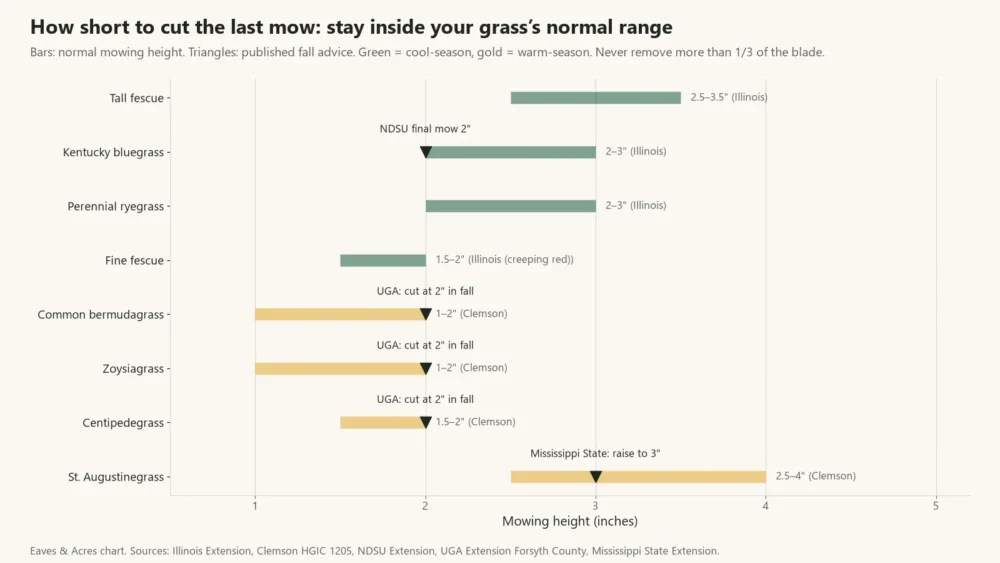
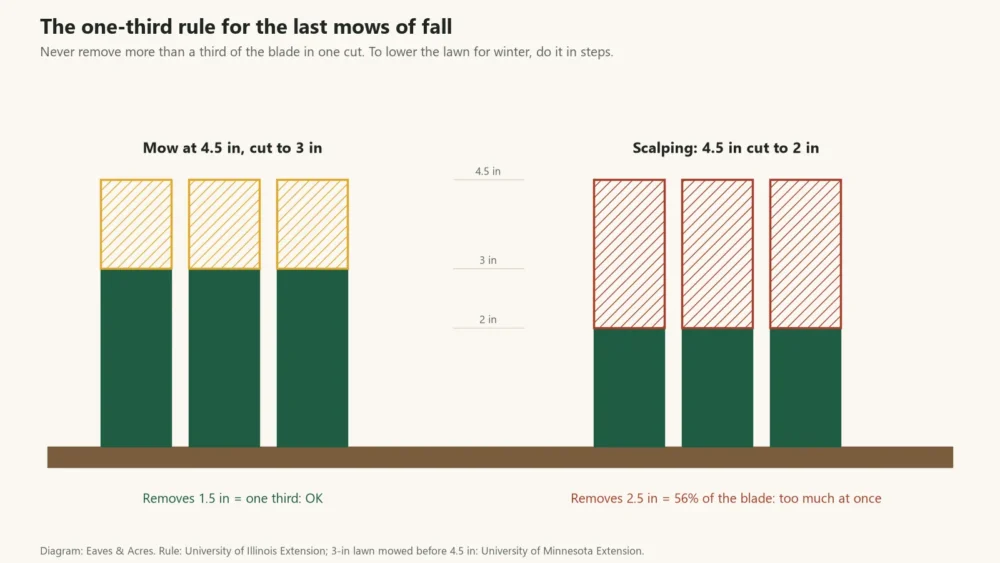
Put together: for a cool-season lawn, the low end of its normal range is as short as any of these sources goes (NDSU’s 2 inches is the bottom of the Kentucky bluegrass range). For warm-season grass, the advice is the top of the range. Either way, lower the mower in steps, because Illinois Extension’s rule is never to remove more than a third of the blade in one cutting.6 The normal ranges come from Illinois Extension for cool-season grasses and Clemson for warm-season grasses.6,10
Mulch the leaves with the mower
Your last few mowings can also deal with the leaves. Purdue’s turf team says oak and maple leaves can be mulched into the lawn with a mower without harming the soil or the grass. In its summary of research, mulched leaves didn’t add thatch, disease or weeds, and didn’t change soil pH.8
The limit is the amount. When leaves cover the lawn so thickly that you can’t see the grass, rake some off first, or the layer can smother the turf. Dry leaves mulch more easily than wet ones.8 The University of Minnesota also suggests bagging or raking up heavy debris at the last mow of the season.5
Signs the season is over
Temperatures give you a date to plan around; the grass gives you the final answer. Use the one-third rule as your test. To keep a 3-inch lawn, the University of Minnesota says to mow before it reaches 4.5 inches.5 If a week or more after your last cut the lawn still hasn’t grown enough to need mowing by that rule, and the daytime highs have settled below 50°F, you have probably made your last mow.
If the weather turns warm again and the grass starts growing, mow again. Wait for wet grass to dry first; Illinois Extension advises against mowing it wet.6
Before you put the mower away
- Sharpen the blade. A dull blade tears grass and leaves it more open to disease.6,5
- Time the last feeding. On cool-season lawns, the late-fall feeding is timed around the last mowing; see when to fertilize your lawn. On warm-season lawns, UGA warns that fall nitrogen can delay dormancy and expose the grass to cold injury.12
- Keep watering in a dry fall. UGA notes that warm-season lawns still need about an inch of water a week as they slow down.12 Our guide to how much to water your lawn shows how much your rain already covers.
- Store the mower by its manual. Fuel, oil and battery storage differ by model, so follow the manufacturer’s instructions.
 Related guideWhen to Fertilize Your Lawn: A Schedule by Grass Type and Climate
How we worked out these dates, and their limits
Each date uses NOAA NCEI’s 1991–2020 monthly normals for daily mean and daily maximum temperature at the station nearest the ZIP code.1 We put each month’s value at mid-month, interpolated the days in between, and took the first fall day below 50°F. “Consistently below 50°F” is our reading of that crossing in a normal year; real years cross earlier or later. Frost dates are the station’s median first 32°F and 28°F nights.
Three limits matter. First, some guides give soil-temperature cutoffs between 40°F and 50°F. We found no extension source for a soil threshold for the end of mowing, and our dataset has no soil temperatures, so we don’t estimate one. Second, a station can be a few miles away, and a valley or hilltop yard can differ by a week or more. Third, these are averages, not a forecast. The methodology page explains how every date on this site is calculated.
For the rest of the season’s yard work, see our mowing and watering guides. If your lawn is thin, check the last safe day to overseed before next fall, or in the North try dormant seeding this winter.
Frequently asked questions
It depends on where you live. For cool-season lawns, normal daytime highs fall below 50°F about Oct 28 in Minneapolis, Nov 12 in Detroit, Nov 23 in Columbus and Dec 6 in Philadelphia. Warm-season lawns stop at the first frost, in November across much of the South.
No. In most of the country cool-season grass is still growing in October. Of the 22 cool-season cities in our table, only Fargo and Minneapolis normally reach the end of growth by late October. Keep mowing while the grass keeps growing.
Usually November. Normal daytime highs fall below 50°F about Nov 12 in Detroit, Nov 10 in Grand Rapids and Lansing, and Nov 2 in Traverse City, and earlier in the Upper Peninsula (Oct 26 in Marquette).
Iowa State Extension says cool-season grass stops when daytime highs are consistently below 50°F; Cornell uses a daily average below 50°F, which comes a few weeks earlier. Warm-season grass goes dormant with the first frost.
Only slightly, if at all. Illinois Extension says the last mowing can be a little shorter, NDSU suggests 2 inches, and Purdue warns against scalping. Warm-season grasses go into fall at the top of their normal range.
Cool-season grass usually doesn't: by NOAA normals the 50°F daytime high comes a median of 33 days after the first frost. Warm-season grass does: Mississippi State and Clemson say the first frost starts its dormancy.
It depends on growth, not the calendar. Use the one-third rule: to keep a 3-inch lawn, the University of Minnesota says to mow before it reaches 4.5 inches. In late fall, if two weeks pass and the lawn still has not grown enough to need a cut, the season is probably over.
Mulch light to moderate leaf cover with the mower, which Purdue found does no harm to the lawn. Rake heavy layers that hide the grass, and the University of Minnesota suggests bagging or raking heavy debris at the last mow.
Sources
- 1.U.S. Climate Normals 1991–2020. NOAA National Centers for Environmental Information, 2021. Used for: daily mean and maximum temperature normals, first frost and hard-freeze dates for every ZIP and city Back to text
- 2.When can I stop mowing the lawn in the fall?. Iowa State University Extension and Outreach, Yard and Garden, 2021. Used for: 50°F daytime-high rule; central Iowa timing Back to text
- 3.Know Your Lawn. Cornell Turfgrass Program, undated. Used for: 50°F average-daily-temperature rule Back to text
- 4.Keep mowing and don’t set the mower down, Zac Reicher. Purdue University Turfgrass Science, 2009. Used for: Indiana timing, no scalping, fall photosynthesis, snow mold Back to text
- 5.Mowing practices for healthy lawns, Sam Bauer and Jonah Reyes. University of Minnesota Extension, 2024. Used for: Minnesota timing, 3-inch height, winter disease and voles, last-mow debris Back to text
- 6.Mowing Your Lawn. University of Illinois Extension, undated. Used for: mowing heights, one-third rule, wet grass, sharp blades, first and last mowing Back to text
- 7.Dakota Gardener: Snow Mold Is Affecting Lawns this Spring, Esther McGinnis. NDSU Extension, 2022. Used for: 2-inch final mowing, snow mold, no home-lawn fungicide Back to text
- 8.What To Do With All Those Falling Leaves?, Aaron Patton. Purdue University Turfgrass Science, 2013. Used for: mulching leaves into turf Back to text
- 9.Fall Lawn Guide. Mississippi State University Extension, undated. Used for: warm-season growth until first frost; St. Augustine height Back to text
- 10.Mowing Lawns (HGIC 1205), Robert F. Polomski and Debbie Shaughnessy. Clemson Cooperative Extension, Home & Garden Information Center, 1999. Used for: warm-season mowing heights Back to text
- 11.Zoysiagrass (HGIC 1212), Gary Forrester. Clemson Cooperative Extension, Home & Garden Information Center, 2018. Used for: zoysia turns brown with the first fall frost Back to text
- 12.Fall chores to ready warm-season lawns for winter, Heather N. Kolich. UGA Extension Forsyth County, 2025. Used for: fall mowing height, nitrogen and water for warm-season lawns Back to text
- 13.2375 and 1097 intersection, lawn with autumn leaves (photo). Nyttend, Wikimedia Commons, public domain, accessed 2026. Used for: hero photo, cropped and resized
- 14.Microdochium nivale (04) (photo). William M. Brown Jr., Bugwood.org, via Wikimedia Commons, CC BY 3.0 US, accessed 2026. Used for: snow mold photo, cropped and resized

.jpg)
How this guide was made
- Written by the Yard & Garden Desk and reviewed by the Data & Methodology Desk.
- Data: end-of-growth dates are the first fall day the NOAA NCEI 1991–2020 normal daily mean or daily maximum temperature falls below 50°F at the station nearest each ZIP (monthly normals interpolated to days); frost dates are the station’s median first 32°F and 28°F nights. Rules from Iowa State, Cornell, Mississippi State and Clemson extension. Real years vary. See our methodology.
- AI use: AI tools help us research, draft and check this guide. Every figure is checked against the source cited for it, and calculated figures come from our own code, described on the methodology page.
- Spotted an error? Tell us — the form opens with this page’s address filled in.
Change log
- Oct 4, 2026Re-checked against today’s search results and sources (Iowa State, Cornell, Purdue, Minnesota, NDSU). Added a FAQ on the time between mowings; table headers shortened for phones.
- Oct 3, 2026Published. End-of-growth dates for 22 cool-season and 18 warm-season cities from NOAA 1991–2020 normals using Iowa State and Cornell 50°F rules and the first-frost rule from Mississippi State and Clemson; checked against Iowa State, Minnesota and Purdue timing.
Covers lawns, gardens, frost and planting. We write the guides and maintain the tools that tell you when to seed, feed and plant for your ZIP.
Keep reading
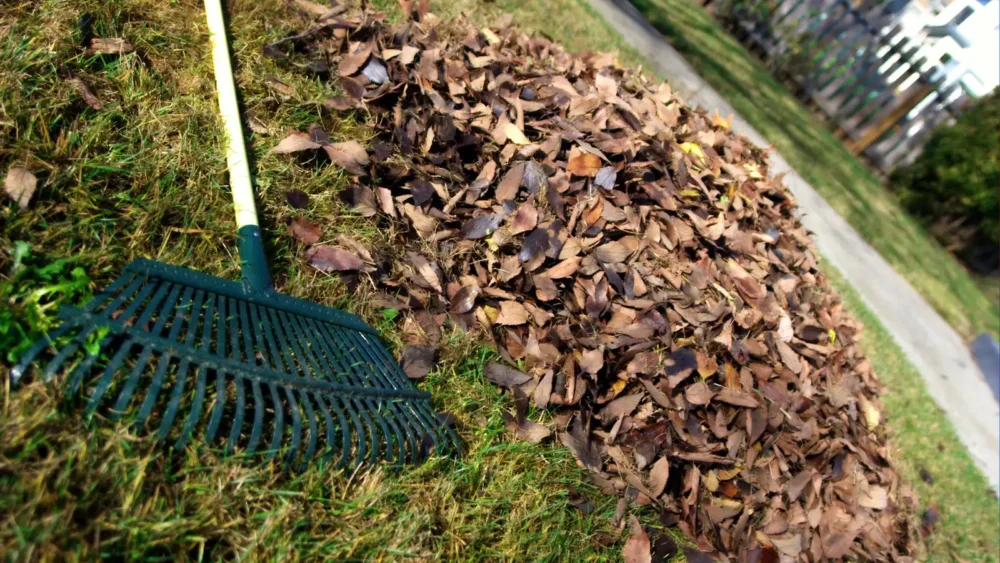
Should You Rake Leaves? When to Mulch, Rake or Leave Them
Usually not. Mow a light or moderate layer of leaves into the lawn until your last mow, and remove only what hides the grass. Extension thresholds, the research, and leaf deadlines for 20 US cities from NOAA normals.
When to Winterize Your Sprinkler System: Freeze Dates Where You Live
Drain a sprinkler system before the first fall freeze and no later than the first 28°F hard freeze. Normal-year freeze dates for 31 US cities from NOAA, the three drain methods and backflow protection.
How Much to Water Your Lawn, and How Much Your Rain Already Covers
Most lawns need about 1 inch of water a week, rain included. How often to water, how long to run a sprinkler, and how much normal summer rain covers in 21 US cities.
Seasonal reminders for your ZIP
Get a short email when it’s time to overseed, start seeds, open the pool or service your furnace — timed to your climate.