




Cool-Season vs. Warm-Season Grass: How to Tell Them Apart and Where Each Grows
The two grass families run on opposite calendars. How to tell yours apart, where each one grows, and how many prime growing weeks 24 US cities get, from NOAA normals.
- Last reviewed Oct 4, 2026
- 19 cited sources
- 9 min read
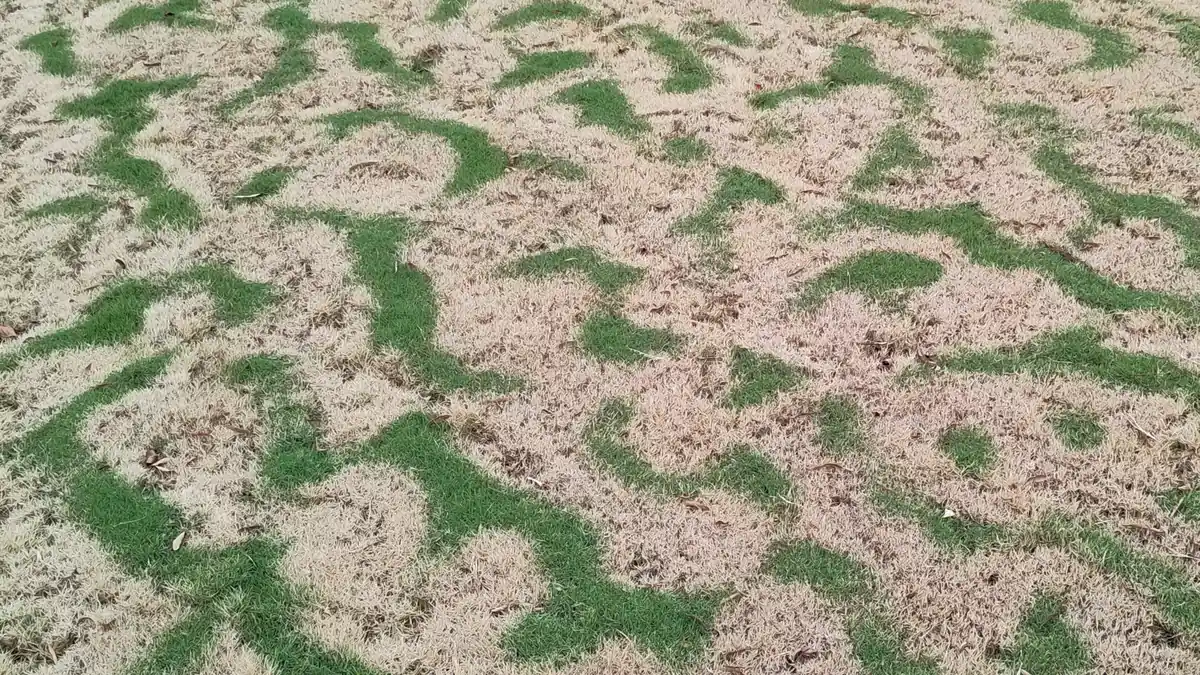
- 1Cool-season grasses (Kentucky bluegrass, tall fescue, ryegrass, fine fescue) grow best at daytime highs of 60–75°F; warm-season grasses (Bermuda, zoysia, St. Augustine, centipede) at 80–95°F.
- 2Easiest test: a lawn that turns tan after repeated frosts and stays tan for months (4–5 in Virginia) is warm-season. Runners lying on the soil also point to warm-season grass.
- 3The transition zone, which extension services place from Virginia and the Carolinas to Arkansas, Oklahoma and northern New Mexico, can grow both types but suits neither perfectly.
- 4From NOAA normals: Seattle gets no warm-season prime weeks, Jacksonville 27, and transition-zone cities 13–24 weeks of each.
- 5Your grass type flips the lawn calendar: seed and feed cool-season lawns in late summer to fall, warm-season lawns in late spring to summer.
Cool-season grasses (Kentucky bluegrass, tall fescue, perennial ryegrass and the fine fescues) grow best when daytime highs run 60–75°F, so they peak in spring and fall. Warm-season grasses (Bermuda grass, zoysia, St. Augustine and centipede) grow best at 80–95°F, peak in summer and turn tan once repeated frosts arrive. The quickest way to tell yours apart is to look at the lawn in midwinter, then check whether it spreads by surface runners.
Below: three identification checks, where each type grows, and the prime growing weeks 24 US cities get, from NOAA’s 1991–2020 normals.
Cool-season and warm-season grass at a glance
The split is biological: cool-season grasses use C3 photosynthesis and warm-season grasses C4. That is why cool-season grasses handle frost and low light better, while warm-season grasses need more heat and light but less water, Illinois Extension explains.6 (For how much each needs, see our guide to how much to water a lawn.)
| Trait | Cool-season | Warm-season |
|---|---|---|
| Common lawn species | Kentucky bluegrass, tall fescue, perennial ryegrass, fine fescues | Bermuda grass, zoysia, centipede, St. Augustine; also buffalograss and bahiagrass |
| Best growth | Daytime highs 60–75°F | Daytime highs 80–95°F |
| Peak seasons | Spring and fall | Mid-spring through mid-fall |
| Summer | Often heat- and drought-stressed | Grows best; more drought tolerant |
| Winter | Tolerates frost; keeps more color | Dormant and tan after repeated frosts (4–5 months in Virginia) |
| How it spreads | Tall fescue and ryegrass in clumps; Kentucky bluegrass by rhizomes | Runners (stolons); Bermuda and zoysia also by rhizomes |
| Seeding window (Tennessee) | Late summer to early fall, by mid-October | Late spring to early summer, by June 30 |
| Typical lawn | Blends or mixtures of seed | One species; often sod, plugs or sprigs |
Sources: Virginia Tech,2 University of Tennessee,4 NC State,5 K-State3 and UF/IFAS.11
How to tell which grass you have
Mowing removes the flower heads botanists rely on, so you identify a lawn from its leaves and the way it spreads:
The seedhead, the main identifying feature, is not present in mowed turf.
Three checks, from easiest to most precise:
1. Look at the lawn in winter
A warm-season lawn goes tan after repeated frosts and stays tan until spring: about 4 to 5 months in a typical Virginia winter, says Virginia Tech. The dormant grass is not dead and still protects the soil.2 A cool-season lawn keeps more color, and Illinois Extension suggests using that timing as your first clue.6
Two things can fool this test. Where frost is rare, as in Miami or Phoenix, winter color tells you little. And a lawn that is green in January but wiry at the soil line may be dormant Bermuda overseeded with ryegrass for winter color.7
2. Find a runner, or a clump
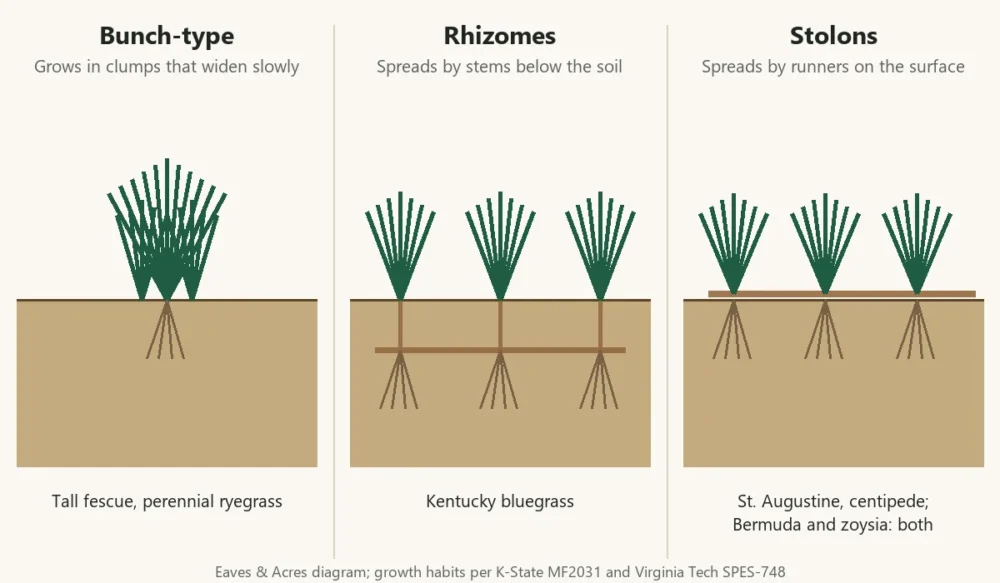
Grasses spread in one of three ways. Bunch-type grasses grow in clumps; rhizomes are stems that run below the soil; stolons are runners on the surface that root at their nodes.3 Tall fescue and ryegrass are bunch-type, Kentucky bluegrass has rhizomes, and Bermuda grass and zoysia have both rhizomes and stolons.3 A lawn knitted together by runners on the soil is almost certainly warm-season.
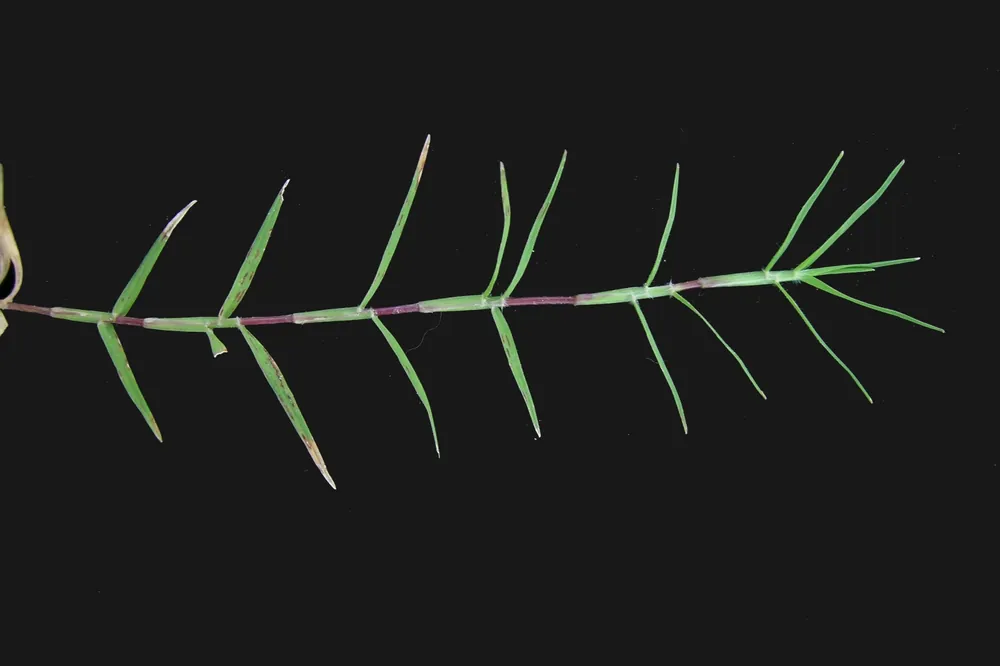
To tell the creepers apart, Virginia Tech notes that centipede shoots alternate along very large stolons, while St. Augustine’s even larger stolons put out shoots side by side, and its blades are the widest, with a blunt tip. Zoysia’s new shoots branch at right angles into a very dense turf.2
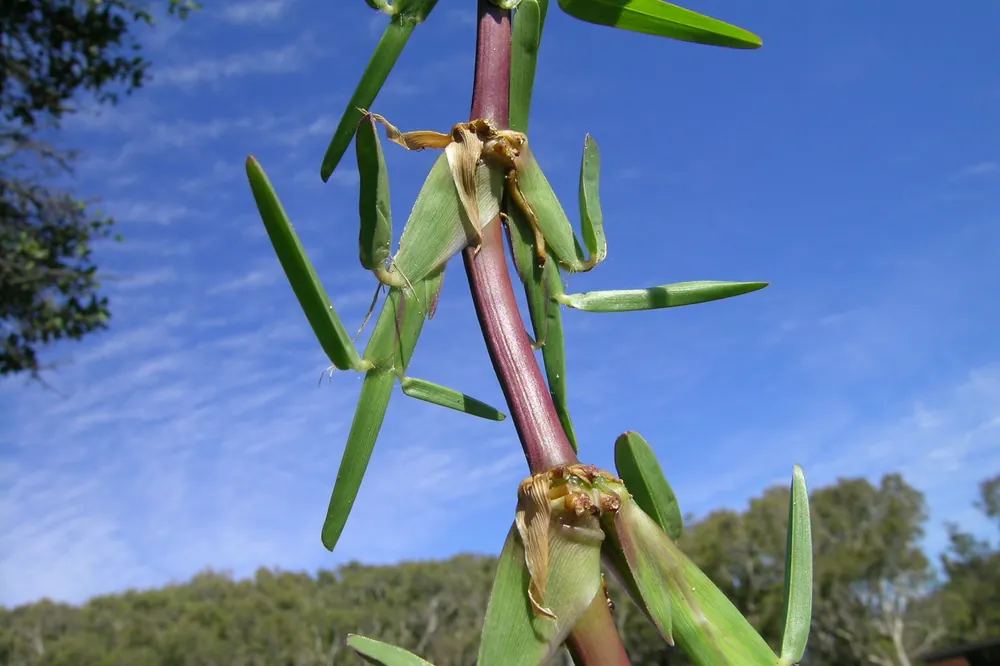
3. Check the leaf up close
Pull a few shoots and look where the blade meets the stem. K-State’s identification card (MF2031) checks whether the newest leaf is folded or rolled, the ligule (a membrane, a fringe of hairs, or nothing), the claw-like auricles and the blade.3
| Grass | Type | New leaf | Ligule | Auricles | Telltale sign |
|---|---|---|---|---|---|
| Kentucky bluegrass | Cool | Folded | Very short membrane | None | Boat-shaped tip; rhizomes |
| Tall fescue | Cool | Rolled | Short membrane | Short, blunt | Wide blades (1/8–1/4 in), strongly veined, rough edges |
| Perennial ryegrass | Cool | Folded | Membrane, toothed | Short | Very glossy underside; reddish at the base |
| Fine fescue | Cool | Folded | Very short membrane | None | Bristle-like blades, 1/16 in or less |
| Bermuda grass | Warm | Folded | Fringe of hairs | None | Collar with long hairs; stolons and rhizomes |
| Zoysia | Warm | Rolled | Fringe of hairs | None | Short, sharp-pointed blades, sparse hairs on top |
| St. Augustine | Warm | — | — | — | Widest blades, blunt rounded tip; thick stolons |
| Centipede | Warm | — | — | — | Light green; large stolons with alternating shoots |
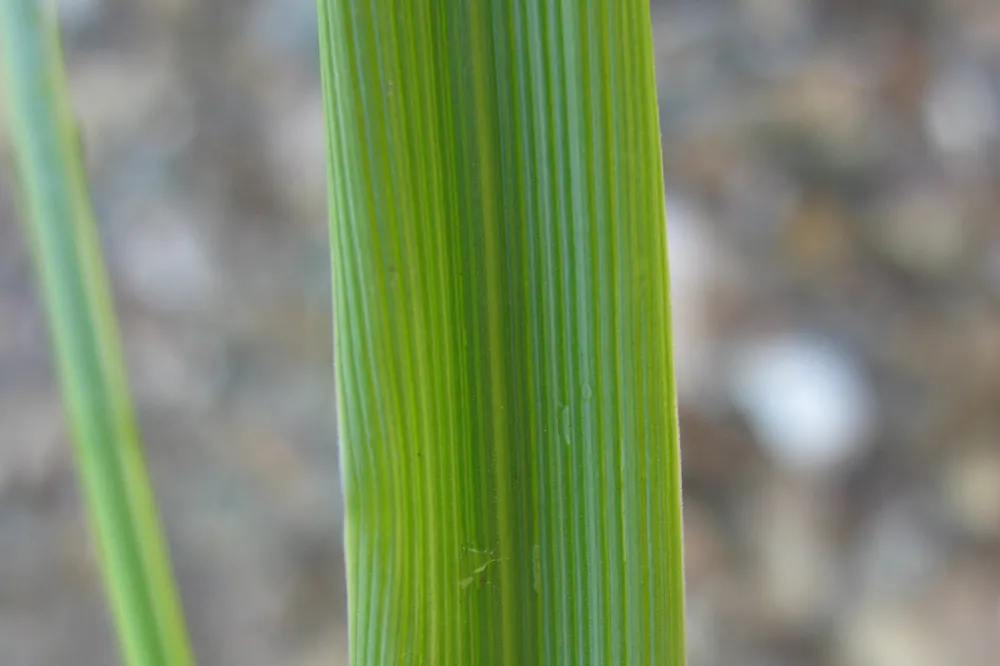
Cool-season lawns are usually seeded as blends or mixtures,2 so one handful may hold several of these. Still unsure? K-State suggests asking your local extension office.3
Where each type grows: North, South and the transition zone
Cool-season grasses dominate the North and the Pacific Northwest, warm-season grasses the South. In between lies the transition zone, cold enough in winter to challenge warm-season grass and hot enough in summer to challenge cool-season grass, says Texas A&M AgriLife Extension:
the transition zone is the most challenging region in which to grow grass
Extension services in North Carolina,5 Virginia,2 South Carolina8 and Arkansas9 place their states in it, and New Mexico State adds northern New Mexico and Oklahoma.10
Inside the zone, local conditions decide. Virginia Tech’s turf team admits the difficulty:
In Virginia, we can grow eight different turfgrasses, not very well!
Its guide favors cool-season grasses and zoysia in the mountains, adds cold-tolerant Bermuda and centipede in the southern Piedmont, and keeps St. Augustine to the southernmost coastal counties.2 In northern New Mexico, elevation largely decides.10 Florida is firmly warm-season: UF/IFAS says northern grasses grow there only from fall to early spring and do not survive the hot, humid summers.11
No boundary is official. One commercial guide lists parts of 24 states from California to New Jersey; another sends readers to the USDA Plant Hardiness Zone Map, which is built on the average annual extreme minimum winter temperature12 and ignores summer heat. We found no USDA map of turfgrass zones.
Prime growing weeks in 24 cities
Both grass groups are defined by daytime highs, so weather data can show how each fares in a city. We took the normal daily high at the nearest NOAA station (1991–2020 normals)1 and counted the weeks it sits at 60–75°F (cool-season prime) and at 80–95°F (warm-season prime), plus the frost season, from the median first fall frost to the median last spring frost.
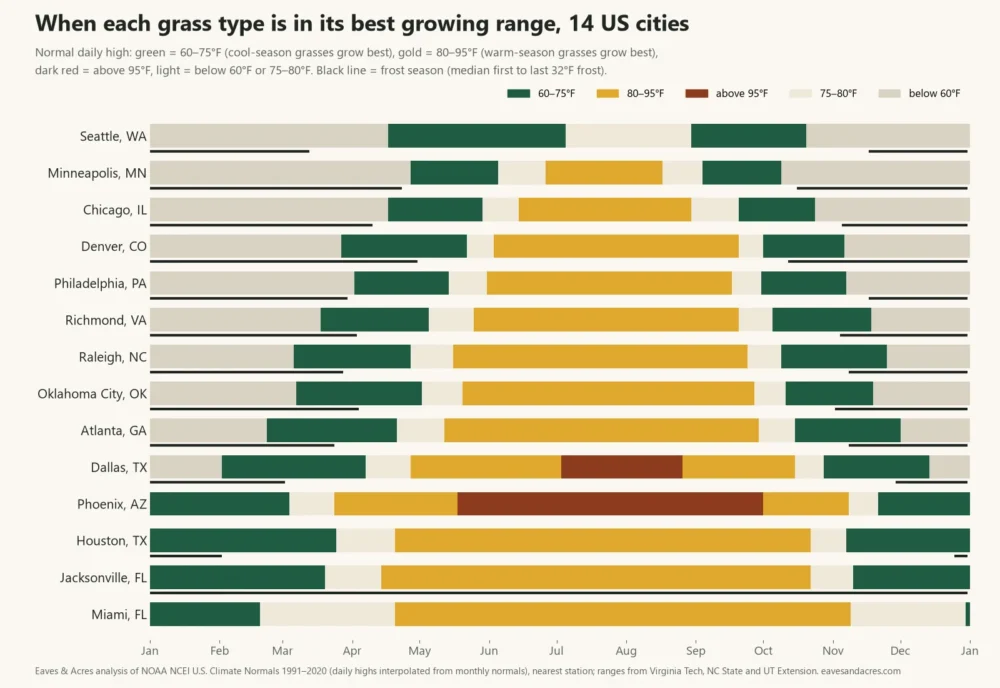
| City (ZIP) | Cool-season prime weeks (highs 60–75°F) | Warm-season prime weeks (highs 80–95°F) | Weeks with highs above 95°F | Frost season, months (median first – last frost) | What extension services say |
|---|---|---|---|---|---|
| Seattle, WA (98101) | 19 | 0 | 0 | 3.9 (Nov 17 – Mar 13) | — |
| Minneapolis, MN (55401) | 11 | 7 | 0 | 6.2 (Oct 16 – Apr 23) | — |
| Boston, MA (02108) | 13 | 6 | 0 | 4.8 (Nov 9 – Apr 4) | — |
| Chicago, IL (60601) | 11 | 11 | 0 | 5.2 (Nov 5 – Apr 10) | — |
| Denver, CO (80202) | 13 | 16 | 0 | 6.6 (Oct 12 – Apr 30) | — |
| Columbus, OH (43215) | 11 | 13 | 0 | 5.9 (Oct 24 – Apr 20) | — |
| Philadelphia, PA (19103) | 11 | 16 | 0 | 4.4 (Nov 17 – Mar 30) | — |
| Washington, DC (20001) | 12 | 17 | 0 | 4.6 (Nov 8 – Mar 29) | — |
| St. Louis, MO (63101) | 11 | 17 | 0 | 4.8 (Nov 4 – Apr 1) | — |
| Kansas City, MO (64105) | 12 | 16 | 0 | 5.1 (Nov 2 – Apr 4) | — |
| Santa Fe, NM (87501) | 13 | 13 | 0 | 6.5 (Oct 17 – May 2) | Northern NM: transition zone (NMSU) |
| Roanoke, VA (24011) | 13 | 16 | 0 | 5.1 (Nov 1 – Apr 3) | Transition zone state (Virginia Tech) |
| Richmond, VA (23219) | 13 | 17 | 0 | 4.9 (Nov 4 – Apr 3) | Transition zone state (Virginia Tech) |
| Norfolk, VA (23510) | 14 | 15 | 0 | 4.1 (Nov 16 – Mar 23) | Transition zone state (Virginia Tech) |
| Raleigh, NC (27601) | 14 | 19 | 0 | 4.5 (Nov 8 – Mar 28) | Transition zone (NC State) |
| Oklahoma City, OK (73102) | 14 | 19 | 0 | 5.0 (Nov 2 – Apr 4) | Transition zone state (NMSU) |
| Little Rock, AR (72201) | 13 | 20 | 0 | 4.3 (Nov 10 – Mar 21) | Transition zone (Arkansas Extension) |
| Columbia, SC (29201) | 20 | 24 | 2 | 3.9 (Nov 16 – Mar 16) | Transition zone (Clemson) |
| Atlanta, GA (30303) | 15 | 20 | 0 | 4.4 (Nov 8 – Mar 24) | — |
| Dallas, TX (75201) | 16 | 17 | 8 | 3.1 (Nov 29 – Mar 2) | — |
| Phoenix, AZ (85004) | 15 | 13 | 19 | none (frost rare) | — |
| Houston, TX (77002) | 20 | 26 | 0 | 1.2 (Dec 25 – Feb 2) | — |
| Jacksonville, FL (32202) | 19 | 27 | 0 | 1.2 (Jan 5 – Feb 1) | — |
| Miami, FL (33130) | 7 | 29 | 0 | none (frost rare) | — |
What the numbers show:
- Seattle never reaches the warm-season range: its normal July high is about 77°F.
- In Minneapolis and Boston, warm-season grass gets only 6–7 prime weeks, and the frost season lasts 4.8 to 6.2 months.
- In Houston and Jacksonville, the 60–75°F weeks fall in winter, from about November to March, while warm-season grass gets 26–27 prime weeks.
- In the cities extension services place in the transition zone, both ranges get 13–24 weeks and the frost season runs 3.9 to 6.5 months: a real season, and a real stress, for both types.
- Phoenix and Dallas spend 19 and 8 weeks above 95°F, past the best range of either group.
Do the numbers match extension observations?
| Place | Extension observation | NOAA normals (our analysis) |
|---|---|---|
| Virginia | Warm-season lawns dormant 4–5 months in a typical winter (Virginia Tech) | Frost season 4.1 months in Norfolk, 4.9 in Richmond, 5.1 in Roanoke; 6.2 in mountain Blacksburg |
| Jacksonville, FL | Northern grasses grow in north Florida only from fall to early spring (UF/IFAS) | Normal highs in the 60–75°F range from Nov 10 to Mar 19 |
| Farmington, NM | Cool-season grass greened up in late February to early March and kept a full canopy from mid-March to mid-November, while average daily temperature stayed above 40°F (NMSU) | Normal daily average above 40°F from Feb 28 to Nov 18 |
Blacksburg’s longer frost season fits Virginia Tech’s advice for the mountains.2 The Farmington row uses daily average temperature, the measure NMSU reported.10
What these numbers cannot tell you
They cannot draw the edge of the transition zone. Chicago, Columbus, Philadelphia and St. Louis look much like the transition-zone cities: 11 cool-season weeks, 11–17 warm-season weeks and 4.4–5.9 months of frost, against 13, 17 and 4.9 in Richmond. What keeps warm-season grass out of the North is winter injury, which depends on how cold it gets and how long and how wet the soil stays frozen (University of Tennessee).4 Monthly normals miss that, along with shade and unusual years. So we do not label any ZIP code cool-season, warm-season or transition zone; follow your state extension service and read the table as context.
What your grass type changes in the lawn calendar
Most lawn jobs are timed to when the grass grows hardest, so the two calendars are nearly opposite.
| Task | Cool-season lawn | Warm-season lawn |
|---|---|---|
| Seeding | Late summer to early fall; by mid-October in Tennessee | Late spring to early summer; by June 30 in Tennessee |
| Main feeding | Late summer to early fall; Aug 15–Sep 15 in central Illinois | After full green-up (early May in South Carolina); last one before Aug 15 there |
| Core aeration | Fall | Late spring and summer, while actively growing |
| Pre-emergent | Spring, against crabgrass | Mid-February to mid-March in South Carolina, plus September for winter weeds |
Sources: University of Tennessee,4 Illinois Extension,13 Clemson’s Bermuda grass calendar14 and Clemson’s aeration fact sheet.15 For dates in your area, see our guides to when to overseed a lawn, when to fertilize, when to apply winterizer, when to aerate, when to apply pre-emergent, when to stop mowing and when to dormant seed.
 Related guideWhen to Fertilize Your Lawn: A Schedule by Grass Type and Climate
Your next step
Run the three checks, then look up your frost dates by ZIP code: on a warm-season lawn, the first fall frosts start the browning. More seasonal jobs are in our lawn care guides; the methodology page explains how we use NOAA normals.
Frequently asked questions
Look at it in midwinter: a lawn that goes tan after repeated frosts and stays tan until spring is warm-season. Runners on the soil surface also point to warm-season grass; clumps point to tall fescue or ryegrass.
Rarely. Virginia Tech says warm-season lawns are almost always one species. Exceptions: ryegrass overseeded into dormant Bermuda for winter color, and 'bluemuda', Kentucky bluegrass grown in Bermuda grass.
Cool-season. It grows best at highs of 60–75°F, spreads by underground rhizomes and has a boat-shaped leaf tip, according to K-State.
Bermuda grass, zoysia, St. Augustine and centipede are the main lawn species; buffalograss, bahiagrass and seashore paspalum, which UF/IFAS says thrives on salty sites, are warm-season too.
UF/IFAS says northern grasses such as bluegrass grow in north and central Florida only from fall to early spring and do not survive the hot, humid summers.
Slowly. New Mexico State found cool-season lawns greened up as daily average temperatures rose above 40°F, but the best growth comes when daytime highs reach 60–75°F.
It depends on the site. NC State says tall fescue is North Carolina's most common lawn grass, followed by Bermuda grass. Check your state extension service before buying seed or sod.
Sources
- 1.U.S. Climate Normals 1991–2020. NOAA National Centers for Environmental Information, 2021. Used for: normal daily highs, daily averages and frost dates for every city in Tables 3–4 Back to text
- 2.Selecting Turfgrass for Virginia (SPES-748NP), Michael Goatley Jr. and Adam Nichols. Virginia Cooperative Extension, Virginia Tech, 2025. Used for: 60–75°F and 80–95°F growth ranges, 4–5 months of winter dormancy, growth habits, regional grass choices, blends vs monocultures Back to text
- 3.Turfgrass Identification, Professional Series (MF2031), Jared Hoyle. Kansas State University Research and Extension, 2017. Used for: leaf bud, ligule, auricle, blade and growth-habit features of 9 lawn grasses Back to text
- 4.Chapter 10: Turfgrass Management in Tennessee, Tom Samples et al.. University of Tennessee Extension Master Gardener, accessed 2026. Used for: growth by daytime air temperature, summer stress, winter injury factors, Tennessee seeding deadlines Back to text
- 5.Turfgrasses. NC State Extension (TurfFiles), 2025. Used for: North Carolina in the transition zone, optimum growth ranges, most common lawn grasses Back to text
- 6.Understanding cool-season and warm-season grasses, Erin Garrett. University of Illinois Extension, 2022. Used for: C3 vs C4 photosynthesis, frost and water tolerance, timing as an identification clue Back to text
- 7.The Need to Overseed (SCSC-PU-179), Chrissie A. Segars. Texas A&M AgriLife Extension, 2019. Used for: definition of the transition zone, ryegrass overseeding of dormant Bermuda grass Back to text
- 8.Reducing Winter Damage in Turfgrass, Gary Forrester. Clemson Cooperative Extension, Home & Garden Information Center, 2018. Used for: South Carolina in the transition zone; edge of warm- and cool-season adaptation Back to text
- 9.Lawns in Arkansas. University of Arkansas System Division of Agriculture, Cooperative Extension Service, accessed 2026. Used for: Arkansas in the transition zone Back to text
- 10.Turfgrasses for Northern New Mexico (Guide H-511), Daniel Smeal and Bonnie Hopkins. New Mexico State University Extension, 2015. Used for: northern New Mexico and Oklahoma in the transition zone, elevation, cool-season green period above 40°F at Farmington Back to text
- 11.Selecting a Turfgrass for Florida Lawns (ENH04/LH005), A. J. Lindsey, Marco Schiavon, J. Bryan Unruh and Kevin E. Kenworthy. UF/IFAS Extension, 2025. Used for: northern grasses in Florida only fall to early spring; St. Augustine not available as seed; Florida warm-season species Back to text
- 12.USDA Plant Hardiness Zone Map. USDA Agricultural Research Service, 2023. Used for: map based on the average annual extreme minimum winter temperature Back to text
- 13.Fertilizing Your Lawn. University of Illinois Extension, accessed 2026. Used for: Aug 15–Sep 15 optimal cool-season feeding in central Illinois; spring crabgrass preemergence Back to text
- 14.Bermudagrass Yearly Maintenance Program (HGIC 1216), Trent C. Hale, Chuck Burgess, rev. Gary Forrester. Clemson Cooperative Extension, Home & Garden Information Center, 2018. Used for: feeding after full green-up and before Aug 15, spring and September pre-emergent timing in South Carolina Back to text
- 15.Aerating Lawns (HGIC 1200), Robert F. Polomski et al.. Clemson Cooperative Extension, Home & Garden Information Center, 2020. Used for: fall aeration for cool-season lawns, late spring and summer for warm-season lawns Back to text
- 16.Bermuda grass going dormant (photo, Tiger striping grass). ManuelSchottdorf, Wikimedia Commons, CC BY 4.0, 2023. Used for: hero photo, cropped and resized
- 17.Bermuda grass stem with stolons (photo). Harry Rose, Wikimedia Commons, CC BY 2.0, accessed 2026. Used for: photo, cropped and resized
- 18.St. Augustine grass stolon (photo). Harry Rose, Wikimedia Commons, CC BY 2.0, accessed 2026. Used for: photo, cropped and resized
- 19.Tall fescue leaf ribs (photo). Harry Rose, Wikimedia Commons, CC BY 2.0, accessed 2026. Used for: photo, cropped and resized

.jpg)
.jpg)
.jpg)
How this guide was made
- Written by the Yard & Garden Desk and reviewed by the Data & Methodology Desk.
- Data: prime growing weeks are a normal-year description, not a grass recommendation: normal daily highs interpolated from NOAA NCEI U.S. Climate Normals 1991–2020 for the station nearest each ZIP code, counted against the 60–75°F (cool-season) and 80–95°F (warm-season) growth ranges published by Virginia Tech, NC State and University of Tennessee Extension; frost season = median first fall to median last spring 32°F frost. Identification and regional guidance come from K-State, Virginia Tech, Illinois, Texas A&M, Clemson, Arkansas, NMSU and UF/IFAS extension publications. See our methodology.
- AI use: AI tools help us research, draft and check this guide. Every figure is checked against the source cited for it, and calculated figures come from our own code, described on the methodology page.
- Spotted an error? Tell us — the form opens with this page’s address filled in.
Change log
- Oct 4, 2026Re-checked against today’s search results and sources (Virginia Tech, NC State, K-State, Texas A&M, UF/IFAS); no factual changes needed. Added links to our watering and mowing guides; table cells shortened for phones.
- Oct 3, 2026Published. Identification checks from K-State MF2031, Virginia Tech and Illinois Extension; transition zone from Texas A&M, NC State, Virginia Tech, Clemson, Arkansas and NMSU; prime growing weeks for 24 cities computed from NOAA 1991–2020 normals with the 60–75°F and 80–95°F ranges, checked against Virginia Tech, UF/IFAS and NMSU observations.
Covers lawns, gardens, frost and planting. We write the guides and maintain the tools that tell you when to seed, feed and plant for your ZIP.
Keep reading

When Does Bermuda Grass Turn Green? Spring Green-Up Dates Where You Live
Bermuda grass greens up between the last spring frost and the first 60°F nights. Normal-year dates for 33 Southern cities from NOAA normals, checked against 13 extension reports, and why a lawn can be late.
Should You Rake Leaves? When to Mulch, Rake or Leave Them
Usually not. Mow a light or moderate layer of leaves into the lawn until your last mow, and remove only what hides the grass. Extension thresholds, the research, and leaf deadlines for 20 US cities from NOAA normals.
When to Apply Lime to Your Lawn: Test First, Then Fall or Winter
Lime a lawn only when a soil test shows low pH, and spread it in fall or winter on dry, unfrozen turf so it has months to work. pH targets by grass, extension rates, NOAA freeze data for 22 cities, and where the West can skip it.
Seasonal reminders for your ZIP
Get a short email when it’s time to overseed, start seeds, open the pool or service your furnace — timed to your climate.