



When to Fertilize Your Lawn: A Schedule by Grass Type and Climate
Fall is the big feeding for bluegrass and fescue; Bermuda grass and zoysia eat in summer. The schedule, the bag math, and the last feeding date for 20 Southern cities.
- Last reviewed Oct 4, 2026
- 12 cited sources
- 9 min read
Set your ZIP to see dates for your area.
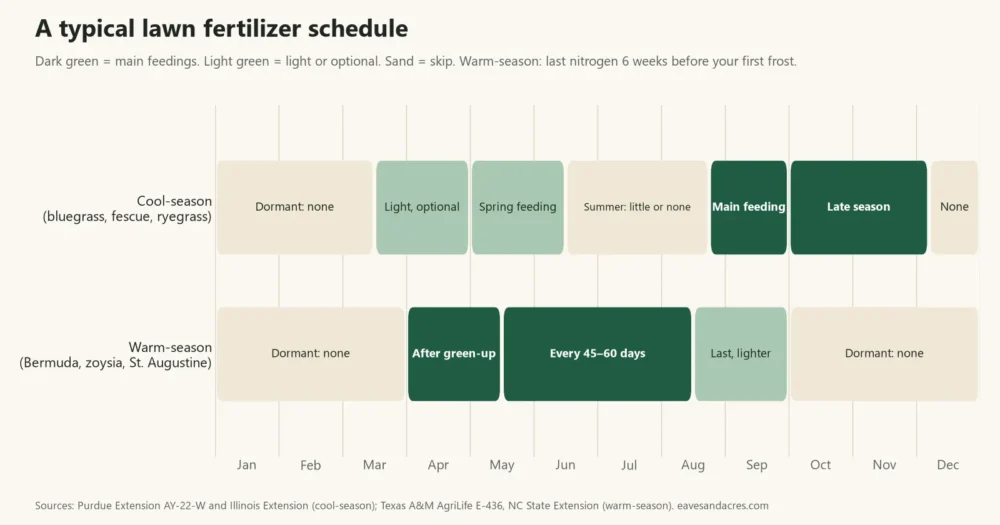
- 1Cool-season lawns (bluegrass, fescue, ryegrass): the main feeding is late summer to early fall, plus a late-season feeding after the last mowing. Feed lightly in spring; skip summer.
- 2Warm-season lawns (Bermuda grass, zoysia, St. Augustine): first feeding after the second mowing; last nitrogen at least six weeks before your first fall frost.
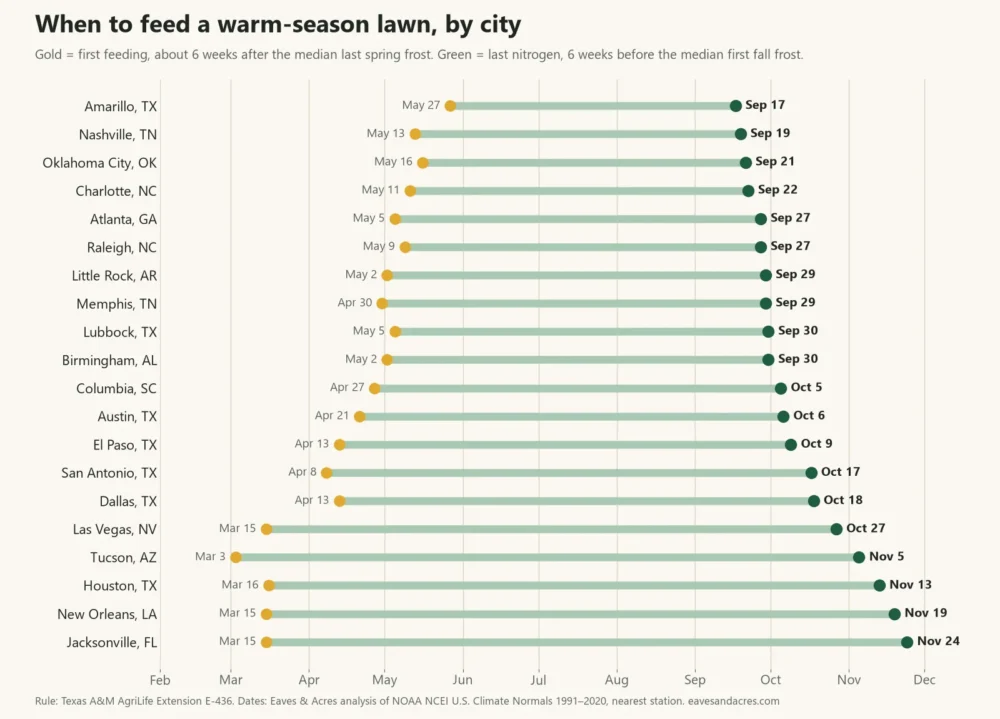
- 3From NOAA normals, that last feeding falls around Sep 27 in Atlanta, Oct 6 in Austin and Nov 13 in downtown Houston.
- 4Pounds of product per 1,000 sq ft = nitrogen rate ÷ the bag’s first number as a decimal. Never more than 1 lb of quick-release nitrogen at once.
- 5Never feed dormant, drought-stressed or frozen turf, and check local law: New Jersey bans homeowner nitrogen and phosphorus after Nov 15 and before Mar 1.
The best time to fertilize depends on your grass. Cool-season lawns (Kentucky bluegrass, tall fescue, perennial ryegrass) get their most important feeding in late summer to early fall, a lighter one in spring, and little or none in summer. Warm-season lawns (Bermuda grass, zoysia, St. Augustine) are fed from spring green-up through summer, and the last nitrogen should go down at least six weeks before your first fall frost.
Below, we turn that rule into dates for 20 Southern cities from NOAA frost normals, and check them against Texas A&M’s own.
The lawn fertilizer schedule at a glance
Check your grass type first (our guide to cool-season vs. warm-season grass shows how). Amounts are pounds of actual nitrogen per 1,000 sq ft for a moderately fed lawn with clippings left on.
| Season | Cool-season lawn | Warm-season lawn |
|---|---|---|
| Early spring | Optional, 0–0.75 lb (mid-March to April) | None (dormant) |
| Late spring | 0.5–0.75 lb (May to mid-June) | First feeding after the second mowing |
| Summer | None, unless the lawn is watered often | Feedings 45–60 days apart |
| Early fall | Main feeding, 0.5–1 lb (late August to September) | Last nitrogen at least 6 weeks before your first frost |
| Late fall | 1–2 lb in two or more doses (October to early December) | None |
| Winter | None, and never on frozen soil | None |
The cool-season column is Purdue Extension’s moderate-maintenance program;2 the warm-season column follows Texas A&M AgriLife Extension.4 On a lower budget, drop the optional feedings.
Cool-season lawns: make the fall feeding count
Purdue’s turf specialists say bluegrass, fescue and ryegrass benefit most when most of the year’s nitrogen goes down from late summer through autumn, with less in spring.2 Illinois Extension says it plainly:
This is considered the optimal fertilizer timing for a cool-season lawn.
The exact weeks shift with latitude:
| Where | Spring | Main feeding | Late season |
|---|---|---|---|
| Northern Illinois | Later than central Illinois | August | Late October to early November |
| Central Illinois | Early to mid-May | August 15 – September 15 | November |
| Southern Illinois | Earlier than central Illinois | September | Late November |
| Indiana | Light, May to mid-June | Up to 1 lb a month, late August to early November | 0.5–0.75 lb every 3 weeks, early October to early December |
Sources: Illinois Extension’s lawn fertilizing guide3 and Purdue’s Fertilizing Established Cool-season Lawns (AY-22-W).2 UW–Madison Extension makes the same call for Wisconsin: early September is “a key time to add nitrogen” (Ideal Timing for Fertilizing Lawns).12 If your state publishes its own calendar, use it.
Spring: later and lighter than you might think
Purdue recommends slow-release products in spring to limit excess growth.2 In central Illinois the spring window is early to mid-May, but crabgrass preventer goes down in early April, so Illinois calls weed-and-feed products a compromise in timing.3 Our guide to when to apply pre-emergent covers crabgrass timing separately.
The late-season feeding (the “winterizer”)
Illinois times the last feeding about a week after the final mowing.3 Our guide to when to stop mowing your lawn gives normal-year last-mow dates by city. Purdue prefers mostly water-soluble nitrogen from early October until early December, or until the ground freezes, and notes that extra phosphorus and potassium are unnecessary if a soil test shows enough.2
Warm-season lawns: feed after green-up, stop six weeks before frost
Bermuda grass, zoysia, St. Augustine and centipede grass grow in the heat and sleep through winter. Texas A&M AgriLife Extension’s Fertilizing Texas Lawns (E-436) ties both ends of their season to frost dates.4 The first feeding comes after the second mowing of grass (not weeds), usually about six weeks after the average last spring frost. The last nitrogen goes down early enough for the lawn to use it before winter:
no later than 6 weeks before the expected autumn frost date
We applied both rules to median frost dates from the NOAA station nearest each of 20 Southern ZIP codes.1
| City (ZIP) | First feeding, about | Last nitrogen by |
|---|---|---|
| Amarillo, TX (79101) | May 27 | Sep 17 |
| Nashville, TN (37201) | May 13 | Sep 19 |
| Oklahoma City, OK (73102) | May 16 | Sep 21 |
| Charlotte, NC (28202) | May 11 | Sep 22 |
| Atlanta, GA (30303) | May 5 | Sep 27 |
| Raleigh, NC (27601) | May 9 | Sep 27 |
| Little Rock, AR (72201) | May 2 | Sep 29 |
| Memphis, TN (38103) | Apr 30 | Sep 29 |
| Lubbock, TX (79401) | May 5 | Sep 30 |
| Birmingham, AL (35203) | May 2 | Sep 30 |
| Columbia, SC (29201) | Apr 27 | Oct 5 |
| Austin, TX (78701) | Apr 21 | Oct 6 |
| El Paso, TX (79901) | Apr 13 | Oct 9 |
| San Antonio, TX (78205) | Apr 8 | Oct 17 |
| Dallas, TX (75201) | Apr 13 | Oct 18 |
| Las Vegas, NV (89101) | Mar 15 | Oct 27 |
| Tucson, AZ (85701) | Mar 3 | Nov 5 |
| Houston, TX (77002) | Mar 16 | Nov 13 |
| New Orleans, LA (70112) | Mar 15 | Nov 19 |
| Jacksonville, FL (32202) | Mar 15 | Nov 24 |
The spring date is an estimate; the second mowing is the real signal. In Houston, New Orleans, Jacksonville and Tucson a fall frost does not come every year, so treat the median as a softer guide. For any other ZIP code, look up your frost dates and count six weeks either way.
Do our dates match Texas A&M’s?
Texas A&M publishes cut-off dates for five Texas frost zones.4 Against our station dates for 15 Texas cities, seven fell within a week and the median gap was eight days. The biggest gaps were downtown Dallas (+17 days) and downtown Houston (+29 days), where city-center stations run warm.
| City | Texas A&M: nitrogen by | Our date (NOAA station) | Difference |
|---|---|---|---|
| Amarillo | Sep 15 | Sep 17 | +2 days |
| Dallas | Oct 1 | Oct 18 | +17 days |
| Austin | Oct 15 | Oct 6 | −9 days |
| San Antonio | Oct 15 | Oct 17 | +2 days |
| College Station | Nov 1 | Oct 19 | −13 days |
Texas A&M uses one average frost date per region; ours are per station. When they disagree, use the earlier date. So a Dallas lawn of common Bermuda grass gets its first feeding in mid-April after two mowings, more every 45–60 days, and the last by October 1.
Georgia and North Carolina are more cautious
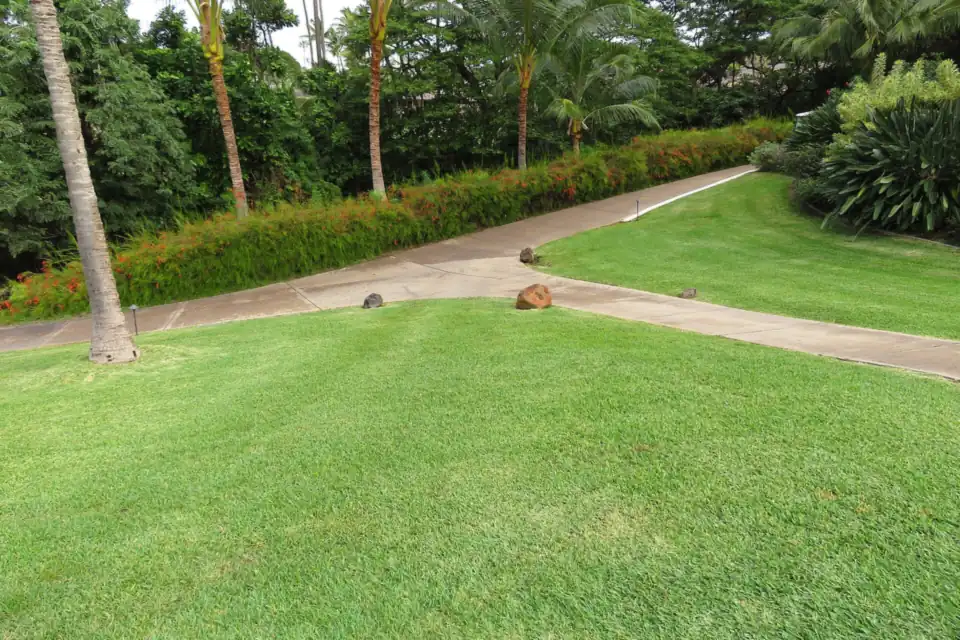
The six-week rule is a latest date. A UGA Extension county office in South Georgia advises feeding Bermuda grass and zoysia only until mid-August, avoiding fall feedings on Bermuda grass, and skipping fall nitrogen entirely on centipede grass.7 NC State Extension limits Bermuda grass to half a pound of nitrogen in September, or four weeks before the first expected frost, as a low-nitrogen, high-potassium product, to limit spring dead spot disease.6 Where your state publishes advice like this, follow it.
In the transition zone, feed the grass, not the state
From Kansas and Missouri east to Virginia and North Carolina, both kinds of grass grow side by side. A tall fescue lawn in Charlotte follows the cool-season schedule, with its main feeding in early fall; the Bermuda grass lawn next door follows the warm-season one and stops in September.
How much fertilizer: the nitrogen math
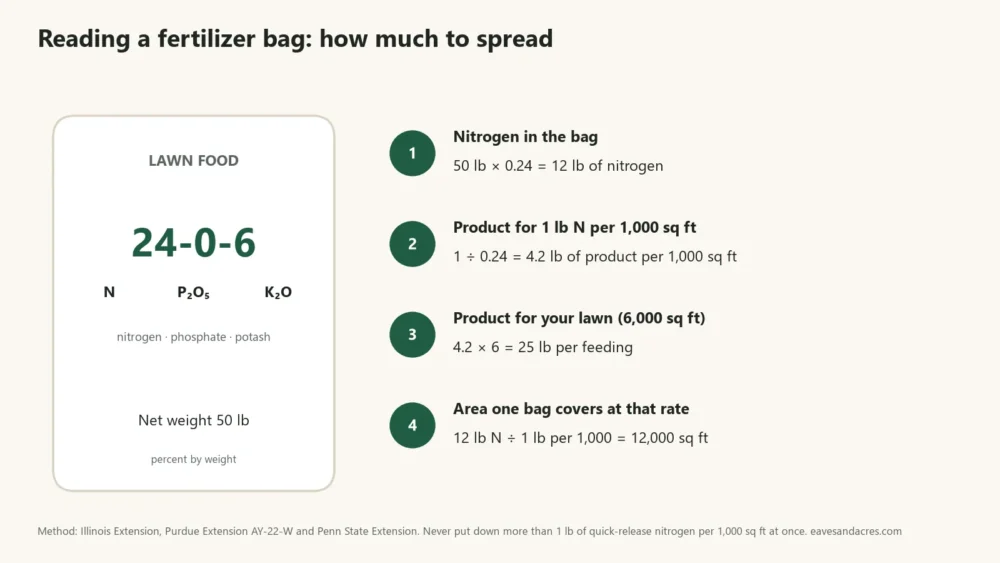
Rates are pounds of nitrogen (N) per 1,000 sq ft, not pounds of product. The first number on the bag is percent nitrogen by weight (see our glossary entry on N-P-K). Illinois, Purdue and Penn State use the same two steps:3
- Divide the nitrogen rate you want by the first number on the bag, written as a decimal. That gives pounds of product per 1,000 sq ft.
- Multiply by your lawn area in thousands of square feet.
Penn State’s example: 1.0 ÷ 0.26 = 3.8 lb of 26-5-10 per 1,000 sq ft.5
Three feedings for a 6,000 sq ft bluegrass lawn in central Illinois
- Scenario
- A sunny bluegrass lawn fed with a 24-0-6 product in 50-lb bags on Illinois Extension’s schedule: mid-May, August 15 to September 15, and November.
- Math
- 1 lb N ÷ 0.24 = 4.2 lb of product per 1,000 sq ft. 4.2 × 6 = 25 lb per feeding. Three feedings = 75 lb a year, or 3 lb of nitrogen per 1,000 sq ft.
- Answer
- Buy two 50-lb bags (12 lb of nitrogen each). They cover all three feedings with about 25 lb to spare.
Yearly needs depend on the grass and how green you want it:
| Grass | Low | Moderate | High |
|---|---|---|---|
| Cool-season mix (bluegrass, fescue, ryegrass) | 1–3 | 2–4 | 3–5 |
| Common Bermuda grass | 2 | 2–3 | 4–5 |
| Hybrid Bermuda grass | 2 | 3–4 | 5–6 |
| St. Augustine grass (sun) | 2 | 2–3 | 3–4 |
| Zoysia grass | 1–2 | 2–3 | 3–4 |
| Centipede grass | 0–1 | 1–2 | Not recommended |
| Buffalo grass | 0–1 | 2 | Not recommended |
Cool-season row: Purdue;2 warm-season rows: Texas A&M.4 Purdue says shaded lawns need up to 50% less, lawns with bagged clippings 25–50% more, and lawns fed for over 10 years less. Never put down more than 1 lb of quick-release nitrogen per 1,000 sq ft at once; products more than half slow-release can go to 2 lb.2
When not to fertilize

Do not apply fertilizer to dormant or severely drought-stressed turf.
Purdue adds: not in winter or on frozen soil.2 Also skip midsummer for cool-season grass, anything after your cut-off date for warm-season grass, and right before a downpour.
Some places make it law. New Jersey homeowners may not apply nitrogen or phosphorus after November 15 and before March 1 (potassium-only products and lime are allowed), according to Rutgers’ guide to the state fertilizer law.8 Minnesota bans phosphorus fertilizer on lawns unless a soil, tissue or other approved test from the past three years shows a need, or you are establishing a new lawn from seed or sod in its first growing season.9 Pinellas County, Florida bans nitrogen and phosphorus from June 1 to September 30, at any time the National Weather Service has a flood, severe thunderstorm, tropical storm or hurricane watch or warning in effect, and whenever 2 inches of rain or more is forecast within 24 hours.10
How to apply it so it ends up in the grass
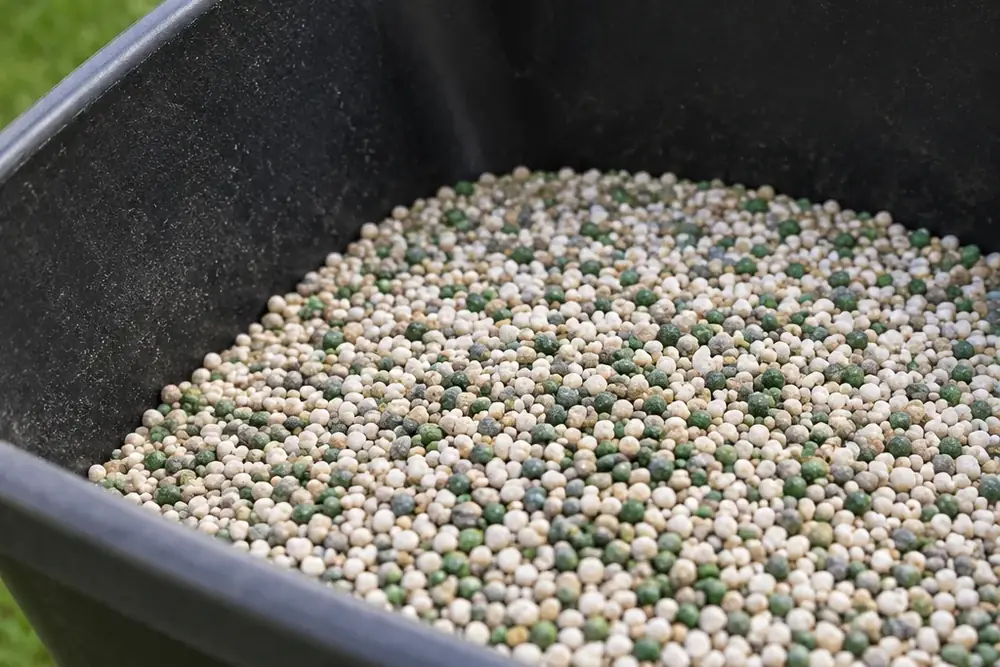
- Test the soil first. A lab test shows whether you need phosphorus, potassium or lime; there is no reliable soil test for nitrogen.2
- Use a rotary (broadcast) spreader for more even coverage than a drop spreader.
- Water it in. Quick-release nitrogen can burn leaves; Purdue2 and UGA7 both say to water fertilizer in.
- Sweep up strays from sidewalks and driveways back onto the grass.
- Mow high and leave the clippings: 2.5 inches or taller, per Purdue. See our mowing and watering guides.
New seedings follow a different plan, with starter fertilizer at seeding. Our guide on when to overseed your lawn covers it, and the seeding section has the rest.
 Related guideWhen to Overseed Your Lawn: The Last Safe Day Where You Live
Your next step
Put two dates in your calendar: your main feeding and your last safe feeding date. Browse the fertilizing section and our other lawn care guides; the methodology page explains how our frost dates are calculated.
Frequently asked questions
Not for cool-season grass: Purdue Extension recommends feedings from early October to early December. For warm-season grass it usually is, because the six-week cut-off falls in late September or early October across most of the South.
For cool-season lawns in central Illinois, Illinois Extension puts the spring feeding in early to mid-May. For warm-season lawns, wait until you have mowed the grass (not the weeds) twice.
Yes, for granular products. Purdue says to water quick-release nitrogen in to avoid leaf burn, and UGA Extension says to water fertilizer in thoroughly. Do not spread right before a downpour.
Illinois Extension lists one feeding a year (late summer to early fall) for a low-density lawn and up to four for a dense, irrigated one. Warm-season lawns get feedings 45–60 days apart.
Purdue Extension says there is no reliable soil test for nitrogen, so it is applied on a schedule; unfertilized lawns gradually thin out and pale. A soil test still shows whether you need phosphorus, potassium or lime.
Not right before heavy rain. Pinellas County, Florida, bans nitrogen and phosphorus whenever 2 inches or more is forecast within 24 hours, and UW–Madison Extension warns that fertilizer on pavement can wash into storm drains. Granular products still need to be watered in, so a light watering after spreading is the goal.
Cool-season lawns benefit from a late-season feeding, but Purdue notes that extra phosphorus and potassium are unnecessary if a soil test shows enough. Warm-season lawns should not get late-fall nitrogen.
Sources
- 1.U.S. Climate Normals 1991–2020. NOAA National Centers for Environmental Information, 2021. Used for: first and last frost dates for every ZIP and city Back to text
- 2.Fertilizing Established Cool-season Lawns (AY-22-W). Purdue Extension, 2013. Used for: cool-season timing and rates, yearly nitrogen, limits per feeding, application tips Back to text
- 3.Fertilizing Your Lawn. University of Illinois Extension, accessed 2026. Used for: Illinois schedule by region, nitrogen math, winterizer and weed-and-feed notes Back to text
- 4.Fertilizing Texas Lawns: 10-Point Checklist for Warm-Season Grasses (E-436). Texas A&M AgriLife Extension, 2007. Used for: first and last feeding rules, Texas cut-off dates, yearly nitrogen by warm-season grass Back to text
- 5.Calculations Used to Determine the Amount of Fertilizer Needed to Treat Turf. Penn State Extension, accessed 2026. Used for: bag math example Back to text
- 6.Bermudagrass Lawn Maintenance Calendar. NC State Extension, 2021. Used for: September nitrogen limit for Bermuda grass Back to text
- 7.Fertilizing Your Lawn in South Georgia: What You Need to Know. UGA Cooperative Extension (Candler and Evans counties), 2025. Used for: South Georgia timing by grass, watering in Back to text
- 8.NJ fertilizer law restrictions on home lawn applications now in effect. Rutgers NJAES, 2013. Used for: New Jersey homeowner blackout dates Back to text
- 9.Minnesota Statutes 18C.60, Phosphorous Turf Fertilizer Use Restrictions. Minnesota Office of the Revisor of Statutes, current. Used for: phosphorus rule Back to text
- 10.Pinellas County Fertilizer Ordinance. Pinellas County, Florida, accessed 2026. Used for: June–September ban, rain rule Back to text
- 11.St. Augustine grass lawn, Wailea, Maui (photo). Forest and Kim Starr, Wikimedia Commons, CC BY 2.0, 2020. Used for: photo, cropped and resized
- 12.Ideal Timing for Fertilizing Lawns. University of Wisconsin–Madison Division of Extension (Bruce Spangenberg), 2025. Used for: Wisconsin early-September feeding, runoff from pavement Back to text
How this guide was made
- Written by the Yard & Garden Desk and reviewed by the Data & Methodology Desk.
- Data: frost dates from NOAA NCEI U.S. Climate Normals 1991–2020 for the station nearest each ZIP code; feeding windows, rates and rules from Purdue, Illinois, Wisconsin, Penn State, Texas A&M, NC State and UGA extension publications; state and county rules from the cited official pages. See our methodology.
- AI use: AI tools help us research, draft and check this guide. Every figure is checked against the source cited for it, and calculated figures come from our own code, described on the methodology page.
- Spotted an error? Tell us — the form opens with this page’s address filled in.
Change log
- Oct 4, 2026Re-checked against today’s search results and sources. Added UW–Madison Extension’s early-September timing and a sourced FAQ on fertilizing before rain; Minnesota’s phosphorus rule now includes its new-lawn exception and three-year test window; the Pinellas County weather rule now lists the watches and warnings it covers; New Jersey dates worded exactly as Rutgers gives them.
- Oct 2, 2026Published. Schedules from Purdue, Illinois, Texas A&M, NC State and UGA extension; warm-season feeding dates for 20 cities computed from NOAA 1991–2020 normals and checked against Texas A&M’s zone dates.
Covers lawns, gardens, frost and planting. We write the guides and maintain the tools that tell you when to seed, feed and plant for your ZIP.
.jpg)
Keep reading
When to Apply Lime to Your Lawn: Test First, Then Fall or Winter
Lime a lawn only when a soil test shows low pH, and spread it in fall or winter on dry, unfrozen turf so it has months to work. pH targets by grass, extension rates, NOAA freeze data for 22 cities, and where the West can skip it.
When to Apply Winterizer Fertilizer: Dates by City and State Rules
Feed a cool-season lawn its winterizer around the last mowing, weeks after the first frost and before your state’s cut-off. Warm-season lawns get no late-fall nitrogen.
Should You Rake Leaves? When to Mulch, Rake or Leave Them
Usually not. Mow a light or moderate layer of leaves into the lawn until your last mow, and remove only what hides the grass. Extension thresholds, the research, and leaf deadlines for 20 US cities from NOAA normals.
Seasonal reminders for your ZIP
Get a short email when it’s time to overseed, start seeds, open the pool or service your furnace — timed to your climate.