




How Long Does Grass Seed Take to Grow? Germination Days by Grass and Season
Germination time depends on the grass and, even more, on how warm the soil is. We combined extension germination figures with 12 years of NOAA’s measured soil temperatures to show how long seed takes in spring and fall, city by city.
- Last reviewed Oct 13, 2026
- 17 cited sources
- 10 min read
Set your ZIP to see dates for your area.
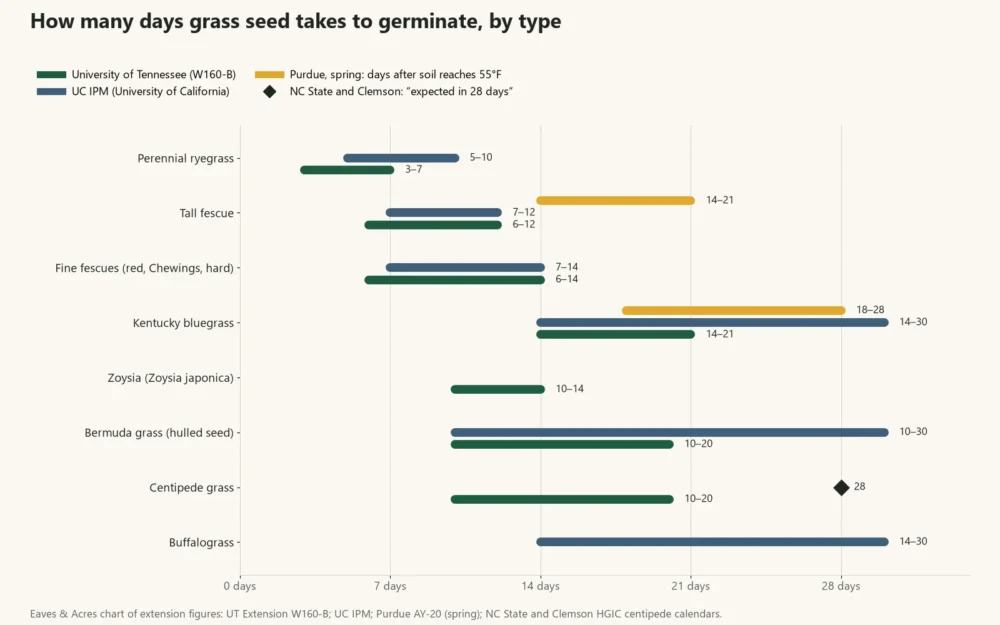
- 1Most lawn grass seed germinates in 3 to 30 days: perennial ryegrass in about 3–10 days, tall fescue in about 6–12, fine fescue in 6–14 and Kentucky bluegrass in 14–30.
- 2Warm-season seed is slower to start: hulled Bermuda grass takes about 10–30 days, zoysia 10–14 and centipede grass from 10 days to about four weeks.
- 3Season matters most. At 35 NOAA soil stations, the top 2 inches averaged 69°F in the two weeks after a September 1 sowing, but only 51°F after an April 15 sowing.
- 4Tall fescue sown when spring soil first reaches 50°F typically comes up 28 to 35 days later; sown in early fall, it takes about one to three weeks.
- 5Seed sown by the last safe day to overseed still lands in soil above 60°F in 31 of 32 cities, with a median 48 more days before the soil drops below 50°F.
- 6Plan on the first mowing two to six weeks after sowing, and keep people and pets off for at least a month after the seed sprouts.
Most lawn grass seed germinates in 3 to 30 days: perennial ryegrass in about a week, tall fescue and fine fescue in one to two weeks, and Kentucky bluegrass, Bermuda grass and centipede grass in two to four weeks or more. The first mowing usually comes two to six weeks after sowing, and University of Maryland Extension calls careful care through the first two months essential.
The biggest swing is the season. We read 12 years of NOAA’s measured soil temperatures at 35 stations: in the two weeks after a September 1 sowing, the top 2 inches averaged 69°F, against 51°F after an April 15 sowing. That is why the same bag of seed can sprout in a week in late summer and take a month in spring.
Germination days by grass type
Extension services publish germination times for seed kept moist at a good temperature. The University of California’s IPM program and the University of Tennessee give these ranges.4,3
| Grass | Tennessee (days) | UC IPM (days) |
|---|---|---|
| Perennial ryegrass | 3–7 | 5–10 |
| Annual ryegrass | 3–7 | 5–10 |
| Tall fescue | 6–12 | 7–12 |
| Fine fescues (red, Chewings, hard, sheep) | 6–14 | 7–14 |
| Kentucky bluegrass | 14–21 | 14–30 |
| Rough bluegrass | — | 7–10 |
| Bentgrass (colonial, creeping) | — | 10–14 |
| Bermuda grass, hulled seed | 10–20* | 10–30 |
| Zoysia (Zoysia japonica) | 10–14 | — |
| Centipede grass | 10–20 | — |
| Buffalograss | — | 14–30 |
*Unhulled Bermuda grass seed often needs 14 to 21 days or longer, Tennessee notes. A dash means the source does not list that grass.
Other extension figures fit inside these ranges. The University of Kentucky gives seven to 10 days for tall fescue under optimal conditions and 15 to 21 days for Kentucky bluegrass,11 UGA gives 5 to 10 days for tall fescue in favorable conditions,9 and NC State gives 10 to 21 days for tall fescue with enough moisture and suitable soil temperature.6
Seed mixes sprout in stages. In a Purdue turf photo taken six days after planting, perennial ryegrass, tall fescue and creeping red fescue were up but Kentucky bluegrass had not yet germinated,17 and Maryland notes that fast species such as tall fescue reach mowing height before slow ones such as Kentucky bluegrass,10 so a patchy first couple of weeks is normal. Centipede grass is the slow extreme: NC State and Clemson plan for germination in about 28 days.13,14
Why the same seed can take 7 days or 30
Moisture and contact with soil matter, but temperature sets the pace. Tennessee says cyclic air temperatures of about 59 to 82°F favor rapid germination of cool-season seed, and 68 to 95°F suits warm-season seed.3 For tall fescue, NC State puts the optimum at 68 to 77°F air and soil warmer than 60°F.6 At the cold end, Jim Murphy of the Rutgers turf program5 writes that, judging from late-fall seedings, tall fescue and Kentucky bluegrass seed
does not effectively develop a seedling turf once soil temperatures drop to 50° F
Spring shows the difference. Purdue’s spring seeding guide counts 14 to 21 days for tall fescue and 18 to 28 days for Kentucky bluegrass, starting only once the soil reaches 55°F.7 For tall fescue that is roughly twice Tennessee’s 6 to 12 days.
Warm-season seed needs warmer ground. UGA says to seed when soil 4 inches down is consistently 65°F and rising,9 and Oklahoma State says Bermuda grass seed will not germinate until the soil reaches about 65°F.16 For seeded zoysia, the University of Arkansas suggests waiting until the soil surface first reaches 68 to 72°F, and reports that its germination keeps rising with heat, peaking at 86 to 95°F.12
Fall vs spring: what NOAA’s soil thermometers show
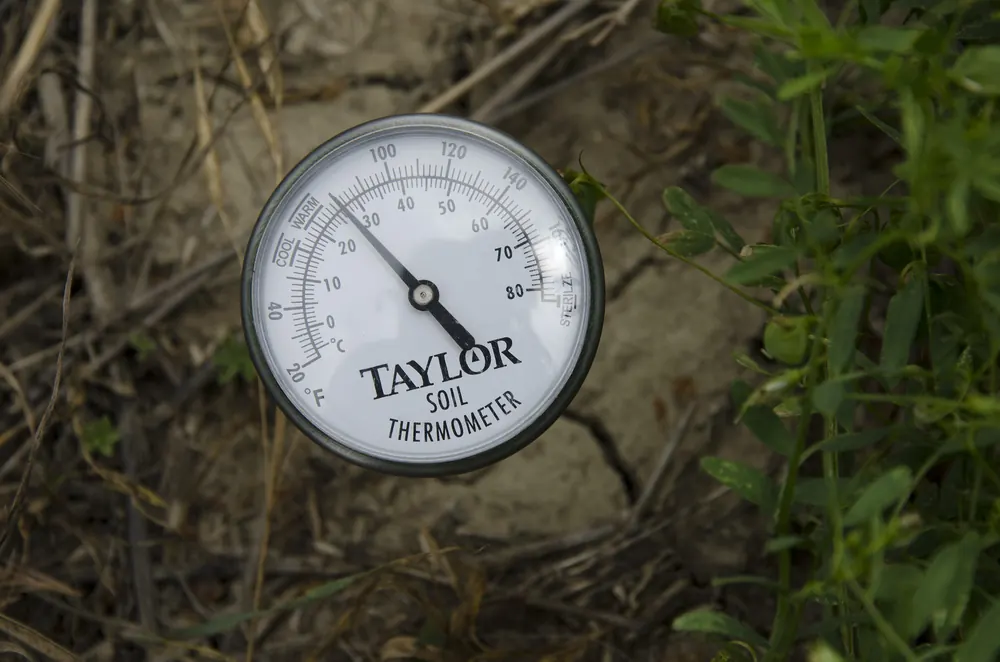
NOAA’s U.S. Climate Reference Network measures soil temperature at stations placed in open sites.1 We took the daily soil temperature 2 inches down (5 cm) at 35 stations across the northern states and the transition zone, from 2014 to 2025, and averaged each station’s soil over the 14 days after nine sowing dates.
| Sown on | Soil 2 in down, next 14 days | Stations above 60°F | Stations below 50°F |
|---|---|---|---|
| Apr 1 | 46°F | 0 of 35 | 22 of 35 |
| Apr 15 | 51°F | 4 of 35 | 16 of 35 |
| May 1 | 57°F | 12 of 35 | 5 of 35 |
| May 15 | 61°F | 21 of 35 | 0 of 35 |
| Aug 15 | 73°F | 35 of 35 | 0 of 35 |
| Sep 1 | 69°F | 33 of 35 | 0 of 35 |
| Sep 15 | 67°F | 30 of 35 | 0 of 35 |
| Oct 1 | 59°F | 16 of 35 | 0 of 35 |
| Oct 15 | 54°F | 5 of 35 | 9 of 35 |
Seed sown in mid-August or early September sits in soil near 70°F, above NC State’s 60°F mark at almost every station. Seed sown on April 15 sits near 51°F, and at 16 of the 35 stations the soil averaged below 50°F. By October 1 the fall soil has cooled to about where spring soil is on May 1.
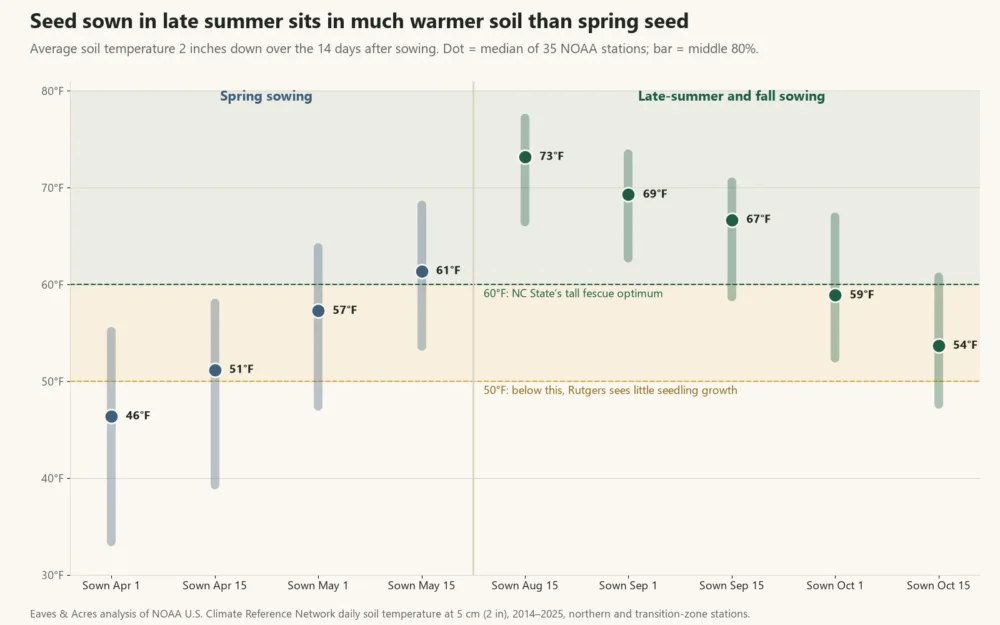
In practice, spring seed waits. If you sow cool-season seed when the soil first reaches 50°F, as our spring guide suggests, soil takes a median 14 more days to reach 55°F, and Purdue’s 14 to 21 days start only then. In our 32 cities that puts tall fescue up about 28 to 35 days after spring sowing, against one to three weeks in early fall. Purdue rates late summer to early fall as the best time to seed cool-season lawns and calls spring seeding difficult and often unsuccessful.8
How long fall soil stays warm enough, city by city
Fall soil cools more slowly than the air. Matching NOAA’s measured soil to the air normals near each station, the top 2 inches dropped below 60°F when the normal daily average air temperature fell to about 56°F, and below 50°F at about 46°F.1,2 Re-estimated with each station left out in turn, those rules landed a median 3 days from the measured date for 50°F and 3 days for 60°F, within a week at 32 and 29 of 35 stations. We applied them to the NOAA 1991–2020 normals for each city.
| City (ZIP) | Last safe day to overseed | Fall soil below 60°F / 50°F | Spring: tall fescue up after sowing |
|---|---|---|---|
| Fargo, ND (58102) | Aug 26 | Sep 25 / Oct 16 | 25–32 days |
| Minneapolis, MN (55401) | Sep 12 | Oct 1 / Oct 22 | 26–33 days |
| Spokane, WA (99201) | Sep 8 | Sep 29 / Oct 22 | 31–38 days |
| Madison, WI (53703) | Sep 5 | Oct 3 / Oct 27 | 27–34 days |
| Boise, ID (83702) | Sep 9 | Oct 4 / Oct 28 | 32–39 days |
| Milwaukee, WI (53202) | Sep 17 | Oct 8 / Oct 31 | 27–34 days |
| Albany, NY (12207) | Sep 13 | Oct 6 / Nov 1 | 27–34 days |
| Des Moines, IA (50309) | Sep 15 | Oct 11 / Nov 2 | 28–35 days |
| Omaha, NE (68102) | Sep 15 | Oct 13 / Nov 4 | 27–34 days |
| Detroit, MI (48201) | Sep 25 | Oct 10 / Nov 5 | 27–34 days |
| Denver, CO (80202) | Sep 6 | Oct 9 / Nov 5 | 33–40 days |
| Indianapolis, IN (46204) | Sep 17 | Oct 12 / Nov 6 | 28–35 days |
| Chicago, IL (60601) | Oct 1 | Oct 14 / Nov 7 | 28–35 days |
| Columbus, OH (43215) | Sep 19 | Oct 13 / Nov 8 | 28–35 days |
| Pittsburgh, PA (15222) | Sep 21 | Oct 14 / Nov 10 | 29–36 days |
| Salt Lake City, UT (84101) | Oct 4 | Oct 18 / Nov 12 | 41–48 days |
| Boston, MA (02108) | Oct 7 | Oct 14 / Nov 13 | 30–37 days |
| Kansas City, MO (64105) | Sep 27 | Oct 23 / Nov 16 | 29–36 days |
| Seattle, WA (98101) | Oct 18 | Oct 10 / Nov 21 | 45–52 days |
| St. Louis, MO (63101) | Oct 1 | Oct 27 / Nov 22 | 28–35 days |
| Louisville, KY (40202) | Oct 6 | Oct 27 / Nov 22 | 27–34 days |
| New York, NY (10001) | Oct 17 | Oct 23 / Nov 24 | 28–35 days |
| Philadelphia, PA (19103) | Oct 15 | Oct 28 / Nov 27 | 27–34 days |
| Washington, DC (20001) | Oct 6 | Oct 27 / Nov 27 | 29–36 days |
The spring column assumes seed sown on the day the top 2 inches reach 50°F, as in our spring seeding guide, plus Purdue’s 14 to 21 days counted from the 55°F date.
The “last safe day” column comes from our guide on when to overseed your lawn: 45 days before the typical first 28°F freeze. Seed sown by then lands in soil above 60°F in 31 of our 32 cities, and the soil stays above 50°F for a median 48 days after it (from 34 to 60). The exception is Seattle, where soil drops below 60°F about a week before its late last safe day.
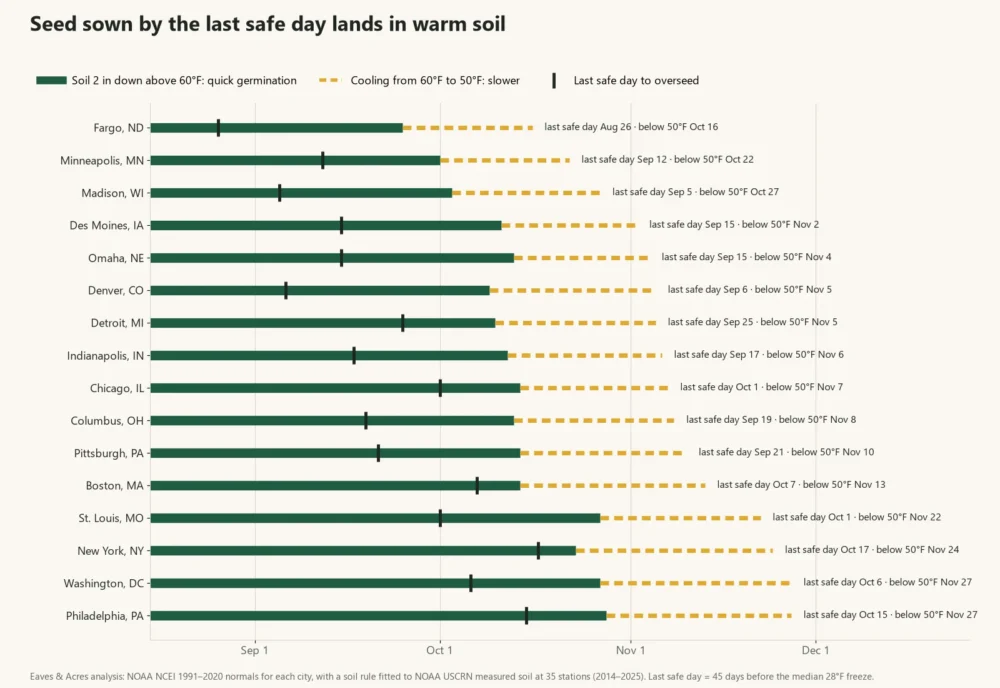
At the same station, the date soil fell below 50°F ranged over a median 25 days between the earliest and latest falls from 2014 to 2025.1 The University of Kentucky’s turf specialist puts the local cut-off plainly:
If we seed much later than Oct. 1, we don’t always get good germination.
If you have missed fall entirely, dormant seeding lets seed sit through winter and sprout as the soil warms in spring. For any other ZIP code, our frost date lookup shows the frost dates for your nearest station.
Bermuda, zoysia and centipede: the slow starters
Warm-season seed goes down in late spring or early summer; UGA lists May to June for common Bermuda grass, centipede grass and zoysia.9 Bermuda grass seed with its hull removed germinates in about 10 to 20 days in Tennessee’s figures, and unhulled seed often needs 14 to 21 days or longer.3 The University of Arkansas says seeded zoysia typically germinates 10 or more days after seeding, sometimes in as little as 7 days in ideal conditions.12
Filling in takes far longer. Arkansas tells growers to expect 90 percent zoysia cover in 75 or more days, given warm soil and moisture.12 NC State warns that it can take up to three years to establish a centipede lawn from seed.13 Not sure which kind of grass you have? Our guide to cool-season vs warm-season grass explains how to tell, and when Bermuda grass turns green covers its spring wake-up.
After it sprouts: first mowing and an established lawn
Here is what comes next, as extension services describe it.
| Stage | What the sources say | Source |
|---|---|---|
| Light, frequent watering | Two to four times a day, keeping the top 0.5–1 inch moist; less often once seedlings are 2 inches tall | Purdue AY-3 |
| First mowing | Tall fescue: 2–3 weeks after seeding in favorable conditions. Typical new lawn: 4–6 weeks after seeding | UGA; Maryland |
| First mowing height | 1.5 in for bluegrass, ryegrass, fine fescue; 2 in for tall fescue; raise to normal height after 3–4 mowings | Purdue AY-3 |
| Foot traffic | Keep off for at least a month after germination, or until mown at least twice | Maryland |
| Feeding | 0.75–1 lb nitrogen per 1,000 sq ft at 4–6 weeks and 8–10 weeks after germination | Purdue AY-3 |
| Broadleaf weed killer | Wait until the new grass has been mown three times; follow the label | Maryland; Purdue |
| Full cover, seeded zoysia | 90% cover in 75 or more days, with warm soil and moisture | Arkansas |
| Full cover, centipede grass | Up to three years from seed | NC State |
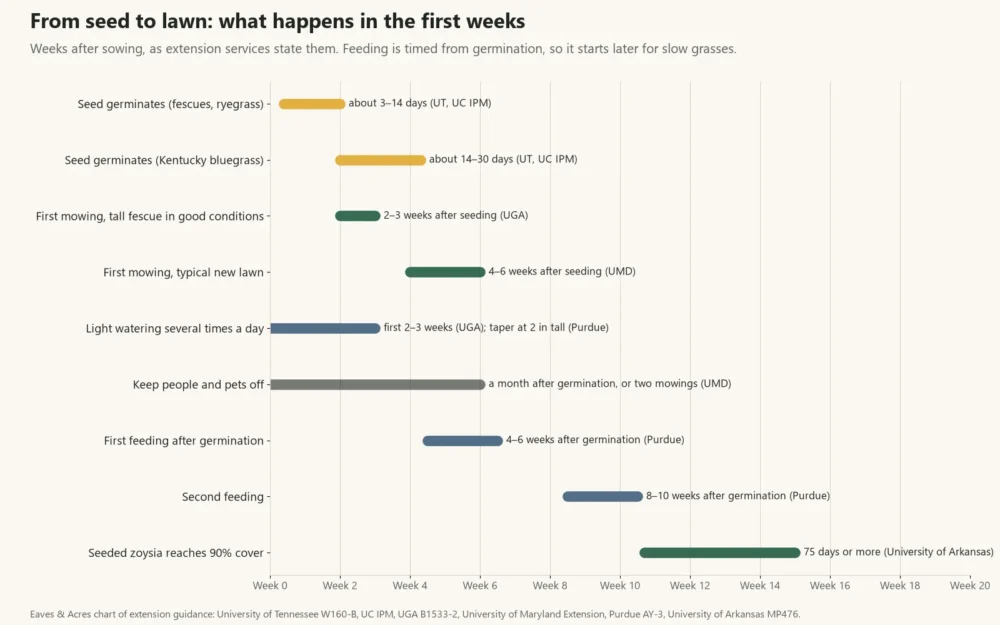
Purdue notes that most people wait too long to mow a newly seeded lawn, and suggests a first cut at 1.5 inches for bluegrass, ryegrass and fine fescue and 2 inches for tall fescue.8 University of Maryland Extension suggests mowing when the grass is about one-third taller than its target height, for example tall fescue at 4 inches for a 3-inch cut.10 Keep foot traffic off:
Restrict people and pet foot traffic from newly planted areas for at least a month
Maryland adds “or until the new lawn has been mown at least twice,” and calls proper care during the first two months of establishment essential.10 Purdue times fertilizer from germination: 0.75 to 1 lb of nitrogen per 1,000 sq ft four to six weeks after germination and again at eight to ten weeks.8 Our lawn fertilizing guide covers the schedule after that.
Watering new seed until it is up
New seed must not dry out, so the routine is the opposite of watering an established lawn. Purdue says a newly seeded lawn may need watering two to four times a day, enough to keep the top 0.5 to 1 inch moist without saturating it.8 UGA describes it as daily watering of about ⅛ to ¼ inch for the first 2 to 3 weeks.9 In spring, Purdue starts the three-to-four-times-a-day routine once the soil reaches 55°F.7
Once seedlings are about 2 inches tall, Purdue says to water less often and more deeply, and after two or three mowings to switch to deep, infrequent watering.8 Maryland suggests waiting for the slowest grass in a mix, such as Kentucky bluegrass, before cutting back.10 Our guide to how much to water your lawn covers the routine for an established lawn.
Grass seed not growing after two weeks? Check these
- Slow species. Kentucky bluegrass, Bermuda grass and centipede grass can take three to four weeks.4,13
- Cold soil. Kentucky says germination takes longer when the soil surface is cold or dry, or when seed is old or poor quality.11
- Old seed. The University of Minnesota suggests a label germination rate above 85% and a test date within the last 9 months.15
- Buried too deep. Maryland says grass seed needs light and should not be covered with more than about ½ inch of soil or ¼ inch of compost or straw.10
- Weed preventer. UGA warns not to seed, or to wait as long as possible, if a preemergence herbicide went down in the previous 60 to 90 days.9 Our pre-emergent guide explains the timing.
- Fresh seed. Kentucky notes that seed harvested in summer can carry a short dormancy.11
 Related guideWhen to Overseed Your Lawn: The Last Safe Day Where You Live
Ways to shorten the wait
Sow cool-season grass in early fall and warm-season grass in late spring. Maryland says raking seed in is not required, but a light cover can improve germination.10 Tennessee notes that vented turf covers can speed germination and conserve moisture, and Maryland suggests a light floating row cover to trap warmth on cool nights.3,10 When overseeding, core aeration first helps: NC State notes that the holes capture seed and hold moisture.6 More timing guides are in our lawn seeding section.
Frequently asked questions
Seed scattered on bare soil can sprout, but contact with the soil matters: NC State calls good seed-to-soil contact paramount. The University of Maryland says raking seed in is not required, though a light cover of soil or compost can improve germination. Do not bury it deeper than about ½ inch, because grass seed needs light.
Often enough that the surface never dries. Purdue says a newly seeded lawn may need watering two to four times a day to keep the top 0.5 to 1 inch moist without saturating it, and UGA describes daily watering of about ⅛ to ¼ inch for the first two to three weeks. Water less often and more deeply once seedlings are about 2 inches tall.
Sow when the soil is warm, which means early fall for cool-season grass and late spring for warm-season grass, then keep the surface moist every day. Good seed-to-soil contact helps, and the University of Tennessee notes that vented turf covers can speed germination. Perennial ryegrass is the fastest common lawn grass, at about 3 to 10 days.
Perennial ryegrass usually shows in about a week, tall fescue and fine fescue in one to two weeks, and Kentucky bluegrass and Bermuda grass in two to four weeks, according to the University of Tennessee and UC IPM. In cool spring soil it takes longer: Purdue counts 14 to 21 days for tall fescue starting only once the soil reaches 55°F.
Look closely at a few seeds on the surface. Purdue describes the order: first a tiny root breaks out of the seed, then an opaque protective sheath, and last the first green leaf, which pushes out through that sheath. From then on the seedling feeds itself through photosynthesis, but the top inch of soil still has to stay moist for the first two or three weeks.
Often it is simply a slow grass: Kentucky bluegrass and Bermuda grass can take up to 30 days, and centipede grass about 28. If a fast grass has not come up, check for soil that is cold or drying out, old seed, seed buried too deep, or a crabgrass preventer applied in the previous 60 to 90 days, which UGA warns will stop grass seed too.
It can, because grass seed needs light, and Maryland says raking it in is not required. A light cover of soil or compost still improves germination, and the surface has to stay moist until the seed sprouts. Seeded zoysia should be no deeper than ¼ inch, the University of Arkansas advises.
Sown in late summer or early fall, cool-season seed sits in warm soil and usually comes up in one to three weeks: 6 to 12 days for tall fescue in Tennessee’s figures, 10 to 21 days in NC State’s. It slows as the soil cools, and Rutgers finds tall fescue and Kentucky bluegrass barely develop once soil drops to 50°F.
In good conditions, tall fescue can be ready for its first mowing two to three weeks after seeding, UGA says, and UGA mows new grass at about 1.5 times its target height, which is 3 to 4.5 inches for tall fescue. For a typical new lawn, the University of Maryland puts the first mowing at four to six weeks after seeding.
The University of Maryland advises keeping people and pets off newly seeded areas for at least a month after the seed germinates, or until the new lawn has been mowed at least twice.
Sources
- 1.U.S. Climate Reference Network (USCRN) daily data, 2014–2025. NOAA National Centers for Environmental Information, 2026. Used for: measured soil temperature at 5 cm (2 in) at 35 northern and transition-zone stations; station siting Back to text
- 2.U.S. Climate Normals 1991–2020. NOAA National Centers for Environmental Information, 2021. Used for: normal daily average temperature for every city in Table 3; 28°F freeze dates behind the last safe day Back to text
- 3.Turfgrass Establishment: Seeding (W160-B), Tom Samples and John Sorochan. University of Tennessee Extension, 2007. Used for: germination days by grass; air temperatures that favor germination; seed covers; mowing and feeding new seedlings Back to text
- 4.Healthy Lawns: Seed germination rates. University of California Statewide IPM Program, 2017. Used for: expected germination days by grass Back to text
- 5.Mild winter, what does it mean for overseeding of turf or dormant seeding?, Jim Murphy. Rutgers Center for Turfgrass Science, 2023. Used for: 50°F soil limit for tall fescue and Kentucky bluegrass seedlings Back to text
- 6.Time for Fall Seeding of Tall Fescue, Grady Miller. NC State Extension (TurfFiles), 2025. Used for: tall fescue optimum air and soil temperatures; 10 to 21 days to germinate; seed-to-soil contact and aeration holes Back to text
- 7.Seeding a Turf Area in the Spring (AY-20), Zac Reicher and Clark Throssell. Purdue Extension, 1998. Used for: spring germination days counted from 55°F soil; spring watering Back to text
- 8.Establishing Turfgrass Areas From Seed (AY-3-W). Purdue Extension and University of Illinois Extension, 2006. Used for: best seeding season; watering, first mowing, feeding and herbicide waits for new seedlings Back to text
- 9.Lawns in Georgia: Establishment (B 1533-2), Clint Waltz. University of Georgia Cooperative Extension, 2021. Used for: tall fescue germination and first mowing; warm-season seeding at 65°F soil; watering; preemergence herbicide wait Back to text
- 10.Starting a New Lawn. University of Maryland Extension, 2026. Used for: first mowing 4 to 6 weeks after seeding; foot traffic; seed cover and depth; watering transition; herbicide waits Back to text
- 11.Time to repair or establish home lawns, Katie Pratt (quoting Gregg Munshaw). University of Kentucky College of Agriculture, Food and Environment, 2013. Used for: Kentucky seeding window; tall fescue and bluegrass germination days; causes of slow germination Back to text
- 12.Establishing Seeded Zoysiagrass on Lawns and Golf Courses (MP476), Aaron Patton. University of Arkansas Division of Agriculture, 2009. Used for: zoysia seeding temperature, germination time and days to 90% cover Back to text
- 13.Centipedegrass Lawn Maintenance Calendar, Grady Miller. NC State Extension, 2021. Used for: centipede germination in 28 days; up to three years to establish from seed Back to text
- 14.Centipedegrass Maintenance Calendar (HGIC 1215). Clemson Cooperative Extension Home & Garden Information Center, 2024. Used for: centipede germination expected in 28 days Back to text
- 15.Buying turfgrass seed for Minnesota lawns, Noah Burley and Eric Watkins. University of Minnesota Extension, 2025. Used for: seed label germination rate and test date Back to text
- 16.Choosing, Establishing, and Managing Bermudagrass Varieties in Oklahoma (PSS-2583). Oklahoma State University Extension, 2017. Used for: Bermuda grass seed germination near 65°F soil Back to text
- 17.Watering Newly Seeded Areas. Turfgrass Science at Purdue University, 2014. Used for: stages of germination (root, sheath, first leaf); six-day photo of a seed mix; keeping the top inch moist Back to text
How this guide was made
- Written by the Yard & Garden Desk and reviewed by the Data & Methodology Desk.
- Data: soil temperatures are NOAA U.S. Climate Reference Network daily means at 5 cm (2 in), 2014–2025, at 35 northern and transition-zone stations; “after sowing” values average the 14 days from each date (median station). Fall dates for cities are the day the NOAA NCEI 1991–2020 normal daily average temperature at the station nearest each ZIP falls below 56°F or 46°F, the air values that matched the measured dates when 2-inch soil fell below 60°F and 50°F (monthly normals interpolated to days). Spring dates come from our spring seeding guide. Real years vary by weeks. See our methodology.
- AI use: AI tools help us research, draft and check this guide. Every figure is checked against the source cited for it, and calculated figures come from our own code, described on the methodology page.
- Spotted an error? Tell us — the form opens with this page’s address filled in.
Change log
- Oct 13, 2026Overall germination range corrected from 5–30 to 3–30 days to match Table 1 (Tennessee lists 3–7 days for ryegrass); added Purdue’s germination stages (FAQ) and its six-day seed-mix photo; quotes and key figures re-checked against Rutgers, Kentucky, Maryland, UC IPM, NC State and UGA.
- Oct 7, 2026Published. Germination days by grass from Tennessee, UC IPM, Purdue, UGA, NC State, Kentucky, Arkansas and Clemson; spring vs fall soil warmth from NOAA USCRN measured soil temperature (35 stations, 2014–2025) and NOAA 1991–2020 normals for 32 cities.
Covers lawns, gardens, frost and planting. We write the guides and maintain the tools that tell you when to seed, feed and plant for your ZIP.
Keep reading
When to Plant Grass Seed in Spring: Soil Temperature Dates Where You Live
Get cool-season seed down before the top 2 inches of soil reach 50°F, and wait for 65°F soil for Bermuda grass. Typical dates for 48 US cities from NOAA’s measured soil temperatures and climate normals.
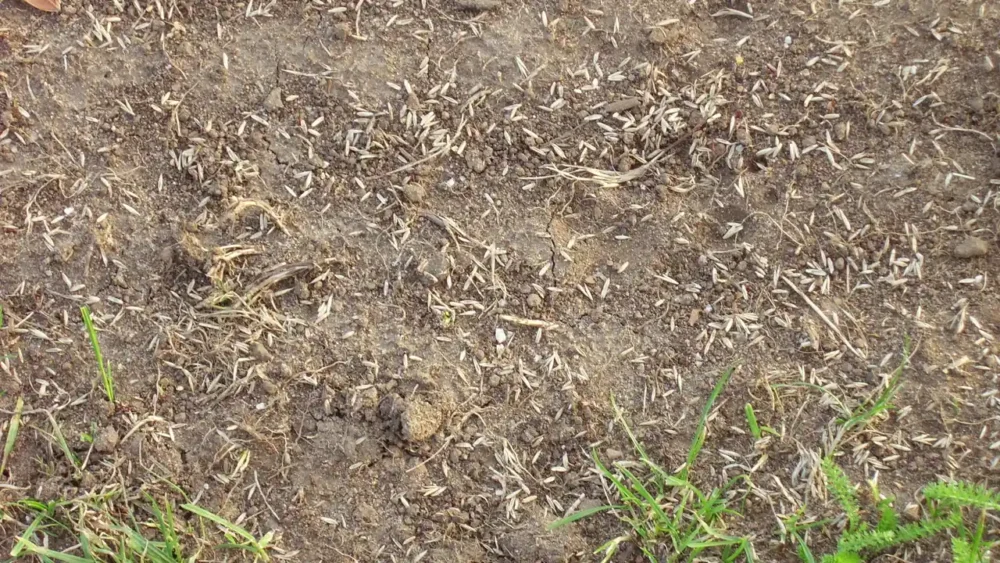
Dormant Seeding Your Lawn: When to Start Where You Live
Dormant seed a cool-season lawn once normal afternoon highs fall below about 40°F, and stop when they climb back. Winter windows for 23 Northern US cities from NOAA normals, checked against extension advice.
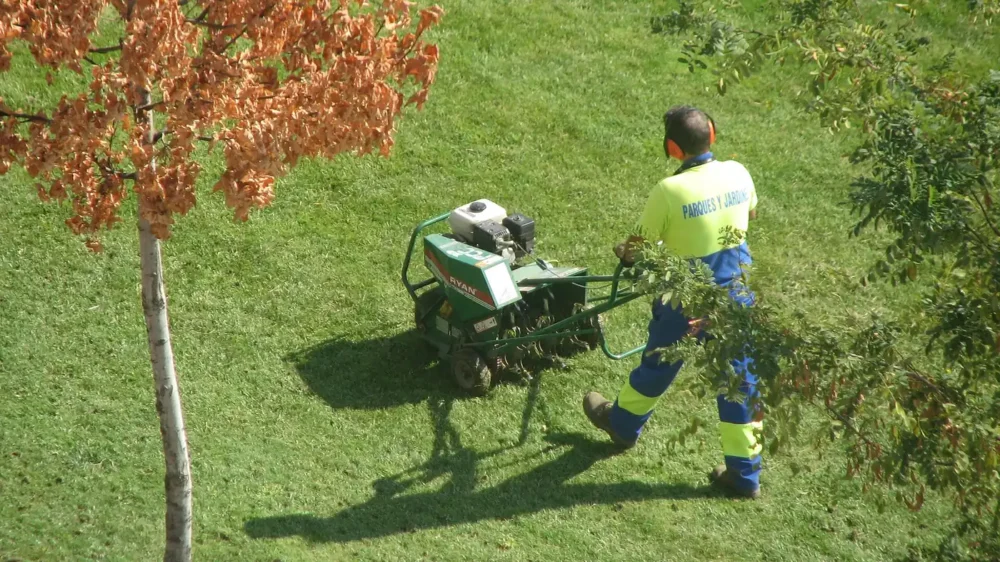
When to Aerate Your Lawn: Dates by Grass Type and City
Core-aerate cool-season lawns in late summer to early fall and warm-season lawns in late spring to summer. Windows for 27 cities from NOAA normals, checked against extension calendars.
Seasonal reminders for your ZIP
Get a short email when it’s time to overseed, start seeds, open the pool or service your furnace — timed to your climate.