




When to Plant Grass Seed in Spring: Soil Temperature Dates Where You Live
Spring seed sprouts once the soil warms, not on a calendar date. We read 12 springs of NOAA’s measured soil temperatures, turned them into a simple air-temperature rule, and worked out typical seeding dates for 48 cities, checked against seven extension services.
- Last reviewed Oct 7, 2026
- 15 cited sources
- 8 min read
Set your ZIP to see dates for your area.
- 1Sow cool-season grass seed (tall fescue, perennial ryegrass, Kentucky bluegrass) as early in spring as the ground can be worked, so it is in place when the top 2 inches of soil reach about 50°F.
- 2In a typical year that happens around Mar 20–26 in St. Louis, Washington and Philadelphia, Apr 1–15 from New York and Columbus to Chicago and Boston, and Apr 22–28 in Minneapolis and Fargo.
- 3Soil warms on a different date each year: at NOAA’s measuring stations the earliest and latest springs were a median 31 days apart, so check the soil, not the calendar.
- 4Spring is the harder season: once the soil reaches 55°F, normal highs hit 80°F about 53 days later, leaving tall fescue seedlings roughly 4½ weeks of mild weather and bluegrass less.
- 5Wait for 65°F soil 4 inches down before sowing Bermuda grass, zoysia or centipede: mid-March on the Gulf Coast, late April in Atlanta, Nashville and Oklahoma City.
- 6Most crabgrass preventers stop grass seed too. Siduron can go down at seeding; for other products follow the label and wait until the new grass has been mowed several times.
Plant cool-season grass seed in spring as early as you can work the soil, so it is already down when the top 2 inches of soil reach about 50°F: in a typical year that is around March 20–26 in St. Louis, Washington and Philadelphia, early to mid-April from New York and Columbus to Chicago and Boston, and late April in Minneapolis and Fargo. Warm-season seed such as Bermuda grass waits for 65°F soil 4 inches down, usually mid-March to late April across the South.
Those dates come from NOAA’s own soil thermometers. We read 12 springs of measured soil temperature at 41 NOAA climate stations, found the air temperature that tracks it, and applied that rule to 32 cool-season and 16 warm-season cities.
The soil temperatures that start spring seed
Cool-season seed (Kentucky bluegrass, tall fescue, perennial ryegrass) begins to sprout as soil warms to 50–55°F, according to Purdue’s turf program.5 Purdue’s spring seeding guide counts germination time from the day soil reaches 55°F.3 Because nothing happens below that, Purdue’s advice is to get seed down before the soil warms:4
Seed as soon as possible (now is not too early)
| Seed | lb per 1,000 sq ft | Days to germinate |
|---|---|---|
| Kentucky bluegrass | 2 | 18–28 |
| Kentucky bluegrass (80–90%) + perennial ryegrass (10–20%) | 4 | 18–28 |
| Kentucky bluegrass (50–70%) + fine fescue (30–50%) | 5 | 18–28 |
| Tall fescue | 8 | 14–21 |
Warm-season grasses need much warmer ground. UGA Extension says to seed them when soil at the 4-inch depth is consistently 65°F and rising, typically mid- to late spring.7
When to plant grass seed in spring, city by city
The table gives typical-year dates for the weather station nearest each ZIP code.2 “Tall fescue up by” adds Purdue’s 21-day upper germination time to the 55°F date. “Highs reach 80°F” marks the heat above which Nebraska Extension says cool-season seed is less likely to grow well.8
| City (ZIP) | Soil 50°F | Tall fescue up by | Highs reach 80°F |
|---|---|---|---|
| Fargo, ND (58102) | Apr 28 | May 30 | Jul 1 |
| Minneapolis, MN (55401) | Apr 22 | May 25 | Jun 26 |
| Green Bay, WI (54301) | Apr 26 | May 29 | Jul 10 |
| Madison, WI (53703) | Apr 21 | May 25 | Jun 29 |
| Milwaukee, WI (53202) | Apr 20 | May 24 | Jun 17 |
| Des Moines, IA (50309) | Apr 8 | May 13 | Jun 10 |
| Sioux Falls, SD (57104) | Apr 19 | May 23 | Jun 14 |
| Omaha, NE (68102) | Apr 5 | May 9 | Jun 3 |
| Chicago, IL (60601) | Apr 10 | May 15 | Jun 14 |
| Detroit, MI (48201) | Apr 17 | May 21 | Jun 22 |
| Grand Rapids, MI (49503) | Apr 22 | May 26 | Jun 28 |
| Indianapolis, IN (46204) | Apr 7 | May 12 | Jun 13 |
| Columbus, OH (43215) | Apr 5 | May 10 | Jun 9 |
| Cleveland, OH (44113) | Apr 14 | May 18 | Jul 11 |
| Pittsburgh, PA (15222) | Apr 7 | May 13 | Jun 12 |
| Buffalo, NY (14202) | Apr 23 | May 26 | Jul 15 |
| Albany, NY (12207) | Apr 17 | May 21 | Jun 20 |
| Burlington, VT (05401) | Apr 23 | May 25 | Jul 1 |
| Portland, ME (04101) | Apr 27 | Jun 2 | rarely |
| Boston, MA (02108) | Apr 15 | May 22 | Jul 6 |
| Hartford, CT (06103) | Apr 12 | May 17 | Jun 19 |
| New York, NY (10001) | Apr 1 | May 6 | Jun 18 |
| Philadelphia, PA (19103) | Mar 26 | Apr 29 | May 31 |
| Washington, DC (20001) | Mar 22 | Apr 27 | May 28 |
| Kansas City, MO (64105) | Mar 22 | Apr 27 | May 29 |
| St. Louis, MO (63101) | Mar 20 | Apr 24 | May 26 |
| Louisville, KY (40202) | Mar 21 | Apr 24 | May 28 |
| Denver, CO (80202) | Apr 7 | May 17 | Jun 3 |
| Salt Lake City, UT (84101) | Mar 21 | May 8 | Jun 8 |
| Boise, ID (83702) | Apr 22 | May 31 | Jun 26 |
| Spokane, WA (99201) | Apr 20 | May 28 | Jul 4 |
| Seattle, WA (98101) | Mar 24 | May 15 | rarely |
Seed in the weeks before the 50°F date if the ground is workable. Purdue notes that spring rain often makes it hard to seed after March in Indiana, and the University of Nebraska says the same for much of the Great Plains.3,15 For any other ZIP code, our frost date lookup shows your nearest station.
How we turned air temperature into soil temperature
NOAA’s Climate Reference Network measures soil temperature at five depths at stations placed in open sites.1 For each station we found the median date, over 2014–2025, when the top 2 inches first averaged 50°F for five days. On that date the normal daily average air temperature was about 48°F at the median station. Soil reached 55°F at about 53°F, and 65°F at 4 inches at about 63°F. So, roughly, the top few inches of soil run about 2°F warmer than the normal daily average in spring.
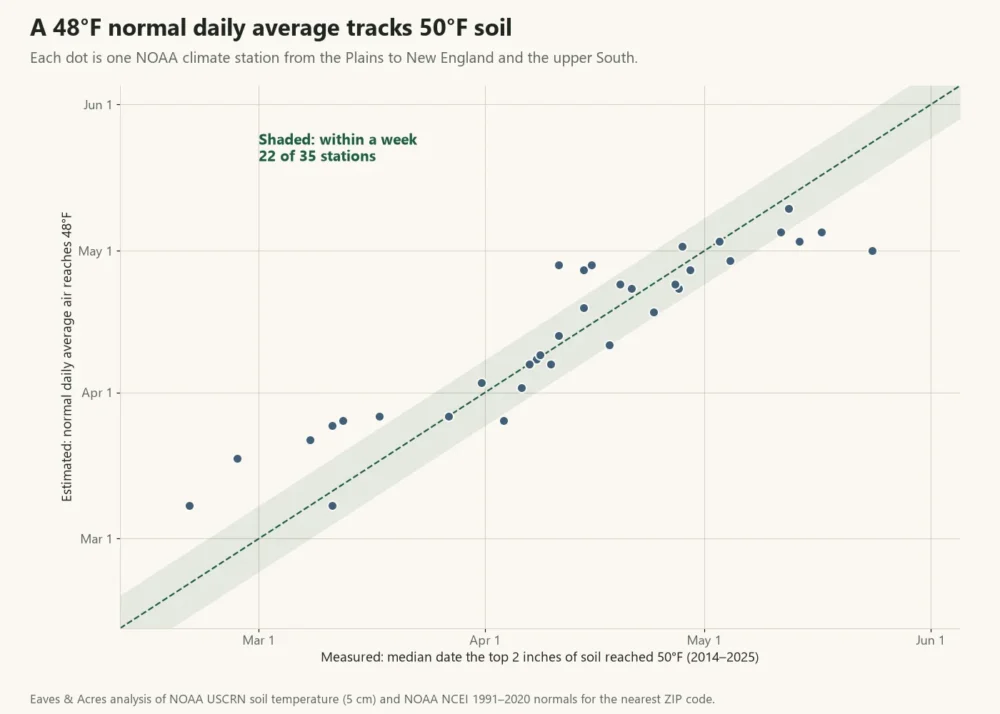
Re-estimated with each station left out in turn, the rule landed within a week at 22 of 35 stations; the median miss was 4½ days. It runs late in the upper South, where soil warmed up to three weeks sooner than it predicts, and early in far northern Minnesota.
Does it match extension advice?
| NOAA station | Measured soil date (median, range) | Extension timing |
|---|---|---|
| Sandstone, MN | 50°F: May 14 (May 8–May 24) 55°F: May 25 | Minnesota: spring seeding acceptable from May through early June (UMN Extension calendar) |
| Bedford, IN | 50°F: Mar 31 (Mar 8–Apr 15) 55°F: Apr 16 | Indiana: seed sown on April 2 “will germinate in mid to late April” (Purdue, 2013) |
| Manhattan, KS | 50°F: Mar 27 (Mar 10–Apr 13) 55°F: Apr 12 | Kansas City area: best spring seeding mid-March through early April (K-State, Johnson County) |
| Chapel Hill, NC | 50°F: Feb 19 (Feb 6–Mar 14) 55°F: Mar 15 | North Carolina piedmont: cool-season spring seeding mid-February to late March (NC State) |
| Watkinsville, GA | 65°F at 4 in: Apr 24 (Apr 4–May 20) | Georgia: warm-season seed at 65°F, 4 inches down, typically mid- to late spring (UGA) |
| Stillwater, OK | 65°F at 4 in: May 8 (Apr 25–May 22) | Oklahoma: seeded Bermuda grass May 1 to June 15 (Oklahoma State) |
| Crossville, TN | 65°F at 4 in: May 11 (May 1–May 24) | Tennessee: warm-season seed between May 1 and June 30 (University of Tennessee) |
Each extension window sits just ahead of, or on top of, the date the soil actually warmed nearby, which is what “seed early” means in practice.
Check the soil, not the calendar
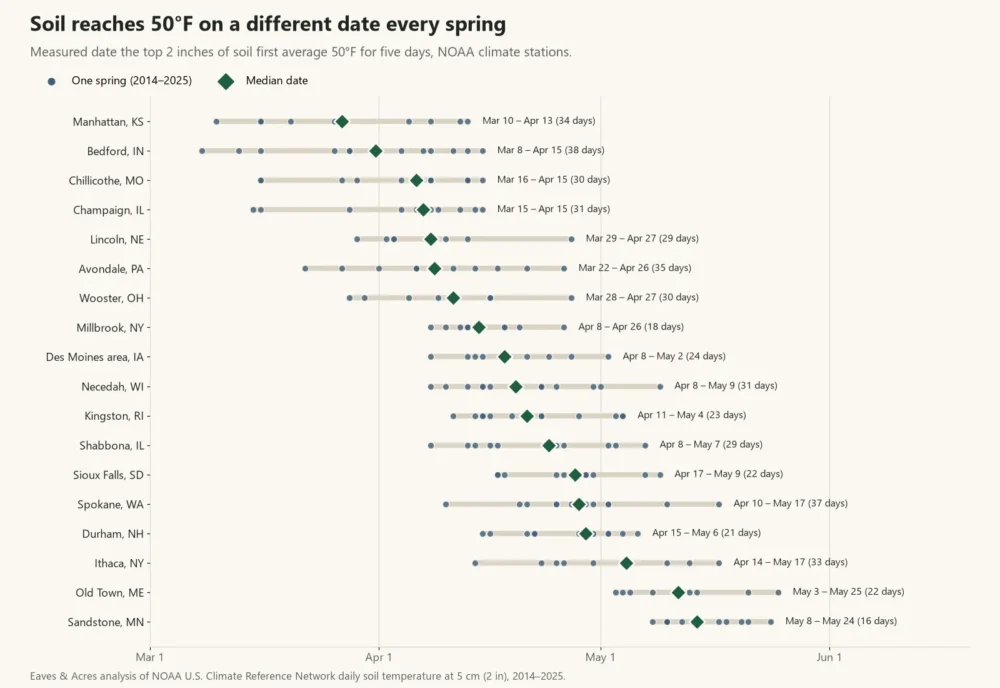
Any city date is a typical year. At the median station, the earliest and latest springs were 31 days apart; at Bedford, Indiana, the date ran from March 8 to April 15.1 In a cold spring, seed sown on the usual date can sit for weeks. A soil thermometer, or that week’s forecast, tells you more than the date.
Is March or April too early to plant grass seed?
For cool-season grass, usually not, as long as the ground is thawed and dry enough to rake. Seed just waits for warm soil. Purdue’s April 2 advice for Indiana was that seed sown then would germinate in mid to late April,6 and K-State expects at least two to three weeks, or more, for it to emerge in spring.10 Where soil reaches 50°F in late March, as in St. Louis or Washington, March seeding is on time. In Minneapolis or Fargo, seed sown in March sits for about a month, so you lose nothing by waiting until the ground can be worked in April.
For warm-season grass, March is too early almost everywhere outside the Gulf Coast and the desert Southwest: in Table 4 only Houston, Jacksonville and Phoenix reach 65°F soil before mid-March.
Why spring seeding is harder: the weeks before summer heat
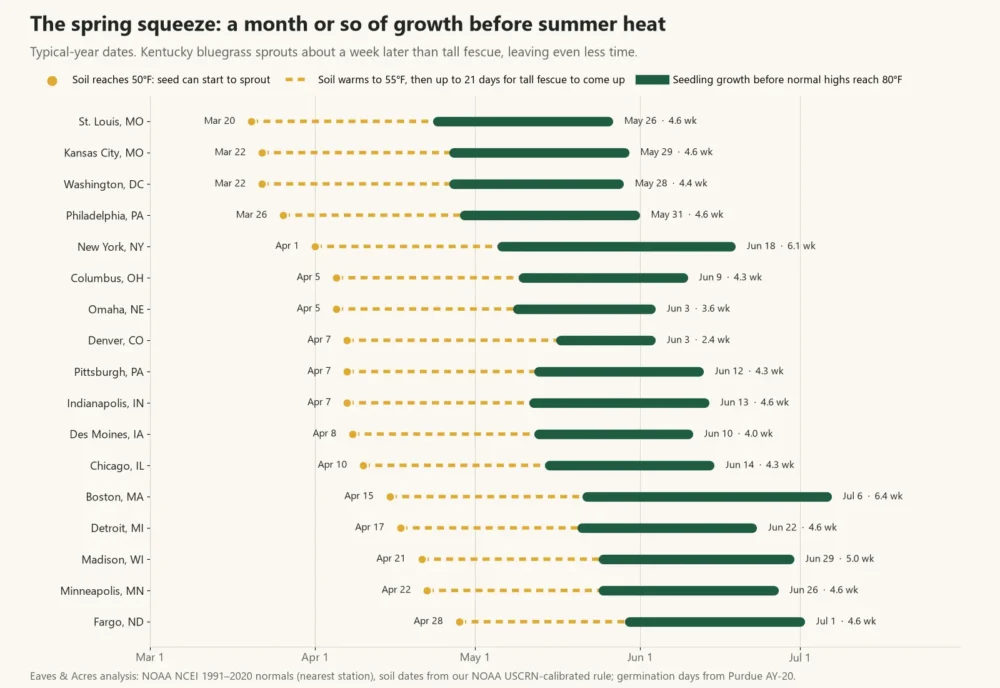
Across 26,208 ZIP codes with a cold spring and summer highs above 80°F, normal highs hit 80°F a median 53 days after the soil reaches 55°F.2 Subtract germination time and tall fescue seedlings get about 4.6 weeks of mild weather, Kentucky bluegrass about 3.6. In 89% of those ZIP codes, tall fescue gets less than six weeks.
Seeding in spring is very difficult and often unsuccessful.
That is why Purdue puts the best seeding window in mid-August to mid-September.3 In spring, Purdue finds tall fescue and perennial ryegrass more successful than Kentucky bluegrass, which germinates slowly; it suggests a 90:10 tall fescue–bluegrass mix or an 80:20 bluegrass–ryegrass mix.6 Shallow spring roots also need summer water:
not to even attempt spring seeding unless you are committed to watering during the summer
Warm-season grass: wait for 65°F soil
Bermuda grass, zoysia and centipede go in later, once soil 4 inches down holds 65°F. These dates use the 63°F daily-average rule:
| City (ZIP) | Soil 65°F at 4 in | Typical first frost |
|---|---|---|
| Nashville, TN (37201) | Apr 29 | Oct 31 |
| Memphis, TN (38103) | Apr 21 | Nov 10 |
| Raleigh, NC (27601) | Apr 25 | Nov 8 |
| Charlotte, NC (28202) | Apr 24 | Nov 3 |
| Atlanta, GA (30303) | Apr 21 | Nov 8 |
| Birmingham, AL (35203) | Apr 14 | Nov 11 |
| Columbia, SC (29201) | Apr 1 | Nov 16 |
| Little Rock, AR (72201) | Apr 22 | Nov 10 |
| Oklahoma City, OK (73102) | Apr 29 | Nov 2 |
| Tulsa, OK (74103) | Apr 24 | Nov 4 |
| Dallas, TX (75201) | Mar 31 | Nov 29 |
| Austin, TX (78701) | Mar 17 | Nov 17 |
| Houston, TX (77002) | Mar 14 | Dec 25 |
| Jacksonville, FL (32202) | Mar 7 | Jan 5 |
| Phoenix, AZ (85004) | Mar 2 | rare |
| Las Vegas, NV (89101) | Mar 26 | Dec 8 |
Finish in time to let seedlings mature before frost. The University of Tennessee says to plant Bermuda grass, zoysia and centipede seed between May 1 and June 30;13 Oklahoma State gives May 1 to June 15 for seeded Bermuda grass;14 UGA says no later than early to mid-August in Georgia.7 Not sure which type you have? See cool-season vs. warm-season grass.
Spring seeding and crabgrass preventers
Spring seed and crabgrass sprout in the same weeks. Illinois Extension says crabgrass germinates once soil stays above 55–60°F for 7–10 days, and that crabgrass preventers also damage germinating grass seed, with the exception of siduron.12
- At seeding: siduron can go down with the seed, but Purdue says it controls crabgrass for only three or four weeks.3
- After seeding: Purdue advises waiting until new grass has been mowed four to eight times before other preventers.3 K-State notes that dithiopyr can go down in early to mid-May; some labels allow it two weeks after germination or once grass is 2 inches tall.10
Our pre-emergent timing guide has the crabgrass window for each city.
How to seed a lawn in spring
- Loosen the surface. Seed needs to touch soil. Purdue suggests raking, power raking or core aeration first; our aeration guide has the timing.3
- Feed at seeding. Purdue suggests a high-phosphorus starter fertilizer.3
- Keep it moist. Purdue advises watering three to four times a day once soil reaches 55°F, then less often but deeper as roots grow, through the summer.3 See how much to water a lawn.
- Mow early. Purdue starts at about 2 inches, then raises the mower to normal height.3
Spring or fall?
If the lawn can wait, late summer is still the better bet: find your last safe day to overseed. In the North, dormant seeding in winter puts seed down before spring even starts.
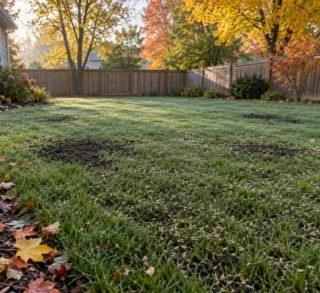 Related guideWhen to Overseed Your Lawn: The Last Safe Day Where You Live
How we worked out these dates, and their limits
Soil dates come from NOAA USCRN daily soil temperature at 5 cm and 10 cm, 2014–2025, using a five-day average.1 City dates apply our air rule to NOAA NCEI 1991–2020 monthly normals interpolated to days.2 Your soil can differ: sun, shade, slope and soil type all change how fast it warms. See our methodology page.
Frequently asked questions
Not reliably. K-State Extension says simply scattering seed on the ground usually gives a poor stand. Purdue recommends raking, power raking or core aerating first so the seed touches soil, then keeping the surface moist once the soil reaches 55°F.
Cool-season seed sits until the soil warms, which is why Purdue advises seeding as early as possible, so the seed is in the ground and ready when soil temperatures rise. Warm-season seed needs soil at 65°F 4 inches down, UGA says, so sowing it weeks earlier gains nothing.
For cool-season grass, March in the mid-Atlantic and lower Midwest (St. Louis, Washington, Kansas City), early to mid-April across the Great Lakes and Northeast, and late April in the Upper Midwest. For Bermuda grass and other warm-season grass, April to June, after the soil warms to 65°F.
It can be, if fall is too long to wait. Purdue says spring seeding is difficult and often unsuccessful but warranted for thin turf after winter damage or poor recovery from grubs or drought. K-State advises not to try it unless you can water through the summer.
Purdue’s spring figures, counted from the day soil reaches 55°F, are 14 to 21 days for tall fescue and 18 to 28 days for Kentucky bluegrass and its mixes. K-State says to expect at least two to three weeks, or more, for emergence. Purdue starts mowing when the first blades reach about 2 inches.
Keep the surface moist, but early-spring seed is waiting for warm soil, not water. Purdue advises watering lightly to keep the seedbed moist as soil warms to 50°F, then three to four times a day once it reaches 55°F. K-State recommends light, frequent watering through germination, then watering only when seedlings wilt or turn bluish.
Only certain products. Illinois Extension says preemergence grass weed killers also damage germinating grass seed, except siduron. Purdue says siduron can go down at seeding but controls crabgrass for only three to four weeks; K-State notes dithiopyr can be applied later in May. Always follow the label.
Seeding too late, scattering seed without soil contact, using a crabgrass preventer that stops grass seed, and stopping watering once the grass is up. Purdue also warns that Kentucky bluegrass alone establishes poorly in spring and suggests mixing it with tall fescue or perennial ryegrass.
Once soil 4 inches down stays at 65°F and rising, UGA advises. That is about mid-March in Houston, mid-April in Birmingham and late April in Atlanta, Nashville and Oklahoma City. Tennessee recommends planting between May 1 and June 30, and Oklahoma State gives May 1 to June 15 for seeded Bermuda grass.
Sources
- 1.U.S. Climate Reference Network (USCRN) daily data, 2014–2025. NOAA National Centers for Environmental Information, 2026. Used for: measured soil temperature at 5 cm and 10 cm at 41 stations; station siting Back to text
- 2.U.S. Climate Normals 1991–2020. NOAA National Centers for Environmental Information, 2021. Used for: normal daily average and high temperatures for every city in Tables 2 and 4; first frost dates Back to text
- 3.Seeding a Turf Area in the Spring (AY-20), Zac Reicher and Clark Throssell. Purdue Extension, 1998. Used for: spring seeding rates and germination days after soil reaches 55°F, site preparation, watering, mowing, siduron and herbicide waits, spring rains Back to text
- 4.If You Must Seed, Do it Now, Zac Reicher. Purdue University Turfgrass Science, 2004. Used for: seed as early as possible; germination as soil warms to 50°F Back to text
- 5.Spring seeding, Jennifer Biehl. Purdue University Turfgrass Science, 2010. Used for: germination once soil climbs above 50–55°F; early April seeding Back to text
- 6.Still Time for Spring Seeding (Turf Tips). Purdue University Turfgrass Science, 2013. Used for: Indiana germination timing; tall fescue and ryegrass vs Kentucky bluegrass in spring; mixtures Back to text
- 7.Lawns in Georgia: Establishment (B 1533-2), Clint Waltz. University of Georgia Cooperative Extension, 2021. Used for: warm-season seeding at 65°F soil, 4-inch depth; latest seeding date Back to text
- 8.Overseeding in the Fall, Amanda Folck. Nebraska Extension Turfgrass Science, 2024. Used for: 80°F air temperature limit for cool-season seed Back to text
- 9.Lawn care calendar, Minnesota. University of Minnesota Extension, 2024. Used for: Minnesota spring seeding window (validation table)
- 10.Spring Grass Seeding May Fill In Bare Areas. K-State Research and Extension, Johnson County, accessed 2026. Used for: Kansas City-area spring window, emergence time, summer watering, dithiopyr Back to text
- 11.Carolina Lawns (AG-69), Grady Miller, Charles Peacock et al.. NC State Extension, 2021. Used for: North Carolina piedmont spring seeding window (validation table)
- 12.Managing Crabgrass in Lawns. University of Illinois Extension, accessed 2026. Used for: crabgrass germination soil temperature; preemergents damage grass seed except siduron Back to text
- 13.Chapter 10: Turfgrass Management in Tennessee, Tom Samples et al.. University of Tennessee Extension Master Gardener, accessed 2026. Used for: May 1 to June 30 warm-season seeding window Back to text
- 14.Choosing, Establishing, and Managing Bermudagrass Varieties in Oklahoma (PSS-2583). Oklahoma State University Extension, 2017. Used for: Bermuda grass seed germination near 65°F soil; May 1 to June 15 seeding Back to text
- 15.Establishing Lawns From Seed (Turf 2012l). University of Nebraska–Lincoln Turfgrass Science, 2012. Used for: seed as early in spring as possible; spring rains in the Great Plains Back to text
How this guide was made
- Written by the Yard & Garden Desk and reviewed by the Data & Methodology Desk.
- Data: soil dates are the median day, 2014–2025, on which the five-day average soil temperature at NOAA U.S. Climate Reference Network stations first reached 50°F or 55°F at 5 cm or 65°F at 10 cm; city dates are the day the NOAA NCEI 1991–2020 normal daily average temperature at the station nearest each ZIP reaches 48°F, 53°F or 63°F, the air values that matched those soil dates at the median station (monthly normals interpolated to days). Real springs vary by weeks. See our methodology.
- AI use: AI tools help us research, draft and check this guide. Every figure is checked against the source cited for it, and calculated figures come from our own code, described on the methodology page.
- Spotted an error? Tell us — the form opens with this page’s address filled in.
Change log
- Oct 7, 2026Re-checked against today’s search results and the cited sources (Purdue, K-State, UGA, Nebraska, Illinois, Tennessee, NC State, University of Minnesota, NOAA). Added a FAQ on watering right after seeding; updated the University of Minnesota lawn care calendar link to its current address.
- Oct 4, 2026Published. Spring seeding dates for 32 cool-season and 16 warm-season cities from NOAA USCRN measured soil temperature (41 stations, 2014–2025) and NOAA 1991–2020 normals; checked against UMN, Purdue, K-State, NC State, UGA, Oklahoma State and Tennessee timing.
Covers lawns, gardens, frost and planting. We write the guides and maintain the tools that tell you when to seed, feed and plant for your ZIP.
Keep reading
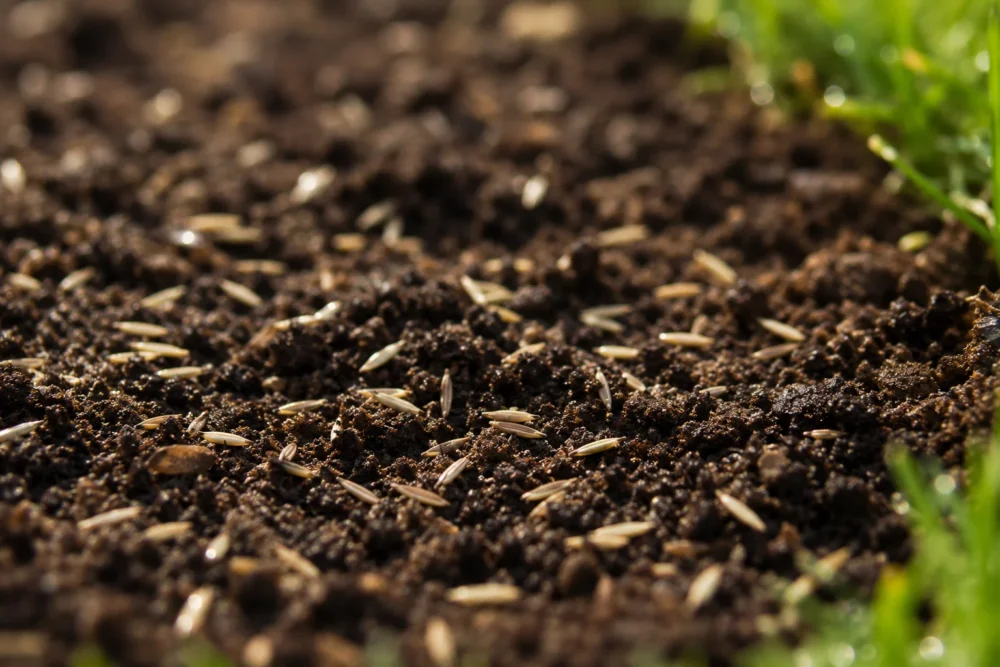
How Long Does Grass Seed Take to Grow? Germination Days by Grass and Season
Most lawn grass seed germinates in 3 to 30 days, from about a week for ryegrass to a month for Kentucky bluegrass and Bermuda grass. NOAA’s measured soil temperatures show why early-fall seed comes up so much faster than spring seed.
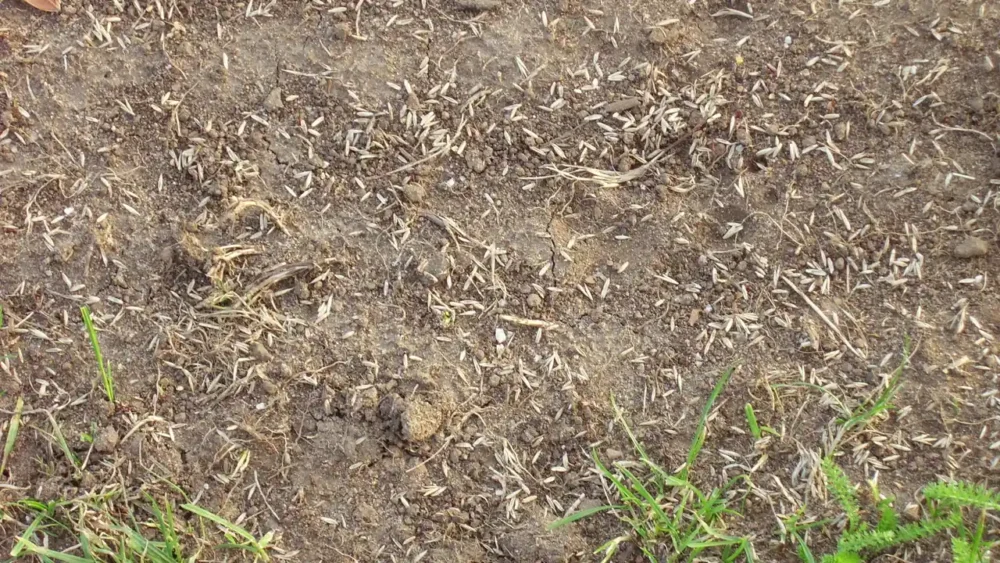
Dormant Seeding Your Lawn: When to Start Where You Live
Dormant seed a cool-season lawn once normal afternoon highs fall below about 40°F, and stop when they climb back. Winter windows for 23 Northern US cities from NOAA normals, checked against extension advice.
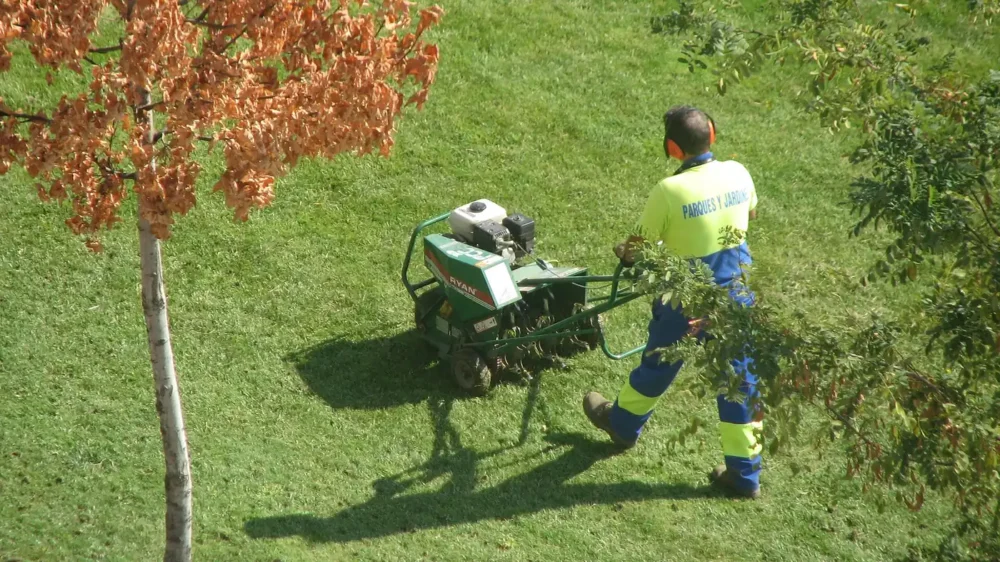
When to Aerate Your Lawn: Dates by Grass Type and City
Core-aerate cool-season lawns in late summer to early fall and warm-season lawns in late spring to summer. Windows for 27 cities from NOAA normals, checked against extension calendars.
Seasonal reminders for your ZIP
Get a short email when it’s time to overseed, start seeds, open the pool or service your furnace — timed to your climate.