




When to Aerate Your Lawn: Dates by Grass Type and City
Aerate while your grass is growing hard and has four weeks left to heal. Windows for 27 cities from NOAA normals, checked against extension calendars.
- Last reviewed Oct 4, 2026
- 17 cited sources
- 7 min read
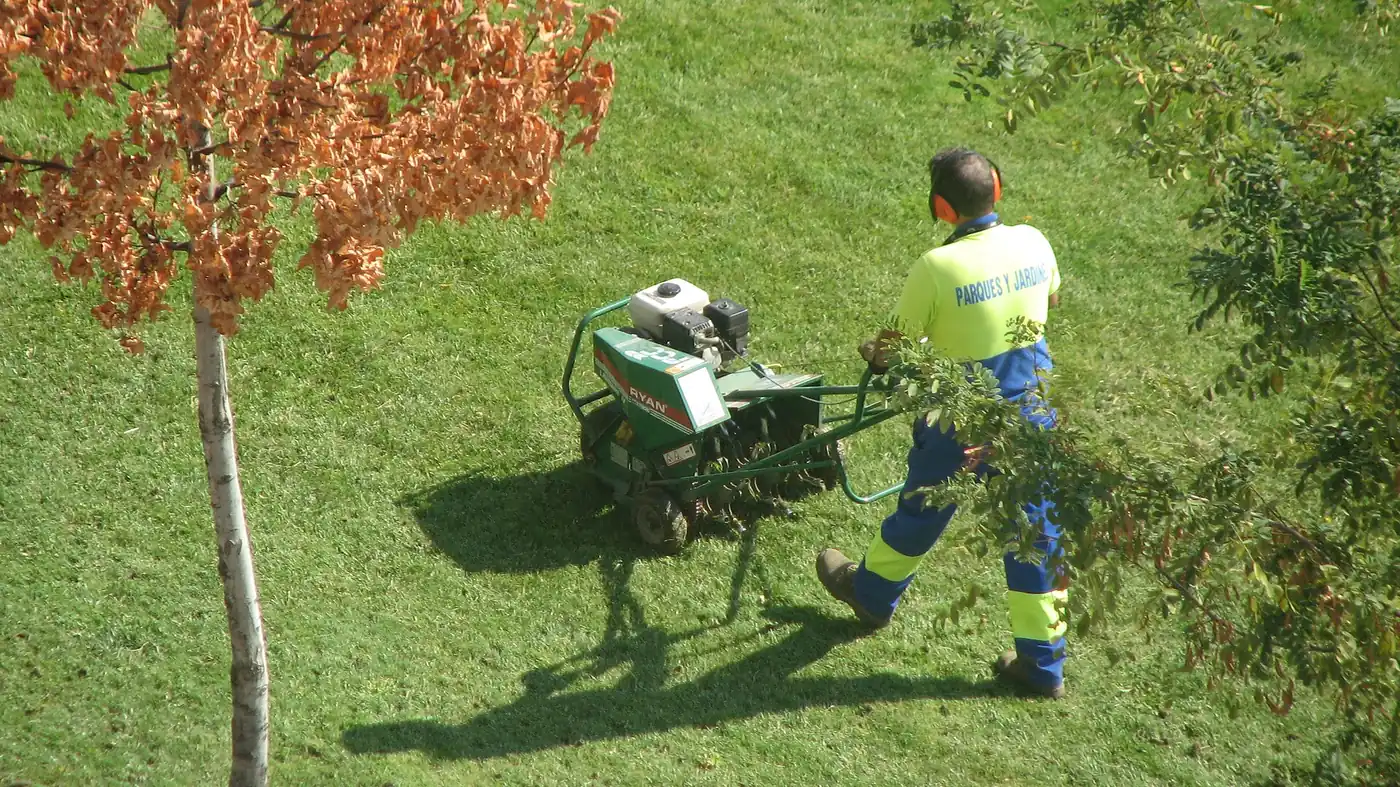
- 1Core-aerate cool-season lawns in late August to September (March to April is second best) and warm-season lawns from late spring through summer.
- 2Leave four weeks of good growing weather afterwards: finish cool-season lawns by about Sep 11 in Minneapolis, Sep 26 in Chicago and Oct 15 in Washington, DC.
- 3Warm-season windows from NOAA normals: about May 12 to Sep 1 in Atlanta and Apr 27 to Sep 17 in Dallas. South Georgia dates match UGA’s calendar.
- 4Use a core aerator on moist, not wet, soil. Most lawns need it every 1–5 years; clay soil with heavy use, once or twice a year.
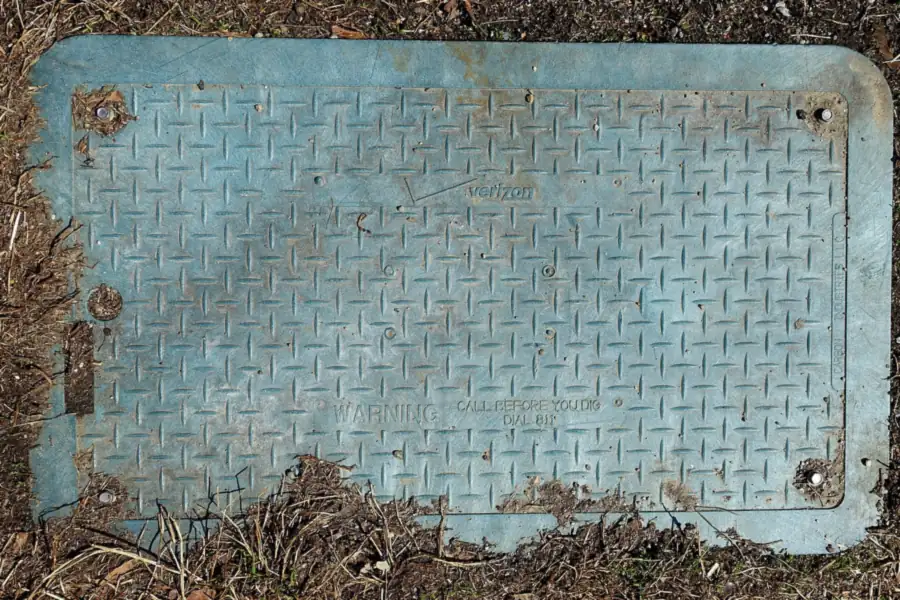
- 5Flag sprinkler heads and contact 811 first, and aerate before applying a pre-emergent, not after.
Core-aerate a cool-season lawn (tall fescue, Kentucky bluegrass, ryegrass) in late summer to early fall, with early spring as the second choice. Aerate a warm-season lawn (Bermuda, zoysia, St. Augustine, centipede) from late spring through summer. Either way, aerate while the grass is growing hard, leave it four weeks of good growing weather afterwards, and wait for soil that is moist but not wet.
Below, we turn the extension calendars into dates for 27 US cities using NOAA’s 1991–2020 climate normals, and check them against published local windows.
The best time to aerate, by grass type
Every extension calendar follows one rule: aerate when the grass can heal fast. Kansas State University puts it plainly:
Core aeration can be done anytime the grass is actively growing.
Cool-season grasses grow best when daytime highs run 60–75°F, and warm-season grasses at 80–95°F, according to University of Tennessee Extension and NC State.4,5 So the two lawn types run on opposite calendars. Not sure which you have? See our guide to cool-season vs. warm-season grass.
| Grass type | Best time | Second choice | Source |
|---|---|---|---|
| Cool-season: tall fescue, Kentucky bluegrass, perennial ryegrass | Late August to September | March to April | NDSU, K-State, Penn State |
| Warm-season: Bermuda, zoysia, St. Augustine, centipede, buffalograss | Late May through July (Kansas); May to August (south Georgia) | April or September (south Georgia) | K-State, UGA |
| Spike (solid-tine) aeration | Any time | — | K-State |
Fall wins for cool-season lawns because there is less heat stress and less risk of weedy annuals moving in, says Clemson Extension’s aeration fact sheet.3 Penn State adds that spring aeration can bring weed seeds to the surface.8 For Bermuda, Clemson waits until the threat of frost has passed.9
Your aeration window, city by city
Months stand in for temperature, so we worked from temperature directly, using two published rules. Warm-season grass grows best once daytime highs reach 80°F. And the lawn needs time to fill the holes: K-State’s Aerating Your Lawn (MF2130) asks for four weeks of good growing weather after aerating warm-season grass,2 and Clemson sets the same margin for cool-season lawns:
Allow at least four weeks of good growing weather to help the plants recover.
For each city we took the normal daily high at the nearest NOAA station,1 found when it crosses 80°F in spring and in fall, and counted back four weeks from the fall crossing.
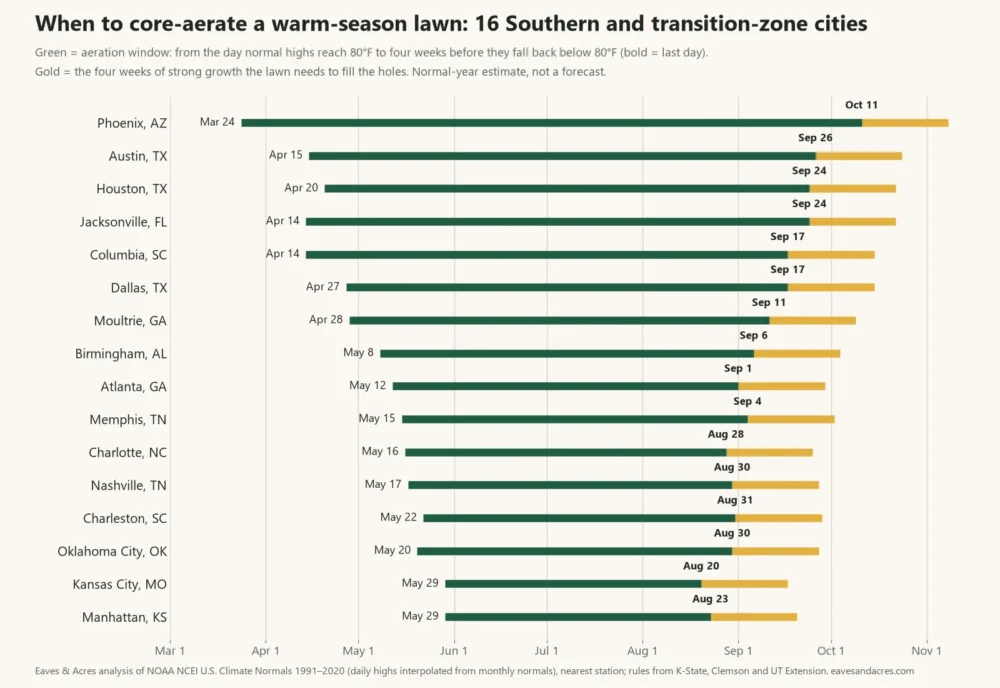
| City (ZIP) | Normal highs reach 80°F | Last day to core-aerate | Normal July–Aug high |
|---|---|---|---|
| Phoenix, AZ (85004) | Mar 24 | Oct 11 | 106°F (heat stress) |
| Austin, TX (78701) | Apr 15 | Sep 26 | 98°F (heat stress) |
| Houston, TX (77002) | Apr 20 | Sep 24 | 94°F |
| Jacksonville, FL (32202) | Apr 14 | Sep 24 | 92°F |
| Columbia, SC (29201) | Apr 14 | Sep 17 | 96°F (heat stress) |
| Dallas, TX (75201) | Apr 27 | Sep 17 | 97°F (heat stress) |
| Moultrie, GA (31768) | Apr 28 | Sep 11 | 90°F |
| Birmingham, AL (35203) | May 8 | Sep 6 | 91°F |
| Atlanta, GA (30303) | May 12 | Sep 1 | 90°F |
| Memphis, TN (38103) | May 15 | Sep 4 | 91°F |
| Charlotte, NC (28202) | May 16 | Aug 28 | 90°F |
| Nashville, TN (37201) | May 17 | Aug 30 | 89°F |
| Charleston, SC (29401) | May 22 | Aug 31 | 88°F |
| Oklahoma City, OK (73102) | May 20 | Aug 30 | 93°F |
| Kansas City, MO (64105) | May 29 | Aug 20 | 90°F |
| Manhattan, KS (66502) | May 29 | Aug 23 | 91°F |
Where normal July and August highs top 95°F, above the best growing range, aerate early in the window and watch the watering: Clemson warns that aerated turf dries out faster in summer drought.3
The last day for fall aeration on cool-season lawns
For cool-season grass, the end of the window matters most: four weeks before normal highs drop below 60°F, the bottom of the best growing range.4 Start once the summer heat breaks; in Fargo, NDSU’s window opens in late August.7
| City (ZIP) | Normal highs fall below 60°F | Last day for fall core aeration |
|---|---|---|
| Fargo, ND (58102) | Oct 9 | Sep 11 |
| Minneapolis, MN (55401) | Oct 9 | Sep 11 |
| Madison, WI (53703) | Oct 19 | Sep 21 |
| State College, PA (16801) | Oct 18 | Sep 20 |
| Detroit, MI (48201) | Oct 20 | Sep 22 |
| Boston, MA (02108) | Oct 23 | Sep 25 |
| Chicago, IL (60601) | Oct 24 | Sep 26 |
| Columbus, OH (43215) | Oct 30 | Oct 2 |
| New York, NY (10001) | Oct 30 | Oct 2 |
| Denver, CO (80202) | Nov 6 | Oct 9 |
| Manhattan, KS (66502) | Nov 5 | Oct 8 |
| Washington, DC (20001) | Nov 12 | Oct 15 |
Overseeding at the same time? Use whichever comes first: this date or the last safe day to overseed for your area.
How the dates compare with extension calendars
| Place | Our estimate | Extension window |
|---|---|---|
| Moultrie, GA (warm-season) | Apr 28 – Sep 11 | Best May–Aug; possible Apr and Sep (UGA Extension) |
| Manhattan, KS (warm-season) | May 29 – Aug 23 | Late May through July (K-State) |
| Manhattan, KS (cool-season) | Until Oct 8 | September (K-State) |
| Fargo, ND (cool-season) | Until Sep 11 | Late Aug to mid-Sep (NDSU) |
| State College, PA (cool-season) | Until Sep 20 | Late summer to early fall (Penn State) |
The south Georgia window closely matches UGA’s calendar,6 and the start dates line up elsewhere. Our end dates run up to about three weeks later than K-State’s, so treat them as limits, not targets. Coastal stations are the weak spot: Charleston’s downtown station doesn’t reach 80°F normal highs until May 22, yet Clemson says coastal Bermuda lawns usually green up in April.9 On the coast, let green-up start your window.
Core or spike aeration?
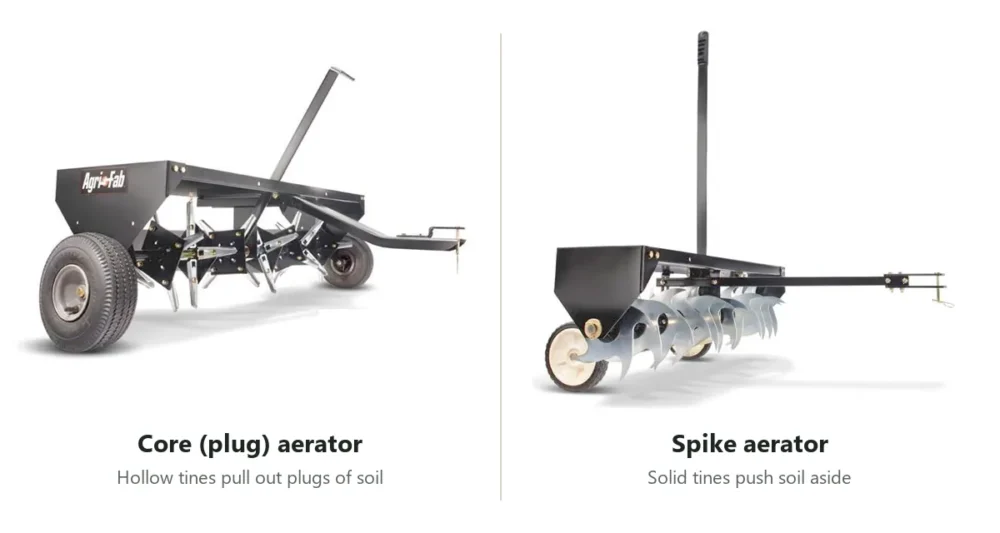
Use a core (plug) aerator. Its hollow tines pull plugs of soil out, which relieves compaction, lets water and air reach the roots and helps control thatch.2 A spike aerator’s solid tines push soil sideways; K-State says the effect is short-term and the soil around each hole is compacted again.2 Utah State Extension keeps solid tines for very sandy soil.13
Aim for holes about 3 inches deep, 3 inches or less apart and 3/4 inch wide, which usually takes several passes (K-State).2 Clemson suggests two passes at right angles.3
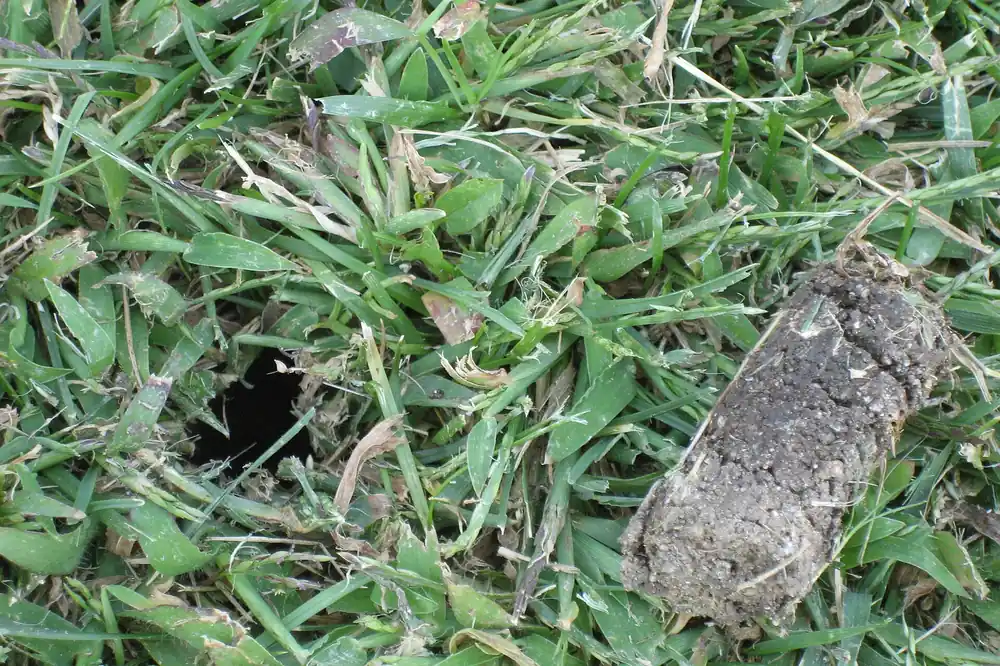
Leave the plugs where they fall. Rain, mowing and foot traffic break them up, and they carry microbes that help decompose thatch.3,7
Check soil moisture first
In dry soil the tines barely penetrate; in wet soil they clog and leave no plugs.2 If soil sticks to your shoes or a soil probe, Clemson says to wait for it to dry a little.3 Colorado State Extension suggests watering a dry lawn a couple of days ahead.14
Moist soil also shows whether you need to aerate at all. Push in a screwdriver: if it slides in easily, you probably don’t; if it is hard to push, the soil is likely compacted.3
How often to aerate
NDSU Extension says almost every lawn benefits from aeration but most do not need it. Lawns with heavy foot traffic, thatch over 1 inch or heavy soils benefit most.7
- Most lawns: every 1–5 years (NDSU), or once a year on soils with lighter use (K-State).7,2
- Clay soil with heavy use: twice a year (K-State); up to 2–4 times a season on poorly drained, heavily used soil (Clemson).2,3
- Thatch-prone grasses: Bermuda, zoysia and buffalograss need more aeration than bluegrass or fescue (K-State).2
Mark sprinklers and utilities before you start
 Related guideWhen to Overseed Your Lawn: The Last Safe Day Where You Live
Aerating with seed, fertilizer and pre-emergent
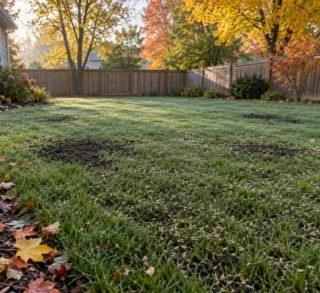
Seed. NDSU says you can overseed right after aerating, and Colorado State notes that seed in the holes stays moist and protected.7,14 Clemson differs for sparse areas: make six to ten passes and give the holes about a month to heal first, or new grass comes up mostly in and around the holes.3 For seeding dates, see our overseeding guide or, in the North, our dormant seeding guide.
Fertilizer. K-State advises aerating before fertilizing, seeding or applying crabgrass preventer.2 Feeding dates are in our guide on when to fertilize a lawn.
Pre-emergent. Aerate first, then apply it: Clemson and Utah State warn that coring through the herbicide barrier lets weeds through.3,13 If you have already applied one, Clemson suggests waiting until just before the next application.9 Crabgrass preventer also kills seedling grass, Colorado State notes, so follow the label’s waiting period before seeding.14 Spring dates by city are in when to apply pre-emergent.
More seasonal tasks are in our lawn care guides and seeding section; the methodology page explains how we use NOAA normals.
Frequently asked questions
Yes. Aerate only when the grass is actively growing; Clemson waits until frost danger has passed for Bermuda grass. Penn State notes spring aeration can bring weed seeds up.
September for most cool-season lawns; NDSU’s window in North Dakota runs from late August to mid-September. For warm-season lawns, May through July in Kansas and May through August in south Georgia, per K-State and UGA.
Push a screwdriver into moist soil. If it is hard to push in, the soil is likely compacted, Clemson says. Water ponding on level ground is another sign, though Clemson notes that low, clay-heavy spots can hold water without being compacted. Heavy traffic and thick thatch are other reasons.
If you are overseeding, yes: NDSU says seed can go down right after aerating. Seed has its own deadline, which can fall before or after the last day to aerate, so check both.
No. Leave them to break down with rain, mowing and traffic; they help decompose thatch (Clemson). NDSU suggests letting them dry a couple of days, then mowing over them.
811 asks for a free locate request a few days before any digging, and many lines sit only inches deep. Core tines reach 2–3 inches. Flag sprinkler heads yourself.
Sources
- 1.U.S. Climate Normals 1991–2020. NOAA National Centers for Environmental Information, 2021. Used for: normal daily highs for every city in Tables 2–4 Back to text
- 2.Aerating Your Lawn (MF2130), Jared Hoyle and Ross Braun. Kansas State University Research and Extension, 2018. Used for: Kansas windows, four-week recovery for warm-season grass, hole size, core vs spike, soil moisture, frequency, order of tasks Back to text
- 3.Aerating Lawns (HGIC 1200), Robert F. Polomski et al.. Clemson Cooperative Extension, Home & Garden Information Center, 2020. Used for: four-week recovery for cool-season grass, timing by grass type, soil moisture test, screwdriver test, frequency, plugs, seeding and pre-emergent order Back to text
- 4.Chapter 10: Turfgrass Management in Tennessee, Tom Samples et al.. University of Tennessee Extension Master Gardener, accessed 2026. Used for: best daytime air temperatures for warm- and cool-season grasses; aerate when actively growing Back to text
- 5.Turfgrasses. NC State Extension (TurfFiles), 2025. Used for: optimum growth temperatures, 60–75°F and 80–95°F Back to text
- 6.Bermudagrass Lawn Calendar. UGA Extension, Colquitt County, 2019. Used for: south Georgia aeration months (best May–August; possible April, September) Back to text
- 7.Should You Aerate Your Lawn? Tom Kalb. North Dakota State University Extension, 2017. Used for: North Dakota window, who benefits, how often, seeding right after aerating, plugs Back to text
- 8.Lawn Management through the Seasons, Peter Landschoot. Penn State Extension, 2025. Used for: cool-weather aeration windows, spring weed seeds Back to text
- 9.Bermudagrass Yearly Maintenance Program (HGIC 1216), Gary Forrester. Clemson Cooperative Extension, Home & Garden Information Center, 2018. Used for: aerate after frost danger, coastal green-up in April, postpone after pre-emergent Back to text
- 10.Tall Fescue Lawn Maintenance Calendar, Grady Miller et al.. NC State Extension, accessed 2026. Used for: delay tall fescue aeration until fall (background)
- 11.St. Augustinegrass Lawn Maintenance Calendar. NC State Extension, accessed 2026. Used for: late spring to early summer aeration (background)
- 12.Lawn Aeration and Overseeding. University of Illinois Extension (Good Growing), 2020. Used for: fall as best time, core vs spike (background)
- 13.Aerate Before it’s Too Late (Jerry Goodspeed), Julene Reese. Utah State University Extension, 2006. Used for: mark sprinkler heads, solid tines only on sandy soil, pre-emergent after aerating Back to text
- 14.1559 – Proper Lawn Aeration. Colorado State University Extension (PlantTalk Colorado), accessed 2026. Used for: water beforehand, mark sprinkler heads, seed in holes, crabgrass preventer kills seedlings Back to text
- 15.Before Every Dig, Every Time. 811, the national call-before-you-dig service, accessed 2026-10-04. Used for: contact 811 a few days before any digging; utilities buried inches deep Back to text
- 16.Core aerator on a lawn (photo, AIREADORA 04). Guipozjim, Wikimedia Commons, CC BY 3.0, accessed 2026. Used for: hero photo, cropped and resized
- 17.Soil core and hole (photo, AIREADORA 07). Guipozjim, Wikimedia Commons, CC BY 3.0, accessed 2026. Used for: photo, cropped and resized


How this guide was made
- Written by the Yard & Garden Desk and reviewed by the Data & Methodology Desk.
- Data: aeration windows are estimates for a normal year: normal daily highs interpolated from NOAA NCEI U.S. Climate Normals 1991–2020 for the station nearest each ZIP code, with the four-week recovery rule from K-State and Clemson Extension and the best-growth temperatures (60–75°F cool-season, 80–95°F warm-season) from University of Tennessee and NC State Extension. Timing, frequency and method come from K-State, Clemson, NDSU, Penn State, UGA, Utah State and Colorado State extension publications. See our methodology.
- AI use: AI tools help us research, draft and check this guide. Every figure is checked against the source cited for it, and calculated figures come from our own code, described on the methodology page.
- Spotted an error? Tell us — the form opens with this page’s address filled in.
Change log
- Oct 4, 2026Re-checked against today’s search results and sources (K-State, Clemson, NDSU, UGA, 811). Corrected the 811 notice to “a few days” ahead, as 811 states it, and updated its address; added Clemson’s ponding sign to the FAQ; grass-type link now points to our cool-season vs. warm-season guide.
- Oct 2, 2026Published. Aeration timing by grass type from K-State, Clemson, NDSU, Penn State and UGA; warm-season windows and the cool-season fall cut-off for 27 cities computed from NOAA 1991–2020 normals with the K-State/Clemson four-week rule and the University of Tennessee growth temperatures, checked against UGA, K-State, NDSU and Penn State windows.
Covers lawns, gardens, frost and planting. We write the guides and maintain the tools that tell you when to seed, feed and plant for your ZIP.
Keep reading
How Long Does Grass Seed Take to Grow? Germination Days by Grass and Season
Most lawn grass seed germinates in 3 to 30 days, from about a week for ryegrass to a month for Kentucky bluegrass and Bermuda grass. NOAA’s measured soil temperatures show why early-fall seed comes up so much faster than spring seed.
When to Plant Grass Seed in Spring: Soil Temperature Dates Where You Live
Get cool-season seed down before the top 2 inches of soil reach 50°F, and wait for 65°F soil for Bermuda grass. Typical dates for 48 US cities from NOAA’s measured soil temperatures and climate normals.
Dormant Seeding Your Lawn: When to Start Where You Live
Dormant seed a cool-season lawn once normal afternoon highs fall below about 40°F, and stop when they climb back. Winter windows for 23 Northern US cities from NOAA normals, checked against extension advice.
Seasonal reminders for your ZIP
Get a short email when it’s time to overseed, start seeds, open the pool or service your furnace — timed to your climate.