




When to Apply Lime to Your Lawn: Test First, Then Fall or Winter
Lime fixes acid soil, slowly, and only where the soil is acid. Here is the pH each grass wants, when to spread lime and how much, tested against NOAA freeze data for 22 cities, and why much of the West can skip it.
- Last reviewed Oct 13, 2026
- 20 cited sources
- 9 min read
Set your ZIP to see dates for your area.
- 1Lime a lawn only when a lab soil test shows the pH is too low; the report also gives the amount. Ohio State strongly discourages yearly liming without a test.
- 2Most lawns do best at pH 6.0–7.0 and centipede at 5.0–6.0; UGA and Arkansas disagree on St. Augustine (5.5–6.5 vs. 6.5–7.5).
- 3Spread it in fall or winter on dry, unfrozen turf, or in early spring. Lime takes three to four months to change pH and 6 to 12 months for the full effect.
- 4In NOAA normals, lime spread at the first fall frost gets 107 to 179 days before the last spring frost in 15 of 16 humid cities, and no ZIP code in Georgia, the Carolinas or Virginia has a stretch where normal highs stay at freezing.
- 5Put down no more than 50 lb per 1,000 sq ft at a time. Much of the West needs none: 87% of Colorado’s ZIP codes get under 20 inches of rain a year.
Apply lime to a lawn only when a soil test shows the pH is too low, and spread it in fall or winter, or in early spring, on dry turf that is not frozen, wilted or frost-covered. Lime works slowly, so a fall application has the winter to start raising the pH before spring growth.
Test the soil before you buy lime
A lab soil test is the only reliable way to know whether a lawn needs lime and how much. Ohio State Extension’s lime fact sheet says home kits and pH probes can show acidity but cannot calculate how much lime to apply, because soils differ greatly in what it takes to move their pH.3 The lab reports that amount as the “lime requirement”.
Yearly lime applications without performing a soil test are strongly discouraged
Too much lime is worse than too little: NCDA&CS, North Carolina’s soil-testing agency, notes that you can always add more, but you cannot remove it.7 Ohio State adds that a pH above 8.0 is as undesirable as a low one.3 Moss isn’t proof either. Asked whether lime will rid a yard of moss, NCDA&CS answers “generally not”, because shade, poor drainage and compaction drive it too.7
NCDA&CS suggests testing sandy soils every 2 to 3 years and clay soils every 3 to 4, and sampling lawns in late summer, which leaves time to lime in the fall.7
The pH your grass wants
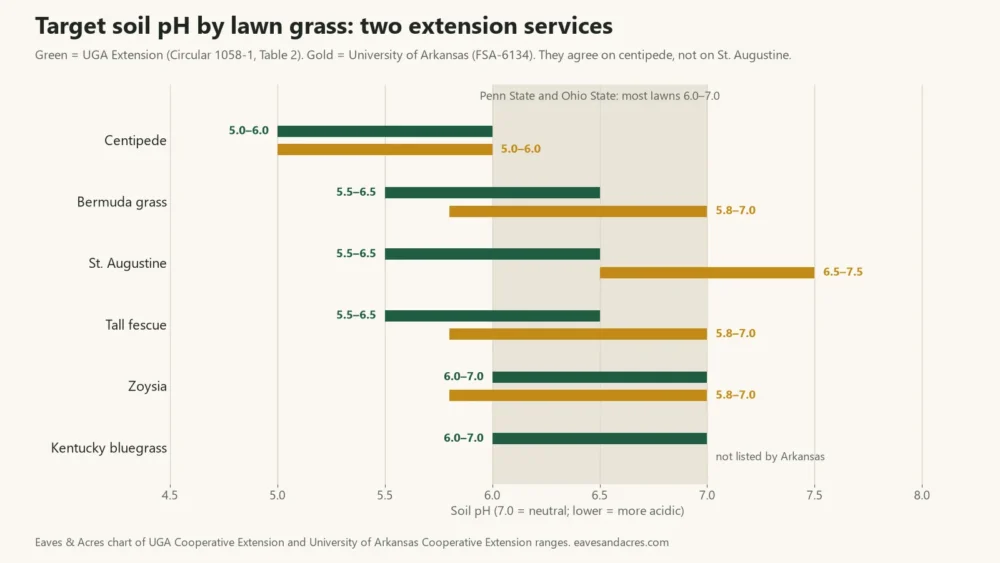
Penn State and Ohio State give 6.0 to 7.0 for most turfgrasses, and Iowa State 6.0 to 7.5.2,3,12 Southern grasses differ, and two extension services don’t fully agree:
| Grass | UGA Extension | Univ. of Arkansas |
|---|---|---|
| Centipede | 5.0–6.0 | 5.0–6.0; lime only below 5.0 |
| Bermuda grass | 5.5–6.5 | 5.8–7.0 |
| St. Augustine | 5.5–6.5 | 6.5–7.5 |
| Tall fescue | 5.5–6.5 | 5.8–7.0 |
| Zoysia | 6.0–7.0 | 5.8–7.0 |
| Kentucky bluegrass | 6.0–7.0 | not listed |
Sources: UGA Circular 1058-1, Table 2; Arkansas FSA-6134.4,5 UGA says not to lime centipede unless a soil test calls for it. Not sure what you grow? See our cool-season vs. warm-season grass guide.
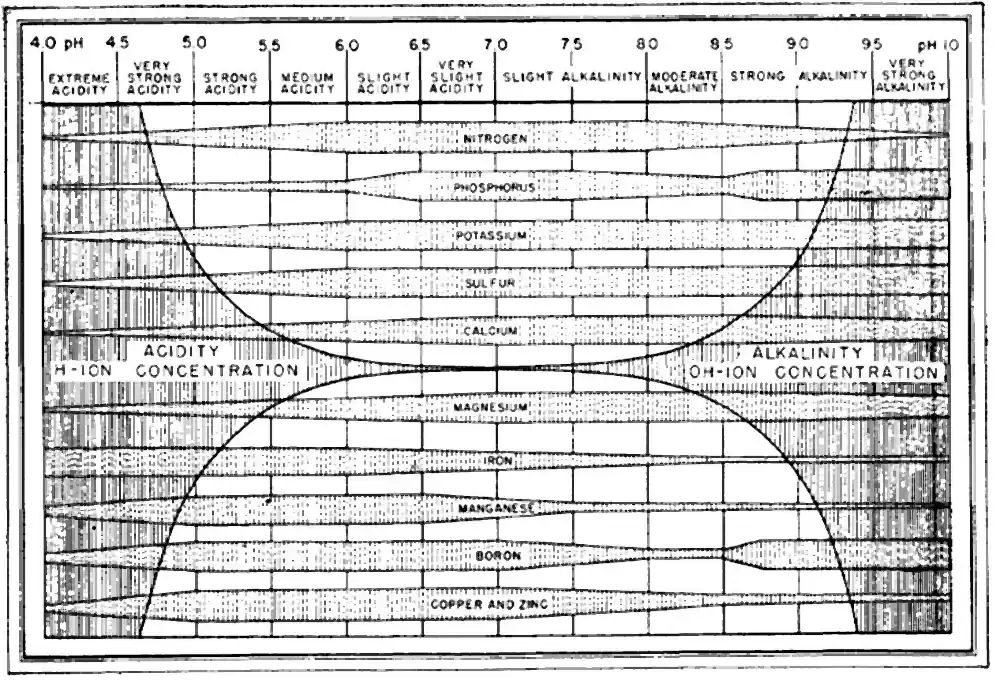
pH matters because it controls which nutrients roots can take up. Below pH 6.0, Ohio State lists nitrogen, phosphorus, potassium, calcium and magnesium among those that become less available, and as they do, it says, the lawn’s color, vigor and ability to recover from heat, drought or traffic stress decline.3
Best time: fall and winter, then early spring
Extension services lean toward fall. Penn State prefers it because rain, snow and the soil’s freezing and thawing during winter help work the limestone in.2 NC State Extension calls fall “an excellent time to test your soil and apply lime”. Clemson says fall or winter, and Arkansas spring or fall.8,10,5
Late winter is also a good time to apply lime.
Winter is where advice splits. Scotts says never to lime a dormant lawn, so not in winter.17 Mississippi State Extension says winter is an excellent time for dormant warm-season lawns, because winter rains get the lime reacting.11 Ohio State allows any time of year, but not on turf that is wilted or frost-covered.3 Our reading: winter works on a dry, unfrozen day; summer, when lawns are stressed, is the season to skip.
How fast lime works
Slowly. Clemson Extension says lime can take three to four months to change soil pH, which makes fall ideal for next spring.18 Even mixed into soil, NCDA&CS says, it shows results within a couple of months but takes 6 to 12 months for the full benefit, and lime spread on an established lawn reacts more slowly, mostly in the top inch or two.7
What our freeze data shows
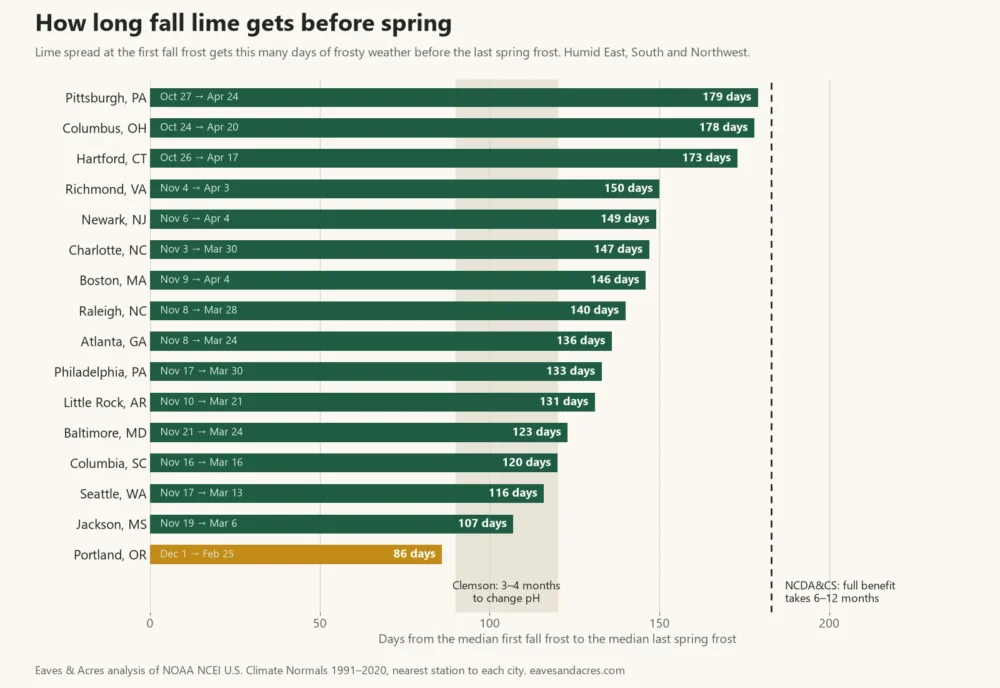
We checked those reasons against NOAA 1991–2020 normals for the station nearest each city, the same frost dates as our frost date tool.1
| City | Rain, in/yr | First fall frost | Last spring frost | Days between |
|---|---|---|---|---|
| Pittsburgh, PA | 38.2 | Oct 27 | Apr 24 | 179 |
| Columbus, OH | 44.6 | Oct 24 | Apr 20 | 178 |
| Hartford, CT | 42.9 | Oct 26 | Apr 17 | 173 |
| Richmond, VA | 45.5 | Nov 4 | Apr 3 | 150 |
| Newark, NJ | 50.6 | Nov 6 | Apr 4 | 149 |
| Charlotte, NC | 43.6 | Nov 3 | Mar 30 | 147 |
| Boston, MA | 43.6 | Nov 9 | Apr 4 | 146 |
| Raleigh, NC | 49.4 | Nov 8 | Mar 28 | 140 |
| Atlanta, GA | 48.0 | Nov 8 | Mar 24 | 136 |
| Philadelphia, PA | 50.9 | Nov 17 | Mar 30 | 133 |
| Little Rock, AR | 50.5 | Nov 10 | Mar 21 | 131 |
| Baltimore, MD | 43.8 | Nov 21 | Mar 24 | 123 |
| Columbia, SC | 47.9 | Nov 16 | Mar 16 | 120 |
| Seattle, WA | 36.5 | Nov 17 | Mar 13 | 116 |
| Jackson, MS | 51.3 | Nov 19 | Mar 6 | 107 |
| Portland, OR | 44.0 | Dec 1 | Feb 25 | 86 |
| Des Moines, IA | 36.6 | Oct 20 | Apr 18 | 180 |
| Salt Lake City, UT | 17.7 | Nov 8 | Mar 31 | 143 |
| Cheyenne, WY | 16.0 | Oct 1 | May 14 | 225 |
| Denver, CO | 15.8 | Oct 12 | Apr 30 | 200 |
| Bend, OR | 9.2 | Sep 20 | Jun 6 | 259 |
| Phoenix, AZ | 7.2 | rare | rare | — |
- Fall lime gets three to six months. Spread at the median first frost, it has 107 to 179 days before the last spring frost in 15 of the 16 humid cities, enough for Clemson’s three to four months. Portland, Oregon, gets 86. None reaches the six months NCDA&CS gives for the full benefit, so retest before adding more.
- Freeze-thaw isn’t only a northern bonus. Across every ZIP code in Georgia, the Carolinas, Virginia, Arkansas and Mississippi, the frost season (median first fall frost to median last spring frost) runs a median 124 to 162 days.
- Winter usually has thaw days. In no ZIP code in Georgia, the Carolinas, Virginia, Arkansas, Mississippi, Maryland or New Jersey does even the normal afternoon high stay at or below 32°F. In Minnesota and Wisconsin every ZIP code has such a stretch, and 93% of Iowa’s do, so long frozen spells fall mostly where lawns rarely need lime.
Normals describe a typical year, not this winter, and air is not soil. Check the ground before you spread; frost vs. freeze explains the difference.
How much lime per 1,000 sq ft
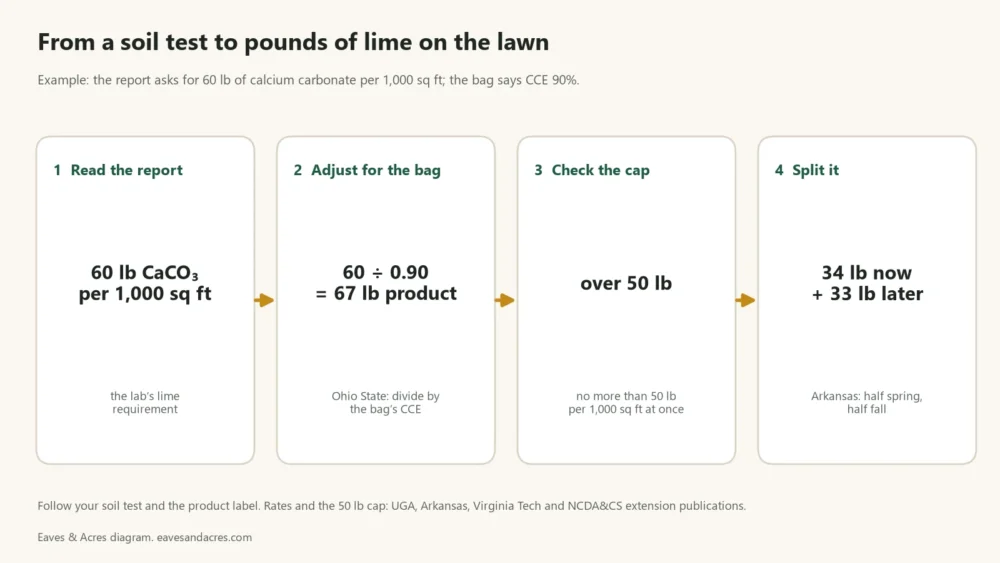
Use the rate on your soil test report, adjusted for the bag. Ohio State’s formula divides the lab’s lime requirement by the product’s calcium carbonate equivalent (CCE) on the label.3 Arkansas suggests a product with a relative neutralizing value or effective CCE above 80%.5
Then respect the cap. UGA, Arkansas, Virginia Tech and NCDA&CS all say no more than 50 lb of lime per 1,000 sq ft on an established lawn at one time; Virginia Tech warns that more can leave a residue on the turf.4,5,6,7
| Source | If the test calls for more than 50 lb per 1,000 sq ft |
|---|---|
| Univ. of Arkansas | 50–100 lb: half in spring, half in fall. Over 100 lb: 50 in spring, 50 in fall, retest yearly |
| UGA Extension | Split in half, two applications four months apart |
| Virginia Tech | Up to 50 lb at a time, 1 to 6 months apart |
| NCDA&CS | 50 lb first, the rest after six months |
A clay lawn that needs 60 lb of lime
- Scenario
- The soil report asks for 60 lb of calcium carbonate per 1,000 sq ft. The bag of pelletized limestone lists a CCE of 90%.
- Math
- 60 ÷ 0.90 = 67 lb of product per 1,000 sq ft, over the 50 lb cap.
- Answer
- About 34 lb per 1,000 sq ft this fall and 33 lb in spring (Arkansas), or 50 lb now and the rest after six months (NCDA&CS).
No test yet? UGA’s fallback table suggests 40 lb per 1,000 sq ft on sand, 50 on sandy loam and 70 on clay (split in two), and still recommends a test.4 NCDA&CS says pelletized lime works as well as powdered when used as labeled and is easier to spread.7 Use dolomitic lime when the test shows magnesium is low.5
Where lime is not needed: much of the West and Plains
Rain leaches calcium and magnesium out of soil, so soils formed under high rainfall are more acidic than those formed under arid conditions, Clemson explains.10 University of Wyoming Extension puts the line at about 20 inches of rain a year, below which alkaline soils occur.14 Colorado State says many Colorado soils are alkaline, pH 7.0 to 8.3; soil that fizzes with vinegar contains free lime.13 Oregon State says western Oregon’s rain makes soils acidic, while eastern Oregon’s tend to be alkaline.15
In NOAA normals, 13.8% of the 40,585 lower-48 ZIP codes we checked get under 20 inches a year, including 96% in Nevada, 95% in Arizona, 89% in Wyoming, 87% in Colorado and 82% in Utah.1 Bend gets 9.2 inches; Portland gets 44.
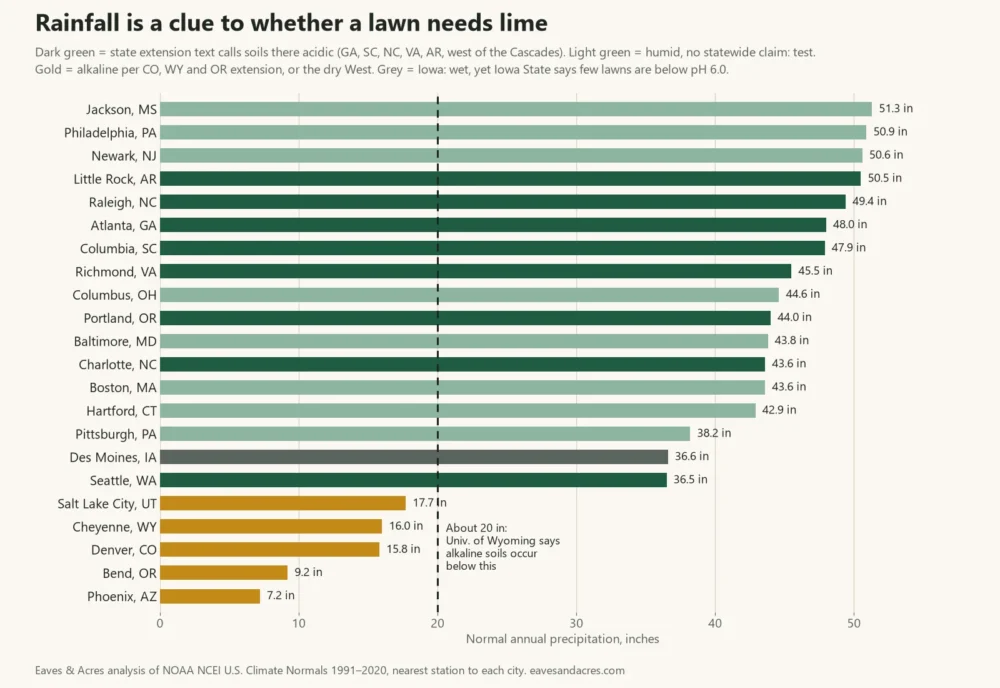
Rain alone doesn’t decide it. None of Iowa’s ZIP codes falls under 20 inches, yet:
There is no need to apply lime to most lawns in Iowa
Ohio State sees the split within one state: acid soils are likelier on eastern Ohio’s sandstone and shale than on western Ohio’s calcite-rich glacial deposits.3 Even in North Carolina, Pender County Extension warns that lime can harm some yards, especially at the beach.9
How to spread lime
Pick a dry day
Spread on dry grass that is not wilted, frozen or frost-covered.3
Core-aerate first if you can
Ohio State says coring before liming helps the lime get into the soil; see when to aerate.3
Use a spreader
Pelletized lime suits a rotary or drop spreader; Arkansas says fine pulverized limestone spreads more accurately with a drop spreader.5
Water it in
Ohio State and Arkansas say to irrigate afterward to wash lime off the leaves and avoid burn; see how much to water.3,5
Retest before liming again
NC State suggests re-testing and re-liming about every three years.8
Lime and fertilizer can share a season: Virginia Tech rakes both into bare spots together when reseeding, and no extension source we read sets a waiting period.6 New Jersey’s fall blackout on nitrogen and phosphorus does not restrict lime, Rutgers says.16 For feeding, see when to fertilize your lawn, and for the last feeding and state cut-offs, when to apply winterizer fertilizer.
 Related guideWhen to Fertilize Your Lawn: A Schedule by Grass Type and Climate
Your next step
Send a soil sample to your state’s extension or soil-testing lab this fall. If it calls for lime, spread it on a dry, unfrozen day before spring, within the 50 lb cap. Overseeding too? Our overseeding guide covers the seed side.
Frequently asked questions
There is no single month. Penn State Extension prefers fall and also likes late winter, and Arkansas says spring or fall. Spread it once your soil test results arrive, on a dry day when the ground is not frozen.
Send a soil sample to your state’s extension or soil-testing lab. Ohio State says home kits and probes can show acidity but cannot tell you how much lime to apply. A pale lawn or moss is not proof on its own.
There is no telltale look. Ohio State says that below pH 6.0 a lawn loses color, vigor and its ability to recover from heat, drought or traffic stress, but those signs have other causes too; NCDA&CS notes that even moss is driven by shade, poor drainage and compaction. Only a soil test shows whether low pH is to blame.
Either order works. No extension source we read sets a waiting period between lime and fertilizer, and Virginia Tech rakes both into bare spots together when reseeding. Follow each product’s label.
Neither works better. NCDA&CS says pelletized lime is just as effective as powdered lime when used as labeled; it costs more but spreads more easily and with less dust.
It depends on your soil test rate. At the 50 lb maximum for one application, a 50 lb bag covers 1,000 sq ft; at UGA’s 40 lb fallback rate for sandy soil, about 1,250 sq ft.
Yes. NCDA&CS says too much lime locks up micronutrients and is harder to fix than too little, and Iowa State warns that liming soil already above pH 7.0 can harm the lawn.
Yes, on a dry day when the ground is not frozen or frost-covered. Mississippi State Extension calls winter an excellent time to lime a dormant warm-season lawn, and Penn State likes late winter.
Generally not, says NCDA&CS: shade, poor drainage, compaction and low fertility all favor moss. Lime helps only if a soil test shows the soil is very acidic.
Sources
- 1.U.S. Climate Normals 1991–2020. NOAA National Centers for Environmental Information, 2021. Used for: frost dates, daily highs and annual precipitation for every city and ZIP code in the tables Back to text
- 2.Lawn Management through the Seasons (rev. Peter Landschoot). Penn State Extension, 2025. Used for: pH 6.0–7.0; fall preferred because rain, snow and freezing and thawing work lime in; late winter also good Back to text
- 3.Lime and the Home Lawn (HYG-4026), Street, White, Nangle and Gardner. Ohio State University Extension, 2021. Used for: soil test only way; pH 6.0–7.0; nutrients below 6.0; above 8.0 and summer patch; any time but not wilted or frost-covered; spring or fall rain; CCE formula; coring; liming materials Back to text
- 4.Turfgrass Fertility: Soil Texture, Organic Matter, Aeration, and pH (C 1058-1), Clint Waltz and Becky Griffin. UGA Cooperative Extension, 2021. Used for: pH by grass (Table 2); lime by soil type without a test (Table 3); 50 lb cap; split four months apart; most Georgia soils too acidic Back to text
- 5.Liming Your Lawn (FSA-6134), Aaron Patton. University of Arkansas Cooperative Extension Service, n.d. Used for: pH by grass; centipede only below 5.0; spring or fall; 50 lb cap and split rules; RNV/ECCE above 80%; about half of Arkansas lawns below optimum; spreaders; water in Back to text
- 6.Soil Test Note 18: Lawn Fertilization for Warm Season Grasses (452-718), Goatley, Ervin and Heckendorn. Virginia Cooperative Extension, 2021, reviewed 2026. Used for: up to 50 lb per application at 1–6 month intervals; residue; lime and fertilizer raked in together on bare spots Back to text
- 7.Soil Testing FAQs. NC Department of Agriculture & Consumer Services, Agronomic Services, accessed 2026. Used for: test intervals; late-summer lawn sampling; too much lime; pelletized vs powdered; surface lime top 1–2 in; 50 lb then the rest after six months; months to react; moss Back to text
- 8.Fall Is the Time to Lime, Hannah Lepsch. NC State Extension, 2024. Used for: fall an excellent time; pH 6.0–7.0; re-test and re-lime about every three years Back to text
- 9.Does Your Lawn or Garden Need Lime?, Charlotte Glen. N.C. Cooperative Extension, Pender County, 2024. Used for: centipede best near pH 5.0–5.5; beach yards can be harmed by lime; above 6.5 lime can harm plants Back to text
- 10.How to Change Soil pH in South Carolina (HGIC 1650), Kluepfel, Lippert; rev. Joey Williamson. Clemson Cooperative Extension, Home & Garden Information Center, reviewed 2026. Used for: South Carolina soils typically pH 4.5–6.0; rainfall leaches calcium and magnesium; fall or winter application; moisture needed Back to text
- 11.Winter is excellent time for applying lime to your lawn. Mississippi State University Extension Service, Turf Tips, 2008. Used for: winter liming of dormant warm-season lawns; winter rains; 50 lb cap Back to text
- 12.Should I apply lime to my lawn?. Iowa State University Extension and Outreach, 2022. Used for: pH 6.0–7.5; no need for most Iowa lawns; liming above 7.0 can be detrimental Back to text
- 13.Soil pH. Colorado State University Extension, accessed 2026. Used for: Colorado soils pH 7.0–8.3 from free lime and limited rainfall; vinegar test; hydrated and burned lime hazardous Back to text
- 14.Alkaline Soils in Wyoming (B-1358). University of Wyoming Extension, accessed 2026. Used for: alkaline soils occur where annual rainfall is under about 20 inches Back to text
- 15.Why soil pH matters — and how to manage it in your garden. Oregon State University Extension Service, accessed 2026. Used for: western Oregon acidic, eastern Oregon alkaline; lawns pH 5.5–6 Back to text
- 16.NJ Fertilizer Law Restrictions on Home Lawn Applications. Rutgers NJAES, 2013. Used for: lime is not restricted by the New Jersey fertilizer blackout Back to text
- 17.How & When to Add Lime to Your Soil. ScottsMiracle-Gro (brand), accessed 2026. Used for: claim compared: never lime a dormant lawn or in winter Back to text
- 18.Could Soil pH Be Limiting Your Garden’s Potential?, N. Jordan Franklin. Clemson Cooperative Extension, Home & Garden Information Center, 2023. Used for: lime can take three to four months to change soil pH; fall ideal for next spring Back to text
- 19.Truog 1947 pH and nutrient availability (diagram). Emil Truog, USDA Yearbook of Agriculture 1943–1947, public domain, via Wikimedia Commons, 1947. Used for: nutrient availability diagram
- 20.AIREADORA 06 (photo). Guipozjim, Wikimedia Commons, CC BY 3.0, 2009. Used for: hero photo, cropped and resized


How this guide was made
- Written by the Yard & Garden Desk and reviewed by the Data & Methodology Desk.
- Data: median first fall frost and last spring frost (32°F), normal daily highs (monthly normals interpolated day by day, the same method as our tulip and winter sowing guides) and normal annual precipitation from NOAA NCEI U.S. Climate Normals 1991–2020 for the station nearest each city and each of 40,585 lower-48 ZIP codes with monthly normals; “frozen stretch” = any day whose normal high is at or below 32°F, an air-temperature proxy, not a soil measurement; the 20-inch line from University of Wyoming Extension; pH targets, timing and rates from the cited extension publications. Normals describe a typical year, not a given winter, and none of this replaces a soil test. See our methodology.
- AI use: AI tools help us research, draft and check this guide. Every figure is checked against the source cited for it, and calculated figures come from our own code, described on the methodology page.
- Spotted an error? Tell us — the form opens with this page’s address filled in.
Change log
- Oct 13, 2026Wording on low-pH symptoms corrected to what Ohio State says (reduced color, vigor and stress recovery); the earlier line that a lawn on acid soil “can stay pale however much you fertilize” went beyond the source. Added the People also ask question on what lime-hungry grass looks like. pH table, rates, timing and quotes re-checked at Ohio State, Penn State, UGA, Clemson, Mississippi State, NCDA&CS and Iowa State.
- Oct 7, 2026Published. pH targets, timing, rates and the split rules read in Penn State, Ohio State, UGA, Arkansas, Virginia Tech, NCDA&CS, NC State, Clemson, Mississippi State, Iowa State, Colorado State, Wyoming, Oregon State and Rutgers publications; fall-to-spring runway for 22 cities and frost-season, frozen-stretch and 20-inch-rain shares for every lower-48 ZIP code computed from NOAA 1991–2020 normals.
Covers lawns, gardens, frost and planting. We write the guides and maintain the tools that tell you when to seed, feed and plant for your ZIP.
Keep reading
When to Apply Winterizer Fertilizer: Dates by City and State Rules
Feed a cool-season lawn its winterizer around the last mowing, weeks after the first frost and before your state’s cut-off. Warm-season lawns get no late-fall nitrogen.
When to Fertilize Your Lawn: A Schedule by Grass Type and Climate
Cool-season lawns get their main feeding in early fall; warm-season lawns are fed after green-up and stop six weeks before frost. Schedule, bag math and dates for 20 cities.
Should You Rake Leaves? When to Mulch, Rake or Leave Them
Usually not. Mow a light or moderate layer of leaves into the lawn until your last mow, and remove only what hides the grass. Extension thresholds, the research, and leaf deadlines for 20 US cities from NOAA normals.
Seasonal reminders for your ZIP
Get a short email when it’s time to overseed, start seeds, open the pool or service your furnace — timed to your climate.