



When to Close Your Pool: Estimated Dates for Your City and State
Close once the water stays below 65°F, or 60°F to be safer, and before freezing nights. Here is when that typically happens in 46 cities, estimated from NOAA climate normals.
- Last reviewed Oct 4, 2026
- 11 cited sources
- 10 min read
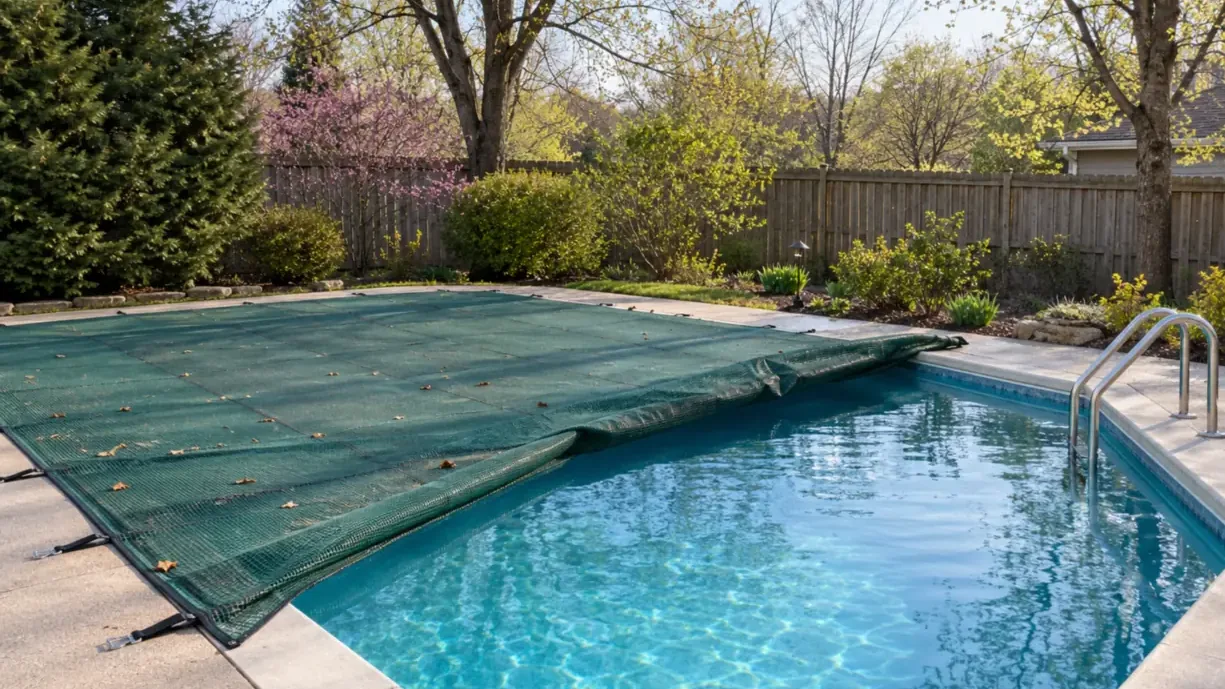
Set your ZIP to see dates for your area.
- 1Close when the water stays below about 65°F for several days. Trouble Free Pool recommends waiting until it is solidly below 60°F, when algae is unlikely to grow.
- 2Finish before freezing nights: water left in pipes, the pump, filter or heater can freeze and crack them.
- 3In NOAA normals, the typical daily mean air temperature drops below 65°F around Sep 17 in Detroit, Sep 26 in Newark and Oct 3 in Philadelphia; pool water cools later.
- 4Northern Michigan and central Massachusetts reach that mark first, in late August or early September; Maryland and the Jersey Shore reach it about a month later, around the start of October.
- 5Use the dates to start checking a pool thermometer, not as a fixed closing day.
Close your pool once the water stays below about 65°F, or below 60°F for the lowest risk of a green pool in spring, and finish before freezing nights put the plumbing at risk. Across most of the Northeast and Midwest that means mid-September to mid-October; the Mid-Atlantic and Ohio Valley run to mid- or late October; much of the South can wait until November or later.
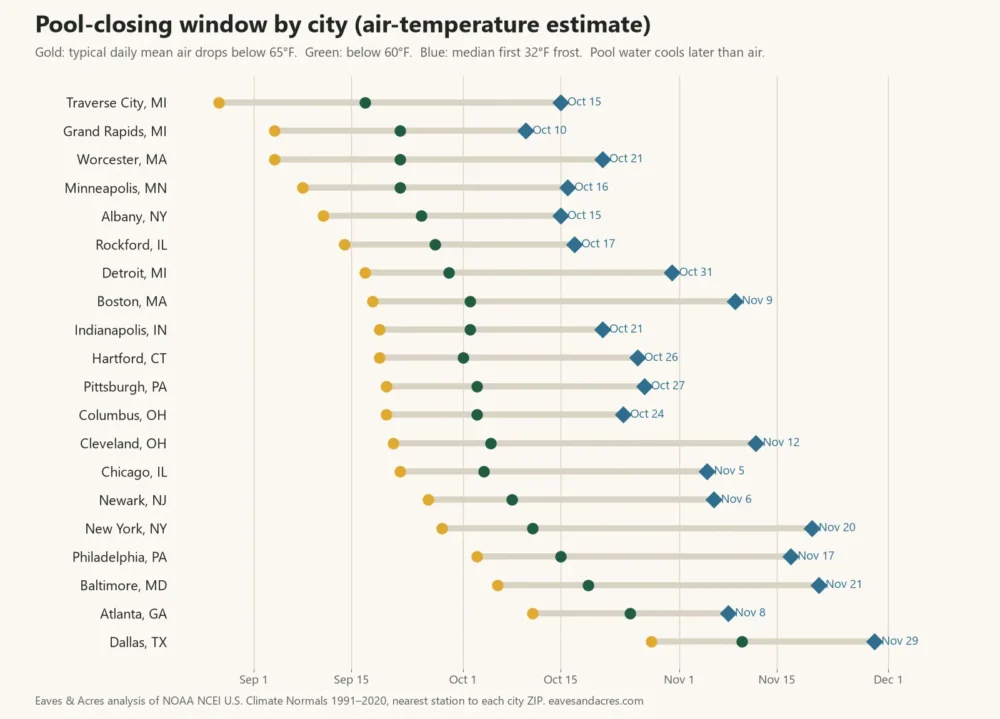
Most guides stop at the temperature. We added dates: the day the typical daily mean air temperature drops below 65°F and 60°F in 46 US cities, from NOAA’s 1991–2020 climate normals, including the ten states people search for most. These are air-temperature estimates. Pool water cools later, so treat each date as the day to start checking your thermometer.
The closing temperature: 65°F or 60°F?
A pool retailer and a cover maker give the same number. Doheny’s Pool Supplies puts it plainly:
Avoid closing your pool until your water temperature readings consistently drop below 65°F.
Anchor Industries, which makes safety covers, uses the same 65°F (18°C) figure.4 The reason is algae: close while the water is warm and algae keeps growing under the cover, using up winter chemicals and leaving a cleanup job in spring. Winterizing doses are per gallon, so check your size first with the pool volume calculator.
The Trouble Free Pool forum sets a stricter bar in its Pool School closing procedure:
Wait to close until the water temperature is solidly below 60 degrees.
Below 60°F, it explains, algae is fairly unlikely to grow, and grows very slowly when it does.2 Both rules mean water temperature over several days.
| Cue | Who publishes it | What it protects against |
|---|---|---|
| Water consistently below 65°F | Doheny’s, Anchor Industries | Algae under the cover; winter chemicals used up early |
| Water solidly below 60°F | Trouble Free Pool | Lower algae risk still, at the cost of a later closing |
| Before nights fall below about 30°F | River Pools | Water freezing in pipes and equipment |
Choose 65°F for a longer season, 60°F for a cleaner spring opening. The freeze deadline is the one you can’t miss.8
When to close your pool: estimated dates by city
We placed each NOAA monthly normal at the middle of its month, joined the months day by day, and found the first fall day the typical daily mean air temperature drops below 65°F and below 60°F.1 The frost column is the median date of the first 32°F night at the nearest station; half of years see it earlier.
| City (ZIP) | Air mean below 65°F | Air mean below 60°F | Median first frost (32°F) |
|---|---|---|---|
| Minneapolis, MN (55401) | Sep 8 | Sep 22 | Oct 16 |
| Denver, CO (80202) | Sep 19 | Sep 30 | Oct 12 |
| Omaha, NE (68102) | Sep 22 | Oct 4 | Oct 21 |
| Salt Lake City, UT (84101) | Sep 26 | Oct 8 | Nov 8 |
| Seattle, WA (98101) | Sep 3 | Sep 26 | Nov 17 |
| St. Louis, MO (63101) | Oct 3 | Oct 16 | Nov 4 |
| Louisville, KY (40202) | Oct 4 | Oct 17 | Nov 9 |
| Washington, DC (20001) | Oct 3 | Oct 15 | Nov 8 |
| Charlotte, NC (28202) | Oct 8 | Oct 22 | Nov 3 |
| Atlanta, GA (30303) | Oct 11 | Oct 25 | Nov 8 |
| Dallas, TX (75201) | Oct 28 | Nov 10 | Nov 29 |
| Houston, TX (77002) | Nov 8 | Nov 27 | Dec 25 |
| Phoenix, AZ (85004) | Nov 17 | Dec 3 | Rare |
Seattle crosses 65°F by early September but has no median frost until mid-November: a long, cool window. Denver’s median frost (Oct 12) comes 12 days after its 60°F date, leaving little slack. In Phoenix and Houston the air stays above 60°F into late November or December and frost is rare or late; PoolResearch and River Pools both note that many owners in the warmest states never close.9,8 For any other ZIP code, look up your first-frost date and its odds.
Why your water cools later than the air
The USGS explains that water absorbs a lot of heat before it gets hot, which is why seasons change gradually near large bodies of water.6 A pool does the same on a small scale: it carries late-summer heat into fall, so the water reaches 65°F or 60°F some days after the air does. How many depends on depth, sun, wind, a solar cover and any heater.
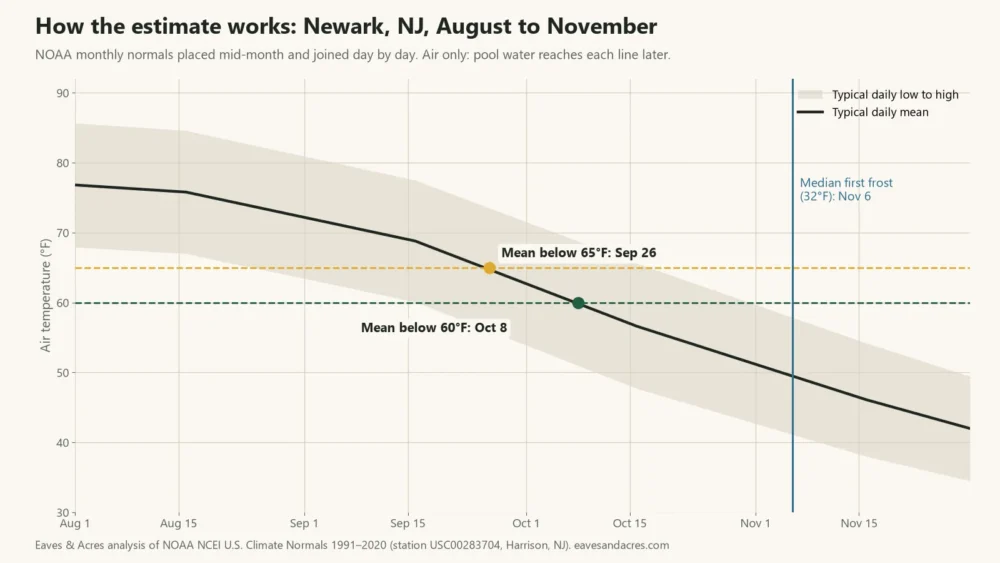
Plan with the table, then let a thermometer decide: read the water at the same time each day and close after several days in a row below your line. Doheny’s adds a forecast test: wait until temperatures below 65°F are forecast for the weeks ahead, not just a cool spell.3
The other deadline: freezing nights
Anchor Industries warns that freezing water can crack pipes and damage filtration equipment,4 and River Pools advises closing before nights fall under 30°F.8 Our frost date tool also shows the date with only a 10% chance of an earlier frost, the safer target if you close late. If a hard freeze is forecast before you are ready, follow the freeze-protection instructions in your pump and heater manuals.
When to close a pool in NJ, NY, PA, MI and six more states
These ten states lead Google’s search suggestions for this question. Inland and higher ground usually runs earlier than a coastal or big-city station.
| City (ZIP) | Air mean below 65°F | Air mean below 60°F | Median first frost (32°F) |
|---|---|---|---|
| New Jersey | |||
| Morristown, NJ (07960) | Sep 22 | Oct 4 | Oct 27 |
| Newark, NJ (07102) | Sep 26 | Oct 8 | Nov 6 |
| Cherry Hill, NJ (08002) | Sep 25 | Oct 7 | Oct 31 |
| Atlantic City, NJ (08401) | Sep 29 | Oct 14 | Nov 21 |
| New York | |||
| Buffalo, NY (14202) | Sep 9 | Sep 25 | Oct 26 |
| Albany, NY (12207) | Sep 11 | Sep 25 | Oct 15 |
| New York, NY (10001) | Sep 28 | Oct 11 | Nov 20 |
| Amityville, NY (11701) | Sep 22 | Oct 6 | Nov 6 |
| Pennsylvania | |||
| Erie, PA (16501) | Sep 17 | Oct 1 | Nov 4 |
| Harrisburg, PA (17101) | Sep 16 | Sep 29 | Oct 23 |
| Pittsburgh, PA (15222) | Sep 20 | Oct 3 | Oct 27 |
| Philadelphia, PA (19103) | Oct 3 | Oct 15 | Nov 17 |
| Michigan | |||
| Traverse City, MI (49684) | Aug 27 | Sep 17 | Oct 15 |
| Grand Rapids, MI (49503) | Sep 4 | Sep 22 | Oct 10 |
| Detroit, MI (48201) | Sep 17 | Sep 29 | Oct 31 |
| Ohio | |||
| Cleveland, OH (44114) | Sep 21 | Oct 5 | Nov 12 |
| Columbus, OH (43215) | Sep 20 | Oct 3 | Oct 24 |
| Cincinnati, OH (45202) | Sep 24 | Oct 6 | Oct 25 |
| Massachusetts | |||
| Worcester, MA (01608) | Sep 4 | Sep 22 | Oct 21 |
| Springfield, MA (01103) | Sep 9 | Sep 24 | Oct 8 |
| Boston, MA (02108) | Sep 18 | Oct 2 | Nov 9 |
| Connecticut | |||
| Hartford, CT (06103) | Sep 19 | Oct 1 | Oct 26 |
| New Haven, CT (06510) | Sep 19 | Oct 2 | Oct 27 |
| Stamford, CT (06901) | Sep 19 | Oct 2 | Oct 23 |
| Maryland | |||
| Frederick, MD (21701) | Sep 29 | Oct 11 | Nov 6 |
| Salisbury, MD (21801) | Oct 4 | Oct 17 | Nov 7 |
| Baltimore, MD (21202) | Oct 6 | Oct 19 | Nov 21 |
| Illinois | |||
| Rockford, IL (61101) | Sep 14 | Sep 27 | Oct 17 |
| Springfield, IL (62701) | Sep 21 | Oct 4 | Oct 22 |
| Chicago, IL (60601) | Sep 22 | Oct 4 | Nov 5 |
| Indiana | |||
| South Bend, IN (46601) | Sep 15 | Sep 28 | Oct 23 |
| Indianapolis, IN (46204) | Sep 19 | Oct 2 | Oct 21 |
| Evansville, IN (47708) | Oct 7 | Oct 20 | Nov 10 |
New Jersey
North Jersey and the Delaware Valley reach the 65°F air mark around Sep 22–26 and 60°F around Oct 4–8. The shore runs about a week later: Atlantic City crosses 60°F near Oct 14, with a median frost of Nov 21. Carlton Pools says New Jersey owners typically close from late September to mid-October.11
New York
Upstate runs about two weeks ahead of the city: Buffalo and Albany cross 60°F by about Sep 25, New York City and Long Island in early October. Central Park’s median first frost isn’t until Nov 20.
Pennsylvania
Erie, Harrisburg and Pittsburgh cross 60°F around the start of October. Philadelphia, whose station is at the Franklin Institute in Center City, is about two weeks later. Erie cools on Harrisburg’s schedule, but its median frost comes 12 days later.
Michigan
Michigan is earliest: the typical daily mean drops below 65°F around Aug 27 in Traverse City, Sep 4 in Grand Rapids and Sep 17 in Detroit.
Ohio
Cleveland, Columbus and Cincinnati all cross 65°F between Sep 20 and 24 and 60°F in the first week of October. The deadline differs: the Cleveland lakefront station’s median frost is Nov 12, nearly three weeks after Columbus.
Massachusetts
Worcester crosses 65°F around Sep 4 and Springfield around Sep 9; Boston is about two weeks behind. SSG Pools, a New England builder, says most owners there close between late September and mid-October.10
Connecticut
Hartford, New Haven and Stamford are nearly identical: about Sep 19 for 65°F and Oct 1–2 for 60°F.
Maryland
Maryland runs latest of the ten states. Frederick crosses 60°F around Oct 11 and Baltimore’s Inner Harbor station around Oct 19, so mid-October closings are realistic.
Illinois
Rockford reaches 60°F around Sep 27; Chicago and Springfield around Oct 4. Chicago’s temperatures come from Midway airport and its frost date from a lakefront station, where frost comes later than in inland suburbs.
Indiana
South Bend and Indianapolis cross 60°F between Sep 28 and Oct 2. Evansville is nearly three weeks later.
Do the dates match published regional advice?
Yes. Every published window below starts on or after our 65°F air dates, and most end within about two weeks of our 60°F dates, consistent with water cooling later than the air. None of these guides gives a date for a specific city.
| Region and source | Published window | Our air estimate (65°F to 60°F) |
|---|---|---|
| New Jersey (Carlton Pools) | Late Sep to mid-Oct | Sep 22 – Oct 14 |
| New England (SSG Pools) | Late Sep to mid-Oct | Sep 4 – Oct 2 |
| Northeast (PoolResearch) | Around the end of September | Sep 9 – Oct 15 |
| Southeast (PoolResearch) | Mid to late October | Oct 8 – Oct 25 |
Other signs it’s time, and the cost of getting it wrong

- Falling leaves. Anchor Industries calls a considerable amount of leaves falling into the pool a clear sign it’s time to close.4
- Too early (water above 65°F): Doheny’s lists algae, stained surfaces, cloudy water and a costlier spring opening.3
- Too late (after a hard freeze): water left in pipes, the pump, filter or heater can freeze and crack them.4
Closing steps at a glance
Every pool, cover and equipment pad is different, so treat this as an overview and follow your equipment and cover manuals.
Balance the water
Trouble Free Pool’s procedure brings pH to 7.4–7.6 and alkalinity and calcium hardness into their normal ranges.2 Our guide to ideal pool chemical levels explains each number.
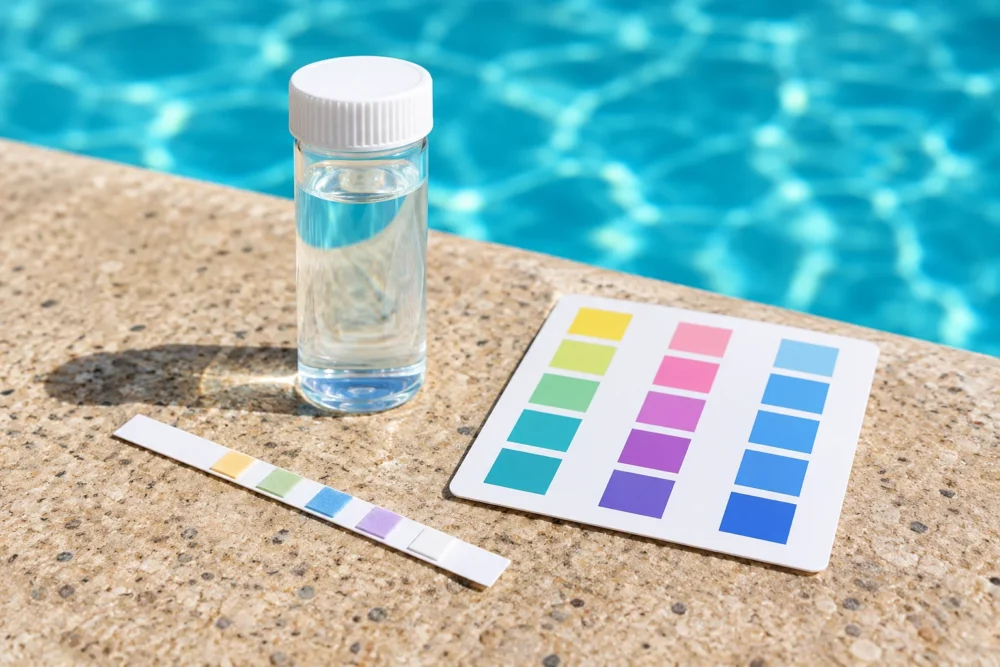
Test pH, alkalinity and calcium a few days before closing. Raise the chlorine
Shock or raise chlorine to the closing level your product label or method specifies, a day or more ahead. Add any winter algaecide only as its label directs.
Clean the pool
Brush, skim and vacuum, then store ladders, rails and toys.
Lower the water only as far as your cover allows
Trouble Free Pool notes that safety-cover makers set a maximum water depth below the deck, and that draining a pool under an automatic cover can damage it.7 Check your cover manual first.
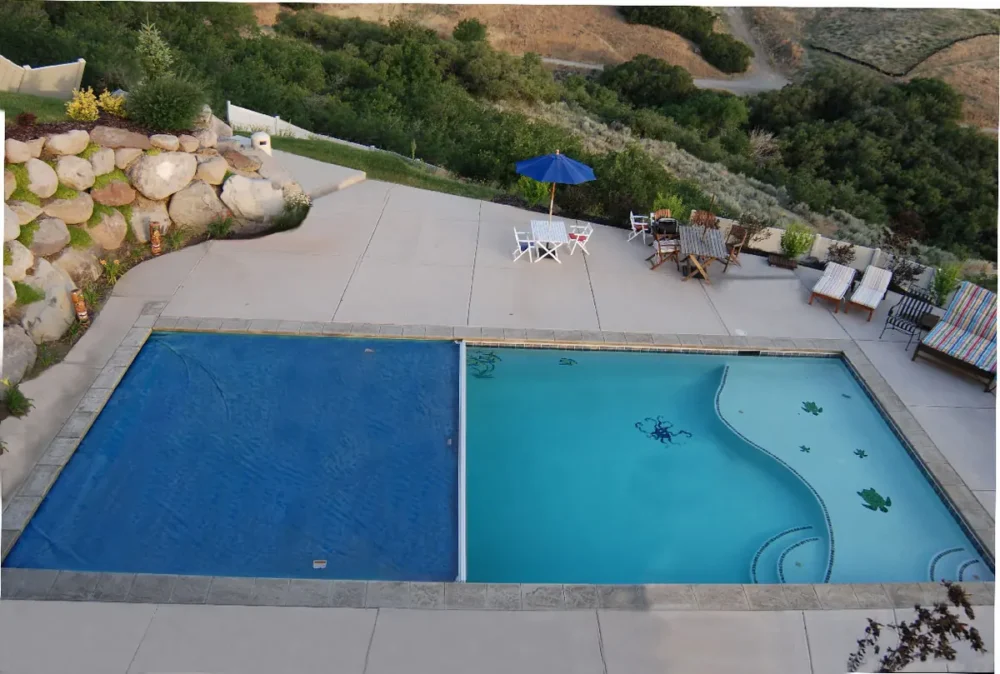
An automatic cover rests on the water, so the pool must not be drained under it. Photo: Slivenbg, public domain (Wikimedia Commons). Clear water from plumbing and equipment
Water left in lines, the pump, filter and heater can freeze. Methods vary by system, so follow each manufacturer’s winterizing instructions or hire a pool service. For a hot tub, see how to winterize a hot tub.
Cover the pool
Fit the winter or safety cover as its maker instructs, and check it through the winter for loose weights, standing water and leaves.
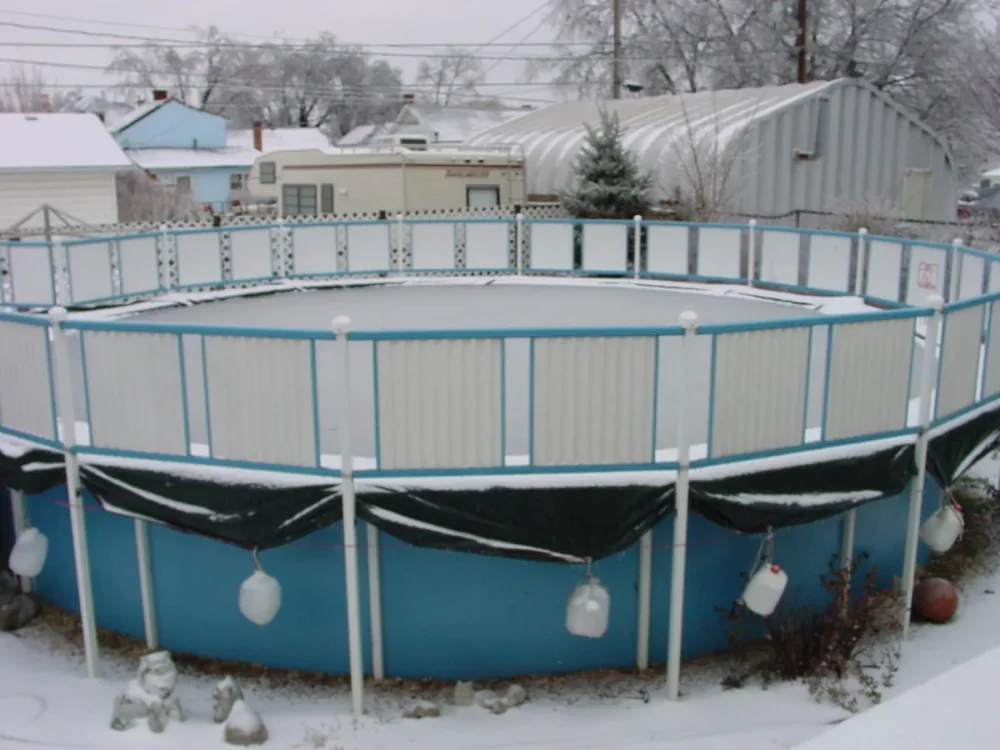
An above-ground pool closed for winter, its cover held down with weighted jugs. Photo: Jonathan Hogue, public domain (Wikimedia Commons).
Add pool chemical to water, NEVER water to pool chemicals.
This guide is general information, not professional advice; your manuals and product labels come first. See our estimates and safety disclaimer.
Next steps
Set your ZIP code above to see your first-frost date, and put two reminders in your calendar: your 65°F date, and two weeks before your frost date. Then browse the opening and closing section, the pool salt calculator and the rest of Pool & Spa; our methodology and climate data pages explain the numbers.
Frequently asked questions
When the water stays below about 65°F for several days, the figure Doheny's and Anchor Industries use. Trouble Free Pool recommends waiting until it is solidly below 60°F, when algae is unlikely to grow.
Not in many northern areas: the typical daily mean air temperature drops below 65°F by early September in Traverse City, Worcester and Minneapolis. In Philadelphia and Baltimore that happens in October, so September is usually too early.
In the Northeast and Midwest, mostly late September to mid-October; New Jersey and New England pool companies both publish that window. In the Southeast it is mid to late October.
Yes. Closing while the water is above 65°F lets algae grow under the cover and uses up winter chemicals, which can mean stains, cloudy water and a harder spring opening.
Ideally, yes. River Pools advises closing before nights fall under 30°F, because water left in pipes and equipment can freeze and crack them.
Usually only partly. Safety-cover makers set a maximum water depth below the deck, and draining a pool under an automatic cover can damage the cover. Your cover manual is the authority.
In Louisville the typical daily mean air temperature drops below 65°F around Oct 4 and below 60°F around Oct 17, and the median first frost is Nov 9 (NOAA normals). Pool water cools later, so start checking your thermometer in early October and close after several days below your line.
Often not. River Pools notes that Florida and Arizona owners may never need to close, and PoolResearch says closing is less common in South Florida, South Texas, Southern California and Hawaii.
Sources
- 1.U.S. Climate Normals 1991–2020. NOAA National Centers for Environmental Information, 2021. Used for: monthly temperature normals and first-frost dates behind every city date Back to text
- 2.Closing an In Ground Pool. Trouble Free Pool, Pool School, 2019. Used for: 60°F closing threshold, pH target, example closing procedure Back to text
- 3.How To Know When It’s Time To Close Your Pool. Doheny’s Pool Supplies, 2025. Used for: 65°F closing threshold, forecast test, risks of closing early Back to text
- 4.When Should You Close Your Pool For The Seasonal Change?. Anchor Industries, 2024. Used for: 65°F threshold, freeze damage, falling leaves Back to text
- 5.Thousands Sent to Emergency Room by Preventable Pool Chemical Injuries. Centers for Disease Control and Prevention, 2014. Used for: pool chemical safety rules Back to text
- 6.Specific Heat Capacity and Water. U.S. Geological Survey, Water Science School, 2026. Used for: why water temperature changes more slowly than air Back to text
- 7.Closing Pool for Winter. Trouble Free Pool wiki. Used for: safety-cover water levels, automatic covers Back to text
- 8.When Should I Close My Pool for the Winter?. River Pools, 2025. Used for: close before nights fall under 30°F; warm-state note Back to text
- 9.When Should You Close Your Pool? Suggested Times by State/Climate. PoolResearch, 2024. Used for: regional closing windows Back to text
- 10.When is the Right Time to Schedule your Pool Closing?. SSG Pools, 2026. Used for: New England closing window, heated pools Back to text
- 11.When to Close Your Pool in NJ. Carlton Pools, 2024. Used for: New Jersey closing window Back to text
How this guide was made
- Written by the Pool Desk and reviewed by the Data & Methodology Desk.
- Data: air-temperature closing estimates computed by Eaves & Acres from NOAA NCEI U.S. Climate Normals 1991–2020 monthly means, interpolated day by day between mid-month values, for the station nearest each ZIP code; first-frost dates from the same normals; closing thresholds from Doheny’s, Anchor Industries and Trouble Free Pool. Pool water cools later than air, so these dates are a starting point, not a closing day. See our methodology.
- AI use: AI tools help us research, draft and check this guide. Every figure is checked against the source cited for it, and calculated figures come from our own code, described on the methodology page.
- Spotted an error? Tell us — the form opens with this page’s address filled in.
Change log
- Oct 4, 2026Corrected the CDC figure (nearly 5,000 emergency room visits in 2012, not a yearly number) and stated Anchor Industries’ leaf advice in its own terms; added Louisville, Kentucky, to Table 2 and a Kentucky FAQ.
- Oct 2, 2026Published. Closing dates for 45 cities computed from NOAA 1991–2020 monthly normals; closing thresholds checked against Doheny’s, Anchor Industries and Trouble Free Pool; regional windows compared with three published guides.
Covers pool and hot tub water chemistry, opening and closing. We maintain the dosing calculators and check every rate against product chemistry and public health guidance.
Keep reading
When to Open Your Pool: Estimated Dates for Your City and State
Open before the water warms past 60°F and after freezing nights end. Estimated opening dates for 49 cities from NOAA climate normals, and how the 70°F rule compares.
How to Winterize a Hot Tub, and When to Keep It Running
Hot tub makers say a tub kept full, heated and covered protects itself from freezing. When to drain and winterize instead, with NOAA freeze dates and winter running costs for 21 US cities.
How Much Does It Cost to Run a Hot Tub? The Math by City
The median hot tub certified in California costs about $25 a month to keep hot at the US average electricity price. Standby cost by month for 21 cities from CEC test data, NOAA normals and EIA prices.
Seasonal reminders for your ZIP
Get a short email when it’s time to overseed, start seeds, open the pool or service your furnace — timed to your climate.