




Portable Generator Safety: The Rules and the CPSC Data Behind Them
Outdoors, at least 20 feet out, exhaust away, CO alarms on every level. CPSC’s records of 789 generator carbon monoxide deaths show why each rule exists, and which shortcuts failed.
- Last reviewed Oct 4, 2026
- 15 cited sources
- 12 min read
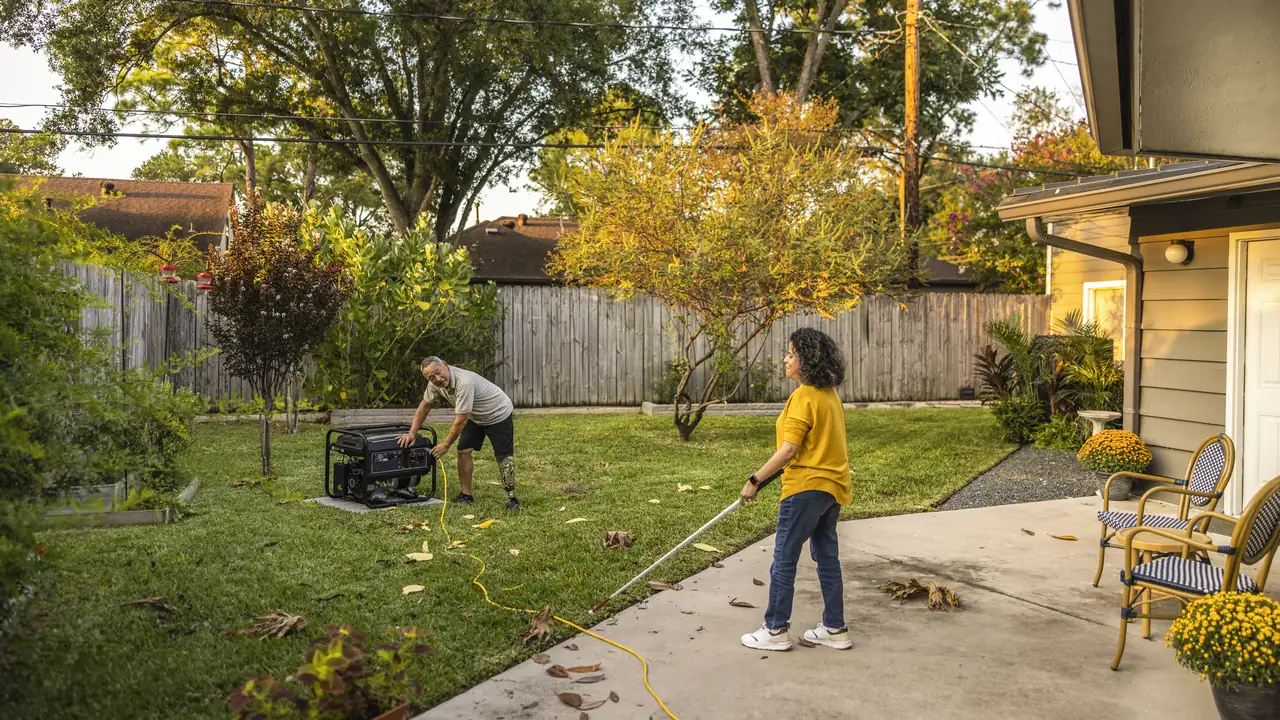
- 1Run a portable generator outdoors only, at least 20 feet from the house, with the exhaust pointed away from windows, doors and vents. Never in a home, garage, basement, crawlspace, shed or porch.
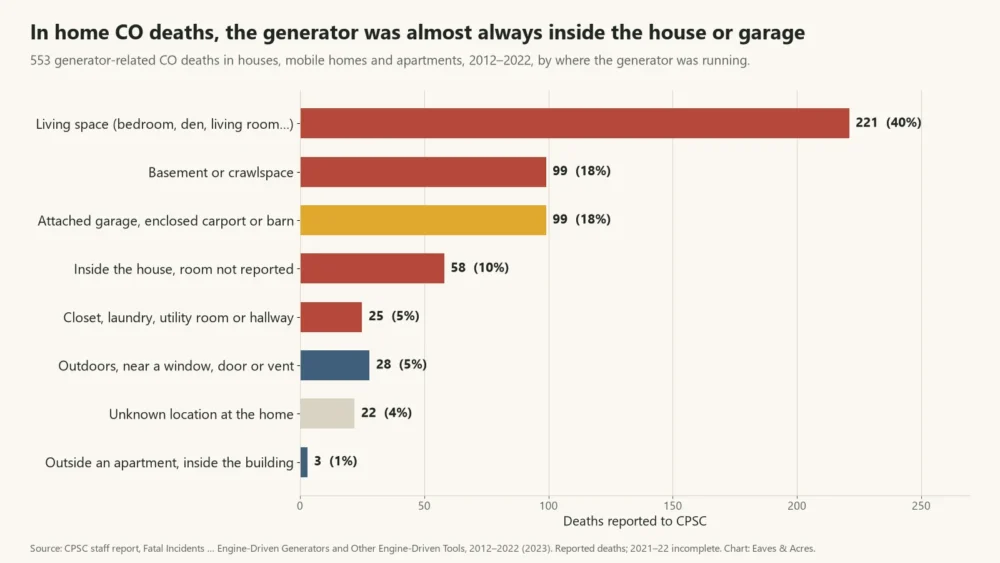
- 2In 553 home CO deaths in CPSC’s 2012–2022 records, the generator was inside the house in 73% and in an attached garage, carport or barn in another 18%.
- 3Ventilating doesn’t make it safe: a third of the deaths with known ventilation status happened with windows or doors open, fans running or the generator just outside an opening.
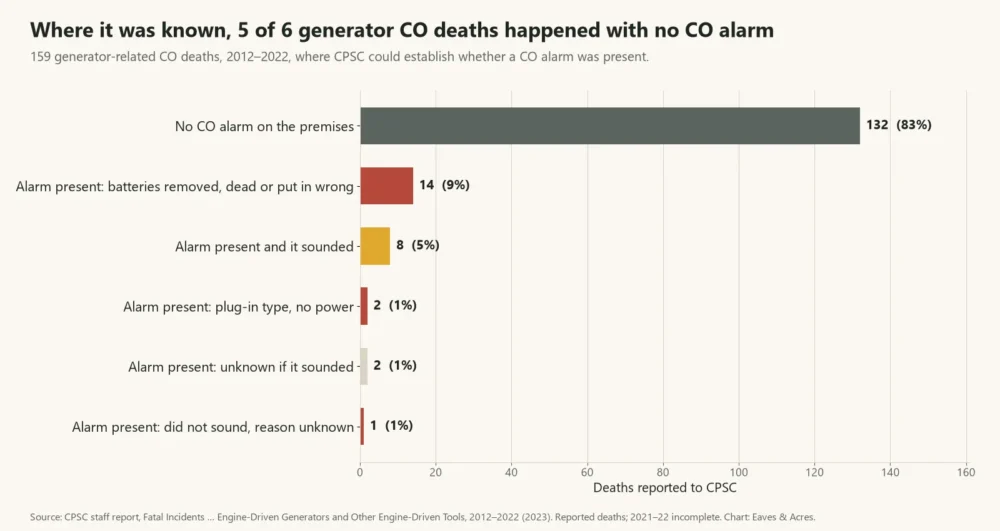
- 4Where alarm status was known, 83% of generator CO deaths happened with no CO alarm. Use battery or battery-backup alarms on every level and test them monthly.
- 5Never plug a generator into a wall outlet, keep it dry, and refuel only with the engine off and cool. Deaths peak from November to February (44%).
Portable generator safety comes down to one rule above all others: run the generator outdoors only, at least 20 feet from the house, with the exhaust pointed away from windows, doors and vents, and keep battery-powered carbon monoxide (CO) alarms on every level of the home. Never run it in a house, garage, basement, crawlspace, shed or on a porch, even with the doors open.3,6 After that come three other hazards: shock (keep it dry and never connect it to house wiring yourself), fire (refuel only when the engine is off and cool) and overloading.
Every safety sheet repeats those rules. What they rarely show is why they are written that way. Below we pull the numbers out of CPSC’s records of 789 generator-related CO deaths from 2012 to 2022: where the generator was running, whether a window was open, whether a CO alarm was on the wall and what month it was.1
Loads from YouTube (privacy-enhanced mode) only when you press play.
Where generator CO deaths happen: what CPSC’s records show
Generators are the single product under CPSC’s jurisdiction linked to the most carbon monoxide deaths. CPSC estimates that generators alone were involved in 892 deaths from 2012 to 2022, or 41% of all non-fire CO deaths from consumer products it oversees.2 Its CO center puts the number above 100 a year.3
Carbon monoxide is a colorless, odorless gas that can kill within minutes
CPSC staff complete an in-depth investigation for most of these deaths. Its latest generator report covers 553 deaths in houses, mobile homes and apartments. In 73% of them the generator was running inside the home itself, and in another 18% it was in an attached garage, an enclosed carport or an attached barn.1
| Generator location | Deaths | Share |
|---|---|---|
| Living space (bedroom, den, living room, enclosed porch…) | 221 | 40% |
| Basement or crawlspace | 99 | 18% |
| Attached garage, enclosed carport or attached barn | 99 | 18% |
| Inside the house, room not reported | 58 | 10% |
| Closet, laundry room, utility room or hallway | 25 | 5% |
| Outdoors, near an open window, door or vent | 28 | 5% |
| Unknown location at the home | 22 | 4% |
| Outside an apartment but inside the building | 3 | 1% |
Rows are as CPSC published them in its Table 13; they add to 555 against a stated total of 553, a small discrepancy in the source. All counts are deaths reported to CPSC, which the agency calls a minimum, and 2021–2022 were still incomplete when the report was written.1
Two details in the same report matter for anyone who thinks “just for a few minutes, in the next room” is safe. Of 440 home deaths where CPSC knew where the victim was, only 24% happened in the same room as the generator; the rest died elsewhere in the home. And the homes were small: the median was about 1,290 square feet, and 64% of the incidents were in homes under 1,500. CPSC says it is unclear whether that reflects income, faster CO buildup in a smaller space, or both.1
Open doors, fans and venting the exhaust don’t make it safe
Opening the garage door or a window feels like ventilation. CPSC’s records show it isn’t. In 303 home deaths where investigators could tell whether anyone had tried to ventilate, 102 people (34%) died even though something had been done: windows or doors open (62 deaths), the generator set outside next to a window, door or air conditioner (25), or a fan or exhaust aimed out a window or door (15).1
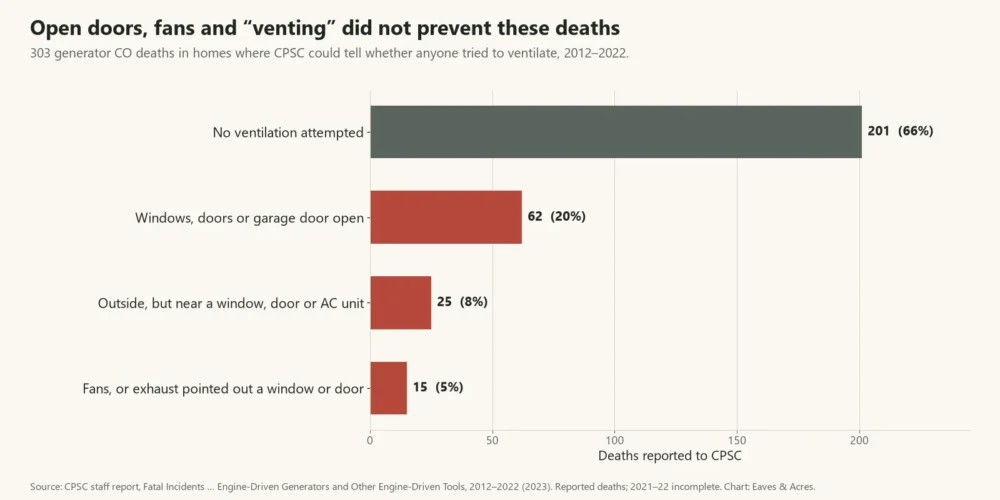
That answers a question people ask search engines every storm: running a generator in a garage with the door open, or trying to vent its exhaust out a window or door, is in the data as a way people died. The American Red Cross, which wrote its guidance with technical advice from CDC, NFPA and CPSC, says opening doors and windows or using fans will not prevent CO buildup.10
Where to put a portable generator
The 20-foot figure is the one the federal agencies agree on, and it is a minimum, not a target. Here is what each source actually says:
| Source | Distance | Also says |
|---|---|---|
| CPSC | At least 20 ft from the house | Exhaust facing away from the home and other buildings; never in a home, garage, basement, crawlspace, shed or on a porch |
| CDC | More than 20 ft from windows, doors and vents | Never in the home or garage, even with doors and windows open |
| Ready.gov (FEMA) | At least 20 ft from windows, doors and attached garages | Applies to the generator and its fuel |
| NFPA | At least 20 ft from all doors, windows and vent openings | Measure from the generator to the building; never in an attached garage |
| OSHA | 3 to 4 ft of clear space on all sides and above | Not outdoors where doors, windows or vents could let CO build up inside; open windows and doors may not prevent buildup in an enclosed space |
| Honda EG5000X manual | At least 3 ft from buildings and other equipment | 3 ft of open space above and around it, for cooling and fire safety; not a CO distance |
Sources: CPSC,6 CDC,7 Ready.gov,8 NFPA,11 OSHA15 and Honda’s EG5000X owner’s manual.9
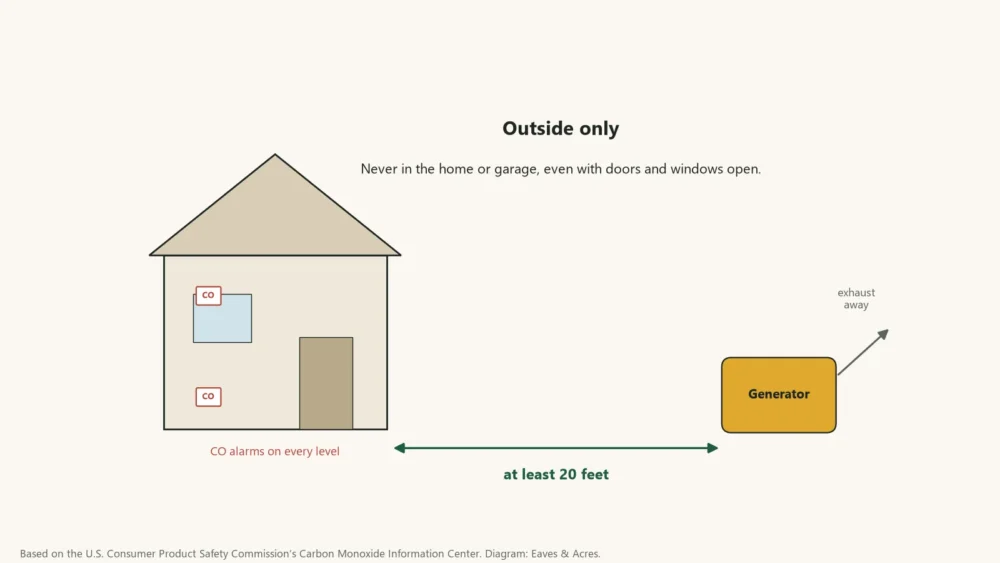
Twenty feet is not a guarantee. In 28 of the home deaths in Table 1, the generator was outdoors, usually near an open window or vent. In 2021, three people died with a generator that had a CO shut-off feature and was advertised as meeting the industry safety standard. It sat outside, under eaves with soffit vents into the attic, its exhaust pointed at a closed door; it did not shut off, and it ran until the tank was empty.1 So keep it in the open, away from eaves, soffit vents and window air conditioners as well as doors and windows. A porch, covered patio or carport is a partly enclosed space, which Honda’s manual rules out.9
Do not enclose the generator in any structure.
CO alarms: the backup that was usually missing
A working CO alarm is the only thing in the house that can warn you, since you can’t see or smell the gas. In the generator deaths where CPSC could establish whether an alarm was present (159 of 789), 83% had no CO alarm at all. Of the 27 deaths where one was present, it was known to have sounded in only 8; in 14, its batteries were missing, dead or put in wrong.1
What CPSC and CDC recommend:5,7
- Type: battery-operated, or plug-in with battery backup, so the alarm still works when the power is out. A plug-in alarm with no battery is useless in an outage.
- Where: on every level of the home and outside sleeping areas. Not in attics or basements unless someone sleeps there. Interconnected alarms are best: when one sounds, they all sound.
- Upkeep: test monthly and replace the batteries every year (CPSC). Replace the alarm itself when the maker says, or every 5 years (CDC).
CO poisoning symptoms, and what to do
CPSC lists the symptoms as headache, dizziness, weakness, nausea, vomiting, sleepiness and confusion; CDC adds chest pain and notes they are often described as flu-like.3,7 The danger is that people who are asleep or drunk may never notice them:
can die from CO poisoning before they have symptoms
If an alarm sounds or anyone feels sick while a generator is running, don’t look for the cause. Get everyone outside to fresh air immediately, then call 911.3
Generators with a CO shut-off
Some newer portable generators shut themselves off when CO builds up nearby. CPSC says models certified to the PGMA G300-2023 and UL 2201-2023 standards include CO safety technology, and that UL 2201 models also have reduced CO emissions.4 It is worth asking for when you buy. But the 2021 case above shows the limit: the feature is a backstop, not a reason to run the generator closer to the house.
Electrical hazards: shock, backfeed and cords
Plug appliances straight into the generator, or use a heavy-duty, outdoor-rated extension cord rated (in watts or amps) for at least the total of everything on it. Check the whole cord for cuts and make sure the plug has all three prongs, including the grounding pin.10,11 Even a properly connected generator can overheat or fail when overloaded, the Red Cross warns, so stagger big loads,10 and check the size you need with our generator size calculator.
Never plug a generator into a wall outlet to power the house. The Red Cross calls this backfeeding: it can electrocute utility workers, your neighbors and your own household.10 Honda’s manual adds that the generator itself may explode, burn or start a fire when utility power comes back.9
Rain, snow and flooding
Water turns a generator into a shock hazard. Honda’s manual says not to expose it to rain or snow and not to operate it with wet hands.9 Ready.gov says to keep it dry and protected from rain or flooding, since touching a wet generator or anything connected to it can shock you.8 The Red Cross suggests a dry surface under an open, canopy-like structure, such as a tarp held up on poles.10
What you must not do is move the generator into the garage, onto the porch or under the eaves to keep it dry. That trades a shock risk for the CO pattern in Table 1. CPSC tells owners to follow the manufacturer’s instructions for wet weather,4 so check your manual before using any cover sold for running generators.
Refueling and storing fuel
Fuel spilled on hot engine parts can ignite, which is why Ready.gov, NFPA, OSHA and the Red Cross all say to turn the generator off and let it cool before refueling.8,10,11,15 Honda’s manual adds the rest of the routine:9
- Stop the engine before you refuel.
- Handle fuel only outdoors, in a well-ventilated area, away from pilot lights, barbecues, sparks and flame.
- Wipe up any spilled fuel before you restart the engine.
None of the sources we checked gives a cooling time in minutes. Google’s AI Overview for “portable generator safety” credited OSHA with “at least 15 to 20 minutes” when we searched in October 2026, but OSHA’s fact sheet says only to shut the generator down “and allow it to cool.”15 Treat any specific number you see online as a rule of thumb, not official guidance.
Store gasoline in a container made and labeled for fuel, outside living areas, and not near a fuel-burning appliance such as a gas water heater in a garage. Local rules may limit how much you can keep; your fire department can tell you.10,11 Honda also warns that gasoline can deteriorate within a few months, which causes hard starting, so keep only fresh fuel for the generator.9
Storm season: when the risk peaks
Generator CO deaths cluster in winter. CPSC counted 44% of them from November through February, often during ice and snow storms, and another 32% in March, April, September and October, when hurricanes and tropical storms drive many of the deaths.1 Among outages with a known weather cause, hurricanes and tropical storms were linked to 55 deaths and ice or snow storms to 38.
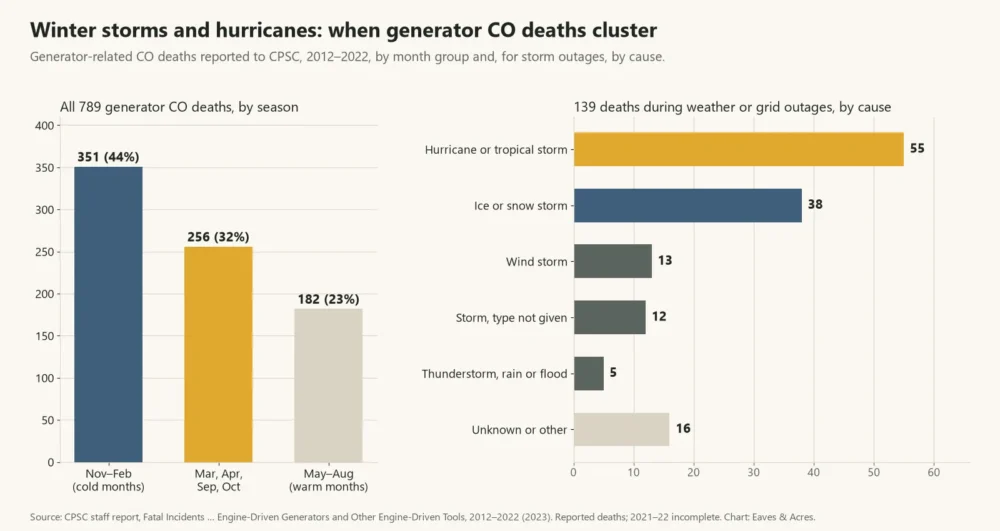
Storms are not the whole story, though. CPSC also tracked why the generator was running:1
| Reason | Deaths |
|---|---|
| Power outage from weather or a grid problem | 139 |
| Power to a temporary place: shed, trailer, boat, camper, cabin, campsite | 139 |
| Power shut off by the utility (billing dispute, nonpayment, other) | 118 |
| New home or owner, power not yet on, or under construction | 82 |
| Home or mobile home that normally has no electricity | 72 |
| Other reasons (testing, shed or garage power, other) | 26 |
| Unknown | 213 |
The rules don’t change with the reason: a generator used every night in a home without power, or in a hunting cabin, is just as deadly indoors as one used during a hurricane. Before each storm season, run through this list:
Test every CO alarm
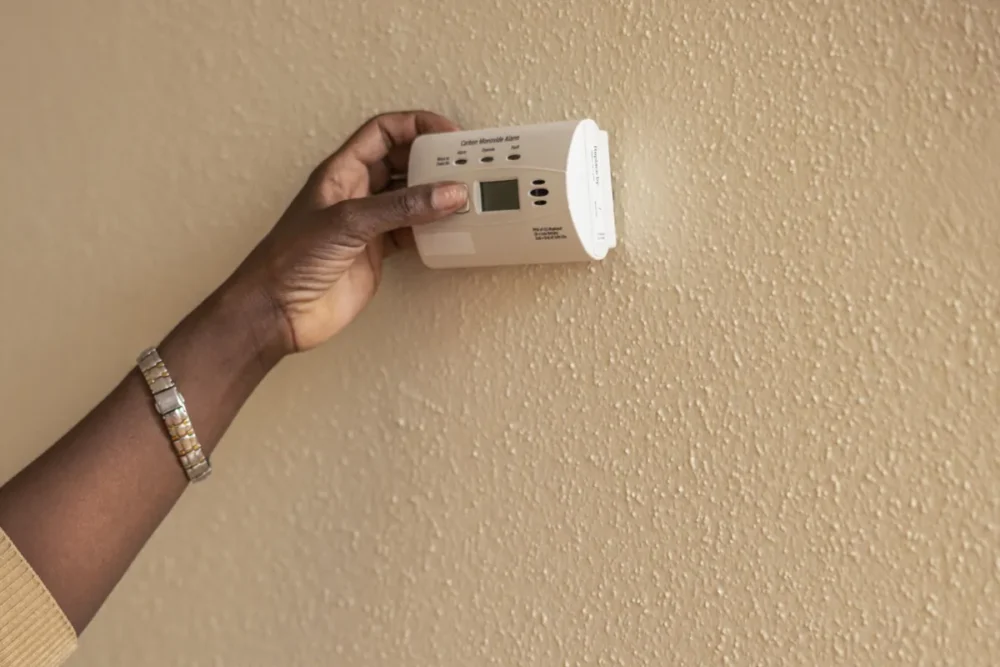
Press the test button and put in fresh batteries if needed. CPSC asks for monthly tests and a yearly battery change.5
Read the manual again
Check the generator, review its safety instructions and do the maintenance the manual asks for, as CPSC advises before hurricane season.4
Get fresh fuel
Old gasoline causes hard starting. Honda says to drain the tank and refill with fresh gasoline if the generator has been stored for a year or more.9
Plan your loads
Decide what you will run at the same time, and confirm the generator can carry it. Our appliance wattage table lists running and starting watts.
Check on neighbors
CPSC asks people to be a good neighbor and check on the people next door during extended power outages.6
In a winter outage, the furnace or heat pump blower needs power too; our guide to heat pump vs furnace running costs covers both systems. If you would rather not set up a portable unit in a storm at all, our calculator page compares portable and standby generators. For the rest of our backup-power guides, see the generators section and the wider home energy section. Our editorial policy explains how we choose sources, and our estimates and safety disclaimer sets the limits of pages like this one.
Frequently asked questions
At least 20 feet, according to CPSC, Ready.gov and NFPA (CDC says more than 20 feet), with the exhaust pointed away from windows, doors and vents. Treat that as a minimum: CPSC has recorded deaths with the generator outdoors but close to an open window, a vent or eaves with soffit vents.
No. CPSC, CDC and NFPA all say never in a garage, even with the door open. In CPSC’s records of home CO deaths from 2012 to 2022, 99 happened with the generator in an attached garage, enclosed carport or barn, and 62 happened with windows, doors or a garage door open.
Not exposed to it. Honda’s manual says not to expose the generator to rain or snow or touch it with wet hands. The Red Cross suggests a dry surface under an open, canopy-like structure. Follow your own manual, and never move the generator into a garage or onto a porch to keep it dry.
None of the official sources we checked sets an hour limit; the danger is where the generator sits. The placement rules apply all night, and battery-powered CO alarms matter most while you sleep, because CDC warns that people who are asleep can die from CO before they have symptoms.
No. That is backfeeding. The Red Cross says it can electrocute utility workers, your neighbors and your household, and Honda warns the generator itself may explode, burn or start a fire when utility power comes back. Powering house circuits takes a transfer switch installed by a licensed electrician.
Ready.gov, NFPA, OSHA and the Red Cross say to turn the generator off and let it cool, and Honda’s manual says to stop the engine first, but none gives a number of minutes; OSHA’s fact sheet says only “allow it to cool,” whatever some online summaries attribute to it. Wait until it is cool, refuel outdoors, and wipe up any spilled fuel before restarting.
They lower the risk. CPSC recommends models certified to PGMA G300-2023 or UL 2201-2023, and says UL 2201 models also emit less CO. But CPSC also documented a 2021 case in which a shut-off-equipped generator under the eaves did not shut off and three people died, so the placement rules still apply.
On every level of the home and outside sleeping areas, battery-operated or with battery backup so they work in an outage, CPSC says; interconnected alarms are best. Test them monthly, change the batteries yearly, and replace the alarm when the maker says or about every 5 years, as CDC advises.
Sources
- 1.Fatal Incidents Associated with Non-Fire Carbon Monoxide Poisoning from Engine-Driven Generators and Other Engine-Driven Tools, 2012–2022. U.S. Consumer Product Safety Commission, Directorate for Epidemiology (K. O’Connor), 2023. Used for: where the generator was, ventilation, CO alarm status, season, storm type, reasons for use, home size, the 2021 CO shut-off case Back to text
- 2.Non-Fire Carbon Monoxide Deaths Associated with the Use of Consumer Products, 2022 Annual Estimates. U.S. Consumer Product Safety Commission, 2026. Used for: generators as the product linked to the most CO deaths; 892 estimated generator deaths 2012–2022 (41%) Back to text
- 3.Carbon Monoxide Information Center. U.S. Consumer Product Safety Commission, accessed 2026. Used for: placement, CO alarm types and locations, symptoms, more than 100 generator deaths a year Back to text
- 4.CPSC Warns of Generator, Carbon Monoxide and Fire Hazards Ahead of Hurricane Season (release 26-519). U.S. Consumer Product Safety Commission, 2026. Used for: CO shut-off standards (PGMA G300-2023, UL 2201-2023), wet weather, pre-storm checks Back to text
- 5.CO Alarms. U.S. Consumer Product Safety Commission, accessed 2026. Used for: alarm locations, monthly tests, yearly battery change Back to text
- 6.What to Know: Generators and CO (CPSC 468). U.S. Consumer Product Safety Commission, 2022. Used for: no use in crawlspaces, sheds or on porches; 20 ft; checking on neighbors Back to text
- 7.Carbon Monoxide Poisoning Basics. Centers for Disease Control and Prevention, 2026. Used for: symptoms, sleeping victims, more than 20 ft, detector replacement Back to text
- 8.Power Outages. Ready.gov (FEMA), 2026. Used for: 20 ft from windows, doors and attached garages; keeping the generator dry; cool before refueling Back to text
- 9.Owner’s Manual, Generator EG5000X. Honda Motor Co., 2009. Used for: 3 ft clearance, no enclosure, rain and snow, refueling, fuel deterioration, backfeed Back to text
- 10.Safe Generator Use. American Red Cross (with technical advice from CDC, NFPA and CPSC), accessed 2026. Used for: ventilation does not prevent CO buildup, cords, backfeeding, canopy in wet weather, fuel storage Back to text
- 11.Generator Safety Tip Sheet. National Fire Protection Association, 2022. Used for: 20 ft measured to the building, attached garages, cords, fuel containers, cooling before refueling Back to text
- 12.Carbon Monoxide Safety: helping install a portable generator (photo). U.S. Consumer Product Safety Commission, public domain, via Wikimedia Commons, 2022. Used for: hero photo, cropped
- 13.Gasoline-powered portable generators (photo). NIST, public domain, via Wikimedia Commons, 2011. Used for: photo, cropped
- 14.Carbon Monoxide Safety: testing a carbon monoxide alarm (photo). U.S. Consumer Product Safety Commission, public domain, via Wikimedia Commons, n.d. Used for: photo, cropped
- 15.Using Portable Generators Safely (OSHA 3286 fact sheet). Occupational Safety and Health Administration, accessed 2026. Used for: 3–4 ft clear space, CO near openings, shut down and allow to cool before refueling Back to text

.jpg)

How this guide was made
- Written by the Home Systems Desk and reviewed by the Data & Methodology Desk.
- Data: death counts and patterns from the CPSC staff report on generator and other engine-driven tool CO deaths, 2012–2022 (deaths reported to CPSC: a minimum count, with 2021–2022 still incomplete), and from CPSC’s 2022 annual CO estimates; safety rules from CPSC, CDC, Ready.gov (FEMA), NFPA, OSHA, the American Red Cross and Honda’s EG5000X owner’s manual. This page uses no NOAA data: generator safety rules do not change with climate. See our methodology.
- AI use: AI tools help us research, draft and check this guide. Every figure is checked against the source cited for it, and calculated figures come from our own code, described on the methodology page.
- Spotted an error? Tell us — the form opens with this page’s address filled in.
Change log
- Oct 4, 2026Review: re-checked the CPSC report figures and the CPSC, CDC and Honda quotes against the live sources; added OSHA’s fact sheet (placement row in Table 2, refueling) and noted that it gives no cooling time in minutes, although Google’s AI Overview credits it with one; added CPSC’s generator PSA video.
- Oct 2, 2026Published. Generator CO death patterns (location, ventilation, CO alarms, season, storm type, reasons for use) taken from CPSC’s 2012–2022 generator report and 2022 annual estimates; placement, alarm, electrical, wet-weather and fuel rules checked against CPSC, CDC, Ready.gov, NFPA, the Red Cross and Honda’s EG5000X manual.
Covers heating, cooling, generators and water heaters. We maintain the sizing calculators and the guides that explain what a number means before you call a contractor.
Keep reading
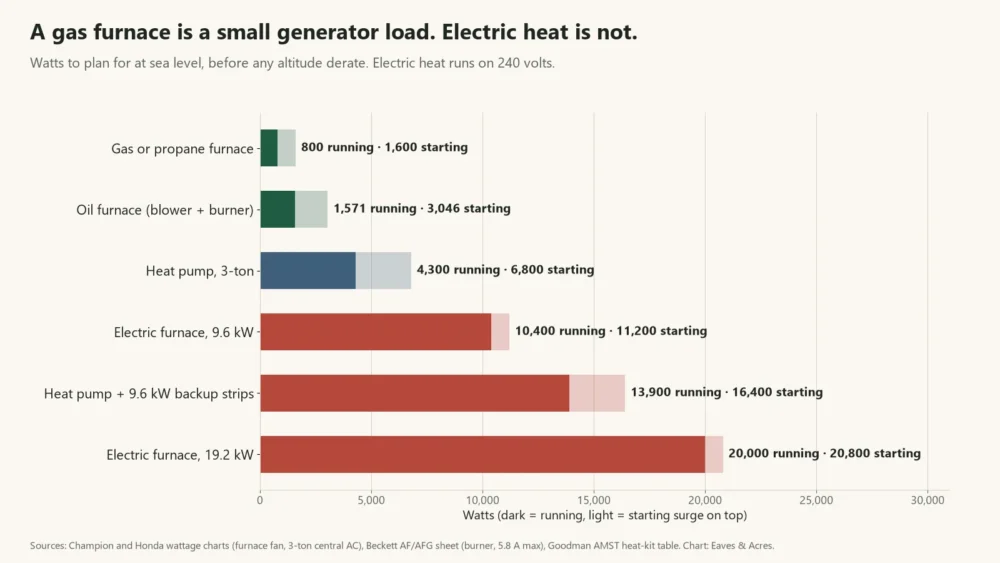
What Size Generator to Run a Furnace? Watts for Gas, Oil and Electric Heat
A gas or propane furnace needs about 300–875 running and 1,600–2,350 starting watts. What oil furnaces, electric furnaces and heat pumps draw, from generator charts and furnace spec sheets, with the altitude derate for 15 cold-winter cities.

What Humidity Should a House Be in Winter? 30–40%, Lower on Cold Nights
About 30–40% relative humidity, inside EPA’s 30–50% range, and lower on the coldest nights. Our NOAA estimate of when windows fog in 20 US cities, plus signs of air that is too dry or too damp.

How Much Does It Cost to Run a Space Heater? Costs by State and City
A 1,500-watt space heater costs about 27¢ an hour at the 2026 US average electricity price. Costs by state and in 20 cities, and how its heat compares with a furnace or heat pump.
Seasonal reminders for your ZIP
Get a short email when it’s time to overseed, start seeds, open the pool or service your furnace — timed to your climate.