




When to Start Seeds Indoors: Crop Chart and City Dates
Count back from the day each crop can go outside, not from the last frost. A crop chart from seven extension and seed sources, plus start dates for 20 US cities computed from NOAA normals.
- Last reviewed Oct 4, 2026
- 22 cited sources
- 11 min read
Set your ZIP to see dates for your area.
- 1Start seeds by counting back from the day each crop can go outside, not from your last-frost date.
- 2Typical indoor lead times from extension guides: onions 8–10 weeks, peppers 8, tomatoes 6, broccoli 4–6, cucumbers and squash 3–4.
- 3Cool crops such as onions and broccoli go out 2–6 weeks before the median last frost; tomatoes and peppers go out weeks after it.
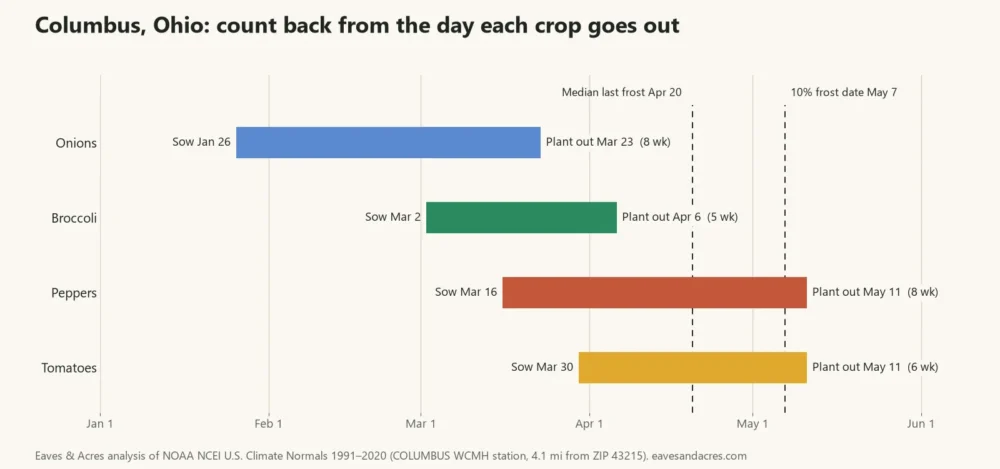
- 4Example, Columbus, Ohio: onions Jan 26, broccoli Mar 2, peppers Mar 16, tomatoes Mar 30.
- 5Counting 6–8 weeks back from the last frost keeps a typical tomato seedling indoors for 9–11 weeks; UMD and UMN advise 5–6.
- 6Your USDA zone can’t set the date: inside zone 6b, tomato seed dates for the middle 80% of sampled ZIP codes span 31 days.
Start seeds indoors by counting back from the day each crop can go outside, not from your last-frost date. Extension guides give about 8 to 10 weeks for onions, 8 for peppers, 6 for tomatoes, 4 to 6 for broccoli and 3 to 4 for cucumbers and squash. Cool crops go out before the last frost and warm crops weeks after it, so in Columbus, Ohio, that means onions in late January, broccoli in early March, peppers in mid-March and tomatoes around March 30.
The shortcut most charts use, starting tomatoes 6 to 8 weeks before your last frost, skips the planting-out step. We tested it against NOAA’s 1991–2020 climate normals for 38,123 ZIP codes. In almost all of them (99.9%) it keeps tomato seedlings indoors for 8 weeks or more, and in 81% for 9 weeks or more. The University of Maryland and the University of Minnesota both say 5 to 6 weeks.2,3
Seed starting chart: weeks indoors and when each crop goes out
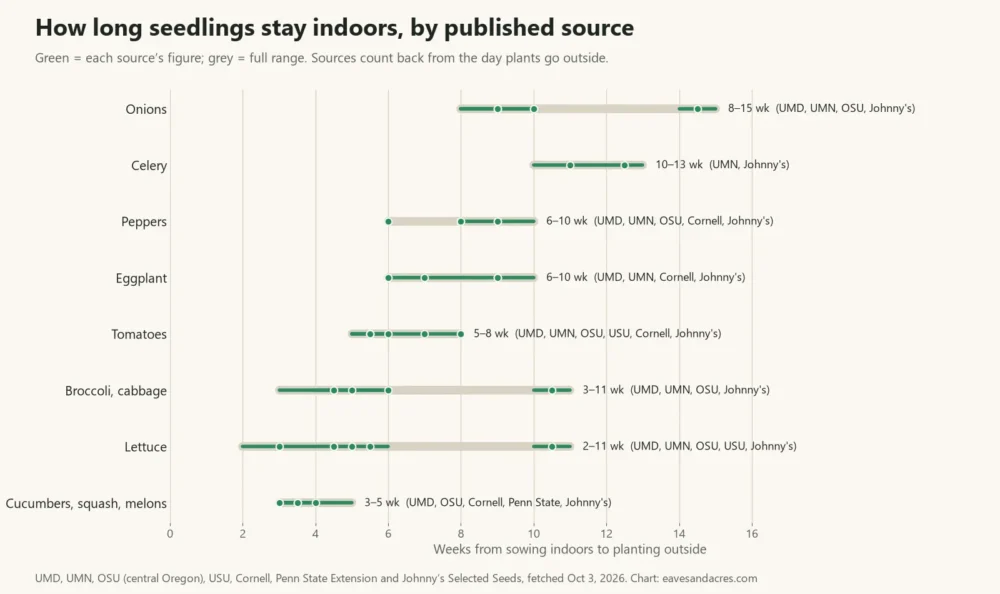
Every number below comes from an extension service or a seed company’s published table, read on October 3, 2026. The “goes outside” column is the step most charts leave out. Oregon State, Johnny’s Selected Seeds and Cornell’s Tompkins County office set it relative to the average last-frost date;4,13,7 we use NOAA’s median (50%) date for that. Where sources disagree, the table shows the range.
| Crop | Weeks indoors before planting out | Goes outside | Sources |
|---|---|---|---|
| Onions, leeks | 8–10 (UMN: 14–15) | 2–6 weeks before the median last frost | UMD, OSU, Johnny’s, UMN |
| Celery | 10–13 | About 1 week after it | UMN, Johnny’s |
| Peppers | 8 (range 6–10) | About 2 weeks after it | UMD, UMN, OSU, Cornell, Johnny’s |
| Eggplant | 6–10 | 2–3 weeks after it (Johnny’s) | UMD, UMN, Cornell, Johnny’s |
| Tomatoes | 6 (range 5–8) | 0–2 weeks after it; nights at 50°F usually decide (see below) | UMD, UMN, OSU, USU, Cornell, Johnny’s |
| Broccoli, cabbage, cauliflower | 4–6 (UMN: 10–11) | 2–5 weeks before it | UMD, OSU, Johnny’s, UMN |
| Kale, collards | 4–6 | 4–5 weeks before it | OSU, Johnny’s |
| Lettuce | 4–6 (UMD: 2–4; UMN head lettuce: 10–11) | 2–4 weeks before it | OSU, USU, Johnny’s, UMD |
| Cucumbers, squash, melons | 3–4 (UMD: 3–5) | 1–2 weeks after it, once the soil is warm | OSU, Cornell, Penn State, UMD, Johnny’s |
UMD is the University of Maryland Extension, UMN the University of Minnesota, OSU Oregon State’s central Oregon guide, USU Utah State and Cornell its Garden-Based Learning program; Johnny’s is a seed company whose calculator uses the same count-back.2,3,4,5,6,13 Penn State gives 3 to 4 weeks for cucumbers, melons and squash.8
Why the sources disagree
Most disagreement is about two crop groups. The University of Minnesota keeps onions indoors 14 to 15 weeks and broccoli, cabbage and head lettuce 10 to 11. Maryland, Oregon State and Johnny’s give onions 8 to 10 weeks and brassicas 4 to 6.3,2,4,13 Longer indoor time gives you bigger transplants. It also gives more chance of root-bound, stretched plants, and Maryland warns about exactly that:
A common mistake is to sow seeds too early
If you are new to it, use the low end of each range. Cornell gives the same advice: small plants catch up with overgrown ones.6
Some crops are better sown straight into the garden. Root crops such as carrots, beets and turnips dislike having their roots disturbed, and fast, cold-tolerant peas and radishes gain little from an indoor start. The Old Farmer’s Almanac chart also marks beans and corn for sowing outdoors.17 Cucumbers, squash and melons can go either way; if you start them inside, keep it to 3 or 4 weeks.8
Count back from the planting-out date, not the frost date
Extension planners all work in three steps: find your last-frost date, decide when each crop can go outside, then count back the indoor weeks. Oregon State’s worksheet has a column for each step.4 Utah State puts the last step this way:
Base this answer on the outside planting date
The middle step is what changes the answer. Onions and broccoli tolerate cold and go out weeks before the median last frost. Tomatoes and peppers go out after it. Cornell says warm-season crops do best planted 2 to 3 weeks after the average last frost, once nights stay above 45°F.6 Our tomato planting guide found the gap is usually wider. Planting out works best once frost risk is down to one year in ten and the normal night low reaches 50°F, a median of 24 days after the median last frost across US ZIP codes.1
That is why the frost-date shortcut runs long for warm crops. Counting 6 to 8 weeks back from the median last frost, as the Old Farmer’s Almanac does for tomatoes,17 gives a typical tomato seedling 9 to 11 weeks indoors before its real planting day. Charts that give peppers 8 to 10 weeks before the last frost, as Google’s AI Overview did when we checked, work out to 11 to 13 weeks.
Seed starting calendar for 20 US cities
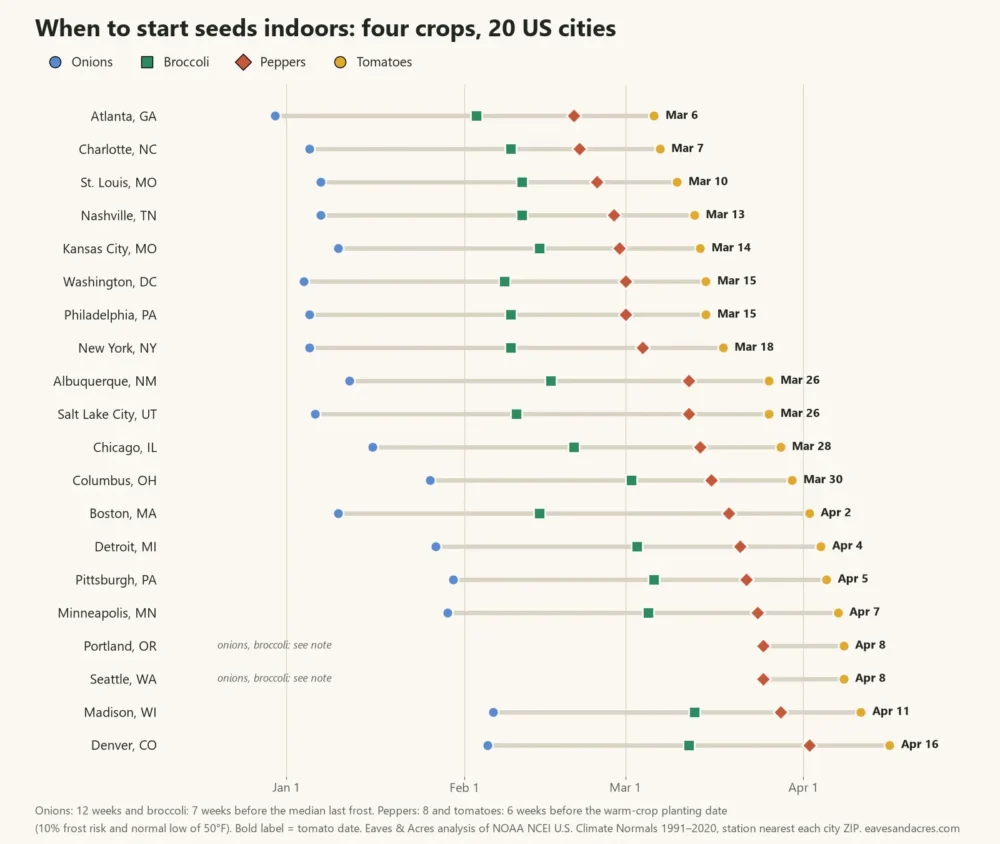
We applied that count-back to the NOAA station nearest each city ZIP code.1 Method: onions go out 4 weeks before the median last frost after 8 weeks indoors. Broccoli goes out 2 weeks before it after 5 weeks indoors. Tomatoes and peppers go out on the later of two dates: the 10% last-frost date, or the day the normal low reaches 50°F. Tomatoes get 6 weeks indoors and peppers 8.
| City (ZIP) | Median last frost | Onions | Broccoli | Peppers | Tomatoes | Warm crops go out |
|---|---|---|---|---|---|---|
| Atlanta, GA (30303) | Mar 24 | Dec 30 | Feb 3 | Feb 20 | Mar 6 | Apr 17 |
| Charlotte, NC (28202) | Mar 30 | Jan 5 | Feb 9 | Feb 21 | Mar 7 | Apr 18 |
| St. Louis, MO (63101) | Apr 1 | Jan 7 | Feb 11 | Feb 24 | Mar 10 | Apr 21 |
| Nashville, TN (37201) | Apr 1 | Jan 7 | Feb 11 | Feb 27 | Mar 13 | Apr 24 |
| Kansas City, MO (64105) | Apr 4 | Jan 10 | Feb 14 | Feb 28 | Mar 14 | Apr 25 |
| Philadelphia, PA (19103) | Mar 30 | Jan 5 | Feb 9 | Mar 1 | Mar 15 | Apr 26 |
| Washington, DC (20001) | Mar 29 | Jan 4 | Feb 8 | Mar 1 | Mar 15 | Apr 26 |
| New York, NY (10001) | Mar 30 | Jan 5 | Feb 9 | Mar 4 | Mar 18 | Apr 29 |
| Salt Lake City, UT (84101) | Mar 31 | Jan 6 | Feb 10 | Mar 12 | Mar 26 | May 7 |
| Albuquerque, NM (87102) | Apr 6 | Jan 12 | Feb 16 | Mar 12 | Mar 26 | May 7 |
| Chicago, IL (60601) | Apr 10 | Jan 16 | Feb 20 | Mar 14 | Mar 28 | May 9 |
| Columbus, OH (43215) | Apr 20 | Jan 26 | Mar 2 | Mar 16 | Mar 30 | May 11 |
| Boston, MA (02108) | Apr 4 | Jan 10 | Feb 14 | Mar 19 | Apr 2 | May 14 |
| Detroit, MI (48201) | Apr 21 | Jan 27 | Mar 3 | Mar 21 | Apr 4 | May 16 |
| Pittsburgh, PA (15222) | Apr 24 | Jan 30 | Mar 6 | Mar 22 | Apr 5 | May 17 |
| Minneapolis, MN (55401) | Apr 23 | Jan 29 | Mar 5 | Mar 24 | Apr 7 | May 19 |
| Seattle, WA (98101) | Mar 13 | —* | —* | Mar 25 | Apr 8 | May 20 |
| Portland, OR (97204) | Feb 25 | —* | —* | Mar 25 | Apr 8 | May 20 |
| Madison, WI (53703) | May 1 | Feb 6 | Mar 13 | Mar 28 | Apr 11 | May 23 |
| Denver, CO (80202) | Apr 30 | Feb 5 | Mar 12 | Apr 2 | Apr 16 | May 28 |
*In Seattle and Portland the median last frost comes in late February or March, but nights stay cool into May. A frost-based count-back would put onion seeds in late fall there, so we leave those cells blank; follow your local extension calendar for cool crops. The onion dates assume a spring crop. Where winters are mild, onions are often grown over winter instead: UF/IFAS says bulbing onions in Florida must be planted in fall.15 Valleys, hilltops and gardens far from a station can be a week or more off. For any ZIP code, look up your frost dates and their odds and count back the same way.
How our dates compare with local extension calendars
We checked the method against six published local calendars:
| Place | Published calendar | Our dates (NOAA) |
|---|---|---|
| Minneapolis, MN | Onions early Feb, broccoli early Mar, peppers mid-Mar, tomatoes early Apr (University of Minnesota) | Jan 29, Mar 5, Mar 24, Apr 7 |
| Lincoln, NE | Broccoli early Mar, peppers mid-Mar, tomatoes late Mar (Nebraska Extension, Lancaster County) | Mar 6, Mar 17, Mar 31 |
| Springfield, IL | Onions in Feb, broccoli early to mid-Mar, peppers and tomatoes mid to late Mar (Illinois Extension, central Illinois) | Jan 21, Feb 25, Mar 12, Mar 26 |
| St. Louis, MO | Broccoli about Feb 15; tomatoes and peppers about Mar 15 (Missouri Botanical Garden) | Feb 11; tomatoes Mar 10, peppers Feb 24 |
| Columbus, OH | Tomatoes and peppers in February, brassicas later in March (Ohio State BYGL) | Tomatoes Mar 30, peppers Mar 16, broccoli Mar 2 |
| Bend, OR | Frost-free date most central Oregon gardeners use: May 31 (OSU) | NOAA median last frost Jun 6 |
Minnesota and Nebraska agree within about a week. Illinois runs later for central Illinois because it puts the last frost around early May.9 NOAA’s Springfield station puts the median at April 15 and the 10% date at April 30, so Illinois is working from the safer date. Missouri Botanical Garden sows peppers with tomatoes,11 which is later than the 8-week pepper lead most sources give. The February tomato start in Ohio State’s BYGL note would mean about 10 to 14 weeks indoors before Columbus’s May 11 planting-out date.12 Sources: University of Minnesota,3 Nebraska Extension in Lancaster County,10 Illinois Extension and Oregon State.4
Why your zone doesn’t set your seed-starting dates
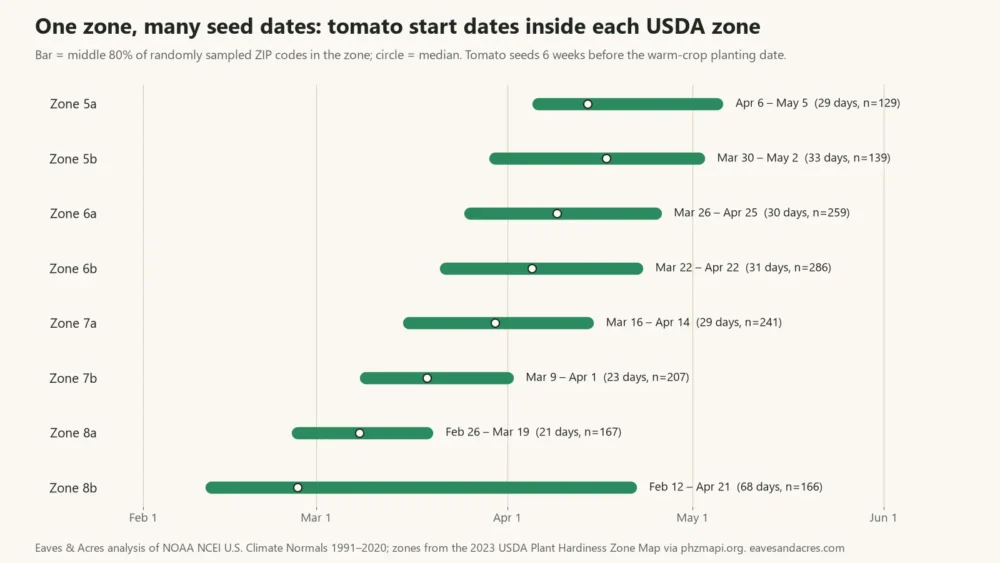
Search for “seed starting calendar zone 6” and you get charts by USDA hardiness zone. But the zone map is based on the average coldest winter night, not on spring frost or warm nights.14 Two gardens in the same zone can reach planting-out weeks apart. We looked up the 2023 zone for 1,934 randomly sampled US ZIP codes18 and compared their NOAA dates:
| USDA zone | ZIP codes sampled | Median last frost | Tomato seed-start date | Spread of seed dates |
|---|---|---|---|---|
| 5a | 129 | Apr 25 – May 16 | Apr 6 – May 5 | 29 days |
| 5b | 139 | Apr 19 – May 17 | Mar 30 – May 2 | 33 days |
| 6a | 259 | Apr 16 – May 10 | Mar 26 – Apr 25 | 30 days |
| 6b | 286 | Apr 12 – May 6 | Mar 22 – Apr 22 | 31 days |
| 7a | 241 | Apr 4 – Apr 27 | Mar 16 – Apr 14 | 29 days |
| 7b | 207 | Mar 29 – Apr 15 | Mar 9 – Apr 1 | 23 days |
| 8a | 167 | Mar 19 – Apr 6 | Feb 26 – Mar 19 | 21 days |
| 8b | 166 | Mar 2 – Mar 30 | Feb 12 – Apr 21 | 68 days |
Inside zone 6b, the middle 80% of sampled ZIP codes reach the tomato seed date anywhere from Mar 22 to Apr 22, a spread of 31 days. In zone 7a it runs from Mar 16 to Apr 14. Zone 8b takes in both Gulf Coast towns and the cool Oregon and Washington coast, and its spread is 68 days. A zone calendar can only give one date for all of them, so it will be weeks early for some gardens and weeks late for others.
Use your zone to choose perennials, not to set seed dates; cold-loving perennial seeds can go out in winter with winter sowing. For more on what the zones measure, see planting zone vs. frost date and our hardiness zone guides.
Warm-winter areas and seed starting for fall crops
Where frost is rare, broccoli, cabbage and their relatives are fall and winter crops. UF/IFAS lists broccoli planting from September to February in north and central Florida, and October to January in south Florida.15 Texas A&M AgriLife’s average fall planting dates for broccoli run from July 15 in Region I to November 1 in Region V.16 Count back 4 to 6 weeks from those dates for the indoor start.
The same works for a northern fall crop. Illinois Extension suggests starting broccoli, cauliflower, cabbage and kale indoors in early July, then planting them out in late July or early August.9 In Minnesota, cabbage and broccoli for fall can be started in June or July.3
Light and temperature basics
These are the conditions extension guides give for healthy seedlings. Ranges show where sources differ.
| Factor | Guidance | Source |
|---|---|---|
| Germination | Potting mix at 65–75°F for most vegetables; 70–75°F for most flowers and vegetables | UMD; Nebraska Extension |
| After sprouting | Nights 55–60°F, days 65–70°F | UMD |
| Light height | No more than 4 inches above the seedlings, 2 inches ideal; 2–6 inches | UMN; UMD |
| Hours of light | 12–16 hours a day, with a dark period at night; 14–16 hours | UMN; UMD |
| Feeding | None until several true leaves; most mixes carry enough fertilizer for at least 6 weeks; follow the label | UMN; UMD |
| Hardening off | A week to 10 days; up to two weeks | Missouri Botanical Garden; UMN |
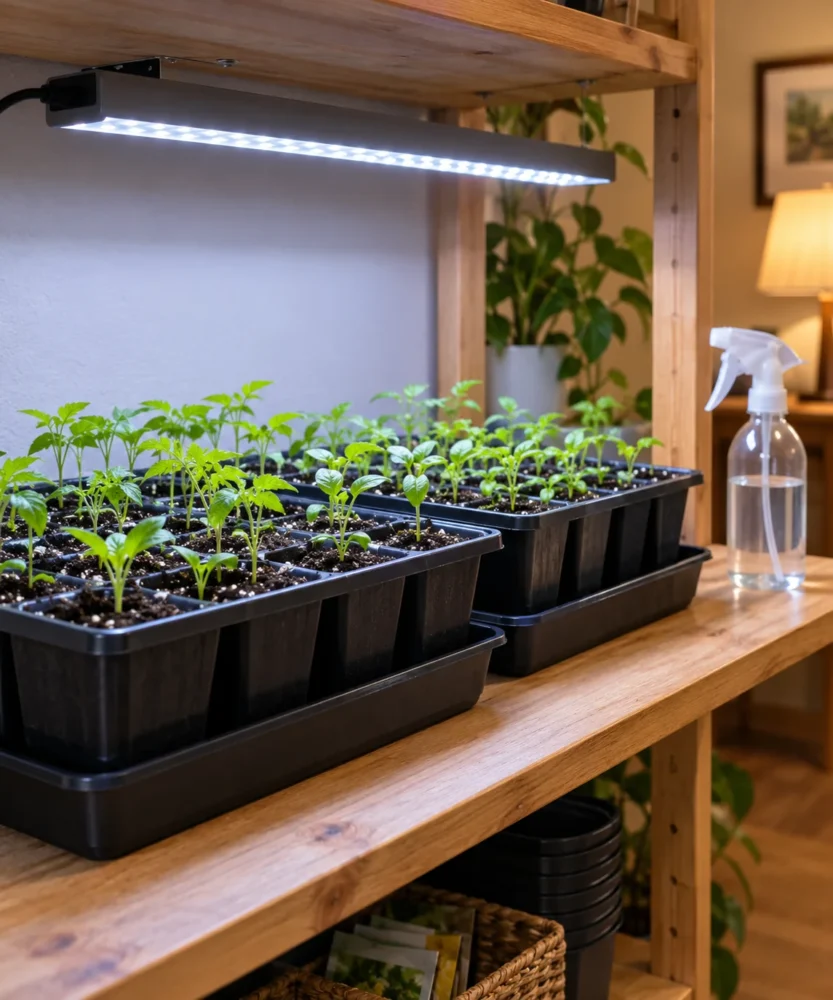
A windowsill is a poor place to start seeds. The University of Minnesota notes that sills can be the coldest spot in the house at night and the hottest by day, and that seedlings grown there tend to be tall with thin, bent stems.3 Lack of light is the main cause of stretched stems, so a fluorescent or LED fixture on a timer usually makes the biggest difference.3 Bottom heat from a seed-starting mat helps germination, but don’t plug the mat into the light timer.3
Potting up and hardening off
Pot up after the first true leaves
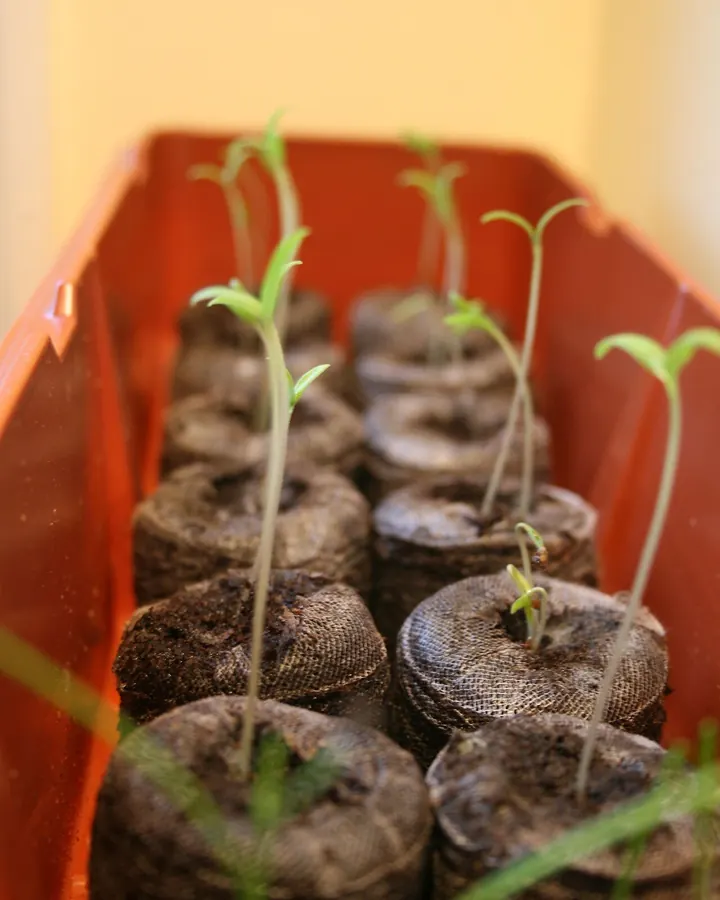
Move seedlings sown in a shared flat into their own containers soon after the first true leaves appear. Maryland moves tomatoes, peppers and eggplant into larger pots 2 to 3 weeks after germination. Handle them by a leaf, never the stem.2
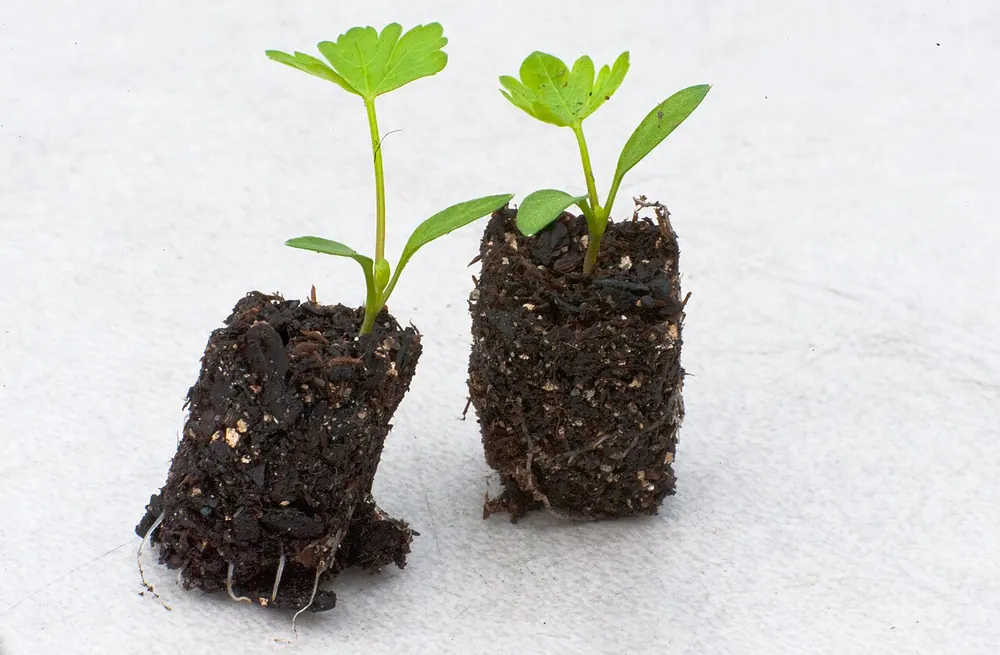
Then plant on a cloudy day or in late afternoon.3 For crop-by-crop timing outside, see our vegetable guides and seed-starting guides, check frost odds in our frost and freeze guides, or read how we process the NOAA frost data. More in the garden section and our climate data.
Frequently asked questions
Root crops such as carrots, beets and turnips dislike having their roots disturbed, and peas and radishes grow fast enough to sow outside, says the Old Farmer’s Almanac, whose chart also lists beans and corn for direct sowing. Cucumbers, squash and melons can be started indoors, but only 3 to 4 weeks ahead.
Sowing too early, which gives tall, root-bound transplants (University of Maryland); too little light, the main cause of stretched stems (University of Minnesota); and keeping the mix too wet, which invites damping-off.
Yes, for germination. Ohio State’s BYGL says any container works if you poke drainage holes. Maryland recommends containers at least 2 inches deep, so move seedlings into bigger pots once their first true leaves appear.
Your zone is too broad to say. Inside zone 6b, tomato seed dates for the middle 80% of sampled ZIP codes run from Mar 22 to Apr 22. Look up your ZIP code’s frost dates and count back from each crop’s planting-out date.
Count from the planting-out date instead: about 6 weeks before it. In a typical US ZIP code that is roughly 2½ weeks before the median last frost, because tomatoes go out a median of 24 days after it.
Count forward from today. Tomatoes need about 5 to 6 weeks to reach transplant size and cucumbers or squash 3 to 4, so a late start still works for those. Onions, celery and peppers need 8 weeks or more; buy transplants if your planting date is closer than that.
Usually. The University of Minnesota says seedlings grow much better under fluorescent or LED lights than on a windowsill, kept 2 to 4 inches above the plants for 12 to 16 hours a day. A roomy south-facing window can do for a few plants.
Sources
- 1.U.S. Climate Normals 1991–2020. NOAA National Centers for Environmental Information, 2021. Used for: last-frost probabilities and normal monthly low temperatures for every ZIP code and city Back to text
- 2.Starting Vegetable Seeds Indoors, Jon Traunfeld. University of Maryland Extension, 2026. Used for: weeks indoors by crop, temperatures, light, containers, potting up Back to text
- 3.Starting seeds indoors. University of Minnesota Extension, 2026. Used for: Minnesota sowing calendar and weeks indoors, light, bottom heat, hardening off Back to text
- 4.When to start seeds indoors in central Oregon, Amy Jo Detweiler. Oregon State University Extension Service, 2024. Used for: set-out weeks relative to the frost-free date and weeks indoors by crop Back to text
- 5.Starting Vegetable Seeds Indoors: I. Planning, Wesley Crump, Taun Beddes, Michael Caron and Milena Oliveira. Utah State University Extension, 2025. Used for: planning steps (outside date first), tomato and lettuce lead times Back to text
- 6.Indoor Vegetable Seed Starting, Lori J. Brewer. Cornell Garden-Based Learning, 2015. Used for: warm crops 2–3 weeks after last frost, 6- and 3-week lead times, start late rather than early Back to text
- 7.First Seeding and Transplanting Dates for Vegetables in New York. Cornell Cooperative Extension of Tompkins County, n.d. Used for: planting-out groups relative to the average last frost Back to text
- 8.Starting Your Summer Vegetable Garden: Seeds or Transplants?, Lois Miklas. Penn State Extension, 2025. Used for: cucurbit transplants 3–4 weeks Back to text
- 9.When should I start my seeds?, Ken Johnson. University of Illinois Extension, 2023. Used for: central Illinois sowing calendar, fall brassicas Back to text
- 10.Starting Seeds Indoors, Sarah Browning. Nebraska Extension in Lancaster County, 2021. Used for: Lincoln-area sowing dates, germination temperature Back to text
- 11.Starting Plants from Seed Indoors. Missouri Botanical Garden, n.d. Used for: St. Louis sowing dates, hardening off Back to text
- 12.It’s Time to Start Seeds, Carri Jagger. Ohio State University Extension, BYGL, 2024. Used for: Ohio sowing months, containers Back to text
- 13.Seed-Starting Date Calculator. Johnny’s Selected Seeds, n.d. Used for: weeks before setting-out and setting-out relative to the frost-free date Back to text
- 14.USDA Plant Hardiness Zone Map. USDA Agricultural Research Service, 2023. Used for: how hardiness zones are defined Back to text
- 15.Florida Vegetable Gardening Guide (SP 103/VH021). UF/IFAS Extension, 2024. Used for: Florida broccoli planting months; bulbing onions planted in fall Back to text
- 16.Fall Vegetable Gardening Guide for Texas, Larry Stein and Joe Masabni. Texas A&M AgriLife Extension, n.d. Used for: fall broccoli planting dates by Texas region Back to text
- 17.How and When to Start Seeds Indoors, Catherine Boeckmann. The Old Farmer’s Almanac, 2026. Used for: frost-date count-back rule tested here; crops to direct-sow Back to text
- 18.2023 USDA Plant Hardiness Zone Map, ZIP-code table. PRISM Climate Group, Oregon State University, for USDA ARS, 2023. Used for: zone for each sampled ZIP code (looked up via phzmapi.org, which mirrors this table; all looked-up ZIP codes present in the table match it, checked 2026-10-03) Back to text
- 19.Photo: Sweet pepper seedlings, Pascal Kings (CC BY 4.0). Wikimedia Commons, n.d. Used for: hero photo
- 20.Photo: Onions in the greenhouse, Dwight Sipler (CC BY 2.0). Wikimedia Commons, n.d. Used for: onion seedling photo
- 21.Photo: Tomato sprouts, Cdw victoria (CC BY 3.0). Wikimedia Commons, n.d. Used for: tomato seedling photo
- 22.Photo: Plugs ready for transplant, Dwight Sipler (CC BY 2.0). Wikimedia Commons, n.d. Used for: seedling plug photo

.jpg)

.jpg)
How this guide was made
- Written by the Yard & Garden Desk and reviewed by the Data & Methodology Desk.
- Data: frost dates and normal night temperatures from NOAA NCEI U.S. Climate Normals 1991–2020 for the station nearest each ZIP code; indoor lead times and planting-out offsets from UMD, UMN, Oregon State, Utah State, Cornell, Penn State and Johnny’s Selected Seeds; USDA 2023 hardiness zones from the PRISM Climate Group ZIP-code table, looked up via phzmapi.org. See our methodology.
- AI use: AI tools help us research, draft and check this guide. Every figure is checked against the source cited for it, and calculated figures come from our own code, described on the methodology page.
- Spotted an error? Tell us — the form opens with this page’s address filled in.
Change log
- Oct 4, 2026Re-checked crop lead times, quotes and light guidance against UMD, UMN, Utah State, Ohio State BYGL and the Almanac; added beans and corn to the crops to sow outdoors (Almanac chart).
- Oct 3, 2026Hardiness-zone source now cited to the PRISM Climate Group’s official 2023 ZIP-code table; every looked-up ZIP code in it matches.
- Oct 2, 2026Published. Crop lead times checked against UMD, UMN, Oregon State, Utah State, Cornell, Penn State and Johnny’s; seed-starting dates for 20 cities and the zone comparison computed from NOAA 1991–2020 normals.
Covers lawns, gardens, frost and planting. We write the guides and maintain the tools that tell you when to seed, feed and plant for your ZIP.
Keep reading
Winter Sowing: When to Start and What to Sow Where You Live
Sow seeds outdoors in covered jugs in winter and let the cold break their dormancy. Extension timing by seed type, plus the last start date for 30- and 60-day seeds in 22 cities from NOAA normals.
When to Plant Onions: Fall in the South, Spring in the North
Plant onion sets and transplants in the four weeks before your last frost, or in fall and winter in the Deep South. Dates for 27 cities and the onion type for every ZIP code's latitude.
When to Plant Wildflower Seeds: Fall, Winter and Spring Dates Where You Live
Most native wildflower seed does best sown in late fall or winter. Dormant-sowing dates for 24 US cities from NOAA hard-freeze normals, two common rules tested, and published calendars from Minnesota to Texas and Florida.
Seasonal reminders for your ZIP
Get a short email when it’s time to overseed, start seeds, open the pool or service your furnace — timed to your climate.