




Winter Sowing: When to Start and What to Sow Where You Live
Sow seeds outdoors in covered jugs and let winter do the work. Extension timing for each kind of seed, plus the last start date for 30- and 60-day seeds in 22 US cities, counted from NOAA cold nights.
- Last reviewed Oct 7, 2026
- 28 cited sources
- 12 min read
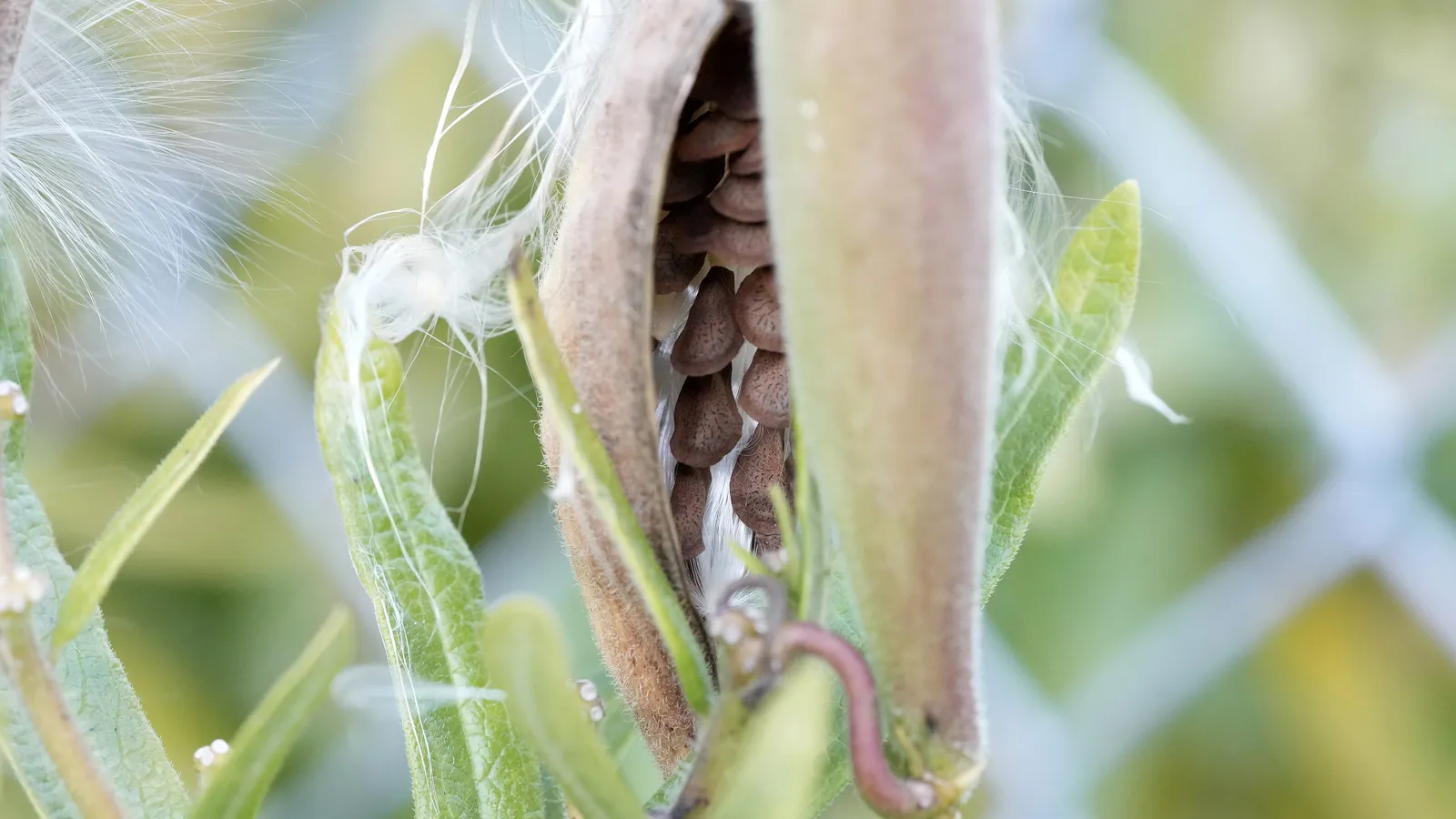
Set your ZIP to see dates for your area.
- 1Winter sowing: seeds in vented, covered containers left outdoors, where cold, moist weather breaks dormancy; no lights or hardening off.
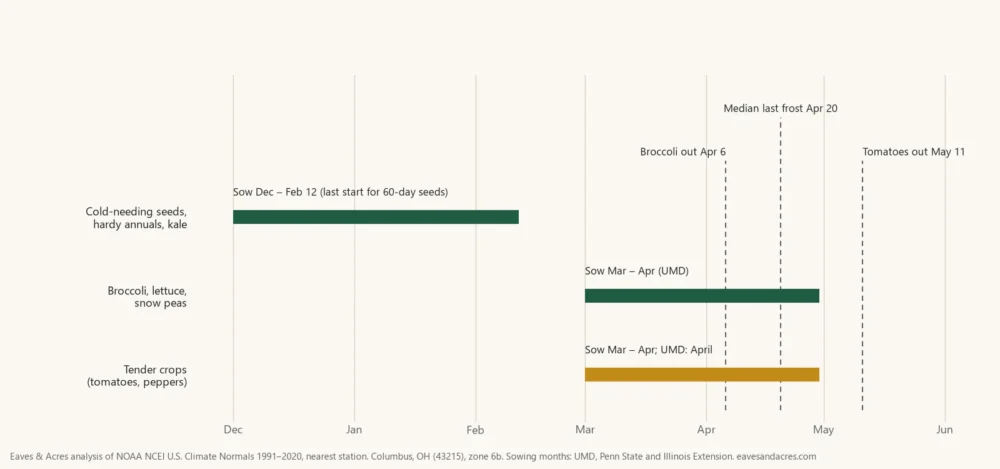
- 2Extension timing: cold-needing seeds, hardy annuals and kale December to February; broccoli, lettuce, tomatoes and peppers March or April.
- 3A 60-day seed needs about 60 nights at 40°F or colder: sow it by Feb 12 in Columbus, Jan 25 in Washington, DC, or Jan 2 in Atlanta.
- 4Zone rules miss it: a Jan 31 sowing still gets 60 cold nights in 95% of zone 6b ZIP codes but in 44% of 7b and 6% of 8a.
- 5Planting-out dates don’t change: broccoli about two weeks before the median last frost, tomatoes once frost risk is one in ten and nights average 50°F.
Winter sowing means sowing seeds in covered, vented containers such as milk jugs and leaving them outdoors over winter, so cold, wet weather breaks their dormancy and they sprout on their own in spring. Extension guides sow seeds that need a cold period, hardy annuals and the toughest greens from December to February, broccoli and lettuce in March or April, and tomatoes and other tender crops in March or April.5,4,6
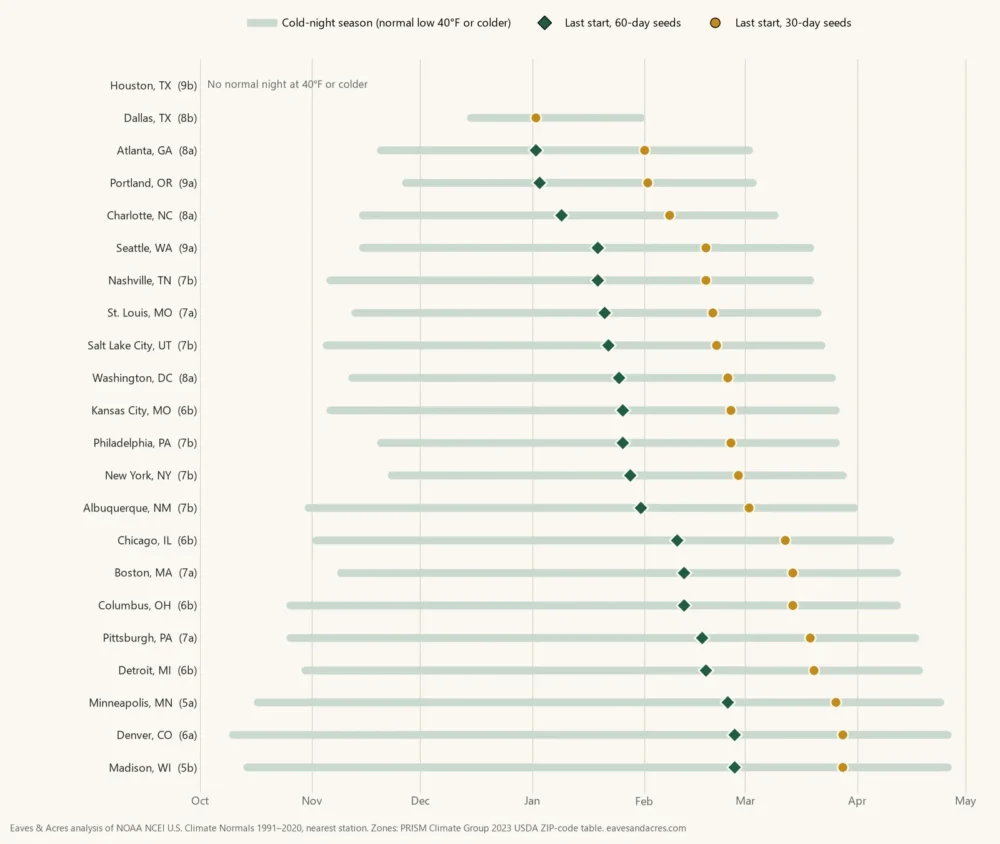
The date that matters most is the last one. A seed labeled for 60 days of cold needs about 60 cold nights before spring warms up. We counted nights at 40°F or colder in NOAA’s 1991–2020 normals for every ZIP code: that deadline falls around Feb 12 in Columbus, Ohio, Jan 25 in Washington, DC, and Jan 2 in Atlanta.1 A January 31 sowing still gets 60 cold nights in 95% of zone 6b ZIP codes, but in only 44% of zone 7b and 6% of 8a.2
What winter sowing is, and how it differs from starting seeds indoors
Penn State Extension describes it as planting seeds outdoors in a container in winter and leaving it there until seedlings come up in spring; the container keeps out animals and the worst weather while cold and moisture break dormancy.4 Trudi Davidoff introduced the method on GardenWeb in 2000, according to University of Maryland Extension Master Gardeners.5
It replaces grow lights, heat mats and hardening off, because seedlings grow up outside.4,5 It doesn’t change when plants can go into the garden. For crops you start under lights, our guide to when to start seeds indoors counts back from each crop’s planting-out date; this page uses the same frost dates.
Loads from YouTube (privacy-enhanced mode) only when you press play.
When to start winter sowing: three waves
Extension and Master Gardener guides split winter sowing into waves by how much cold each seed can take:
| Seed type | Examples | When to sow | Sources |
|---|---|---|---|
| Seeds that need cold to sprout | Native perennials such as milkweed, butterfly weed, liatris, lobelia; other stratifying perennials | December to February (Northeast natives: November to February) | UMD, Wild Seed Project |
| Hardy annuals and cool-season vegetables | Pansies; spinach, kale, Brussels sprouts | December to February (UMD); January or February (Illinois); perennials and hardy annuals December to March (Penn State) | UMD, Illinois Extension, Penn State |
| Cool crops that prefer milder weather | Broccoli, bok choy, lettuce, snow peas | March to April (Illinois counts broccoli as frost-tolerant and sows it in January or February) | UMD, Illinois Extension |
| Tender crops | Tomatoes, peppers, eggplant, squash; zinnias, marigolds | March or April (UMD: April for tomatoes and peppers) | Penn State, Illinois Extension, UMD |
Sources: Maryland’s Charles County Master Gardeners,5 Illinois Extension,6 Penn State4 and Maine’s Wild Seed Project.12 As Penn State puts it:
Tender plants including annuals and vegetables can be sown later in spring (March or April)
Don’t start in fall. Illinois Extension waits until January or February, and explains why:
If there is a warm spell, the seeds can germinate but won’t be hardy enough
Google’s AI Overview, citing a YouTube channel, said to start once nights stay below 50°F, but normal lows reach 50°F by Sep 24 in Minneapolis and Oct 19 in Atlanta, months before any extension start date.1
The real deadline: enough cold nights before spring
Many perennial and native seeds stay dormant until they have spent weeks cold and moist, a process called cold stratification. The seed packet should say how many days a species needs, notes UW–Madison Extension’s Lisa Johnson in Dane County.7 Prairie Moon Nursery writes it as a code: C(30) or C(60) for 30 or 60 days of cold, moist treatment, which it gives at 33–40°F in a refrigerator.10 A jug outside does the same job on cold nights, so its sowing date has to leave enough of them.
We counted, for the NOAA station nearest each ZIP code, the nights whose normal low is 40°F or colder, the top of Prairie Moon’s range. Frozen nights count too, since the guides treat freezing and thawing as part of the process.11 The last start for a 60-day seed is the date that still leaves 60 such nights before spring.1
| City (ZIP) | 2023 zone | Cold nights per winter | Last start, 60-day seeds | Last start, 30-day seeds | Median last frost | Tender crops go out |
|---|---|---|---|---|---|---|
| Atlanta, GA (30303) | 8a | 103 | Jan 2 | Feb 1 | Mar 24 | Apr 17 |
| Portland, OR (97204) | 9a | 97 | Jan 3 | Feb 2 | Feb 25 | May 20 |
| Charlotte, NC (28202) | 8a | 115 | Jan 9 | Feb 8 | Mar 30 | Apr 18 |
| Nashville, TN (37201) | 7b | 134 | Jan 19 | Feb 18 | Apr 1 | Apr 24 |
| Seattle, WA (98101) | 9a | 125 | Jan 19 | Feb 18 | Mar 13 | May 20 |
| St. Louis, MO (63101) | 7a | 129 | Jan 21 | Feb 20 | Apr 1 | Apr 21 |
| Salt Lake City, UT (84101) | 7b | 138 | Jan 22 | Feb 21 | Mar 31 | May 7 |
| Washington, DC (20001) | 8a | 134 | Jan 25 | Feb 24 | Mar 29 | Apr 26 |
| Kansas City, MO (64105) | 6b | 141 | Jan 26 | Feb 25 | Apr 4 | Apr 25 |
| Philadelphia, PA (19103) | 7b | 127 | Jan 26 | Feb 25 | Mar 30 | Apr 26 |
| New York, NY (10001) | 7b | 126 | Jan 28 | Feb 27 | Mar 30 | Apr 29 |
| Albuquerque, NM (87102) | 7b | 152 | Jan 31 | Mar 2 | Apr 6 | May 7 |
| Chicago, IL (60601) | 6b | 160 | Feb 10 | Mar 12 | Apr 10 | May 9 |
| Columbus, OH (43215) | 6b | 169 | Feb 12 | Mar 14 | Apr 20 | May 11 |
| Boston, MA (02108) | 7a | 155 | Feb 12 | Mar 14 | Apr 4 | May 14 |
| Pittsburgh, PA (15222) | 7a | 174 | Feb 17 | Mar 19 | Apr 24 | May 17 |
| Detroit, MI (48201) | 6b | 171 | Feb 18 | Mar 20 | Apr 21 | May 16 |
| Minneapolis, MN (55401) | 5a | 190 | Feb 24 | Mar 26 | Apr 23 | May 19 |
| Denver, CO (80202) | 6a | 199 | Feb 26 | Mar 28 | Apr 30 | May 28 |
| Madison, WI (53703) | 5b | 195 | Feb 26 | Mar 28 | May 1 | May 23 |
| Dallas, TX (75201) | 8b | 48 | — | Jan 2 | Mar 2 | Mar 19 |
| Houston, TX (77002) | 9b | 0 | — | — | Feb 2 | Mar 5 |
The deadline runs from late February in Minneapolis, Madison and Denver to early January in Atlanta and Portland. Dallas averages 48 cold nights, enough only for 30-day seeds sown by Jan 2; Houston’s normal nights never reach 40°F. Gardens far from a station can run a week or more off, so treat these as a guide and look up your own frost dates.
How we counted cold nights
We spread NOAA’s monthly normal lows into daily values, as our daffodil and tulip guides do, and counted nights from July to June. These are station air temperatures in a typical winter, not the soil in a jug. We dropped two other measures: a daily mean of 40°F or colder gave Atlanta zero cold nights though its January lows average about 33°F, and leaving out fully frozen days pushed Minneapolis’s deadline into November, against Hennepin County Master Gardeners, who winter sow from January on.8
Does your hardiness zone tell you when to winter sow? We tested it
Google’s AI Overview told us that cold zones 3 to 5 should sow perennials in January and February, and zones 6 to 8 from late December through January. We checked the end of each window for 39,894 contiguous-US ZIP codes in PRISM’s 2023 zone table (look up your zone).2,1
| Half-zone | ZIP codes | Cold nights per winter (median, middle 80%) | Last start, 60-day seeds (median, middle 80%) | 60 cold nights left if sown Dec 21 / Jan 31 / Feb 28 | Fewer than 30 cold nights |
|---|---|---|---|---|---|
| 4a | 783 | 224 (211–242) | Mar 12 (Mar 6 – Mar 22) | 100% / 100% / 100% | 0% |
| 4b | 1,256 | 213 (201–241) | Mar 7 (Mar 1 – Mar 23) | 100% / 100% / 93% | 0% |
| 5a | 2,393 | 205 (190–239) | Mar 2 (Feb 23 – Mar 21) | 100% / 100% / 64% | 0% |
| 5b | 2,865 | 198 (179–227) | Mar 1 (Feb 16 – Mar 17) | 100% / 100% / 55% | 0% |
| 6a | 5,183 | 188 (167–213) | Feb 24 (Feb 11 – Mar 9) | 100% / 100% / 38% | 0% |
| 6b | 5,263 | 175 (153–200) | Feb 17 (Feb 3 – Mar 2) | 100% / 95% / 15% | 0% |
| 7a | 4,855 | 163 (139–190) | Feb 10 (Jan 25 – Feb 23) | 100% / 78% / 6% | 0% |
| 7b | 3,840 | 140 (122–165) | Jan 28 (Jan 15 – Feb 11) | 100% / 44% / 2% | 0% |
| 8a | 3,404 | 120 (97–138) | Jan 14 (Jan 1 – Jan 27) | 100% / 6% / 2% | 0% |
| 8b | 3,375 | 89 (48–148) | Dec 29 (Dec 19 – Feb 10) | 72% / 12% / 2% | 4% |
| 9a | 2,199 | 21 (0–124) | Most ZIP codes never get 60 | 22% / 6% / 2% | 55% |
| 9b | 2,085 | 0 (0–71) | Most ZIP codes never get 60 | 6% / 2% / 1% | 72% |
The direction is right: warmer zones run out of cold nights sooner. The end dates are not. A seed needing 60 days of cold sown on January 31 gets enough nights in 95% of zone 6b ZIP codes, 78% of 7a, 44% of 7b and 6% of 8a. A February 28 sowing works in 64% of zone 5a. Inside one half-zone, the middle 80% of ZIP codes reach the deadline over a span of 22 to 29 days from 4b to 8a, and 53 days in 8b, which takes in both the Gulf Coast and the Pacific Northwest.
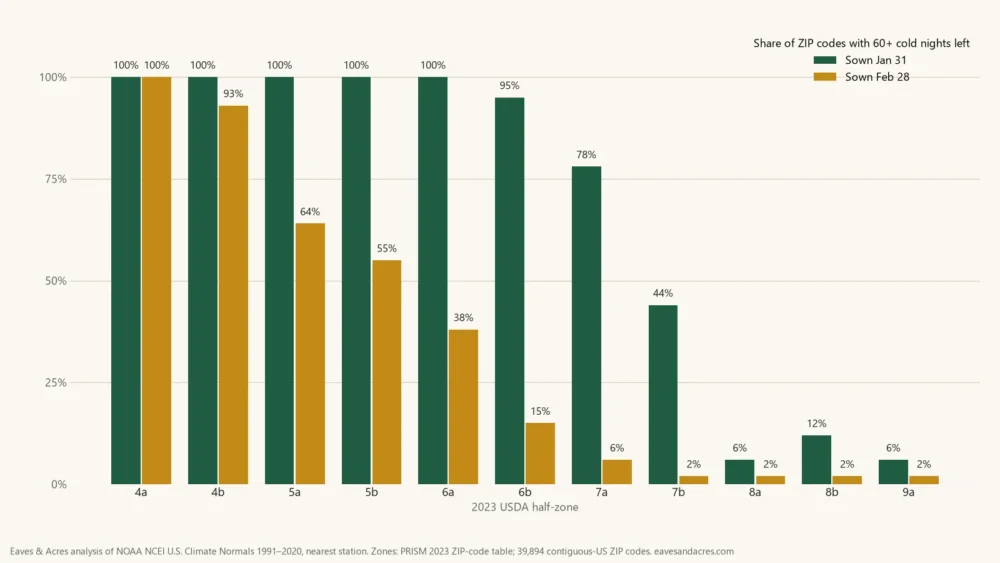
The winter solstice, another common start date, leaves 60 cold nights in every half-zone through 8a, but in 72% of 8b and 22% of 9a ZIP codes. Hardiness zones measure the coldest night of the year, not how many cold nights there are.3 Seattle is zone 9a, yet it averages 125 cold nights; Dallas, in 8b, has 48. See planting zone vs. frost date and what changed on the 2023 zone map.
Which seeds to winter sow
Penn State suggests looking for catalog terms such as “self-sows”, “hardy” or “requires stratification”.4 Many native perennials need cold, but not all. Prairie Moon Nursery’s germination codes for common species:
| Plant | Code | What it means |
|---|---|---|
| Butterfly weed (Asclepias tuberosa) | C(30) | 30 days cold and moist15 |
| Common milkweed (Asclepias syriaca) | C(30) | 30 days cold and moist16 |
| Black-eyed Susan (Rudbeckia hirta) | C(30) | 30 days cold and moist17 |
| Foxglove beardtongue (Penstemon digitalis) | C(30) | 30 days cold and moist18 |
| Dense blazing star (Liatris spicata) | C(60) | 60 days cold and moist19 |
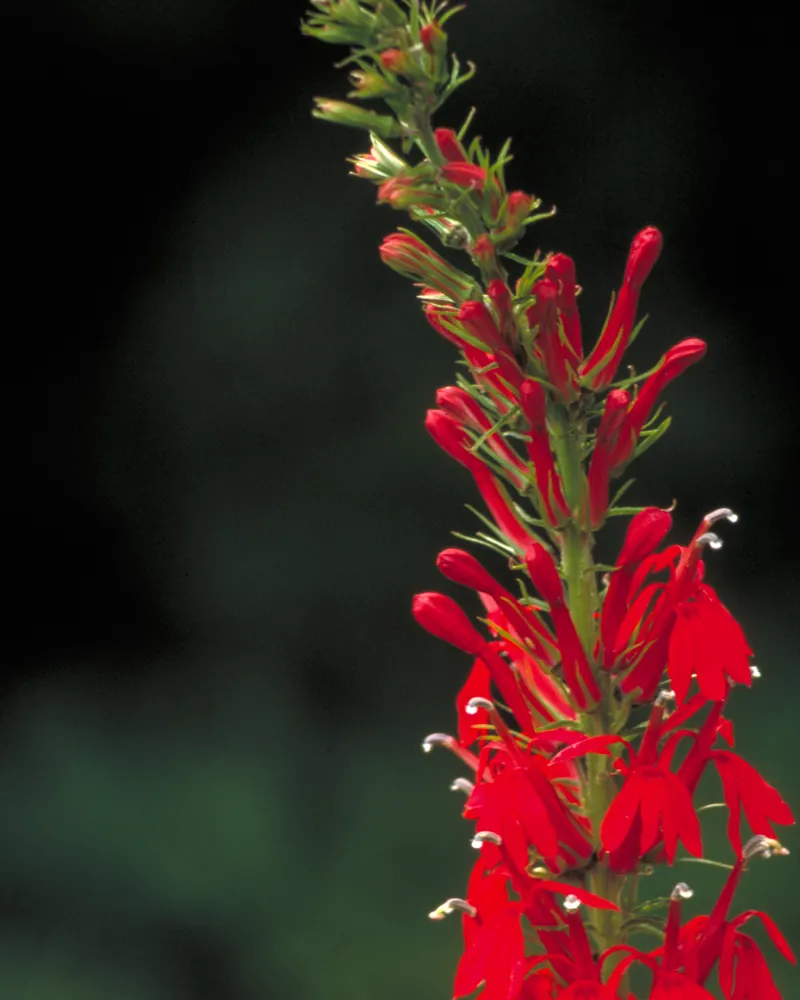
| Cardinal flower (Lobelia cardinalis) | C(60), D | 60 days cold and moist; tiny seed, sow on the surface20 |
| Nodding onion (Allium cernuum) | C(60) | 60 days cold and moist21 |
| Purple coneflower (Echinacea purpurea) | A | No pre-treatment needed22 |
| Wild bergamot (Monarda fistulosa) | A | No pre-treatment needed23 |
Brandywine Conservancy in Pennsylvania gives the same 60 days for nodding onion and 30 for milkweeds.11 Purple coneflower is a useful surprise: Google’s AI Overview and the Maryland Master Gardeners’ list group it with seeds that need winter’s chill, but Prairie Moon gives it code A. It still winter sows well; the Wild Seed Project sows no-cold seeds outdoors from November to April.12
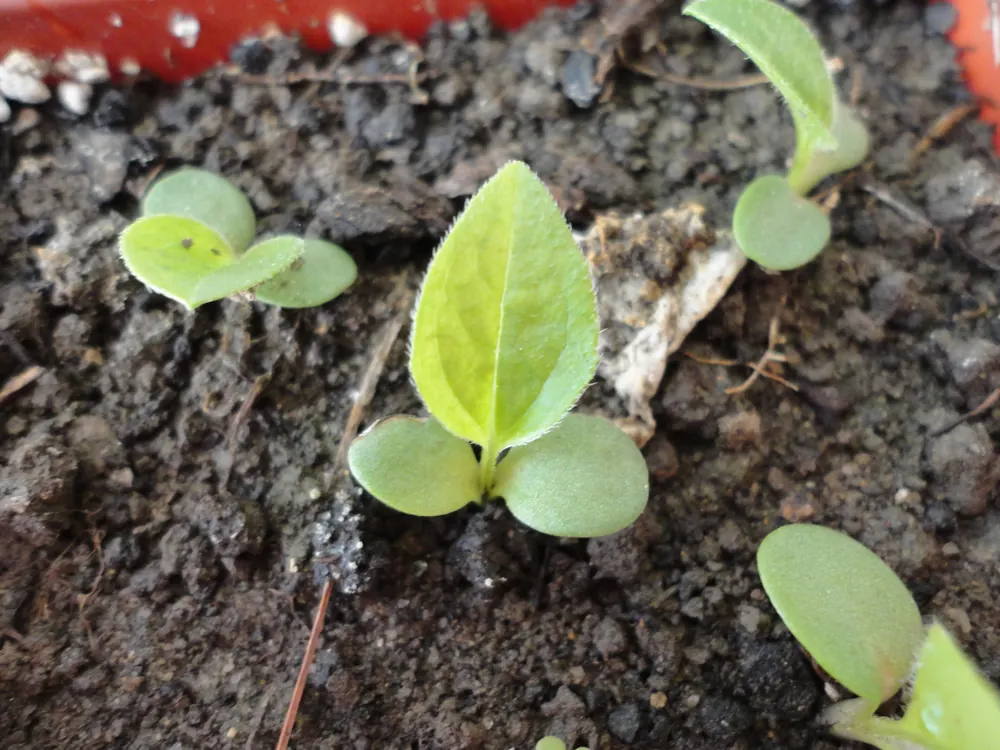
Hardy annuals such as poppies, snapdragons, calendula and bachelor’s buttons do well too, according to Seed Savers Exchange.13 Most vegetables are a different case:
The majority of garden crops do not need nor benefit from cold stratification.
For vegetables, winter sowing is about an early outdoor start, not cold. Root crops are poor candidates because they dislike transplanting, says Hennepin County Master Gardener Theresa Rooney.8
How to winter sow in a milk jug
Prepare the container
Wash a clear or translucent jug, cut it around below the handle, leaving a hinge, and throw away the cap. Make 4 to 6 drainage holes in the bottom.5 Penn State warns that without drainage holes your seeds will drown.4 Freezer bags, salad-green boxes, takeout trays and 2-liter bottles also work.5,9
Add moist mix and sow
Fill the base with 3 to 4 inches of damp potting mix, not garden soil; natives and perennials need at least 4 inches for roots.5,11 Sow one kind of seed per container at the depth on the packet. Press tiny seeds, and those that need light, onto the surface.7,10 Space seeds about 2 inches apart if you want to separate them later.9
Label, tape and set outside
Label the jug outside and inside, since markers fade over winter. Tape it shut and set it in winter sun, out of strong wind, where rain and snow can reach it, not on a covered porch.4,5,6 Snow around the jugs helps insulate them.7
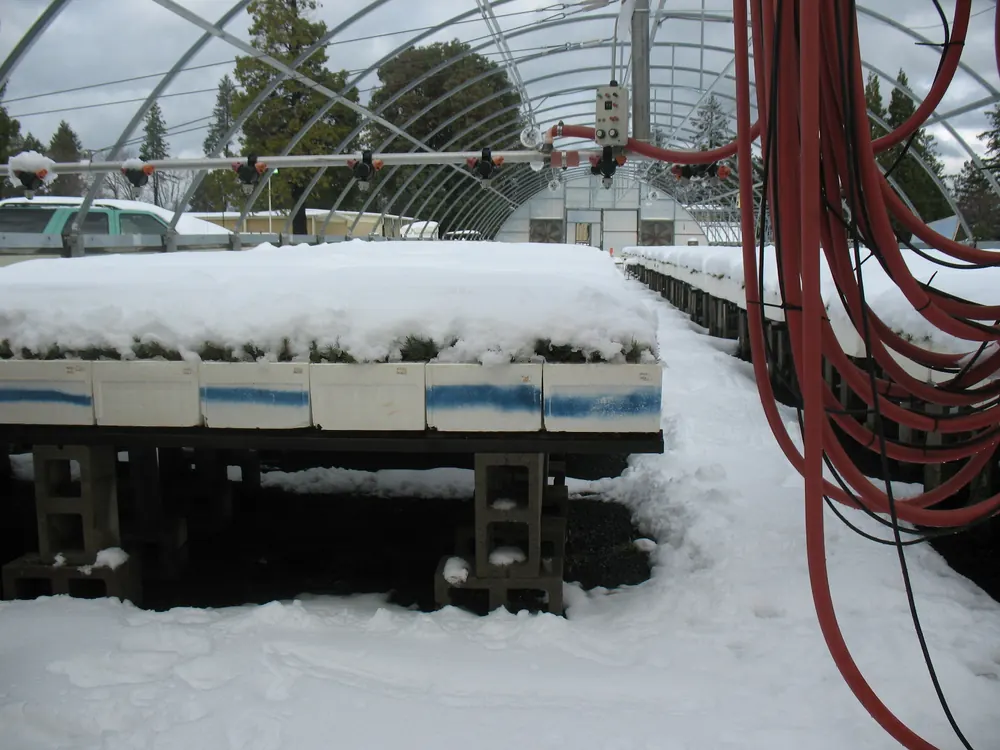
Container seedlings under snow at a USDA Forest Service nursery in California. Snow insulates containers left outside. Photo: USDA Forest Service, Pacific Southwest Region, public domain, via Wikimedia Commons (cropped).
Leave it, checking occasionally for condensation inside; water only if the mix dries out.5,9
Spring care and planting out
Once seedlings appear, open the containers on sunny days and close them at dusk, Illinois Extension advises.6 Maryland’s Master Gardeners move them to shade in a sudden heat spell and cover them with a sheet or row cover if a freeze is forecast. Transplant after at least two true leaves, opening the containers for two or three days first; thick sowings can be cut apart “brownie-style”.5
Winter sowing does not change your planting dates. Cool crops such as broccoli go out about two weeks before your median last frost. Tender crops wait until frost risk is down to one year in ten and nights average 50°F, the rule our tomato planting guide tested.1
Maryland’s Master Gardeners told one tomato story: sown in a jug on March 3, 2021, planted out April 12 and covered with cloches on April 21 when a freeze was forecast.5 For La Plata, the nearest NOAA station, 15 miles away, puts the median last frost at Apr 17, the 10% date at May 2 and 50°F nights at May 9, so that planting was early and needed the cover. See what the 10% and 50% frost dates mean.
Expect tender crops to lag. A Fairfax Master Gardener’s January-sown tomatoes sprouted only in May, smaller than indoor ones, though they caught up.9 A Mother Earth News reader contributor in Virginia starts summer crops indoors because winter-sown tomatoes stay “too small”, but sows cool crops straight into straw-covered beds in February.14
Winter sowing where winters are mild
Across the lower 48 states, 12.5% of ZIP codes average fewer than 30 cold nights a winter. Most are in zones 9 and 10: 55% of zone 9a ZIP codes and 72% of 9b.1,2 There, seeds that need cold won’t get it in a jug.
Seed Savers Exchange suggests the refrigerator: seeds in a damp medium in a sealed, labeled bag for 4 to 12 weeks before you would normally sow.13 Prairie Moon gives 33–40°F for this step.10 Seeds that need no cold can go in at their usual local time; for fall and winter crops, see our fall vegetable planting dates.
Next step: find your ZIP code’s frost dates in our frost date lookup, then count back for anything you start indoors with our seed-starting guides.
Frequently asked questions
From December for seeds that need cold; Illinois Extension waits for January or February so a warm spell can’t sprout them early. The last start matters more: leave about 60 nights at 40°F or colder for a 60-day seed.
Native perennials that need cold, such as milkweeds, liatris and cardinal flower; hardy annuals such as poppies and snapdragons; and cold-tolerant greens such as spinach and kale.
Root crops, which dislike being transplanted, and frost-tender plants sown too early. Sow tomatoes, peppers, squash and zinnias in March or April instead, as Penn State, Illinois and Maryland Extension advise.
No drainage holes, containers under a roof where rain and snow can’t reach, garden soil instead of potting mix, sowing too thickly, and not opening jugs on warm spring days.
Yes. Prairie Moon Nursery suggests surface-sowing seeds that need cold outdoors in late fall on bare, weed-free ground. A Mother Earth News contributor in Virginia sows cool crops into straw-covered beds in February.
Yes. Maryland Extension Master Gardeners list baggies among usable containers, and Nashville PBS’s Volunteer Gardener shows a gallon freezer-bag method.
Not for seeds that need no cold or for tender crops. For cold-needing seeds, check your deadline: 30-day seeds can still go out by about Mar 14 in Columbus, but in Atlanta the 30-day deadline is Feb 1.
No, says Penn State, since they grow outside from the start. Maryland’s Master Gardeners still open containers for two or three days before transplanting.
Sources
- 1.U.S. Climate Normals 1991–2020. NOAA National Centers for Environmental Information, 2021. Used for: normal monthly lows (cold nights), frost probabilities and 50°F-night dates for every ZIP code and city Back to text
- 2.2023 USDA Plant Hardiness Zone Map, ZIP-code table. PRISM Climate Group, Oregon State University, for USDA ARS, 2023. Used for: 2023 zone for every ZIP code in the tables and the zone test Back to text
- 3.USDA Plant Hardiness Zone Map. USDA Agricultural Research Service, 2023. Used for: zones are based on the average annual extreme minimum winter temperature Back to text
- 4.Starting Seeds in Winter, Lori Voll-Wallace. Penn State Extension, 2025. Used for: definition; perennials and hardy annuals December to March, tender plants March or April; drainage, placement, no hardening off Back to text
- 5.All the Dirt on Winter Sowing, Molly Moore and Marlene Smith. University of Maryland Extension, Charles County Master Gardeners, 2021. Used for: sowing waves by month and seed type; containers, mix depth, drain holes, labels, spring care, transplanting; tomato example; Trudi Davidoff Back to text
- 6.January and February are prime time for winter sowing, Nicole Flowers-Kimmerle. University of Illinois Extension, 2023. Used for: start in January or February; warm-spell risk; frost-tolerant vs frost-sensitive seeds; venting Back to text
- 7.Winter Sowing Native Wildflower Seed, Lisa A. Johnson. University of Wisconsin–Madison Extension, Dane County, 2026. Used for: stratification days on the packet; longer cold is fine; light-needing seeds; jug method; snow insulation Back to text
- 8.Winter Sowing in Minnesota!, Theresa Rooney. Hennepin County Master Gardeners (University of Minnesota Extension), 2013. Used for: sow from January on; root crops and frost-sensitive seeds Back to text
- 9.Sow Your Seeds Outdoors in Winter, Marsha Goldberg. Fairfax Master Gardeners, 2022. Used for: containers; condensation; spacing seeds; January-sown tomatoes sprouted in May Back to text
- 10.How to Germinate Native Seeds. Prairie Moon Nursery, n.d. Used for: germination codes; cold, moist stratification at 33–40°F; surface sowing; fall sowing outdoors Back to text
- 11.Winter Sowing with Native Plant Seeds, Melissa Reckner. Brandywine Conservancy and Museum of Art, 2024. Used for: 60 days for nodding onion, 30 for milkweeds; freeze-thaw cycles; potting mix, not garden soil Back to text
- 12.How to Sow Native Seeds in Fall and Winter. Wild Seed Project, n.d. Used for: cold-needing seeds November to February in the Northeast; no-cold seeds November to April Back to text
- 13.How to Sow Seeds in Winter, Sara Friedl-Putnam. Seed Savers Exchange, 2025. Used for: hardy annuals to winter sow; most garden crops need no stratification; refrigerator method for warm climates Back to text
- 14.Winter Sowing Vegetables and Other Crops, Sheryl Campbell (reader contribution). Mother Earth News, 2026. Used for: direct sowing in February in zone 6b Virginia; winter-sown tomatoes too small Back to text
- 15.Butterfly Weed (Asclepias tuberosa). Prairie Moon Nursery, n.d. Used for: germination code C(30) Back to text
- 16.Common Milkweed (Asclepias syriaca). Prairie Moon Nursery, n.d. Used for: germination code C(30) Back to text
- 17.Black-Eyed Susan (Rudbeckia hirta). Prairie Moon Nursery, n.d. Used for: germination code C(30) Back to text
- 18.Foxglove Beardtongue (Penstemon digitalis). Prairie Moon Nursery, n.d. Used for: germination code C(30) Back to text
- 19.Dense Blazing Star (Liatris spicata). Prairie Moon Nursery, n.d. Used for: germination code C(60) Back to text
- 20.Cardinal Flower (Lobelia cardinalis). Prairie Moon Nursery, n.d. Used for: germination code C(60), D Back to text
- 21.Nodding Onion (Allium cernuum). Prairie Moon Nursery, n.d. Used for: germination code C(60) Back to text
- 22.Purple Coneflower (Echinacea purpurea). Prairie Moon Nursery, n.d. Used for: germination code A Back to text
- 23.Wild Bergamot (Monarda fistulosa). Prairie Moon Nursery, n.d. Used for: germination code A Back to text
- 24.Winter Sowing (video). Volunteer Gardener, Nashville PBS, 2026. Used for: freezer-bag winter sowing method (embedded video)
- 25.Photo: Butterfly milkweed seeds, Courtney Celley/USFWS (public domain). Wikimedia Commons, 2026. Used for: hero photo
- 26.Photo: Echinacea purpurea seedling, PhytoplanktonSandwich (CC0). Wikimedia Commons, 2012. Used for: coneflower seedling photo
- 27.Photo: Cardinal flower (Lobelia cardinalis), Thomas G. Barnes/USFWS (public domain). Wikimedia Commons, n.d. Used for: cardinal flower photo
- 28.Photo: Seedlings covered in snow, USDA Forest Service Pacific Southwest Region (public domain). Wikimedia Commons, 2009. Used for: container seedlings under snow
.jpg)

.jpg)
.jpg)
How this guide was made
- Written by the Yard & Garden Desk and reviewed by the Data & Methodology Desk.
- Data: cold nights (normal daily low of 40°F or colder, the top of Prairie Moon Nursery’s 33–40°F stratification range), median and 10% last-frost dates and 50°F-night dates from NOAA NCEI U.S. Climate Normals 1991–2020 for the station nearest each ZIP code, interpolated to daily values with the same method as our tulip and daffodil guides; planting-out dates use the method of our seed-starting guide; USDA 2023 hardiness zones from the PRISM Climate Group ZIP-code table; sowing months, seed choices and container steps from Penn State, UMD, Illinois and UW–Madison Extension, Hennepin County and Fairfax Master Gardeners, Brandywine Conservancy, the Wild Seed Project, Seed Savers Exchange and Prairie Moon Nursery. Normals are air temperatures for a typical winter, not the soil in a container. See our methodology.
- AI use: AI tools help us research, draft and check this guide. Every figure is checked against the source cited for it, and calculated figures come from our own code, described on the methodology page.
- Spotted an error? Tell us — the form opens with this page’s address filled in.
Change log
- Oct 7, 2026Re-checked the Penn State, Maryland, Illinois and Seed Savers Exchange guidance and quotes against the live pages; eight of the Prairie Moon Nursery source links updated to their current addresses, and Liatris spicata now carries Prairie Moon's current common name, dense blazing star.
- Oct 6, 2026Published. Winter sowing timing read from Penn State, UMD, Illinois, UW–Madison, Hennepin County and Fairfax Master Gardeners, Brandywine Conservancy, the Wild Seed Project, Seed Savers Exchange and Prairie Moon Nursery; cold nights and 30- and 60-day deadlines computed from NOAA 1991–2020 normals for 22 cities and every ZIP code in PRISM’s 2023 zone table; planting-out dates use the same method as our seed-starting guide.
Covers lawns, gardens, frost and planting. We write the guides and maintain the tools that tell you when to seed, feed and plant for your ZIP.
Keep reading
When to Start Seeds Indoors: Crop Chart and City Dates
Count back from the day each crop goes outside, not from the last frost. A sourced crop chart plus seed-starting dates for 20 US cities from NOAA normals.
When to Plant Onions: Fall in the South, Spring in the North
Plant onion sets and transplants in the four weeks before your last frost, or in fall and winter in the Deep South. Dates for 27 cities and the onion type for every ZIP code's latitude.
When to Plant Wildflower Seeds: Fall, Winter and Spring Dates Where You Live
Most native wildflower seed does best sown in late fall or winter. Dormant-sowing dates for 24 US cities from NOAA hard-freeze normals, two common rules tested, and published calendars from Minnesota to Texas and Florida.
Seasonal reminders for your ZIP
Get a short email when it’s time to overseed, start seeds, open the pool or service your furnace — timed to your climate.