




When to Plant Wildflower Seeds: Fall, Winter and Spring Dates Where You Live
Most native wildflower seed does best sown in late fall or winter. Dormant-sowing dates for 24 US cities from NOAA hard-freeze normals, two common rules tested, and published calendars from Minnesota to Texas and Florida.
- Last reviewed Oct 13, 2026
- 27 cited sources
- 12 min read
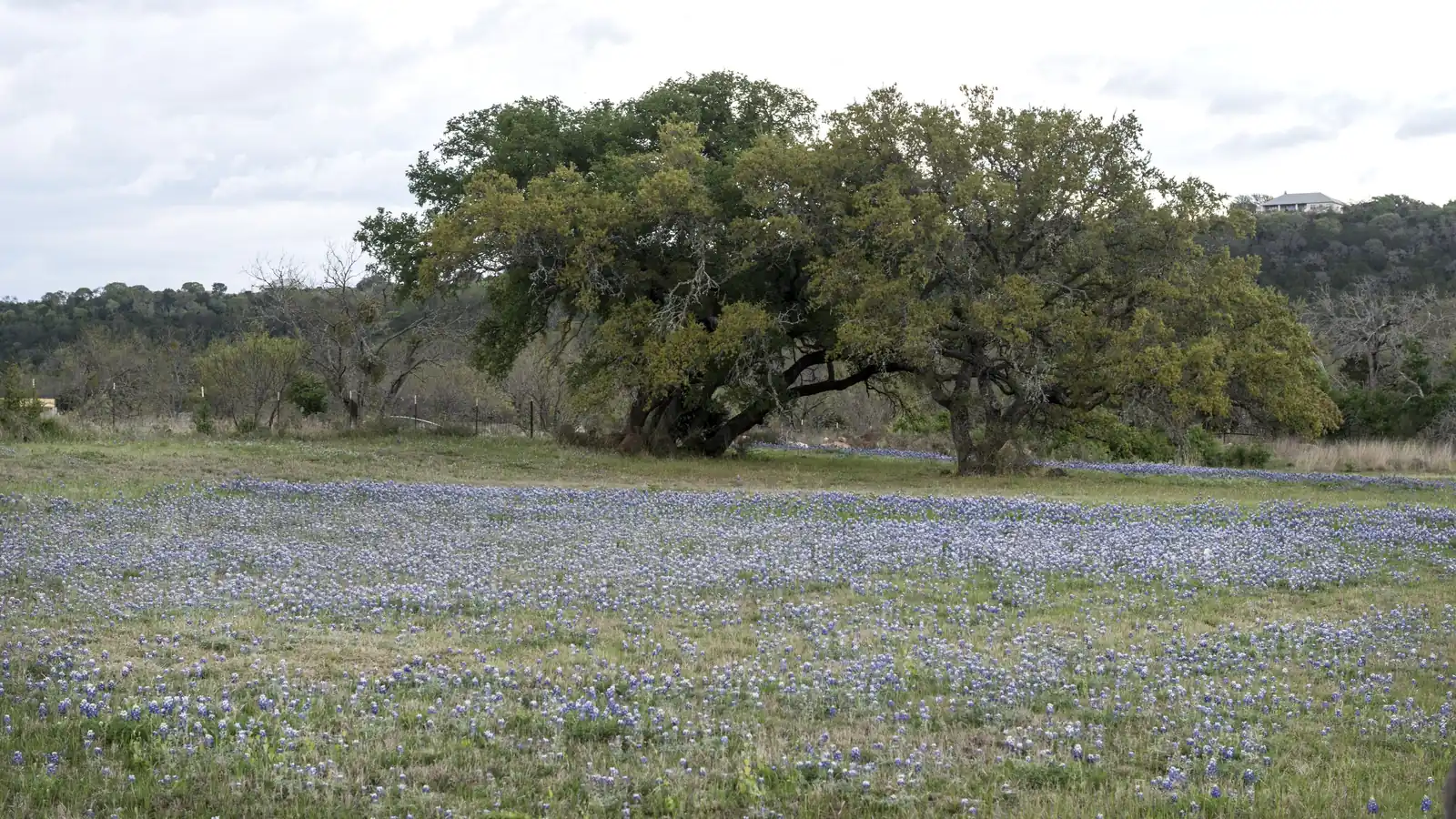
Set your ZIP to see dates for your area.
- 1Most native wildflower seed does best sown in late fall or winter: where winters are cold, after a hard frost and before the ground freezes, so winter breaks its dormancy.
- 2By NOAA normals the first 28°F hard freeze comes about Oct 27 in Minneapolis, Nov 15 in Chicago and Nov 20 in Atlanta; sow 60-day seeds by Feb 24, Feb 10 and Jan 2.
- 3Texas sows September through November, earlier farther north; Florida from mid-September into January by region; Los Angeles from mid-October to late November.
- 4The “zones 7–10: sow 8 weeks before first frost” rule misplaces the switch: dormant sowing still gives 60 cold nights in every ZIP code through zone 8a, and fails only from zone 8b south.
- 5Spring sowing on the last-frost date leaves no cold nights, so cold-needing wildflowers often wait a year to sprout.
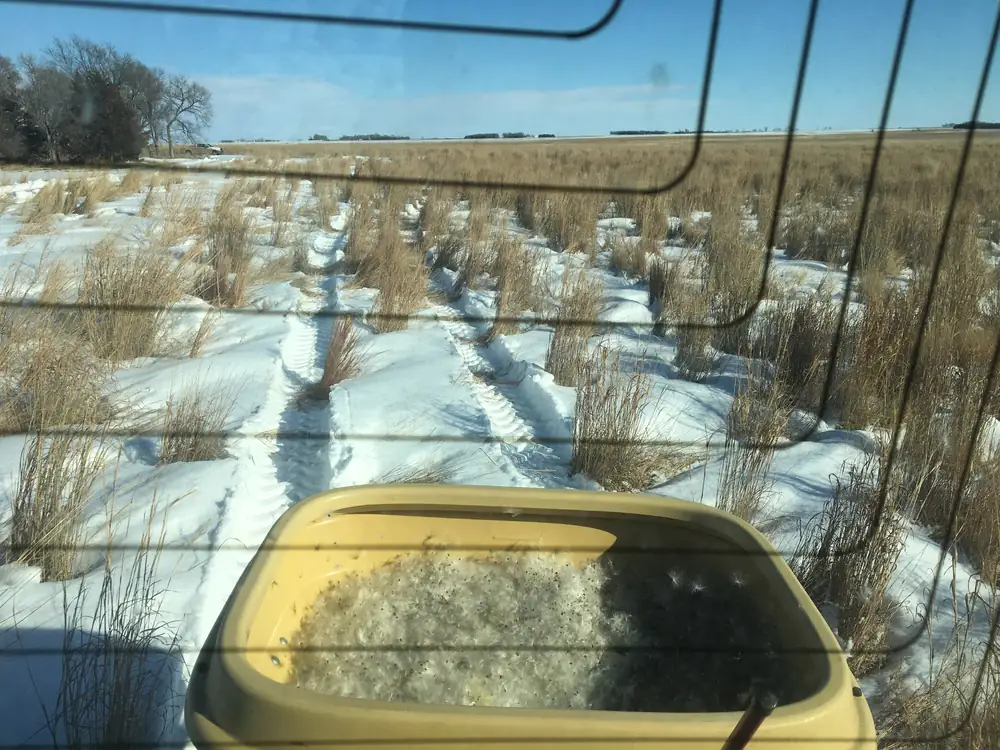
Plant wildflower seeds in late fall or winter in most of the US: where winters are cold, sow after the first hard frost and before the ground freezes, so the seed lies dormant and sprouts in spring. In Texas, Florida and Southern California, sow earlier, from September to November (into January in central and south Florida), so seedlings grow over winter. Spring sowing also works, but seeds that need cold often wait a year to sprout.4,13,17,18
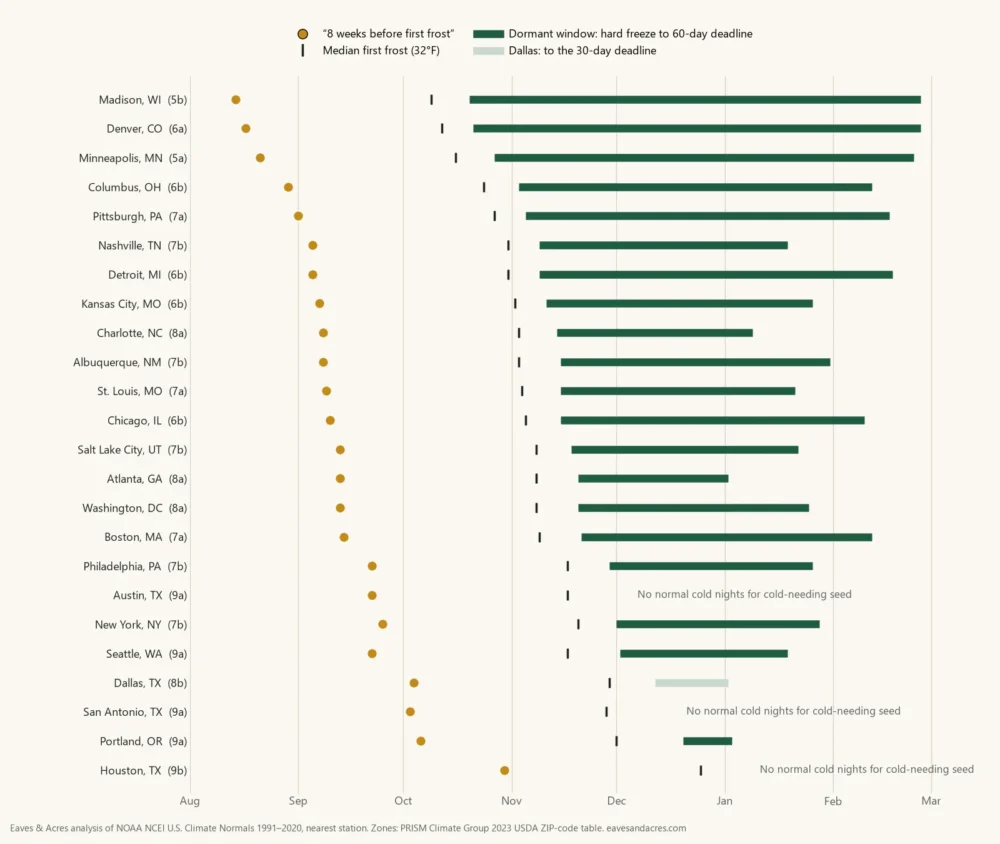
We dated the fall window for 24 cities from NOAA’s 1991–2020 normals. The first 28°F hard freeze, when dormant sowing can start, comes around Oct 27 in Minneapolis, Nov 15 in Chicago and Nov 20 in Atlanta. Seeds that need 60 days of cold must be down by Feb 24, Feb 10 and Jan 2.1 We also tested two common rules against our data, and checked published calendars from seven sources for 14 places.
Dormant, fall or spring: the three sowing seasons
The sources describe three sowing seasons; which one fits depends on your winter:
| Method | When the sources sow | What it does | Drawbacks |
|---|---|---|---|
| Dormant (late fall) | After a hard frost until the ground freezes: from mid-October in the Upper Midwest (Prairie Moon, UMN); Sept 15 to soil freeze (Illinois DNR); late in the season, before the ground freezes entirely (University of Maine)27 | Seed stays dormant; winter breaks dormancy; more wildflowers sprout the first spring | Sown too early, seed can sprout in a warm spell and winter-kill |
| Frost seeding (winter) | Snow-free spells or light snow, until early spring while soils still freeze overnight (Prairie Moon, Xerces) | Freezing and thawing work seed into the soil; no raking or packing | Seed on ice or heavy snow can blow away |
| Active fall (mild winters) | Sept–Nov in Texas (TxDOT, Texas A&M); Sept 1–Oct 20 in South Carolina (NRCS); Sept–Jan by region in Florida; mid-Oct–late Nov in Los Angeles (Theodore Payne) | Seed sprouts with fall rain; seedlings grow through winter for spring bloom | Depends on rain; little natural cold |
| Spring | April–June, best mid-May to mid-June (Prairie Moon); May 15–June 20 (UMN); Mar 1–June 20 (Illinois DNR) | Time to clear weeds first; best for warm-season grasses | Cold-needing wildflowers wait a year; more watering |
Sources: Prairie Moon Nursery,4,6 the University of Minnesota (prairie seed),10 the University of Maine,27 Illinois DNR,11 the Xerces Society,8 TxDOT,13 Texas A&M,14 South Carolina NRCS,15 the Florida Wildflower Foundation17 and the Theodore Payne Foundation.18 Prairie Moon, a Minnesota native-seed nursery, puts it simply:
Late fall (after a hard frost) is the optimal time for outdoor seedings.
Fall works because most native wildflowers need a winter to break dormancy.9 Prairie Moon codes seeds that need cold, moist treatment as C(30) or C(60), for 30 or 60 days, which it gives at 33–40°F in a refrigerator; sown outdoors in late fall, winter does it for you.5 Minnesota’s Board of Water and Soil Resources lists exceptions that need no cold, such as wild bergamot, evening primrose, mountain mint and asters, which can be sown in spring or fall.9 For sowing in covered containers instead of the ground, see our winter sowing guide.
Loads from YouTube (privacy-enhanced mode) only when you press play.
Dormant sowing dates by city
For each city we took two dates from the NOAA station nearest its ZIP code. Dormant sowing opens at the median first hard freeze, 28°F, the National Weather Service’s definition.3 The deadline for seeds that need 60 days of cold is the last date that still leaves 60 nights at 40°F or colder before spring, counted exactly as in our winter sowing guide, so the two pages agree.1,5
| City (ZIP) | 2023 zone | “8 weeks before first frost” (normal high) | Median first frost | Dormant sowing opens (hard freeze) | Last sowing, 60-day seeds | Cold nights per winter |
|---|---|---|---|---|---|---|
| Madison, WI (53703) | 5b | Aug 14 (81°F) | Oct 9 | Oct 20 | Feb 26 | 195 |
| Denver, CO (80202) | 6a | Aug 17 (89°F) | Oct 12 | Oct 21 | Feb 26 | 199 |
| Minneapolis, MN (55401) | 5a | Aug 21 (78°F) | Oct 16 | Oct 27 | Feb 24 | 190 |
| Columbus, OH (43215) | 6b | Aug 29 (81°F) | Oct 24 | Nov 3 | Feb 12 | 169 |
| Pittsburgh, PA (15222) | 7a | Sep 1 (81°F) | Oct 27 | Nov 5 | Feb 17 | 174 |
| Detroit, MI (48201) | 6b | Sep 5 (77°F) | Oct 31 | Nov 9 | Feb 18 | 171 |
| Nashville, TN (37201) | 7b | Sep 5 (85°F) | Oct 31 | Nov 9 | Jan 19 | 134 |
| Kansas City, MO (64105) | 6b | Sep 7 (83°F) | Nov 2 | Nov 11 | Jan 26 | 141 |
| Charlotte, NC (28202) | 8a | Sep 8 (84°F) | Nov 3 | Nov 14 | Jan 9 | 115 |
| Chicago, IL (60601) | 6b | Sep 10 (77°F) | Nov 5 | Nov 15 | Feb 10 | 160 |
| St. Louis, MO (63101) | 7a | Sep 9 (83°F) | Nov 4 | Nov 15 | Jan 21 | 129 |
| Albuquerque, NM (87102) | 7b | Sep 8 (84°F) | Nov 3 | Nov 15 | Jan 31 | 152 |
| Salt Lake City, UT (84101) | 7b | Sep 13 (80°F) | Nov 8 | Nov 18 | Jan 22 | 138 |
| Washington, DC (20001) | 8a | Sep 13 (82°F) | Nov 8 | Nov 20 | Jan 25 | 134 |
| Atlanta, GA (30303) | 8a | Sep 13 (84°F) | Nov 8 | Nov 20 | Jan 2 | 103 |
| Boston, MA (02108) | 7a | Sep 14 (73°F) | Nov 9 | Nov 21 | Feb 12 | 155 |
| Philadelphia, PA (19103) | 7b | Sep 22 (77°F) | Nov 17 | Nov 29 | Jan 26 | 127 |
| New York, NY (10001) | 7b | Sep 25 (72°F) | Nov 20 | Dec 1 | Jan 28 | 126 |
| Austin, TX (78701) | 9a | Sep 22 (89°F) | Nov 17 | Dec 1 | No cold nights | 0 |
| Seattle, WA (98101) | 9a | Sep 22 (69°F) | Nov 17 | Dec 2 | Jan 19 | 125 |
| Dallas, TX (75201) | 8b | Oct 4 (83°F) | Nov 29 | Dec 12 | 30-day seeds by Jan 2 | 48 |
| San Antonio, TX (78205) | 9a | Oct 3 (85°F) | Nov 28 | Dec 15 | No cold nights | 0 |
| Portland, OR (97204) | 9a | Oct 6 (66°F) | Dec 1 | Dec 20 | Jan 3 | 97 |
| Houston, TX (77002) | 9b | Oct 30 (77°F) | Dec 25 | Jan 5 | No cold nights | 0 |
The window shrinks to the south. Minneapolis opens Oct 27 and runs to Feb 24, about four months; Atlanta opens Nov 20 and closes for 60-day seeds Jan 2; Portland, Oregon, gets two weeks. Dallas averages 48 cold nights, enough only for 30-day seeds, and Austin, San Antonio and Houston have no normal night at 40°F or colder, so seed sown there gets little natural cold; Texas sources sow from September instead (below). Gardens far from a station can differ, so look up your own frost and hard-freeze dates.
Two common rules, tested
“Sow after a killing frost”
A killing frost has no fixed temperature, as our frost vs. freeze guide explains, and the advice varies: after two or three killing frosts, after the first few, or after a hard frost.19,20,4 Across 36,955 ZIP codes, the median hard freeze follows the median first 32°F frost by 11 days (middle 80%: 9–15 days).1 Either way, the goal is seed that stays dormant: Prairie Moon warns that grass seed sown before mid-October in the Upper Midwest can sprout within ten days in warm weather and be winter-killed.6
“Sow 8 weeks before your first frost” in zones 7–10
The National Garden Bureau advises an active fall sowing at least 8 weeks before the first frost in mild-winter zones 7 to 10, and a dormant sowing in zones 1 to 6; American Meadows gives the same two-month rule for warm climates, and Google’s AI Overview repeats the split.20,19
In the 13 cities in zones 7 to 9 outside Texas, eight weeks before the median first frost falls between Sep 1 and Oct 6, with normal highs of 66–85°F: an active sowing like South Carolina’s. That can work, but the zone line misplaces the switch. A sowing on the median hard-freeze date still gets 60 cold nights in 100% of ZIP codes through zone 8a, 86% of 8b, 28% of 9a and 8% of 9b.1,2 In 38% of 9b and 95% of 10a ZIP codes there is no normal hard freeze to wait for.
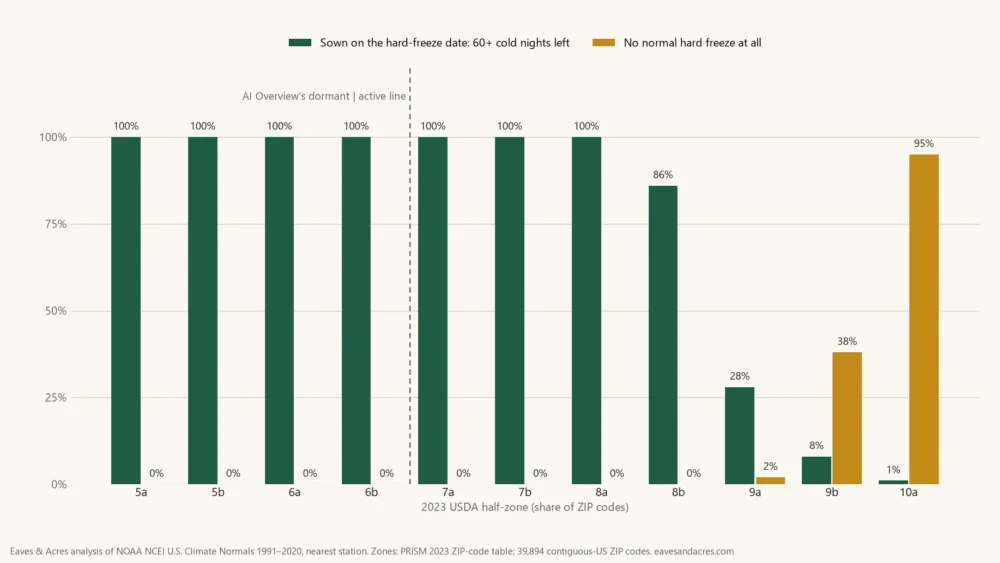
Hardiness zones measure the coldest night of the year, not the length of winter, so a zone can’t date this.21 To check yours, use our zone lookup by ZIP code.
Published calendars against the NOAA dates
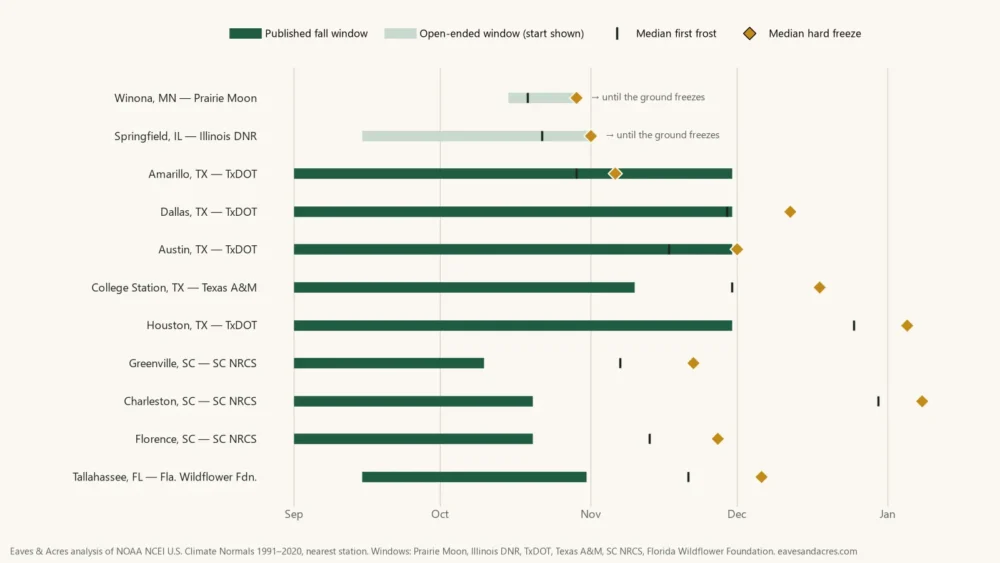
We checked published fall windows from seven sources against the NOAA dates for 14 places they cover:
| Place (source) | Published fall window | Median first frost | Median hard freeze | How they line up |
|---|---|---|---|---|
| Winona, MN (Prairie Moon Nursery) | From mid-Oct (sow late Oct–Mar) | Oct 19 | Oct 29 | Starts 4 days before first frost, 14 days before hard freeze |
| Springfield, IL (Illinois DNR) | Sep 15 until the soil freezes | Oct 22 | Nov 1 | Starts 37 days before first frost, 47 days before hard freeze |
| Amarillo, TX (TxDOT) | Sep 1 – Nov 30 | Oct 29 | Nov 6 | Starts 58 days before first frost, ends 32 days after first frost, 24 days after hard freeze |
| Dallas, TX (TxDOT) | Sep 1 – Nov 30 | Nov 29 | Dec 12 | Starts 89 days before first frost, ends 1 day after first frost, 12 days before hard freeze |
| Austin, TX (TxDOT) | Sep 1 – Nov 30 | Nov 17 | Dec 1 | Starts 77 days before first frost, ends 13 days after first frost, 1 day before hard freeze |
| College Station, TX (Texas A&M) | Sep, Oct or early Nov | Nov 30 | Dec 18 | Starts 90 days before first frost, ends 20 days before first frost, 38 days before hard freeze |
| Houston, TX (TxDOT) | Sep 1 – Nov 30 | Dec 25 | Jan 5 | Starts 115 days before first frost, ends 25 days before first frost, 36 days before hard freeze |
| Greenville, SC (SC NRCS, Piedmont) | Sep 1 – Oct 10 | Nov 7 | Nov 22 | Starts 67 days before first frost, ends 28 days before first frost, 43 days before hard freeze |
| Charleston, SC (SC NRCS, Coastal Plain) | Sep 1 – Oct 20 | Dec 30 | Jan 8 | Starts 120 days before first frost, ends 71 days before first frost, 80 days before hard freeze |
| Florence, SC (SC NRCS, Coastal Plain) | Sep 1 – Oct 20 | Nov 13 | Nov 27 | Starts 73 days before first frost, ends 24 days before first frost, 38 days before hard freeze |
| Tallahassee, FL (Florida Wildflower Foundation, north) | Mid-Sep – late Oct | Nov 21 | Dec 6 | Starts 67 days before first frost, ends 21 days before first frost, 36 days before hard freeze |
| Orlando, FL (Florida Wildflower Foundation, central) | Mid-Oct – early Jan | — | — | No normal frost; window set by soil warmth and rain |
| Miami, FL (Florida Wildflower Foundation, south) | Nov – mid-Jan | — | — | No normal frost; window set by soil warmth and rain |
| Sun Valley, CA (Theodore Payne Foundation) | Mid-Oct – late Nov | — | — | No normal frost; sown ahead of the fall rains |
None of these windows waits for a killing frost. Prairie Moon’s mid-October start comes closest, 4 days before Winona’s median first frost and 14 before its hard freeze; Illinois DNR starts September 15, 37 days before Springfield’s first frost, and says the seeds won’t sprout until spring.6,11 In the South, agencies aim to finish before frost. South Carolina NRCS wants fall planting done at least six weeks before hard-freezing weather, by October 10 in the Piedmont; Greenville’s median hard freeze comes 43 days later, a match.15
Texas, Florida and California
TxDOT sows from September 1 through the end of November for most of Texas, and bluebonnets in late summer or early fall.13 That window closes 1 day after Dallas’s median first frost but 24 days after Amarillo’s hard freeze, and Texas A&M’s Michael Arnold adds:
The farther north you are in Texas, then the earlier you should plant.
Florida’s windows run mid-September to late October in the north, mid-October to early January in central Florida and November to mid-January in the south, set by soil warmth and rain rather than frost; germination drops as soil cools below the mid-60s.17 Orlando and Miami have no normal frost. In Los Angeles, the Theodore Payne Foundation sows annual wildflowers from mid-October through late November, so seed sprouts with the fall rains.18 In Colorado, NRCS asks dormant seedings to get at least 45 days of soil at 45°F or colder.16
Spring sowing: what you give up
Sown on the median last-frost date, seed gets a median of 0 cold nights in every hardiness zone, and 9 at most in our 24 cities.1 Seeds that need cold mostly sit out the first summer: Prairie Moon lists a one-year delay for those species, and Illinois DNR says some won’t germinate until the second year.6,11
Spring does give time to clear weeds, and it suits warm-season grasses.6 To sow cold-needing seed in spring, chill it first: Oklahoma State Extension gives four to eight weeks in a moist medium in the refrigerator, and Prairie Moon 33–40°F.12,5 See what a last frost date means.
Site prep, seeding rates and sowing
Prairie Moon, UMN, Illinois DNR and Oklahoma State all start by removing the existing vegetation; Prairie Moon lists smothering, sod removal, repeated shallow tilling or herbicide, and gives a weedy site a full season or two.6,7,10,11,12 TxDOT is the outlier: it says most seed can go on undisturbed soil, with some delay, as long as it touches the soil.13 Follow the label on any herbicide. Rates and carriers vary by source:
| Source | Seeding rate | Carrier | Depth and finishing |
|---|---|---|---|
| UMN Extension | About 30 seeds per sq ft; grasses as low as 20, wildflowers as high as 60 | 1 bushel damp sawdust or peat per 1,000 sq ft | Roll after sowing, when the soil is dry |
| South Carolina NRCS | Pollinator mix: 40 pure live seeds per sq ft (50 if broadcast) | — | No tillage for late-fall forb seed |
| TxDOT | 20 seeds per sq ft (Soil Conservation Service); figure on pure live seed | — | Tamp or roll lightly |
| Prairie Moon | As labeled for the mix | About 4 gallons filler per 1,000 sq ft | Small seed on the surface; fall and frost seedings need no packing |
| Oklahoma State | — | 3 parts filler to 1 part seed | Tamp lightly; don’t bury |
| Theodore Payne | — | 3 parts horticultural sand to 1 part seed | About 1/8 inch deep |
Pure live seed is purity times germination rate, figures the supplier provides.13 Prairie Moon’s rule of thumb is to sow no deeper than the seed is wide.5 Divide the seed and the area into equal parts and broadcast each part; Prairie Moon compares it to sowing lawn seed.6,7,12 Turf grass is a different crop with its own cue; see dormant seeding a lawn.
What to expect after sowing
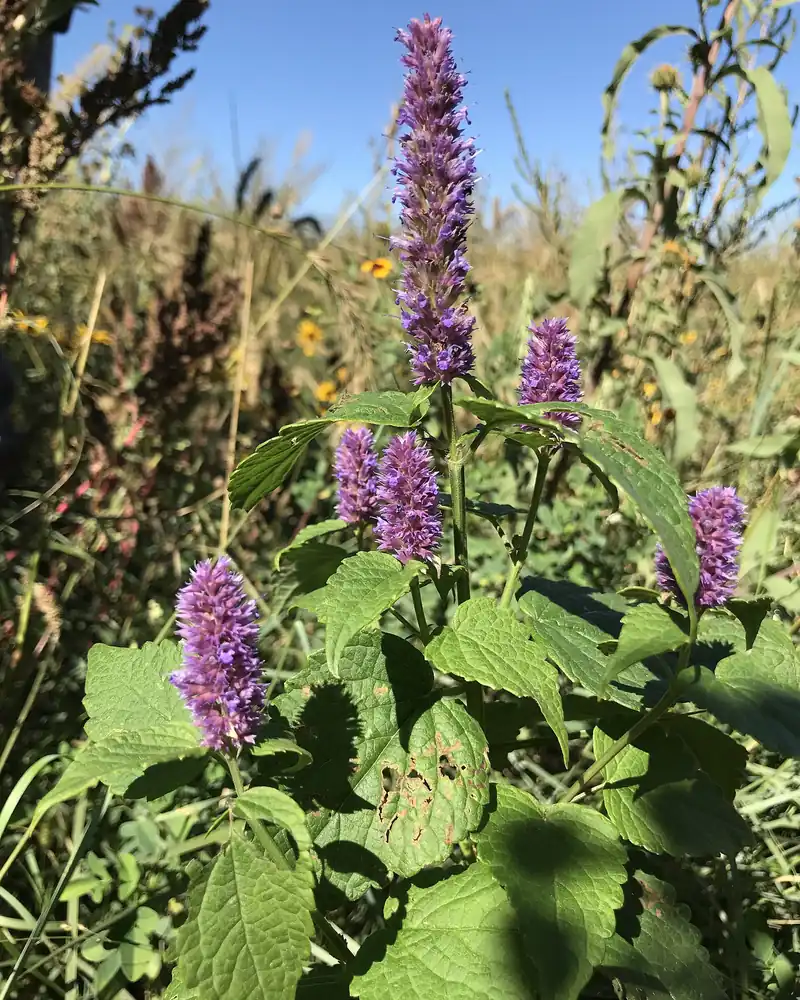
Texas A&M notes that annuals bloom the first year while perennials do better in the second or third.14 Illinois DNR expects most of its native mix to bloom in year two or three, and UMN says seeded wildflowers take two to five years.11,10 First-year weeds outgrow the seedlings, so Prairie Moon mows to 4–5 inches whenever weeds reach 8–10 inches.7
Next step: find your ZIP code’s first frost and hard freeze in our frost date lookup, then see our other flower and bulb planting guides.
Frequently asked questions
Only on bare soil. Prairie Moon, UMN, Illinois DNR and Oklahoma State clear existing plants first so seedlings don’t compete with weeds or turf. TxDOT says seed can go on undisturbed ground, with slower results, if it touches the soil.
Dormant sowing runs until the ground freezes, and Prairie Moon frost seeds on snow-free days into early spring. Seeds that need 60 days of cold must be down by about Feb 24 in Minneapolis, Feb 10 in Chicago or Jan 2 in Atlanta.
Perennials do. Annuals return only from the seed they drop; Texas A&M notes that once a seed bank builds up, some annuals come back every year.
Usually not. Prairie Moon uses a hot-water soak only for a few hard-coated species (its code B), and says fall- or winter-sown seed should not be scarified, to avoid early sprouting and winter kill.
Annuals can bloom the first season. Illinois DNR expects most of its native mix to bloom in year two or three, and UMN allows two to five years for seeded wildflowers.
Remove what grows there by smothering, sod removal, repeated shallow tilling or a labeled herbicide, then sow on bare soil and press the seed in.
Most native perennials, since most need a winter to break dormancy, says Minnesota’s BWSR. In Texas, TxDOT sows bluebonnets in late summer or early fall. Wild bergamot, asters and others that need no cold work in spring or fall.
Fall, for most native mixes: Prairie Moon reports more wildflowers sprouting the first year and less watering. Spring suits warm-season grasses and leaves time to clear weeds, but cold-needing species may wait a year.
Sources
- 1.U.S. Climate Normals 1991–2020. NOAA National Centers for Environmental Information, 2021. Used for: median first frost (32°F), hard freeze (28°F) and last frost; normal daily lows (cold nights) and highs for every ZIP code and city Back to text
- 2.2023 USDA Plant Hardiness Zone Map, ZIP-code table. PRISM Climate Group, Oregon State University, for USDA ARS, 2023. Used for: 2023 zone for every ZIP code in the tables and the zone test Back to text
- 3.Glossary: Hard Freeze. NOAA National Weather Service, n.d. Used for: hard freeze = 28°F or lower Back to text
- 4.Frequently Asked Questions. Prairie Moon Nursery, n.d. Used for: late fall after a hard frost is optimal; winter and early spring sowing; no summer sowing; snow and freeze-thaw Back to text
- 5.How to Germinate Native Seeds. Prairie Moon Nursery, n.d. Used for: germination codes; cold, moist stratification at 33–40°F; hot-water soak (code B); no scarifying fall-sown seed; sowing depth Back to text
- 6.Growing Your Prairie. Prairie Moon Nursery, n.d. Used for: fall, frost and spring planting seasons; mid-October start in the Upper Midwest; one-year delay for cold-needing forbs in spring; site preparation; packing Back to text
- 7.Planting Instructions for Hand Sowing Your Native Seed Mix. Prairie Moon Nursery, n.d. Used for: late October to March and April to June sowing; site preparation methods; filler per 1,000 sq ft; sowing depth; first-year mowing Back to text
- 8.Interseeding Wildflowers to Diversify Grasslands for Pollinators, Williams et al.. Xerces Society (hosted by the Minnesota Board of Water and Soil Resources), 2018. Used for: dormant-season seeding; before the ground freezes or early spring while soils freeze overnight; seeding onto snow Back to text
- 9.Pollinator Toolbox – Planting. Minnesota Board of Water and Soil Resources, n.d. Used for: most forbs need a winter to break dormancy; species that need no pre-stratification Back to text
- 10.Planting and maintaining a prairie garden, Mary Meyer and Julie Weisenhorn. University of Minnesota Extension, 2025. Used for: prairie seed May 15–June 20 or mid-October to freezing; 30 seeds per sq ft; carrier; two to five years to bloom Back to text
- 11.Pollinator Wildflower Seed Mix Planting Instructions. Illinois Department of Natural Resources, n.d. Used for: fall from Sept 15 until the soil freezes; spring Mar 1–June 20; second-year germination; bloom in year two or three Back to text
- 12.Wildflower Gardening in Oklahoma (HLA-6464), Andy Fusco and Louis Anella. Oklahoma State University Extension, 2020. Used for: late-fall planting; refrigerator stratification four to eight weeks; three parts filler; site preparation Back to text
- 13.Planting wildflowers. Texas Department of Transportation, Wildflower Program, n.d. Used for: Sept 1 through November for most of Texas; bluebonnets late summer or early fall; 20 seeds per sq ft; pure live seed; seed-to-soil contact Back to text
- 14.When To Plant Wildflower Seeds For Stunning Spring Blooms, Helen White. Texas A&M University (AgriLife), 2024. Used for: Michael Arnold: September, October or early November; earlier farther north; annuals vs perennials Back to text
- 15.Technical Guide – Wildlife Habitat Planting (420). USDA Natural Resources Conservation Service, South Carolina, 2022. Used for: fall planting finished 6 weeks before hard-freezing weather (Oct 10 Piedmont, Oct 20 Coastal Plain); dormant season; 40 PLS per sq ft Back to text
- 16.Plant Materials Technical Note 77: Conservation Cover Establishment, Christine Taliga. USDA Natural Resources Conservation Service, Colorado, 2015. Used for: dormant seedings need at least 45 days of soil at 45°F or below Back to text
- 17.Seeding Dates for Native Wildflowers and Grasses, Jeff Norcini. Florida Wildflower Foundation, 2020. Used for: North, Central and South Florida sowing windows; germination falls as soil cools below the mid-60s Back to text
- 18.Sowing California Native Wild Flowers. Theodore Payne Foundation for Wild Flowers and Native Plants, n.d. Used for: mid-October through late November for annual wildflowers; seed-sand mix; depth Back to text
- 19.How To Grow Wildflower Seeds. American Meadows (seed retailer), 2026. Used for: rules tested: after 2–3 killing frosts in cold climates; at least 2 months before the first frost in warm climates Back to text
- 20.Wildflower Seeds for Fall Planting: Tips and Tricks, Tabar Gifford. National Garden Bureau, 2024. Used for: rule tested: active fall sowing 8 weeks before first frost in zones 7–10, dormant sowing in zones 1–6 Back to text
- 21.USDA Plant Hardiness Zone Map. USDA Agricultural Research Service, 2023. Used for: zones are based on the average annual extreme minimum winter temperature Back to text
- 22.Wildflower meadow seeding (video). Lady Bird Johnson Wildflower Center, 2010. Used for: embedded video: hand-sowing a meadow after a prescribed burn
- 23.Photo: Field of bluebonnets in the Texas Hill Country, near Burnet, Carol M. Highsmith (public domain). Wikimedia Commons / Library of Congress, 2014. Used for: hero photo
- 24.Photo: Broadcasting milkweed seed, Lake Andes NWR, Mick Hanan/USFWS (public domain). Wikimedia Commons, 2017. Used for: frost-seeding photo
- 25.Photo: Anise hyssop on Malm WPA (1st year reconstruction), Krista Lundgren/USFWS (public domain). Wikimedia Commons, 2021. Used for: first-year dormant seeding photo
- 26.Photo: Black-eyed Susan (Rudbeckia hirta), Tom Koerner/USFWS (public domain). Wikimedia Commons, 2009. Used for: black-eyed Susan photo
- 27.Should I plant wildflower seeds prior to winter or in the spring?, Jonathan Foster. University of Maine Cooperative Extension, 2022. Used for: fall sowing late in the season, before the ground freezes entirely; spring sowing needs cold stratification first Back to text
.jpg)
_(51561263617).jpg)
_(13941288943).jpg)
How this guide was made
- Written by the Yard & Garden Desk and reviewed by the Data & Methodology Desk.
- Data: median first 32°F frost, first 28°F hard freeze and last frost dates, normal daily lows and highs from NOAA NCEI U.S. Climate Normals 1991–2020 for the station nearest each ZIP code, interpolated to daily values with the same method as our tulip, daffodil and winter sowing guides; cold nights (normal low of 40°F or colder, the top of Prairie Moon Nursery’s 33–40°F stratification range) and 60-day deadlines computed exactly as in our winter sowing guide; USDA 2023 hardiness zones from the PRISM Climate Group ZIP-code table; sowing seasons, seeding rates and site preparation from Prairie Moon Nursery, the Xerces Society, Minnesota BWSR, UMN and Oklahoma State Extension, Illinois DNR, TxDOT, Texas A&M, USDA NRCS, the Florida Wildflower Foundation and the Theodore Payne Foundation. Normals are air temperatures for a typical year, not soil temperature or a given winter. See our methodology.
- AI use: AI tools help us research, draft and check this guide. Every figure is checked against the source cited for it, and calculated figures come from our own code, described on the methodology page.
- Spotted an error? Tell us — the form opens with this page’s address filled in.
Change log
- Oct 13, 2026Re-checked the Prairie Moon, Texas A&M, TxDOT, Illinois DNR, Minnesota (UMN, BWSR), Oklahoma State, South Carolina and Colorado NRCS, Florida Wildflower Foundation and NWS sources against the live pages (all unchanged); added the University of Maine Cooperative Extension's fall-sowing advice to Table 1 for the Northeast.
- Oct 7, 2026Published. Fall, frost and spring sowing timing read from Prairie Moon Nursery, the Xerces Society, Minnesota BWSR, UMN and Oklahoma State Extension, Illinois DNR, TxDOT, Texas A&M, USDA NRCS (South Carolina and Colorado), the Florida Wildflower Foundation and the Theodore Payne Foundation; dormant-sowing windows computed from NOAA 1991–2020 hard-freeze normals for 24 cities and every ZIP code in PRISM’s 2023 zone table, with 60-day deadlines from the same method as our winter sowing guide; 14 published windows checked against NOAA dates.
Covers lawns, gardens, frost and planting. We write the guides and maintain the tools that tell you when to seed, feed and plant for your ZIP.
Keep reading
When to Plant Daffodil Bulbs: Fall Dates Before Your Hard Freeze
Plant daffodils from when fall nights reach 50°F until your first frost, before the 28°F hard freeze. Dates for 24 cities, checked against nine extension calendars, plus Southern types that need no chilling.
When to Plant Tulip Bulbs: Fall Planting Dates Where You Live
Plant tulips as fall nights cool from 50°F to 40°F, finishing around your first frost. Dates for 24 cities, checked against 16 extension calendars, plus warm-winter chilling.
When to Plant Onions: Fall in the South, Spring in the North
Plant onion sets and transplants in the four weeks before your last frost, or in fall and winter in the Deep South. Dates for 27 cities and the onion type for every ZIP code's latitude.
Seasonal reminders for your ZIP
Get a short email when it’s time to overseed, start seeds, open the pool or service your furnace — timed to your climate.