




When to Plant Tulip Bulbs: Fall Planting Dates Where You Live
Tulips go in as fall nights settle into the 40s and finish around the first frost. Dates for 24 US cities from NOAA normals, checked against 16 extension calendars, and what mild-winter gardeners do instead.
- Last reviewed Oct 4, 2026
- 29 cited sources
- 11 min read
Set your ZIP to see dates for your area.
- 1Plant tulip bulbs in fall, while normal night lows fall from about 50°F to 40°F, and aim to finish around your median first frost.
- 2Examples: Minneapolis Sep 24–Oct 17, Chicago Oct 7–Nov 2, Washington, DC Oct 13–Nov 12, Atlanta Oct 19–Nov 20.
- 3The median first frost falls inside 11 of the 12 published fall bulb-planting calendars we checked against NOAA normals.
- 4Hardiness zone is a poor guide where winters are mild: Seattle and Portland (zone 9a) get 17–19 cool weeks; Austin and Charleston, also 9a, get none.
- 5Where winters are too warm, chill bulbs in the refrigerator first (extension sources give 4 weeks to 4 months) and plant from mid-December to early January.
Plant tulip bulbs in fall, once nights have cooled into the 40s°F and before the ground freezes. In most of the northern US that means late September to mid-October; in the Mid-Atlantic, the lower Midwest and the Pacific Northwest, October into November. Where winters stay mild, as in Texas, Florida, the Gulf Coast and coastal South Carolina, chill the bulbs in the refrigerator first and plant them from mid-December to early January.
We turned that advice into dates. Using NOAA’s 1991–2020 climate normals, we found when typical night lows fall from 50°F to 40°F in 24 cities, then checked those dates against 16 planting calendars published by extension services.1 The median first frost fell inside 11 of the 12 fall calendars. We also counted cold winter days by hardiness zone. In zone 8b, only about 1 in 6 sampled ZIP codes gets the 13 cool weeks tulips need, yet Seattle, in zone 9a, gets 19.
Tulip planting dates for 24 US cities
South Dakota State University Extension gives a planting cue that works almost anywhere in the North. Start planting:
if the nighttime temperatures stay in that 40 to 50-degrees Fahrenheit range
SDSU adds that bulbs should be in the ground four to six weeks before the soil freezes.3 NOAA normals include the average daily low for every month, so we can date the first half of that rule: the day the normal nightly low drops to 50°F, and the day it reaches 40°F, at the weather station nearest each city.1 We can’t date the second half, because the normals contain no soil-freeze data.
| City (ZIP) | Plant tulips (nights 50°F → 40°F) | Median first frost, 32°F |
|---|---|---|
| Madison, WI (53703) | Sep 17 – Oct 14 | Oct 9 |
| Denver, CO (80202) | Sep 17 – Oct 10 | Oct 12 |
| Sioux Falls, SD (57104) | Sep 20 – Oct 11 | Oct 6 |
| Minneapolis, MN (55401) | Sep 24 – Oct 17 | Oct 16 |
| Rochester, NY (14604) | Sep 26 – Oct 26 | Oct 25 |
| Des Moines, IA (50309) | Sep 28 – Oct 23 | Oct 20 |
| Columbus, OH (43215) | Sep 28 – Oct 26 | Oct 24 |
| Pittsburgh, PA (15222) | Sep 28 – Oct 26 | Oct 27 |
| Detroit, MI (48201) | Oct 1 – Oct 30 | Oct 31 |
| Seattle, WA (98101) | Oct 1 – Nov 15 | Nov 17 |
| Chicago, IL (60601) | Oct 7 – Nov 2 | Nov 5 |
| Salt Lake City, UT (84101) | Oct 7 – Nov 5 | Nov 8 |
| Portland, OR (97204) | Oct 7 – Nov 27 | Dec 1 |
| Boston, MA (02108) | Oct 8 – Nov 9 | Nov 9 |
| Nashville, TN (37201) | Oct 9 – Nov 6 | Oct 31 |
| Kansas City, MO (64105) | Oct 12 – Nov 6 | Nov 2 |
| Washington, DC (20001) | Oct 13 – Nov 12 | Nov 8 |
| Oklahoma City, OK (73102) | Oct 14 – Nov 9 | Nov 2 |
| St. Louis, MO (63101) | Oct 15 – Nov 13 | Nov 4 |
| Louisville, KY (40202) | Oct 15 – Nov 10 | Nov 9 |
| Charlotte, NC (28202) | Oct 17 – Nov 15 | Nov 3 |
| Philadelphia, PA (19103) | Oct 19 – Nov 20 | Nov 17 |
| Atlanta, GA (30303) | Oct 19 – Nov 20 | Nov 8 |
| New York, NY (10001) | Oct 20 – Nov 23 | Nov 20 |
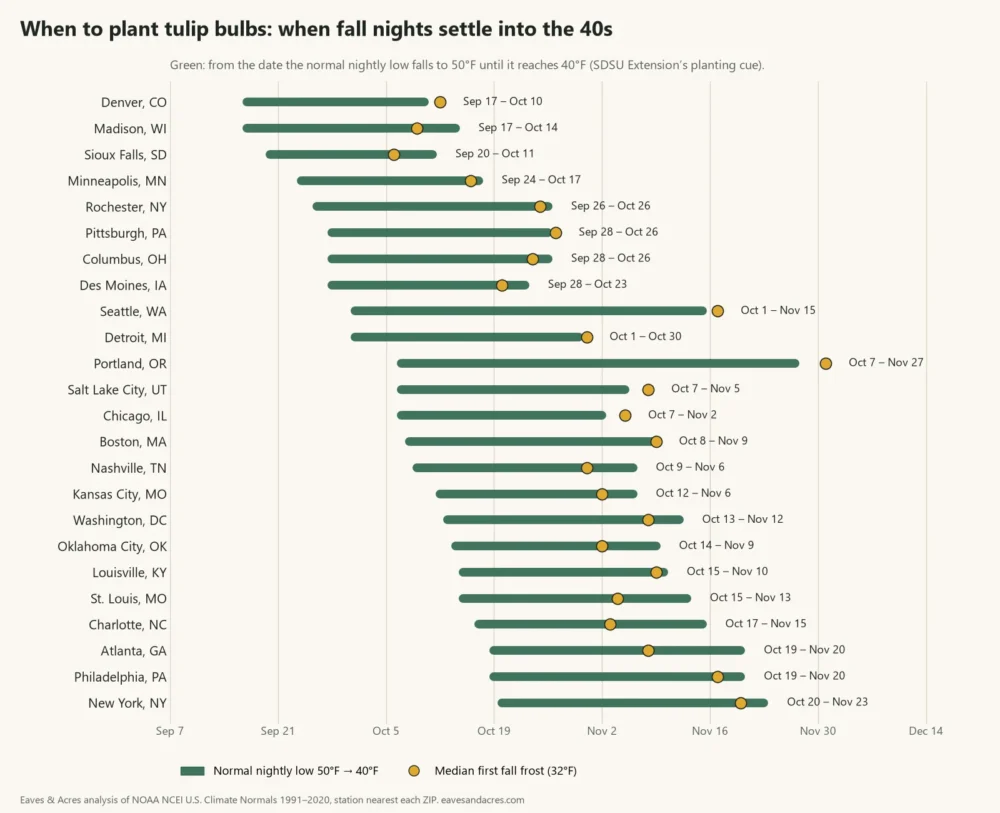
In most cities the median first frost (32°F) falls near the end of the window, within about a week of the 40°F night. One weather station can’t describe a whole metro area, so a valley, hilltop or lakeshore garden can differ by a week or more. For your own ZIP code, look up your first fall frost date and its odds, then aim to finish planting by about that date.
How the dates compare with local extension calendars
We lined up every local tulip or spring-bulb planting window we could find from extension services against the NOAA dates for the same place.5,2,12,13,6,8,10,11,14,15,16,17,18,20
| Place | Published planting window | Nights 50°F → 40°F | Median first frost |
|---|---|---|---|
| St. Paul, MN | Mid-September to mid-October (University of Minnesota) | Sep 20 – Oct 13 | Oct 8 |
| Brookings, SD | Mid-September through mid-October (SDSU Extension) | Sep 9 – Oct 3 | Oct 1 |
| Fort Collins, CO | September and October (Colorado State) | Sep 8 – Oct 6 | Oct 7 |
| Bend, OR | Late September through October (Oregon State, Central Oregon) | by mid-July – Sep 24 | Sep 20 |
| Ames, IA | October (Iowa State) | Sep 20 – Oct 14 | Oct 12 |
| Urbana, IL | Late September through October (Illinois Extension) | Sep 30 – Oct 26 | Oct 24 |
| Rochester, NY | October (Cornell Cooperative Extension, Monroe County) | Sep 26 – Oct 26 | Oct 25 |
| Pittsburgh, PA | September to October, western Pennsylvania (Penn State) | Sep 28 – Oct 26 | Oct 27 |
| College Park, MD | Usually October (University of Maryland) | Oct 8 – Nov 5 | Nov 1 |
| Stillwater, OK | Late September through early November (Oklahoma State) | Oct 13 – Nov 7 | Oct 30 |
| Corvallis, OR | October and November, Western Oregon (Oregon State) | Aug 29 – Oct 30 | Oct 28 |
| Athens, GA | October through late December (UGA Extension) | Oct 21 – Nov 25 | Nov 10 |
| Columbia, SC | Chilled bulbs, November to late December (Clemson HGIC) | Oct 28 – Dec 8 | Nov 16 |
| Charleston, SC | Chilled bulbs, late December or early January (Clemson HGIC) | Nov 30 – never | Dec 30 |
| San Antonio, TX | Chilled bulbs, mid- to late December (Texas A&M AgriLife) | Nov 12 – never | Nov 28 |
| Baton Rouge, LA | Chilled bulbs, late December or early January (LSU AgCenter) | Nov 7 – never | Nov 26 |
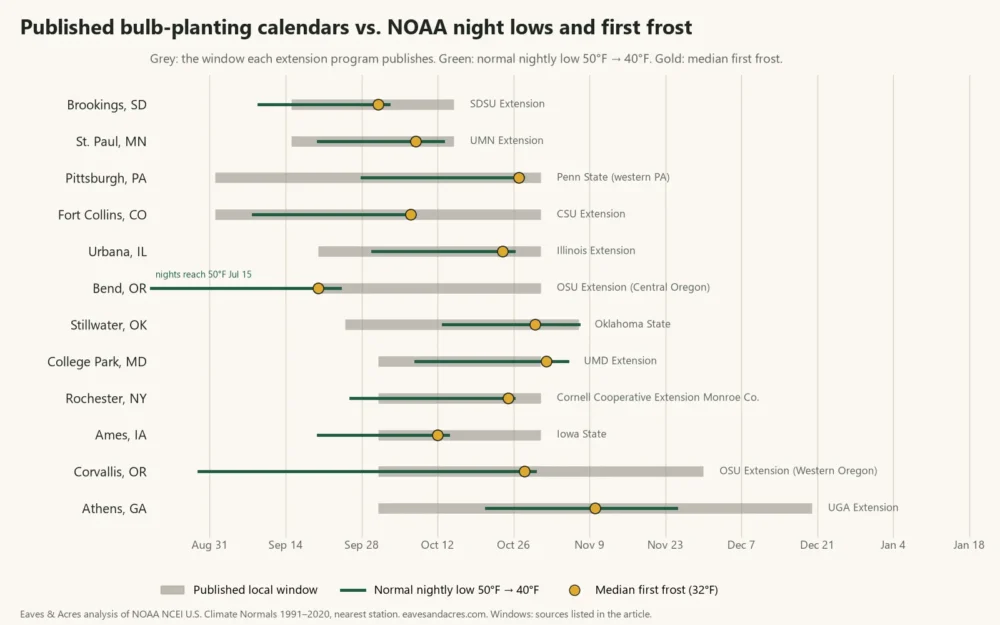
Three patterns stand out across the 12 fall calendars. The median first frost falls inside 11 of them; Maryland’s October window ends one day before it. The date nights reach 40°F also falls inside 11 of the 12. And the published windows open a median 6 days before nights reach 50°F and close a median 8 to 9 days after they reach 40°F, so the green bars in the chart are a slightly conservative version of what extension services advise.
The night-temperature cue fails in two places, both in Oregon. In Bend, on the high desert, normal lows drop to 50°F by mid-July, and in Corvallis by late August, months before anyone plants bulbs there. Where nights cool early, anchor on the first frost instead: Oregon State’s windows contain the median first frost in both places.13
Soil temperature: the cue we can’t map
Clemson’s Home & Garden Information Center says to wait until the soil at planting depth stays below 60°F,17 and University of Wisconsin–Madison Extension says bulbs can go in when ground temperatures drop to around 50–55°F.24 NOAA climate normals don’t include soil temperature, so we don’t estimate a soil date. If you want to use this rule, push a soil thermometer to bulb depth, 6 to 8 inches, on a few mornings in a row.
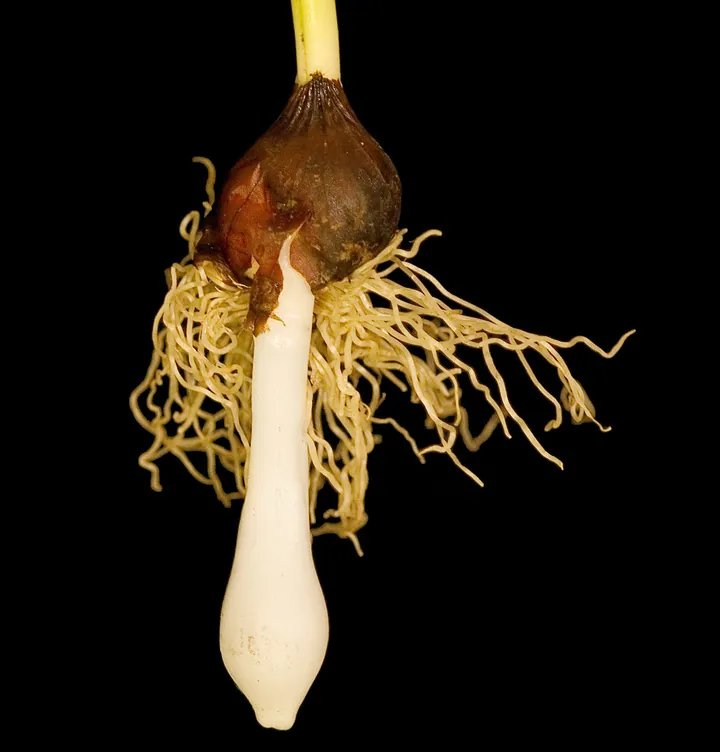
Iowa State warns that tulips planted in September, before soils cool, may come up in the fall.6 Purdue notes that roots keep forming as long as the soil stays above 40°F, which is why late plantings still work.23
How much winter cold tulips need
Tulips form their flowers only after a long cool spell. SDSU puts it at 35 to 48°F for 13 to 20 weeks;4 Purdue says most spring bulbs need 10 to 13 weeks below 40°F.23 Without enough cold, Clemson says, bulbs bloom close to the ground on very short stems.17
Soil temperatures at bulb depth aren’t in the climate normals, and neither are chill hours. As a rough guide we counted, for every ZIP code, the days in a normal winter whose average air temperature is 48°F or colder, the top of SDSU’s range.1 In 26.6% of 40,563 ZIP codes in the contiguous US there are fewer than 91 such days, the 13 weeks at the low end of SDSU’s range.
Warm-winter gardens: zone 8 is not one climate
Bulb catalogs and Google’s AI Overview sort this advice by USDA hardiness zone: pre-chill in zones 8 to 9 and plant in winter. But the zone map is based on the average annual extreme minimum winter temperature, the coldest night of a typical year, not on how long the cool season lasts.27 When we looked up the 2023 zone for a random sample of ZIP codes,28 96% of zone 7b ZIPs reached 13 cool weeks, but only 48% in zone 8a, 16% in 8b and 18% in 9a.
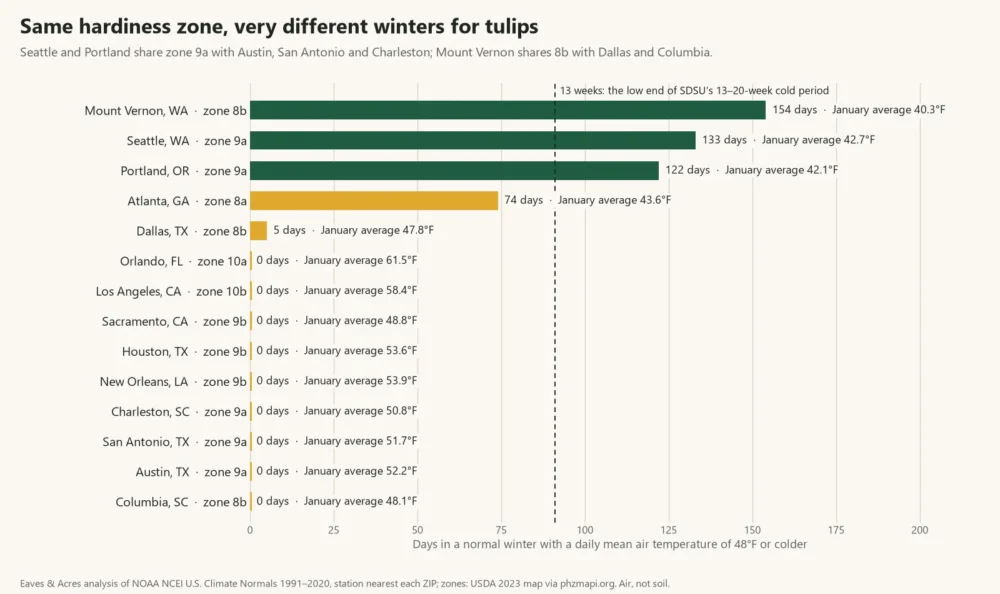
The exceptions are in the Pacific Northwest. Seattle and Portland are zone 9a, like Austin, San Antonio and Charleston, but their winters average in the low 40s°F, while those three cities have no days at or below 48°F at all.
| City (ZIP) | USDA zone (2023) | Days at or below 48°F | What local extension advice says |
|---|---|---|---|
| Mount Vernon, WA (98273) | 8b | 154 | Plant in late fall or early winter (WSU Extension Master Gardeners, Skagit County) |
| Seattle, WA (98101) | 9a | 133 | Fall planting; no refrigeration step in the WSU or Oregon State advice we read |
| Portland, OR (97204) | 9a | 122 | October and November in Western Oregon (Oregon State) |
| Atlanta, GA (30303) | 8a | 74 | October through late December; UGA suggests precooling some bulbs only in the mildest areas |
| Dallas, TX (75201) | 8b | 5 | Chill in the refrigerator until mid- or late December, then plant (Texas A&M AgriLife) |
| Columbia, SC (29201) | 8b | 0 | Refrigerate from purchase; plant November to late December (Clemson) |
| Austin, TX (78701) | 9a | 0 | Chill until mid- or late December, then plant (Texas A&M AgriLife) |
| San Antonio, TX (78205) | 9a | 0 | Chill 6–8 weeks; plant mid- to late December (Texas A&M AgriLife, Bexar County) |
| Charleston, SC (29401) | 9a | 0 | Refrigerate; plant late December or early January (Clemson) |
| New Orleans, LA (70112) | 9b | 0 | Refrigerate 6–8 weeks; plant late December or early January (LSU AgCenter) |
| Houston, TX (77002) | 9b | 0 | Chill until mid- or late December, then plant (Texas A&M AgriLife) |
| Sacramento, CA (95814) | 9b | 0 | Prechill at least 4–6 weeks (UC ANR) |
| Los Angeles, CA (90012) | 10b | 0 | Prechill at least 4–6 weeks (UC ANR) |
| Orlando, FL (32801) | 10a | 0 | Plant bulbs pre-chilled for 2–4 months, in winter (UF/IFAS) |
How long to pre-chill tulip bulbs
Published chilling times range from 4 to 20 weeks, depending on the source and on whether it means the full cold requirement or the least that still gets a bloom. Google’s AI Overview showed the same split: 6 to 10 weeks for “when to plant tulip bulbs” and 10 to 14 weeks for the zone 8 version of the question.
| Source | Region | Cold period |
|---|---|---|
| UC ANR, The Leaflet | California | Prechill at least 4–6 weeks |
| LSU AgCenter | Louisiana | Refrigerate at least 6–8 weeks |
| Texas A&M AgriLife, Bexar County | San Antonio | 6–8 weeks of chilling |
| UF/IFAS Gardening Solutions | Florida | Bulbs pre-chilled for 2–4 months |
| Purdue Extension | Outdoors, Indiana | 10–13 weeks below 40°F (most spring bulbs) |
| UGA Extension | Georgia’s mildest areas | 12–16 weeks at 40–50°F (most spring bulbs) |
| Clemson HGIC | South Carolina | 12–16 weeks (most bulbs) |
| SDSU Extension | Outdoors, South Dakota | 13–20 weeks at 35–48°F |
Sources: UC ANR,22 LSU AgCenter,18 Texas A&M AgriLife,19 UF/IFAS,21 Purdue,23 UGA,16 Clemson17 and SDSU.4 The Gulf Coast advice is the practical minimum for tulips grown as a one-season flower. To meet the longer figures as well, put bulbs in the refrigerator as soon as you buy them in September or October, as Clemson suggests, and keep them there until planting.17
- Where: the lower part of the refrigerator, not in airtight plastic bags.20
- Away from fruit: apples and other fruits give off ethylene gas that can harm the bulbs.22
- Plant straight from the fridge: plant immediately after removing the bulbs.22
Don’t rush chilled bulbs into the ground in November. LSU’s Dan Gill explains why Louisiana waits until late December:
soil that is still too warm can cancel the chilling process
Texas A&M AgriLife gives the same advice for Texas: chill until mid- or late December, then plant.20
How to plant tulip bulbs
Depth advice differs a little by source. Most measure from the base of the bulb:
| Source | Depth | Spacing |
|---|---|---|
| University of Minnesota | 2–3 times the bulb’s diameter; deeper in sandy soil, shallower in clay | Not given |
| Iowa State | 6–8 in for large bulbs such as tulips | 4–6 in |
| Illinois Extension | About 8 in (2–3 times the bulb’s height) | Not given for tulips |
| Cornell Cooperative Extension | 6–8 in | 6 in |
| Clemson HGIC | 6–8 in | 4–6 in |
| K-State Research and Extension | 4–6 in for perennial plantings; a couple of inches for one-season tulips | Not given |
| LSU AgCenter | About 5 in (Louisiana, one-season tulips) | 3–4 in |
Set bulbs point up, in groups
Place each bulb with the nose up and the root plate down.9 Clumps look natural and mean fewer holes: UW–Madison suggests 5 to 8 bulbs per hole, about an inch apart for large bulbs like tulips.24
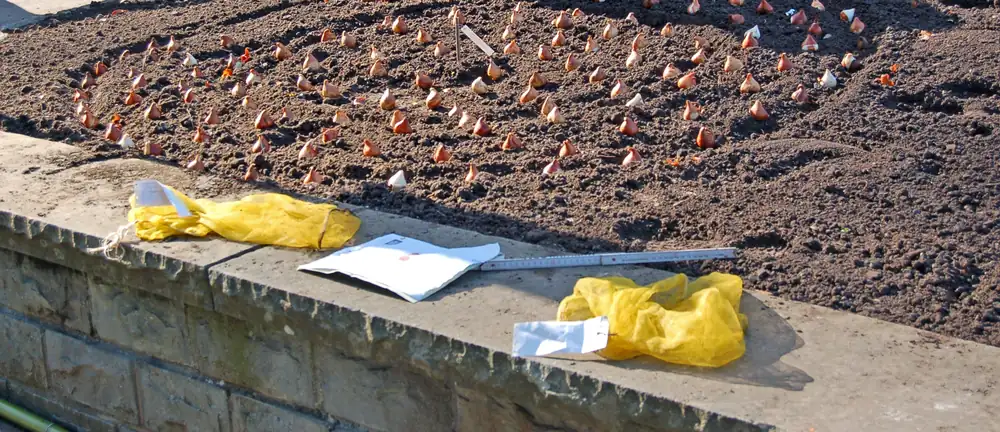
Tulip bulbs set out on a bed before planting. Photo: Gerhard Giebener, CC BY 2.0, via Wikimedia Commons (cropped). Water in, then mulch
Minnesota suggests covering the bulbs with half the soil, soaking the area, then adding the rest. Finish with 2 to 3 inches of leaves, wood mulch or clean straw.5 If fall is dry, Illinois Extension says to water weekly until the ground freezes.8
Feed only if a soil test says so
Minnesota advises skipping fertilizer unless a soil test shows a phosphorus or potassium shortage, and adding compost instead.5 If you use a product, follow its label for the amount.
Most hybrid tulips bloom well for only three or four years, says Cornell; Darwin hybrids, Fosterianas and species tulips last longest.10 In the warm South, Clemson says tulips can usually be counted on for only one season.17
Missed the window? Late planting and leftover bulbs
Tulips are the most forgiving bulb for late planting. The University of Minnesota says:
you can plant these as late as you can get them into the soil
Iowa State says tulips can go in as late as December if the soil isn’t frozen,7 and Cornell names late November and early December for New York.10 Plant late bulbs rather than store them: Iowa State finds unplanted tulip bulbs are usually dead by early spring. Its other option is to pot them up and give them 12 to 16 weeks at 40 to 45°F to bloom indoors.7
For the rest of the fall garden, see our guides to fall vegetable planting dates, when to plant garlic, when to plant daffodil bulbs and when to cover plants for frost. The flowers and bulbs section collects related guides, our hardiness zone guides explain what zones measure, and the methodology page shows how every frost date here is calculated.
Frequently asked questions
October in much of the North, starting in late September where fall comes early, as in Minnesota and Colorado. October into November in the Mid-Atlantic, lower Midwest and Pacific Northwest. Chilled bulbs on the Gulf Coast: mid-December to early January.
Usually not while you can still dig. The University of Minnesota says tulips can go in as late as you can get them into the soil, and Iowa State says as late as December if the ground isn’t frozen.
Iowa State says unplanted tulip bulbs are usually dead by spring, and survivors rarely perform well. Plant them in late fall or winter, or pot and chill them for indoor bloom.
Only where winters are too mild, such as the Gulf Coast, Florida, much of Texas and coastal South Carolina. Extension advice runs from 4–8 weeks to 12–16 weeks.
About 6 to 8 inches, say Iowa State, Cornell and Clemson. The University of Minnesota suggests 1 to 2 inches deeper in sandy soil and shallower in heavy clay.
University of Wisconsin–Madison Extension suggests 5 to 8 bulbs per hole, with about an inch between large bulbs such as tulips.
Most hybrid tulips bloom well for three or four years, says Cornell; Darwin hybrids, Fosterianas and species tulips last longest. Leave the leaves on for at least six weeks after bloom, or until they turn brown, so they can build up the bulb for next year, Clemson advises. In South Carolina, it adds, tulips are usually treated as annuals, dug and discarded after bloom.
Sources
- 1.U.S. Climate Normals 1991–2020. NOAA National Centers for Environmental Information, 2021. Used for: normal monthly lows and means, first-frost dates for every ZIP and city Back to text
- 2.Prepare for Early Spring Blooms by Planting Hardy Bulbs in the Fall. South Dakota State University Extension (Cindy Schnabel, Kristine Lang), 2021. Used for: night temperatures of 40–50°F as the planting cue; mid-September to mid-October Back to text
- 3.Warm Winter Temperature Impacts on Flowering Bulbs. South Dakota State University Extension, 2026. Used for: plant once nights stay at 40–50°F; four to six weeks before the soil freezes Back to text
- 4.Tulips Bring Early-Season Color to the Garden Each Year. South Dakota State University Extension, 2021. Used for: 35–48°F for 13–20 weeks to initiate flowers Back to text
- 5.Planting bulbs, tubers and rhizomes. University of Minnesota Extension (Mary H. Meyer), 2026. Used for: mid-September to mid-October; tulips as late as the soil can be worked; depth, watering, mulch, fertilizer Back to text
- 6.Selecting and Planting Spring-Blooming Bulbs. Iowa State University Extension and Outreach, 2023. Used for: October in Iowa; September planting can cause fall emergence; depth and spacing Back to text
- 7.Can I plant tulip bulbs in November or should I wait for Spring?. Iowa State University Extension and Outreach, 2024. Used for: planting until December if unfrozen; unplanted bulbs die; forcing at 40–45°F for 12–16 weeks Back to text
- 8.Select and plant spring-flowering bulbs now. University of Illinois Extension, 2020. Used for: late September through October; watering until the ground freezes Back to text
- 9.Planting Bulbs. University of Illinois Extension, n.d. Used for: depth rule; nose up, root plate down Back to text
- 10.Planting Tulips. Cornell Cooperative Extension of Monroe County, n.d. Used for: October; as late as early December if unfrozen; depth, spacing, long-lived tulip types Back to text
- 11.Plant Bulbs in the Fall for a Spring Celebration. Penn State Extension, 2025. Used for: western Pennsylvania: September to October, before the first frost Back to text
- 12.Fall-Planted Bulbs and Corms. Colorado State University Extension, 2025. Used for: September and October; late September preferred Back to text
- 13.Plant spring-blooming bulbs in fall for years of low-maintenance color. Oregon State University Extension, 2025. Used for: Western Oregon October–November; Central and Eastern Oregon late September through October Back to text
- 14.
- 15.Bulb planting season is here. Oklahoma State University Extension, 2025. Used for: plant from late September through early November Back to text
- 16.Flowering Bulbs for Georgia Gardens (B 918). University of Georgia Extension, 2024. Used for: October through late December; 12–16 weeks at 40–50°F for precooling in the mildest areas Back to text
- 17.Spring-Flowering Bulbs (HGIC 1155). Clemson Cooperative Extension Home & Garden Information Center, 2023. Used for: soil below 60°F; 12–16 week chilling; refrigerate and plant November to January in South Carolina; depth, spacing Back to text
- 18.It’s time to plant tulips and hyacinths. LSU AgCenter (Dan Gill), 2017. Used for: refrigerate 6–8 weeks; plant late December or early January; warm soil cancels chilling Back to text
- 19.December 11 2004 Timely Tips. Texas A&M AgriLife Extension, Bexar County, 2004. Used for: plant tulips after 6–8 weeks of chilling Back to text
- 20.Garden advice: Maintain the leaves you have, plan and plant ahead. Texas A&M AgriLife Today (Larry Stein), 2023. Used for: chill until mid- or late December; lower part of the refrigerator; no airtight bags Back to text
- 21.Tulips. UF/IFAS Gardening Solutions, n.d. Used for: Florida: plant bulbs pre-chilled for two to four months, in winter Back to text
- 22.Plant bulbs in fall for spring beauty. UC Agriculture and Natural Resources, The Leaflet, 2020. Used for: prechill at least 4–6 weeks; keep away from fruit; plant right after removal Back to text
- 23.Didn’t get your bulbs planted?. Purdue University Consumer Horticulture, 2017. Used for: 10–13 weeks below 40°F; roots form while soil is above 40°F Back to text
- 24.Plant Bulbs Now for Spring Color. University of Wisconsin–Madison Extension (Lisa Johnson), 2021. Used for: ground temperatures of 50–55°F; 5–8 bulbs per hole Back to text
- 25.Plant Spring Blooming Bulbs Now. WSU Extension Master Gardeners, Skagit County (Jessamyn Tuttle), 2023. Used for: Western Washington: plant in late fall or early winter Back to text
- 26.How to Plant Tulips. K-State Research and Extension, Johnson County, n.d. Used for: perennial vs one-season plantings; depth; drainage Back to text
- 27.USDA Plant Hardiness Zone Map. USDA Agricultural Research Service, 2023. Used for: zones are based on the average annual extreme minimum winter temperature Back to text
- 28.2023 USDA Plant Hardiness Zone Map, ZIP-code table. PRISM Climate Group, Oregon State University, for USDA ARS, 2023. Used for: zone for each table city and sampled ZIP code (looked up via phzmapi.org, which mirrors this table; all looked-up ZIP codes present in the table match it, checked 2026-10-03) Back to text
- 29.Bulbs and blooms. Washington State Magazine, 2002. Used for: Skagit Valley tulip bulb growing Back to text
How this guide was made
- Written by the Yard & Garden Desk and reviewed by the Data & Methodology Desk.
- Data: normal monthly low and mean temperatures and first-frost dates from NOAA NCEI U.S. Climate Normals 1991–2020 for the station nearest each ZIP code, interpolated to daily values; planting windows, chilling periods and depths from SDSU, UMN, Iowa State, Illinois, Cornell, Penn State, Colorado State, Oregon State, UMD, Oklahoma State, UGA, Clemson, LSU, Texas A&M, UF/IFAS, UC, Purdue, UW–Madison, WSU and K-State publications; USDA 2023 hardiness zones from the PRISM Climate Group ZIP-code table, looked up via phzmapi.org. See our methodology.
- AI use: AI tools help us research, draft and check this guide. Every figure is checked against the source cited for it, and calculated figures come from our own code, described on the methodology page.
- Spotted an error? Tell us — the form opens with this page’s address filled in.
Change log
- Oct 4, 2026Re-checked the SDSU, Minnesota, Iowa State, Clemson and LSU guidance against the live pages; the FAQ on whether tulips come back now adds Clemson’s advice on leaving the leaves after bloom.
- Oct 3, 2026Hardiness-zone source now cited to the PRISM Climate Group’s official 2023 ZIP-code table; every looked-up ZIP code in it matches.
- Oct 2, 2026Published. Planting windows for 24 cities computed from NOAA 1991–2020 normal night lows and checked against 16 published extension planting calendars; chilling periods, depths and late-planting advice read from SDSU, UMN, Iowa State, Illinois, Cornell, Clemson, UGA, LSU, Texas A&M, UF/IFAS, UC and others.
Covers lawns, gardens, frost and planting. We write the guides and maintain the tools that tell you when to seed, feed and plant for your ZIP.
Keep reading
When to Plant Wildflower Seeds: Fall, Winter and Spring Dates Where You Live
Most native wildflower seed does best sown in late fall or winter. Dormant-sowing dates for 24 US cities from NOAA hard-freeze normals, two common rules tested, and published calendars from Minnesota to Texas and Florida.
When to Plant Daffodil Bulbs: Fall Dates Before Your Hard Freeze
Plant daffodils from when fall nights reach 50°F until your first frost, before the 28°F hard freeze. Dates for 24 cities, checked against nine extension calendars, plus Southern types that need no chilling.
When to Plant Onions: Fall in the South, Spring in the North
Plant onion sets and transplants in the four weeks before your last frost, or in fall and winter in the Deep South. Dates for 27 cities and the onion type for every ZIP code's latitude.
Seasonal reminders for your ZIP
Get a short email when it’s time to overseed, start seeds, open the pool or service your furnace — timed to your climate.