




When to Plant Daffodil Bulbs: Fall Dates Before Your Hard Freeze
Daffodils go in once fall nights cool to about 50°F and should be rooted before the first hard freeze. Dates for 24 US cities from NOAA normals, checked against nine extension calendars, and the daffodils the South plants instead of chilling.
- Last reviewed Oct 7, 2026
- 25 cited sources
- 10 min read
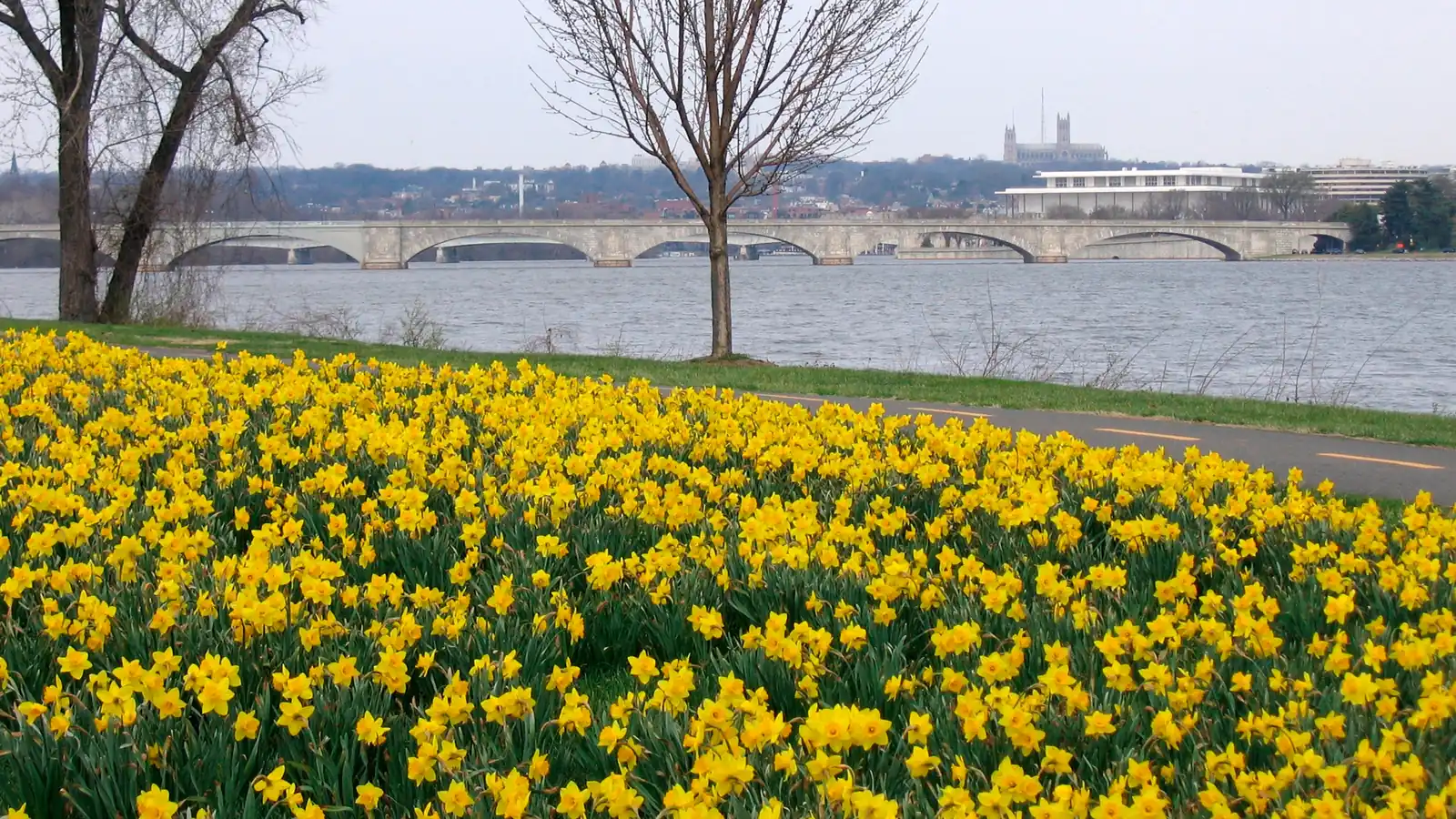
Set your ZIP to see dates for your area.
- 1Plant daffodil bulbs in fall, from when normal night lows reach about 50°F until your median first frost; the median hard freeze (28°F) is the last call.
- 2Examples: Minneapolis Sep 24–Oct 16, Chicago Oct 7–Nov 5, Washington, DC Oct 13–Nov 8, Atlanta Oct 19–Nov 8.
- 3Published daffodil calendars close a median 2 days before the NOAA median hard freeze (eight places; Sacramento rarely has one).
- 4Plant daffodils before tulips: Southern extension calendars plant them unchilled, one to three months before refrigerated tulips.
- 5Deer, squirrels and voles avoid daffodils (Rutgers: rarely damaged; tulips: frequently severely damaged), but the bulbs are toxic to pets.
Plant daffodil bulbs in fall, starting when nights cool to about 50°F and finishing by your first frost, or at the latest by your first hard freeze (28°F). That means mid-September to mid-October in the upper Midwest and northern Plains, late September to mid-November across the lower Midwest and Northeast, and mid-October to early November from Washington, DC, to Atlanta. Plant them before your tulips: daffodils need their roots set before the cold, and Southern extension services plant them in October and November with no refrigerator step.
We turned that advice into dates for 24 cities using NOAA’s 1991–2020 climate normals,1 then checked them against nine daffodil planting windows published by extension services and Master Gardener programs. Where hard freezes occur, those windows close a median 2 days before the median hard freeze, and the median first frost falls inside seven of the nine. Tulips can wait longer; see when to plant tulip bulbs.
Daffodil planting dates for 24 US cities
South Dakota State University Extension’s cue for hardy bulbs applies to daffodils too: start once nights stay between 40 and 50°F.3 As in our tulip guide, we date it from the day the normal nightly low reaches 50°F at the nearest weather station.1 The deadline comes from frost. The National Weather Service defines a hard freeze as 28°F or lower for an extended time2 (frost vs. freeze explains the difference).
| City (ZIP) | 2023 zone | Start: nights reach 50°F | Finish by: median first frost (32°F) | Last call: median hard freeze (28°F) |
|---|---|---|---|---|
| Madison, WI (53703) | 5b | Sep 17 | Oct 9 | Oct 20 |
| Denver, CO (80202) | 6a | Sep 17 | Oct 12 | Oct 21 |
| Sioux Falls, SD (57104) | 5a | Sep 20 | Oct 6 | Oct 17 |
| Minneapolis, MN (55401) | 5a | Sep 24 | Oct 16 | Oct 27 |
| Rochester, NY (14604) | 6b | Sep 26 | Oct 25 | Nov 6 |
| Des Moines, IA (50309) | 5b | Sep 28 | Oct 20 | Oct 30 |
| Columbus, OH (43215) | 6b | Sep 28 | Oct 24 | Nov 3 |
| Pittsburgh, PA (15222) | 7a | Sep 28 | Oct 27 | Nov 5 |
| Detroit, MI (48201) | 6b | Oct 1 | Oct 31 | Nov 9 |
| Seattle, WA (98101) | 9a | Oct 1 | Nov 17 | Dec 2 |
| Chicago, IL (60601) | 6b | Oct 7 | Nov 5 | Nov 15 |
| Salt Lake City, UT (84101) | 7b | Oct 7 | Nov 8 | Nov 18 |
| Portland, OR (97204) | 9a | Oct 7 | Dec 1 | Dec 20 |
| Boston, MA (02108) | 7a | Oct 8 | Nov 9 | Nov 21 |
| Nashville, TN (37201) | 7b | Oct 9 | Oct 31 | Nov 9 |
| Kansas City, MO (64105) | 6b | Oct 12 | Nov 2 | Nov 11 |
| Washington, DC (20001) | 8a | Oct 13 | Nov 8 | Nov 20 |
| Oklahoma City, OK (73102) | 7b | Oct 14 | Nov 2 | Nov 11 |
| St. Louis, MO (63101) | 7a | Oct 15 | Nov 4 | Nov 15 |
| Louisville, KY (40202) | 7a | Oct 15 | Nov 9 | Nov 20 |
| Charlotte, NC (28202) | 8a | Oct 17 | Nov 3 | Nov 14 |
| Atlanta, GA (30303) | 8a | Oct 19 | Nov 8 | Nov 20 |
| Philadelphia, PA (19103) | 7b | Oct 19 | Nov 17 | Nov 29 |
| New York, NY (10001) | 7b | Oct 20 | Nov 20 | Dec 1 |
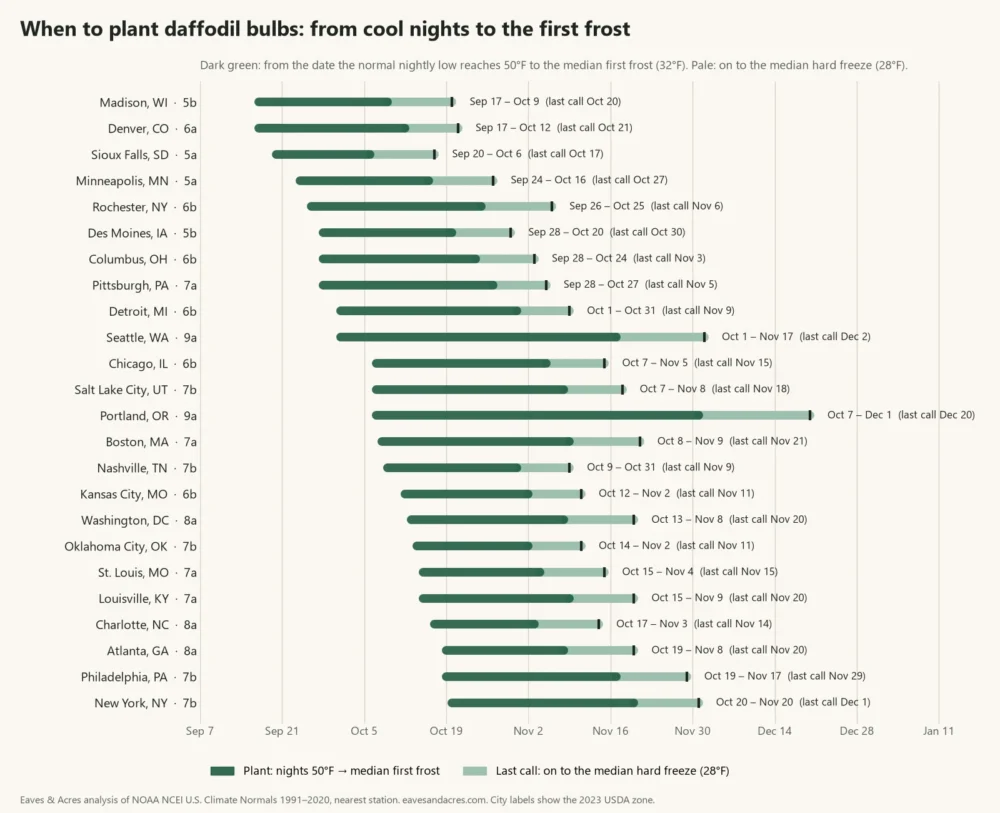
Across 37,569 ZIP codes, the median hard freeze comes 11 days after the median first frost (9 to 15 days in 8 of 10), your margin if planting runs late. For your own ZIP code, look up your first frost and hard-freeze dates.
Loads from YouTube (privacy-enhanced mode) only when you press play.
How the dates compare with nine local daffodil calendars
We compared every local daffodil window we could read from an extension service or Master Gardener program with the NOAA dates for the same place.4,5,6,8,9,10,11,12,13
| Place | Published daffodil window | Nights reach 50°F | Median first frost | Median hard freeze |
|---|---|---|---|---|
| St. Paul, MN | Mid-September to mid-October (University of Minnesota) | Sep 20 | Oct 8 | Oct 21 |
| Scottsbluff, NE | Late September through October (Nebraska Extension Master Gardener, Panhandle) | Sep 5 | Oct 2 | Oct 12 |
| Ames, IA | October (Iowa State) | Sep 20 | Oct 12 | Oct 23 |
| Chillicothe, OH | September through October (Ohio State Master Gardeners, Ross County) | Sep 27 | Oct 22 | Nov 2 |
| Columbia, MO | Early to mid-October (MU Extension) | Oct 8 | Oct 31 | Nov 9 |
| Carson City, NV | Mid-October, before Thanksgiving (University of Nevada Extension educator) | late August | Oct 6 | Oct 18 |
| Columbia, SC | October or November (Clemson HGIC) | Oct 28 | Nov 16 | Dec 2 |
| Baton Rouge, LA | October and November (LSU AgCenter) | Nov 7 | Nov 26 | Dec 16 |
| Sacramento, CA | September to December (UC Master Gardeners, Sacramento County) | Oct 27 | Dec 16 | rare |
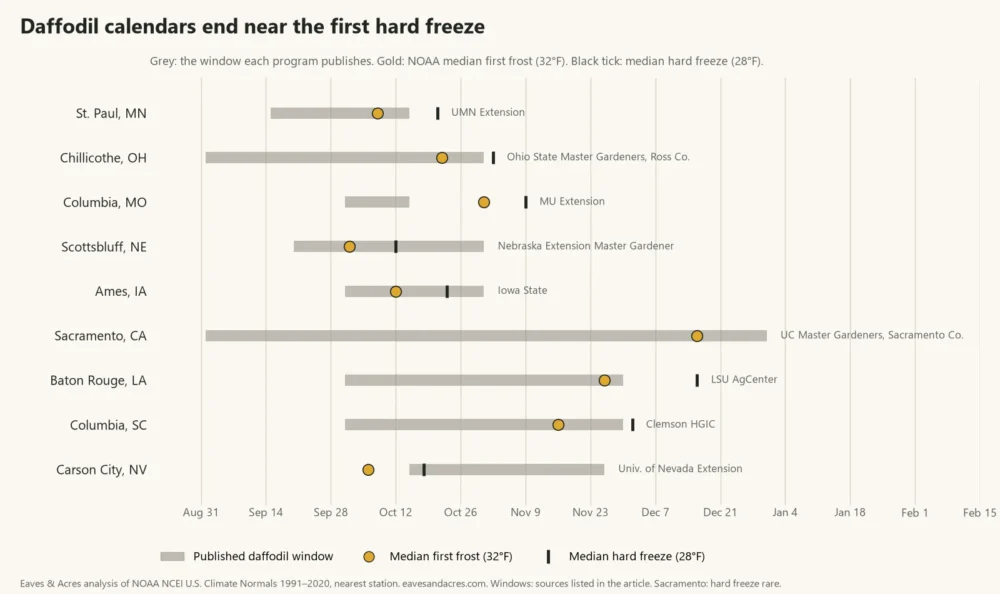
The windows end a median 14 days after the median first frost and, in the eight places with hard freezes, 2 days before the median hard freeze. MU Extension is the most cautious, advising early to mid-October around Columbia, two weeks before the median first frost, though it says later planting can work in a mild fall.9 In Carson City, Nevada, normal lows reach 50°F by late August, so, as with Bend, Oregon, in our tulip guide, go by frost in the high desert.10
Why daffodils go in before tulips
Roots are the reason, as Missouri’s David Trinklein explains:
Daffodils must have time to develop a good root system before cold temperatures set in
Ohio State’s Master Gardeners in Ross County single out daffodils as needing time to root before the ground freezes.8 Tulips are more forgiving, as our tulip guide shows. In the North the calendars barely separate the two, and Iowa State gives October for both,6 so plant daffodils first. In the South the gap is one to three months, because tulips must be chilled first:
| Where (source) | Plant daffodils | Plant tulips | Chilling for tulips |
|---|---|---|---|
| Iowa (Iowa State) | October | October | None |
| South Carolina (Clemson HGIC) | October or November | November to late December (central SC); late December or early January (coast) | Refrigerate from purchase until planting |
| Louisiana (LSU AgCenter) | October and November | January | Refrigerate at least 6–8 weeks |
| Sacramento, CA (UC Master Gardeners) | September to December | November to December | Refrigerate at least 6 weeks |
Sources: Iowa State,6 Clemson,11 LSU AgCenter12 and UC Master Gardeners of Sacramento County.13 Clemson’s rule: daffodils in October or November, other spring bulbs only once the soil at planting depth stays below 60°F.11
What soil temperature to plant daffodils
Chicago Botanic Garden says daffodils prefer soil below 55°F,21 and University of Wisconsin–Madison Extension plants spring bulbs, daffodils included, once the ground cools to about 50–55°F.20 NOAA normals contain no soil temperatures, so, as in the tulip guide, we don’t estimate a soil date; a soil thermometer at bulb depth will tell you.
Deer, squirrels and voles leave daffodils alone
Rutgers Cooperative Extension rates daffodils “Rarely Damaged” by deer, its best category, and tulips “Frequently Severely Damaged,” its worst.18 Colorado State Extension notes that deer tend to avoid them.19 On digging animals, the University of Minnesota warns that squirrels and chipmunks
may dig up and eat bulbs after being planted, especially tulips (narcissus bulbs are poisonous)
Clemson says animals rarely eat daffodil bulbs,11 Ohio State’s Master Gardeners say squirrels, chipmunks and mice leave daffodils alone,8 and Nebraska Extension Master Gardener Kathy Tando writes that voles love tulip bulbs but don’t bother daffodils.5
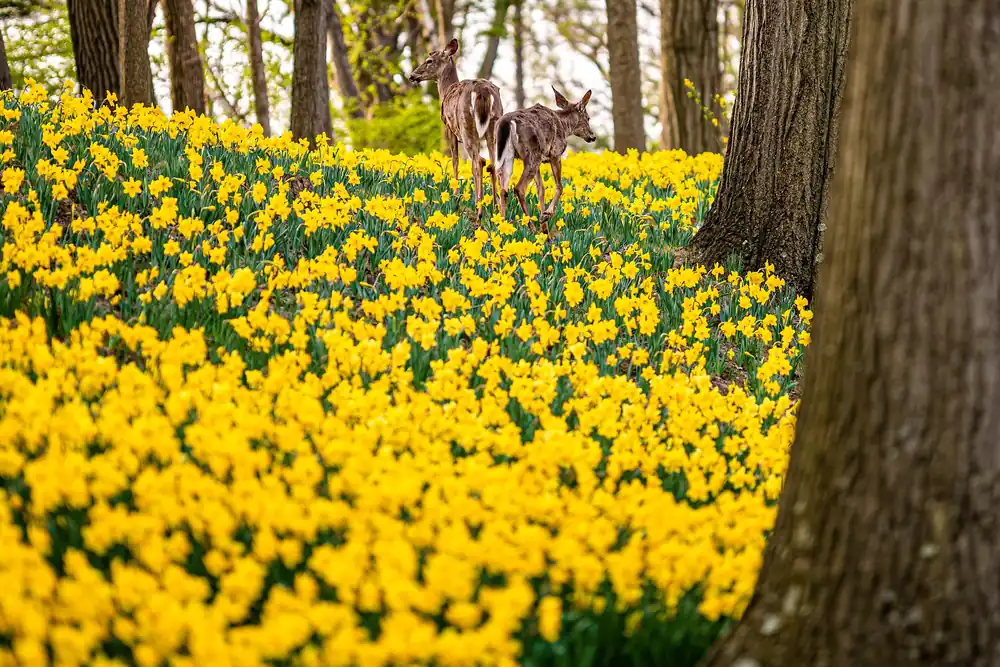
The reason is chemistry. NC State Extension lists phenanthridine alkaloids such as lycorine, plus calcium oxalate crystals, as the plant’s toxic principles.16
Daffodils come back; most tulips don’t
UW–Madison Extension says daffodils tend to live longer in Wisconsin soils than tulips,20 and Iowa State calls them more vigorous than tulips and most other spring bulbs.7 The gap widens in the South, where Clemson calls daffodils
the most successful of the popular spring bulbs for naturalizing in the South
Tulips there are usually grown for a single season.11 To keep daffodils coming back, leave the leaves until they turn yellow: at least six weeks after bloom, says Clemson, and about eight weeks, says MU.11,9 Divide clumps when flowers shrink: every three or four years for large daffodils in South Carolina, every five to 10 years for well-spaced bulbs in Missouri.11,9
Mild winters: chilling, zones and which daffodils to plant
Large trumpet daffodils need a real winter: MU Extension gives 13 weeks at 40 to 45°F for daffodils forced into bloom.9 With that yardstick, we counted for every ZIP code in PRISM’s table of 2023 hardiness zones the normal-winter days averaging 45°F or colder.25,1 It is stricter than the 48°F count in our tulip guide and, like it, measures air, not soil.
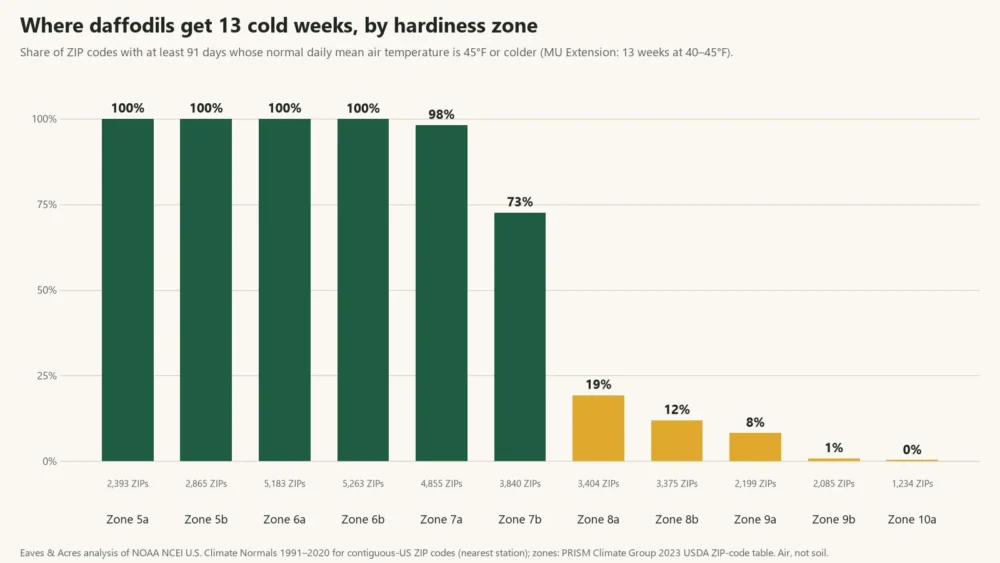
In a normal winter, 98% of zone 7a ZIP codes get at least 13 weeks at 45°F or colder, but only 73% in 7b, 19% in 8a, 12% in 8b, 8% in 9a and 1% in 9b. The zone is not the whole story, because it measures the coldest night, not the length of winter (planting zone vs. frost date).24 Seattle, in zone 9a, gets 93 such days; Austin and Savannah, also in 9a, get none.
Southern extension services answer with different daffodils, not a refrigerator. Clemson says tazettas, paperwhites among them, need no chilling period, that jonquil, tazetta, poeticus and species daffodils grow reliably throughout South Carolina, and that large-flowered ‘Carlton’ and ‘Ice Follies’ are reliable perennials in the South.11 LSU AgCenter recommends heirloom types with proven heat tolerance that need little chilling.12 Texas A&M AgriLife’s Travis County list for Central Texas leans on tazettas and jonquils,14 and UGA’s Coastal Georgia Botanical Gardens in Savannah reports ‘Ice Follies’ and the tazetta ‘Erlicheer’ returning year after year.15
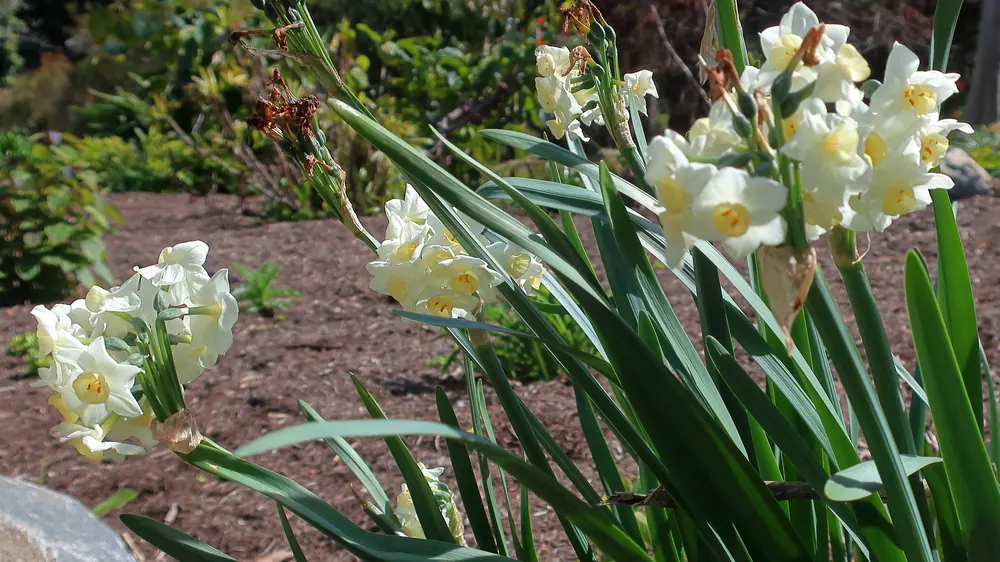
For classic trumpets in a mild climate, the Northern California Daffodil Society suggests refrigerating new bulbs for several weeks and planting in mid- to late November.22 Google’s AI Overview gives 8 to 12 weeks of refrigeration for zone 9; we found no extension source for that figure.
How to plant daffodil bulbs
Depth advice runs deeper in the North and shallower in the warm South, where LSU says deep planting can rot bulbs.12 Most sources measure from the base of the bulb.7,23
| Source | Depth | Spacing |
|---|---|---|
| Iowa State | 6–8 in for trumpet and large-cupped types; 3–5 in for miniatures | 6–8 in; 4–6 in for miniatures |
| MU Extension (Missouri) | Base about 6 in down; up to 8 in in light soil | 6–12 in |
| Clemson HGIC (South Carolina) | 6–8 in; less for small species | 3–6 in |
| UGA, Coastal Georgia Botanical Gardens | 5–6 in for large bulbs; 3–5 in for small | 6–8 in |
| UC Master Gardeners, Sacramento | 5–6 in large; 4–5 in medium; 3–4 in small | 6–8 in large; 2–3 in small |
| LSU AgCenter (Louisiana) | No more than 4–5 in for large bulbs; 1–2 in for small | Not given |
| Northern California Daffodil Society | About 6 in for standard bulbs; about 2 in for miniatures | Not given |
Water in, then mulch
Water to settle the soil, without overwatering, says Iowa State.7 Minnesota adds 2 to 3 inches of leaf mulch, wood mulch or clean straw.4
Go easy on fertilizer
Iowa State says fertilizer at planting isn’t typically necessary and mostly feeds next year’s bulb, not this spring’s flowers.7 If you use a product, follow its label for the amount.
Missed the window?
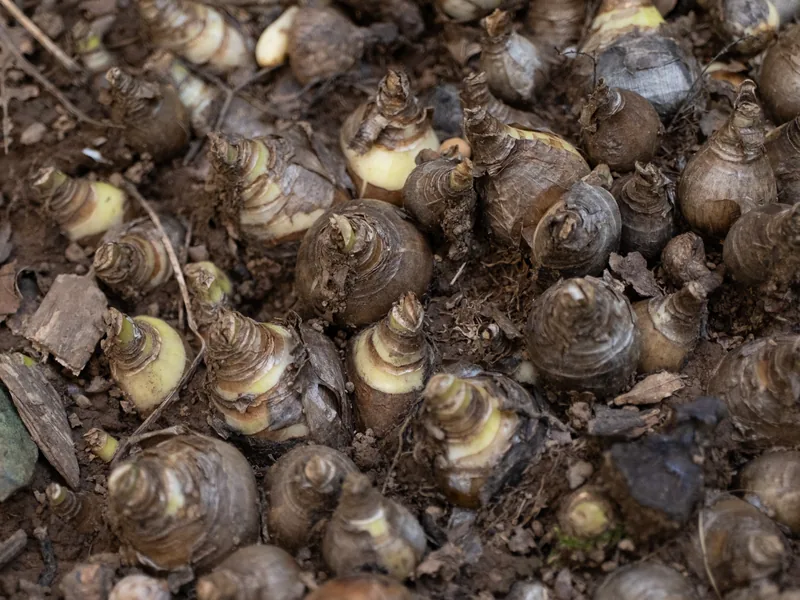
Iowa State says bulbs can go in as late as late November or early December if the weather allows,6 and Nevada’s JoAnne Skelly plants while the ground is unfrozen, ideally before Thanksgiving.10 Don’t hold bulbs until spring: Iowa State says unplanted bulbs often shrivel over winter, and spring-planted ones often fail to bloom.7
Next, see when to plant tulip bulbs, when to plant garlic or the flowers and bulbs section; our hardiness zone guides and methodology page explain the data.
Frequently asked questions
Mid-September to mid-October in the upper Midwest, late September to mid-November in the lower Midwest and Northeast, and mid-October to early November from Washington, DC, to Atlanta.
Yes. MU Extension says daffodils need roots before cold weather, while tulips tolerate late planting. In South Carolina, Louisiana and Sacramento, daffodils go in one to three months before chilled tulips.
Yes. Iowa State plants both 6 to 8 inches deep, and Nebraska Extension Master Gardener Kathy Tando suggests surrounding tulips with daffodils, since voles go for tulip bulbs.
Yes. The University of Minnesota says hardy bulbs such as daffodils can stay in the ground to flower year after year; divide only when crowding shrinks the flowers.
Usually. UW–Madison says they outlive tulips in Wisconsin soils; in the South, Clemson finds jonquil, tazetta, poeticus and species types the most reliable.
Iowa State says spring-planted bulbs usually lack roots and often fail to bloom. Plant in fall, even late, while the ground can be dug.
UW–Madison suggests 5 to 8 bulbs per hole, about an inch apart; Chicago Botanic Garden plants groups of three or five.
Not while the ground can be dug. Iowa State allows late November or early December in a mild year; LSU plants through November, UC Master Gardeners in Sacramento through December.
Sources
- 1.U.S. Climate Normals 1991–2020. NOAA National Centers for Environmental Information, 2021. Used for: normal monthly lows and means, first-frost and hard-freeze dates for every ZIP code and city Back to text
- 2.Glossary: Hard Freeze. NOAA National Weather Service, n.d. Used for: hard freeze = 28°F or lower for an extended time Back to text
- 3.Prepare for Early Spring Blooms by Planting Hardy Bulbs in the Fall. South Dakota State University Extension (Cindy Schnabel, Kristine Lang), 2021. Used for: start planting when nights stay at 40–50°F Back to text
- 4.Planting bulbs, tubers and rhizomes. University of Minnesota Extension (Mary H. Meyer), 2026. Used for: mid-September to mid-October; hardy bulbs left in the ground; squirrels and chipmunks prefer tulips; mulch Back to text
- 5.Master Gardener: Choosing the best tulips and daffodils for your landscape. Nebraska Extension, Panhandle Research, Extension and Education Center (Kathy Tando, Master Gardener), 2025. Used for: late September through October; voles skip daffodils Back to text
- 6.When is the best time to plant daffodils?. Iowa State University Extension and Outreach, 2021. Used for: October for daffodils and tulips; as late as late November or early December Back to text
- 7.Selecting and Planting Spring-Blooming Bulbs. Iowa State University Extension and Outreach (Jauron, Haynes, Steil), 2023. Used for: depth and spacing table; groups; watering; fertilizer; unplanted and spring-planted bulbs; daffodil vigor Back to text
- 8.The best time to plant bulbs is September through October. Ohio State University Extension, Ross County Master Gardener Volunteers, n.d. Used for: September–October, especially daffodils; rodents leave daffodils alone Back to text
- 9.Daffodils: Harbingers of Spring. University of Missouri Extension, IPM (David Trinklein), 2009. Used for: early to mid-October in Missouri; roots before cold; drainage; depth, spacing; foliage; division; 13 weeks at 40–45°F for forcing Back to text
- 10.Northern Nevada landscapes and gardens: Plant daffodil bulbs now. Carson Now (JoAnne Skelly, University of Nevada Extension educator emerita), 2021. Used for: mid-October; before Thanksgiving; ground squirrels skip daffodils Back to text
- 11.Spring-Flowering Bulbs (HGIC 1155). Clemson Cooperative Extension Home & Garden Information Center, 2023. Used for: daffodils October or November; tulips chilled; animals rarely eat daffodils; naturalizing; Southern daffodil types; depth, spacing, sun, foliage, division Back to text
- 12.Buried treasure: Plant bulbs now for beautiful blooms this spring. LSU AgCenter, Get It Growing (Olivia McClure), 2025. Used for: narcissus October–November; tulips refrigerated 6–8 weeks and planted in January; heirlooms that need little chilling; shallow planting Back to text
- 13.Sacramento Bulb Planting Schedule. UC Master Gardeners of Sacramento County (UC ANR), n.d. Used for: daffodils September–December, depth and spacing; tulips November–December after 6 weeks of chilling; gophers and squirrels avoid daffodils Back to text
- 14.Bulbs for Central Texas. Texas A&M AgriLife Extension, Travis County, n.d. Used for: daffodils recommended for Central Texas (tazettas, jonquils, Thalia) Back to text
- 15.Narcissus: The official trumpets of spring bring incredible joy. University of Georgia, Coastal Georgia Botanical Gardens (Norman Winter), 2017. Used for: Ice Follies and Erlicheer return in Savannah; depth and spacing Back to text
- 16.Narcissus (Daffodils). NC State Extension Gardener Plant Toolbox, n.d. Used for: toxic principles (lycorine and other alkaloids, calcium oxalate); contact dermatitis; deer and rabbit resistant Back to text
- 17.Daffodil. ASPCA Poison Control, n.d. Used for: toxic to dogs, cats and horses; bulbs most poisonous; poison control number Back to text
- 18.Landscape Plants Rated by Deer Resistance. Rutgers Cooperative Extension, New Jersey Agricultural Experiment Station, n.d. Used for: daffodil rated A (rarely damaged); tulip rated D (frequently severely damaged) Back to text
- 19.1067 – Deer Resistant Bulbs. Colorado State University Extension, PlantTalk Colorado, n.d. Used for: deer tend to avoid daffodils; narcissus naturalize Back to text
- 20.Plant Bulbs Now for Spring Color. University of Wisconsin–Madison Extension (Lisa Johnson), 2021. Used for: ground at 50–55°F; 5–8 bulbs per hole; daffodils outlive tulips; squirrels and chipmunks Back to text
- 21.Plant Now, Applause Later. Chicago Botanic Garden (Karen Zaworski), n.d. Used for: soil below 55°F; groups of three or five; first-spring emergence about two weeks late Back to text
- 22.Guidelines To Growing Beautiful Daffodils In Your Garden. Northern California Daffodil Society, n.d. Used for: mild-winter climates: refrigerate several weeks, plant mid- to late November; depth Back to text
- 23.Planting Bulbs. University of Illinois Extension, n.d. Used for: depth measured from the base of the bulb; nose up, root plate down Back to text
- 24.USDA Plant Hardiness Zone Map. USDA Agricultural Research Service, 2023. Used for: zones are based on the average annual extreme minimum winter temperature Back to text
- 25.2023 USDA Plant Hardiness Zone Map, ZIP-code table. PRISM Climate Group, Oregon State University, for USDA ARS, 2023. Used for: 2023 zone for every ZIP code in the tables and the zone analysis Back to text
How this guide was made
- Written by the Yard & Garden Desk and reviewed by the Data & Methodology Desk.
- Data: normal monthly low and mean temperatures and median first-frost (32°F) and hard-freeze (28°F) dates from NOAA NCEI U.S. Climate Normals 1991–2020 for the station nearest each ZIP code, interpolated to daily values with the same method as our tulip guide; USDA 2023 hardiness zones from the PRISM Climate Group ZIP-code table; planting windows, chilling, depth and animal advice from MU, Iowa State, Clemson, LSU, UC Master Gardeners, UMN, Nebraska, Ohio State, University of Nevada, UW–Madison, Rutgers, NC State, CSU, UGA, Texas A&M AgriLife and Illinois Extension publications, Chicago Botanic Garden, the Northern California Daffodil Society and the ASPCA. NOAA normals have no soil temperatures, so no soil date is estimated. See our methodology.
- AI use: AI tools help us research, draft and check this guide. Every figure is checked against the source cited for it, and calculated figures come from our own code, described on the methodology page.
- Spotted an error? Tell us — the form opens with this page’s address filled in.
Change log
- Oct 7, 2026Re-checked the Missouri, Clemson, Minnesota, LSU, Rutgers and ASPCA sources against the live pages; the pet-poisoning note now uses ASPCA Poison Control's current name and its consultation-fee note; five source links updated to their current addresses.
- Oct 5, 2026Published. Daffodil planting windows for 24 cities computed from NOAA 1991–2020 normals (normal night lows, median first frost and hard freeze) and checked against nine published daffodil calendars; cold-week shares computed for every ZIP code in PRISM’s 2023 zone table; timing, animal, toxicity, chilling and depth advice read from MU, Iowa State, Clemson, LSU, UC Master Gardeners, UMN, UW–Madison, Rutgers, NC State, the ASPCA and others.
Covers lawns, gardens, frost and planting. We write the guides and maintain the tools that tell you when to seed, feed and plant for your ZIP.
Keep reading
When to Plant Wildflower Seeds: Fall, Winter and Spring Dates Where You Live
Most native wildflower seed does best sown in late fall or winter. Dormant-sowing dates for 24 US cities from NOAA hard-freeze normals, two common rules tested, and published calendars from Minnesota to Texas and Florida.
When to Plant Tulip Bulbs: Fall Planting Dates Where You Live
Plant tulips as fall nights cool from 50°F to 40°F, finishing around your first frost. Dates for 24 cities, checked against 16 extension calendars, plus warm-winter chilling.
When to Plant Onions: Fall in the South, Spring in the North
Plant onion sets and transplants in the four weeks before your last frost, or in fall and winter in the Deep South. Dates for 27 cities and the onion type for every ZIP code's latitude.
Seasonal reminders for your ZIP
Get a short email when it’s time to overseed, start seeds, open the pool or service your furnace — timed to your climate.