




Saltwater vs Chlorine Pool: What Changes and What It Costs
A salt cell makes the same chlorine you would otherwise buy. What it costs in electricity and cell wear, what changes in upkeep and corrosion, and how much stabilizer chlorine tablets add in 19 US cities.
- Last reviewed Oct 7, 2026
- 15 cited sources
- 10 min read
- 1A saltwater pool is a chlorine pool: its cell makes the same free chlorine, at targets inside the 1–4 ppm a tablet label gives.
- 2A Pentair IC40 uses up to 3.1 kWh (56¢ at the US average) to make a gallon of 10% liquid chlorine’s worth, plus 14¢ per $100 of cell price.
- 3Tablets add stabilizer; a salt cell adds none. By our NOAA analysis, a season of trichlor adds 42 ppm in the median US ZIP code and 128 in Miami.
- 4Salt pools still need testing, occasional shock and cell cleaning, and salt raises corrosion risk for metal and some stone.
A saltwater pool is a chlorine pool. Its salt cell runs an electric current through lightly salted water and makes the same free chlorine that tablets or liquid chlorine add, so the real choice is how chlorine gets into your water. A salt system costs more up front and trades chemical purchases for electricity and a cell that wears out. A chlorine pool costs less to set up, but you buy chlorine all season, and tablets leave stabilizer behind with every dose.
Instead of repeating “softer water, lower costs,” we read the manufacturer manuals, EPA-registered labels and CDC’s pool code, priced a salt cell’s chlorine from Pentair’s specifications and federal electricity data, and used NOAA climate data to show how much stabilizer a season of tablets adds in 19 US cities.
Same chlorine, different source
In a salt cell, says CDC’s Model Aquatic Health Code (MAHC) Annex, a low-voltage current splits dissolved salt and the chlorine formed becomes hypochlorous acid, the free chlorine that kills germs.2 Used chlorine turns back into salt, so salt is lost only when water leaves by splashing, backwashing or draining.5 The Pool & Hot Tub Alliance (PHTA), the industry’s trade association, notes one difference that matters later:
This process does not result in the addition of stabilizer or balancing chemicals.
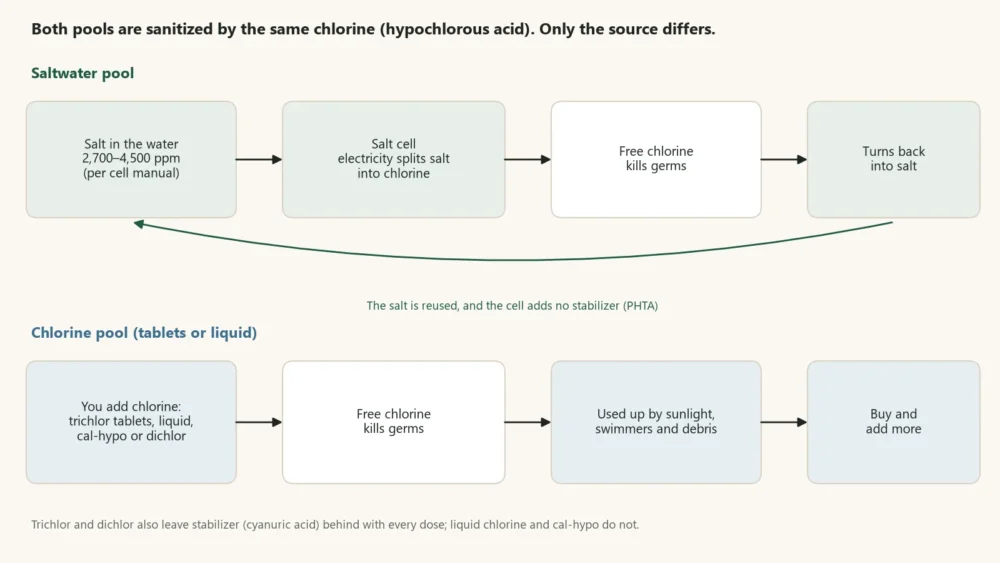
The chlorine target is the same too: 1–3 ppm in Hayward’s AquaRite manual, 2.0–4.0 ppm in Pentair’s IntelliChlor guide5,4 and 1–4 ppm on the trichlor tablet label we read,6 with CDC’s floor of 2 ppm in any stabilized pool.1 The manuals don’t support the claim that salt pools run on “less chlorine.” Our guide to ideal pool chemical levels lists every range.
Saltwater vs. chlorine pool, side by side
| Topic | Saltwater pool | Chlorine (tablet or liquid) pool |
|---|---|---|
| Where chlorine comes from | Salt cell, while the pump runs | Tablets in a feeder or floater, liquid or granules |
| Free chlorine target | 1–3 ppm (Hayward); 2–4 ppm (Pentair) | 1–4 ppm (trichlor label) |
| Salt level | 2,700–3,400 ppm (Hayward); 2,800–4,500 ppm, ideal 3,600 (Pentair) | Not needed |
| Stabilizer from the chlorine source | None; added separately, 30–50 ppm (Pentair) | Trichlor adds 0.6 ppm per ppm chlorine |
| Shock | Cell boost mode; a separate product may be needed | Every 1–2 weeks (trichlor label) |
| Electricity | Up to 220 W while the cell runs (Pentair IC20–IC60) | None beyond the pump |
| Parts that wear out | Cell, designed for about 10,000 hours (Pentair) | No cell |
| Routine care | Inspect the cell every 2–3 months; salt monthly | Check and refill the feeder often |
| Cold water | Cell stops below 50°F (Hayward) or 52°F (Pentair) | Label lowers the dose for 60–70°F water |
| Material cautions | Salt raises corrosion risk to metal and some stone | Tablets must not touch pool surfaces |
Sources by row: the two manuals,5,4 the trichlor tablet label,6 PHTA3,12 and the MAHC Annex.2
What each costs to run, without made-up prices
We found no official source that tracks prices for pool chlorine, salt or replacement cells, and Google’s AI answers quote cells anywhere from $300 to $1,800 without one. So we worked out what a salt cell spends to make chlorine, for you to compare with what you pay for liquid chlorine.
Electricity and cell wear
Pentair’s IntelliChlor IC40 makes 1.40 pounds of chlorine per 24 hours, and the power center for its IC20–IC60 cells is rated at 220 watts input,4 a maximum, so the energy below is a ceiling. A 10% liquid chlorine label says 13 fluid ounces adds 1 ppm to 10,000 gallons,7 which means 0.82 pound of chlorine per gallon.
| Step | Math | Result |
|---|---|---|
| Energy per pound of chlorine | 0.220 kW × 24 h ÷ 1.40 lb | Up to 3.77 kWh |
| Energy for one gallon’s worth | 3.77 kWh × 0.82 lb | Up to 3.1 kWh |
| Electricity cost, U.S. average | 3.1 kWh × 18.19¢ | Up to 56¢ |
| Chlorine over the cell’s life | 10,000 h × 1.40 lb ÷ 24 h | 583 lb, about 710 gallons’ worth |
| Cell wear per gallon’s worth | Cell price ÷ 710 | 14¢ per $100 of cell price |
The price is the U.S. residential average for January–July 2026 from the Energy Information Administration (13.53¢ in Nevada to 33.25¢ in California among our table’s states), the same prices our heat pump vs. furnace and hot tub running cost guides use.8 The 10,000 hours is Pentair’s design life, which it puts at roughly five years of average use.4
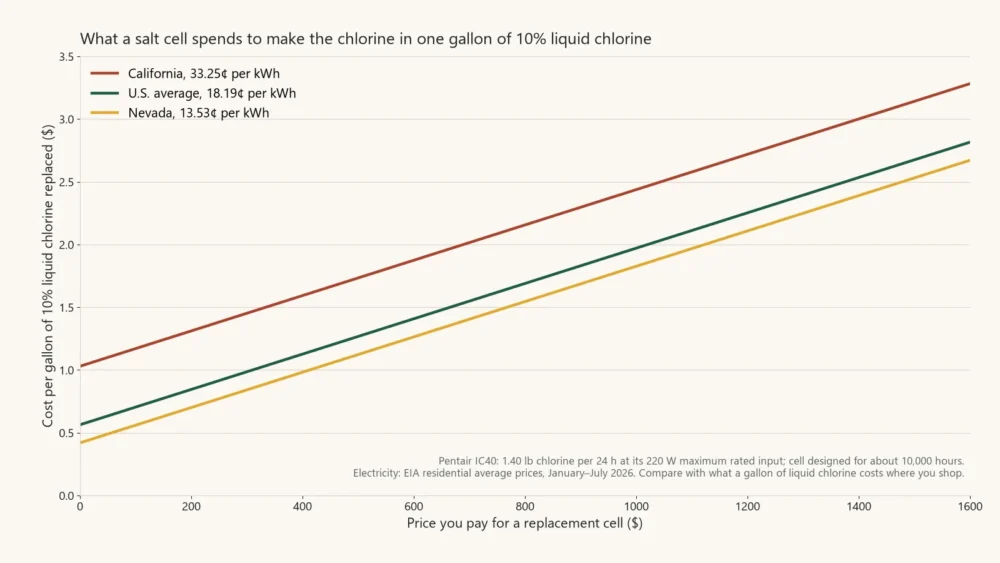
The rule: a salt cell makes chlorine more cheaply when a gallon of 10% liquid chlorine costs you more than 3.1 kWh of electricity plus your cell’s price divided by 710.
One Chicago season with a salt cell
- Scenario
- A Pentair IC40 running 8 hours a day at full output, Hayward’s filter time for an average pool, through Chicago’s 118-day swim season (Table 3).
- Math
- 944 h × 1.40 lb ÷ 24 h = 55 lb of chlorine, or 67 gallons of 10% liquid. Energy: 944 h × 0.220 kW = 208 kWh × 19.22¢ (Illinois, January–July 2026) = $40.
- Answer
- Up to $40 of electricity and 9% of the cell’s 10,000 hours replace about 67 gallons of liquid chlorine. Price those 67 gallons where you shop to see which side wins.
Your output setting decides how many hours the cell really works.5 A salt pool also needs its first load of salt, about 20 bags of 40 lb for a new 30,000-gallon pool at 3,200 ppm; our pool salt calculator counts bags for your gallons and shows how much rain can dilute them where you live.
Stabilizer: where tablets and salt cells part ways
Chlorine tablets are trichlor, which PHTA says adds 0.6 ppm of cyanuric acid (stabilizer) for every ppm of chlorine.12 Stabilizer shields chlorine from sunlight but also weakens it, and CDC’s code caps it at 90 ppm in public pools.2 A salt cell adds none, so a salt pool’s stabilizer only falls unless you add more; Hayward notes that salt and stabilizer usually drop together.3,5
We took the weekly dose chart on an EPA-registered 3-inch trichlor label (12 ounces per 20,000 gallons for 70–80°F water, 18 ounces for 80–90°F),6 converted it with PubChem molecular weights to 2.5 and 3.7 ppm of stabilizer a week,13 and multiplied by the swim season: weeks with a normal daily mean air temperature of 65°F or more (NOAA 1991–2020, nearest station),14 the same season our shock guide uses for dichlor.
| City | Swim season | Stabilizer from tablets | Salt cell at 8 h/day | Cell electricity |
|---|---|---|---|---|
| Seattle, WA | 9 weeks | 22–33 ppm | 512 h (5%) | 113 kWh, $16 |
| Minneapolis, MN | 14 weeks | 35–52 ppm | 760 h (8%) | 167 kWh, $27 |
| Boston, MA | 15 weeks | 37–56 ppm | 824 h (8%) | 181 kWh, $55 |
| Denver, CO | 16 weeks | 40–59 ppm | 880 h (9%) | 194 kWh, $32 |
| Chicago, IL | 17 weeks | 42–63 ppm | 944 h (9%) | 208 kWh, $40 |
| Columbus, OH | 17 weeks | 42–63 ppm | 952 h (10%) | 209 kWh, $39 |
| New York, NY | 18 weeks | 44–67 ppm | 1,024 h (10%) | 225 kWh, $66 |
| Philadelphia, PA | 20 weeks | 49–74 ppm | 1,144 h (11%) | 252 kWh, $53 |
| Kansas City, MO | 20 weeks | 49–74 ppm | 1,136 h (11%) | 250 kWh, $35 |
| Nashville, TN | 22 weeks | 54–82 ppm | 1,208 h (12%) | 266 kWh, $37 |
| Charlotte, NC | 23 weeks | 57–85 ppm | 1,280 h (13%) | 282 kWh, $42 |
| Atlanta, GA | 24 weeks | 59–89 ppm | 1,320 h (13%) | 290 kWh, $45 |
| Los Angeles, CA | 27 weeks | 67–100 ppm | 1,488 h (15%) | 327 kWh, $109 |
| Dallas, TX | 29 weeks | 72–108 ppm | 1,624 h (16%) | 357 kWh, $57 |
| Las Vegas, NV | 30 weeks | 74–111 ppm | 1,664 h (17%) | 366 kWh, $50 |
| Houston, TX | 33 weeks | 82–122 ppm | 1,832 h (18%) | 403 kWh, $65 |
| Phoenix, AZ | 36 weeks | 89–134 ppm | 2,008 h (20%) | 442 kWh, $68 |
| Tampa, FL | 43 weeks | 106–160 ppm | 2,408 h (24%) | 530 kWh, $81 |
| Miami, FL | 52 weeks | 128–193 ppm | 2,920 h (29%) | 642 kWh, $98 |
Cell hours are shares of Pentair’s 10,000-hour design life; electricity is the 220-watt ceiling at each state’s average residential price for January–July 2026.4,8
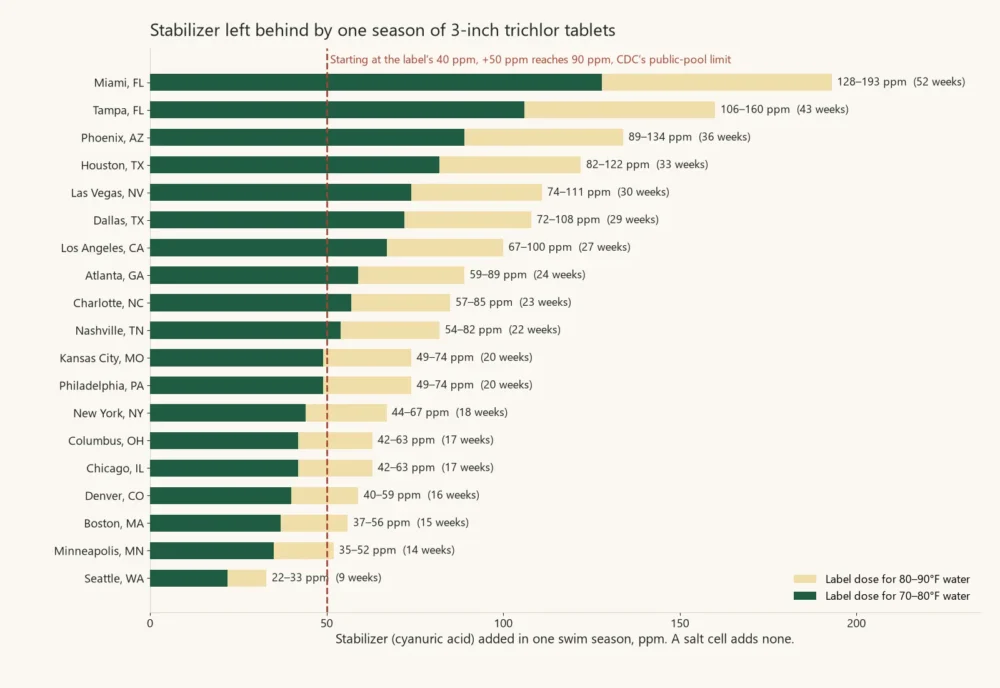
Across 40,906 ZIP codes, the median 17-week season lets tablets add 42 ppm at the 70–80°F dose and 63 ppm at the warmer one. Starting from the label’s 40 ppm,6 a season passes the 90 ppm limit in 33% of ZIP codes at the cooler dose and 73% at the warmer one. The label also says to add more after heavy use, heat or rain, so real pools can climb faster.
Maintenance: what changes and what doesn’t
Testing doesn’t change: CDC tells home pool owners to check chlorine and pH at least twice a day,1 and Pentair adds a monthly salt and stabilizer check.4 The hardware does.
- Cell cleaning. Inspect the cell every 3 months (Hayward) or every 2 months at first, then at least twice a year (Pentair).5,4 PHTA warns that scale forms inside it even in balanced water.3
- Shock. Both units have a boost mode, but the MAHC Annex says a separate chlorine product may be needed for shock,2 and Pentair suggests one at start-up.4 Our guide to shock doses has the label amounts.
- Acid. Both manuals discourage dry acid (sodium bisulfate) in arid regions; its by-products can damage the cell.5,4
- Tablet pools need the feeder refilled and a shock every one to two weeks, and nothing else in the feeder: the label warns an explosion might occur.6

Corrosion, stone and equipment
Salt is an inherently corrosive material.
Pentair singles out metal parts, steel pools and some natural and man-made surfaces, warns that salt above 4,500 ppm or chlorine above 4.0 ppm can cause excessive corrosion, and puts the cell at least 3 feet from the heater outlet.4 Hayward tells owners with natural stone coping or decking to consult a stone specialist first; its warranty excludes stone damage.5 On new plaster, wait 10–14 days (Hayward) or a month (Pentair) before adding salt.5,4 Tablets carry their own risk: keep them off pool surfaces, and use the skimmer only if it and its piping are plastic.6
Does salt water feel different?
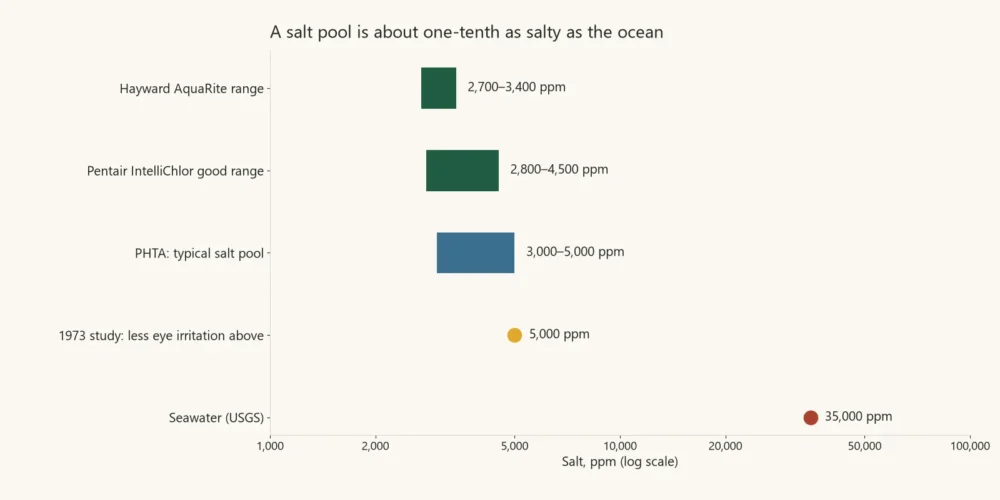
PHTA puts typical salt pools at about 3,000–5,000 ppm and seawater at 31,000–38,000 ppm, and says too much salt makes water taste and feel more like seawater.3 The USGS puts the ocean at about 35 parts per thousand.11
Much of what gets blamed on chlorine is something else:
If you smell “chlorine” at the place you swim, you are probably smelling chloramines.
Chloramines form when chlorine combines with sweat, dirt and pee, CDC’s eye irritation page explains, and that happens in salt and chlorine pools alike.9 The salt study the MAHC Annex cites found salt prevented eye irritation from tap water only above about 0.5%, or 5,000 ppm, saltier than the 2,700–4,500 ppm the manuals call for.10,2
Which one fits your pool
- Salt fits if you want chlorine made for you, swim a long season where tablets push stabilizer high, and your metal, stone and plaster suit salt.
- Chlorine fits if you want the lowest setup cost, have stone or metal you would rather keep away from salt, or swim a short season.
- Either way, find your gallons with the pool volume calculator; cell sizing and every dose depend on them.
Closing a salt pool? Both manuals warn that freezing water damages the cell,5,4 and our guide to when to close your pool covers timing; the water chemistry section has the rest.
Frequently asked questions
Higher equipment cost, electricity while the cell runs, a cell that wears out (Pentair designs its cell for about 10,000 hours), regular scale checks, and more corrosion risk for metal and some stone.
It depends on two local prices. A Pentair IC40 spends up to 56¢ of electricity at the US average to make a gallon of 10% liquid chlorine’s worth, plus 14¢ per $100 of cell price. If liquid chlorine costs you more than that, the cell is cheaper.
Check your materials first: Pentair warns about metal parts and steel pools, and Hayward about natural stone. Size the cell to your gallons, let new plaster cure, then run the cost math with your own prices.
A properly sized cell makes the daily chlorine, says PHTA, but superchlorination may still be needed on occasion. CDC’s pool code annex notes a separate chlorine product may be needed to shock, and Pentair suggests one at start-up.
You stop buying and adding chlorine, but testing stays the same: CDC says to check chlorine and pH at least twice a day. You add a monthly salt check and a cell inspection every two to three months.
Not iodized salt: CDC’s pool code annex warns it can form more toxic by-products. Hayward asks for salt over 99% pure without anti-caking additives, and Pentair for at least 99.8% pure, non-iodized salt with no additives.
Sources
- 1.Home Pool and Hot Tub Water Treatment and Testing. Centers for Disease Control and Prevention, 2024. Used for: free chlorine minimums (2 ppm with stabilizer), testing at least twice a day Back to text
- 2.Model Aquatic Health Code Annex, 5th Edition (2024 MAHC Annex). Centers for Disease Control and Prevention, 2024. Used for: how salt chlorination works, separate product may be needed for shock, cell wear and scale, 90 ppm CYA limit, pool-grade (non-iodized) salt, the salt and eye-irritation study it cites Back to text
- 3.Fact Sheet: Electrolytic Chlorine Generators. Pool & Hot Tub Alliance (PHTA) Recreational Water Quality Committee, 2021. Used for: adds no stabilizer or balancing chemicals, salt 3,000–5,000 ppm vs seawater 31,000–38,000, scale forms even in balanced water, occasional superchlorination Back to text
- 4.IntelliChlor Salt Chlorine Generator Installation and User’s Guide (P/N 520589 Rev R). Pentair, 2023. Used for: IC40 1.40 lb chlorine per 24 h, 220 W rated input, about 10,000 hours (about five years), 2.0–4.0 ppm chlorine, salt 2,800–4,500 ppm, corrosion warnings, cell inspection, 52°F cutoff, plaster wait, salt purity Back to text
- 5.AquaRite Electronic Chlorine Generator Owner’s Manual (092538 Rev D). Hayward Pool Products, 2019. Used for: salt 2,700–3,400 ppm, 1–3 ppm chlorine, salt lost only by splash/backwash/drain, 8-hour filter time, cell inspection every 3 months, 50°F cutoff, natural stone note, dry acid, plaster wait Back to text
- 6.RWP Master Trichloro label, 99% trichloro-s-triazinetrione, sold as Pool Time and Aqua Chem tablets (EPA Reg. No. 67262-17). Recreational Water Products / U.S. EPA, 2024. Used for: 3-inch tablet weekly dose chart by water temperature, 1–4 ppm, start stabilizer at 40–50 ppm, shock every 1–2 weeks, feeder and surface warnings Back to text
- 7.Chlorinating Liquid label, 10% sodium hypochlorite (EPA Reg. No. 7616-45). KIK Pool Additives / U.S. EPA, 2024. Used for: 13 fl oz per 10,000 gallons = 1 ppm (0.82 lb chlorine per gallon) Back to text
- 8.Electric Power Monthly, Table 5.6.B: Average Price of Electricity to Ultimate Customers by End-Use Sector, by State, Year-to-Date. U.S. Energy Information Administration, 2026. Used for: residential prices, January–July 2026 (U.S. 18.19¢; state prices in Table 3) Back to text
- 9.Preventing Eye Irritation from Pool Chemicals. Centers for Disease Control and Prevention, 2025. Used for: “chlorine” smell and eye irritation come from chloramines Back to text
- 10.The effect of saline on the eye irritation caused by swimming-pool water (Rylander R, Victorin K, Sörensen S; J Hyg 71:587–92). Journal of Hygiene, via PubMed Central, 1973. Used for: salt above about 0.5% prevented eye irritation from tap water Back to text
- 11.Why is the ocean salty?. U.S. Geological Survey, n.d. Used for: seawater about 35 parts per thousand Back to text
- 12.Trichlor: The dependable pool performer. PHTA Recreational Water Quality Committee, ICC Building Safety Journal, 2020. Used for: trichlor adds 0.6 ppm cyanuric acid per ppm chlorine Back to text
- 13.Cyanuric acid (CID 7956); trichloroisocyanuric acid (CID 6909). National Library of Medicine, PubChem, 2026. Used for: molecular weights for stabilizer per tablet dose (2.5 and 3.7 ppm a week) Back to text
- 14.U.S. Climate Normals 1991–2020. NOAA National Centers for Environmental Information, 2021. Used for: monthly mean temperatures behind the swim season for 19 cities and 40,906 ZIP codes Back to text
- 15.Use Pool Chemicals Safely (poster CS317109-B). Centers for Disease Control and Prevention, n.d. Used for: never mix chlorine with acid or different chlorine products; add chemical to water Back to text
How this guide was made
- Written by the Pool Desk and reviewed by the Data & Methodology Desk.
- Data: chlorine targets, salt ranges, cell output (Pentair IC40 1.40 lb per 24 h), power-center rating (220 W, a maximum) and cell life (about 10,000 hours) transcribed from the Hayward AquaRite and Pentair IntelliChlor manuals; 0.82 lb chlorine per gallon from the 10% liquid label (EPA Reg. No. 7616-45); electricity from EIA Table 5.6.B, residential prices averaged over January–July 2026 (the period our heat pump and hot tub cost guides use); stabilizer per tablet dose from the weekly chart on EPA Reg. No. 67262-17 and PubChem molecular weights; swim season = days with a normal daily mean air temperature of 65°F or more, NOAA NCEI U.S. Climate Normals 1991–2020 (station nearest each ZIP code), the same method as our shock guide. Air temperature stands in for water temperature, and dilution is ignored. See our methodology.
- AI use: AI tools help us research, draft and check this guide. Every figure is checked against the source cited for it, and calculated figures come from our own code, described on the methodology page.
- Spotted an error? Tell us — the form opens with this page’s address filled in.
Change log
- Oct 4, 2026Published. Salt and chlorine pools compared from the Hayward and Pentair manuals, EPA-registered labels, PHTA and CDC; salt-cell chlorine priced from Pentair’s specifications and EIA electricity prices; stabilizer from a season of trichlor tablets computed for 19 cities and 40,906 ZIP codes from NOAA 1991–2020 normals.
- Oct 7, 2026Electricity prices switched from EIA’s July 2026 monthly table (5.6.A) to its January–July 2026 averages (5.6.B), the period our other cost guides use: a gallon’s worth of salt-cell chlorine is now up to 56¢ at the US average (was 57¢), and the city electricity costs in Table 3 moved by $0–5. Chart 2 redrawn. Manual, label, PHTA and CDC figures and quotes re-checked.
Covers pool and hot tub water chemistry, opening and closing. We maintain the dosing calculators and check every rate against product chemistry and public health guidance.
Keep reading
How Much Shock to Add to a Pool: Doses, SLAM and CYA
One label shock dose adds about 5–10 ppm free chlorine. Label doses for liquid chlorine, cal-hypo, dichlor and non-chlorine shock, SLAM levels by stabilizer, and the CYA that weekly dichlor adds by city.
Ideal Pool Chemical Levels: The Ranges and Who Sets Them
Free chlorine 2–3 ppm, pH 7.4–7.6, alkalinity 80–120 ppm, calcium 200–400 ppm, stabilizer 30–50 ppm: every range tied to CDC or a manufacturer’s manual.
How to Winterize a Hot Tub, and When to Keep It Running
Hot tub makers say a tub kept full, heated and covered protects itself from freezing. When to drain and winterize instead, with NOAA freeze dates and winter running costs for 21 US cities.
Seasonal reminders for your ZIP
Get a short email when it’s time to overseed, start seeds, open the pool or service your furnace — timed to your climate.