




Hot Tub Chemical Levels: Chlorine, Bromine and pH Ranges by Source
CDC’s hot tub minimums, three state spa codes and three spa makers’ manuals side by side, plus why a tub needs more sanitizer than a pool and how often to test and refill it.
- Last reviewed Oct 7, 2026
- 18 cited sources
- 10 min read
- 1CDC’s hot tub minimums are at least 3 ppm free chlorine or 4 ppm bromine, pH 7.0–7.8 and no stabilizer; its 2024 model code sets the same floors for public spas.
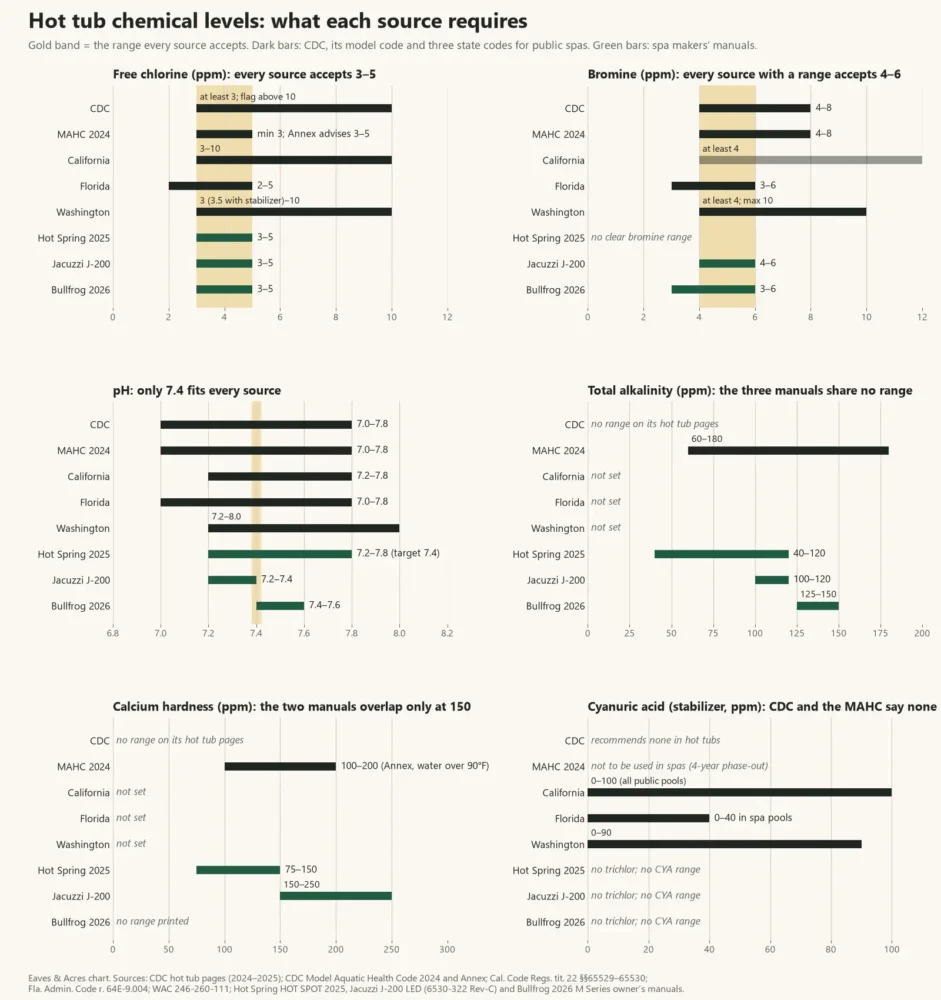
- 2Every source we read accepts 3–5 ppm chlorine, 4–6 ppm bromine and a pH of 7.4. Alkalinity and calcium differ by manual, so use your tub’s.
- 3A hot tub needs three times a pool’s 1 ppm chlorine floor because hot water, a small volume and heavy use burn sanitizer off.
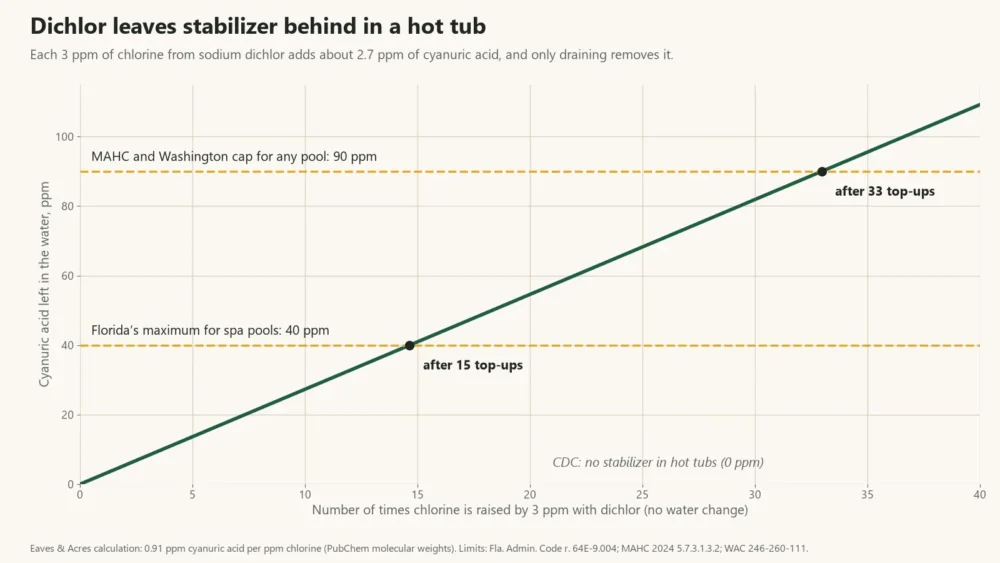
- 4Dichlor leaves about 0.9 ppm of stabilizer per ppm of chlorine, and only draining removes it; Florida caps spa stabilizer at 40 ppm.
- 5Keep the water at 104°F or below, the limit in CPSC’s spa safety alert, CDC’s model code and the state codes we read.
A hot tub needs at least 3 ppm free chlorine or 4 ppm bromine, a pH between 7.0 and 7.8, no stabilizer, and water no hotter than 104°F. Those are CDC’s numbers, and the chlorine floor is three times a pool’s 1 ppm because hot water, a small volume and a crowd of bathers use up sanitizer fast. Many hot tub charts, and Google’s AI summary when we checked, still list 1–3 ppm chlorine, which falls below CDC’s floor.
Below, each number is tied to the document it comes from: CDC’s hot tub pages, its Model Aquatic Health Code (MAHC), three state spa codes and three spa makers’ manuals. Where they disagree, we show both.
Hot tub chemical levels at a glance
CDC recommends not using cyanuric acid or chlorine products with cyanuric acid in hot tubs.
“Home target” is the range every source we read accepts, or your manual’s where they disagree. “Official limits” are CDC’s advice and the MAHC’s rules for public spas, a model many health departments build on.4
| Test | Home target | Official limits | Where it comes from |
|---|---|---|---|
| Free chlorine | 3–5 ppm | At least 3 ppm; CDC flags readings above 10 ppm | CDC; MAHC 5.7.3.1.1.2.3 |
| Bromine | 4–6 ppm | 4–8 ppm | CDC; MAHC 5.7.3.1.2 |
| pH | 7.4 | 7.0–7.8 | CDC; MAHC 5.7.3.4.1 |
| Total alkalinity | Your spa manual’s range | 60–180 ppm | MAHC 5.7.4.4.1 |
| Calcium hardness | Your spa manual’s range | 100–200 ppm advised for water over 90°F | MAHC Annex |
| Cyanuric acid (stabilizer) | 0 ppm | None advised (CDC); not to be used in spas (MAHC) | CDC; MAHC 5.7.3.1.3.1 |
| Combined chlorine | 0 ppm | Act above 0.4 ppm | MAHC 5.7.4.4.2 |
| Water temperature | 104°F or lower | 104°F maximum | CPSC; MAHC 5.7.4.7.2 |
The chlorine, bromine and pH floors are on CDC’s hot tub safety page and its home pool and hot tub page.1,2 The rest come from the 2024 MAHC, 5th edition and its Annex.4,5 The upper limit for chlorine is the product label’s, and the Annex notes that EPA has approved no spa product for use above 5 ppm free chlorine while people are in the water.5 For the pool versions of these numbers, see our guide to ideal pool chemical levels.
Why hot tub numbers differ from pool numbers
Low water volumes combined with high temperatures and heavy bather loads
The result, CDC says, can be disinfectant levels low enough to let germs grow and spread.3 The MAHC Annex gives the same reasons for a 3 ppm spa minimum instead of 1 ppm: more people for the volume, higher temperatures and the users these venues serve. It recommends 3–5 ppm in spas against 2–4 ppm in pools, as a margin above the floor.5
| Rule | Pool | Hot tub | Source |
|---|---|---|---|
| Minimum free chlorine | 1 ppm; 2 ppm with stabilizer | 3 ppm | CDC |
| Minimum bromine | 3 ppm | 4 ppm | MAHC |
| Stabilizer (cyanuric acid) | Allowed; at most 90 ppm in public pools | None advised | CDC; MAHC |
| Calcium hardness | 200–400 ppm preferred | 100–200 ppm for water over 90°F | MAHC Annex |
Hot water uses up chlorine faster
The Annex says chlorine “is not stable at high temperatures” and breaks down to inactive chloride even with no one in the water.5 Hotter water also means more sweat, so the Annex’s design formula adds a sweat factor for water routinely above 95°F.5 CDC also lists the droplets and mist from hot tub jets among the things that lower chlorine.2
A small volume concentrates every bather
Put the same bather in a 400-gallon hot tub and a 20,000-gallon pool (find your pool’s gallons with our pool volume calculator), and whatever they bring in lands in fifty times less water in the tub. The MAHC’s water-change rule for public spas is built on the same two numbers, gallons and users.4
No stabilizer: the biggest difference
Outdoor pools use cyanuric acid to shield chlorine from sunlight. Hot tubs are the exception: CDC recommends against it, and the MAHC says spas must not use stabilizer or stabilized chlorine, giving existing public spas four years to stop.2,4 The Annex cites trouble killing germs in biofilms and keeping pH where it is needed in spas.5 Not every state has followed: Florida allows up to 40 ppm in spa pools, and Washington allows stabilizer if the spa keeps at least 3.5 ppm chlorine.10,11
The catch is sodium dichlor, the granular chlorine that the Hot Spring and Bullfrog manuals list, which is a stabilized chlorine.12,14,2 By molecular weight, each ppm of chlorine it adds leaves about 0.9 ppm of cyanuric acid, the same figure our shock guide uses for pools.16 Only draining removes it. Raise a tub’s chlorine by 3 ppm with dichlor 15 times without a water change and it reaches Florida’s 40 ppm spa cap; 33 times reaches the 90 ppm cap the MAHC sets for any pool.10,4 If you use dichlor, test stabilizer and refill on schedule. Liquid chlorine adds none.
Chlorine or bromine: what each reading means
A home tub runs on one of the two. Their floors differ, and so does what the test reads, so check the number for the sanitizer you actually use.
Hot tub chlorine level
Keep free chlorine at 3 ppm or more at all times. That is the floor in CDC’s advice, the MAHC and the California and Washington codes; Florida’s spa floor is 2 ppm.1,4,8,11,10 All three manuals we read target 3–5 ppm.12,13,14 CDC tells hot tub users to raise any reading over 10 ppm with the owner, and warns that above 10 ppm a DPD test can bleach out and read falsely low.1,2
The common 1–3 ppm matches the pool range in two salt-chlorinator manuals, as our pool guide shows, and Hot Spring’s chart puts 1 ppm at the bottom of its “OK” band while targeting 3 ppm.12 Tubs with ozone may run nearer the minimum by their maker’s instructions, but Bullfrog still sets an absolute minimum of 2 ppm.14 None of that changes CDC’s 3 ppm.
Hot tub bromine level
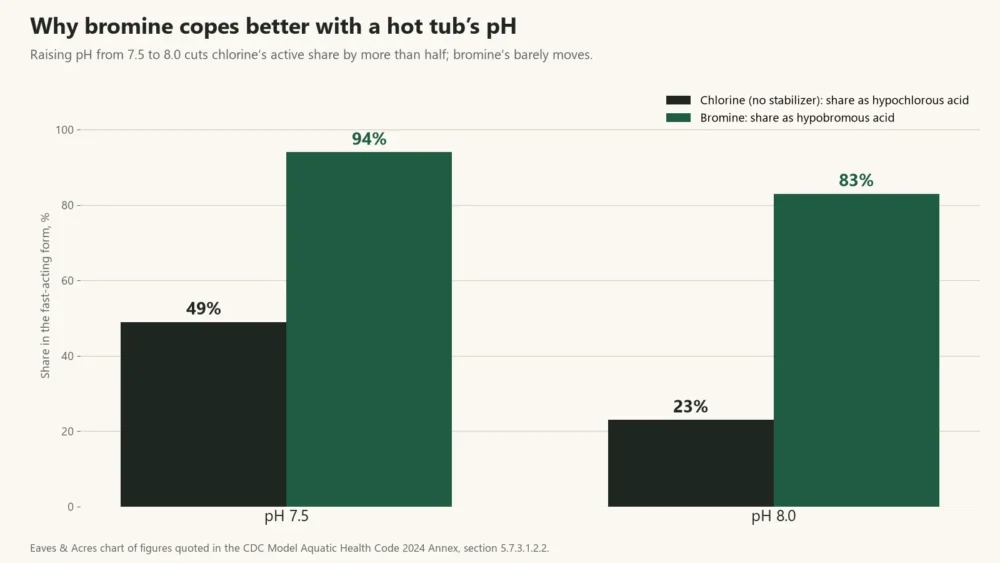
Bromine floors are higher: at least 4 ppm in CDC’s advice, the MAHC, California and Washington, with 8 ppm as the MAHC’s maximum and CDC’s flag.1,4,8,11 Jacuzzi prints 4–6 ppm, Bullfrog 3–6, and Florida allows 3–6.13,14,10 The Annex notes that every jurisdiction asks for more bromine than chlorine, and that test kits report total bromine, a chlorine-scale reading multiplied by 2.25 for bromine’s heavier atoms. It adds that spa pH tends to run high, where bromine holds up better.5
The MAHC approves BCDMH, a common bromine tablet, but Hot Spring tells owners not to use it in its spas.4,12 And cyanuric acid does not protect bromine, which sunlight destroys quickly, so keep the cover on; CDC advises public operators to cover hot tubs to cut disinfectant loss.5,3
What state codes and spa manuals say
State spa codes cover public hot tubs at hotels, gyms and apartments; a backyard tub answers to its manual and product labels. California’s tit. 22 §65529 is typical, with a separate row for spas.8
| Source | Free chlorine | Bromine | pH | Alkalinity | Calcium | Stabilizer |
|---|---|---|---|---|---|---|
| California (tit. 22 §§65529–65530) | 3–10 | At least 4 | 7.2–7.8 | Not set | Not set | 0–100, all public pools |
| Florida (r. 64E-9.004) | 2–5 | 3–6 | 7.0–7.8 | Not set | Not set | 40 maximum in spa pools |
| Washington (WAC 246-260-111) | 3–10 (3.5 with stabilizer) | At least 4 | 7.2–8.0 | Not set | Not set | 0–90 |
| Hot Spring HOT SPOT, 2025 | 3–5 | No clear range | 7.2–7.8 | 40–120 | 75–150 | No trichlor |
| Jacuzzi J-200 series | 3–5 | 4–6 | 7.2–7.4 | 100–120 | 150–250 | No trichlor |
| Bullfrog M Series, 2026 | 3–5 | 3–6 | 7.4–7.6 | 125–150 | Not printed | No trichlor |
On sanitizer the sources agree: 3–5 ppm chlorine and 4–6 ppm bromine satisfy every one that prints a range. On pH, the only value inside all of them is 7.4, because Jacuzzi tops out there and Bullfrog starts there. Alkalinity and calcium have no shared band: Hot Spring’s and Jacuzzi’s alkalinity both end at 120 ppm, below Bullfrog’s 125. Use the range printed for your own tub; the MAHC’s public limit of 60–180 ppm spans all three.4,12,13,14
Hot tub temperature: the 104°F limit
Keep the temperature of the water in the spa at 104 degrees Fahrenheit or below.
CPSC’s safety alert says it helped develop requirements in 1987 for temperature controls so spa water never exceeds 104°F.6 The MAHC uses the same maximum, based on most state codes, and California and Washington write it into their rules.4,5,9,11 The Hot Spring and Jacuzzi manuals agree, and advise cooler water for young children and for soaks over 10 minutes.12,13 In 1979, CPSC also advised checking with an accurate thermometer, as thermostats could be off by up to four degrees.7
A test-and-adjust routine from the sources
The sources agree on the order of adjustments, not on how often to test.
How often to test hot tub water
| Source | Sanitizer and pH | Alkalinity and calcium |
|---|---|---|
| CDC, home pools and hot tubs | At least twice a day; more with many users | Not stated |
| MAHC, public spas | Before opening, then every 2 hours (manual feed) or 4 hours (automatic) | Alkalinity weekly, calcium monthly |
| Hot Spring | Weekly, or each time the spa is used | Alkalinity monthly |
| Bullfrog | 2–3 times a week for up to 3 uses a week, plus once per extra use | Not stated |
CDC calls a DPD kit the most accurate home test, says strips are less accurate, and tells owners to follow the kit maker’s directions.2
Adjust in order, one product at a time
Hot Spring balances calcium, then alkalinity, then pH, since each step makes the next easier and changing alkalinity can swing pH; Bullfrog adjusts alkalinity, then pH, then sanitizer.12,14 Hot Spring has every chemical poured into the filter compartment with the jets on high for at least 10 minutes, and the cover left open at least 20 minutes after a shock to vent the gas.12 CDC tells public operators to shock hot tubs daily to weekly, depending on water quality and how often water is replaced;3 the dose is on your product’s label.
Drain and refill on a schedule
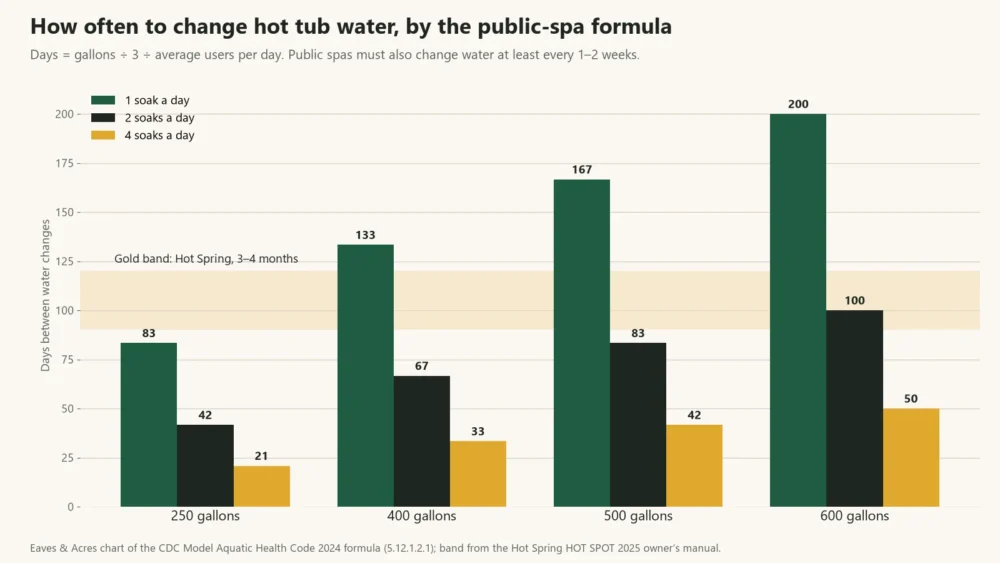
Minerals left behind by evaporation, and stabilizer from dichlor, leave only with the water, so hot tubs get fresh water on a schedule.12 For public spas, the MAHC sets the interval at the tub’s gallons divided by 3, divided by average daily users, and at least every 1–2 weeks; its example is a 600-gallon spa with 25 users a day, refilled every 8 days.4,5 Run the same formula on a home tub and two soaks a day in 400 gallons comes to about 67 days. The manuals say every 3–4 months (Hot Spring) and every 1–4 months (Bullfrog).12,14
Where to go next
For the same numbers in a swimming pool, and why they are lower, see ideal pool chemical levels. Before freezing weather, see how to winterize a hot tub. More guides are collected in the hot tubs section of Pool & Spa.
Frequently asked questions
Free chlorine 3–5 ppm or bromine 4–6 ppm, pH about 7.4, no stabilizer, and alkalinity and calcium in your tub manual's ranges. Those values satisfy CDC, its model code, three state spa codes and the three spa manuals we read.
CDC's minimum for hot tubs is 3 ppm free chlorine, or 4 ppm bromine, and it warns that low disinfectant levels let germs grow and spread. If a test reads lower, raise it and retest before anyone gets in.
You are over the label. CDC's model code Annex notes that EPA has approved no spa product above 5 ppm free chlorine with people in the water, and CDC flags readings above 10 ppm, where a DPD test can bleach out and read falsely low. Stay out until it is back within the label's range.
Above 8 ppm. That is the maximum in CDC's 2024 Model Aquatic Health Code while bathers are present, and CDC tells hot tub users to raise any reading above 8 ppm with the owner.
Add the bromine product your spa maker recommends, by its label for your gallons, then retest. Check the product first: CDC's model code approves BCDMH and DBDMH bromine, but Hot Spring forbids BCDMH in its spas.
CDC lists bather waste such as sweat, sunlight and the mist from hot tub jets as things that lower chlorine, and its model code Annex says chlorine is unstable at high temperatures. CDC also advises covering hot tubs to cut disinfectant loss.
Every 3–4 months by the Hot Spring manual, or every 1–4 months by Bullfrog's. The public-spa formula in CDC's model code is gallons ÷ 3 ÷ average daily users, about 67 days for a 400-gallon tub used twice a day.
Sources
- 1.What You Can Do to Stay Healthy in Hot Tubs. Centers for Disease Control and Prevention, 2025. Used for: hot tub chlorine at least 3 ppm (ask above 10), bromine 4–8 ppm, pH 7.0–7.8, 104°F maximum, children under 5, alcohol Back to text
- 2.Home Pool and Hot Tub Water Treatment and Testing. Centers for Disease Control and Prevention, 2024. Used for: 3 ppm in hot tubs, no cyanuric acid or stabilized chlorine in hot tubs, what lowers chlorine (incl. jets), testing twice a day, DPD kits vs strips Back to text
- 3.Operating and Managing Public Pools, Hot Tubs and Splash Pads. Centers for Disease Control and Prevention, 2025. Used for: low volume, high temperature and bather load; 3 ppm chlorine or 4 ppm bromine; shock daily to weekly; covers cut disinfectant loss Back to text
- 4.Model Aquatic Health Code, 5th Edition (2024 MAHC Code). Centers for Disease Control and Prevention, 2024. Used for: spa minimums (5.7.3.1.1.2.3, 5.7.3.1.2.2), bromine maximum, no CYA in spas (5.7.3.1.3.1), pH, alkalinity, combined chlorine, 104°F maximum (5.7.4.7.2), testing (5.7.5), water replacement formula (5.12.1.2.1) Back to text
- 5.Model Aquatic Health Code Annex, 5th Edition (2024 MAHC Annex). Centers for Disease Control and Prevention, 2025. Used for: why spas need 3 ppm, 3–5 ppm advised, EPA 5 ppm spa cap with bathers, chlorine unstable at high temperature, sweat factor, bromine ×2.25 and HOBr vs HOCl, why no CYA in spas, calcium 100–200 ppm above 90°F, 104°F basis, water replacement example Back to text
- 6.Spas, Hot Tubs, and Whirlpools (Consumer Product Safety Alert). U.S. Consumer Product Safety Commission, undated. Used for: 1987 temperature-control requirements, keep spa water at 104°F or below Back to text
- 7.CPSC Warns Of Hot Tub Temperatures (release 79-071). U.S. Consumer Product Safety Commission, 1979. Used for: check with an accurate thermometer; thermostats may err by up to four degrees Back to text
- 8.Cal. Code Regs. tit. 22, § 65529 – Public Pool Disinfection. State of California (via Cornell LII), 2016. Used for: public spas: free chlorine 3.0–10.0 ppm, bromine at least 4.0 ppm Back to text
- 9.Cal. Code Regs. tit. 22, § 65530 – Public Pool Water Characteristics. State of California (via Cornell LII), 2016. Used for: pH 7.2–7.8, cyanuric acid 0–100 ppm, 104°F maximum Back to text
- 10.Fla. Admin. Code r. 64E-9.004 – Water Quality. Florida Department of Health (via Cornell LII), 2023. Used for: spa-type pools: free chlorine 2–5 mg/L, bromine 3–6 mg/L, cyanuric acid 40 mg/L maximum, pH 7.0–7.8 Back to text
- 11.WAC 246-260-111 – Water quality standards (and Appendix A tables). Washington State Department of Health, accessed 2026. Used for: spa minimums 3.0 ppm chlorine (3.5 with cyanurate) and 4.0 ppm bromine, 10 ppm maximum, pH 7.2–8.0, cyanuric acid 0–90 ppm, 104°F maximum Back to text
- 12.HOT SPOT Collection 2025 Owner’s Manual. Hot Spring Spas (Watkins Wellness), 2025. Used for: water quality chart, balancing order, testing weekly or each use, dichlor, no trichlor or BCDMH, jets and cover-open rules, drain every 3–4 months, 104°F Back to text
- 13.LED Series Hot Tub Owner’s Manual, J-210/J-220/J-230 (6530-322 Rev-C). Jacuzzi, undated. Used for: APSP-based ranges (chlorine 3–5, bromine 4–6, pH 7.2–7.4, alkalinity 100–120, calcium 150–250), no trichlor, 104°F Back to text
- 14.M Series Owners Manual 2026 (v1.2). Bullfrog International, 2026. Used for: chlorine 3–5, bromine 3–6, pH 7.4–7.6, alkalinity 125–150, adjustment order, testing frequency, ozone 2 ppm minimum, no trichlor, water change every 1–4 months Back to text
- 15.Thousands Sent to Emergency Room by Preventable Pool Chemical Injuries. Centers for Disease Control and Prevention, 2014. Used for: pool chemical safety rules Back to text
- 16.Cyanuric acid (CID 7956); sodium dichloroisocyanurate dihydrate (CID 23667638). National Library of Medicine, PubChem, 2026. Used for: molecular weights behind 0.91 ppm cyanuric acid per ppm chlorine from dichlor Back to text
- 17.The Spa at the Silver Legacy (photo). Missvain, via Wikimedia Commons, CC BY 4.0, 2021. Used for: hero photo, cropped and resized
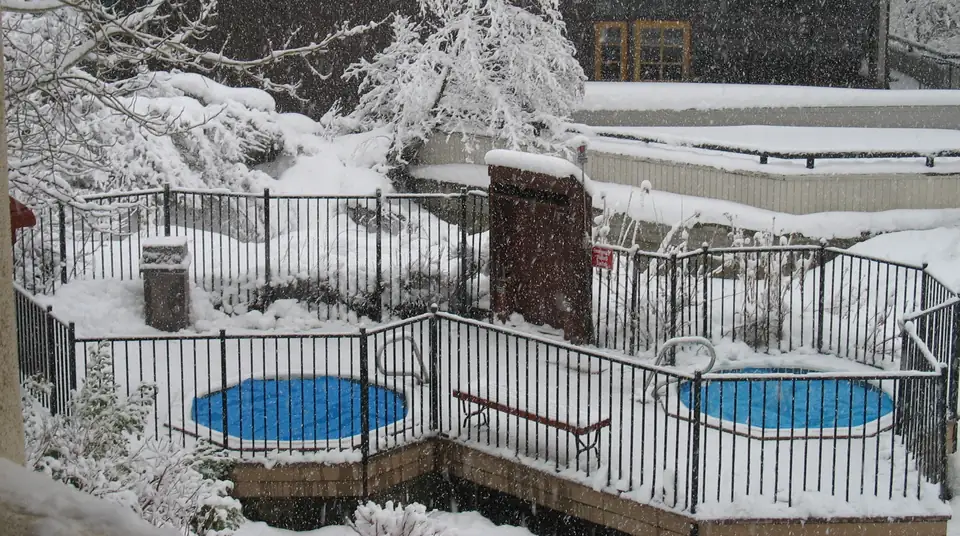
- 18.Hot Tubs Olympic Village Inn (photo). Rennett Stowe, via Wikimedia Commons, CC BY 2.0, 2007. Used for: inline photo, cropped and resized

.jpg)
How this guide was made
- Written by the Pool Desk and reviewed by the Data & Methodology Desk.
- Data: ranges transcribed from CDC’s hot tub pages, the 2024 Model Aquatic Health Code and Annex, three state spa codes and three spa owner’s manuals. Stabilizer from dichlor uses 0.91 ppm cyanuric acid per ppm chlorine (PubChem molecular weights); water-change days use the MAHC formula, gallons ÷ 3 ÷ average daily users. This guide uses no NOAA climate data: hot tub water is heated, so outdoor air normals do not set its chemistry. See our methodology.
- AI use: AI tools help us research, draft and check this guide. Every figure is checked against the source cited for it, and calculated figures come from our own code, described on the methodology page.
- Spotted an error? Tell us — the form opens with this page’s address filled in.
Change log
- Oct 6, 2026Published. Hot tub ranges reconciled from CDC’s three hot tub pages, the 2024 Model Aquatic Health Code and Annex, the California, Florida and Washington spa codes and the Hot Spring, Jacuzzi and Bullfrog owner’s manuals; stabilizer build-up from dichlor and water-change intervals calculated from those sources.
- Oct 7, 2026Re-checked the CDC, MAHC, CPSC and Florida figures and every quote; added a short introduction to the chlorine-or-bromine section; links to our hot tub running-cost guide added in the temperature and water-change sections.
Covers pool and hot tub water chemistry, opening and closing. We maintain the dosing calculators and check every rate against product chemistry and public health guidance.
Keep reading
How to Winterize a Hot Tub, and When to Keep It Running
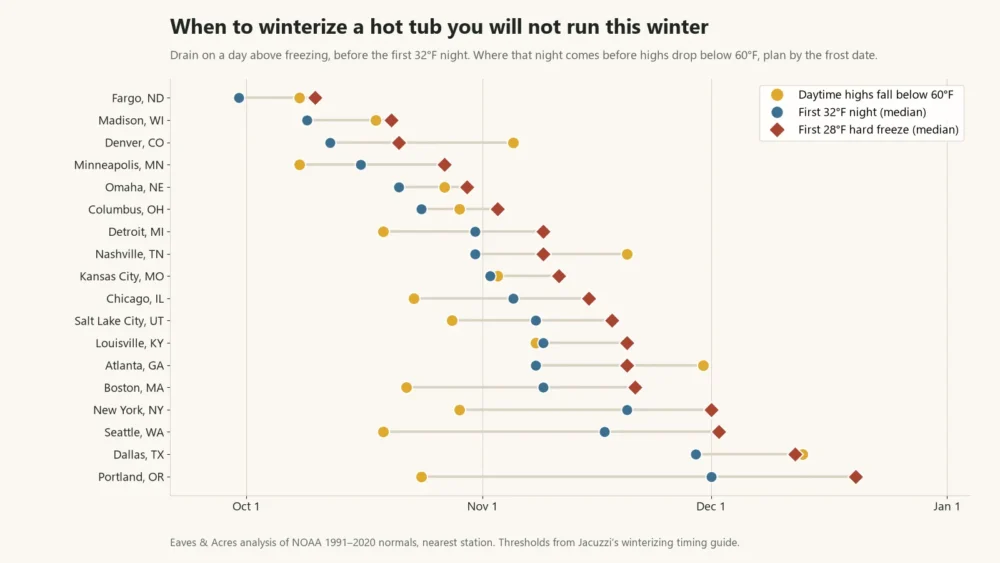
Hot tub makers say a tub kept full, heated and covered protects itself from freezing. When to drain and winterize instead, with NOAA freeze dates and winter running costs for 21 US cities.
How Much Does It Cost to Run a Hot Tub? The Math by City
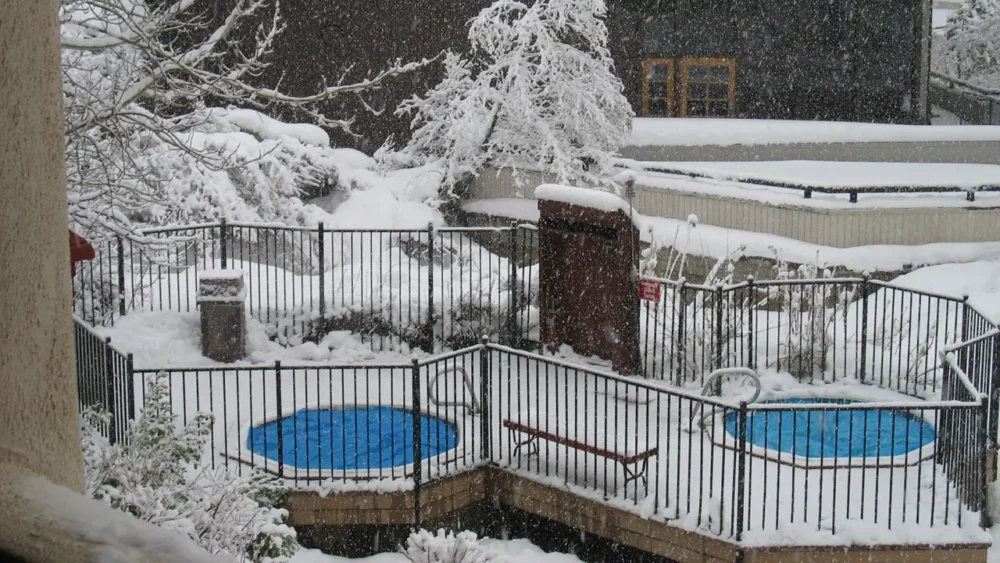
The median hot tub certified in California costs about $25 a month to keep hot at the US average electricity price. Standby cost by month for 21 cities from CEC test data, NOAA normals and EIA prices.
When to Open Your Pool: Estimated Dates for Your City and State
Open before the water warms past 60°F and after freezing nights end. Estimated opening dates for 49 cities from NOAA climate normals, and how the 70°F rule compares.
Seasonal reminders for your ZIP
Get a short email when it’s time to overseed, start seeds, open the pool or service your furnace — timed to your climate.