




When to Apply Grub Control: Preventive and Curative Dates Where You Live
Preventive and curative grub products work at different times of year. Here is when each fits, with normal-year Japanese beetle flight dates for 29 cities from NOAA normals and Iowa State’s degree-day rule, checked against seven extension services.
- Last reviewed Oct 7, 2026
- 22 cited sources
- 8 min read
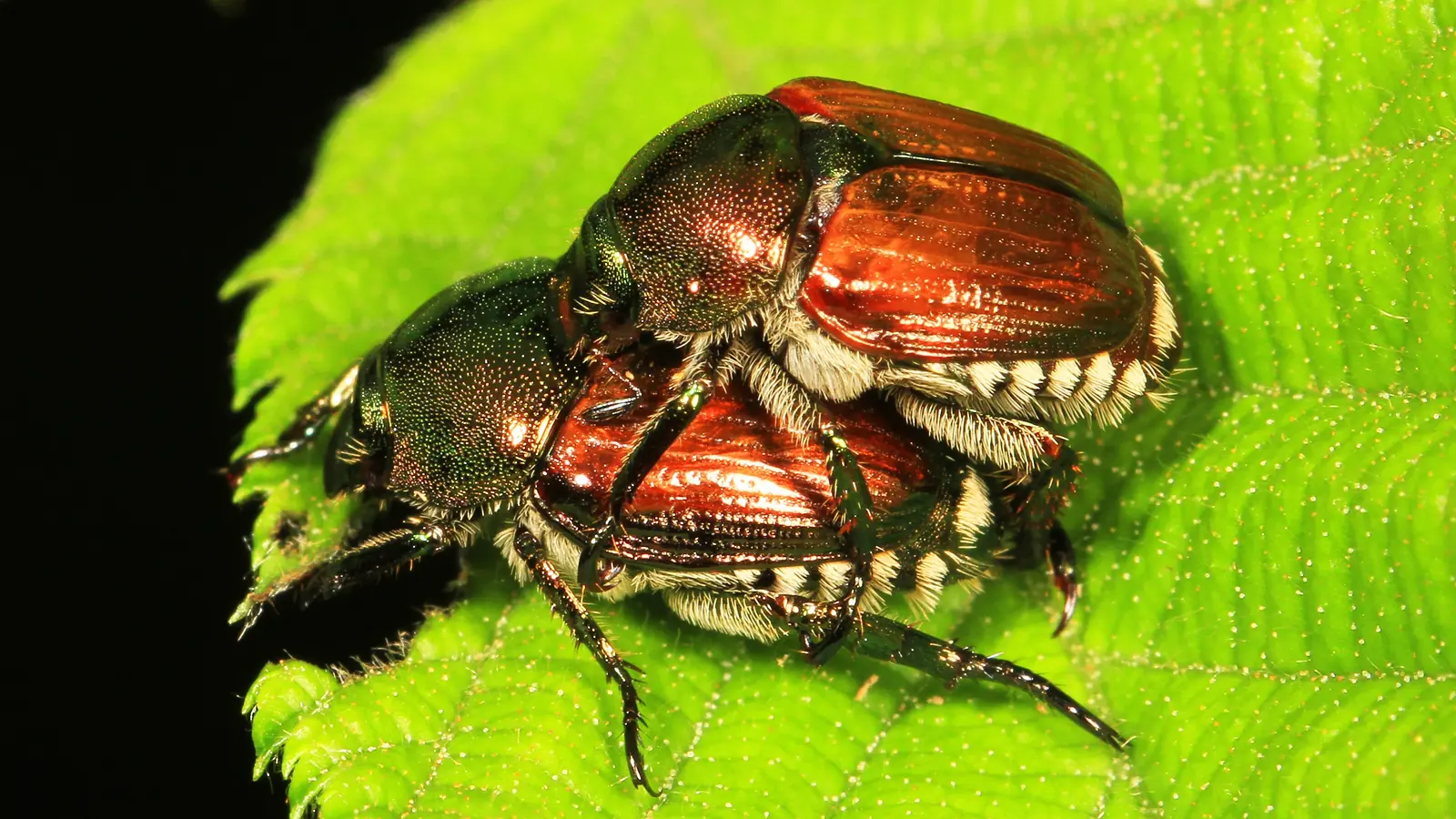
- 1Preventive grub control (imidacloprid, clothianidin, thiamethoxam) goes down as beetles lay eggs, mid-June to mid-July in Kentucky and Pennsylvania, and works on newly hatched grubs.
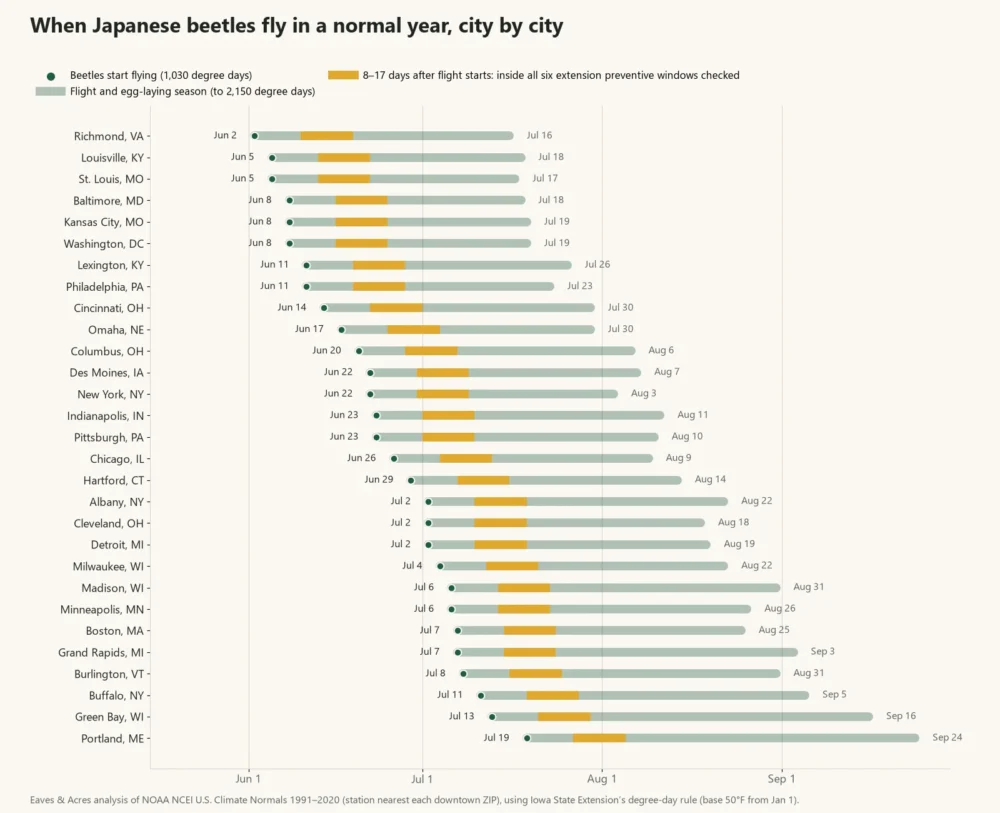
- 2Our preventive target, 8 to 17 days after Japanese beetles start flying (Iowa State’s 1,030 degree-day rule on NOAA normals), is about Jun 16–25 in Washington, Jul 4–13 in Chicago and Jul 15–24 in Boston. It falls inside all six extension windows we checked.
- 3Chlorantraniliprole, the active ingredient in today’s GrubEx, moves slowly and goes down earlier: mid-April to early June (UMass) or late May to late June (UNH) in New England. Older guides list GrubEx as imidacloprid, so check the label.
- 4Curatives (trichlorfon, carbaryl) belong in August to early September, while grubs are small. Spring treatment rarely works.
- 5Treat only after damage or a grub count that justifies it (Purdue: under 5 per square foot rarely does), water about ½ inch in, and keep insecticides off blooming weeds.
Apply a preventive grub control while Japanese beetles and related beetles are laying eggs, usually mid-June to mid-July, so it is already in the soil when the eggs hatch. Chlorantraniliprole, the active ingredient in today’s GrubEx, can go down weeks earlier. Use a curative product such as trichlorfon in August or early September, and only when you find enough young grubs. Spring treatment rarely pays.
Egg-laying follows the weather. By Iowa State Extension’s degree-day rule and NOAA’s 1991–2020 climate normals, Japanese beetles normally start flying around Jun 8 in Washington, Jun 26 in Chicago and Jul 7 in Boston. Dates for 29 cities are below, checked against seven extension services.
Preventive or curative: two different calendars
Preventive products last for weeks in the soil and work best on newly hatched grubs. Curative products act fast but briefly, for grubs you have already found.4,6
| Approach | Active ingredients (examples) | When |
|---|---|---|
| Preventive: neonicotinoid (new grubs) | imidacloprid, clothianidin, thiamethoxam | Around egg-laying: mid-June to mid-July in Kentucky and Pennsylvania |
| Preventive: diamide (new grubs) | chlorantraniliprole (GrubEx, Acelepryn) | Earlier: from mid-April or late May in New England; May 15 to late July in Kentucky |
| Curative (feeding grubs) | trichlorfon (Dylox), carbaryl (Sevin) | August to early September, while grubs are small |
Biological products such as nematodes and milky spore give limited, highly variable control, UW–Madison Extension adds, and milky spore has not proved effective in recent university research.4
Loads from YouTube (privacy-enhanced mode) only when you press play.
When Japanese beetles fly in your city
Iowa State Extension entomologists say Japanese beetle adults begin emerging at about 1,030 growing degree days (base 50°F) counted from January 1, and keep emerging until about 2,150.2 We applied that rule to NOAA’s normals at the weather station nearest each city.1 The preventive target is day 8 to day 17 after flight starts, the stretch inside all six published preventive windows we could tie to a place.
| City (ZIP) | Flight starts | Preventive target | Flight ends |
|---|---|---|---|
| Richmond, VA (23219) | Jun 2 | Jun 10–19 | Jul 16 |
| Louisville, KY (40202) | Jun 5 | Jun 13–22 | Jul 18 |
| St. Louis, MO (63101) | Jun 5 | Jun 13–22 | Jul 17 |
| Baltimore, MD (21202) | Jun 8 | Jun 16–25 | Jul 18 |
| Kansas City, MO (64105) | Jun 8 | Jun 16–25 | Jul 19 |
| Washington, DC (20001) | Jun 8 | Jun 16–25 | Jul 19 |
| Lexington, KY (40507) | Jun 11 | Jun 19–28 | Jul 26 |
| Philadelphia, PA (19103) | Jun 11 | Jun 19–28 | Jul 23 |
| Cincinnati, OH (45202) | Jun 14 | Jun 22–Jul 1 | Jul 30 |
| Omaha, NE (68102) | Jun 17 | Jun 25–Jul 4 | Jul 30 |
| Columbus, OH (43215) | Jun 20 | Jun 28–Jul 7 | Aug 6 |
| Des Moines, IA (50309) | Jun 22 | Jun 30–Jul 9 | Aug 7 |
| New York, NY (10001) | Jun 22 | Jun 30–Jul 9 | Aug 3 |
| Indianapolis, IN (46204) | Jun 23 | Jul 1–10 | Aug 11 |
| Pittsburgh, PA (15222) | Jun 23 | Jul 1–10 | Aug 10 |
| Chicago, IL (60601) | Jun 26 | Jul 4–13 | Aug 9 |
| Hartford, CT (06103) | Jun 29 | Jul 7–16 | Aug 14 |
| Albany, NY (12207) | Jul 2 | Jul 10–19 | Aug 22 |
| Cleveland, OH (44113) | Jul 2 | Jul 10–19 | Aug 18 |
| Detroit, MI (48201) | Jul 2 | Jul 10–19 | Aug 19 |
| Milwaukee, WI (53202) | Jul 4 | Jul 12–21 | Aug 22 |
| Madison, WI (53703) | Jul 6 | Jul 14–23 | Aug 31 |
| Minneapolis, MN (55401) | Jul 6 | Jul 14–23 | Aug 26 |
| Boston, MA (02108) | Jul 7 | Jul 15–24 | Aug 25 |
| Grand Rapids, MI (49503) | Jul 7 | Jul 15–24 | Sep 3 |
| Burlington, VT (05401) | Jul 8 | Jul 16–25 | Aug 31 |
| Buffalo, NY (14202) | Jul 11 | Jul 19–28 | Sep 5 |
| Green Bay, WI (54301) | Jul 13 | Jul 21–30 | Sep 16 |
| Portland, ME (04101) | Jul 19 | Jul 27–Aug 5 | Sep 24 |
These are normal-year dates: in 2020 Iowa State reported emergence 7 to 10 days early.3 The rule is for Japanese beetle, which NC State says lives in most of the eastern US and parts of the West.19
Does the degree-day rule match extension advice?
| Place | Computed flight start | Published timing |
|---|---|---|
| Southern Iowa: Burlington, Ottumwa, Mount Ayr | Jun 21 / Jun 22 / Jun 27 | In 2020, emergence was starting about June 13, “7–10 days ahead of the last few years” (Iowa State) |
| Central Pennsylvania: State College | Jul 3 | Japanese beetle and masked chafer adults emerge mid-June to mid-July (Penn State) |
| Kentucky: Louisville, Lexington | Jun 5 / Jun 11 | Adults emerge in June and July; best preventive window mid-June to mid-July (Kentucky) |
| Illinois: Champaign, Chicago | Jun 20 / Jun 26 | Peak egg-laying late June to mid-July (Illinois Extension) |
| Indiana: Indianapolis, West Lafayette | Jun 23 / Jun 26 | Best preventive timing early to mid-July (Purdue) |
| New England: Boston, Amherst, Concord NH | Jul 7 / Jul 7 / Jul 10 | Adults fly in early summer; eggs late June to late July (UMass, UNH) |
| Western North Carolina: Hendersonville | Jun 9 | Emerging in early June; adults out mid- to late June through early July (NC Extension, Henderson County) |
Every computed start falls inside the published range or within about a week of it; New England runs a little late.3,8,6,11,5,9,10,13 The six preventive windows open from 35 days before the computed start (UW–Madison) to 8 days after it (Purdue’s E-271), and all overlap from day 8 to day 17.
Early-to-mid-July is almost always optimum timing for preventive applications.
GrubEx (chlorantraniliprole) goes down earlier
Chlorantraniliprole moves slowly: UMass says it takes 60 to 90 days to fully dissipate in soil and advises mid-April to early June, while UNH says late May to late June.9,10 That is 4 to 12 weeks before our computed flight start for Boston and 1 to 7 weeks before it for Concord, New Hampshire. Kentucky’s 2012 insecticide table allowed May 15 to late July for the professional version, Acelepryn.7
Read the active ingredient, not the brand. Kentucky’s 2012 insecticide table and Iowa State’s 2021 answer list GrubEx as imidacloprid,7,16 but Scotts’ current US product page and UW–Madison list chlorantraniliprole,17,4 and the two need different dates.
Curative treatment: late summer, small grubs
Kentucky’s best curative window is early to mid-August, while grubs are small; by late September some move down out of reach.6 Penn State gives August through mid-September, and UW–Madison August to October, best early.8,4 Once grubs are full size, often by mid-September in New England, UMass says curatives seldom cut their numbers by more than half.9
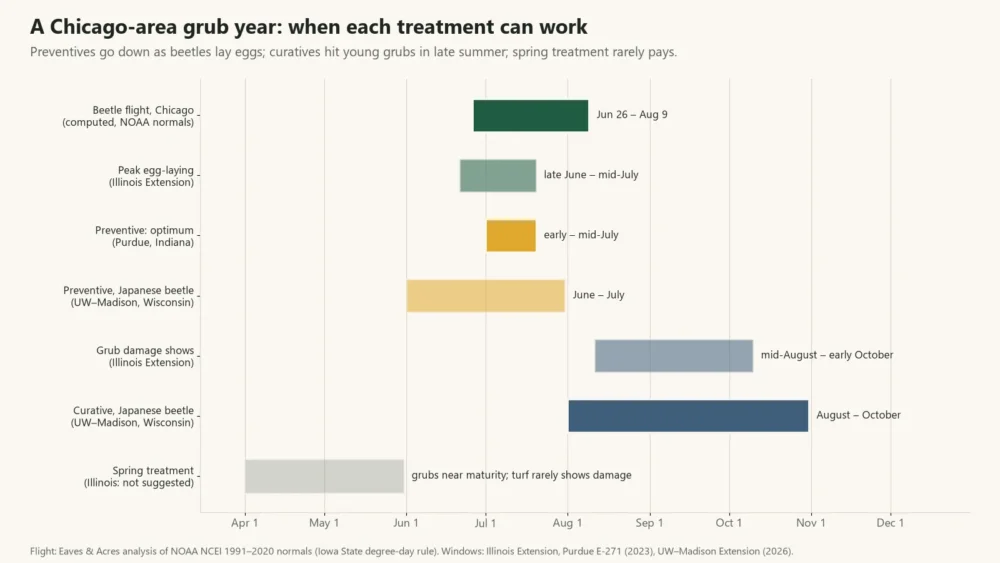
Spring generally is not a good time for curative grub control.
Overwintered grubs are large and hard to kill, and a spring curative leaves nothing for summer’s eggs.6 UNH advises no curative after May 15, when grubs stop feeding.10 To repair dead patches, reseed in the late-summer overseeding window.
Southern lawns and other grub species
In Texas the main lawn grubs are May/June beetles and the southern masked chafer; Texas A&M says to treat in June in South Texas and early July in North Texas, around the time the grubs hatch.14 NC State times curatives for August through October, later in the mountains than in the east.12 Species differ too:4
| Species | Preventive | Curative |
|---|---|---|
| Japanese beetle | June – July | August – October |
| May/June beetle | May – early June | July – September |
| European chafer | Late May – mid-July | August – October |
| Northern masked chafer | June – July | August – October |
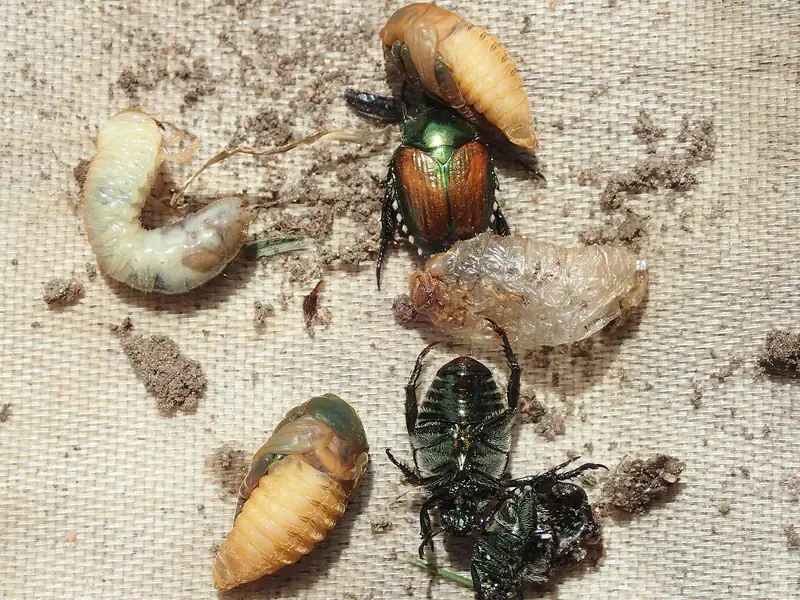
European chafer runs about two weeks ahead of the other species, UMass notes.9 Purdue says it can also damage lawns in spring, and that May/June beetles take two to three years per generation.5
Check for grubs before you treat
Only a small share of lawns need treatment in a given year, Kentucky notes.6 Cut out a square foot of sod at the edge of a brown patch in July or August and count. Purdue says fewer than 5 grubs rarely need treatment and Japanese beetle usually takes 10 or more; Penn State uses 5 to 10, Illinois about 12.5,8,11
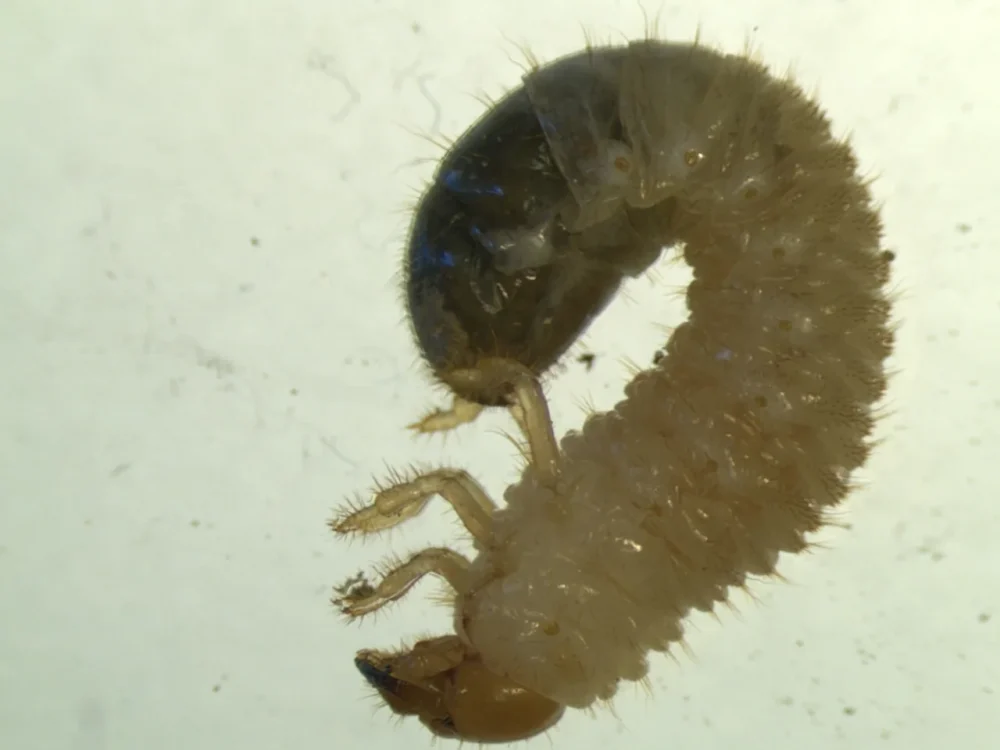
Kentucky also notes that:
- Heavy watering in June and July attracts egg-laying beetles (see our lawn watering guide).6
- Moderate nitrogen from October through December helps turf resist grub injury (when to fertilize).6
- Tall fescue tolerates grubs better than Kentucky bluegrass (which grass do you have?).6
- Killing grubs will not stop moles, which also eat earthworms.6
Skip beetle traps: Purdue says catches don’t predict grubs, and NC State says traps draw beetles in.5,12 And a crabgrass pre-emergent is a weed product, not a grub preventive.
Water it in, and protect bees
- Water it in. UW–Madison says about ½ inch right after applying, or control is poor; Kentucky suggests ½ to 1 inch.4,6
- Clear the thatch. Kentucky suggests mowing and raking first, and dethatching if thatch is over ½ inch.6
- Keep it off flowers. Purdue advises not treating where dandelions or clover bloom, mowing just before spraying, and leaving a 2–3 foot untreated strip by flower beds with neonicotinoids.15
- Weigh the product. UMass reports chlorantraniliprole has no activity against bees, while carbaryl is very toxic to them.9
neonicotinoid insecticides used for grub control can pose risks to bees and other pollinators
 Related guideWhen to Apply Pre-Emergent: Soil Temperature and Dates Where You Live
How we worked out these dates, and their limits
We took NOAA NCEI’s 1991–2020 monthly normal highs and lows at the station nearest each city, interpolated them to days, and summed degree days above 50°F from January 1, capping highs at 86°F (a common method; Iowa State’s notes don’t name one).1 A simple daily-mean method would shift dates a median 9 days later. A hot spring brings beetles early.3 Details are on our methodology page.
Next step: put your city’s preventive target on the calendar, and check the sod in August before buying a curative. More in our weeds and grubs section.
Frequently asked questions
No. Preventives work only if they are in the soil when eggs hatch: mid-June to mid-July for imidacloprid-type products in Kentucky and Pennsylvania, and earlier for chlorantraniliprole. Curatives work on grubs feeding near the surface, best in August. In spring the grubs are large and hard to kill, Kentucky Extension says.
It depends on the month and the active ingredient. For chlorantraniliprole GrubEx, UMass advises by early June in New England and UNH by late June; Kentucky’s 2012 insecticide table allowed it until late July. Later than that, preventives are much less active on large grubs, so check for grubs in August and use a curative if the count justifies it.
Yes. UW–Madison Extension says to apply about ½ inch of water right after treating, and that skipping it gives poor control. Kentucky suggests ½ to 1 inch. On dry soil, Texas A&M suggests ¼ to ½ inch the day before, which brings grubs closer to the surface.
It is late. Kentucky says grubs are still vulnerable in September but harder to kill, and by late September some move deeper. UMass says that once grubs reach full size, often by mid-September, curatives seldom cut their numbers by more than half. A preventive applied in September is too late for that year’s grubs.
Preventive. Scotts’ product page says to apply it once in spring or early summer to stop grubs as they hatch, and UW–Madison lists its active ingredient, chlorantraniliprole, as a preventive. For grubs already damaging a lawn, extension services name the curatives trichlorfon and carbaryl.
For prevention, June or July across most of the North, with chlorantraniliprole as early as mid-April to June; in Texas, June in the south and early July in the north. For a cure, August to early September. Table 2 gives a preventive target for 29 cities.
Not by itself. Kentucky Extension says killing grubs does not eliminate mole activity, because moles also eat earthworms and other soil insects. Controlling grubs may discourage digging by skunks and raccoons.
Sources
- 1.U.S. Climate Normals 1991–2020. NOAA National Centers for Environmental Information, 2021. Used for: daily normal high and low temperatures for every city and ZIP; degree-day sums Back to text
- 2.Japanese Beetle Adult Emergence Beginning in Southern Iowa, Ashley Dean and Erin Hodgson. Iowa State University Extension and Outreach, Integrated Crop Management News, 2021. Used for: 1,030 and 2,150 degree-day (base 50°F) emergence rule Back to text
- 3.Watch for Japanese Beetle Emergence, Erin Hodgson. Iowa State University Extension and Outreach, Integrated Crop Management News, 2020. Used for: southern Iowa emergence in 2020, 7–10 days ahead of recent years Back to text
- 4.White Grub Control in Turfgrass, PJ Liesch and Vijai Pandian. University of Wisconsin–Madison Extension, 2026. Used for: preventive vs. curative, product classes, species timing table, watering in, pollinator risk, biologicals Back to text
- 5.Managing White Grubs in Turfgrass (E-271), Douglas S. Richmond. Purdue Extension, 2023. Used for: early-to-mid-July preventive optimum, thresholds, sampling, European chafer and May/June beetle biology, traps Back to text
- 6.Controlling White Grubs in Turfgrass (ENT-10), Daniel A. Potter and Michael F. Potter. University of Kentucky College of Agriculture, 2026. Used for: preventive and curative windows, spring treatment, watering, thatch, irrigation, fall nitrogen, tall fescue, moles Back to text
- 7.Insecticides for Control of White Grubs in Kentucky Turfgrass (ENTFACT-441, 2012 table), Michael F. Potter and Daniel A. Potter. University of Kentucky College of Agriculture, 2012. Used for: Acelepryn (chlorantraniliprole) May 15–late July; GrubEx listed as imidacloprid. Kentucky’s March 2026 revision of ENTFACT-441 replaced this table with a note that it is available on request Back to text
- 8.White Grubs in Home Lawns, Paul Heller. Penn State Extension, 2006, updated 2026. Used for: central Pennsylvania emergence and preventive window, curative August–mid-September, 5–10 grub threshold Back to text
- 9.Current Insecticide Approaches for White Grub Control, Pat Vittum. UMass Extension Turf Program, 2013. Used for: New England life cycle, neonicotinoid and chlorantraniliprole windows, curative limits, bee toxicity, school-ground restrictions Back to text
- 10.Grub Control (video). University of New Hampshire Extension, 2017. Used for: embedded video; chlorantraniliprole late May–late June, no spring curative after May 15 Back to text
- 11.Dealing with Grubs in Lawns. University of Illinois Extension, undated. Used for: peak egg-laying late June–mid-July, damage mid-August–early October, 12-grub threshold, no spring treatment Back to text
- 12.White Grubs in Turf, Rick Brandenburg and Terri Billeisen. NC State Extension (TurfFiles), 2017, revised 2022. Used for: North Carolina curative timing, mountains later, traps Back to text
- 13.Pest Alert – Japanese Beetles, Steve Pettis. N.C. Cooperative Extension, Henderson County Center, 2023. Used for: western North Carolina emergence timing Back to text
- 14.White Grubs, Casey Reynolds, Mike Merchant and Diane Silcox Reynolds. Texas A&M AgriLife Extension, AggieTurf, 2015. Used for: Texas species and June/early July timing, watering before treatment Back to text
- 15.Protecting Pollinators From Insecticide Applications in Turfgrass (E-267), Douglas Richmond. Purdue Extension, 2015. Used for: flowering weeds, mowing before spraying, 2–3 foot buffer Back to text
- 16.When should I apply a preventive type insecticide to control white grubs in the lawn?. Iowa State University Extension and Outreach, Yard and Garden, 2021. Used for: late June–early August window; GrubEx listed as imidacloprid Back to text
- 17.Scotts GrubEx1 Season Long Grub Killer (product page). The Scotts Company, accessed 2026. Used for: active ingredient chlorantraniliprole; apply once in spring or early summer Back to text
- 18.Introduction to Pesticide Labels. U.S. Environmental Protection Agency, 2026. Used for: the label is the law Back to text
- 19.Japanese Beetle, Jim Walgenbach. NC State Extension, undated. Used for: Japanese beetle range in the US Back to text
- 20.Popillia japonica (28) (photo). Michael Reding, USDA Agricultural Research Service, Bugwood.org, via Wikimedia Commons, CC BY 3.0 US, accessed 2026. Used for: grub photo, cropped and resized
- 21.Popillia japonica (25) (photo). Whitney Cranshaw, Colorado State University, Bugwood.org, via Wikimedia Commons, CC BY 3.0 US, accessed 2026. Used for: life-stage photo, cropped and resized
- 22.366 - Japanese Beetles - Popillia japonica, Jackson Abbott Wetlands, Ft. Belvoir, Virginia (photo). Judy Gallagher, via Wikimedia Commons, CC BY 2.0, accessed 2026. Used for: hero photo, cropped and resized
.jpg)
.jpg)

How this guide was made
- Written by the Yard & Garden Desk and reviewed by the Data & Methodology Desk.
- Data: beetle flight dates are the days cumulative growing degree days (base 50°F, highs capped at 86°F, from January 1) reach 1,030 and 2,150 at the NOAA NCEI 1991–2020 normals station nearest each city (monthly normal highs and lows interpolated to days), from Iowa State Extension’s Japanese beetle emergence rule. The preventive target is 8–17 days after flight starts, the overlap of six published extension windows. Real years vary. See our methodology.
- AI use: AI tools help us research, draft and check this guide. Every figure is checked against the source cited for it, and calculated figures come from our own code, described on the methodology page.
- Spotted an error? Tell us — the form opens with this page’s address filled in.
Change log
- Oct 7, 2026Re-checked against today’s search results and the cited sources (Iowa State, UW–Madison, Purdue, Kentucky, Penn State, UMass, UNH, Illinois, NC State, Texas A&M, Scotts, EPA). Kentucky’s March 2026 revision of ENTFACT-441 removed its insecticide table, so the Kentucky chlorantraniliprole window and GrubEx listing are now dated as its 2012 table; corrected the Texas A&M timing wording (treat around the time grubs hatch); updated the Scotts GrubEx product link; linked the fall-nitrogen tip to our winterizer guide.
- Oct 4, 2026Published. Normal-year Japanese beetle flight and preventive target dates for 29 cities from NOAA 1991–2020 normals using Iowa State’s degree-day rule, checked against Iowa State, Penn State, Kentucky, Illinois, Purdue, UMass/UNH and NC Extension timing.
Covers lawns, gardens, frost and planting. We write the guides and maintain the tools that tell you when to seed, feed and plant for your ZIP.
Keep reading
When to Apply Pre-Emergent: Soil Temperature and Dates Where You Live
Apply crabgrass preventer when the top two inches of soil hold about 50–55°F. Typical windows for 22 cities from NOAA normals, checked against extension dates, plus Southern timing.
Should You Rake Leaves? When to Mulch, Rake or Leave Them
Usually not. Mow a light or moderate layer of leaves into the lawn until your last mow, and remove only what hides the grass. Extension thresholds, the research, and leaf deadlines for 20 US cities from NOAA normals.
When to Apply Lime to Your Lawn: Test First, Then Fall or Winter
Lime a lawn only when a soil test shows low pH, and spread it in fall or winter on dry, unfrozen turf so it has months to work. pH targets by grass, extension rates, NOAA freeze data for 22 cities, and where the West can skip it.
Seasonal reminders for your ZIP
Get a short email when it’s time to overseed, start seeds, open the pool or service your furnace — timed to your climate.