


How Long Does a Furnace Last? DOE, NAHB and Manufacturer Figures Compared
We compared NAHB, Minnesota, ENERGY STAR and DOE lifespan figures, read a DOE end-of-life study and a Trane manual, and estimated furnace run hours for 20 cities from NOAA data.
- Last reviewed Oct 22, 2026
- 17 cited sources
- 9 min read
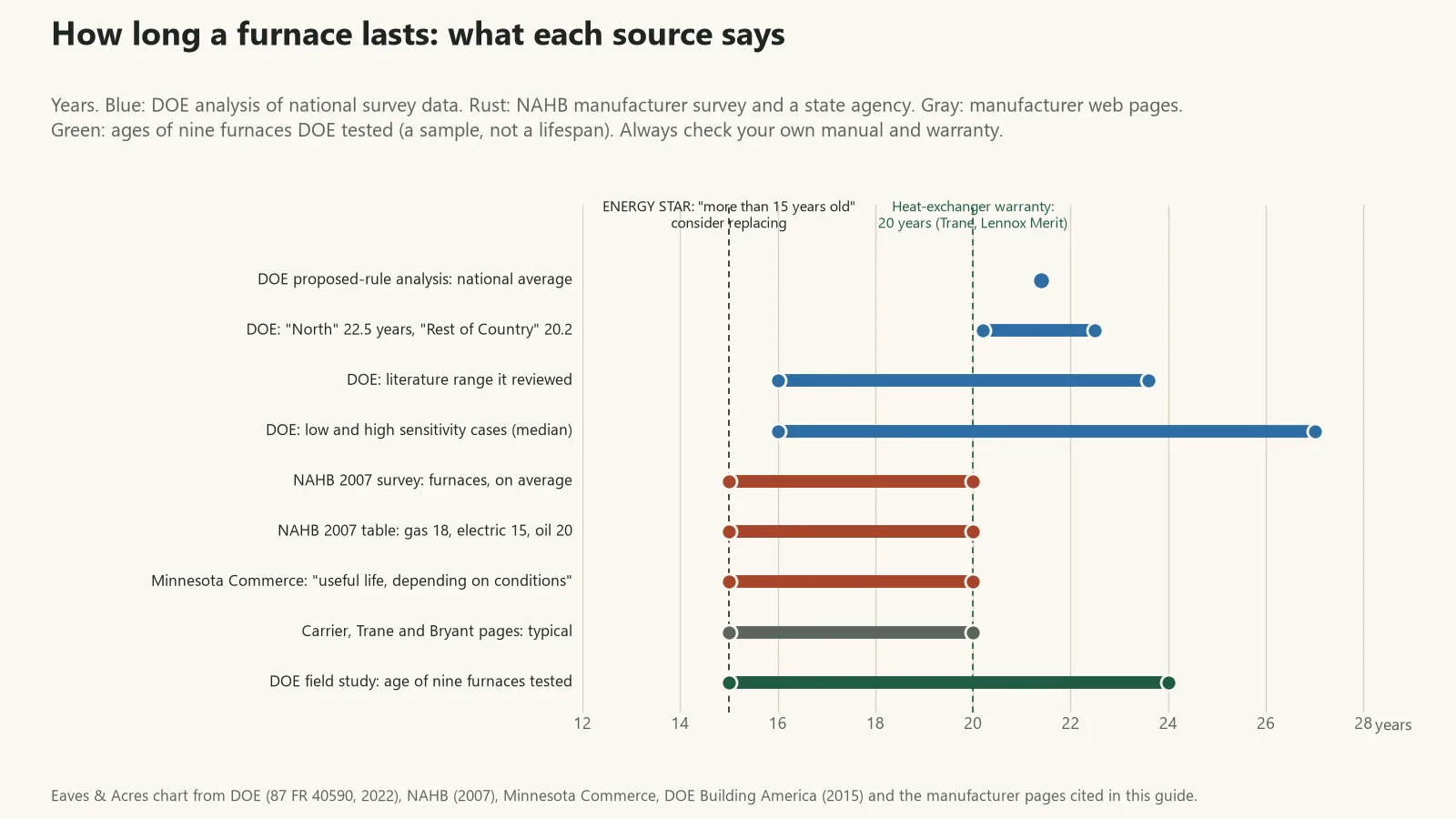
- 1NAHB says gas furnaces last 18 years and electric 15; Minnesota says 15 to 20; DOE’s 2022 proposed-rule analysis averages 21.4 years.
- 2No source we read backs the claim that electric furnaces last 20 to 30 years, or the 50% and $5,000 replacement rules.
- 3Minneapolis has 2.77 times Atlanta’s heating degree days but only about 1.5 times the estimated furnace run hours.
- 4ENERGY STAR flags a furnace more than 15 years old; Minnesota says repairs of 25% or more of a new furnace’s cost may mean replace.
- 5Trane’s manual and the CDC both ask for a yearly check by a qualified technician; smell gas or suspect CO, leave and call for help.
Most furnaces are retired after roughly 15 to 22 years, and the number depends on whose study you read. A 2007 National Association of Home Builders (NAHB) survey of manufacturers says gas furnaces average 18 years,2 Minnesota’s Department of Commerce says 15 to 20 years “depending on conditions,”3 and the Department of Energy (DOE) estimated an average of 21.4 years from national household surveys in a 2022 proposed rule.1 The often-repeated “electric lasts 20 to 30 years” has no study behind it in anything we read; NAHB lists electric furnaces at 15.2 What we added: using NOAA degree days, a furnace in Minneapolis logs about 1.5 times the full-load hours of one in Atlanta, not the 2.8 times that degree days alone suggest. It is our estimate, with the method and its limits shown below.
This guide lines up the primary sources, explains why they differ, shows our city-by-city run-hours estimate, and covers what sources say shortens a furnace’s life, when to replace and the safety signs agencies and manuals name.
What agencies and studies say about furnace life
Three kinds of source use the word “lifespan,” and they measure different things. DOE’s figure comes from a survival analysis: it took appliance ages reported in the federal Residential Energy Consumption Survey and the American Housing Survey, matched them to shipment history, and estimated when furnaces leave service. Its proposed-rule average is 21.4 years, inside a 16 to 23.6 year range it found in the literature, with 16 and 27 years as its low and high test cases.1 NAHB phoned manufacturers, trade associations and researchers in summer 2006; its table lists warm-air gas furnaces at 18 years, electric at 15, oil at 20 and heat pumps at 16, and it warns that the figures are no guarantee for any individual product.2 The Minnesota leaflet is a short agency summary.3 Manufacturer pages from Carrier, Trane and Bryant repeat 15 to 20 years without naming a study.12,13,14
| Source | What it is | Furnace figure |
|---|---|---|
| DOE, proposed rule 87 FR 40590 (2022) | Survival analysis of national household surveys (gas furnaces) | 21.4 years average; 16 to 23.6 in the literature; 16 and 27 as test cases1 |
| DOE, same document, by region | Average lifetime used in the analysis | North 22.5 years; rest of country 20.21 |
| NAHB / Bank of America Home Equity (2007) | Phone survey of manufacturers, trade groups, researchers | Furnaces 15 to 20; gas 18, electric 15, oil 202 |
| Minnesota Department of Commerce | Agency leaflet (undated) | 15 to 20 years, “depending on conditions”3 |
| ENERGY STAR replacement page | When to look at replacing | Furnace or boiler more than 15 years old4 |
| DOE Building America field study (2015) | Nine furnaces tested after 15 to 24 years in service | Average age 19; no efficiency loss with age5 |
| Carrier, Trane, Bryant web pages | Manufacturer estimate, no study named | 15 to 20 years typical12 |
Notice what is missing: no source says a furnace “fails” at a given age. DOE counts retirement, which includes furnaces replaced early with a new air conditioner; it says replacements outside its “North” region are more likely to be paired with a central AC.1 ENERGY STAR treats age as a prompt to look, not a verdict: its replacement page lists a furnace or boiler “more than 15 years old” as one prompt to consider replacing, alongside frequent repairs with rising bills.4
DOE assumed that equipment operated for fewer hours will have a longer service lifetime.
Gas, electric, oil and heat pumps
Only NAHB gives a fuel-by-fuel table in anything we found: gas 18, electric 15, oil 20 and heat pumps 16 years.2 Google’s AI Overview and several contractor pages credit electric furnaces with 20 to 30 years because they have fewer mechanical parts; we found no government or manufacturer study that measures that, so we do not repeat it. DOE’s 21.4-year figure covers gas furnaces only.1 For running costs and when a heat pump beats a furnace, see our heat pump vs. furnace guide and the cold-weather heat pump guide.
Our estimate: how many hours a furnace runs by city
Does a cold winter wear a furnace out faster? Bryant says furnaces in colder regions run more often and longer, which can add wear to the blower motor, heat exchanger and ignition system.14 DOE modeled the opposite for the North: a 22.5-year average there against 20.2 years in the rest of the country. Its reason is that northern furnaces are generally higher capacity for the larger heating load and so log fewer operating hours.1 We cannot settle that argument, but we can measure how different the hours really are.
The method is short. A furnace sized to a home’s load runs at full output for about 24 hours times heating degree days (HDD) divided by the gap between 65°F and the design temperature, the cold night the furnace is sized for. We take HDD from NOAA’s 1991 to 2020 normals15 and the 99% heating design temperature from Climate.OneBuilding.Org weather files for the city’s airport.16 We show a second case for a furnace 40% oversize, the top of the range DOE notes for ACCA Manual S sizing, which cuts hours by the same factor. See our heating degree days guide for how HDD are counted.
Minneapolis, furnace sized to the load
- Scenario
- NOAA normals for ZIP 55401: 7,699 heating degree days a year. Minneapolis airport 99% design temperature: −5.1°F.
- Math
- 24 × 7,699 = 184,776. 65 − (−5.1) = 70.1. 184,776 ÷ 70.1 = 2,636 hours a year. × 21.4 years = 56,400.
- Answer
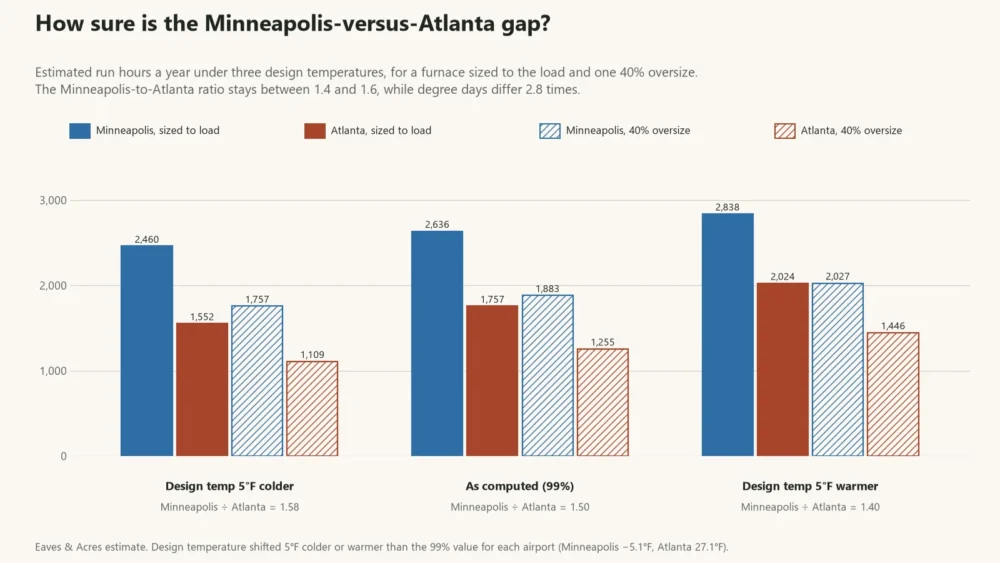
- About 2,640 hours a year. Atlanta: 24 × 2,775 ÷ (65 − 27.1) = 1,757, so Minneapolis is 1.50 times Atlanta; degree days are 2.77 times.
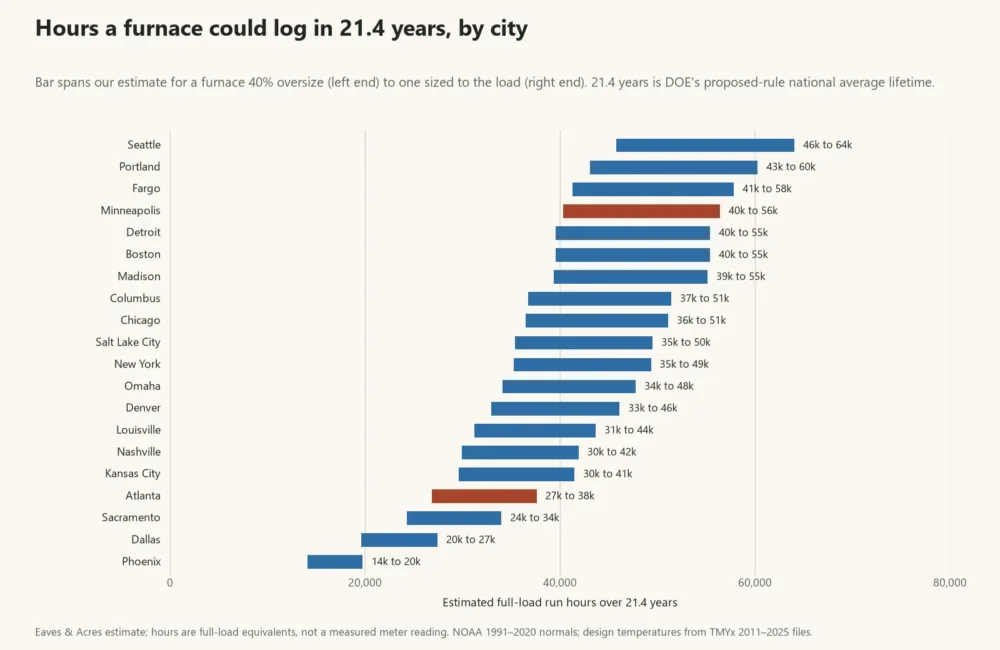
The result is the point of the exercise: the colder city has 2.77 times the degree days but only 1.50 times the run hours, because a furnace there is sized for a much colder design night. Our 20-city average is 2,210 full-load hours a year, 6% above the 2,080 “national average heating load hours” in DOE’s furnace test procedure,17 a sanity check that the method is in a sensible range. Seattle and Portland come out highest because base-65 degree days count many mild days that a house’s own heat gains would cover; we do not read that as proof that their furnaces run most.

| City (ZIP) | HDD | Design °F | Hours a year, sized | Hours a year, 40% oversize | Hours in 21.4 years |
|---|---|---|---|---|---|
| Fargo, ND (58102) | 8,806 | -13.2 | 2,700 | 1,930 | 57,840 |
| Minneapolis, MN (55401) | 7,699 | -5.1 | 2,640 | 1,880 | 56,410 |
| Madison, WI (53703) | 7,096 | -1.1 | 2,580 | 1,840 | 55,140 |
| Detroit, MI (48226) | 6,106 | 8.4 | 2,590 | 1,850 | 55,410 |
| Chicago, IL (60602) | 6,018 | 4.5 | 2,390 | 1,710 | 51,090 |
| Omaha, NE (68102) | 5,833 | 2.3 | 2,230 | 1,590 | 47,780 |
| Boston, MA (02108) | 5,545 | 13.6 | 2,590 | 1,850 | 55,410 |
| Columbus, OH (43215) | 5,417 | 10.9 | 2,400 | 1,720 | 51,430 |
| Denver, CO (80202) | 5,262 | 6.4 | 2,160 | 1,540 | 46,120 |
| Salt Lake City, UT (84101) | 4,724 | 16.0 | 2,310 | 1,650 | 49,520 |
| Kansas City, MO (64106) | 4,613 | 7.9 | 1,940 | 1,380 | 41,490 |
| New York, NY (10001) | 4,553 | 17.6 | 2,310 | 1,650 | 49,330 |
| Seattle, WA (98101) | 4,340 | 30.2 | 2,990 | 2,140 | 64,050 |
| Portland, OR (97204) | 4,167 | 29.5 | 2,820 | 2,010 | 60,290 |
| Louisville, KY (40202) | 4,141 | 16.3 | 2,040 | 1,460 | 43,670 |
| Nashville, TN (37201) | 3,648 | 20.3 | 1,960 | 1,400 | 41,920 |
| Atlanta, GA (30303) | 2,775 | 27.1 | 1,760 | 1,260 | 37,610 |
| Sacramento, CA (95814) | 2,138 | 32.7 | 1,590 | 1,130 | 34,000 |
| Dallas, TX (75201) | 1,992 | 27.7 | 1,280 | 920 | 27,430 |
| Phoenix, AZ (85004) | 874 | 42.3 | 920 | 660 | 19,770 |
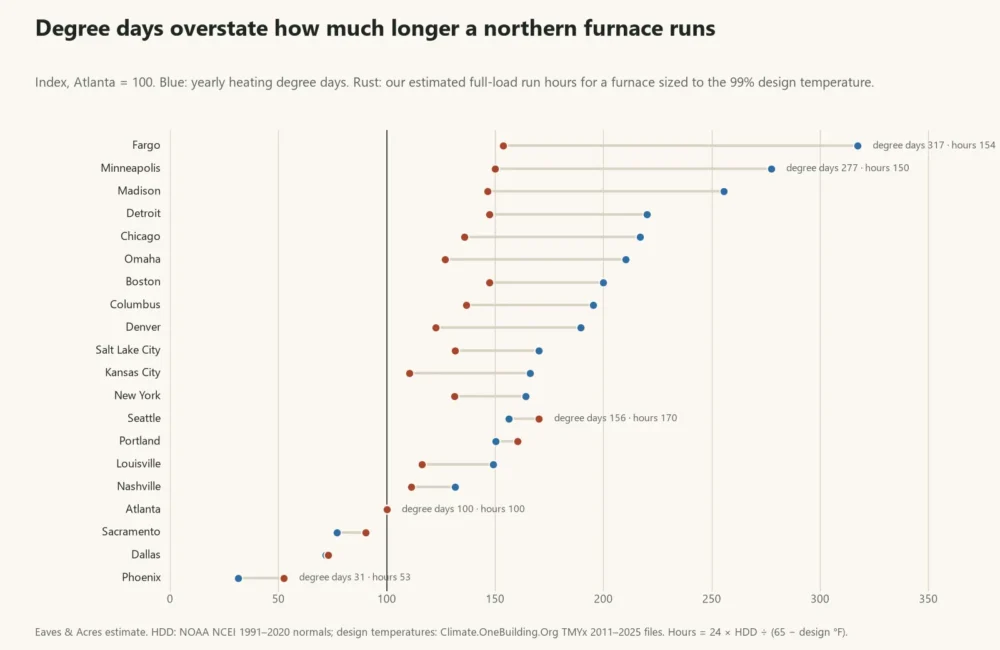
How much to trust it: the ratio between two cities holds up better than any single number. Moving both design temperatures 5°F colder or warmer keeps Minneapolis at 1.40 to 1.58 times Atlanta. The limits are real. The design temperatures are computed by a third-party site from airport hourly records, not copied from the ASHRAE tables; our HDD station can differ from that airport; hours are full-load equivalents and say nothing about how many times a furnace starts; and no manufacturer or agency we read rates a furnace in hours, so treat this as context, not a prediction of your furnace’s life.
What sources say shortens or extends a furnace’s life
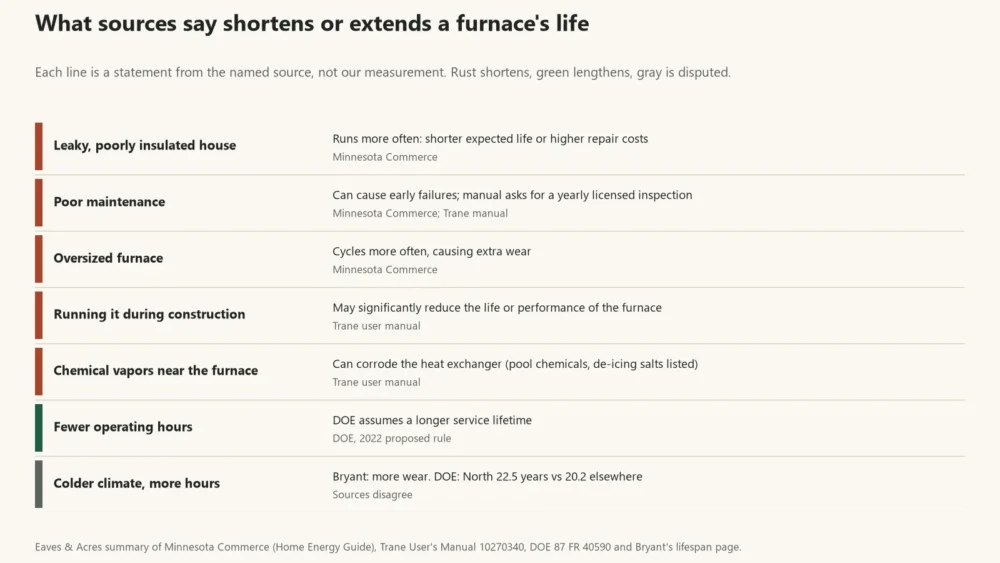
Minnesota Commerce says a furnace in a leaky, poorly insulated building runs more often and will have a shortened expected life or higher repair costs, that poor maintenance can cause early failures, and that an oversized furnace cycles more frequently, causing extra wear.3 Trane’s user manual asks for annual inspection by a licensed HVAC technician and says operating a gas furnace in a construction environment may significantly reduce its life:6
may significantly reduce the life or the performance of the furnace
The same manual lists household chemicals whose vapors can cause heat exchanger corrosion if pulled into the burners, including chlorine-based swimming pool chemicals, de-icing salts and water softening chemicals, and says not to store them near the furnace.6 It also asks owners to check the filter at least monthly; see how often to change a furnace filter for the agency and manual intervals.6
Repair or replace: what is sourced
ENERGY STAR lists three prompts: a furnace or boiler more than 15 years old, frequent repairs with rising bills, and rooms that are too hot or cold.4 For the repair side, Minnesota says spending 25% or more of a new furnace’s cost on repairs may mean it is time to replace.3 The popular “50% rule” and “$5,000 rule” in search results have no government or manufacturer source that we found.
Rising bills and age are not the same thing. DOE’s Building America team pulled nine furnaces with 15 to 24 years of service from Des Moines-area homes and tested them in a lab: it found no loss of efficiency with age (average age 19) and field efficiency 6.4% below lab, which it attributed to poor installation or misadjustment.5 Nine furnaces is a small sample, but in our reading it suggests that any saving from replacing comes mainly from the new model’s higher rating rather than from decay in the old one. A warranty is not a life forecast either: Trane’s covers furnace parts for 5 years (10 if registered within 60 days) and the heat exchanger for 20, and Lennox lists 20 years on Merit heat exchangers and 20 years or limited lifetime on Elite and Signature models.7,8 Plan the replacement while the old unit still works; our generator guide and generator size calculator cover backup power for the blower, and the turn-on-the-heat guide is the right moment for a pre-season check.
Safety signs agencies and manuals name
The CDC calls carbon monoxide (CO) odorless and colorless and says it kills without warning; it asks that your heating system and other gas, oil or coal appliances be serviced by a qualified technician every year, and that CO detectors be replaced per the maker’s instructions or every five years.9 The EPA lists worn or poorly maintained furnaces among significant CO sources.11 If you suspect CO poisoning, the Consumer Product Safety Commission says to get outside to fresh air and then call 911.10 Trane’s manual says that if you smell gas you should not light any appliance or use a switch or phone in the building, should leave immediately, call your gas supplier from a neighbor’s phone and, if you cannot reach it, call the fire department. It also says a flame roll-out switch that trips signals a serious burner problem and that only a licensed technician can reset it.6 We found no owner-level test for a cracked heat exchanger in these sources; that is why they point to a technician’s annual check.
Next step
Find your furnace’s install year on its label, book the annual inspection your manual names, and start the replacement comparison once it is past 15. Our methodology page explains the NOAA data behind the estimates.
Frequently asked questions
Sources range from 15 to 20 years (NAHB: gas 18; Minnesota Commerce: 15 to 20) to a 21.4-year average in DOE’s 2022 proposed-rule analysis. Check your own manual and warranty.
We found no study that gives 30 years as typical. DOE’s high test case uses a 27-year median, and its field study tested furnaces up to 24 years old.
NAHB’s 2007 table lists electric at 15 years and gas at 18. The 20 to 30 years often quoted for electric has no study behind it in what we read.
ENERGY STAR lists a furnace over 15 years old, frequent repairs with rising bills, and rooms that are too hot or cold. Minnesota adds repairs of 25% or more of a new furnace’s cost.
We found no government or manufacturer source for either. The only repair threshold we could source is Minnesota Commerce’s 25% of the cost of a new furnace.
Sources disagree. Bryant says colder regions add wear; DOE assumes fewer hours mean longer life and uses 22.5 years for the North against 20.2 elsewhere.
No. Trane covers parts for 5 years (10 if registered) and the heat exchanger for 20; Lennox lists 20 years or limited lifetime on heat exchangers. A warranty is coverage, not a forecast.
Minnesota says poor maintenance can cause early failures and Trane’s manual asks for a yearly licensed inspection. No source we read states how many years it adds.
Sources
- 1.Energy Conservation Program: Energy Conservation Standards for Consumer Furnaces (NOPR), 87 FR 40590. U.S. Department of Energy, Federal Register, 2022. Used for: average lifetime 21.4 years; North 22.5, rest of country 20.2; literature range 16 to 23.6; sensitivity 16 and 27; fewer operating hours, longer life; Manual S oversize 1.0 to 1.4 Back to text
- 2.Study of Life Expectancy of Home Components. National Association of Home Builders / Bank of America Home Equity, 2007. Used for: furnaces 15 to 20; gas 18, electric 15, oil 20, heat pump 16; telephone survey; not a guarantee Back to text
- 3.Home Energy Guide: Furnace Replacement. Minnesota Department of Commerce, undated. Used for: useful life 15 to 20 years; leaky house shortens life; poor maintenance; oversized furnaces cycle more; 25% repair threshold Back to text
- 4.When is it time to replace?. ENERGY STAR (EPA/DOE), read 2026-10-22. Used for: furnace or boiler more than 15 years old; frequent repairs and rising bills; uneven rooms Back to text
- 5.Improving Gas Furnace Performance: A Field and Laboratory Study at End of Life. U.S. DOE Building America, Partnership for Advanced Residential Retrofit, NREL, 2015. Used for: nine furnaces 15 to 24 years old; no efficiency loss with age; field 6.4% below lab Back to text
- 6.Single Stage & Two-Stage Gas Furnaces User’s Manual (10270340, 02/20). Trane Technologies, 2020. Used for: annual licensed inspection; construction dust reduces life; chemical vapors corrode heat exchanger; monthly filter check; gas-smell and CO instructions Back to text
- 7.Trane Warranties: Types and Coverage Explained. Trane, 2024. Used for: furnace parts 5 or 10 years, heat exchanger 20; 60-day registration Back to text
- 8.Warranty & Coverage. Lennox, read 2026-10-22. Used for: Merit 5 years parts and 20 years heat exchanger; Elite and Signature 20 years or limited lifetime Back to text
- 9.Carbon Monoxide Poisoning Basics. Centers for Disease Control and Prevention, 2026. Used for: serviced annually by a qualified technician; detector replacement every 5 years Back to text
- 10.Carbon Monoxide. U.S. Consumer Product Safety Commission, read 2026-10-22. Used for: suspect CO poisoning: get outside to fresh air, then call 911 Back to text
- 11.What is Carbon Monoxide?. U.S. Environmental Protection Agency, read 2026-10-22. Used for: worn or poorly maintained furnaces can be significant CO sources Back to text
- 12.How Long Does A Furnace Last? (Carrier). Carrier, read 2026-10-22. Used for: well-maintained furnace typically 15 to 20 years Back to text
- 13.How Long Should a Furnace Last? (Trane). Trane, 2024. Used for: average furnace will last 15 to 20 years Back to text
- 14.How Long Does A Furnace Last? (Bryant). Bryant, read 2026-10-22. Used for: 15 to 20 years; colder regions run longer, more wear Back to text
- 15.U.S. Climate Normals 1991-2020 (annual heating degree days, base 65F). NOAA NCEI, 2021. Used for: HDD by station; same values as wp_ea_climate Back to text
- 16.TMYx 2011-2025 weather files with .ddy design conditions (99% heating dry-bulb for 20 airports). Climate.OneBuilding.Org, 2025. Used for: third-party computed design temperatures, not ASHRAE tables Back to text
- 17.10 CFR 430 Subpart B Appendix N, section 10.4. U.S. DOE, Electronic Code of Federal Regulations, read 2026-10-22. Used for: 2,080 national average heating load hours; 0.77 adjustment factor Back to text
How this guide was made
- Written by the Home Systems Desk and reviewed by the Data & Methodology Desk.
- Data: hours = 24 × heating degree days ÷ (65 − 99% heating design °F), the full-load hours of a furnace sized to the load; 40% oversize divides by 1.4. HDD are NOAA NCEI 1991–2020 normals (nearest station to the ZIP); design temperatures come from Climate.OneBuilding.Org TMYx 2011–2025 files for each city’s airport, so station mismatch is possible. The 20-city mean is 2,210 hours against 2,080 national average heating load hours in DOE’s test procedure. Hours are our estimate, not a measurement, and no source rates furnace life in hours. See our methodology.
- AI use: AI tools help us research, draft and check this guide. Every figure is checked against the source cited for it, and calculated figures come from our own code, described on the methodology page.
- Spotted an error? Tell us — the form opens with this page’s address filled in.
Change log
- Oct 22, 2026Published. NAHB, DOE, Minnesota Commerce, ENERGY STAR, DOE end-of-life study, Trane manual, Trane and Lennox warranties, CDC, CPSC and EPA read; NOAA degree days and design temperatures used for the run-hours estimate.
Covers heating, cooling, generators and water heaters. We maintain the sizing calculators and the guides that explain what a number means before you call a contractor.
Keep reading
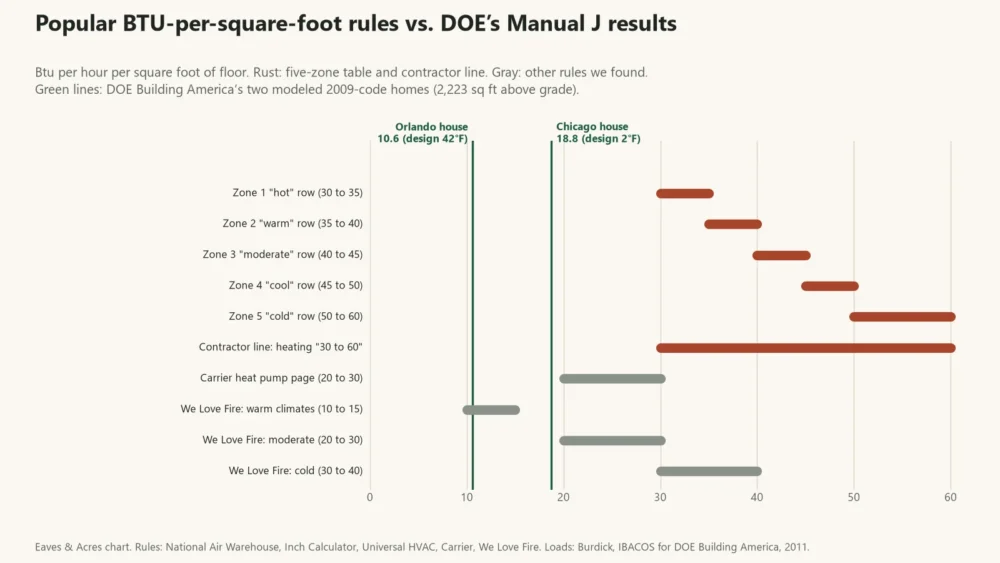
How Many BTU to Heat a Room? Rules of Thumb Tested Against Design Temperatures
Popular tables say 30 to 60 BTU per square foot; DOE's modeled homes need 10.6 to 18.8. We convert BTU to watts and test the rules against design temperatures for 39 cities and 40,565 ZIP codes.

How to Winterize Your House: A Fall Checklist With Dates
The typical US ZIP code gets its first freeze around October 25. A deadline-ordered fall checklist for caulk, hoses, gutters, attic, furnace and alarms, with dates for 24 cities and what labels, CPSC and extension services say.
When to Turn On the Heat in Fall: City and State Dates
In the typical US ZIP code the average day falls below 60°F around October 5. Dates for 24 cities and every state, seven landlord heat rules, and what a furnace manual says to check first.
Seasonal reminders for your ZIP
Get a short email when it’s time to overseed, start seeds, open the pool or service your furnace — timed to your climate.