How to Winterize Your House: A Fall Checklist With Dates
NOAA normals for 24 cities and every ZIP code set the order of fall jobs, from caulk and hoses to furnace checks, with what labels, CPSC and extension services say about each.
- Last reviewed Oct 22, 2026
- 16 cited sources
- 12 min read
- 1Winterize by deadline: materials have a weather limit, water has a freeze date, and heating equipment has a start date.
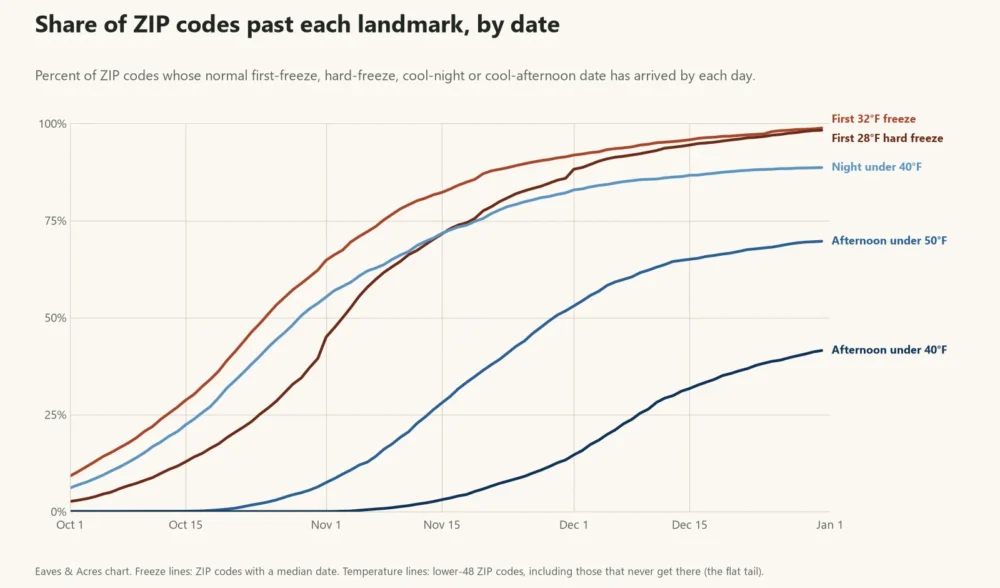
- 2In NOAA’s 1991–2020 normals the typical US ZIP code gets its first 32°F freeze around October 25, and 62% of ZIP codes that have one reach it before November 1; Fargo’s is September 30 and Houston’s December 25.
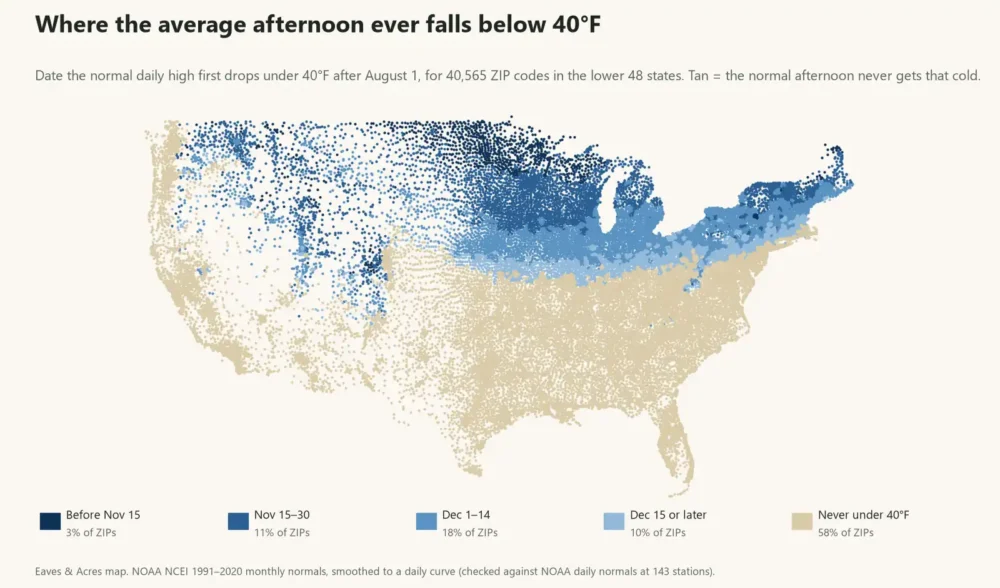
- 3One widely sold caulk is labeled for 40°F to 100°F with no freeze forecast within 24 hours; the normal afternoon high never falls under 40°F in 58% of ZIP codes, so the freeze rule limits caulking first.
- 4CPSC says to have a professional inspect all fuel-burning heating systems every year and to test smoke and CO alarms every month.
- 5Draining the plumbing of an empty house is a different job: Illinois Extension’s options are heat left on at no lower than 55°F with daily checks, or draining and shutting off the water system.
Winterize your house in deadline order: seal exterior gaps while caulk can still cure, unhook hoses and drain outdoor lines before the first freeze, and have the heating system, chimney and alarms checked before heating season starts. In NOAA’s 1991–2020 normals the typical US ZIP code gets its first 32°F freeze around October 25, and in 62% of the ZIP codes that have one it comes before November 1.1
The top results for this search are checklists of 9 to 14 jobs in no particular order, and none gives dates for where you live.14,13,16 We counted the fall landmarks that decide the order, first freeze, first hard freeze and the date nights and afternoons turn cold, for 24 cities and every ZIP code, then matched each job to what a product label, an agency or an extension service says about it. Where one of our guides already covers a job in depth, this page gives the deadline and links to it instead of repeating the steps.
Work to deadlines, not to the calendar
Fall jobs fall into three groups, and each has a different deadline. Materials have a weather limit: a caulk label sets the temperature range for applying it. Water has a freeze deadline: hoses, outdoor faucets, sprinklers and exposed pipes. Heating equipment has a start date: Travelers says to have a heating system serviced “preferably before the heating season begins,” and Illinois Extension heads its list of pipe jobs “Before Cold Weather.”11,9 Neither gives a date, so the figure below places each job under the landmark that matches its trigger, using the median ZIP code.
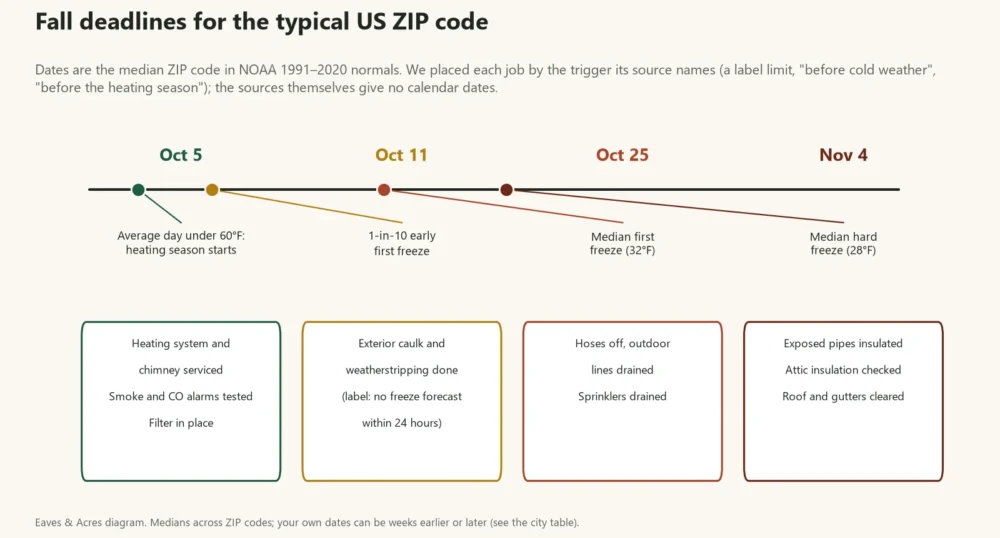
The median ZIP code’s average day drops below 60°F, a common sign that heating season has started, around October 5, according to our guide to when to turn on the heat. Its 1-in-10 early first freeze is about October 11, its median first freeze October 25 and its median hard freeze (28°F) November 4.1 Because half of years have a first freeze before the median, the earlier date is the safer one for anything a freeze can damage.
Fall dates for 24 cities
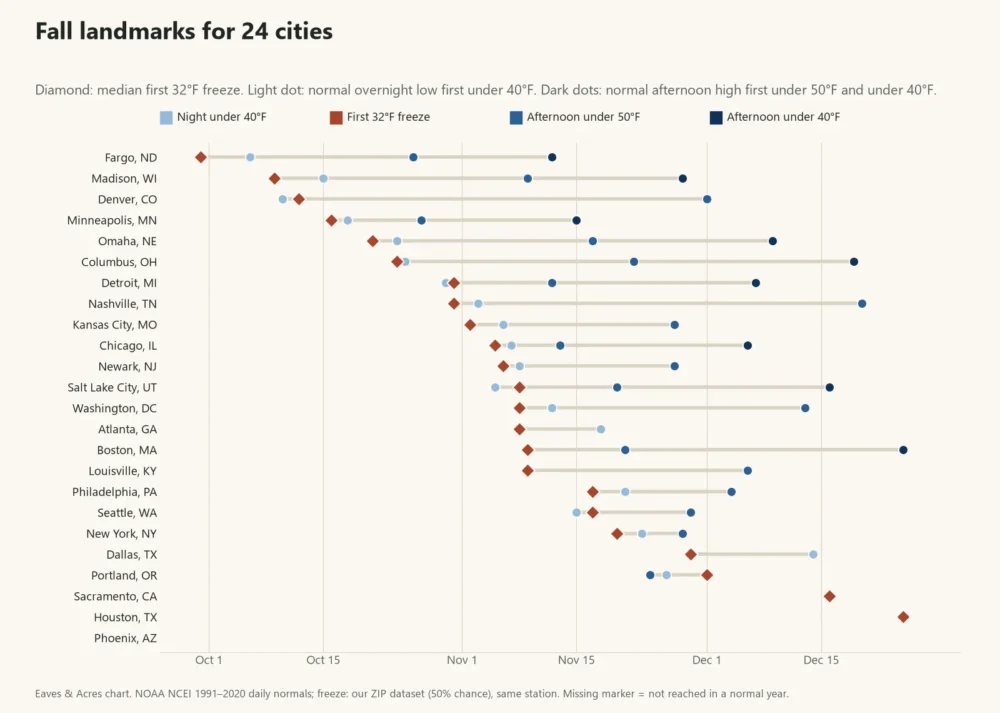
Table 1 uses the NOAA station behind each city’s ZIP code. The night and afternoon dates are the first day after August 1 on which NOAA’s normal daily low or high falls below the level shown; the freeze date is the median first 32°F freeze from our ZIP dataset at the same station.1 Normals describe a typical year, and a single fall can run weeks earlier or later.
| City | Night under 40°F | Median first freeze | Afternoon under 50°F | Afternoon under 40°F |
|---|---|---|---|---|
| Fargo, ND ZIP 58102 | Oct 6 | Sep 30 | Oct 26 | Nov 12 |
| Madison, WI ZIP 53703 | Oct 15 | Oct 9 | Nov 9 | Nov 28 |
| Denver, CO ZIP 80202 | Oct 10 | Oct 12 | Dec 1 | Not reached |
| Minneapolis, MN ZIP 55401 | Oct 18 | Oct 16 | Oct 27 | Nov 15 |
| Omaha, NE ZIP 68102 | Oct 24 | Oct 21 | Nov 17 | Dec 9 |
| Columbus, OH ZIP 43215 | Oct 25 | Oct 24 | Nov 22 | Dec 19 |
| Detroit, MI ZIP 48226 | Oct 30 | Oct 31 | Nov 12 | Dec 7 |
| Nashville, TN ZIP 37201 | Nov 3 | Oct 31 | Dec 20 | Not reached |
| Kansas City, MO ZIP 64106 | Nov 6 | Nov 2 | Nov 27 | Not reached |
| Chicago, IL ZIP 60602 | Nov 7 | Nov 5 | Nov 13 | Dec 6 |
| Newark, NJ ZIP 07102 | Nov 8 | Nov 6 | Nov 27 | Not reached |
| Salt Lake City, UT ZIP 84101 | Nov 5 | Nov 8 | Nov 20 | Dec 16 |
| Washington, DC ZIP 20001 | Nov 12 | Nov 8 | Dec 13 | Not reached |
| Atlanta, GA ZIP 30303 | Nov 18 | Nov 8 | Not reached | Not reached |
| Boston, MA ZIP 02108 | Nov 9 | Nov 9 | Nov 21 | Dec 25 |
| Louisville, KY ZIP 40202 | Nov 9 | Nov 9 | Dec 6 | Not reached |
| Philadelphia, PA ZIP 19107 | Nov 21 | Nov 17 | Dec 4 | Not reached |
| Seattle, WA ZIP 98101 | Nov 15 | Nov 17 | Nov 29 | Not reached |
| New York, NY ZIP 10001 | Nov 23 | Nov 20 | Nov 28 | Not reached |
| Dallas, TX ZIP 75201 | Dec 14 | Nov 29 | Not reached | Not reached |
| Portland, OR ZIP 97204 | Nov 26 | Dec 1 | Nov 24 | Not reached |
| Sacramento, CA ZIP 95814 | Not reached | Dec 16 | Not reached | Not reached |
| Houston, TX ZIP 77002 | Not reached | Dec 25 | Not reached | Not reached |
| Phoenix, AZ ZIP 85004 | Not reached | Rare | Not reached | Not reached |
Fargo’s median first freeze is September 30 and Houston’s is December 25, almost twelve weeks later. In 14 of the 24 cities the median first freeze arrives before the average night falls under 40°F: November 5 against November 7 in Chicago, September 30 against October 6 in Fargo. A freeze is a single cold night, so it can come while the average night is still milder. Our sprinkler guide lists 1-in-10 early freeze and hard-freeze dates for 31 cities, and the frost date lookup gives yours by ZIP code.
The national picture by ZIP code
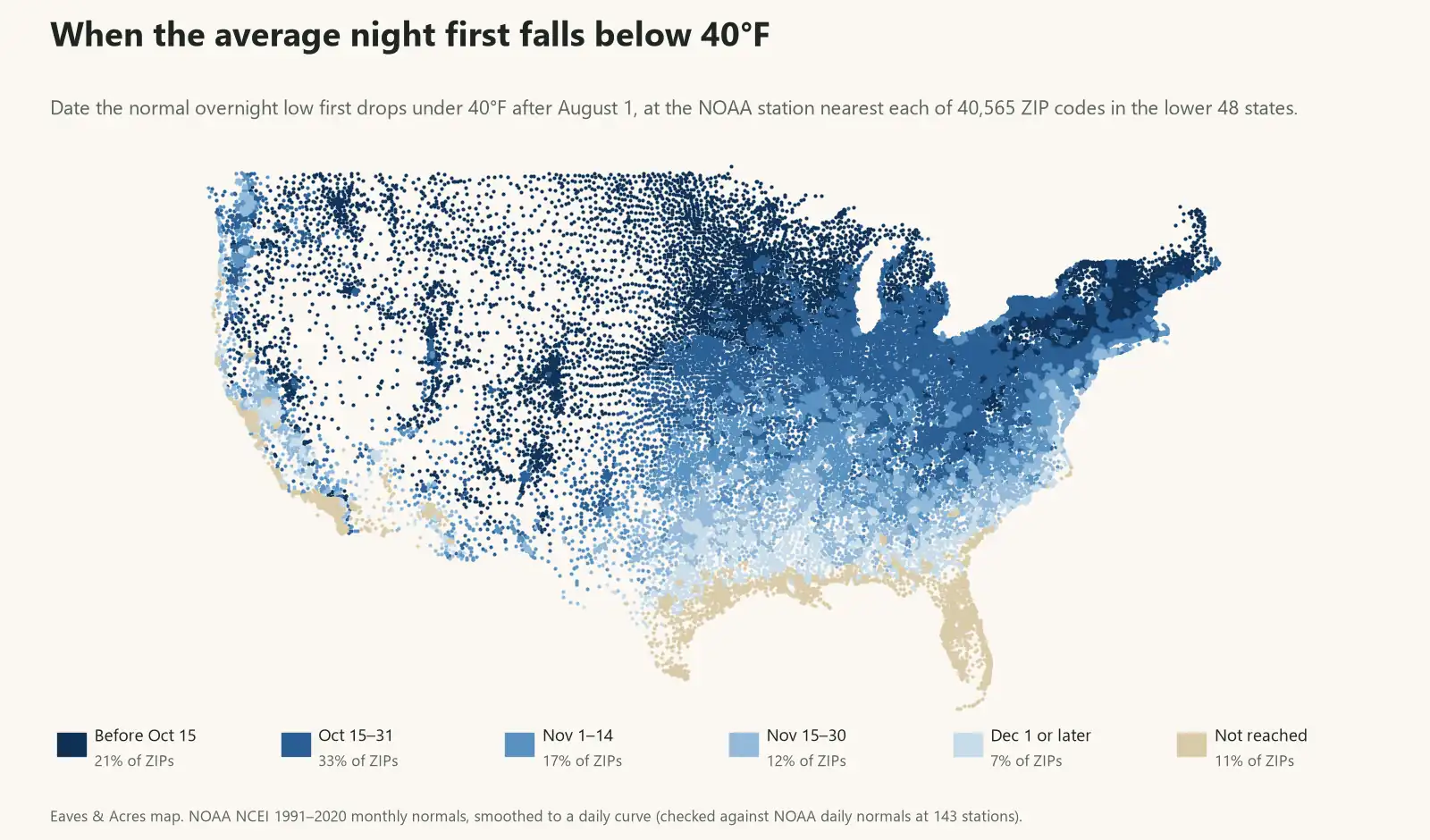
Across the 39,195 ZIP codes that have a median first freeze, 27% reach it before October 15 and 62% before November 1; the middle 80% range from October 2 to November 26. The other 1,645 ZIP codes are mostly in California (752) and Florida (697), where a 32°F night is uncommon.1 The normal overnight low drops under 40°F before November 1 in 54% of all ZIP codes and never in 11%.1
The ZIP-level temperature dates come from a smoothed curve through NOAA’s twelve monthly normals, which we checked against NOAA’s own daily normals at 143 stations: for the 40°F night date, 99% of stations agreed within 3 days, with an average error of about half a day.1
Seal air leaks while caulk can still cure
The Department of Energy puts the stakes in one line:
By sealing uncontrolled air leaks, you can save 10%-20% on your heating and cooling bills.
ENERGY STAR gives a lower figure, up to 10% off annual energy bills for sealing and insulating together, so treat the range as an upper bound for a leaky house.8 DOE’s checklist is to look around walls, ceilings, windows, doors, lighting and plumbing fixtures, switches and outlets, then weatherstrip doors and windows, caulk and seal where plumbing, ducting or wiring comes through walls, floors and ceilings, and check that fireplace dampers close properly.2
DOE pairs air sealing with ventilation and warns that combustion appliances that do not get enough oxygen may release dangerous gases such as carbon monoxide. It recommends a professional contractor for sealing around flues and vents.3 That is a reason to leave those spots alone and to have working CO alarms first (see the heating section below).
Caulk has a weather limit. One widely sold acrylic latex caulk, DAP Alex Plus, says:
Apply in temperatures between 40°F to 100°F.
The same sheet says not to apply when rain or freezing temperatures are forecast within 24 hours, and that cooler temperatures and higher humidity slow drying.4 Labels differ, so read the one on your tube. Under this label, the limit is the air temperature at the time you work, so an afternoon above 40°F still qualifies after nights have dropped below it. The freeze-forecast rule bites first: after the first freeze, every day with a freeze in the next 24 hours is off the table, so the window turns patchy. The 40°F floor only closes afternoons in the colder north: the normal afternoon high never falls under 40°F in 15 of the 24 cities, or in 58% of ZIP codes (the tan area on the map).1
Hoses, outdoor faucets and sprinklers: before the first freeze
Illinois Extension’s “Before Cold Weather” list says to disconnect garden hoses and to shut off and drain the water from pipes leading to outside faucets, which reduces the chance of freezing in the short span of pipe just inside the house.9 Mississippi State Extension, passing on advice from the state emergency management agency, adds draining the hose, storing it in a covered place and fitting an insulated cover over each outdoor faucet.10 Those two lines are the whole of it for most homes; our frozen-pipe guide has the full source-by-source list, including insulating exposed pipes. Sprinklers follow the same freeze deadline, with dates for 31 cities in our sprinkler guide, and pools and hot tubs have their own: when to close a pool and how to winterize a hot tub.
Roof, gutters and attic
Mississippi State Extension lists clearing gutters of leaves and debris so rainwater flows freely, which helps prevent icicles and ice dams, and Travelers adds that downspouts should direct water away from the foundation.10,11 Lowe’s rule of thumb is to clean gutters as soon as the last leaves have fallen.14 Our leaf guide ties the leaf deadline to the last mow. A ladder is the main hazard: CPSC says falls from ladders can cause injuries from bruises to death, and tells anyone climbing for gutter cleaning to have a partner steady the ladder, set it on stable ground and keep it away from power lines.12
For the attic, ENERGY STAR’s quick check is to look across it: if the insulation is level with or below the floor joists, you probably need more. It also warns not to disturb vermiculite insulation, which may contain asbestos, unless it has been tested by an approved lab.7 Our ice dam guide explains why sealing comes before adding insulation.
Furnace, chimney and alarms: before heating season
CPSC’s January 2026 winter-safety release says to have a professional inspect all fuel-burning heating systems, including furnaces, boilers, fireplaces, wood stoves, water heaters, chimneys, flues and vents, each year, and that fireplaces can spark fires if chimneys are cracked, blocked or coated with creosote.5 For alarms it says to put smoke alarms on every level and inside each bedroom, and CO alarms on every level and outside sleeping areas:
Test the alarms every month to make sure they are working.
The same release says to replace batteries at least yearly or install alarms with sealed 10-year batteries.5 DOE’s guide says to clean or replace furnace filters once a month or as recommended;2 our furnace filter guide starts from the manual. Once the house is cool, when to turn on the heat gives dates, and the winter thermostat guide the settings. If an outage worries you, read portable generator safety before buying one.
The checklist in deadline order
Table 2 collects each job with the trigger its source names and where to read more.
| Job | Deadline trigger | What the source says | Read more |
|---|---|---|---|
| Caulk and weatherstrip | Before a freeze is forecast; label limit 40–100°F | Label: apply between 40°F and 100°F, not when rain or freezing is forecast within 24 hours.4 DOE lists weatherstripping for doors and windows, and caulk where plumbing, ducting or wiring comes through.2 | Ice dam guide (attic sealing) |
| Fireplace damper and flue | Before the first fire | DOE: check that fireplace dampers close properly.2 For sealing around flues and vents it recommends a professional contractor.3 | Generator safety (CO) |
| Hoses and outdoor faucets | Before the first freeze | Disconnect garden hoses; shut off and drain the pipes to outside faucets.9 Drain the hose, store it covered, fit an insulated faucet cover.10 | Frozen-pipe guide |
| Sprinklers | Before the first freeze; no later than the first hard freeze | Our sprinkler guide: dates for 31 cities, with a 1-in-10 early date. | Sprinkler guide |
| Pool and hot tub | When water cools or freezing nights near | See our pool-closing and hot-tub guides; manufacturer manuals decide. | Close a pool, hot tub |
| Exposed pipes | Before cold weather | Insulate pipes near outer walls, in crawl spaces or the attic; UL-approved heat tape; seal leaks that let cold air in where pipes run.9 | Frozen-pipe guide |
| Gutters and downspouts | After the leaves fall, before snow | Clear leaves and debris so rainwater flows freely.10 Downspouts should direct water away from the foundation.11 Ladder: a partner steadies it, stable ground, clear of power lines.12 | Leaf guide |
| Attic insulation | Before snow | If insulation is level with or below the floor joists, you probably need more; do not disturb vermiculite insulation unless tested.7 | Ice dam guide |
| Furnace, boiler and chimney | Before heating season; every year | A professional inspects all fuel-burning heating systems, chimneys, flues and vents each year.5 Preferably before the heating season begins.11 | When to turn on the heat |
| Furnace filter | Monthly, or as the manual says | Clean or replace furnace filters once a month or as recommended.2 | Filter guide |
| Smoke and CO alarms | Before heating season; then every month | Smoke alarms on every level and in each bedroom; CO alarms on every level and outside sleeping areas; test monthly; batteries yearly or sealed 10-year.5 | Generator safety |
| Backup power | Before outage season | Portable generators outdoors only, at least 20 feet from the home, exhaust pointed away.5,6 | Generator size calculator |
| Leaving for the winter | Before you go | Heat on, no lower than 55°F, with someone checking daily, or drain and shut off the water system.9 A licensed plumber can drain; never shut off water to a fire sprinkler system.11 | Frozen-pipe guide |
If the house will sit empty
Vacant-house winterizing, which can mean draining the plumbing, is a different job from the one above. Illinois Extension’s options for a trip away are to have someone check daily that the heat is on, or to drain and shut off the water system; it also says to leave the heat on and set no lower than 55°F in cold weather.9 Travelers likewise says 55°F or higher keeps the floor and wall cavities where pipes run above freezing, suggests a licensed plumber for draining, and warns not to shut off water to a fire sprinkler system.11 We give no draining or antifreeze steps here; see the frozen-pipe guide and ask a plumber.
Next step
Look up your first freeze in the frost date lookup, find your city in Table 1, and work down Table 2 from the top. Pick the earlier date wherever a freeze could do damage. More cold-weather guides are in heating and cooling, and our methodology page explains how ZIP codes are matched to NOAA stations.
Frequently asked questions
By deadline. Caulk and weatherstrip while the label allows (one common caulk: 40°F to 100°F, no freeze forecast within 24 hours), take hoses off and drain outdoor lines before the first freeze (about October 25 in the typical US ZIP code), and have the heating system, chimney and alarms checked before heating season. Table 2 lists every job.
Many jobs are homeowner jobs. DOE says do-it-yourself air sealing can work for obvious leaks such as door frames and exterior wall penetrations, but it recommends a professional contractor for sealing around flues and vents, and CPSC says to have a professional inspect fuel-burning heating systems every year.
Illinois Extension says to leave the heat on and set no lower than 55°F in cold weather, and Travelers says 55°F or higher keeps the wall and floor cavities where pipes run above freezing. For comfort settings when you are home, see our winter thermostat guide.
It depends on the job, and sources differ. For an occupied house in a hard cold snap, Illinois Extension says to let hot and cold water trickle at night from a faucet on an outside wall. For draining the whole system for a long absence, it and Travelers describe it, and Travelers suggests a licensed plumber; we give no draining steps. Our frozen-pipe guide covers where the sources disagree on dripping.
Under one common caulk label, any day from 40°F to 100°F with no rain or freeze forecast within 24 hours. Plan around your freeze date: the typical ZIP code’s 1-in-10 early first freeze is about October 11 and its median is October 25. Table 1 gives 24 cities.
We found no agency price. Twin Cities Habitat for Humanity’s 2024 list gives about $6 per window for an insulator kit, about $20 for a furnace filter, about $65 for an inflatable chimney plug and $100 to $500 for a furnace inspection; those are its figures, not ours.
Lowe’s rule of thumb is as soon as the last leaves have fallen. Mississippi State Extension says to clear leaves and debris so rainwater flows freely. CPSC says to have a partner steady the ladder and to keep it away from power lines.
Less for water, still for air sealing, heating and alarms. Houston’s median first freeze is December 25 and Sacramento’s December 16, and a 32°F night is rare at Phoenix’s station, but 1,645 ZIP codes have no median freeze date rather than no risk. Check your own ZIP code in the frost date lookup.
Mostly yes for the heating checks. In the typical ZIP code the average day falls below 60°F around October 5, three weeks before the median first freeze on October 25, so the furnace, chimney and alarm checks come first and the water jobs follow.
Sources
- 1.U.S. Climate Normals 1991–2020: daily and monthly station normals. NOAA National Centers for Environmental Information, 2021. Used for: daily and monthly temperature normals; our ZIP-code frost dates from the same stations Back to text
- 2.Energy Saver Guide: Tips on Saving Money and Energy at Home. U.S. Department of Energy, 2022. Used for: air sealing 10%-20%, weatherstrip and caulk list, fireplace dampers, furnace filters monthly Back to text
- 3.Consumer Guide to Air Sealing the Home. U.S. Department of Energy, 2021. Used for: combustion appliances and carbon monoxide; professional contractor for flues and vents; DIY for obvious leaks Back to text
- 4.DAP ALEX PLUS All Purpose Acrylic Latex Caulk Plus Silicone, technical data sheet (5/12/25). DAP, 2025. Used for: apply between 40°F and 100°F; not when rain or freezing is forecast within 24 hours Back to text
- 5.Keep Warm and Safe This Winter: Tips for Using Generators, Furnaces and Space Heaters. U.S. Consumer Product Safety Commission, 2026-01-23. Used for: annual professional inspection; alarm placement, monthly test, batteries; generators outdoors 20 feet Back to text
- 6.Carbon Monoxide. U.S. Consumer Product Safety Commission, read 2026-10-22. Used for: CO symptoms; get outside to fresh air and call 911; generators outdoors Back to text
- 7.What to Look For: DIY Checks and Inspections (attic insulation). ENERGY STAR (EPA and DOE), read 2026-10-22. Used for: insulation level with or below joists; vermiculite asbestos caution Back to text
- 8.Seal and Insulate with ENERGY STAR. ENERGY STAR (EPA and DOE), read 2026-10-22. Used for: up to 10% savings on annual energy bills Back to text
- 9.Water Pipes. University of Illinois Extension, read 2026-10-22. Used for: Before Cold Weather list; heat no lower than 55°F; away options Back to text
- 10.How to Winterize Your Home. Mississippi State University Extension Service (steps from the Mississippi Emergency Management Agency), read 2026-10-22. Used for: gutters, weather stripping, hoses and faucet covers Back to text
- 11.Snowbirds: How to Winterize Your Home While You’re Away. Travelers, 2023. Used for: heating service before the heating season; 55°F; downspouts; licensed plumber; fire sprinkler system Back to text
- 12.Home Safe: Outdoor Repairs. U.S. Consumer Product Safety Commission, 2020. Used for: ladder safety for gutter cleaning Back to text
- 13.Winterize your home: winter weather checklist. University of Illinois Extension, 2020. Used for: what an extension checklist covers; no dates (competitor read) Back to text
- 14.Winterize Your Home: 14 Strategies for Maximum Efficiency. Lowe’s, updated 2025-11-06. Used for: gutters after the last leaves have fallen; 14-job list without dates (competitor read) Back to text
- 15.Winterize Your Home on a Budget. Twin Cities Habitat for Humanity, 2024-11-30. Used for: cost figures by job
- 16.Google search results pages for “how to winterize your house” and “winterize home checklist” (gl=us, hl=en, pws=0). Google Search, read 2026-10-22. Used for: AI Overview, People also ask and top results Back to text
How this guide was made
- Written by the Home Systems Desk and reviewed by the Data & Methodology Desk.
- Data: dates are NOAA NCEI 1991–2020 normals at the station nearest each ZIP code. City night and afternoon dates use NOAA’s daily normals (first date after August 1 below each level); freeze dates are the median (50% chance) first 32°F freeze in our ZIP dataset at the same station. ZIP-code temperature dates use a smoothed curve through the twelve monthly normals, checked against NOAA daily normals at 143 stations (night under 40°F: 99% within 3 days; afternoon under 50°F: 100%; afternoon under 40°F: 99%). Hawaii, territories and ZIP codes without monthly normals are left out of temperature shares; 1,645 ZIP codes without a median first freeze are left out of freeze shares. Product labels differ; check yours. See our methodology.
- AI use: AI tools help us research, draft and check this guide. Every figure is checked against the source cited for it, and calculated figures come from our own code, described on the methodology page.
- Spotted an error? Tell us — the form opens with this page’s address filled in.
Change log
- Oct 22, 2026Published. NOAA 1991–2020 normals turned into fall landmark dates (night under 40°F, first freeze, afternoon under 50°F and 40°F) for 24 cities and 40,749 ZIP codes; a caulk label, DOE, ENERGY STAR, CPSC and two extension services read.
Covers heating, cooling, generators and water heaters. We maintain the sizing calculators and the guides that explain what a number means before you call a contractor.
Keep reading
How Many BTU to Heat a Room? Rules of Thumb Tested Against Design Temperatures
Popular tables say 30 to 60 BTU per square foot; DOE's modeled homes need 10.6 to 18.8. We convert BTU to watts and test the rules against design temperatures for 39 cities and 40,565 ZIP codes.

How Long Does a Furnace Last? DOE, NAHB and Manufacturer Figures Compared
Sources put furnace life at 15 to 22 years: NAHB says gas 18, Minnesota 15 to 20, DOE 21.4. We show why they differ and estimate run hours for 20 cities from NOAA data.
When to Turn On the Heat in Fall: City and State Dates
In the typical US ZIP code the average day falls below 60°F around October 5. Dates for 24 cities and every state, seven landlord heat rules, and what a furnace manual says to check first.