
When to Plant Fruit Trees: Dormant Season Dates by City and Zone
Bare-root, container and balled trees each get a different window. We tested the extension rules against NOAA normals for 40,557 ZIP codes and found where winter, spring or fall is the planting season.
- Last reviewed Oct 27, 2026
- 21 cited sources
- 15 min read
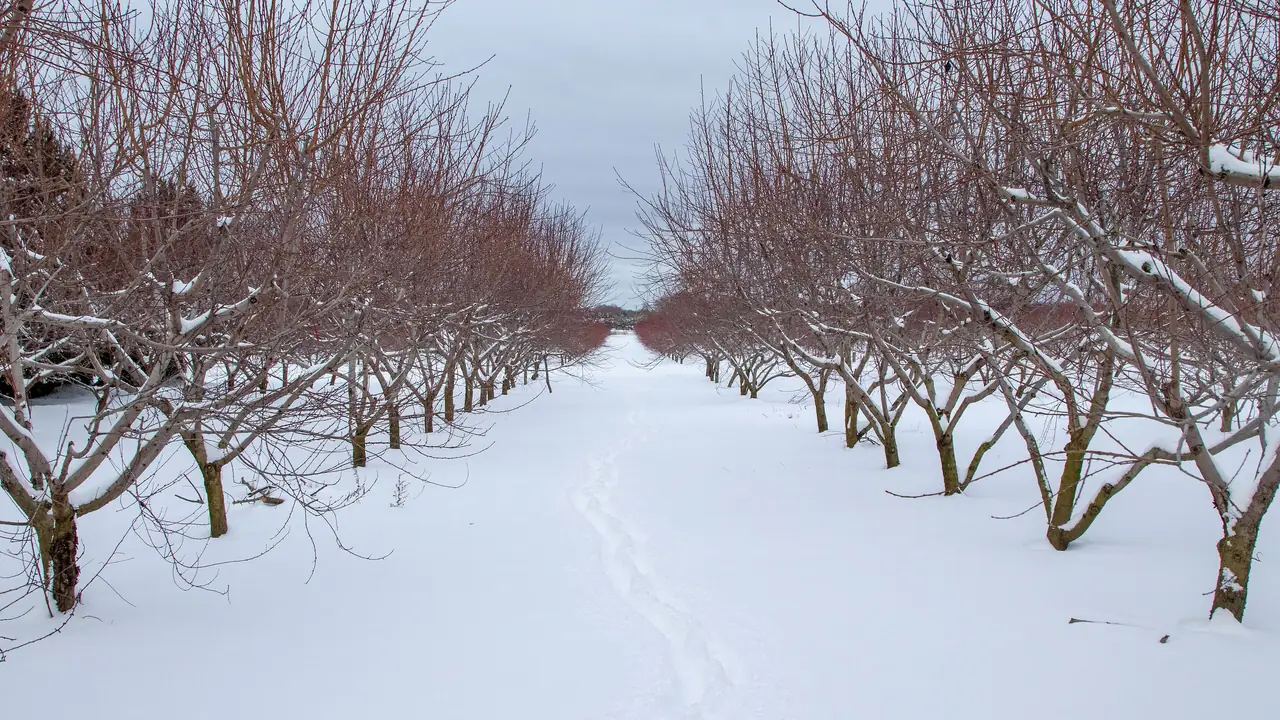

Set your ZIP to see dates for your area.
- 1Plant bare-root fruit trees dormant, as soon as the soil can be worked and before the buds open: late February through March in Maryland, March in southern and April in northern Illinois (extension).
- 2In 20.6% of lower-48 ZIP codes the normal air temperature never averages below 45°F; Texas A&M AgriLife says to plant December through February there. Elsewhere the median spring start is March 29: Chicago March 31, Atlanta January 27.
- 3Container and balled trees can go in during fall, while the soil is well above 55°F (Purdue) and roots still grow above 40°F (Oklahoma State): the median ZIP code cools below 55°F on October 16 and has 42 days before 40°F.
- 4Your hardiness zone says what survives, not when to plant: the median spring start runs from April 29 in zone 3 to February 16 in zone 8. Maryland says stone fruits should only be planted in spring.
Plant dormant bare-root fruit trees in late winter or early spring, as soon as the soil can be worked and before the buds open; where winters are mild, plant them from December through February. Container and balled-and-burlapped trees are more flexible, but cool-season planting beats midsummer for all three. The split is geographic: in 20.6% of lower-48 ZIP codes the normal air temperature never averages below 45°F, so winter is the planting season there, and among the ZIP codes that do reach 45°F in spring the median start date is March 29.
Extension sources agree on the rules and leave you to find your own dates. We set them beside NOAA 1991–2020 normals1 for 40,557 lower-48 ZIP codes and built spring and fall dates for 29 cities and a table by hardiness zone. Everything uses air temperature as a stand-in for soil temperature, because our NOAA data has no soil readings, and our 45°F spring line is a calibration to two extension calendars, not a published rule.
How the tree is sold sets the planting window
A fruit tree arrives in one of three forms, and each has its own limits. UConn describes bare-root trees as plants sold dormant, not in a pot or balled and burlapped, usually in late winter or early spring, and best planted while still dormant or just before bud break.7 Balled-and-burlapped trees are dug and sold with native soil around the root ball and can be extremely heavy, Alabama Extension notes,15 and container trees come with their roots in potting mix. Table 1 shows the window each form gets in the extension sources we read.
| Form | Best window in the sources | Why | Sources |
|---|---|---|---|
| Bare-root | Dormant: late winter to early spring, before buds open. Late fall only where winters are mild or before the ground freezes; December to February in Texas | Sold only while dormant, with the roots uncovered | Maryland, Illinois, Iowa State, UConn, Purdue, Oklahoma State, Texas A&M AgriLife |
| Balled-and-burlapped | Fall, or the dormant season | Soil stays around the roots; fall planting gives them time to recover before spring growth | Oklahoma State, Purdue, Alabama |
| Container-grown | Almost any time of year; the cool season is best (fall in the North, December and January in north and central Florida); midsummer is the risk | Roots are already in a pot, so heat and drought are the hazard | UF/IFAS, LSU AgCenter, Georgia, Alabama, Purdue |
Fall is where the forms part company. Purdue’s fall advice is to select balled-and-burlapped or container-grown plants rather than bare-rooted stock, and to plant bare-root plants only in late winter or early spring while they are still dormant.10 Texas A&M AgriLife, which prefers bare-root trees, says container trees also work well.5
Spring: plant when the soil thaws, before the buds open
The University of Maryland gives the plainest rule:3
The best time to plant is late February through March, before buds open.
Illinois Extension ties it to the ground instead of the calendar, with a different month for each end of the state:4
just after the soil thaws and before plant growth starts
Iowa State says bare-root trees and shrubs must be planted in early spring before growth begins,8 and Illinois adds that spring planting is preferred in all its areas, with late fall satisfactory only in southern Illinois.4 Google’s AI Overview for this query, when we checked on October 22, 2026, sent cold regions to “late March through April” once the ground thaws, and mild ones to fall and winter. Table 2 turns the rule into dates: the first day the normal daily mean air temperature reaches 45°F.
| City (ZIP, zone) | Median last frost | Air mean reaches 32°F | Spring start (45°F) | Coldest normal daily mean |
|---|---|---|---|---|
| Fargo, ND (58102, zone 4a) | May 10 | Mar 25 | Apr 20 | 9.2°F |
| Bend, OR (97701, zone 6b) | Jun 6 | Never below 32°F | Apr 20 | 31.9°F |
| Minneapolis, MN (55401, zone 5a) | Apr 23 | Mar 15 | Apr 14 | 14.9°F |
| Burlington, VT (05401, zone 5b) | Apr 29 | Mar 15 | Apr 14 | 20.9°F |
| Lansing, MI (48906, zone 6a) | May 1 | Mar 6 | Apr 10 | 23.9°F |
| Boston, MA (02108, zone 7a) | Apr 4 | Feb 16 | Apr 5 | 29.9°F |
| Chicago, IL (60601, zone 6b) | Apr 10 | Feb 22 | Mar 31 | 26.0°F |
| Des Moines, IA (50309, zone 5b) | Apr 18 | Feb 27 | Mar 30 | 22.3°F |
| Indianapolis, IN (46204, zone 6b) | Apr 20 | Feb 20 | Mar 29 | 26.6°F |
| Columbus, OH (43215, zone 6b) | Apr 20 | Feb 17 | Mar 27 | 28.7°F |
| New York, NY (10001, zone 7b) | Mar 30 | Never below 32°F | Mar 22 | 33.7°F |
| Denver, CO (80202, zone 6a) | Apr 30 | Never below 32°F | Mar 22 | 34.0°F |
| College Park, MD (20742, zone 7b) | Apr 10 | Never below 32°F | Mar 19 | 34.0°F |
| Carbondale, IL (62901, zone 7a) | Apr 9 | Never below 32°F | Mar 15 | 32.4°F |
| St. Louis, MO (63101, zone 7a) | Apr 1 | Never below 32°F | Mar 10 | 32.6°F |
| Salt Lake City, UT (84101, zone 7b) | Mar 31 | Never below 32°F | Mar 8 | 33.7°F |
| Richmond, VA (23219, zone 7b) | Apr 3 | Never below 32°F | Mar 3 | 38.3°F |
| Seattle, WA (98101, zone 9a) | Mar 13 | Never below 32°F | Feb 26 | 42.0°F |
| Nashville, TN (37201, zone 7b) | Apr 1 | Never below 32°F | Feb 26 | 37.8°F |
| Raleigh, NC (27601, zone 8a) | Mar 28 | Never below 32°F | Feb 19 | 41.7°F |
| Portland, OR (97201, zone 8b) | Feb 25 | Never below 32°F | Feb 18 | 41.6°F |
| Atlanta, GA (30303, zone 8a) | Mar 24 | Never below 32°F | Jan 27 | 43.6°F |
| Dallas, TX (75201, zone 8b) | Mar 2 | Never below 32°F | All winter | 47.8°F |
| Sacramento, CA (95814, zone 9b) | Jan 12 | Never below 32°F | All winter | 48.5°F |
| Claxton, GA (30417, zone 9a) | Mar 9 | Never below 32°F | All winter | 49.0°F |
| College Station, TX (77840, zone 9a) | Feb 27 | Never below 32°F | All winter | 51.5°F |
| Houston, TX (77002, zone 9b) | Feb 2 | Never below 32°F | All winter | 53.6°F |
| Gainesville, FL (32601, zone 9a) | Mar 3 | Never below 32°F | All winter | 54.8°F |
| Phoenix, AZ (85001, zone 10a) | None | Never below 32°F | All winter | 55.8°F |
Across the 32,149 ZIP codes that have a 45°F date, the median is March 29 and the middle 80% run from February 20 to April 21. In 44.2% it falls after March 31 and in 17.2% after April 15; in 3.4% it falls before February 1. The date comes before the median last frost in 99.5% of those ZIP codes, a median of 24 days earlier, so unlike a vegetable bed a fruit tree does not wait for the last frost.1
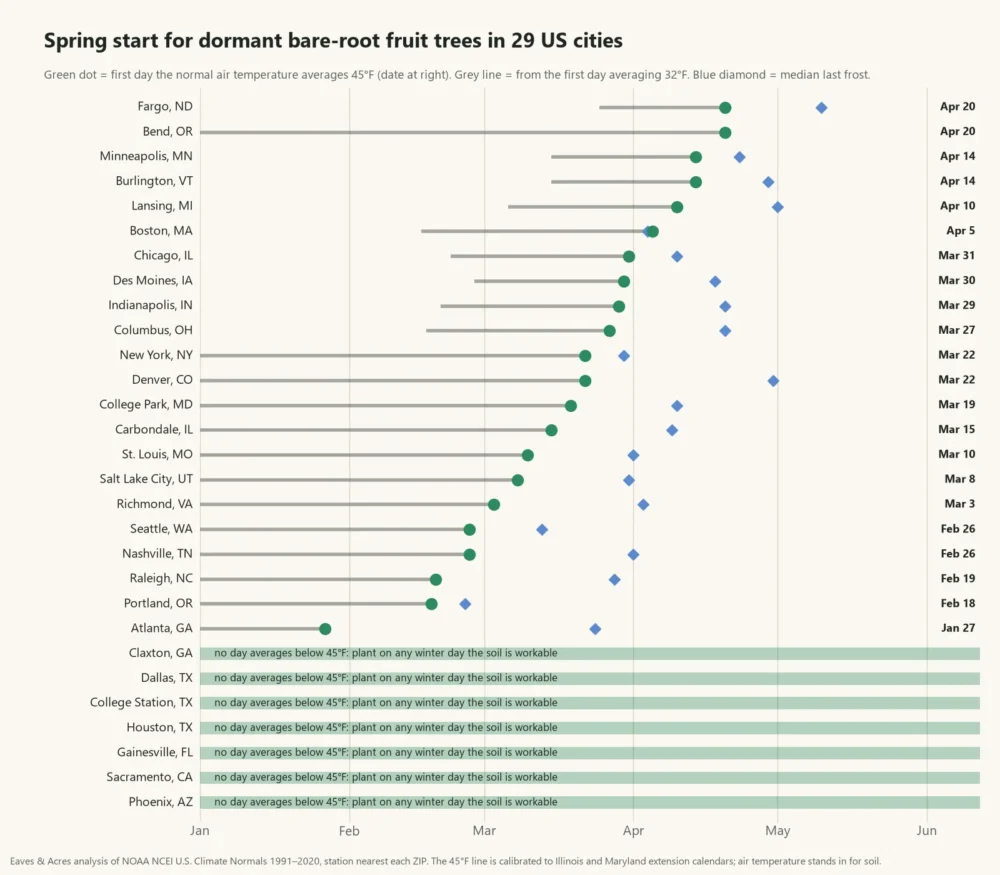
Where the dormant window closes depends on the tree, not the calendar: UConn and Maryland both say before buds open.7,3 Our data cannot predict bud break, so we give no end date. Check the buds on the tree in your hand and plant when they are still tight.
How we set the 45°F line
Extension sources describe the start of spring planting by the ground (“soil thaws”), not by a temperature, so we tested four air-temperature lines on the published calendars that name a month. Table 3 shows the result.
| Place | Published window | 32°F | 35°F | 40°F | 45°F |
|---|---|---|---|---|---|
| Carbondale, IL | Southern Illinois: March (Illinois Extension) | Never below 32°F | Feb 5 | Feb 27 | Mar 15 |
| Chicago, IL | Northern Illinois: April (Illinois Extension) | Feb 22 | Mar 2 | Mar 17 | Mar 31 |
| Rockford, IL | Northern Illinois: April (Illinois Extension) | Mar 3 | Mar 10 | Mar 23 | Apr 5 |
| College Park, MD | Late February through March (University of Maryland; late February read as Feb 20) | Never below 32°F | Jan 29 | Mar 1 | Mar 19 |
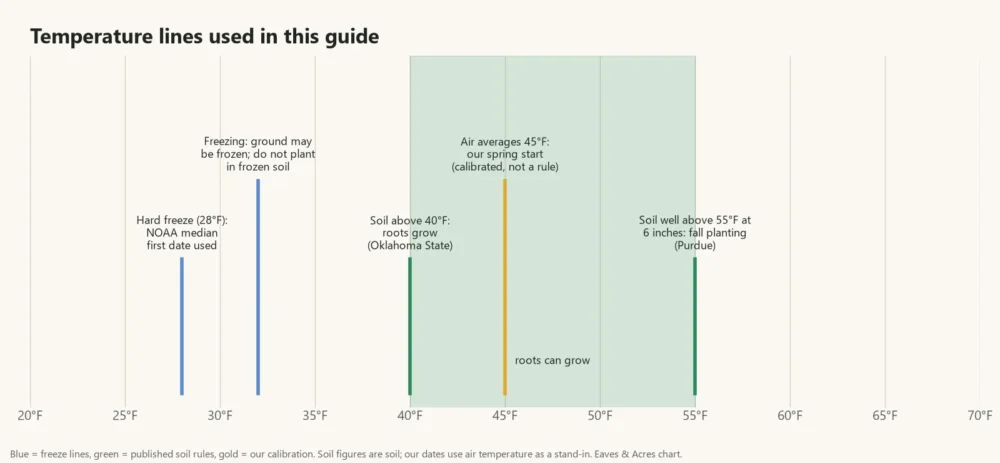
The 45°F line lands inside the published window in three of the four places and misses Chicago’s April by a day. The 40°F line fits only Maryland and runs up to 2 weeks early for northern Illinois, and the freezing line runs four to five weeks early. That is a fit to three calendars, so treat the 45°F date as a planning guide, not a measurement. Oklahoma State sets a lower floor for roots:9
Roots grow when the soil temperature is above 40 degrees.
The chart shows where each line sits. Soil lags air in spring, so a thermometer in the planting hole settles what a normal cannot.
Fall: warm soil for roots, but not for bare-root in the North
Sources split on fall. Maryland calls mid-September through mid-October the second-best time, except for stone fruits, which it says should only be planted in spring because they need more time to establish.3 UConn plants bare-root stock in late fall after it goes dormant but before the ground freezes,7 while Iowa State, Purdue and Oklahoma State send bare-root trees to late winter or early spring.8,10,9 Oregon State says that if you plant in fall, wait for cool weather (October, for example) and plant dormant trees, and that bare-root fruit trees are hard to find that early because nurseries dig them as late as January.6
The soil rules for balled and container trees are more exact. Purdue says soil should be well above 55°F at 6 inches at planting time, a condition that usually lasts until early to late October depending on location,10 and Missouri says if the soil is consistently 50°F or higher you are good to plant and that the ideal fall window is mid-September to the end of October.11 Oklahoma State’s 40°F root line sets the end of useful root growth. Table 4 counts the days between the two.
| City (ZIP, zone) | Median first hard freeze (28°F) | Air falls below 55°F | Air falls below 40°F | Days between |
|---|---|---|---|---|
| Bend, OR (97701, zone 6b) | Oct 4 | Sep 25 | Nov 10 | 46 |
| Fargo, ND (58102, zone 4a) | Oct 10 | Sep 26 | Oct 26 | 30 |
| Minneapolis, MN (55401, zone 5a) | Oct 27 | Oct 2 | Nov 2 | 31 |
| Burlington, VT (05401, zone 5b) | Oct 28 | Oct 4 | Nov 14 | 41 |
| Lansing, MI (48906, zone 6a) | Oct 27 | Oct 5 | Nov 14 | 40 |
| Denver, CO (80202, zone 6a) | Oct 21 | Oct 10 | Nov 22 | 43 |
| Des Moines, IA (50309, zone 5b) | Oct 30 | Oct 11 | Nov 14 | 34 |
| Seattle, WA (98101, zone 9a) | Dec 2 | Oct 11 | Stays above | — |
| Indianapolis, IN (46204, zone 6b) | Nov 1 | Oct 13 | Nov 21 | 39 |
| Columbus, OH (43215, zone 6b) | Nov 3 | Oct 14 | Nov 24 | 41 |
| Chicago, IL (60601, zone 6b) | Nov 15 | Oct 15 | Nov 21 | 37 |
| Boston, MA (02108, zone 7a) | Nov 21 | Oct 15 | Dec 1 | 47 |
| Portland, OR (97201, zone 8b) | Dec 20 | Oct 17 | Stays above | — |
| Salt Lake City, UT (84101, zone 7b) | Nov 18 | Oct 19 | Nov 28 | 40 |
| Carbondale, IL (62901, zone 7a) | Nov 1 | Oct 21 | Dec 3 | 43 |
| College Park, MD (20742, zone 7b) | Nov 11 | Oct 22 | Dec 9 | 48 |
| New York, NY (10001, zone 7b) | Dec 1 | Oct 25 | Dec 12 | 48 |
| St. Louis, MO (63101, zone 7a) | Nov 15 | Oct 28 | Dec 8 | 41 |
| Richmond, VA (23219, zone 7b) | Nov 15 | Oct 30 | Dec 31 | 62 |
| Nashville, TN (37201, zone 7b) | Nov 9 | Oct 30 | Dec 28 | 59 |
| Raleigh, NC (27601, zone 8a) | Nov 23 | Nov 5 | Stays above | — |
| Atlanta, GA (30303, zone 8a) | Nov 20 | Nov 8 | Stays above | — |
| Sacramento, CA (95814, zone 9b) | — | Nov 17 | Stays above | — |
| Dallas, TX (75201, zone 8b) | Dec 12 | Nov 26 | Stays above | — |
| Claxton, GA (30417, zone 9a) | Dec 9 | Nov 29 | Stays above | — |
| College Station, TX (77840, zone 9a) | Dec 18 | Dec 8 | Stays above | — |
| Houston, TX (77002, zone 9b) | Jan 5 | Dec 25 | Stays above | — |
Across 37,960 ZIP codes whose air falls below 55°F, the median date is October 16. It has passed by October 1 in 15.2% and by October 15 in 46.9%, while 12.3% stay above 55°F until after November 15; another 6.4% never fall below it. Among the 27,429 ZIP codes that fall below both lines the median gap is 42 days, and no ZIP code has less than 28. Minneapolis has 31 days, Fargo 30 and Richmond 62.
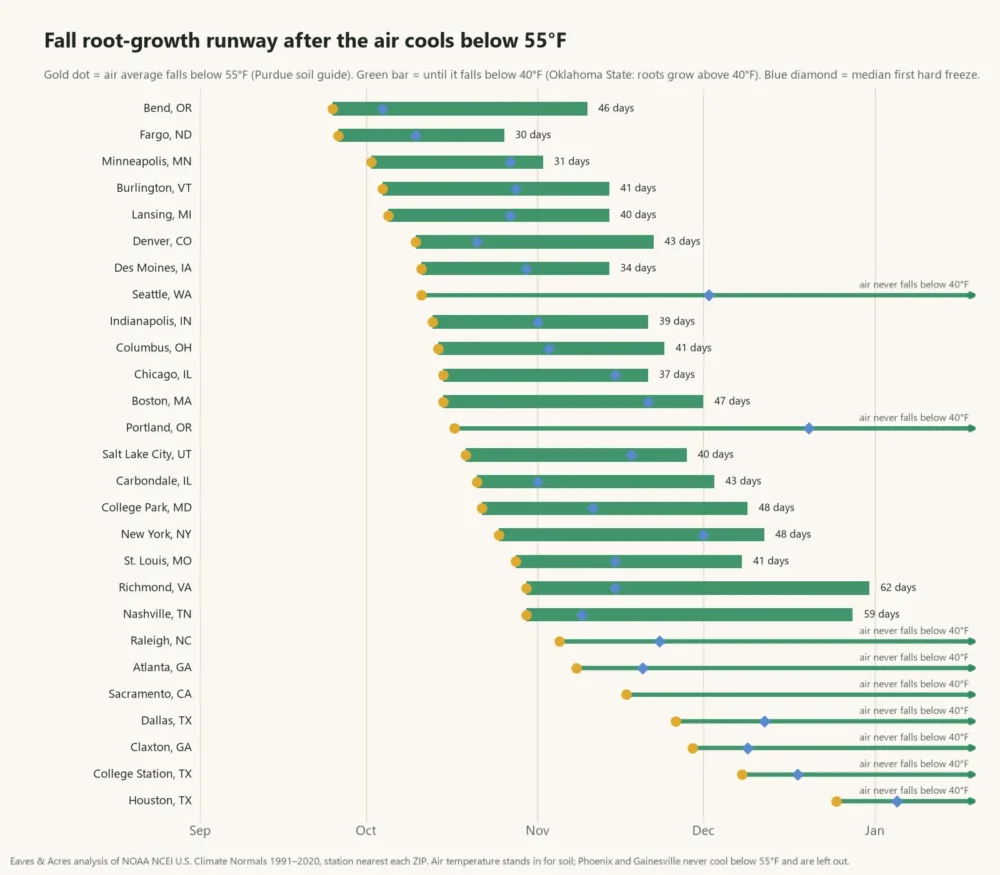
The median first hard freeze is November 4 and the 55°F date comes before it in 98.5% of the 37,067 ZIP codes with both dates, a median of 17 days. Missouri’s rule of thumb is that if the trees in your area still have leaves, you can plant new trees,11 while the Arbor Day Foundation plants bare-root trees in fall only after the leaves have dropped.17 The warm-soil window for container and balled trees therefore comes first, and the bare-root window, if you use one, comes after it.
Fall planting costs something. Purdue warns that fall-planted stock needs extra attention because plants may not have time to establish a good root system before winter, that cold winter winds and sun pull water from the branches and the roots must replace it, and that cherries and plums are among the plants best saved for spring.10 Missouri names dry winter soil as one of the main drawbacks and says to water through the winter.11
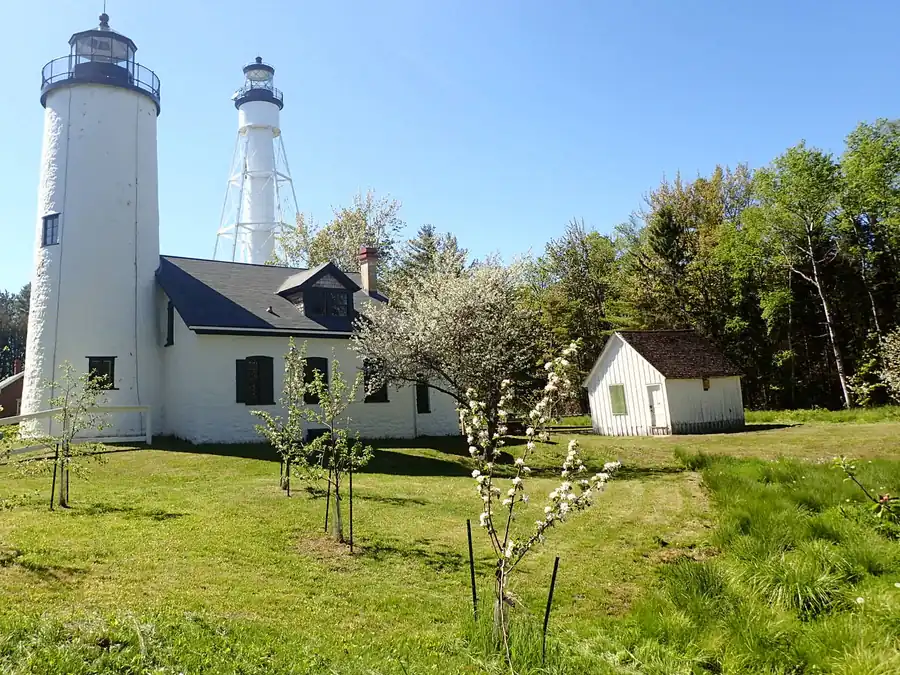

Mild winters: plant from December through February
Where the ground does not freeze for long, extension says to use the winter. Texas A&M AgriLife says December through February is the best time to plant most fruit trees in Texas, so roots grow during mild winter days and are established before summer heat and drought.5 The University of Georgia’s office in Evans County says the best time in southeast Georgia is from late fall to about the middle of February, and that a tree planted in December has more time to establish feeder roots.12 UF/IFAS, writing about peaches, plums and nectarines for north and central Florida, says container-grown fruit trees may be planted at any time of the year, with December and January the best months.13 LSU AgCenter makes the same case for container plants in Louisiana: November is its single best month, because roots keep growing through the winter and the plants get about seven months to settle before the heat.14
In our data 20.6% of the 40,557 lower-48 ZIP codes (8,355) have a coldest normal daily mean of 45°F or more; 30.0% never average below 40°F and 51.8% never average below freezing. The opposite is also common: 48.2% have a normal daily mean that falls below 32°F, and in 65.4% no winter day (December to February) averages as high as 45°F. College Station, Texas, has a coldest normal daily mean of 51.5°F, Claxton, Georgia, 49.0°F and Sacramento 48.5°F; Atlanta first averages 45°F on January 27. Mild winters bring a different problem, too little cold: UF/IFAS tells north and central Florida gardeners to look for “low chill” cultivars, and Maryland defines the chilling requirement as the cold weather overwintering buds need to develop flowers and fruits properly.13,3
Planting dates by USDA hardiness zone
A hardiness zone says which fruit trees survive your winter, not when to plant them: the USDA map is based on the average annual extreme minimum winter temperature.2 Oregon State still tells gardeners in the state’s colder regions to pay close attention to the zone when choosing a tree.6 The table adds the planting dates our data gives for each zone; look up yours with our planting zone by ZIP code tool and read why zone and frost date are different questions.
| Zone | ZIP codes | Spring start (air mean 45°F) | Air falls below 55°F | First hard freeze |
|---|---|---|---|---|
| Zone 3 | 209 | Apr 29 | Sep 17 | Oct 3 |
| Zone 4 | 2,039 | Apr 22 | Sep 24 | Oct 9 |
| Zone 5 | 5,258 | Apr 14 | Oct 2 | Oct 19 |
| Zone 6 | 10,446 | Apr 2 | Oct 10 | Oct 30 |
| Zone 7 | 8,695 | Mar 15 | Oct 22 | Nov 7 |
| Zone 8 | 6,779 | Feb 16 (68% of ZIPs; the rest never below 45°F) | Nov 8 | Nov 23 |
| Zone 9 | 4,284 | Winter (91% of ZIPs never below 45°F) | Nov 29 | Dec 18 |
| Zone 10 | 1,984 | Winter (100% of ZIPs never below 45°F) | Dec 1 | Dec 19 |
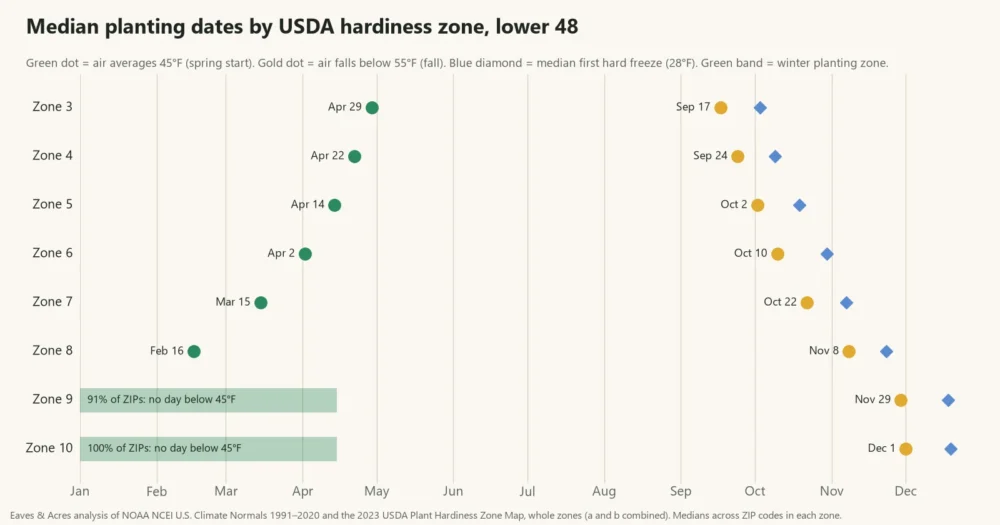
In zone 7 the median spring start is March 15 and the air falls below 55°F on October 22. Zone 5 starts a month later, on April 14, and its fall window closes on October 2. In zone 8, only 67.6% of ZIP codes have a 45°F date at all, because the rest never get that cold; zones 9 and 10 are mostly winter-planting country.
Fruit trees that should wait for spring
Two groups do not follow the dormant-season rule. Maryland’s fall window excludes stone fruits (peaches, plums, apricots, nectarines and cherries), which it says should only be planted in spring.3 Citrus and other subtropical trees are the opposite case: AgriLife says to wait until the threat of frost has passed before planting subtropical species such as citrus, olives and pineapple guava.5 For those, use your median last frost from our frost date lookup and the cover advice in the frost-cover guide, which lists what to protect when a late freeze arrives.
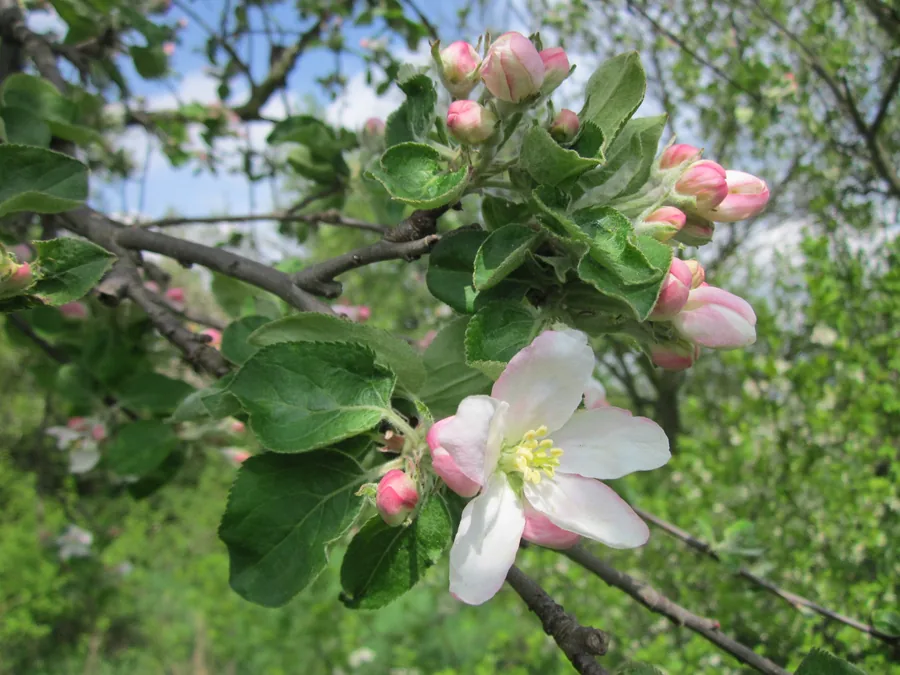

If the tree arrives before the ground is ready
Bare-root nursery stock ships in early spring, often before the soil can be dug. UConn says dormant stock can be kept in the original package in a refrigerator or an unheated garage for no more than two weeks.7 Illinois says to open a mail-order package as soon as it arrives and stand the trees in a tub of water for no longer than 2 days; if planting is delayed longer, heel the trees in by laying the roots in a shallow trench in a shaded area, with the trunk at 45 degrees, and covering them with loose soil.4 Maryland describes the same heeling-in and says plant roots must be kept moist and free of freezing temperatures at all times.3
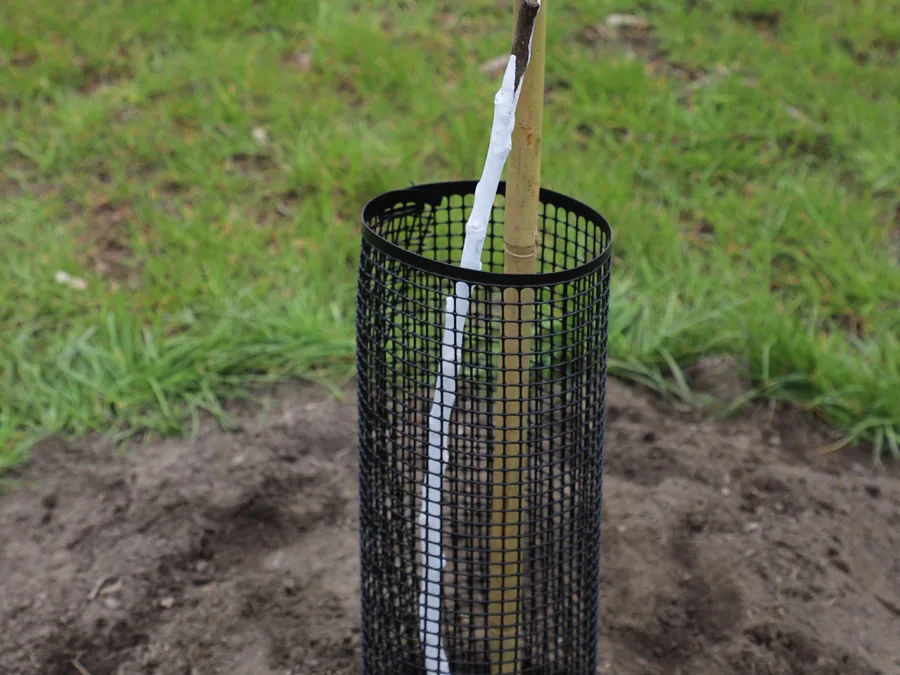

Container trees in summer
You can, but heat is the cost. LSU AgCenter agrees that container plants can go in at any time of the year, then names harsh summer heat as a major cause of transplant shock.14 The University of Georgia says trees can be planted almost any time if you are a persistent waterer, but the best time is typically fall, and in south Georgia spring-planted trees have little time to root before hot, dry weather.16 Alabama Extension says the dormant season is best because trees then need much less watering, with warmer-season planting possible, especially for container trees.15 The heat in question is common: the normal July high is 90°F or more in 29.1% of lower-48 ZIP codes and 85°F or more in 60.0%.
How published calendars compare with our dates
Twelve comparisons gave us something to test. Ten agree or land within a day. Maryland’s fall window ends a week before our 55°F date in College Park, and Bend, in central Oregon, is the miss: Oregon State’s February-or-March example ends well before our April 20 date there.
| Source | What it says | Our date | Fit |
|---|---|---|---|
| Illinois Extension, southern Illinois | Spring, just after the soil thaws: March | Carbondale Mar 15 | Inside |
| Illinois Extension, northern Illinois | Spring, just after the soil thaws: April | Chicago Mar 31; Rockford Apr 5 | Rockford inside; Chicago 1 day short |
| University of Maryland Extension, spring | Late February through March, before buds open | College Park Mar 19 | Inside |
| University of Maryland Extension, fall | Mid-September through mid-October (second best) | College Park, air below 55°F: Oct 22 | Our date is 7 days after the window ends |
| Texas A&M AgriLife | December through February | College Station: coldest normal daily mean 51.5°F | Agrees: no day below 45°F |
| UGA, Evans County | Late fall to about mid-February | Claxton: coldest normal daily mean 49.0°F | Agrees: no day below 45°F |
| UF/IFAS (container trees) | December and January best | Gainesville: coldest normal daily mean 54.8°F | Agrees: no day below 45°F |
| Oregon State Extension, spring | Early spring: February or March, for example | Portland Feb 18; Corvallis Mar 3 | Inside |
| Oregon State Extension, cold eastern and central Oregon | Early spring preferred where winters are cold | Bend Apr 20 | Miss: 20 days after March ends |
| Oregon State Extension, fall | Wait for cool weather: October, for example | Portland, air below 55°F: Oct 17 | Inside |
| Purdue | Soil well above 55°F until early to late October | Indianapolis, air below 55°F: Oct 13 | Inside |
| University of Missouri Extension | Mid-September to the end of October | St. Louis, air below 55°F: Oct 28 | Inside (3 days before the end) |
How we calculated these dates
Daily temperatures are NOAA’s monthly normals placed on the 15th of each month and interpolated linearly, for the station nearest each ZIP code.1 The spring start is the first day the normal daily mean reaches 45°F after the coldest day of the year; the fall lines are the days the normal mean falls below 55°F and 40°F. Frost dates are NOAA’s median 32°F and 28°F dates. Zones are the 2023 USDA map.2 Soil lags air, and a single year can run weeks ahead of or behind the normal.
Next steps
Look up your zone with the planting zone tool and your frost dates with the frost date lookup. Our strawberry planting guide covers bare-root strawberries. Once the trees are in, pruning is a separate job; see when to prune roses and when to prune hydrangeas for how we handle timing there. Asparagus crowns are another perennial planted dormant; see when to plant asparagus.
Frequently asked questions
Bare-root fruit trees go in dormant, in late winter or early spring: late February through March in Maryland, March in southern Illinois and April in northern Illinois. In mild-winter places such as Texas the extension window is December through February.
Spring for bare-root trees in most of the North: Illinois, Iowa State, Purdue and Oklahoma State all send bare-root trees to late winter or spring. Fall suits container and balled trees while the soil is well above 55°F, and mild-winter regions plant through winter. Maryland says stone fruits should be planted only in spring.
Yes where the soil is not frozen. Texas A&M AgriLife says December through February is the best time in Texas, and UGA’s Evans County office says late fall to mid-February in southeast Georgia. In 20.6% of lower-48 ZIP codes the normal air temperature never averages below 45°F.
For bare-root trees, the buds set the limit: UConn and Maryland say plant before buds open. Container trees can go in later, but LSU AgCenter and UGA warn that summer heat causes transplant shock and needs steady watering. We found no extension source that names a last date.
It works if you keep them watered. LSU AgCenter says container plants can go in at any time of the year but names harsh summer heat as a major cause of transplant shock. The normal July high is 90°F or more in 29.1% of lower-48 ZIP codes.
Keep the roots moist and out of freezing. Illinois says to stand the trees in water for no longer than 2 days and then heel them in; UConn says dormant stock keeps in its package, cold, for no more than two weeks.
Maryland says stone fruits (peaches, plums, apricots, nectarines, cherries) should be planted only in spring. Citrus and other subtropical trees wait until the threat of frost has passed, per Texas A&M AgriLife.
In our data the median zone 7 ZIP code reaches a 45°F air average on March 15 and cools below 55°F on October 22. Maryland Extension (College Park is zone 7b) says late February through March for bare-root trees and mid-September through mid-October as second best.
Sources
- 1.U.S. Climate Normals 1991–2020. NOAA National Centers for Environmental Information, 2021. Used for: monthly temperature normals and median last- and first-frost dates for every ZIP code Back to text
- 2.2023 USDA Plant Hardiness Zone Map. USDA Agricultural Research Service, 2023. Used for: zones based on the average annual extreme minimum winter temperature; zone by ZIP code Back to text
- 3.Starting a Home Fruit Garden. University of Maryland Extension, 2026. Used for: best time late February through March before buds open; second best mid-September to mid-October except stone fruits; heeling-in; chilling requirement Back to text
- 4.Fruit Trees for Home Gardens: Planting. University of Illinois Extension, n.d. Used for: spring planting after the soil thaws, March in southern and April in northern Illinois; late fall for southern Illinois; tub 2 days then heel in Back to text
- 5.When and how to plant fruit trees for ‘fruitful’ results, Adam Russell. Texas A&M AgriLife Extension Service, 2026. Used for: December through February in Texas; bare-root preferable, container also works; wait for frost to pass for subtropical trees Back to text
- 6.Should I plant fruit trees in fall or spring?. Oregon State University Extension Service, 2024. Used for: fall planting from October with dormant trees; bare-root dug as late as January; early spring February or March; check USDA zone Back to text
- 7.Planting Bare Root Trees and Shrubs, Lauren Kurtz. UConn Home & Garden Education Center, 2026. Used for: bare-root defined; dormant or just before bud break; early spring or late fall before the ground freezes; two weeks stored dormant Back to text
- 8.When should bare-root trees be planted?. Iowa State University Extension and Outreach, n.d. Used for: bare-root trees and shrubs must be planted in early spring before growth begins Back to text
- 9.Fall is a great time to add trees to the landscape, David Hillock. Oklahoma State University Extension, 2020. Used for: roots grow when soil is above 40 degrees; balled-and-burlapped in fall; bare-root in late winter Back to text
- 10.Fall Ideal for Planting Trees, Rosie Lerner. Purdue Consumer Horticulture, 2000. Used for: soil well above 55°F at 6 inches until early to late October; choose balled or container; bare-root late winter or early spring; cherries and plums in spring Back to text
- 11.Fall is the Perfect Time to Plant a Yard Tree, Hank Stelzer. University of Missouri Extension, 2019. Used for: mid-September to end of October; soil consistently 50°F or higher; trees still in leaf; dry winter soil Back to text
- 12.Planting Apples and Pears in Southeast Georgia, Wiley Ross Greene. University of Georgia Cooperative Extension, Evans County, 2020. Used for: best time from late fall to about mid-February; December planting has more time to establish feeder roots Back to text
- 13.Deciduous Fruit Trees. UF/IFAS Gardening Solutions, n.d. Used for: container-grown fruit trees any time, December and January best; low-chill cultivars Back to text
- 14.Landscaping Plants. LSU AgCenter, 2018. Used for: container plants any time; November best in Louisiana; summer heat causes transplant shock; about 7 months to establish Back to text
- 15.Proper Tree Planting. Alabama Cooperative Extension System, 2026. Used for: balled-and-burlapped description; dormant season best; container trees can go in at warmer times Back to text
- 16.Plant trees early to survive Georgia’s hot summers, Sage Barnard. University of Georgia College of Agricultural and Environmental Sciences, 2025. Used for: best time typically fall; almost any time with persistent watering; bare-root late winter, containerized year-round Back to text
- 17.How to Plant Bare-Root Trees. Arbor Day Foundation, n.d. Used for: plant when dormant: in fall after the leaves have dropped, in early spring before leaves or new growth appear Back to text
- 18.Photo: Peach Orchard Rows in Winter, Hayden Soloviev (CC BY 4.0). Wikimedia Commons, 2025. Used for: hero photo
- 19.Photo: Young fruit trees at Michigan Island, National Park Service (public domain). Wikimedia Commons, 2017. Used for: young staked trees photo
- 20.Photo: Caged and Painted Fruit Tree, National Park Service (public domain). Wikimedia Commons, 2024. Used for: bare-root tree photo
- 21.Photo: 20130429Malus domestica blossom2, AnRo0002 (CC0). Wikimedia Commons, 2013. Used for: apple blossom photo
How this guide was made
- Written by the Yard & Garden Desk and reviewed by the Data & Methodology Desk.
- Data: monthly temperature normals and median last- and first-frost dates from NOAA NCEI U.S. Climate Normals 1991–2020 for the station nearest each ZIP code, with daily values interpolated from the monthly normals; USDA 2023 Plant Hardiness Zone Map; planting rules and published calendars from University of Maryland, Illinois, Oregon State, Texas A&M AgriLife, UConn, Iowa State, Oklahoma State, Purdue, Missouri, Georgia, UF/IFAS, LSU, Alabama and the Arbor Day Foundation. Air temperature stands in for soil temperature, and the 45°F spring line is calibrated to extension calendars, not published. See our methodology.
- AI use: AI tools help us research, draft and check this guide. Every figure is checked against the source cited for it, and calculated figures come from our own code, described on the methodology page.
- Spotted an error? Tell us — the form opens with this page’s address filled in.
Change log
- Oct 27, 2026Corrected a date-handling error in our national count: first hard-freeze dates that NOAA lists in January to June (mostly Gulf Coast and Florida ZIP codes; they belong to the following winter) were placed in the same calendar year. Median first hard freeze November 4 (was November 3); the 55°F date comes before it in 98.5% of ZIP codes (was 97.6%); median gap 17 days (was 16); zone 9 median hard freeze December 18 (was December 11); zone 10 December 19 (was December 4). The zone chart was redrawn.
- Oct 22, 2026Published. Spring start and fall root-growth dates for 29 cities and by USDA zone from NOAA 1991–2020 normals for 40,557 lower-48 ZIP codes, tested against twelve extension calendar statements.
Covers lawns, gardens, frost and planting. We write the guides and maintain the tools that tell you when to seed, feed and plant for your ZIP.
Keep reading
When to Plant Pumpkins: Count Back From Halloween, Not Forward From Frost
Sow pumpkins once the soil reaches about 65°F, a median 37 days after the last frost, then count back 90 to 120 days from Halloween or the first frost. Dates for 24 cities.
When to Plant Corn: Match the Date to the Type, Not Just the Frost
Sow standard sweet corn once the soil reaches about 55°F, sugar-enhanced at 60°F and supersweet at 65°F: a median April 25, May 9 and May 25. Dates for 28 spring and 21 fall cities.
When to Plant Trees and Shrubs: Fall Dates Counted From Your Freeze
Finish fall planting about six weeks before your first hard freeze, plant evergreens earlier or wait for spring, and avoid midsummer. Dates for 30 cities and 40,557 ZIP codes.
Seasonal reminders for your ZIP
Get a short email when it’s time to overseed, start seeds, open the pool or service your furnace — timed to your climate.