When to Plant Strawberries: Fall in the South, Spring in the North
The South plants strawberries in fall as an annual crop, and the North plants them in spring as a perennial patch. We checked 22 extension calendars against NOAA frost dates and tested the zone rules against every ZIP code.
- Last reviewed Oct 13, 2026
- 21 cited sources
- 8 min read

Set your ZIP to see dates for your area.
- 1Plant strawberries in fall in the South: UF/IFAS gives September 15 to October 15 in North Florida, September 25 to October 25 in Central Florida and October 1 to December 1 in South Florida.
- 2In the North, plant in early spring: Penn State says April and early May, Illinois Extension March or April, and the University of Minnesota April and May for dormant plants.
- 3The growing system decides the season, not the hardiness zone: fall-planted annual beds suit the South, where disease destroys matted rows, and spring-planted matted rows suit the North.
- 4Fall windows sit 1.3 to 13 weeks before the median first frost, at normal highs of 75 to 85°F, so use your state’s calendar instead of a frost-date count.
- 5Zone rules fail the test: 70% of Oregon ZIP codes are zone 8 or warmer, yet Oregon State plants in spring.
Plant strawberries in the fall if you live in the South, where they grow as an annual crop, and in early spring if you live in the North, where a perennial patch goes in around the last frost. Southern windows run from early September in the North Carolina mountains to December 1 in South Florida. Northern calendars run from March in Chicago to May in Minneapolis.
We put 22 extension calendars next to NOAA frost dates for their cities, counted the days of strawberry-friendly weather for every ZIP code in the lower 48, and tested three hardiness-zone rules against all of them.
Fall or spring? The growing system decides
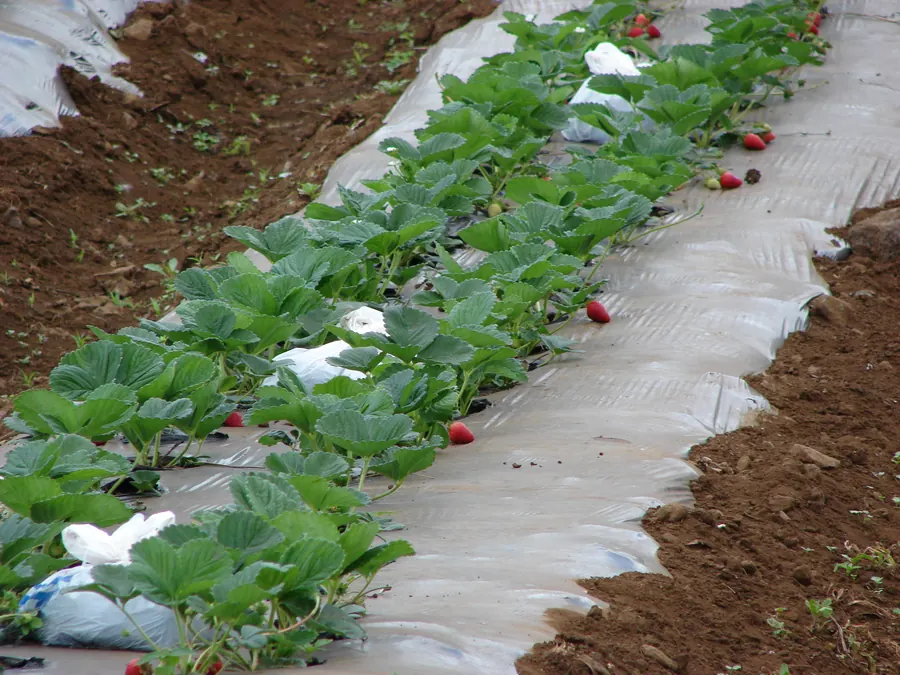
Strawberries are grown two ways, and each has its own season. In a matted row, you set plants out in spring, pick off the first flowers, let runners fill the row, and pick the following spring. Clemson says matted-row plants go in during the spring of year one and fruit in the spring of year two.6 In the annual hill system, often on black plastic, you plant in fall, harvest the next spring and then pull the plants. The South uses the annual system for a reason other than cold:
Because of diseases, two very different production systems are used in Georgia.
Anthracnose often destroys matted rows in middle and south Georgia during their first summer, so the annual hill system is preferred there, while the matted row works best in north Georgia.7 Clemson draws the same line between the Upstate and the Coastal Plain.6 Texas A&M AgriLife doesn’t recommend the matted row for central Texas at all.8
Loads from YouTube (privacy-enhanced mode) only when you press play.
Fall planting dates in the South
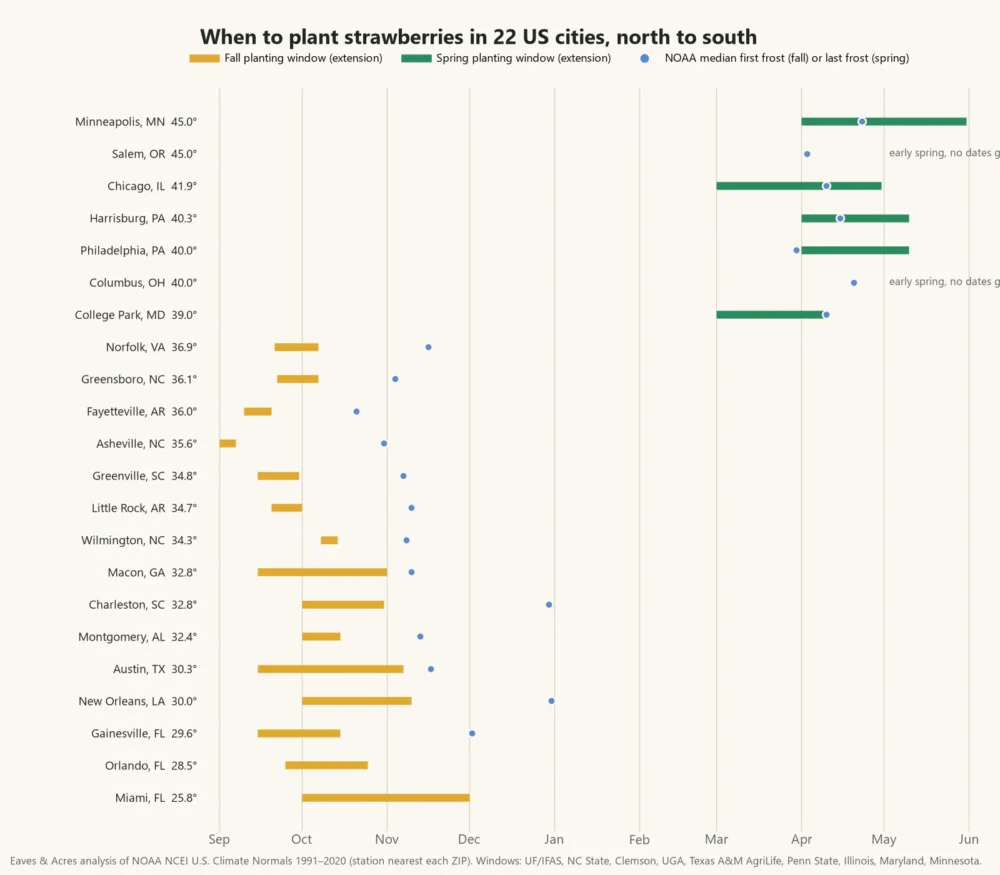
Southern extension services publish fall windows by region. In a guide for growers, NC State lists them for North Carolina, Virginia, Arkansas, Alabama and Louisiana.5 Texas A&M AgriLife, Clemson, UGA and UF/IFAS publish their own.8,6,7,4 We measured each one against its city’s NOAA median first fall frost.1
| City (ZIP) | Zone (2023) | Published fall window | Median first frost | Weeks before median frost | Normal high, mid-window |
|---|---|---|---|---|---|
| Asheville, NC (28801) | 7b | First week of September NC State (Mountains) | Oct 31 | 7.7 to 8.6 | 81°F |
| Fayetteville, AR (72701) | 7a | September 10–20 NC State table (northern Arkansas) | Oct 21 | 4.4 to 5.9 | 82°F |
| Greenville, SC (29601) | 8a | September (Upstate) Clemson | Nov 7 | 5.4 to 7.6 | 78°F |
| Little Rock, AR (72201) | 8a | September 20 – October 1 NC State table (central Arkansas) | Nov 10 | 5.7 to 7.3 | 81°F |
| Greensboro, NC (27401) | 8a | Fourth week of September – first week of October NC State (Upper Piedmont) | Nov 4 | 4 to 6.1 | 76°F |
| Norfolk, VA (23510) | 8b | Late September – first week of October NC State table (southeast Virginia) | Nov 16 | 5.7 to 8 | 75°F |
| Wilmington, NC (28401) | 8b | Second week of October NC State (Lower Coastal Plain) | Nov 8 | 3.6 to 4.4 | 76°F |
| Montgomery, AL (36104) | 8b | October 1–15 NC State table (Alabama) | Nov 13 | 4.1 to 6.1 | 82°F |
| Macon, GA (31201) | 8b | September 15 – November 1 (early October best) UGA | Nov 10 | 1.3 to 8 | 81°F |
| Charleston, SC (29401) | 9a | October (Coastal Plain) Clemson | Dec 30 | 8.6 to 12.9 | 75°F |
| New Orleans, LA (70112) | 9b | October – early November (bare-root) NC State table (southeast Louisiana) | Dec 31 | 7.3 to 13 | 79°F |
| Austin, TX (78701) | 9a | Mid-September – early November Texas A&M AgriLife (Travis County) | Nov 17 | 1.4 to 9 | 84°F |
| Gainesville, FL (32601) | 9a | September 15 – October 15 UF/IFAS (North Florida) | Dec 2 | 6.9 to 11.1 | 85°F |
| Orlando, FL (32801) | 10a | September 25 – October 25 UF/IFAS (Central Florida) | Rare | Frost is rare | 85°F |
| Miami, FL (33130) | 11a | October 1 – December 1 UF/IFAS (South Florida) | Rare | Frost is rare | 81°F |
Two patterns stand out:
- Colder places plant first. NC State starts in the mountains in the first week of September, about eight weeks before Asheville’s median first frost. Wilmington, on the coast, waits until the second week of October, about four weeks before its frost.
- No fixed frost rule fits. The windows sit anywhere from 1.3 to 13 weeks before the median first frost. One top-ranking page gives “6 to 8 weeks before the first frost” without a source; three of the 13 windows with a frost date don’t overlap that range at all.
What the windows share is warmth. At the middle of every one of the 15 windows, the normal daily high is between 75 and 85°F, with a median of 81°F. Texas A&M AgriLife horticulturist Russell Wallace names October as the prime time in Texas and warns against buying plants in spring:9
that is really the wrong time of year because it gets too hot, too quickly
Why fall planting works in the South
UF/IFAS explains the season with two numbers. Most varieties need temperatures between 50 and 80°F and days of 14 hours or less to develop flowers and fruit. North of Florida, it says, those conditions occur only briefly in early fall and again in spring.3
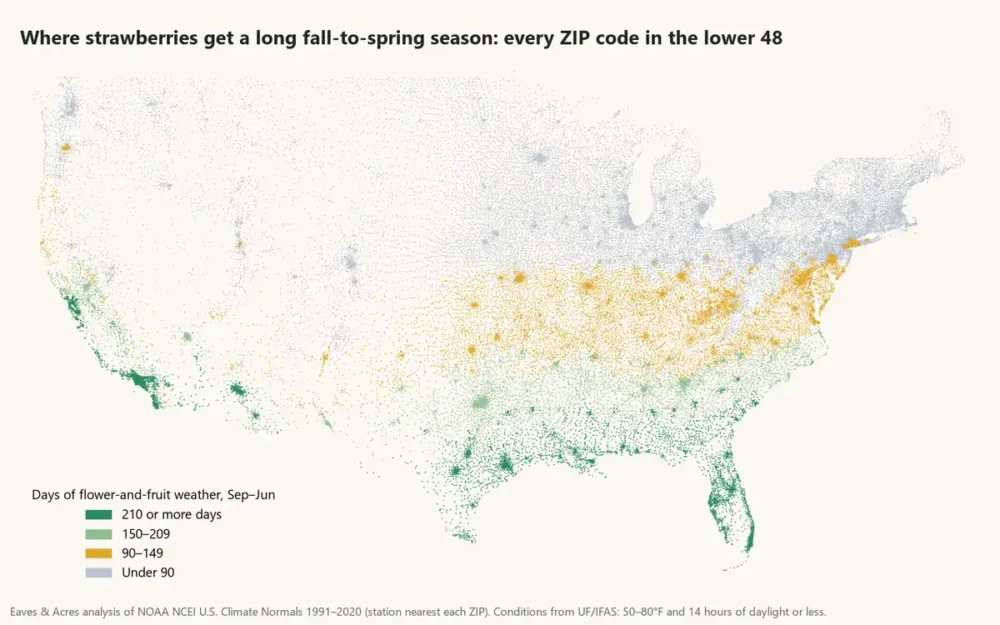
We counted those days for every ZIP code from September 1 to June 30, using the normal daily mean temperature and the day length at its latitude. Gainesville, Florida, gets 282 such days, almost the whole season. Austin gets 256 and Macon 211. Minneapolis gets 43, Chicago 74 and Philadelphia 108, split into a fall stretch and a short spring one. Across the lower 48, the median ZIP code gets 92 days.
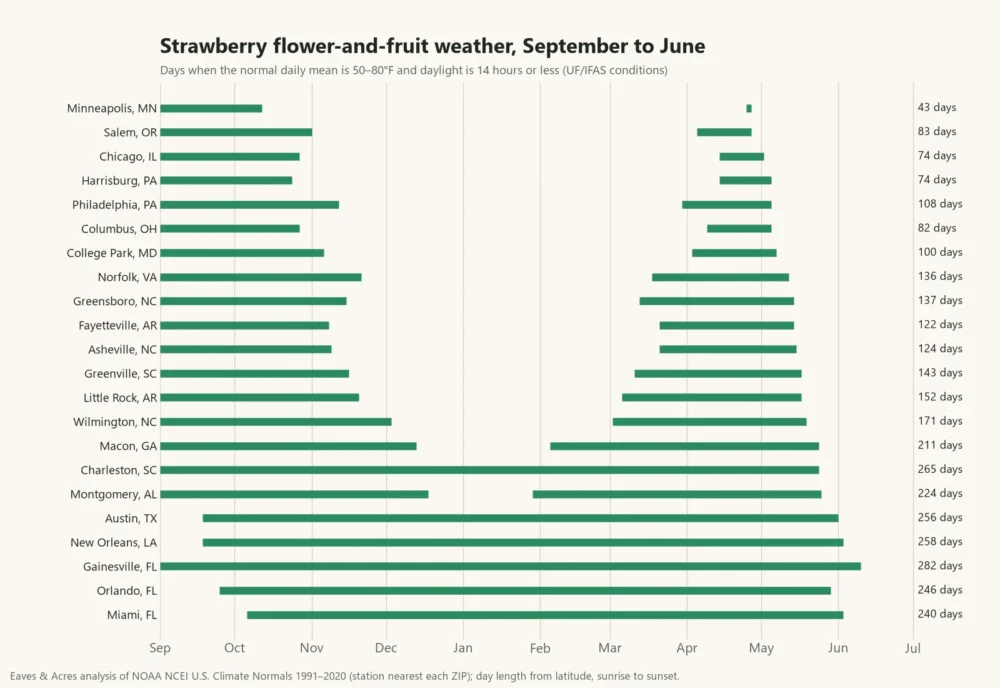
UF/IFAS’s claim holds up in the data. Only 11.8% of lower-48 ZIP codes keep a normal January mean of 50°F or more, and 1,464 of Florida’s 1,473 ZIP codes are among them. UF/IFAS calls Florida the winter strawberry capital of the world.3
If you are planting late
NC State calls the planting date the most important factor in how many crowns the plants carry in spring.5 Late plantings can recover some fall growth under floating row covers, but research it cites from Arkansas found that covers can’t fully make up the lost time. In Austin, Texas A&M AgriLife covers plants with a frost blanket on freezing nights and takes row covers off in February so bees can reach the flowers.8

Spring planting dates in the North
Northern extension services plant in early spring. Penn State plants in April and early May and advises against planting after June 1.11 Ohio State calls early spring the best time and doesn’t recommend fall planting, because freezing and thawing can heave plants out of the soil.14 Oregon State plants as early as the soil can be worked.16
| City (ZIP) | Zone (2023) | Published spring window | Median last frost | 10% chance of frost after | Window vs. median frost |
|---|---|---|---|---|---|
| Minneapolis, MN (55401) | 5a | April and May (dormant plants) University of Minnesota | Apr 23 | May 7 | 3.1 weeks before to 5.4 weeks after |
| Chicago, IL (60601) | 6b | March or April Illinois Extension | Apr 10 | Apr 25 | 5.7 weeks before to 2.9 weeks after |
| Harrisburg, PA (17101) | 7a | April and early May Penn State | Apr 15 | May 2 | 2 weeks before to 3.6 weeks after |
| Philadelphia, PA (19103) | 7b | April and early May Penn State | Mar 30 | Apr 12 | 0.3 weeks after to 5.9 weeks after |
| College Park, MD (20742) | 7b | March or early April University of Maryland | Apr 10 | May 1 | 5.7 weeks before to the frost date |
| Columbus, OH (43215) | 6b | Early spring Ohio State | Apr 20 | May 7 | No dates given |
| Salem, OR (97301) | 8b | As early as the soil can be worked Oregon State | Apr 3 | Apr 27 | No dates given |
Sources: University of Minnesota,15 Illinois Extension,12 Penn State,11 University of Maryland,13 Ohio State14 and Oregon State.16
Each of the five calendars with dates falls within about six weeks either side of the NOAA median last frost. That median is a 50% date, so frost is still possible afterward. That is fine for new plants: Clemson says frost generally won’t harm newly set plants.6 Open flowers are another matter. Illinois Extension warns that buds, blooms and young fruit are very susceptible to spring frost.12 Our frost-cover guide shows how to protect them. For your own dates, look up your ZIP code’s frost dates.
In the first summer, remove the flowers from June-bearing plants. Illinois says fruit left on newly set plants delays root and runner growth and reduces the next year’s crop.12

Why your hardiness zone can’t pick the season
Most quick answers use a zone line. Google’s AI Overview, citing a short YouTube video, sends zones 8 to 11 to fall planting. Bonnie Plants draws the line between zones 6 and 7, and a Martha Stewart guide sends zones 7 through 10 to fall. We tested the three rules on the 2023 USDA zone of every ZIP code.2
| Rule | What it says | What our ZIP codes show | What extension says |
|---|---|---|---|
| Google AI Overview (citing a YouTube Short) | Zones 8–11: fall | Oregon: 70% of 473 ZIP codes are zone 8 or warmer | Oregon State plants in spring, as early as the soil can be worked |
| Bonnie Plants | Zone 7 and south: fall; zone 6 and north: spring | Maryland: 97% of 599 ZIP codes are zone 7 or warmer. Pennsylvania: 36% of 2108 | University of Maryland and Penn State plant in spring |
| Martha Stewart (quoting a garden-center founder) | Zones 7–10: fall | Same ZIP codes as the row above | Same extension calendars: spring |
| Google AI Overview | Zones 4–7: spring | North Carolina and Arkansas: 27% of 1765 ZIP codes are zone 7 or colder | NC State gives fall dates for every North Carolina and Arkansas region |
A hardiness zone measures the coldest winter night, as our zone versus frost date explainer shows. It doesn’t measure disease pressure or how long fall stays mild. The map also moves. Between the 2012 and 2023 maps, 2,228 ZIP codes moved from zone 7 into zone 8 and 3,532 from zone 6 into zone 7. A rule tied to the zone number flips for those ZIP codes whenever the map is redrawn. See what changed on the 2023 map, or find your zone by ZIP code.
Does the strawberry type change the date?
A little. June-bearing plants form next year’s flower buds as the days shorten in late summer and fall, says Iowa State,17 so Northern June-bearers need a full season to build up first. Day-neutral plants fruit in the year you plant them but stop when it is below 40°F or 90°F and above, says Oregon State.16 Penn State finds they may not perform well in southern Pennsylvania.11 In the South, though, Russell Wallace reports that several day-neutral varieties performed very well in Texas research,9 and LSU AgCenter has had good results with day-neutral types in Louisiana.10
Planning the rest of the garden? See when to plant onions, another crop the South plants in fall, and when to plant tomatoes. Our fall vegetable planting dates cover the crops you harvest before winter, and the other vegetable guides cover the rest.
Frequently asked questions
In the South, September to November; in the North, March to May. UF/IFAS plants in Florida from mid-September to early December depending on the region, Texas A&M AgriLife in central Texas from mid-September to early November, and Penn State in April and early May.
Mostly no. Ohio State doesn’t recommend it, because freezing and thawing can heave plants out of the soil. Penn State does set plug plants on plastic in late summer or early fall, with row covers for winter.
It depends on the region. A zone 7 ZIP code in the North Carolina mountains plants in early September, while one in Pennsylvania plants in April. Pick the date from your state’s extension calendar, not the zone number.
Day-neutral types do, says Oregon State. June-bearers fruit the year after planting. Fall plantings in the South are picked the next spring, from late February through early May in Austin according to Texas A&M AgriLife.
Not in the South. Central Florida runs to October 25, South Florida to December 1, and Austin to early November. NC State calls planting date the biggest factor in crowns, and notes row covers can’t fully make up for a late start.
You can, but Texas A&M AgriLife’s Russell Wallace says spring is the wrong time because it gets too hot too quickly. Plants set out in fall fruit the following spring.
UF/IFAS recommends ‘Camarosa’, ‘Florida Brilliance’ and Sweet Sensation ‘Florida127’ for Florida home gardens.
Sources
- 1.U.S. Climate Normals 1991–2020. NOAA National Centers for Environmental Information, 2021. Used for: median first and last frost dates and monthly temperature normals for every ZIP and city Back to text
- 2.USDA Plant Hardiness Zone Map. USDA Agricultural Research Service, 2023. Used for: what hardiness zones measure; the 2023 and 2012 zones used to test zone rules Back to text
- 3.Growing Strawberries in the Florida Home Garden (HS403), Whitaker, Peres, Lahiri, Park-Brown and Chandler. UF/IFAS Extension, 2024. Used for: 50–80°F and 14-hour conditions for flowers and fruit; fall planting; grown as an annual Back to text
- 4.Strawberries. UF/IFAS Gardening Solutions, n.d. Used for: Florida planting windows by region: North Sept 15–Oct 15, Central Sept 25–Oct 25, South Oct 1–Dec 1 Back to text
- 5.Strawberries: Late Planting and the Use of Floating Row Covers, Mark Hoffmann, Amanda McWhirt and Jayesh Samtani. NC State Extension, 2022. Used for: recommended fall planting dates for North Carolina, Virginia, Arkansas, Alabama and Louisiana; planting date and crowns; row covers Back to text
- 6.Growing Strawberries in South Carolina (HGIC). Clemson Cooperative Extension Home & Garden Information Center, 2025. Used for: matted row vs annual hill; Sept 15–Nov 15 planting; frost and new plants Back to text
- 7.Home Garden Strawberries (Circular 883), Bob Westerfield and Phillip M. Brannen. University of Georgia Cooperative Extension, 2022. Used for: two production systems because of disease; Sept 15–Nov 1 planting in middle and south Georgia Back to text
- 8.Growing Strawberries in Austin. Texas A&M AgriLife Extension, Travis County, 2024. Used for: annual system mid-September to early November; matted row not recommended for central Texas; frost blankets and row covers Back to text
- 9.If summer’s end has you in a jam, plant strawberries now, Katharine Cook (quoting Russell Wallace). Texas A&M AgriLife Today, 2023. Used for: October is prime time in Texas; day-neutral varieties performed well Back to text
- 10.On the Hunt for the Ideal Strawberry for Louisiana Home Gardens, Michael Polozola. LSU AgCenter, 2025. Used for: fall planting in Louisiana; day-neutral varieties in trials Back to text
- 11.Growing Strawberries. Penn State Extension, 2026. Used for: plant April and early May; not after June 1; day-neutral types in southern Pennsylvania Back to text
- 12.Growing Strawberries. University of Illinois Extension, n.d. Used for: March or April planting; first-year flower removal; frost injury to buds and blooms Back to text
- 13.Growing Strawberries in a Home Garden. University of Maryland Extension, 2026. Used for: plant outdoors in March or early April when the soil begins to warm Back to text
- 14.Growing Strawberries in the Home Garden (HYG-1424). The Ohio State University Extension, 2017. Used for: early spring planting; fall planting not recommended because of soil heaving Back to text
- 15.Growing strawberries in the home garden, Emily Hoover, Annie Klodd, Emily Tepe and Doug Foulk. University of Minnesota Extension, 2024. Used for: calendar: dormant transplants April and May, potted transplants May and June Back to text
- 16.Growing strawberries in your home garden (EC 1307), Bernadine Strik and others. Oregon State University Extension Service, 2020. Used for: plant as early as the soil can be worked; June-bearing, everbearing and day-neutral timing Back to text
- 17.What are the differences between the different types of strawberries?. Iowa State University Extension and Outreach, 2026. Used for: June-bearers form flower buds as days shorten; day-neutral types struggle in heat Back to text
- 18.Get It Growing: Here’s how to grow strawberries (video), Heather Kirk-Ballard. LSU AgCenter, 2021. Used for: embedded video
- 19.Photo: Starr 070313-5671 Fragaria x ananassa, Forest & Kim Starr (CC BY 3.0). Wikimedia Commons, 2007. Used for: hero photo
- 20.Photo: Starr-090426-6399 Fragaria x ananassa, Kula, Maui, Forest & Kim Starr (CC BY 3.0 US). Wikimedia Commons, 2009. Used for: plastic-mulch bed photo
- 21.Photo: Starr 080914-9878 Fragaria x ananassa (flower), Forest & Kim Starr (CC BY 3.0). Wikimedia Commons, 2008. Used for: flower photo
How this guide was made
- Written by the Yard & Garden Desk and reviewed by the Data & Methodology Desk.
- Data: median first and last frost dates and monthly mean temperatures from NOAA NCEI U.S. Climate Normals 1991–2020 for the station nearest each ZIP code; day length computed from each ZIP code's latitude (sunrise to sunset, the method validated against University of Maryland Extension's Rockville figure in our onion guide); USDA hardiness zones from the 2023 map with the 2012 map for comparison; planting windows from UF/IFAS, NC State, Clemson, UGA, Texas A&M AgriLife, Penn State, Illinois, Maryland, Ohio State, Minnesota and Oregon State extension publications. See our methodology.
- AI use: AI tools help us research, draft and check this guide. Every figure is checked against the source cited for it, and calculated figures come from our own code, described on the methodology page.
- Spotted an error? Tell us — the form opens with this page’s address filled in.
Change log
- Oct 13, 2026Published. Fall and spring planting windows for 22 cities from extension calendars measured against NOAA 1991–2020 frost dates, strawberry flower-and-fruit weather counted for every lower-48 ZIP code, and three hardiness-zone rules tested on 2023 and 2012 USDA zones.
Covers lawns, gardens, frost and planting. We write the guides and maintain the tools that tell you when to seed, feed and plant for your ZIP.
Keep reading
When to Plant Pumpkins: Count Back From Halloween, Not Forward From Frost
Sow pumpkins once the soil reaches about 65°F, a median 37 days after the last frost, then count back 90 to 120 days from Halloween or the first frost. Dates for 24 cities.
When to Plant Corn: Match the Date to the Type, Not Just the Frost
Sow standard sweet corn once the soil reaches about 55°F, sugar-enhanced at 60°F and supersweet at 65°F: a median April 25, May 9 and May 25. Dates for 28 spring and 21 fall cities.
When to Harvest Pumpkins: Ripeness Signs and the Freeze Deadline
Pick pumpkins when the rind resists a fingernail and the stem is dry, before a 28°F hard freeze. Median frost and freeze dates for 23 cities, plus curing and storage.
Seasonal reminders for your ZIP
Get a short email when it’s time to overseed, start seeds, open the pool or service your furnace — timed to your climate.