When to Harvest Pumpkins: Ripeness Signs and the Freeze Deadline
Ripeness is a fingernail test; the real deadline is a freeze. We combined 12 extension pages with NOAA normals for 37,563 ZIP codes to put dates on it for 23 cities.
- Last reviewed Oct 22, 2026
- 19 cited sources
- 12 min read

Set your ZIP to see dates for your area.
- 1Pick when the rind resists a fingernail, the color is deep and even for the variety, and the stem is dry (Iowa State, Nebraska, Colorado State). The packet’s 70 to 120 days is a cross-check.
- 2A light frost kills the vines, not the fruit; a hard freeze (28°F or lower) can damage it (Iowa State, Penn State, NWS). The median first frost comes before Halloween in 62.7% of ZIP codes, the median hard freeze in 36.9%.
- 3Median first frost and first hard freeze: Minneapolis October 16 and 27, Chicago November 5 and 15, Dallas November 29 and December 12. The median gap between them is 11 days.
- 4Cut with 2 to 4 inches of stem, cure about 10 days at 80 to 85°F, then store at 50 to 55°F for 2 to 3 months (Iowa State, Oregon State).
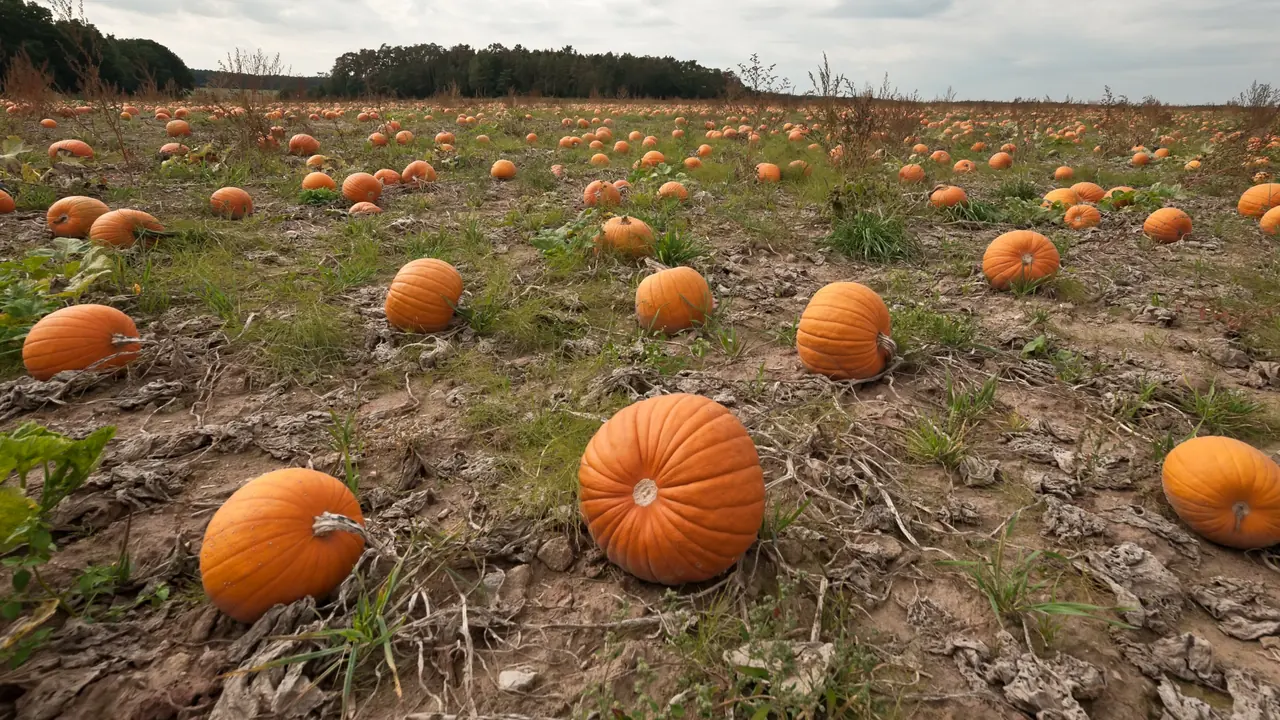
Harvest a pumpkin when the rind is hard enough that a fingernail will not puncture it, the color is deep and even for the variety, and the stem has dried, then cut it before a hard freeze, which the National Weather Service puts at 28°F or lower.2 A light frost that kills the vines does not harm the fruit, according to Iowa State, Nebraska and Colorado State extension.4,5,8 The deadline comes earlier than most calendars suggest: in 62.7% of lower-48 ZIP codes the median first 32°F frost arrives before Halloween, and in 36.9% the median first 28°F freeze does.
Extension sources agree on the ripeness signs but draw the cold line in three different places, and none of them gives a date for your town. We read 12 extension pages, the Chicago Botanic Garden’s pumpkin page and the NWS glossary, then used NOAA 1991–2020 normals1 for 37,563 lower-48 ZIP codes to put dates on each line for 23 cities. Every date is a median for the nearest weather station: in half of all years it comes earlier.
Four signs a pumpkin is ready
The rind resists a fingernail. This is the test every source uses. Nebraska Extension describes it this way:
Mature pumpkins have hard, shiny shells that can’t be easily punctured by a fingernail.
Oregon State says to use your thumbnail to try to puncture the skin and that if you cannot make an indentation, the pumpkin can be harvested,11 and Colorado State adds that the stems should be dry as well.8
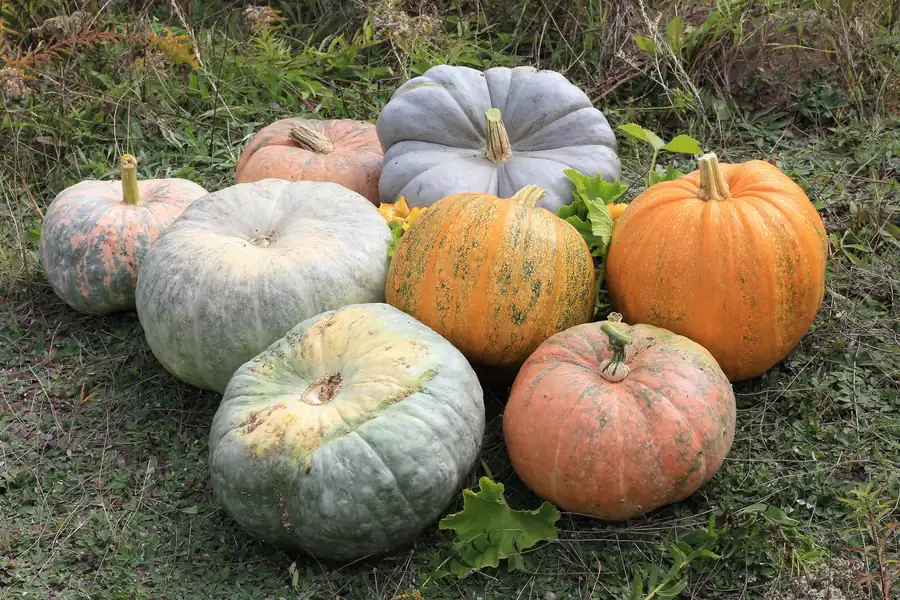
The color is deep and even. Iowa State looks for a deep, uniform orange.3 Nebraska says the uniform color can be orange, white, gray or blue depending on the variety, and tells gardeners to check the seed packet for what a ripe one looks like.5 Oregon State puts it simply: pumpkins are ripe when they are bright orange.10

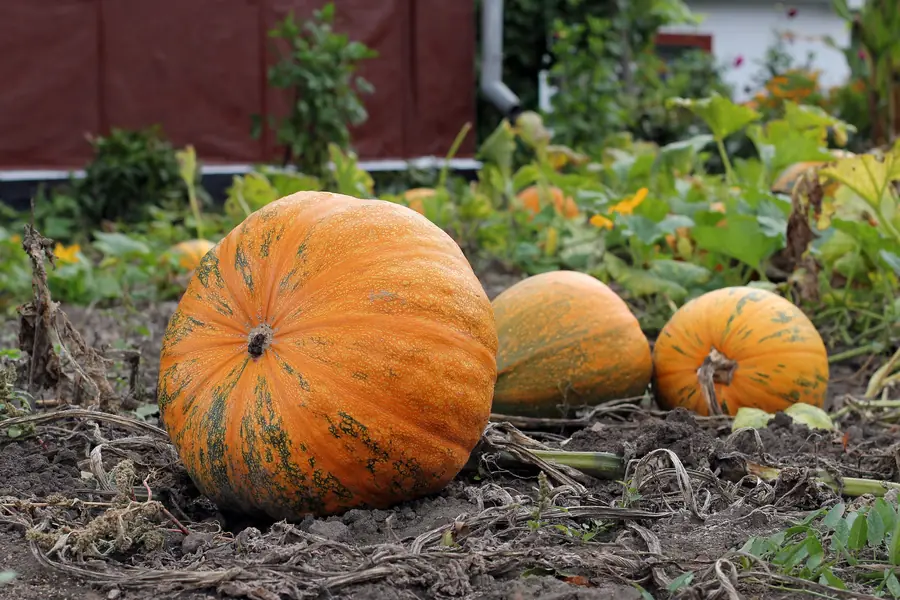
The stem and vine dry out. Nebraska’s Backyard Farmer says the stem should be dry and starting to wither,14 and Penn State says vines start to dry and wither from maturity, not disease, and slowly die back.7 Vines that are still green in late October do not protect the fruit from a freeze, so the dates below apply either way.

The calendar agrees. Days to maturity are a cross-check, not a trigger. Clemson gives 70 to 120 days depending on conditions,12 Arkansas 90 to 120 (about 100 for a medium carving pumpkin, 120 for the largest),13 Nebraska’s Backyard Farmer 75 to 100,14 and the Chicago Botanic Garden 85 to 115 frost-free days.15 If your fruit is far short of the packet number, expect it to need more time.
Too early or too late
The University of Vermont sums up the trade-off: picking before the fruit is mature gives poor flavor and color, while harvesting too late leads to cold injury and quicker breakdown.9 Clemson adds that immature pumpkins do not store well.12
What about a pumpkin that is only partly orange? The sources split. Penn State says unripe pumpkins can continue to ripen off the vine if they have started to turn orange, and that semi-ripe fruit should be cut and cured warm.7 Nebraska says green, immature pumpkins will not turn orange after a killing frost.5 Both can be true: a fruit that has begun to color can finish indoors, while a fully green one stays green. If a hard freeze is coming, Penn State says it is time to bring the pumpkins in.7
Leaving ripe fruit out has a small upside and a clear limit. Oregon State says pumpkins you plan to eat can stay on the vine until the first frost, which may make them sweeter,11 and Iowa State says mature pumpkins can stay until a light frost or freeze kills the vines.3 Oregon State’s storage advice is to bring the harvest in once temperatures stay below 50°F for more than a week or rain becomes frequent.10
Frost or hard freeze: where extension draws the line
A frost and a freeze are different events, as our frost vs freeze guide explains. The NWS defines a freeze as a surface air temperature of 32°F or below over a widespread area, and a hard freeze like this:2
28°F or lower for an extended period of time, killing most types of vegetation
Google’s AI Overview for “should pumpkins be picked before frost” gave the hard freeze as “at or below 28°F to 32°F” when we checked on October 22, 2026. That blends two alerts: 32°F is a freeze, and 28°F is a hard freeze. The extension sources below are more specific, and they do not fully agree.
| Source | Light frost or freeze | Hard freeze or colder | Pick-by instruction |
|---|---|---|---|
| Iowa State Extension | Mature pumpkins can stay until a light frost or freeze kills the vines; a light frost should not harm the fruit | A hard freeze may damage the fruit | Harvest all mature pumpkins before a hard freeze |
| Nebraska Extension, Lancaster County (pumpkins) | A light frost will not damage the pumpkins themselves | Harvest before temperatures drop into the mid to low 20s | Mature fruit left in freezing temperatures will rot |
| Nebraska Extension, Lancaster County (frost) | Frost damages the rinds of storage pumpkins and shortens storage life | — | Harvest storage pumpkins before frost; harvest frosted ones within a day or two and use them right away |
| Colorado State Extension | Not damaging | — | Harvest before a hard freeze |
| Penn State Extension | Fruit can survive a light frost that damages the vines | Below 28°F weakens the rind and lets bacteria in | September to October, before the first hard frost |
| Oregon State Extension | Fruit for eating may stay on the vine until the first frost; it may be sweeter | Damage possible below 50°F | Bring in when it stays under 50°F for more than a week or rain is frequent |
| University of Vermont Extension | — | Harvesting too late leads to cold injury and quicker breakdown | Wait for solid color, then harvest |
| National Weather Service | Freeze: 32°F or below over a widespread area | Hard freeze: 28°F or lower for an extended period, killing most vegetation | — |
Penn State is the clearest on why the hard freeze matters:
a hard freeze (less than 28°F) will weaken the rind
The same Nebraska office gives two lines. One page says mature pumpkins can wait through a light, vine-killing frost but should come in before temperatures drop into the mid to low 20s.5 Another says winter squash and pumpkins meant for storage should be harvested before frost because frost damages their rinds and shortens storage life, and that frosted fruit should be harvested within a day or two and used right away.6 Our planning rule, which is ours and not a source’s: start watching forecasts at the 1-in-10 frost date, pick storage pumpkins by the median first frost if you can, and treat the median first hard freeze as the last safe date. Our frost-cover guide covers what to do on a cold night if some fruit is still ripening.
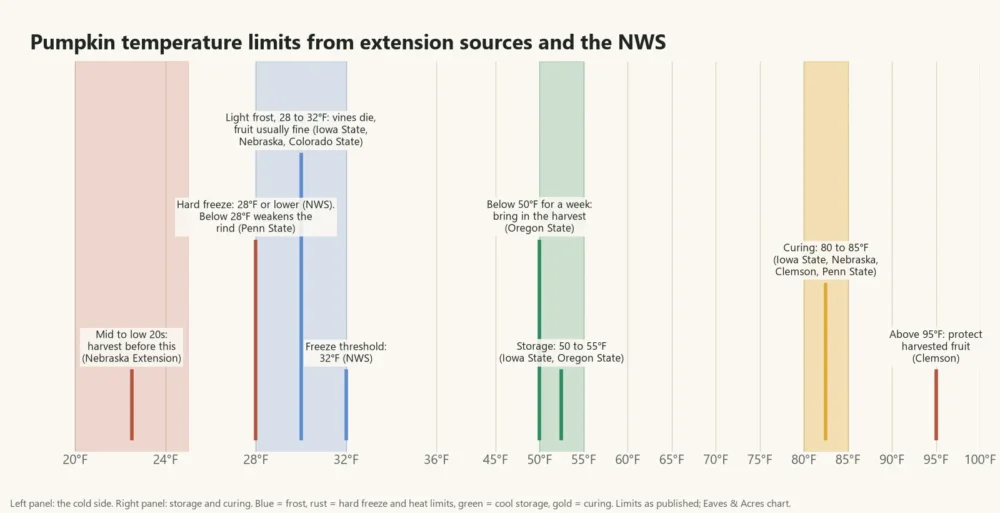
Low spots run colder because cold air pools there.6 Nebraska’s mid-20s limit is one our data cannot map: our NOAA file has 32°F and 28°F dates but no 24°F date.
Pick-by dates for 23 cities
Table 1 gives three dates per city: the 1-in-10 frost (a 10% chance a 32°F frost has come by then), the median first 32°F frost and the median first 28°F hard freeze. It also shows where Halloween falls and, as a reading aid, the latest sowing that would still ripen before the median first frost for a 90-day and a 120-day pumpkin (the Arkansas range). Look up your own ZIP code with our frost date lookup.
| City (ZIP) | 1-in-10 frost | Median first 32°F frost | Median first 28°F freeze | Halloween is (vs. freeze) | Latest sowing 90 / 120-day |
|---|---|---|---|---|---|
| Denver, CO (80202) | Sep 28 | Oct 12 | Oct 21 | 10 days after | Jul 14 / Jun 14 |
| Lincoln, NE (68508) | Sep 29 | Oct 13 | Oct 22 | 9 days after | Jul 15 / Jun 15 |
| Burlington, VT (05401) | Oct 2 | Oct 15 | Oct 28 | 3 days after | Jul 17 / Jun 17 |
| Minneapolis, MN (55401) | Oct 2 | Oct 16 | Oct 27 | 4 days after | Jul 18 / Jun 18 |
| Des Moines, IA (50309) | Oct 4 | Oct 20 | Oct 30 | 1 days after | Jul 22 / Jun 22 |
| Indianapolis, IN (46204) | Oct 7 | Oct 21 | Nov 1 | 1 days before | Jul 23 / Jun 23 |
| Columbus, OH (43215) | Oct 13 | Oct 24 | Nov 3 | 3 days before | Jul 26 / Jun 26 |
| Pittsburgh, PA (15222) | Oct 13 | Oct 27 | Nov 5 | 5 days before | Jul 29 / Jun 29 |
| Detroit, MI (48201) | Oct 17 | Oct 31 | Nov 9 | 9 days before | Aug 2 / Jul 3 |
| Nashville, TN (37201) | Oct 18 | Oct 31 | Nov 9 | 9 days before | Aug 2 / Jul 3 |
| St. Louis, MO (63101) | Oct 24 | Nov 4 | Nov 15 | 15 days before | Aug 6 / Jul 7 |
| Chicago, IL (60601) | Oct 24 | Nov 5 | Nov 15 | 15 days before | Aug 7 / Jul 8 |
| Salt Lake City, UT (84101) | Oct 23 | Nov 8 | Nov 18 | 18 days before | Aug 10 / Jul 11 |
| Raleigh, NC (27601) | Oct 28 | Nov 8 | Nov 23 | 23 days before | Aug 10 / Jul 11 |
| Atlanta, GA (30303) | Oct 27 | Nov 8 | Nov 20 | 20 days before | Aug 10 / Jul 11 |
| Boston, MA (02108) | Oct 29 | Nov 9 | Nov 21 | 21 days before | Aug 11 / Jul 12 |
| Little Rock, AR (72201) | Oct 29 | Nov 10 | Nov 21 | 21 days before | Aug 12 / Jul 13 |
| Columbia, SC (29201) | Nov 2 | Nov 16 | Dec 2 | 32 days before | Aug 18 / Jul 19 |
| Seattle, WA (98101) | Nov 1 | Nov 17 | Dec 2 | 32 days before | Aug 19 / Jul 20 |
| New York, NY (10001) | Nov 6 | Nov 20 | Dec 1 | 31 days before | Aug 22 / Jul 23 |
| Dallas, TX (75201) | Nov 10 | Nov 29 | Dec 12 | 42 days before | Aug 31 / Aug 1 |
| Portland, OR (97201) | Nov 10 | Dec 1 | Dec 20 | 50 days before | Sep 2 / Aug 3 |
| Houston, TX (77002) | Nov 27 | Dec 25 | Jan 5 | 66 days before | Sep 26 / Aug 27 |

Minneapolis shows the squeeze: the median hard freeze is October 27, four days before Halloween, and the median frost is October 16. Denver (October 12 and 21) and Lincoln (October 13 and 22) are earlier still. In Chicago the median frost is November 5, so Halloween pumpkins can wait there. Detroit and Nashville sit on the line, with a median frost on October 31. In Portland, Dallas and Houston the median hard freeze comes in December or January, so a freeze is not the first limit; Oregon State’s advice to bring the harvest in when temperatures stay under 50°F for a week or rain turns frequent is the one to watch.10
Across the 37,563 ZIP codes, the median first frost is October 24 and the median first hard freeze November 4. The median gap between those two dates is 11 days, and 19.8% of ZIP codes have 14 days or more. That gap is the window in which a frost has killed the vines but the fruit is still safe, and it is short: only 1.6% of ZIP codes have a week or less.
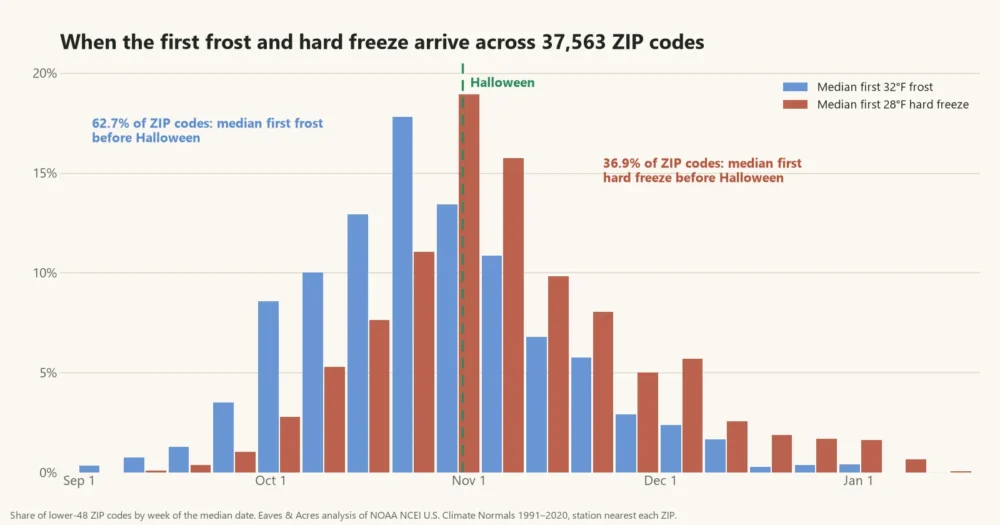
The risk is larger than the medians suggest. In 83.4% of ZIP codes the chance of a 32°F frost before Halloween is better than 1 in 10, in 59.3% before October 15, and in 27.1% before October 1. Late sowing makes it worse: Clemson says to plant most pumpkins by early July to ripen for Halloween,12 which is about 120 days before October 31, and an early-July sowing of a 120-day pumpkin ripens after the median first frost in 62.7% of ZIP codes. We left out 3,004 lower-48 ZIP codes that have no median frost or hard-freeze date; frost is not their deadline.
How the dates compare with published ones
Five extension or garden sources publish a date or planting rule we could test against the NOAA numbers.
| Source | What it says | Our NOAA number | Comparison |
|---|---|---|---|
| Nebraska Extension, Lancaster County | Average first fall frost about October 10 | Lincoln (68508): median first frost Oct 13 | 3 days later |
| Chicago Botanic Garden (pumpkin page) | Frost not expected again until October 15 | Glencoe (60022), station at the Garden: Oct 21 | 6 days later |
| Clemson Extension | Plant most pumpkins by early July to ripen for Halloween (70 to 120 days) | October 31 minus 120 days = July 3 | Matches a 120-day pumpkin |
| University of Arkansas Division of Agriculture | Plant mid-June to early July for Halloween; 90 to 120 days | Oct 31 minus 120 days = Jul 3, minus 90 = Aug 2; Little Rock median first frost Nov 10 | Early July matches 120 days; mid-June plus 120 days is October 13, four weeks before the frost |
| University of Vermont Extension (published Sept. 26, 2025) | Widespread frost and even a freeze in some spots in Vermont | Burlington (05401): median first frost Oct 15, 1-in-10 date Oct 2 | A frost already past by September 26 is at least 6 days ahead of the 1-in-10 date |

Cut, cure and store
Cut the pumpkin with a sharp knife or pruners and leave a handle. Oregon State says 2 to 4 inches of stem, and that pumpkins without stems will not store well;10 Iowa State says a 3 to 5 inch stem, and not to carry pumpkins by the stem because it may break off.3 UVM says to hold a pumpkin like a ball.9 Clemson says not to harvest or handle wet fruit,12 and Colorado State says that if pumpkins cure in the garden, you should check regularly for wildlife damage and sunscald.8
Then cure, then store. The sources agree on the temperature and differ on the rest, as Table 3 shows.
| Source | Cure at | For | Store at | Stem left on |
|---|---|---|---|---|
| Iowa State Extension | 80 to 85°F, 80 to 85% humidity | About 10 days | 50 to 55°F, single layer; 2 to 3 months | 3 to 5 inches (3 to 4 in its longer guide) |
| Clemson Extension | 80 to 85°F, 75 to 80% humidity | About 10 days | Protect from above 95°F and below 50°F | A generous stem |
| Penn State Extension | 80 to 85°F, 80 to 85% humidity (semi-ripe fruit) | Field-harden 7 to 14 days if conditions are good | 50 to 60°F, 50 to 75% humidity | 3 to 4 inches for a pumpkin |
| Oregon State Extension | 80 to 85°F, dry | Several days | 50 to 55°F; pumpkins 2 to 3 months | 2 to 4 inches |
| University of Vermont Extension | Above 60°F, ideally 80 to 85°F, out of the sun | 5 to 10 days | Up to 2 to 3 months for pumpkins | A few inches |
| Nebraska Extension (Backyard Farmer) | Warm, dry and sunny spot | 7 to 14 days | 50 to 55°F, good air circulation | 2 to 4 inches |
| Colorado State Extension | May cure in the garden | — | Above freezing, below 65°F; 2 to 3 months | A long, intact portion |
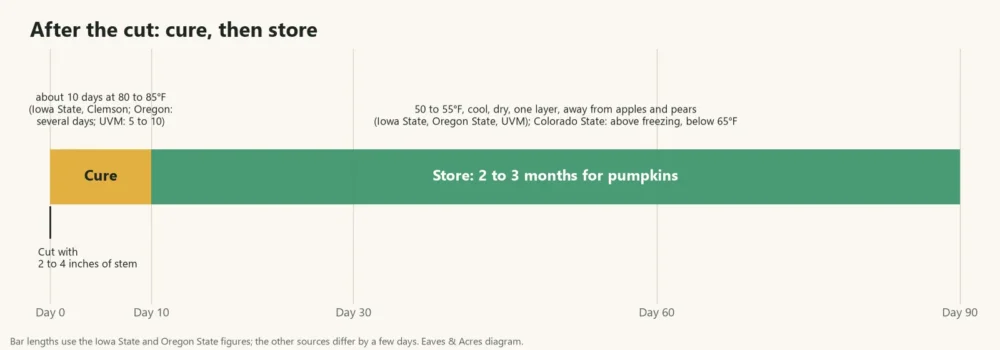
Two disagreements are worth knowing about. Humidity runs from 75 to 85%, and Nebraska’s Backyard Farmer cures in a warm, dry, sunny spot14 while the Lancaster County office says to keep pumpkins out of direct sun,5 as does UVM.9 Keep stored fruit away from apples, pears and other ripening fruit, whose ethylene shortens storage life (Iowa State, Oregon State, UVM), and check the pile often: Iowa State says to discard any pumpkin that shows signs of decay.4
How we calculated these dates
Frost dates are NOAA’s 1991–2020 normals for the station nearest each ZIP code, and the median and 1-in-10 dates work as they do in our last frost date explainer, only in fall:1 the median first 32°F frost, the median first 28°F freeze, and the date with a 10% chance of an earlier 32°F frost. City stations such as Boston Logan and New York’s Central Park can be warmer than the surrounding suburbs. The 90- and 120-day counts come from the Arkansas range13 and are subtracted from the median frost date. Individual years vary by weeks, and a single cold night can bring frost and a hard freeze together, so the 11-day gap is a typical spacing of two median dates, not a promise.
Next steps
Check the forecast against the lines above and pick by the date that fits how long you want the fruit to keep. For other crops that must come in before frost, see our fall vegetable planting dates, and for the other end of the frost calendar, when to plant potatoes. Cucumbers are another frost-tender vine crop; see when to plant cucumbers. Frost dates and hardiness zones are different things, as planting zone vs frost date explains. More crops are in our vegetable guides.
Frequently asked questions
Check three things: the rind resists a fingernail, the color is deep and even for the variety, and the stem is dry. The seed packet’s days to maturity is a cross-check; Clemson gives 70 to 120 days, depending on conditions.
Yes. UVM says picking before maturity gives poor flavor and color, and Clemson says immature pumpkins do not store well. Penn State says fruit that has started to turn orange can ripen off the vine; Nebraska says green ones will not turn orange after a killing frost.
The fruit usually survives a light frost, which kills the vines (Iowa State, Nebraska, Colorado State), though Nebraska says storage pumpkins should come in before frost because it damages the rind. A hard freeze is the firm deadline.
Penn State says a hard freeze below 28°F weakens the rind and lets bacteria in, and Iowa State says a hard freeze may damage the fruit. Nebraska’s outer limit is the mid to low 20s. Oregon State says pumpkins can be damaged below 50°F.
Penn State says September to October, before the first hard frost. Across lower-48 ZIP codes the median first frost is October 24 and the median hard freeze November 4.
Iowa State, UVM and Oregon State say about 2 to 3 months when cured and stored at 50 to 55°F in a single layer, away from apples and pears.
Yes. UVM says harvesting too late leads to cold injury and quicker breakdown, and Nebraska says mature pumpkins rot if left in the field in freezing temperatures.
Sources
- 1.U.S. Climate Normals 1991–2020. NOAA National Centers for Environmental Information, 2021. Used for: median first 32°F and 28°F dates and the 1-in-10 first-frost date for every ZIP code Back to text
- 2.NWS Glossary: Freeze, Freeze Warning, Freeze Watch, Hard Freeze. National Weather Service, n.d. Used for: freeze (32°F or below, widespread) and hard freeze (28°F or lower for an extended period) definitions Back to text
- 3.When should I harvest my pumpkins?. Iowa State University Extension and Outreach, 2024. Used for: deep uniform orange and hard rind; can stay until a light frost or freeze kills the vines; 3 to 5 inch stem; cure 10 days; store 50 to 55°F Back to text
- 4.All about Pumpkins, Aaron Steil. Iowa State University Extension and Outreach, 2026. Used for: harvest before a hard freeze; light frost destroys vines but should not harm fruit; curing, ethylene, storage 2 to 3 months Back to text
- 5.Late Season Harvesting of Tomatoes and Pumpkins. Nebraska Extension in Lancaster County, n.d. Used for: fingernail test, color by variety, light frost tolerated, harvest before the mid to low 20s, green pumpkins stay green, curing Back to text
- 6.Frost – Cold Temperatures Bring an End to the Gardening Season. Nebraska Extension in Lancaster County, n.d. Used for: storage squash and pumpkins harvested before frost; frosted fruit harvested within a day or two and used right away; cold air pools in low areas Back to text
- 7.Pumpkins and Winter Squash in the Garden and the Kitchen. Penn State Extension, n.d. Used for: September to October before the first hard frost; hard freeze below 28°F weakens the rind; unripe fruit that has begun to turn orange ripens off the vine; curing and storage Back to text
- 8.1829 Harvesting Pumpkins. Colorado State University Extension (PlantTalk Colorado), n.d. Used for: dry stems and thumbnail test; light frost not damaging; harvest before a hard freeze; storage above freezing and below 65°F Back to text
- 9.Pumpkin and Squash Harvest and Storage, Deb Heleba. University of Vermont Extension, 2025. Used for: too early gives poor flavor, too late gives cold injury; hold like a ball; cure 5 to 10 days; storage life Back to text
- 10.Plan ahead for winter storage of pumpkins and squash, Kym Pokorny. Oregon State University Extension Service, 2025. Used for: bright orange; harvest when below 50°F for a week or rain is frequent; 2 to 4 inch stem; cure 80 to 85°F; store 50 to 55°F; 2 to 3 months Back to text
- 11.When should I harvest my pumpkins? (Ask Extension). Oregon State University Extension Service, 2024. Used for: thumbnail test; may leave on the vine until the first frost for eating Back to text
- 12.Pumpkins & Winter Squash (HGIC). Clemson Cooperative Extension Home & Garden Information Center, n.d. Used for: 70 to 120 days to maturity; plant by early July for Halloween; immature fruit does not store; curing 80 to 85°F and 75 to 80% humidity for about 10 days Back to text
- 13.Mid-June: Plant pumpkins soon for Halloween arrival. University of Arkansas System Division of Agriculture, 2020. Used for: 90 to 120 days to mature; plant mid-June to early July for Halloween Back to text
- 14.Pumpkins. Nebraska Extension (Backyard Farmer), n.d. Used for: 75 to 100 days; full color, hard rind, dry stem; cure 7 to 14 days warm, dry and sunny; store 50 to 55°F Back to text
- 15.Pumpkins. Chicago Botanic Garden, n.d. Used for: 85 to 115 frost-free days; Chicago-area frost not expected again until October 15 Back to text
- 16.Photo: Rotten pumpkins in cloister garden Abenberg, Hans-Jürgen Neubert (CC BY 4.0). Wikimedia Commons, 2016. Used for: hero photo
- 17.Photo: Cucurbita pepo 2013 G1, George Chernilevsky (public domain). Wikimedia Commons, 2013. Used for: pumpkins and dried vines photo
- 18.Photo: Cucurbita 2011 G1, George Chernilevsky (public domain). Wikimedia Commons, 2011. Used for: pumpkins and squash colors photo
- 19.Photo: When the Frost is on the Pumpkin, Berkshires, Mass., Detroit Publishing Company (public domain). Wikimedia Commons, 1906. Used for: postcard photo
How this guide was made
- Written by the Yard & Garden Desk and reviewed by the Data & Methodology Desk.
- Data: median first 32°F and 28°F dates and the 1-in-10 first-frost date from NOAA NCEI U.S. Climate Normals 1991–2020 for the station nearest each ZIP code; ripeness, frost, curing and storage guidance from Iowa State, Nebraska, Penn State, Colorado State, Vermont, Oregon State, Clemson and Arkansas extension, the Chicago Botanic Garden and the National Weather Service. Normals are medians; individual years vary by weeks. See our methodology.
- AI use: AI tools help us research, draft and check this guide. Every figure is checked against the source cited for it, and calculated figures come from our own code, described on the methodology page.
- Spotted an error? Tell us — the form opens with this page’s address filled in.
Change log
- Oct 22, 2026Published. Median first frost and hard-freeze dates for 23 cities from NOAA 1991–2020 normals, the share of 37,563 lower-48 ZIP codes with a frost or hard freeze before Halloween, and what 12 extension pages and the NWS say about ripeness, frost, curing and storage.
Covers lawns, gardens, frost and planting. We write the guides and maintain the tools that tell you when to seed, feed and plant for your ZIP.
Keep reading
When to Plant Pumpkins: Count Back From Halloween, Not Forward From Frost
Sow pumpkins once the soil reaches about 65°F, a median 37 days after the last frost, then count back 90 to 120 days from Halloween or the first frost. Dates for 24 cities.
When to Plant Corn: Match the Date to the Type, Not Just the Frost
Sow standard sweet corn once the soil reaches about 55°F, sugar-enhanced at 60°F and supersweet at 65°F: a median April 25, May 9 and May 25. Dates for 28 spring and 21 fall cities.

When to Plant Asparagus: Crown Dates by Region and Zone
Plant asparagus crowns in early spring while dormant: May in Minnesota, January to March in the South. 17 city dates from NOAA frost data, and a zone test across 39,904 ZIP codes.
Seasonal reminders for your ZIP
Get a short email when it’s time to overseed, start seeds, open the pool or service your furnace — timed to your climate.